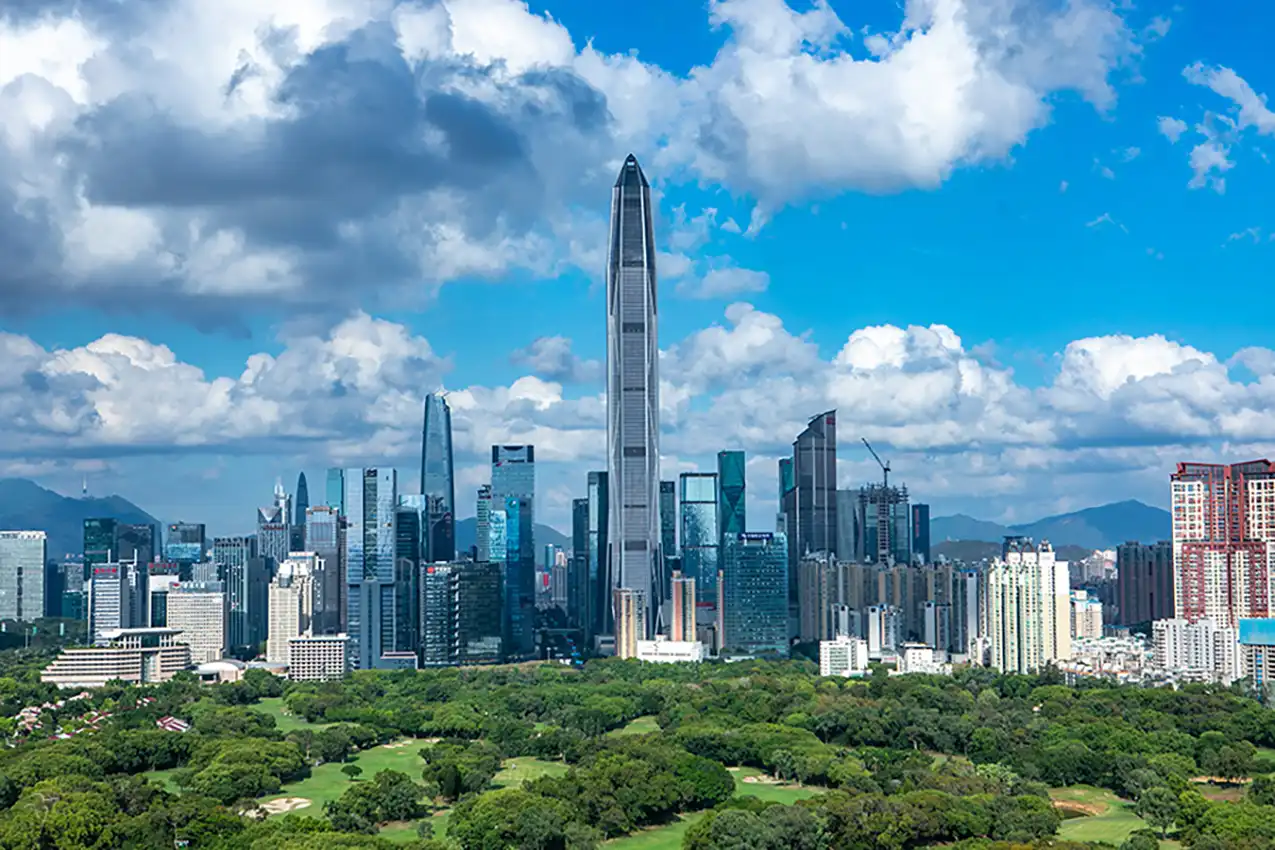

GREEN CITIES SERIES | ARTICLE 10
In 2017, Shenzhen became the first city in the world to operate a fully electric public bus fleet. In 2019, its entire taxi fleet followed. These are not incremental improvements or pilot schemes — they are structural transformations, achieved at a speed and scale that no other city of comparable size has approached. What Shenzhen demonstrates is that when a Chinese city decides something will happen, it happens faster than the frameworks of Western urban governance can readily explain. What it also demonstrates, with equal clarity, is that electrification is not the same as environmental health, and that the manufacturing economy behind the world’s most celebrated green transit revolution carries ecological costs that the city’s own promotional narrative has not fully confronted.
Arrive at Shenzhen North station on the high-speed rail from Guangzhou — a journey of under thirty minutes that covers a distance it once took three hours to drive — and the first thing you notice, stepping out to the taxi rank, is the silence. Not the silence of a quiet city: Shenzhen is not a quiet city. It is a city of thirteen million people and the density of ambition that comes from building a metropolis in forty years on land that was fishing villages and rice paddies. The silence is specific and relative: the silence of electric motors rather than combustion engines. The taxis waiting at the rank are BYD e6s or BYD Han EVs, their bodywork in the jade-green livery of Shenzhen’s taxi companies, their interiors slightly cool, their departure from the kerb producing nothing louder than tyre noise on tarmac.
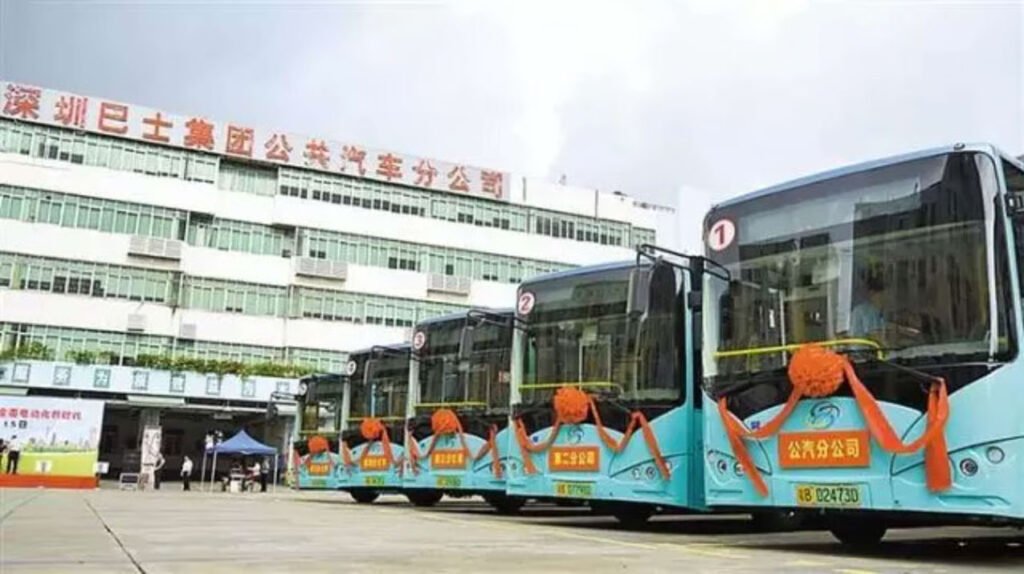
This is the most banal possible experience of something genuinely extraordinary. Every taxi in Shenzhen — more than 21,000 vehicles — runs on electricity.1 Every bus in the city’s public fleet — over 16,000 vehicles at the time of the full electrification milestone — runs on electricity. The city’s metro system, which has expanded from a single line in 2004 to twelve operational lines carrying more than six million passengers daily by 2024, runs on electricity. When you move through Shenzhen’s public transport system, you are moving through an entirely electrified mobility infrastructure in a city the size of a small European country. Nothing comparable exists anywhere else on Earth.
To understand how this happened, and what it means, and what it does not mean, you need to understand what kind of city Shenzhen is — which is to say, what kind of city China decided to make it, and what the speed and conditions of its making have left behind.
The City That Was Invented
Shenzhen does not have a history in the sense that London or Mexico City or even Shanghai has a history. In 1979, the year Deng Xiaoping designated it China’s first Special Economic Zone — the laboratory in which market economics would be tested within a socialist state, separated from Hong Kong by a river and from the rest of China by a fence — it was a collection of fishing villages and agricultural communes with a total population of approximately 30,000 people.2 By 1990, it had a million residents and a manufacturing economy that was already supplying garments, electronics, and consumer goods to the global market. By 2000, it had over seven million. By 2024, the official resident population exceeded thirteen million, and the broader metropolitan economy of the Pearl River Delta — of which Shenzhen is the technological and financial anchor, connected to Guangzhou, Dongguan, Foshan, and Hong Kong in a continuous urban conurbation of more than sixty million people — is one of the largest manufacturing and export systems in human history.
The speed of Shenzhen’s growth is not merely a statistic. It is the defining condition of every environmental question the city faces. A city that did not exist forty years ago and is now the size of a major European nation has built itself under conditions of continuous, breakneck construction that left no time for the slow accumulation of civic culture, ecological knowledge, or the kind of institutional memory that tends to moderate the worst excesses of development. Everything in Shenzhen was built recently, at speed, in the service of growth. The Pearl River estuary wetlands that once occupied the southern coastline were reclaimed for industrial and residential development. The natural drainage systems of the Longhua district were channelled and culverted to make way for the Foxconn manufacturing city — the largest single factory complex in the world, where iPhones and PlayStations and laptops destined for global consumers are assembled under conditions that have been the subject of sustained international scrutiny.3 The hills of the eastern Dapeng Peninsula, which retain some of the best-preserved coastal ecology in Guangdong Province, survive not because they were planned for conservation but because they were topographically inconvenient for the development that consumed everything more accessible.
The environmental inheritance of this growth is not subtle. Shenzhen’s air quality, despite the electrification of its transit fleet, remains significantly impaired by the industrial and manufacturing emissions of the wider Pearl River Delta airshed — a regional pollution problem that the city’s own vehicle fleet, however clean, cannot resolve unilaterally.4 Its rivers — the Shenzhen River on the Hong Kong border, the Maozhou in the north, and dozens of smaller waterways threading through the urban fabric — were comprehensively polluted by industrial discharge and domestic sewage during the city’s growth decades, producing water quality conditions that were, at their worst in the 2000s and 2010s, among the most severe documented in any Chinese city of comparable size. Its urban heat island is intense: the transition from the subtropical coastal vegetation and wetland that once covered the Pearl River delta to the dark roofing, dense building, and impervious surface of a modern megacity has raised local temperatures by several degrees, compounding the regional warming that climate change is delivering to southern China.
Understanding the electrification achievement requires holding this context in view. Shenzhen has done something remarkable with its transit fleet. It has done so in a city whose environmental condition, taken as a whole, is considerably more complicated than the electric bus statistics suggest.
The Electric Fleet: How the Transformation Happened
The Shenzhen bus electrification story begins not with environmental policy but with industrial policy. BYD — Build Your Dream — was founded in Shenzhen in 1995 as a rechargeable battery manufacturer before pivoting to electric vehicles in the mid-2000s under the vision of its founder Wang Chuanfu.5 When BYD began producing electric buses at commercial scale, Shenzhen’s municipal government made the decision — driven by a combination of industrial strategy, air quality concern, and the political leverage that a city government in China’s planning system has over its own public transit operators — to be BYD’s largest and most committed customer. The electrification of Shenzhen’s buses was, from this angle, not primarily a transit policy. It was a manufacturing ecosystem policy: the city creating the demand that made BYD’s production scale viable, and BYD’s production scale reducing the unit cost that made the city’s procurement economically defensible.
The mechanism was direct and unambiguous in ways that market-based electrification programmes in Europe or North America have found impossible to replicate. Shenzhen’s bus operators are state-owned enterprises, their procurement decisions subject to municipal government direction. When the Shenzhen government decided in 2015 that the entire bus fleet would be electric by 2017, this was not an aspiration or a target. It was an instruction, backed by subsidy, infrastructure investment, and the institutional authority to make it happen.6 Charging infrastructure — more than 40,000 charging points — was built concurrently with the vehicle fleet’s replacement, avoiding the chicken-and-egg problem that has slowed EV adoption in market economies where charging infrastructure and vehicle demand must develop in uncertain tandem. Electricity pricing for transit operators was negotiated at rates that made the total cost of ownership for electric buses competitive with diesel equivalents even before the full lifecycle fuel saving was calculated.
The results were measured and published with the transparency that an internationally watched demonstration project requires. Bus fleet emissions of nitrogen oxides fell by approximately 85 percent in the years following electrification. Carbon dioxide emissions from the bus fleet dropped by an estimated 48 percent relative to the diesel baseline, accounting for the carbon intensity of the electricity grid supplying the charging infrastructure.7 Noise levels on bus corridors fell. Maintenance costs for bus operators declined — electric drivetrains have substantially fewer moving parts than diesel engines and require less frequent servicing. The particulate matter from diesel exhaust that had been a significant contributor to Shenzhen’s urban air pollution loading was largely eliminated from the bus fleet’s contribution.
The taxi electrification followed a similar model. Shenzhen’s taxi fleet, like its buses, operates through companies that are effectively regulated utilities, their vehicle replacement cycles subject to government direction. The requirement that new taxi licences be issued only for electric vehicles, combined with the natural replacement cycle of an ageing diesel fleet, produced full electrification of the approximately 21,000-vehicle taxi fleet by 2019.8 BYD was again the primary supplier, its e6 model — purpose-designed for high-mileage taxi operation, with a battery capacity suited to the range requirements of a vehicle that might cover 300 kilometres in a single shift — becoming the standard vehicle of Shenzhen’s streets in a way that made the city an inadvertent global showroom for Chinese electric vehicle technology.
The Metro and the City It Is Shaping
The Shenzhen Metro is, by any comparative measure, one of the most extraordinary pieces of urban infrastructure built in the twenty-first century. The first line opened in 2004. By 2024, the network comprises twelve lines, more than 500 stations, and over 400 kilometres of track, carrying approximately six million passenger trips per day — more than the London Underground’s pre-pandemic peak ridership.9 Lines 14 and 16, which opened in 2022, extended the network into the mountainous eastern districts of Pingshan and Longhua, areas that had been effectively transit-isolated despite substantial residential development. Phase 5 of the network expansion, currently under construction, will add further lines connecting the outer districts and strengthening cross-city capacity on the most congested corridors.
The metro’s environmental significance extends beyond its electrification. Its construction has been the primary mechanism through which Shenzhen has attempted to impose transit-oriented development logic on a city whose original growth pattern — driven by the uncoordinated sprawl of industrial zones, dormitory housing blocks, and the villages that pre-dated the SEZ — was anything but transit-oriented. The metro lines have catalysed high-density mixed-use development at their station areas, concentrating retail, commercial, and residential investment in nodes served by the transit network and beginning, slowly and incompletely, to create the walkable urban fabric around stations that makes transit genuinely competitive with the private car for everyday journeys.
The private car, however, has not surrendered. Shenzhen’s vehicle fleet — private cars, ride-hailing vehicles, logistics and delivery vehicles — has continued to grow rapidly alongside the transit expansion, a dynamic familiar from the Curitiba paradox examined elsewhere in this series. The city had approximately 3.5 million registered private vehicles by 2023, a figure that has grown faster than the metro network has expanded.10 Traffic congestion on Shenzhen’s road network remains severe by any comparative standard. The environmental benefit of the electrified bus and taxi fleet is partially offset, at the city scale, by the continued growth of a private vehicle fleet that is still predominantly internal combustion, though with an increasing proportion of electric and plug-in hybrid vehicles as China’s domestic EV market has grown.
The city’s response to private vehicle growth has included a vehicle purchase quota system — Shenzhen allocates new number plates by lottery, limiting the pace of fleet expansion — and a congestion pricing study that, as of 2024, had not been converted into an operational scheme.11 The contrast with London’s Congestion Charge or Stockholm’s congestion pricing is instructive: cities where pricing has been implemented have typically done so through contested democratic processes that were slow but produced legitimacy. Shenzhen has the governance tools to implement pricing rapidly; what it has so far lacked is the political decision to do so in the face of the middle-class consumer preference for private car ownership that economic growth has generated.
The Air Above the Charging Cables
Shenzhen’s air quality has improved significantly over the past decade, driven by the transit electrification, the closure or relocation of the most polluting industrial facilities from the city core, and aggressive enforcement of emission standards for the remaining industrial operations in the northern Longhua and Bao’an districts.12 Annual average PM2.5 concentrations fell from above 40 micrograms per cubic metre in the early 2010s to approximately 17–18 micrograms per cubic metre by 2022 — still above the WHO guideline of 5 micrograms per cubic metre, and above the revised WHO interim targets, but representing a genuine improvement in the air quality experienced by the city’s residents.
The remaining air quality problem in Shenzhen is not primarily local. It is regional. The Pearl River Delta airshed — encompassing Guangzhou, Foshan, Dongguan, Zhongshan, Zhuhai, and the manufacturing hinterland of Guangdong Province — is one of the most intensively industrialised regions in the world, and the atmospheric chemistry of its pollution is complex: ozone precursors from vehicle exhausts and industrial solvents react in the strong subtropical sunlight to produce ground-level ozone at concentrations that are, in the Pearl River Delta, among the highest in Asia.13 Shenzhen’s electric buses do not emit the nitrogen oxides that are one of the primary ozone precursors. But the diesel trucks from the logistics and manufacturing corridors of Dongguan, the coal-fired power stations still operating in Guangdong’s outer provinces, and the volatile organic compound emissions from the paint, plastics, and electronics manufacturing of the wider delta continue to supply the chemistry that produces ozone exceedances over Shenzhen on days when the wind direction is unfavourable.
The electricity grid that charges Shenzhen’s buses and taxis is a further complication. China’s national grid remains heavily coal-dependent, though the proportion of renewable generation — solar, wind, and hydro — has been growing rapidly: renewables accounted for approximately 31 percent of China’s electricity generation in 2023, up from 26 percent in 2020.14 Guangdong Province draws electricity from a mix of local natural gas generation, nuclear power at the Daya Bay and Yangjiang plants, imported hydropower from Yunnan and Sichuan, and increasing volumes of local solar and offshore wind. The carbon intensity of the electricity supplying Shenzhen’s charging infrastructure is lower than the Chinese national average but substantially higher than the renewable-heavy grids of South Australia, Norway, or the UK. An electric bus charged on Shenzhen’s grid is cleaner than a diesel bus, by a significant margin, on virtually every measure. It is not yet as clean as an electric bus charged on a renewable-dominated grid, and the pace at which China’s grid decarbonises will determine how much of Shenzhen’s transit electrification achievement translates into climate benefit over the coming decades.
The Rivers and the Reckoning
In 2019, the State Council in Beijing issued a formal criticism of Shenzhen’s water environment. The Maozhou River — the city’s largest, running through the industrial northern districts of Guangming and Bao’an — had been assessed as Class V, the worst category in China’s water quality classification system: water so contaminated that it cannot be used for agriculture, industry, or recreational contact.15 The embarrassment was acute for a city that had positioned itself as China’s innovation capital and was bidding to host major international events. The State Council’s intervention triggered the most intensive river rehabilitation programme in Shenzhen’s history: a multi-year, multi-billion yuan investment in sewage treatment infrastructure, stormwater separation, riverbank remediation, and industrial pollution enforcement that was organised with the administrative urgency that Chinese governance systems can apply when political priority demands it.
The results have been substantial, measured, and honestly documented in a way that reflects the political stakes of the cleanup rather than a culture of environmental transparency per se. By 2022, the Maozhou had been reclassified to Class IV — impaired, but no longer the most contaminated category — with concentrations of ammonia nitrogen, dissolved oxygen, and biochemical oxygen demand all showing marked improvement over the 2019 baseline.16 Riverbank parks have been created along the improved sections: linear green spaces with planted embankments, pedestrian paths, and planted bioswales that combine the amenity of public waterfront and the ecological function of vegetated riparian buffer. These parks are well-used, heavily managed, and ecologically modest: the planted species are typically ornamental and non-native, the riverbed in most sections remains concrete-lined, and the ecological function is primarily aesthetic and recreational rather than genuinely restorative in the way that Singapore’s Bishan-Ang Mo Kio park or Seoul’s Cheonggyecheon aspire to be.
The Shenzhen River — the watercourse marking the boundary between Shenzhen and the New Territories of Hong Kong — has a different ecology and a different politics. Its water quality is jointly managed between the Shenzhen municipal government and the Hong Kong Environmental Protection Department, and the data-sharing and joint monitoring arrangements between the two administrations are among the more effective examples of trans-boundary environmental governance in the Pearl River Delta.17 The river’s marginal wetland habitats, particularly in the Mai Po-Inner Deep Bay Ramsar site on the Hong Kong side, support internationally significant populations of migratory shorebirds — black-faced spoonbills, spotted greenshanks, and numerous wader species that use the Deep Bay mudflats as a staging post on the East Asian-Australasian Flyway. The Shenzhen side of the border is managed as the Shenzhen Bay Park, a linear waterfront space of considerable popular appeal. The ecology of the broader wetland system that both sides adjoin remains under pressure from urban development, water quality impacts, and the gradual loss of the intertidal mudflat habitat that is the migratory birds’ primary feeding resource.
Heat, Green Space, and the Uneven City
Shenzhen sits at 22 degrees north latitude, in a subtropical climate that produces hot, humid summers with mean maximum temperatures above 30 degrees Celsius for five months of the year and occasional extreme events exceeding 38 degrees.18 The urban heat island effect in the city’s most densely built districts — the manufacturing and logistics zones of Bao’an and Longhua, the high-density residential precincts of Luohu and Futian — adds several degrees to the regional temperature, producing summer street-level conditions that are physiologically demanding for the outdoor workers, construction labourers, and delivery riders who constitute a significant proportion of the city’s workforce.
The urban green space provision in Shenzhen is, by the standards of a Chinese megacity, relatively high. The city’s official green coverage rate — a Chinese planning metric that includes all vegetated surfaces, including private gardens, roadside planting, and the slopes of the surrounding hills — is reported at approximately 45 percent, placing it among the greener of China’s major cities.19 The mountainous terrain of the eastern and northern districts, much of which falls within the Dapeng National Geopark or the Yangtai Mountain Forest Park, provides a substantial forest backdrop that moderates the regional climate and gives the city a visual relationship with nature unusual for a megacity of its density. The Fairy Lake Botanical Garden in the Luohu district — established in 1958, predating the SEZ itself, and containing one of the most species-rich subtropical botanical collections in China — is an ecological anchor in the central city whose age and canopy maturity distinguish it from most of Shenzhen’s urban greenery, which is recent, managed, and ecologically thin.
The distribution of green space across the metropolitan area is deeply unequal, in ways that track the city’s social geography with familiar precision. The planned districts of Futian, Nanshan, and the coastal Shekou area — home to the city’s professional and managerial classes, its tech workers, and its more affluent residents — have higher-quality parks, more mature street trees, and better access to the eastern mountain parks. The older industrial and manufacturing districts, and particularly the urban villages — the self-built communities that absorbed the migrant workers who built Shenzhen’s manufacturing economy across four decades — have lower green space provision, higher density, poorer air quality, and higher heat exposure.20
The urban villages deserve particular attention, because they are the most ecologically and socially complex feature of Shenzhen’s built environment. More than a thousand urban villages — communities of original rural residents who retained land rights as the city grew around them, and who built high-density rental housing for the millions of migrant workers who arrived to staff the factories — occupy irregular patches of older, smaller-scale building within the otherwise planned city. They are crowded, poorly ventilated, inadequately served by green space, and systematically neglected by the environmental improvements that the planned city receives. They are also, for hundreds of thousands of the city’s lowest-income residents, the only affordable housing available. Urban village demolition — a persistent pressure in a city where land values are high and property developers are influential — removes affordable housing from the market and displaces communities whose contribution to the city’s manufacturing economy has never been adequately acknowledged in its planning framework.
The Manufacturing of the Green Transition
Shenzhen’s most significant contribution to the global green transition may not be its own electrified fleet. It may be the manufacturing ecosystem that it has built — the cluster of battery manufacturers, EV assemblers, electronics suppliers, and materials technology companies concentrated in and around the city that is now supplying the clean energy transition worldwide.
BYD is the anchor, but the ecosystem extends far beyond a single company. CATL — Contemporary Amperex Technology Co. Limited, headquartered in Fujian Province but with major manufacturing operations and supply chain connections in the Pearl River Delta — has become the world’s largest lithium-ion battery manufacturer, supplying cells to Tesla, BMW, Volkswagen, and Toyota alongside its domestic Chinese customers.21 The supply chain that feeds these manufacturers — the lithium processing from Sichuan and Tibet, the cobalt refining that draws on ore from the Democratic Republic of Congo, the graphite anode production, the rare earth elements used in motor magnets — runs in large part through Guangdong Province and is partly located in Shenzhen’s own industrial districts. The green technology that is decarbonising transport systems in Oslo, Amsterdam, London, and Adelaide is being manufactured in and around a city whose own environmental condition is still compromised by the industrial activity that manufacturing requires.
This is not a contradiction in the narrow sense that it invalidates the transition. It is a more honest account of what the transition involves: moving the pollution associated with energy production from the point of consumption — the tailpipe of the London bus, the exhaust stack of the Adelaide power station — to the point of production, which is concentrated in manufacturing regions of China, the DRC, and other parts of the Global South that are not well represented in the discourse of green urbanism.22 The children in Shenzhen’s Longhua district who breathe the air downwind of the industrial zones are participants in the global supply chain that is cleaning the air for the children in Marylebone and the students cycling on Barcelona’s Consell de Cent. That relationship is not discussed in the green city literature with anything approaching the frequency it deserves.
Shenzhen is aware of this. The city’s own industrial upgrading programme — which has been systematically relocating the most polluting manufacturing operations northward into the inland provinces while retaining the higher-value, lower-pollution technology and design functions in the city itself — is a form of environmental improvement by displacement rather than by elimination.23 The pollution moves; the city’s metrics improve; the global supply chain’s ecological footprint, distributed more thinly across a wider territory, is harder to see and harder to account for. This is not unique to Shenzhen. It is the operating principle of the global manufacturing economy. Shenzhen makes it visible because the concentration of clean technology manufacturing in a city with measurable environmental problems makes the relationship between production and consumption impossible to ignore.
The Speed Advantage and Its Costs
The most frequently cited lesson from Shenzhen, in the international green city literature, is a lesson about speed. A city that can decide to fully electrify its bus fleet by 2017 and fully electrify its taxi fleet by 2019, and then actually do it, is operating at a tempo of environmental transformation that democratic governance in market economies has not demonstrated the capacity to match. The argument is made explicitly in reports from the International Council on Clean Transportation, the Rocky Mountain Institute, and the C40 Cities network: if the world needs to decarbonise its urban transport systems by 2030 or 2040, the question of whether Shenzhen’s governance model can be emulated matters enormously.
The argument is real but it requires careful qualification. Shenzhen’s speed advantage operates in a specific set of conditions: state ownership of transit operators, a planning system in which municipal government direction has binding force over enterprise decision-making, a financial system in which subsidies can be deployed at scale without the legislative approval processes that slow equivalent programmes in parliamentary democracies, and a political culture in which the expression of organised citizen opposition to a government decision carries different weight and different risk than in London or Barcelona or Melbourne.24 These conditions are not incidental to the speed. They are its preconditions. The electrification happened as fast as it did because the governance structures that slowed comparable programmes elsewhere — the tender processes, the public consultations, the legal challenges from affected industries, the parliamentary committee scrutiny — either do not exist in the same form or do not have the same power to delay.
The costs of that governance model are visible in the areas where Shenzhen’s environmental record is weakest. The urban villages were not consulted about the road widening schemes that cut through their streets to serve the industrial zones. The communities adjacent to the Maozhou River were not meaningfully engaged in the river rehabilitation programme that followed the State Council’s 2019 intervention; the rehabilitation happened to them rather than with them.25 The migrant workers whose labour built and maintains the city’s infrastructure have had no mechanism through which to raise the heat exposure, air quality, and housing conditions they face as environmental justice concerns. Environmental data in Shenzhen is collected and published by agencies whose primary accountability runs to the municipal government that funds them, and whose incentive to document problems that reflect negatively on the city’s environmental performance is structurally limited. The improvements in Maozhou water quality are reported and verifiable. The conditions in the urban village streets of Longhua and Bao’an are less systematically documented.
What Shenzhen Actually Teaches
Strip away the governance model question — which is ultimately a question about political values that empirical evidence cannot resolve — and what Shenzhen demonstrates is a set of propositions about large-scale urban electrification that are technically and economically instructive regardless of how the governance lesson is judged.
The first proposition is that full electrification of a large urban public transit fleet is technically and operationally feasible at the scale of a megacity, including all the charging infrastructure, grid management, vehicle maintenance, and driver training that full electrification requires. Before Shenzhen, this had not been demonstrated. The city’s achievement removed a category of doubt from the global electrification discourse: not whether EVs could work at small scale or in wealthy European cities, but whether they could work as the entire public mobility system of a subtropical megacity of thirteen million people, in demanding operational conditions, at a cost that a developing-country city could sustain.
The second proposition is about the relationship between manufacturing scale and unit cost. BYD’s ability to produce electric buses and taxis at costs competitive with diesel vehicles was not independent of Shenzhen’s procurement decisions. The city created the volume demand that allowed BYD to move down the cost curve, and BYD’s reduced costs subsequently made electrification viable for cities that were not in a position to make Shenzhen’s level of subsidy commitment.26 The global decline in electric bus prices since 2017 — which has made EV procurement competitive with diesel in an increasing number of markets — is partly a function of the manufacturing learning that Shenzhen’s scale enabled. Cities in Latin America, Africa, and South Asia that are now purchasing electric buses at prices that their transport budgets can accommodate are, in a direct economic sense, beneficiaries of the Shenzhen demonstration.
The third proposition is about the complementarity of industrial strategy and environmental policy. Shenzhen did not achieve its transit electrification by setting targets and hoping that the market would deliver. It achieved it by aligning public procurement, industrial subsidy, infrastructure investment, and regulatory direction toward a single objective, in a sustained programme over several years. That alignment — between what the city bought, what the city built, what the city subsidised, and what the city required — is the precondition for the speed, and it is reproducible in principle in governance systems very different from Shenzhen’s, if the political will to align those instruments exists.
The Charging City and Its Incomplete Account
Back at Shenzhen North station, the BYD taxi pulls silently away from the rank and onto the expressway. The Longhua district passes outside the window: the Foxconn compound behind its perimeter walls, the towers of the migrant worker dormitories that house the assembly line workforce, the street-level commerce of the urban villages threading between new apartment blocks, a construction site where another mixed-use development is rising on what was, two years ago, a cluster of older buildings. The air, this morning, is hazy. The pollution index on the taxi’s in-car display reads moderate.
The taxi is silent and electric and clean in its immediate emissions. The city through which it moves is complicated in its environmental condition in ways that the taxi’s silence does not capture. Both of these things are true simultaneously, and holding them both in view is the condition of an honest assessment of what Shenzhen has achieved and what it represents.
The fully electrified bus and taxi fleet is a genuine achievement of global significance. It proves, at scale, that electrification is possible and that it delivers measurable air quality improvement. The metro system, expanding at a pace that no Western city has approached in recent decades, is progressively reducing the private car’s dominance over a city that private cars could easily have consumed entirely. The river rehabilitation, belated and State Council-mandated as it was, is producing measurable water quality improvement and returning some ecological function to waterways that had been effectively dead. These are real things, achieved at real scale, and they matter for a city of thirteen million people.
What Shenzhen has not yet achieved — and what the speed of its governance model has not delivered, perhaps because speed and certain kinds of improvement are in tension with each other — is the integration of its environmental programmes with the wellbeing of the residents most exposed to the environmental problems those programmes address. The migrant workers of the urban villages, the assembly line workers of the manufacturing zones, the outdoor workers navigating the subtropical heat without the shade that the planned city’s parks provide: these are the people for whom environmental improvement is most urgently needed and for whom it has arrived most slowly and most incompletely.
Shenzhen was invented in forty years. Its environmental condition — partially improved, structurally complicated, driven more by industrial strategy than by ecological commitment — reflects the terms of that invention. The question its next forty years will answer is whether the city that built the world’s first electrified megacity bus fleet can also build a city in which the benefits of that achievement are distributed as equitably as its production costs have been distributed elsewhere.
Endnotes
1. Shenzhen taxi fleet electrification: Shenzhen Municipal Transportation Commission, fleet statistics; International Council on Clean Transportation (ICCT), ‘Shenzhen’s Bus Electrification’ (2018). The 21,000-vehicle figure is from ICCT and SZ municipal transport data. On BYD e6 specifications for taxi operation: BYD Auto technical documentation.
2. Shenzhen SEZ designation and population history: China State Council Decree establishing Shenzhen SEZ (1980); Shenzhen Municipal Bureau of Statistics, Historical Population Data. On the 1979 baseline population of approximately 30,000: Ezra Vogel, Deng Xiaoping and the Transformation of China (Harvard University Press, 2011), Chapter 14.
3. Foxconn Longhua complex: Pun Ngai and Jenny Chan, ‘The Spatial Politics of Labor in China: Life, Labor, and a New Generation of Migrant Workers,’ South Atlantic Quarterly (2012); and reporting by The New York Times, Bloomberg, and The Guardian on Foxconn working conditions. On Pearl River estuary wetland loss: Guangdong Province coastal land use surveys and satellite analysis by USGS/NASA.
4. Pearl River Delta regional air quality: Guangdong Environmental Monitoring Centre, annual air quality reports; and Zhong et al., ‘Significant concentrations of nitryl chloride sustained in the daytime: investigations in the Pearl River Delta region of southern China,’ Atmospheric Chemistry and Physics (2022). On Shenzhen’s PM2.5 trend: China National Environmental Monitoring Centre, city-level data series.
5. BYD history and electric bus development: BYD Company Ltd., corporate history documentation; Dunne and Qi, ‘BYD: the rise of China’s electric vehicle giant,’ in China’s Electric Vehicle Disruption (Routledge, 2023). On Wang Chuanfu’s pivot to EVs: Bloomberg Businessweek, ‘The Man Behind China’s Electric Vehicle Ambitions’ (2020).
6. Shenzhen bus electrification programme: Shenzhen Municipal Transportation Commission, Bus Electrification Programme Report (2017); ICCT, ‘Shenzhen, China: Developing an electric bus program’ (2018). The 40,000 charging points figure is from Shenzhen’s own infrastructure deployment records. On state-owned enterprise procurement direction: analysis by Bloomberg NEF and the Rocky Mountain Institute, ‘China’s Electric Bus Boom’ (2018).
7. Bus electrification emission reductions: ICCT, ‘How did Shenzhen become the world’s first fully electrified city bus fleet?’ (2019). The 85% NOx reduction figure and the 48% CO2 lifecycle reduction are from ICCT analysis accounting for Guangdong grid carbon intensity.
8. Shenzhen taxi electrification timeline: Shenzhen Municipal Transportation Commission, Taxi Fleet Statistics 2019; and C40 Cities, ‘Shenzhen: 100% Electric Taxi Fleet’ case study (2019). On operational requirements for high-mileage EV taxi use: analysis by Rocky Mountain Institute and BloombergNEF.
9. Shenzhen Metro network statistics: Shenzhen Metro Co., Ltd., Annual Report 2023; and Shenzhen Municipal Transportation Commission data. The 500+ stations and 400+ km track figures are from end-2023 network documentation. Daily ridership of approximately 6 million: Shenzhen Metro operational statistics.
10. Shenzhen private vehicle registration: Guangdong Province Public Security Bureau, vehicle registration data; and Shenzhen Daily reporting on vehicle quota system. The 3.5 million registered vehicles figure is from 2023 registration data.
11. Shenzhen vehicle quota system and congestion pricing study: National Development and Reform Commission, Urban Congestion Pricing research programme; and Shenzhen Municipal Transportation Commission, Traffic Management Annual Report. On the political economy of congestion pricing in Chinese cities: Wang and Ye, ‘Congestion Pricing in China: Policy, Politics and Implementation,’ Transport Policy (2021).
12. Shenzhen air quality improvement trends: Shenzhen Environmental Monitoring Centre, Air Quality Annual Reports 2013–2023. The PM2.5 decline from above 40 to approximately 17–18 micrograms/m³ is documented in these reports. WHO PM2.5 guideline of 5 micrograms/m³ is from WHO Global Air Quality Guidelines (2021).
13. Pearl River Delta ozone problem: Wang et al., ‘Ground-level ozone in the Pearl River Delta region: Analysis of data from a recently established regional air quality monitoring network,’ Atmospheric Environment (2009); and more recent data from the China National Environmental Monitoring Centre’s regional ozone tracking. On ozone as the primary remaining air quality challenge in reformed Chinese cities: Zhang et al., ‘Drivers of improved PM2.5 air quality in China from 2013 to 2017,’ Proceedings of the National Academy of Sciences (2019).
14. China electricity grid carbon intensity and renewable generation share: National Energy Administration (NEA), Renewable Energy Development Report 2023; IEA, China Electricity Security Assessment (2024). The 31% renewables figure (including hydro) is from NEA 2023 data. On Guangdong Province generation mix: Guangdong Energy Bureau, Provincial Power Supply Report.
15. State Council criticism and Maozhou River Class V assessment: China State Council, National Supervision on Black and Odorous Water Bodies (2019); and reporting by Caixin and South China Morning Post on the State Council’s Shenzhen assessment. On the Maozhou River rehabilitation programme investment: Shenzhen Water Affairs Bureau, Maozhou River Comprehensive Treatment Plan documentation.
16. Maozhou River rehabilitation results: Shenzhen Water Affairs Bureau, Maozhou River Water Quality Assessment 2022; and satellite water quality monitoring data from Shenzhen Institute of Advanced Technology, Chinese Academy of Sciences.
17. Shenzhen River cross-boundary water quality management: Shenzhen-Hong Kong Joint Working Group on Water Quality in Deep Bay, meeting records and water quality monitoring reports; Hong Kong Environmental Protection Department, Deep Bay Water Quality data series. On the Mai Po-Inner Deep Bay Ramsar site: WWF-Hong Kong, Mai Po Nature Reserve documentation; BirdLife International, Important Bird and Biodiversity Area documentation.
18. Shenzhen climate data: China Meteorological Administration, Shenzhen meteorological station historical records. On subtropical heat and outdoor worker exposure: Xie et al., ‘Assessment of heat stress for outdoor workers in Guangdong Province,’ International Journal of Biometeorology (2021).
19. Shenzhen green coverage rate: Shenzhen Urban Planning and Land Commission, City Greening Statistics (2022). On the Dapeng National Geopark and Yangtai Mountain Forest Park: Shenzhen Urban Management Bureau, Protected Areas documentation. Fairy Lake Botanical Garden: South China Botanical Garden (SCBG), partner institution documentation.
20. Urban villages in Shenzhen — environmental and social conditions: Bach et al., ‘Urban Villages and the Making of Shenzhen,’ in The Origins of China’s Urban Villages and Their Transformation (Lincoln Institute of Land Policy, 2010); and reporting by the South China Morning Post and Caixin on urban village redevelopment pressure and migrant worker housing conditions.
21. CATL and China’s battery manufacturing ecosystem: BloombergNEF, Electric Vehicle Outlook (2024); and CATL corporate reporting. On DRC cobalt supply chain: Amnesty International, ‘Time to Recharge: Corporate Action and Inaction to Tackle Abuses in the Cobalt Supply Chain’ (2017, updated); and Global Witness, Cobalt Supply Chain reports.
22. Supply chain pollution displacement from consumption to production regions: Kate Aronoff et al., A Planet to Win: Why We Need a Green New Deal (Verso, 2019), Chapter 3; and academic literature on the carbon and ecological footprint of electric vehicle manufacturing: Hawkins et al., ‘Comparative Environmental Life Cycle Assessment of Conventional and Electric Vehicles,’ Journal of Industrial Ecology (2013).
23. Shenzhen industrial upgrading policy: Shenzhen Municipal Development and Reform Commission, Industrial Upgrading and Innovation Development Plan; and reporting by Caixin and The Economist on the relocation of manufacturing from Shenzhen to inland provinces.
24. On the relationship between Chinese governance structures and the pace of urban environmental transformation: Yannis Karamouzis and Mark Swilling, ‘Urban transitions and governance in Chinese cities,’ Urban Studies (2022); and Jonathan Woetzel et al., ‘China’s Urban Billion’ (McKinsey Global Institute, 2013). On comparative transit electrification governance: ICCT, ‘Barriers to electric bus adoption in cities outside China’ (2021).
25. Urban village demolition and community displacement in Shenzhen: Mary Ann O’Donnell, ‘Heroes of the Special Zone: Modeling Reform and Its Futures,’ in Learning from Shenzhen: China’s Post-Mao Experiment from Special Zone to Model City (University of Chicago Press, 2017); and Shenzhen-based journalism from Shenzhen Daily and South China Morning Post on urban village demolition programmes.
26. BYD cost curve and global electric bus price decline: BloombergNEF, Electric Bus Outlook (2023); and ICCT, ‘Electric buses in cities: Driving towards cleaner air and lower CO2’ (2018). On the global procurement impact of Shenzhen’s demand creation: Rocky Mountain Institute, ‘The China Factor in Global EV Markets’ (2022).
Source Note
This article draws on data from the International Council on Clean Transportation (ICCT), whose research on Shenzhen’s bus and taxi electrification is the most rigorous English-language documentation of the programme; BloombergNEF’s electric vehicle and battery manufacturing research; the China National Environmental Monitoring Centre’s air quality data series; and Shenzhen’s own municipal reporting from the Transportation Commission, Water Affairs Bureau, and Urban Planning Commission. The South China Morning Post, Caixin, and China Dialogue provide the most reliable English-language journalism on Chinese urban environmental governance. Academic sources include the urban studies literature on Shenzhen’s development model, including Mary Ann O’Donnell and colleagues’ Learning from Shenzhen (University of Chicago Press, 2017), and the atmospheric chemistry literature on the Pearl River Delta. Supply chain analysis draws on Amnesty International, Global Witness, and academic lifecycle assessment research. The article does not rely on municipal promotional material as a primary source and acknowledges that data transparency limitations in Chinese urban governance require sourcing judgements not required for comparable Western cities.
Further Reading / Watching / Listening
Reading: Mary Ann O’Donnell, Winnie Wong, and Jonathan Bach (eds.), Learning from Shenzhen: China’s Post-Mao Experiment from Special Zone to Model City (University of Chicago Press, 2017) — the most rigorous interdisciplinary account of how Shenzhen was made and what it reveals about Chinese urbanism. Ezra Vogel, Deng Xiaoping and the Transformation of China (Harvard University Press, 2011) — essential on the political decisions that created the SEZ framework. For the supply chain dimension: Thea Riofrancos, Resource Radicals: From Petro-Nationalism to Post-Extractivism in Ecuador (Duke University Press, 2020) illuminates, by analogy, the politics of raw material extraction for the clean energy transition. BloombergNEF’s annual Electric Vehicle Outlook is the most accessible current assessment of the global EV market context within which Shenzhen’s achievement sits. China Dialogue — the bilingual environmental journalism platform — provides the best ongoing English-language coverage of Chinese urban and industrial environmental policy.
Watching: The ICCT has produced accessible video explainers on Shenzhen’s electrification programme available via its YouTube channel. China Uncensored and SupChina’s Sinica podcast have both produced material on China’s EV industry that is more analytically rigorous than most Western broadcast coverage. For the supply chain dimension: the BBC and Channel 4 Dispatches have both investigated cobalt supply chain conditions in the DRC; watching these alongside the Shenzhen electric bus story is the most direct way of experiencing the consumption-production tension that this article addresses.
Listening: The Sinica Podcast (SupChina) is the best English-language audio resource on Chinese urban and economic policy. The ICCT Podcast has covered electric vehicle policy in China in depth. For the broader context of China’s environmental governance: Isabel Hilton’s work for China Dialogue, available in podcast and written form, provides the most nuanced English-language analysis of the gap between Chinese environmental policy ambition and delivery reality. Azeem Azhar’s Exponential View podcast has covered China’s clean technology manufacturing dominance in terms useful for understanding the global significance of the BYD-Shenzhen relationship.