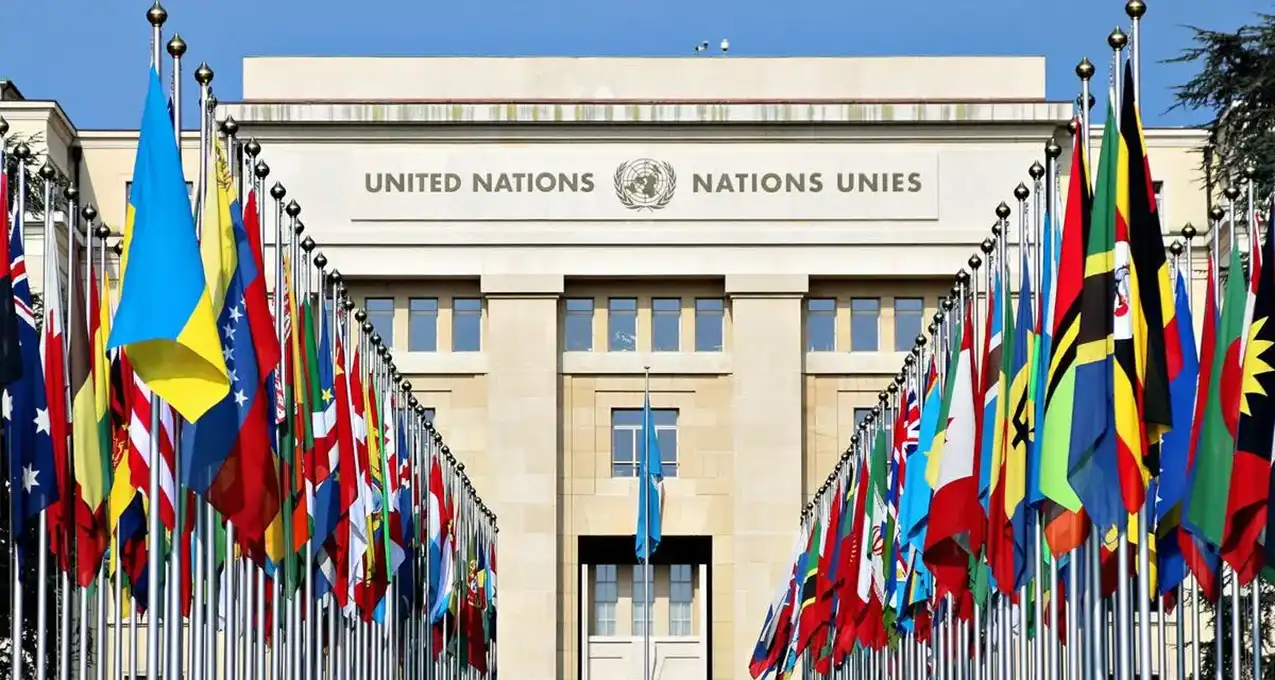

The chamber still looks improbably calm. Green marble. Translation headsets. Country names set out in alphabetical order, as though the world’s grief can be organised by stationery. Afghanistan sits near Albania. Tuvalu speaks into the same record as the United States. Delegates rise, denounce, defend, abstain and explain. The cameras catch the choreography. The cynics call it theatre.
Sometimes it is.
But it is also the last truly universal political room on Earth. In a century increasingly defined by shattered norms, armed nationalism, climate injury, forced displacement, digital manipulation and the casual return of nuclear threats, the existence of one place where almost every sovereign state must at least hear the others speak remains no small thing. The United Nations is not a world government, nor was it ever designed to be one. The Charter created not an imperial authority above states, but a mechanism through which states could seek peace, security, cooperation, human rights and social progress after the catastrophe of world war.1
That is why its current crisis matters.
The UN is now eighty years old, and it is fashionable to treat it as a failed inheritance: a relic of 1945, overrun by bureaucracy, paralysed by vetoes, mocked by strongmen, mistrusted by populists, resented by taxpayers and quietly bled by governments that demand results while withholding the money, authority and political solidarity required to produce them. The easy sneer is that the UN is useless. The more accurate charge is both more damning and more hopeful: the UN is the institution the world keeps refusing to empower, then blames for its impotence.
That distinction matters. The UN cannot tax. It cannot conscript. It cannot make great powers behave well by moral force alone. Its Secretary-General cannot order peace into being. Its agencies cannot vaccinate children, feed refugees, protect women, monitor elections, inspect nuclear sites or deliver food convoys where states block access, militias attack workers, donors retreat, or member governments turn international law into an à la carte menu.
What the UN can do — and often does — is provide the common machinery without which disorder becomes not an emergency but a system. It convenes. It records. It coordinates. It keeps fragile channels open when diplomacy has otherwise collapsed. It creates norms, treaties, inspection regimes and humanitarian pipelines. It gives small states a platform. It gives the stateless at least some form of recognition. It gives the powerful a place to be challenged in public. It gives the weak, the displaced and the forgotten a thin but sometimes decisive thread back to law, food, medicine and visibility.
The question, then, is not whether the UN deserves sentimental birthday speeches. It does not. The question is what must be done to restore faith in it — not as an immaculate moral authority, but as the world’s indispensable common table — so that it can survive beyond the ideological swings of sovereign governments.
The Age of Scapegoating
The world has entered a period in which the need for multilateralism is rising at precisely the moment political support for it is weakening. Wars grind on in Ukraine, Gaza, Sudan, Myanmar and elsewhere. Haiti has slipped deeper into violence and institutional collapse. The Sahel has become a belt of coups, insurgencies and geopolitical experimentation. Refugee flows grow as legal protections are contested. The climate crisis has moved from forecast to lived condition. Debt distress is strangling development budgets. Artificial intelligence, cyber operations and autonomous weapons are outrunning the rules meant to govern them. Nuclear language, once buried under the rubble of the Cold War, has returned to public speech.
In January 2026, António Guterres told the General Assembly that the world was “brimming with conflict, impunity, inequality and unpredictability”. He warned that “1945 problem-solving” would not solve 2026 problems, and argued that institutions which no longer reflect contemporary realities risk losing legitimacy.2 The phrase was bleak because it was accurate. This should not be read as a dismissal of the Charter. It is a warning that the furniture of the post-war order no longer fits the room.
The Security Council still reflects the victors of 1945 more than the realities of the twenty-first century. Africa, with more than a quarter of UN member states and a central place in peacekeeping, development, climate vulnerability and future population growth, has no permanent seat. India, the world’s most populous country, is not a permanent member. Latin America is absent from the permanent table. The Middle East, despite being a theatre of repeated Council attention, has no structural voice commensurate with its importance. The veto, originally defended as the price of keeping great powers inside the tent, now often functions as a licence for paralysis.
Yet it would be a mistake to locate all of the UN’s troubles in the Security Council. The deeper crisis is one of political bad faith. Governments use the UN when it suits them, denounce it when it constrains them, starve it when its agencies are inconvenient, and blame it when the consequences of underfunding arrive. The organisation is expected to be omnipresent but inexpensive, impartial but obedient, courageous but deferential, efficient but endlessly consultative, independent but donor-driven. It is asked to be a fire brigade whose hoses are controlled by the arsonists.
This is especially visible in the financial crisis now gripping the institution. In early 2026, Guterres warned of possible “imminent financial collapse”, pointing to unpaid dues and structural budget rules that had left the organisation facing a severe liquidity crisis. Member states had approved a reduced 2026 regular budget of about US$3.45 billion.3 The peacekeeping budget for 2025–26 was approximately US$5.38 billion.4 By contrast, global military expenditure reached US$2.887 trillion in 2025, the eleventh consecutive annual rise.5 Taken together, the UN’s core regular and peacekeeping budgets are roughly equivalent to a little over a day of global military spending. The world can find money for war preparation. It pleads poverty over prevention.
That is not prudence. It is civilisational incoherence.
What the UN Is — and Is Not
Any serious defence of the UN must begin by refusing fantasy. The UN is not a moral superpower hovering above states. It is made of states. When Russia invades Ukraine and uses its Council position to frustrate action, that is not simply “UN failure”; it is great-power impunity exposed inside the UN system. When civilians in Gaza, Sudan or Syria are left inadequately protected, the failure belongs not only to New York but to the member states that disagree, delay, veto, arm, equivocate or refuse political risk. When humanitarian appeals go underfunded, the shortfall is not caused by a shortage of suffering but by a shortage of will.
This distinction is not an excuse. It is a diagnosis.
The UN’s greatest strength is its universality. With 193 member states, it is the only institution where almost every sovereign government can be seen, heard, challenged and recorded.6 That record matters. Speeches may not stop tanks, but they create evidence. Resolutions may lack enforcement, but they shape expectations. Investigations may be ignored by the guilty, but they deny impunity the comfort of silence. The world often mistakes slow normative work for irrelevance because it wants courtroom drama and gets minutes, reports, votes, drafts, commas and quarrels. Yet this is how law thickens. This is how consensus forms. This is how yesterday’s moral aspiration becomes tomorrow’s treaty obligation.
The practical UN is also larger and less visible than the debating chamber. It is the World Health Organization coordinating disease surveillance. It is UNICEF working on child immunisation and nutrition. It is the World Food Programme keeping famine at bay where markets and governments have failed. It is UNHCR registering refugees, securing documentation and negotiating protection. It is the International Civil Aviation Organization shaping the standards that help aircraft cross borders safely. It is the International Maritime Organization working on shipping rules. It is the International Labour Organization setting conventions on work, exploitation and safety. It is the International Atomic Energy Agency inspecting nuclear facilities. It is UNESCO protecting cultural heritage, UN Women defending gender equality, UNFPA supporting reproductive health, UNDP working on governance and development, and OCHA trying to coordinate relief when everything else has fractured.
Most citizens do not see this machinery because it is woven into the background of functioning life. The UN is like plumbing: noticed most when blocked, least appreciated when working. Aviation standards are not news until planes fall. Disease surveillance is not news until a pathogen outruns it. Refugee registration is not news until people disappear. Food logistics are not news until children starve. Treaties are not news until the rules collapse.
The UN’s victories are therefore easily forgotten. Smallpox, the only infectious human disease eradicated globally, was defeated under WHO leadership, culminating in the World Health Assembly’s 1980 declaration of global eradication.7 The Montreal Protocol remains one of the great environmental successes of the modern age, with scientific assessments continuing to show the ozone layer on track for recovery.8 The Paris Agreement did not solve climate change, but it created a durable cycle of national pledges, transparency and stocktakes that now shapes domestic climate policy across the world.9 The Kunming-Montreal Global Biodiversity Framework gave states a common target to conserve at least 30 per cent of land and sea by 2030.10 The High Seas Treaty, which entered into force in January 2026, created a legal framework for marine biodiversity beyond national jurisdiction — a reminder that even in an age of fragmentation, multilateral law can still be made.11
Public health offers another lesson. COVAX was imperfect, late and often outmatched by vaccine nationalism. Rich countries hoarded doses. Supply chains were chaotic. The moral gap between rhetoric and delivery was painful. Yet the mechanism still delivered nearly two billion COVID-19 vaccine doses to 146 economies before closing at the end of 2023.12 Its failures should be studied; its existence should not be dismissed. In the next pandemic, the answer cannot be less coordination. It must be faster, fairer and better-financed coordination.
Peacekeeping is similarly caricatured. Blue helmets do not end wars by magic. They are often deployed late, under-mandated, under-equipped and sent into conflicts that powerful states do not wish to solve. Some missions have failed grievously. Some personnel have abused the very people they were sent to protect. Yet the broad empirical literature is more favourable than the caricature. Research by Lisa Hultman, Jacob Kathman and Megan Shannon found that UN peacekeeping can reduce civilian killings where properly deployed and resourced.13 Peacekeepers do not abolish violence. They narrow its field. That is not romance. It is crisis insurance.
The tragedy is that this insurance is being cut as the fire season lengthens.
The Indictment Must Be Heard
A revival of the UN cannot be built on piety. The institution has failed, and some of its failures are not merely technical but moral.
Rwanda and Srebrenica remain permanent stains on the conscience of the international system. The UN’s role in the Haiti cholera outbreak damaged trust in precisely the communities that had reason to expect protection. Sexual exploitation and abuse by peacekeepers and personnel have inflicted harm under the cover of a blue flag. Bureaucratic opacity has too often protected careers rather than victims. Whistleblowers have not always been safe. Troop-contributing countries have not always faced sufficient consequences for misconduct. Human rights bodies are sometimes accused, not without reason, of politicisation and selective outrage. Authoritarian states seek seats on committees whose values they undermine. Democracies invoke law selectively. Agencies compete. Mandates overlap. Reports multiply while field capacity shrinks.
The scale of misconduct is not incidental to the argument; it goes to legitimacy. In 2024, allegations of sexual abuse and exploitation in UN peacekeeping and political missions topped 100 for the third time in a decade, according to a UN report covered by Associated Press.14 Every such case wounds not only the victim, but also the moral authority of the flag. An institution that asks communities to trust it in moments of extremity must be judged by the seriousness with which it polices its own badge.
The Security Council is the most visible failure because its paralysis is theatrical. A veto is a raised hand against the dead. It can prevent action in the very cases where collective action is most necessary. The General Assembly’s veto initiative, adopted in 2022, at least requires the Assembly to meet whenever a veto is cast in the Security Council, creating a public forum in which permanent members must face wider scrutiny.15 That is useful as public accountability, but it is not enough. Shame is not enforcement. Explanation is not protection.
The veto should be politically disciplined, even if formal Charter amendment remains improbable. Permanent members should accept a binding code of restraint in situations involving genocide, crimes against humanity, major war crimes or clear mass atrocity risk. France and Mexico have long argued for versions of such restraint, while the Accountability, Coherence and Transparency group has pushed related ideas.16 These proposals should no longer be treated as diplomatic ornaments. A permanent member that uses the veto to shield mass atrocity should pay a visible reputational and procedural price across the UN system.
The Council itself must expand. Reform has been discussed for decades, usually with all the urgency of a committee rearranging a museum. But legitimacy cannot be postponed indefinitely. A Council that claims primary responsibility for international peace and security while structurally excluding entire regions from permanent representation will continue to lose authority. Africa’s case is overwhelming. So too is the need for stronger representation from Asia, Latin America and the broader Global South. The choice is not between a perfect Council and the current one. It is between managed reform and growing irrelevance.
Yet reform must not be limited to the Council, because the UN’s credibility depends as much on conduct as architecture. Accountability for sexual exploitation and abuse must be faster, clearer and more public. Victim support should not depend on diplomatic embarrassment. Troop-contributing countries must accept enforceable standards before deployment. Misconduct data should be accessible. Investigations should be independent. Whistleblower protections should be real rather than rhetorical. A blue helmet cannot be permitted to become a shield against justice.
Moral repair is not an accessory to revival. It is the condition of revival.
The Politics of Distrust
The UN’s trust problem is not uniform. In many countries, public opinion remains more favourable than the noise of domestic politics suggests. Pew Research Center found in 2025 that a median of 61 per cent of adults across twenty-five surveyed countries held a favourable view of the UN, compared with 32 per cent who held an unfavourable view.17 This is important. The UN is not universally despised. It is contested, misunderstood and increasingly filtered through ideological identity.
In some democracies, attitudes to the UN now divide sharply along partisan lines. For internationalists, the UN may symbolise law, cooperation and humanitarian obligation. For nationalist movements, it is often cast as an unelected foreign bureaucracy intruding on sovereignty. For sections of the left, it may appear compromised by great-power hypocrisy and neoliberal development models. For sections of the right, it may appear as globalism with a flag collection. Authoritarian governments, meanwhile, often use UN language when it protects sovereignty and reject it when it defends rights.
This politicised distrust is dangerous because agencies that perform essential global functions become hostage to domestic electoral cycles. A change of government in a major donor country can suddenly threaten funding for reproductive health, refugees, climate programmes, education, disease surveillance or humanitarian relief. Agencies such as WHO, UNRWA, UNFPA, UNESCO, UN Women, UNICEF, WFP and UNHCR can find themselves whipsawed by ideological shifts far from the field. The result is not democratic accountability. It is institutional fragility masquerading as sovereignty.
The UN must therefore be protected as a provider of global public goods. That does not mean insulating it from scrutiny. It means distinguishing between legitimate oversight and political vandalism. A country should argue about mandates, evaluate performance and demand reform. It should not be able to casually destabilise life-saving systems because an agency has become a symbolic enemy in domestic politics.
This is where the case for revival must become practical. Faith in the UN cannot be restored by better slogans. It must be restored by building an institution that is harder to sabotage, easier to understand, quicker to correct itself and more visibly useful to the people in whose name it acts.
A Programme for Revival
The first reform is financial seriousness. Member states must pay assessed contributions in full and on time. This is not charity; it is membership. Chronic arrears should carry escalating political costs. The current system allows governments to approve mandates, delay payment, demand austerity and then complain about poor delivery. That is a recipe for cynicism.
The UN needs predictable multi-year funding for core functions: humanitarian coordination, peacekeeping, human rights monitoring, disease surveillance and refugee protection. Voluntary earmarked funding should be reduced where it distorts priorities. Donors should not be able to turn agencies into subcontractors for their domestic political moods.
Second, the UN needs a protected global public goods compact. Certain functions should be treated as essential infrastructure: pandemic surveillance, emergency food relief, refugee registration, civilian protection, nuclear inspection, climate data, humanitarian coordination, aviation and maritime standards. These should be financed through broadened contribution bases, replenishment mechanisms and reserve funds that prevent collapse when one major donor withdraws or delays payment. Philanthropic and private contributions may have a role, but only under strict governance to prevent the purchase of influence.
Third, reform must be honest about efficiency without allowing efficiency to become a euphemism for retreat. Duplication exists. Some mandates are stale. Headquarters-heavy structures need scrutiny. Posts can be relocated. Common administrative platforms may save money. But a smaller UN is not automatically a better UN. Cutting human rights capacity while retaining ceremonial process would be perverse. Merging agencies may reduce overhead, but it can also erase mandates. If gender equality, reproductive health, refugee protection or children’s welfare are folded into broader structures without safeguards, vulnerable people will lose. Reform should strengthen field delivery and accountability, not simply satisfy capitals that want a leaner invoice.
Fourth, the UN must develop a public delivery ledger. Every country office, mission and agency should be able to show, in plain language, what it did, what it cost, who benefited, what failed and what remains unfunded. Citizens should be able to see the UN not as a fog of acronyms but as work: meals delivered, vaccines supplied, schools supported, refugees registered, ceasefire lines monitored, mines cleared, elections assisted, women protected, emissions reported, heritage preserved. The UN’s enemies thrive when its usefulness is invisible. Visibility is not vanity; it is democratic defence.
Fifth, the Security Council must be reformed, and until it is reformed, constrained. Expansion should reflect population, regional legitimacy and contemporary geopolitical reality. Africa’s claim must be central rather than decorative. Veto restraint in atrocity situations should become a minimum standard of responsible permanent membership. When the Council is blocked, the General Assembly should more confidently use its voice, including emergency special sessions, investigative mechanisms and recommendations under the Uniting for Peace tradition. These do not replace Council authority, but they prevent paralysis from becoming silence.
Sixth, international law must be defended as law, not as a weapon used only against enemies. The International Court of Justice, the International Criminal Court where jurisdiction exists, human rights treaty bodies, commissions of inquiry and fact-finding missions are imperfect, slow and often ignored. But the alternative is not swift justice. The alternative is impunity without paperwork. Records matter. Evidence matters. Naming matters. In an age of disinformation, archives are a form of resistance.
Seventh, the UN must move faster on future risks. Artificial intelligence, autonomous weapons, cyber conflict, synthetic biology, geoengineering, space security and climate overshoot all require rules before catastrophe normalises them. The UN will not be the only forum for such governance, but it must be a central one because these risks are not confined to alliances or wealthy states. A world governed only by clubs of the powerful will not be stable. Those outside the club will not consent to rules they did not help write.
Finally, the UN must recover its moral language without becoming sanctimonious. The Charter’s promise was not administrative. It was human. Peace, dignity, equal rights, self-determination, cooperation, freedom from fear and want: these are not obsolete words. They have been betrayed often, including by the states that speak them most fluently. But betrayal is not refutation. Hypocrisy proves the value of a norm by revealing the shame attached to violating it.
Humanitarianism as the Test Case
If there is one area where the UN’s revival must become tangible, it is humanitarian action. OCHA’s Global Humanitarian Overview for 2026 estimated that 239 million people would need humanitarian assistance and protection, with the UN and humanitarian partners seeking about US$33 billion to assist 135 million people in crisis.18 These figures are staggering, but they also reveal a grim politics of prioritisation. In a world of expanding need and shrinking funds, humanitarian agencies are forced to choose not between good and bad programmes, but between terrible forms of insufficiency.
This is where talk of “efficiency” must be handled with care. No serious person should defend waste. But the humanitarian system is not bloated because children in Sudan receive too much nutrition support, or because refugees in Lebanon have too many legal protections, or because women in Afghanistan have too much access to reproductive health care. It is strained because war, climate, displacement, poverty and impunity are producing needs faster than political systems are willing to meet them.
A revived UN would treat humanitarian access as a central test of legitimacy. Parties to conflict must be pressured to allow safe, sustained and principled aid delivery. Attacks on humanitarian workers must carry consequences. The independence of agencies such as UNHCR, UNICEF, WFP, UNFPA and OCHA must be protected from donor governments seeking to bend relief around political optics. The purpose of humanitarian action is not to reward the deserving, punish the embarrassing or cleanse the conscience of the comfortable. It is to preserve life and dignity where politics has failed.
Beyond the Ideological Weather
The hardest question is how to make the UN and its agencies thrive beyond ideological changes in sovereign governments. The honest answer is that no institution made by states can be entirely insulated from state politics. Nor should it be. Democratic governments have the right to debate foreign policy, development priorities and institutional reform. But there is a difference between democratic oversight and the destruction of continuity.
A revived UN needs what domestic societies already recognise in other settings: protected public institutions. Courts, central banks, electoral commissions, public broadcasters, scientific agencies and civil services all vary by country and are never perfectly insulated from politics. But where they work best, they are protected from immediate partisan retaliation because their function is too important to be remade after every election. The same principle should apply internationally.
Disease surveillance cannot pause because a minister dislikes WHO. Refugee protection cannot collapse because migrants have become useful villains in an election campaign. Food relief cannot depend on whether starving people fit a donor’s ideological narrative. Gender-based violence services cannot be treated as optional culture-war expenditure. Nuclear inspections cannot be funded like a seasonal charity appeal. Climate data cannot be subject to the weather of party politics.
This requires legal, financial and civic reinforcement. Legally, member states should entrench assessed obligations and reduce arbitrary withdrawal from essential agencies. Financially, the UN system needs reserves, broader donor coalitions and mandatory funding for core humanitarian and public-good functions. Civically, citizens need to understand that the UN is not “foreign aid” in the narrow sense. It is part of the operating system of a crowded planet.
Sovereignty itself must be reimagined. The old nationalist fantasy treats sovereignty as insulation: the right to be left alone. But climate, pandemics, financial contagion, cyber attacks, refugee flows, trafficking, nuclear fallout and ecological collapse do not respect borders. In the twenty-first century, sovereignty is not weakened by cooperation; it is made usable by cooperation. A state that cannot breathe clean air, prevent pandemics, regulate digital threats, manage forced migration or avert climate disaster alone is not sovereign in any meaningful sense. It is merely alone.
The UN’s task is not to abolish sovereignty. It is to civilise it.
The Case for Hope Without Illusion
None of this will be easy. Security Council reform may remain blocked. Great powers may continue to prefer impunity to constraint. Donor governments may keep treating multilateral budgets as bargaining chips. Some UN bureaucracies will resist scrutiny. Some critics will never be satisfied because their real objection is not inefficiency but international obligation itself.
Still, despair is a poor analyst. The UN has survived the Cold War, decolonisation, superpower rivalry, oil shocks, genocides, failed missions, financial crises, ideological campaigns, pandemics and the contempt of leaders who later found themselves needing its platforms. It has done so not because it is elegant, but because it is necessary.
The question is whether necessity can now be turned into renewal.
A serious revival would begin with a different public bargain. Governments should tell their citizens the truth: the UN is flawed, sometimes maddening, occasionally compromised, but no alternative institution exists with comparable legitimacy, reach and universality. Reform is essential, but abandonment would be reckless. The world does not need a weaker UN in an age of stronger shocks. It needs a more accountable, better funded, more representative and more intelligible one.
The green marble is not magic. The blue helmet is not a halo. The flag does not sanctify everyone who serves beneath it. But the table still matters. In a burning world, the answer to a damaged common room is not to burn the room down. It is to repair the roof, widen the doors, discipline those who abuse it, pay the bills, let the smaller voices be heard, and insist that even the powerful sit under rules.
The United Nations does not need reverence. It needs rescue. More precisely, it needs the rescue that only member states, citizens and civil society can provide: political shelter, reliable money, enforced accountability, structural reform and a renewed belief that humanity’s common problems require common institutions.
The alternative is not national freedom. It is organised helplessness.
And we have had enough of that.
Endnotes
- United Nations, Charter of the United Nations (San Francisco: United Nations, 1945), arts. 1, 2 and 24.
- António Guterres, “Secretary-General’s Remarks to the General Assembly on Priorities for 2026,” United Nations, January 15, 2026.
- Reuters, “UN Chief Guterres Warns of Imminent Financial Collapse,” January 30, 2026; Reuters, “Why Is UN Warning of ‘Imminent Financial Collapse’?” February 4, 2026.
- Security Council Report, “UN Peacekeeping Operations: Closed Consultations,” April 28, 2026.
- Stockholm International Peace Research Institute, “Global Military Spending Rise Continues as European and Asian Expenditures Surge,” April 27, 2026; Stockholm International Peace Research Institute, Trends in World Military Expenditure, 2025 (Stockholm: SIPRI, 2026).
- United Nations, “Member States,” accessed June 13, 2026.
- World Health Organization, “WHA33.3 — Declaration of Global Eradication of Smallpox,” May 8, 1980; World Health Organization, “Smallpox,” accessed June 13, 2026.
- World Meteorological Organization, “WMO Bulletin Shows Successful Recovery of Ozone Layer, Driven by Science,” September 16, 2025; World Meteorological Organization, “Small and Short-Lived 2025 Ozone Hole Confirms Long-Term Recovery Trend,” December 12, 2025.
- United Nations Framework Convention on Climate Change, “The Paris Agreement,” accessed June 13, 2026; United Nations Framework Convention on Climate Change, “Global Stocktake,” accessed June 13, 2026.
- Convention on Biological Diversity, “Kunming-Montreal Global Biodiversity Framework,” December 2022.
- United Nations, “Agreement on Marine Biological Diversity of Areas beyond National Jurisdiction,” accessed June 13, 2026; United Nations University, “What Is the High Seas Treaty and Why Is It Important?” January 16, 2026.
- World Health Organization, “COVID-19 Vaccinations Shift to Regular Immunization as COVAX Draws to a Close,” December 19, 2023; Gavi, “COVAX Facility,” accessed June 13, 2026.
- Lisa Hultman, Jacob Kathman and Megan Shannon, “United Nations Peacekeeping and Civilian Protection in Civil War,” American Journal of Political Science 57, no. 4 (2013): 875–91.
- Edith M. Lederer, “Sexual Misconduct Allegations in UN Missions Topped 100 in 2024, UN Says,” Associated Press, March 18, 2025.
- United Nations General Assembly, Resolution 76/262: Standing Mandate for a General Assembly Debate When a Veto Is Cast in the Security Council, A/RES/76/262, April 26, 2022.
- Security Council Report, “The Veto,” Research Report, October 19, 2015; Security Council Report, Living with the Veto, March 23, 2026.
- Pew Research Center, “United Nations Seen Favorably by Many across 25 Countries,” September 5, 2025.
- United Nations Office for the Coordination of Humanitarian Affairs, Global Humanitarian Overview 2026 (Geneva/New York: OCHA, 2025); OCHA, “‘Life by Life’ — UN Launches US$33 Billion Aid Appeal with Urgent Call for Global Solidarity,” December 7, 2025.