
GREEN CITIES SERIES | ARTICLE 13
A city that buried its river in concrete, siphoned water from across a continent, and built the world’s most famous freeway system now confronts the ecological bill for a century of extraction. The question is whether Los Angeles can remake itself — or whether it will make a spectacle of doing so while the fundamentals remain unchanged.
On a January morning in the Glendale Narrows, before the city has quite remembered itself, the Los Angeles River looks almost like a river. Egrets stand in the shallows. A green heron works the reeds along the eastern bank. The water moves slowly, muted silver in the winter light, across a bed of sand and gravel and the roots of willows that have colonised what little the concrete engineers left them. This eleven-mile stretch — the only significant section of the fifty-one-mile channel where the riverbed was left unpaved, the substrate too unstable for concrete — is home to over 200 species of birds and the site of the most intensive ecological argument in the American West.
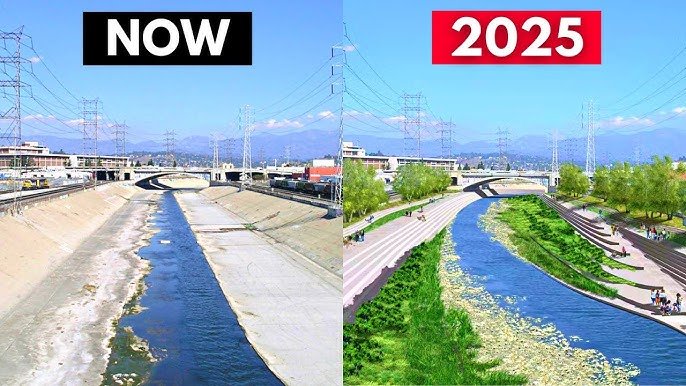
A hundred metres upstream, the argument becomes impossible to ignore. The river transitions from living system to storm drain: a vast concrete trapezoidal channel, thirty metres wide in places, its walls smooth and vertical and blank, designed not to nurture anything but to move water as fast as possible to the sea. Graffiti has colonised the lower walls. Shopping trolleys rest in the shallow flow. The roar of the I-5 freeway — which runs, with astonishing symbolism, directly alongside the channel for much of its length — drowns out everything except itself.
That contrast — the fragile, tenacious living section against the engineered emptiness — is the central image of Los Angeles’s environmental condition. It is a city of extraordinary ecological endowment, sitting at the junction of desert, mountain, wetland, and ocean, within one of the world’s most biodiverse coastal regions. It is also a city that spent a century systematically dismantling its ecology in the service of growth, mobility, and the imported logic of the American West: that water is something to be moved, contained, and consumed; that land is something to be paved; that nature is something to be managed at a safe remove from urban life. Reinventing that logic is the work that Los Angeles is now attempting, unevenly, expensively, and — in ways that matter — with a seriousness it has not always possessed.
A City Built Against Its Landscape
The Tongva people — the Gabrielino — lived in this basin for at least 3,500 years before Spanish missionaries arrived in 1771, and they lived well. The Los Angeles River was not the concrete trough it would become. It was a braided, unpredictable, seasonally flooding waterway that supported riparian forests, wetlands, and seasonal abundance in an otherwise semi-arid landscape. The Tongva navigated its rhythms. They did not try to conquer them.
The Americans who arrived in the nineteenth century held different ambitions. The city’s first great transformation came not from internal growth but from hydraulic conquest. In 1913, William Mulholland opened the Los Angeles Aqueduct, a 233-mile channel that diverted the water of the Owens River — and with it the agricultural future of the Owens Valley — to the growing city to the south.1 The water that flowed across the desert opened hundreds of thousands of acres to annexation and development. It made the modern city possible. It also established the defining logic of Los Angeles’s relationship with its landscape: nature as a problem to be solved by engineering, at whatever distance and cost that required.
The concrete river was the next expression of that logic. The 1938 floods — a catastrophic series of storms that killed eighty-seven people, destroyed thousands of homes, and sent a thirty-foot wall of water through Long Beach — provided both the political will and the federal funding for the Army Corps of Engineers to channelise the river entirely.2 The work was completed over the following two decades. What had been an erratic, flooding, living river was transformed into a flood-control channel of extraordinary efficiency: a concrete trapezoid capable of carrying immense volumes of water to the ocean with maximum speed and minimum ecological content. The river, as a river, effectively ceased to exist.
What followed was the freeway. Between the 1940s and the 1970s, Los Angeles built the template for car-dependent urban form that American cities would replicate for the rest of the century. Freeways consumed neighbourhoods — often Black and Latino neighbourhoods, which lacked the political power to resist displacement. Streetcar networks, once among the most extensive in the world, were dismantled. The car became not merely a transport choice but the condition of possibility for life in the city: for work, for groceries, for the school run, for the emergency room. By the end of the twentieth century, Los Angeles County had more registered vehicles than the entire country of Australia.
The environmental consequences arrived more or less immediately. By the early 1940s, the city was experiencing smog events so dense that residents initially feared a Japanese chemical attack.3 The South Coast Air Basin — hemmed in by mountains that trap particulates and ozone precursors in the same bowl-like geography that makes the region so beautiful — became, for decades, the most polluted urban airshed in the United States. A generation of children grew up with restricted lung development. An entire science of photochemical smog was essentially invented to study what was happening over Los Angeles.
The Bill Arrives
The pressures bearing on Los Angeles today are several, and they compound each other with uncomfortable precision.
Water is the most existential. The Colorado River, which supplies much of Southern California’s imported water alongside the State Water Project’s Sierran snowpack, is in structural decline. Lake Mead and Lake Powell — the great reservoirs of the Colorado system — reached historic lows in 2022, exposing the so-called “bathtub ring” of bleached rock that marks the waterline of more abundant decades.4 The Colorado River Compact of 1922, which allocated the river’s water among seven states plus Mexico, was written during an anomalously wet period; scientists now understand that the flow it allocated was substantially higher than the river can reliably provide in a warming climate. Renegotiations among the basin states are ongoing and unresolved. Los Angeles cannot assume that the water it has long relied upon will continue to arrive in the volumes it has demanded.
Heat is the most immediately deadly. Los Angeles already experiences urban heat island effects that produce temperature differentials of up to ten degrees Fahrenheit between wealthy, tree-shaded neighbourhoods on the Westside and low-income, heavily paved communities in the east and south — in Watts, in Boyle Heights, in South Los Angeles.5 Extreme heat kills more Californians each year than any other weather-related event, and the toll falls overwhelmingly on the elderly, the outdoors-working poor, and communities of colour. As the climate warms, what are now severe heat events will become routine. The city’s infrastructure — its housing stock, its cooling systems, its emergency services — is not designed for what is coming.
Fire has redrawn the terms of the conversation. In January 2025, the Palisades Fire and the Eaton Fire together became among the most destructive urban-wildland fires in California history, burning through Pacific Palisades, Altadena, and surrounding communities, destroying thousands of structures and exposing the fragility of the city’s urban-wildland interface in conditions of severe drought and extreme wind.6 The fires raised questions that the city is still struggling to answer: about fire department preparedness, about water system pressure during simultaneous emergencies, about whether insurer withdrawal from California’s market will render some neighbourhoods financially uninhabitable regardless of their physical reconstruction, and about whether it is ecologically rational to rebuild, at public expense, in areas whose fire risk will only increase.
And through all of this, the car remains. Los Angeles County’s freeway system carries some of the heaviest traffic volumes in the world. The region has been in violation of federal ground-level ozone standards for decades. The Port of Los Angeles and Port of Long Beach together form the largest port complex in the Western Hemisphere, generating immense volumes of diesel truck traffic through communities — Wilmington, West Long Beach, Commerce — that bear a disproportionate share of the port’s pollution burden and almost none of its economic benefit.
Restoration, Capture, and the River’s Second Chance
The Los Angeles River’s transformation from flood-control infrastructure to ecological corridor is the project that most clearly represents what the city wants to become. It is also the project that most clearly reveals the distance between ambition and delivery.
The modern restoration movement began with a poet. In 1986, Lewis MacAdams — writer, activist, and what he called “a rogue bureaucrat of the imagination” — stood at the edge of the concrete channel with a pair of bolt cutters and ceremonially cut through a chain-link fence to claim the riverbank for the public.7 His organisation, Friends of the LA River (FoLAR), spent the following decades reframing the channel not as infrastructure but as a living system with rights and a future. The designation of the river as a “navigable waterway” by the EPA in 2010 — a classification that carries significant regulatory protections under the Clean Water Act — was in large measure the result of that advocacy.
The City of Los Angeles adopted a river revitalisation master plan in 2007, and the Army Corps of Engineers spent years studying restoration alternatives for the most ecologically viable stretches. The study’s preferred alternative — Alternative 20 — proposed restoring approximately eleven miles of the river, including the Glendale Narrows, at a cost that would run into billions of dollars.8 The 2021 Infrastructure Investment and Jobs Act provided a major infusion of federal funding for Army Corps water infrastructure that has given the restoration new financial traction.
Alongside the river work, Los Angeles has launched what may be its most consequential long-term infrastructure shift: a campaign to produce water locally rather than import it. Pure Water LA — the city’s programme for advanced water purification and indirect potable reuse — aims to provide thirty-five percent of the city’s water from recycled sources by 2035, reducing dependence on the Colorado River and the increasingly unreliable Sierra snowpack.9 Measure W, a parcel tax passed by LA County voters in 2018, is funding a network of spreading grounds, infiltration basins, and green infrastructure to capture stormwater that currently runs off impervious surfaces and into the ocean, replenishing depleted groundwater basins instead of wasting a resource the region cannot afford to lose.
On heat, the city has made institutional commitments that are at least symbolically significant. In 2022, Marta Segura was appointed as Los Angeles’s Chief Heat Officer — among the first such appointments of any major American city — with a mandate to develop an equitable heat action plan focused on the communities most at risk rather than the city’s already-comfortable wealthy enclaves.10 Cool roof and cool pavement programmes have begun to roll out in the most heat-exposed neighbourhoods. Tree equity mapping has documented the canopy gap with enough clarity to make ignoring it politically awkward.
On transport, the Metro system is undergoing its most ambitious expansion since the freeway era ran in the opposite direction. The Crenshaw/LAX Line opened in 2022, connecting one of the city’s historically under-served corridors to the airport and to the broader network. The Purple Line extension is extending rapid transit to Westwood and UCLA. The 2028 Olympic and Paralympic Games — awarded to Los Angeles in 2017 — have become both a deadline and a justification for accelerated transit investment, with the city attempting to use the games as Seoul and Barcelona did: as a forcing mechanism for infrastructure that long-term political fragmentation had stalled.
And in the Santa Monica Mountains above Agoura Hills, a structure of concrete, steel, and native plantings has been quietly doing something the freeway system never managed: healing a wound. The Wallis Annenberg Wildlife Crossing, opened in October 2023, spans ten lanes of US Highway 101 at Liberty Canyon — the single most critical pinch point between the Santa Monica Mountains and the larger wildlands to the north.11 It is the world’s largest wildlife crossing, designed to allow mountain lions, mule deer, coyotes, and hundreds of other species to traverse a freeway that had functionally bisected the mountains for sixty years. Its construction was driven partly by the death — the celebrity — of P-22, a mountain lion who colonised Griffith Park in 2012, lived there alone for a decade, and was euthanised in December 2022 after being struck by a vehicle. P-22 became the most famous wild animal in the history of Los Angeles, and his life and death made the crossing politically irresistible.
Progress, Partial and Uneven
Air quality is the story of what patient, sustained regulation can achieve in a generation. The South Coast Air Basin is dramatically cleaner than it was in the 1970s, when Stage 1 smog alerts — meaning conditions dangerous to breathe outdoors — were declared on more than a hundred days per year. By the 2020s, Stage 1 alerts had been effectively eliminated.12 The concentrations of many pollutants have fallen substantially, driven by vehicle emission standards, reformulated fuels, industrial controls, and the slow electrification of transport and freight. Children growing up in Los Angeles today have measurably better lung function than children raised here in the 1980s. That is an enormous public health achievement, and it should not be diminished.
The Port of Los Angeles and Long Beach’s Clean Truck Program, launched in 2008, replaced thousands of older diesel trucks with lower-emission vehicles and is now transitioning toward zero-emission alternatives. The ports have set targets for zero-emission cargo handling equipment and are working with shipping lines on cleaner vessel operations. These are not symbolic gestures: the ports generate enough diesel pollution to be a significant regional health burden, and the communities downwind — predominantly Latino and Black — have been bearing that burden for decades. Progress is real, if still insufficient.
Stormwater capture, while less visible, represents a genuine structural shift. The San Gabriel Valley’s spreading grounds and the county’s network of debris basins and infiltration facilities are increasingly being managed not just for flood control but for groundwater recharge. Measure W’s funding has begun to flow into green infrastructure projects — bioswales, permeable pavements, park-based retention basins — that perform multiple functions simultaneously: capturing water, cooling neighbourhoods, providing public space, and reducing runoff pollution. The approach is exactly what water scientists have been urging for decades, and the county is, at last, deploying it at something approaching scale.
The wildlife crossing is working. Within months of its opening, camera traps were recording mountain lions, coyotes, and other species using the structure. The crossing’s design — planted with native vegetation, shielded from light and noise on its edges — appears to be achieving what its engineers intended. Restoring genetic connectivity between isolated mountain lion populations could, over decades, prevent the inbreeding depression that threatens P-22’s successors with local extinction. It is one of the more ecologically consequential pieces of infrastructure built in California in recent years, and it cost approximately ninety million dollars — roughly the price of two miles of new freeway.
The Car, the Concrete, and the Gentrification of Green
Against these gains, the contradictions accumulate with a weight that should induce honesty about where Los Angeles actually stands.
The river restoration, for all its ecological aspiration, has produced a troubling political economy along its corridor. As plans to transform the riverbank into parkland and public amenity have advanced, real estate speculation has followed. Neighbourhoods adjacent to the proposed greenway — Elysian Valley, Cypress Park, Frogtown — have experienced rapid gentrification. Long-term Latino residents, artists, and small-business owners who settled along the industrial riverbank precisely because it was overlooked and affordable have been displaced by rising rents. The ecological benefit accrues to whoever remains; those who built the social fabric of the neighbourhood often do not.13 “Green gentrification” is not unique to Los Angeles — Seoul’s Cheonggyecheon faced similar dynamics — but it is particularly acute in a city with a chronic housing shortage and a history of using infrastructure investment as a vector for neighbourhood transformation.
The freeway system continues to expand even as the city invests in transit. Caltrans — the state transport agency, whose culture and incentive structure remains oriented toward highway capacity — has proposed widening several freeways in the Los Angeles basin, including sections of the 10 and the 605. Environmental advocates have challenged these projects, and federal reviews of highway widening projects have become more stringent under recent administrations. But the institutional momentum of freeway expansion is formidable, and the political economy of construction — the labour agreements, the federal funding formulas, the contractor relationships — does not simply reverse because the climate politics have shifted.
Transit investment is real but the mode share remains stubbornly car-dominated. LA Metro carries several hundred million trips per year — a substantial and growing ridership — but in a county of ten million people making tens of millions of trips daily, transit’s share of total movement remains modest. The system’s expansion has been hampered by the fractured governance of the region: the City of Los Angeles, Los Angeles County, and dozens of incorporated municipalities each control different pieces of the built environment, and their planning decisions are not coordinated by any single authority with the power to align them. Density required to support transit — the walkable, mixed-use, frequent-service urbanism that makes trains and buses genuinely competitive with cars — is resisted in most of the city’s neighbourhoods by homeowner interests, parking requirements embedded in decades-old zoning codes, and a political culture that has long treated single-family suburban form as the aspirational norm.
The January 2025 fires burned in some of the wealthiest parts of the metropolitan area, and the aftermath has revealed the limits of the city’s resilience planning with an uncomfortable clarity. Insurance companies had begun withdrawing from California’s home insurance market before the fires; after them, the withdrawal accelerated. A city in which it becomes financially impossible to insure a home in fire-exposed zones is a city that will experience, through the market rather than through policy, a managed retreat from those zones — but in a chaotic, inequitable way that leaves individuals bearing losses that should be socialised, while destroying communities that might otherwise be protected or adapted. The rebuilding debate has exposed a genuine tension between the right to return to a beloved place and the ecological rationality of rebuilding in landscapes that will burn again.
Air quality remains below federal standards for ozone. Despite fifty years of regulation, the South Coast Air Basin has not achieved attainment, and the SCAQMD’s own projections show that meeting the current standard will require emissions reductions that are not yet visible in the region’s trajectory. The region’s geography — the mountains, the inversions, the sun — is a permanent disadvantage, but so is the political difficulty of reducing vehicle miles travelled in a city that has built itself around the assumption of unlimited car access.
The River as Spine, the City as Watershed
The vision that Los Angeles’s more ambitious planners and ecologists are articulating is not merely a restored river. It is a city reoriented around its watershed — in which the LA River functions as the ecological spine of a green network extending from the mountains to the sea, connecting parks, wetlands, and habitat corridors that currently exist as disconnected fragments.
The Ballona Wetlands, a sixty-hectare coastal wetland near Marina del Rey — one of the last significant coastal wetlands remaining in Los Angeles County — is undergoing a major state-funded restoration that aims to re-establish tidal flows, remove invasive species, and reconnect the wetland to its sediment and nutrient cycles. The project has been contentious: local residents who use the degraded wetland for walking and informal recreation have resisted elements of the restoration plan, and the balance between public access and ecological recovery has been difficult to strike. But the wetland, when restored, will provide coastal resilience functions — wave attenuation, carbon storage, habitat for migratory birds along the Pacific Flyway — that no amount of engineered infrastructure can replicate.
Pure Water LA represents perhaps the most consequential long-term shift: the potential reorientation of the city’s water economy from import-dependence to local cycle. A city that captures and recycles a substantial fraction of its water — treating wastewater to drinking standard, infiltrating stormwater into groundwater basins, reducing landscape irrigation through native and drought-adapted planting — is a city that has fundamentally changed its metabolic relationship with its bioregion. That is not yet what Los Angeles is. It is, in principle, what Los Angeles could become.
The 2028 Olympics will be a test of whether the city can make a transit system that approaches functionality for a global audience — and whether the improvements made for the games can be institutionalised rather than reversed when the cameras leave. Los Angeles has seen previous events — the 1984 Olympics, the 1994 World Cup — used to promise transformation and deliver far less. But the scale of transit investment underway, driven by federal funding and the political commitment of Mayor Karen Bass’s administration, is larger than what preceded the 1984 games, and the political appetite for maintaining it has some institutional grounding that previous moments lacked.
The Weight of the Concrete
Standing at the edge of the Glendale Narrows on a winter morning, watching the egrets work the shallows and the willows lean over the water, it is possible to feel something that the rest of the channel does not permit: a sense of the city as it might have been, or might yet become. The river, in this stretch, is not performing ecology. It is simply practicing it, quietly and without subsidy, in the narrow margin of concrete and history that the Army Corps left it.
That margin is both a literal and a metaphorical description of Los Angeles’s environmental condition. The city is working, in fits and starts, with real resources and genuine institutional commitment in some areas, to recover something of what it buried and paved and diverted. The wildlife crossing is not nothing. The stormwater capture programme is not nothing. The Chief Heat Officer is not nothing. The fact that the river revitalisation project has spent twenty years moving through planning and is now, slowly, finding federal funding is not nothing.
But the weight of the concrete — the weight of a century of decisions made on the premise that nature is a problem for engineering to solve — is enormous. The car is still central to daily life in a way that transit cannot yet displace. The water system still depends on rivers that climate change is diminishing. The heat that will kill people in the decades ahead is already written into the urban form: the asphalt, the lack of trees, the absence of shade in the neighbourhoods that have always had the least. The fires will come again.
Los Angeles is not failing. It is trying. But the scale of what it is trying to undo — the ecological debt accumulated over a century of confident, well-funded, institutionally supported extraction — is larger than anything its current programmes are designed to repay. The river knows this. The willows growing in the narrow soft-bottomed stretch know this. They have been making the argument for ecological recovery for decades, without legislation or bond measures, without master plans or mayoral directives. They simply persisted in the margin the concrete left them, and waited for the city to catch up.
The question is whether the city will move fast enough, and honestly enough, to deserve them.
Endnotes
1. The Los Angeles Aqueduct was completed in 1913 under chief engineer William Mulholland, diverting the Owens River approximately 233 miles to Los Angeles. The project enabled the annexation of vast areas of the San Fernando Valley and is widely credited with making the modern city’s scale possible. On the Owens Valley’s ecological and social cost: see Norris Hundley Jr., The Great Thirst: Californians and Water — A History (University of California Press, 2001).
2. The 1938 floods struck Los Angeles in late February and early March of that year, with multiple storms producing severe flooding across the basin. Contemporary and historical records attribute approximately 87 deaths to the disaster, though exact figures vary by source. On the Army Corps channelisation that followed: see Blake Gumprecht, The Los Angeles River: Its Life, Death, and Possible Rebirth (Johns Hopkins University Press, 1999) — the definitive historical account.
3. The first documented Los Angeles smog event of the modern era occurred on 26 July 1943. The event was severe enough that some residents initially suspected a Japanese chemical attack. See Chip Jacobs and William J. Kelly, Smogtown: The Lung-Burning History of Pollution in Los Angeles (Overlook Press, 2008).
4. On Colorado River water stress and the overallocation problem embedded in the 1922 Compact: see Bureau of Reclamation, Colorado River Basin Water Supply and Demand Study (2012); and more recently, Federal Register notices from 2022–2024 concerning Tier 1 and Tier 2 shortage declarations. Lake Mead reached its lowest recorded level in July 2022 since the reservoir was filled in the 1930s.
5. Urban heat island differentials in Los Angeles have been documented extensively. Studies using satellite land surface temperature data have found temperature differentials of 8–12°F between the hottest low-income neighbourhoods (often in the eastern San Gabriel Valley, South LA, and East LA) and cooler, tree-canopied areas on the Westside. See UCLA Institute of the Environment and Sustainability reports on urban heat and tree equity.
6. The Palisades Fire and Eaton Fire ignited in January 2025 under conditions of strong Santa Ana winds and exceptional drought. Specific damage figures and cause determinations were still subject to active investigation and litigation at the time of writing. On California’s wildfire insurance crisis preceding the fires: California Department of Insurance reports, 2023–2024.
7. Lewis MacAdams founded Friends of the LA River (FoLAR) in 1986. His account of the organisation’s founding and early years is documented in FoLAR’s organisational history and in numerous interviews. See also Jenny Price’s work on LA River ecological and cultural history.
8. The Army Corps of Engineers’ Los Angeles River Ecosystem Restoration Feasibility Study concluded with a recommended alternative (Alternative 20) proposing restoration of approximately 11 miles of the river, at cost estimates that have ranged widely depending on scope and methodology. The project has been subject to ongoing political and fiscal negotiation. Current status: see Corps of Engineers, Los Angeles District, project documentation.
9. Pure Water LA is the City of LA’s programme for advanced purified water. The 35% local supply target by 2035 has been stated in city planning documents and LA Department of Water and Power strategic plans. On the broader shift to water self-sufficiency: see Metropolitan Water District of Southern California, Integrated Water Resources Plan.
10. Marta Segura was appointed Chief Heat Officer for the City of Los Angeles in 2022. See City of LA Office of Sustainability and City of LA Climate Emergency Mobilization Office, Heat Action Plan documentation.
11. The Wallis Annenberg Wildlife Crossing opened in October 2023 at Liberty Canyon, spanning US Highway 101 in Agoura Hills. At approximately 65 metres wide, it is the largest wildlife crossing in the world. Cost approximately $90 million, funded through public and private sources. On P-22: National Park Service, Santa Monica Mountains National Recreation Area, wildlife monitoring reports; see also National Geographic coverage of P-22’s life and death.
12. On air quality improvement in the South Coast Air Basin: South Coast Air Quality Management District (SCAQMD), State of Air Quality annual reports, multiple years. Stage 1 smog alerts (ozone concentrations at 0.20 ppm or above) peaked at over 120 days per year in the 1970s and had been reduced to near zero by the early 2000s.
13. On green gentrification along the LA River corridor: see scholarly literature on environmental gentrification, including work by Isabelle Anguelovski and colleagues (2018), and local reporting by the Los Angeles Times and LAist on displacement in Frogtown, Elysian Valley, and Cypress Park.
Source Note
This article draws on historical scholarship on Los Angeles water history (Hundley, Gumprecht), air quality history (Jacobs and Kelly), urban ecology and environmental justice, Army Corps of Engineers project documentation, SCAQMD annual reporting, Bureau of Reclamation Colorado River materials, City of LA and LA County planning documents, National Park Service wildlife monitoring data, academic literature on green gentrification, and investigative and analytical journalism from the Los Angeles Times, LAist, CalMatters, and ProPublica. On the 2025 fires, reporting at the time of writing was still developing and specific damage figures have been treated with appropriate caution.
Further Reading / Watching / Listening
Reading: Blake Gumprecht, The Los Angeles River: Its Life, Death, and Possible Rebirth (Johns Hopkins University Press, 1999). Norris Hundley Jr., The Great Thirst: Californians and Water (University of California Press, 2001). Mike Davis, Ecology of Fear: Los Angeles and the Imagination of Disaster (Vintage, 1998). Jenny Price, ‘Thirteen Ways of Seeing Nature in LA,’ The Believer (2006) — essential for understanding how Angelenos relate to urban nature. William Deverell and Greg Hise (eds.), Land of Sunshine: An Environmental History of Metropolitan Los Angeles (University of Pittsburgh Press, 2005).
Watching: LA 2050 (various municipal planning videos, LA’s Department of City Planning); The Promise of the LA River (numerous documentary short films produced by FoLAR). Coverage of P-22 and the wildlife crossing by National Geographic and the Los Angeles Times.
Listening: KCRW’s Press Play and DnA: Design and Architecture podcast — among the best ongoing radio coverage of Los Angeles’s urban and environmental evolution. CalMatters’ California Divide podcast on environmental justice in the state.