
GREEN CITIES SERIES | ARTICLE 12
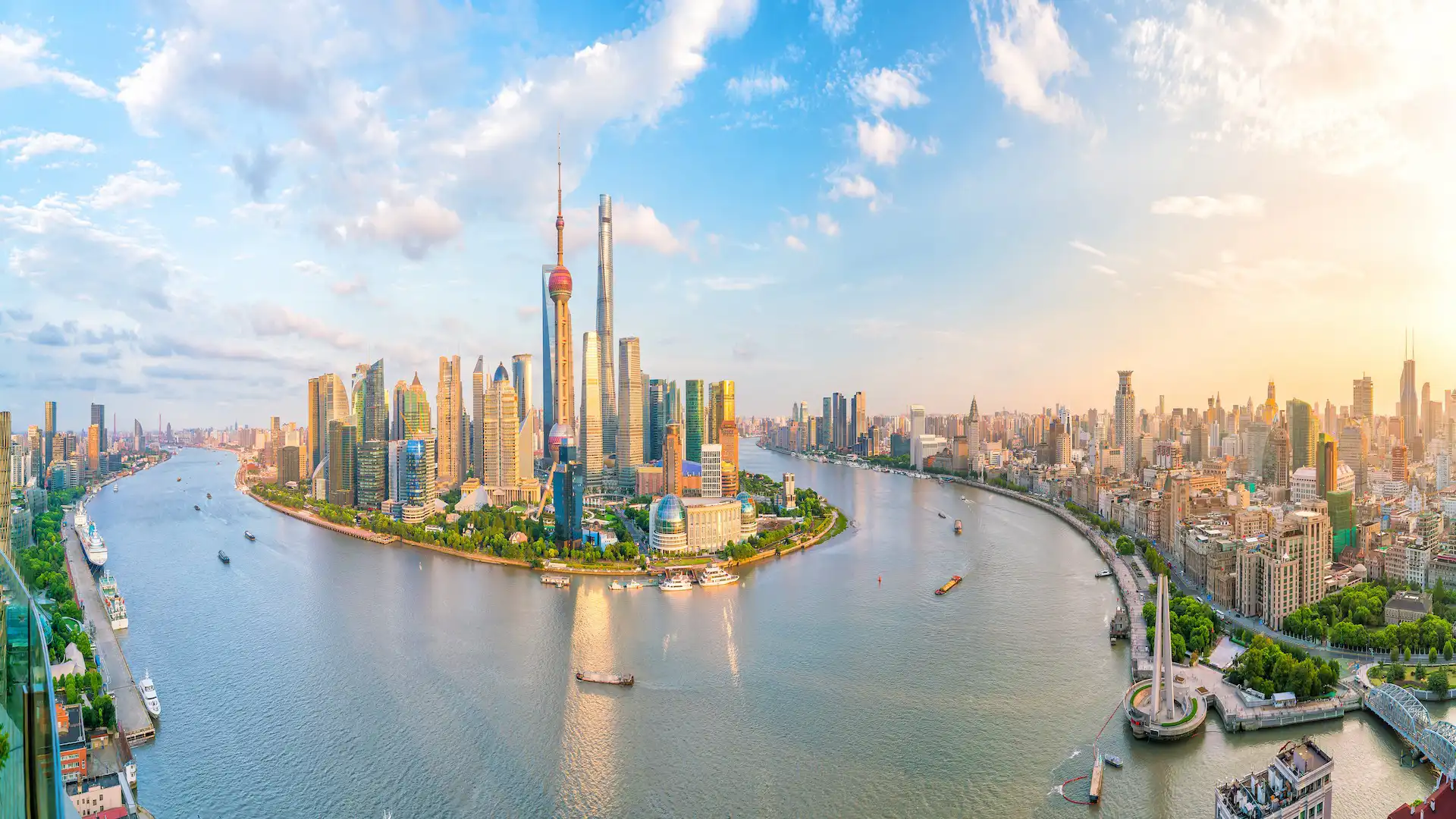
Shanghai is sinking. The city centre has subsided more than three metres since the late nineteenth century, while the sea rises around it. In response, China has rolled out the most ambitious urban water-management programme in history — the Sponge City Initiative — and Shanghai is at once its most important test case and its most vivid illustration of the tension between ecological ambition and the relentless logic of construction.
On a bright autumn morning along the Huangpu River, the park at Houtan moves between registers. Egrets stalk the reed margins. A school group files across a bamboo boardwalk, peering into the water where native grasses trail in the current. The city’s glass towers rise beyond the levee on the far bank, their reflections blurred by the slow-moving river. Below the visitors’ feet, invisible to them, a constructed wetland is at work — filtering Grade V river water up to Grade III through a cascade of terraced cells planted with bulrush, iris, and canna. The park treats some 2,400 cubic metres of polluted Huangpu water per day and sequesters an estimated 242 tonnes of carbon annually in its plantings.
Houtan Park was built on a derelict steelworks and shipyard for the 2010 Shanghai World Expo. Its designer was Kongjian Yu, a landscape architect from Peking University who spent his career arguing that Chinese cities had made a catastrophic mistake by trying to fight water with concrete. Yu died in September 2025, at the age of sixty-two, in a small plane crash in Brazil. He did not live to see whether the programme he inspired — China’s national Sponge City Initiative — would ultimately rescue or merely ornament the delta cities that need it most.
Shanghai is the largest and most important of those cities. With a population of around twenty-four million and the world’s busiest container port, it sits at the mouth of the Yangtze River on a foundation of alluvial mud deposited over hundreds of thousands of years. That mud is the source of the city’s wealth and the origin of its deepest existential problem. It compresses under the weight of towers and highways. It floods when the rain comes fast, when the typhoons push surge tides up the estuary, when the upstream Taihu Lake empties into the Huangpu. And it is, in a manner that concentrates the mind, slowly going under.
A City Built on Borrowed Ground
The story of Shanghai and water is inseparable from the story of Shanghai itself. For most of its history, the city was a fishing town on the tidal flats of the Yangtze estuary — low, wet, crisscrossed by canals and creeks that drained the surrounding rice paddies into the river. The transformation into a modern metropolis began with the forced opening of the treaty port in 1843, when British merchants and then diplomats, financiers, and industrialists poured in and began filling in the creeks, draining the marshes, and building on land that had no business supporting grand ambitions.
The price was paid slowly at first, then more obviously. Shanghai was one of the first Chinese cities to suffer serious land subsidence, with an average rate of 22.94 millimetres per year from 1921 to 2007.1 The weight of buildings compressing the alluvial deposits, and the extraction of groundwater to supply them, caused the ground to sink. In the most heavily developed parts of the city centre, the total subsidence since the late nineteenth century has exceeded three metres. The city is, in an arresting geological sense, lower than it was when the Bund was built.
The most vivid demonstration of what this means in practice came in July 1949, when a historically powerful typhoon coincided with high tides. With no adequate levees along the Huangpu and a drainage system built for a smaller and lighter city, floodwaters surged through the urban core. More than 1,600 people died.2 It remains one of the most destructive storms in modern Chinese history. The government that came to power later that year — the People’s Republic, proclaimed in October — inherited not just a city but an urgent hydraulic emergency.
The response was grey infrastructure at vast scale. The Huangpu River levee, initially constructed in 1956 to withstand a one-hundred-year flood, was repeatedly overtopped and eventually rebuilt between 1988 and 1993 into a 208-kilometre structure 2.5 metres high and 14.4 metres wide, designed to withstand a thousand-year flood.3 Seawalls went up along the Yangtze estuary and Hangzhou Bay. Drainage networks expanded under the streets of a rapidly growing city. By the early 2000s, Shanghai had what its planners described as a four-layer flood-defence system: the river levee, seawalls, drainage, and a network of real-time monitoring stations feeding data to the city’s Flood Control Headquarters every five minutes.
It was not enough. Rainstorm frequency in the city rose from around six events per year in the 1980s to nine by the 2000s.4 Sea level has risen 115 millimetres along the Shanghai coast over the past three decades — a rate of 3.8 millimetres per year, higher than the global average.5 Land subsidence, while slowed by restrictions on groundwater extraction and groundwater recharge programmes, has stabilised at an estimated 6 millimetres per year in the city centre, not zero.6 The arithmetic is unforgiving: when you add rising seas, sinking land, and intensifying storms, what was a one-hundred-year flood event begins to occur with terrifying regularity.
A 2025 study by researchers from the University of East Anglia, Shanghai Normal University, and the University of Southampton modelled all the flood drivers together for the first time. Their findings were stark. By 2100, under high-emissions scenarios, floods in Shanghai could expand in area by up to 80 percent compared to current events, and be substantially deeper.7 Without major adaptation, a thousand-year flood event is projected to inundate 69 percent of the city’s area with water exceeding 25 centimetres by the end of the century.8 The researchers described what they called a ‘polder effect’ — the danger that if levee defences fail catastrophically, the very infrastructure that protects the city becomes the wall of a bathtub, trapping floodwater inside.
The Idea of the Sponge
Against this backdrop of accumulated risk, the Sponge City Initiative arrived in 2013 as something radical: a national policy that proposed absorbing water rather than racing it away. The concept drew on ideas that had been circulating in landscape architecture and hydrology for decades — low-impact development, water-sensitive urban design, constructed wetlands, permeable paving — and gave them a unifying metaphor and the backing of the Chinese state.
Kongjian Yu had been articulating the core argument since his return from Harvard in the late 1990s: that Chinese cities, in their rush to modernise, had treated rivers and wetlands as obstacles rather than infrastructure. They had straightened and embanked the rivers, channelled the streams into concrete drains, sealed the soil under asphalt and tower foundations, and lost the natural buffering capacity that had made the delta habitable for millennia. What was needed was not more and higher grey infrastructure but a fundamentally different relationship with water — one that slowed it down, spread it out, cleaned it through natural processes, and kept it in the landscape long enough to be useful.
His firm, Turenscape, had been testing these principles in projects across China for years. The most significant was Houtan Park. Built on the former Shanghai steelworks and shipyard in time for the 2010 Expo, the 14-hectare park demonstrated that ecological restoration, flood buffering, water purification, and public amenity were not competing objectives but a single, integrated possibility.9 The constructed wetland’s ability to raise water quality from Grade V — the poorest category on China’s national scale — to Grade III proved the point at full scale. The park won the American Society of Landscape Architects’ Award of Excellence, was broadcast on national television, and provided the proof of concept that helped make Sponge City policy a reality.
In 2013, Xi Jinping gave the programme explicit political endorsement, telling the Urbanisation Work Conference that cities should ‘give priority to retaining limited rainwater and use the power of nature to drain water.’ The following year, the Ministry of Housing and Urban-Rural Development issued national technical guidelines. In 2015 and 2016, 30 pilot cities were selected; Shanghai was designated in the second batch.10 The national targets were set at 20 percent of urban areas to be made ‘sponge-like’ — capable of retaining 70 percent of annual rainfall — by 2020, 40 percent by 2025, and 80 percent by 2030.
For Shanghai, the sponge approach was formally embedded in municipal water planning in July 2024, when the city’s water authority released a comprehensive plan aligning with the 40-percent target for 2025 and the 80-percent target for 2030.11 The plan called for green infrastructure — rain gardens, bioswales, green roofs, permeable paving, constructed wetlands — to be incorporated into all new development, combined with upgrades to grey drainage systems and real-time monitoring. New construction projects must now demonstrate rainwater storage capacity and source-control measures as conditions of approval.
Crucially, Shanghai set itself the most ambitious flood-protection standard of any pilot city: a one-hundred-year return period for urban flooding, consistent with the design of green infrastructure in United States cities.12 This is not a modest aspiration. Most Chinese cities in the programme are designed for ten- to fifty-year events. The higher target reflects both Shanghai’s economic exposure — its GDP represents a significant fraction of China’s national output — and the city’s acute awareness that it cannot afford to repeat the lessons of Zhengzhou.
The Zhengzhou Warning
In July 2021, the central Chinese city of Zhengzhou experienced 696.9 millimetres of rainfall within 24 hours — more than its entire annual average — including a record 202 millimetres in a single hour. The flooding killed hundreds of people and left the city paralysed for days. What made the disaster internationally significant was that Zhengzhou had spent the preceding years converting itself into a sponge city, investing more than 53.4 billion yuan — roughly 8.3 billion US dollars — in drainage networks, bioswales, and green parks.13
The disaster did not discredit the sponge city concept, but it clarified its limits. Sponge infrastructure is designed for the routine, for frequent rain events of moderate intensity, for the daily and seasonal rhythms of a monsoon climate. It was never going to absorb a meteorological event of the kind Zhengzhou experienced, any more than a city park can stop a river in flood. The question that Zhengzhou made unavoidable was whether the programme’s advocates — and the government communications surrounding it — had been honest about this distinction. Of the 30 original pilot cities, 19 experienced significant flooding after their sponge city works were completed.14 The green infrastructure performed as designed in moderate events; in extreme ones, it was overwhelmed.
For Shanghai, the Zhengzhou lesson pointed toward a more integrated framework. The city’s nightmare scenario — a strong typhoon making landfall at high tide while the Taihu Lake is running high — was already on record. Typhoon Winnie in 1997 produced a storm tide of 5.72 metres at a Shanghai hydrological station.15 If the same event occurred today, accounting for the subsidence that has accumulated since, the water level would be nearly three metres above the city centre. Sponge parks and permeable paving offer nothing against that.
Researchers at East China Normal University and Loughborough University, who have modelled Shanghai’s flood risk in the most detail, have called for the city to consider a movable tidal barrier at the mouth of the Huangpu — equivalent in function to London’s Thames Barrier or Rotterdam’s Maeslantkering.16 The 479.7 kilometres of floodwalls that currently ring the city would otherwise need to be raised every decade as sea levels continue to climb, at escalating cost and with diminishing confidence in the margins. No such barrier has been formally approved, and the political and engineering complexities of constructing one across one of the world’s busiest waterways are formidable. The conversation, however, is now underway.
The Wetlands at the Edge of the World
Forty-five kilometres northeast of the Bund, the city ends. Or rather it does not end — Shanghai is an administrative unit of extraordinary scale, encompassing rural districts, islands, and coast — but the urban fabric thins, the towers recede, and what remains is water and reed and sky. Chongming Island, the world’s largest alluvial island, formed from Yangtze sediment over fourteen centuries, sits at the estuary’s mouth. At its eastern tip, the Chongming Dongtan National Nature Reserve covers 241.55 square kilometres of tidal flat, salt marsh, and mudflat. In 2024, it was inscribed as a UNESCO World Heritage Site — Shanghai’s first — as part of the Yellow Sea Migratory Bird Habitat network.17
Dongtan is significant at a scale that dwarfs any individual urban design project. More than 300 bird species have been recorded in the reserve, including 19 under China’s first-tier national protection status and 59 under second-tier protection. Each year, tens of thousands of migratory waterbirds — hooded cranes, spoonbills, Oriental white storks — use the wetland as a critical stopover on the East Asian-Australasian flyway, one of the longest migratory routes on the planet. The reserve holds populations representing more than 1 percent of the global total for at least 12 waterbird species.18
The reed marshes that make up 70 percent of the reserve’s vegetation serve ecological functions that extend well beyond bird habitat. They stabilise embankments, filter water, sequester carbon, and provide the coastal buffer that protects the low-lying island from storm surge. The reserve is also a working example of an ecological problem that defies easy resolution: when the paper mills that had historically managed the reed beds were shut down by environmental regulations, the reeds began to outcompete other vegetation, reducing biodiversity. Since 2022, Shanghai has trialled a programme that employs local women — many of them in communities where male migration to cities has created a predominantly female remaining population — to harvest and process reeds into handicrafts and artworks, turning conservation labour into an economic opportunity.19
Elsewhere on Chongming, Shanghai has created the first wild habitat for Père David’s deer, a species hunted to extinction in China and reintroduced from captive populations abroad. GPS-monitored deer now roam reed marshes and seasonal fields. Their presence, and the egrets and frogs and finless porpoises that wildlife surveys confirm are returning to the estuary, suggests that the island’s decade-long ecological programme is producing genuine results.
The broader picture for Shanghai’s urban habitat is harder to read with confidence. A study using the InVEST model tracked habitat quality across the metropolitan area between 2000 and 2017, finding that the overall index declined from 0.56 to 0.42 over that period, with roughly a third of the area experiencing deterioration.20 The highest-quality habitat remained concentrated in Chongming and the western and southern coastal wetlands. The downtown and inner suburbs, by contrast, had continued to lose ecological value as development consumed and fragmented remaining green space. The pattern is familiar from cities worldwide; in Shanghai, the speed and scale of urbanisation has made it particularly acute.
Green Roofs and Grey Realities
Inside the city, the sponge programme is visible in scattered patches. The Lingang New City development in Pudong, built largely in the 2010s and 2020s, incorporates sponge design principles throughout — permeable paving on streets and plazas, sunken green spaces designed to collect and temporarily store rainwater, constructed wetlands integrated into the open space network. It is the kind of place that looks well in ministerial reports and is cited in international conferences on urban resilience.
But Lingang is new. The challenge that defies easy resolution is the existing city — the hundreds of square kilometres of older housing, road surfaces, and commercial districts where the soil was sealed decades ago and where retrofitting sponge infrastructure means disrupting the fabric of urban life. Permeable paving on a busy arterial road is an engineering and logistical undertaking of a different order from installing it in a new development from scratch. Green roofs on ageing apartment blocks require structural assessment, landlord agreement, and maintenance arrangements that do not yet have a smooth institutional pathway. The programme’s targets — 40 percent of urban area by 2025, 80 percent by 2030 — are ambitious to the point where, even within China’s capacity for large-scale infrastructure delivery, the word ‘ambitious’ functions as a softened synonym for ‘probably unachievable on schedule.’
The financing gap compounds the delivery challenge. National estimates suggest that meeting China’s 2030 sponge city targets will require approximately 230 billion US dollars in investment.21 The central government has committed to subsidising around one-fifth of the cost; the rest must come from local government budgets, public-private partnerships, and other sources. In Shanghai, which has greater fiscal resources than most Chinese cities, the burden is more manageable than elsewhere. But even here, the public-private partnership model that the government has promoted carries its own tensions — private investors are attentive to returns and risk, and the flooding of more than half of the original pilot cities has understandably concentrated minds on the limits of the approach.
There is also the simpler problem of scale. Shanghai is simultaneously a sponge city in aspiration and one of the most intensively developed construction environments on Earth. While the western edge of Chongming is being gradually rewilded and the Dongtan reserve earns its UNESCO designation, the city’s inner and middle rings continue to expand vertically and horizontally. Land reclamation along the coastline — a practice that directly destroys tidal flat habitat and reduces coastal buffering capacity — has slowed but not stopped. A 2013 study found that between 1990 and 2000 alone, Chongming Island’s tidal flats experienced a 71 percent loss.22 The trend has partially reversed under more recent ecological protections, but the underlying economic logic of development — the value of land at the delta mouth — has not disappeared.
What the Delta Asks
The question that Shanghai cannot avoid is whether the sponge city programme and the ecological protections being applied to Dongtan and Chongming represent a genuine structural shift in how the city relates to its hydrological environment, or whether they are a layer of green applied over a fundamentally unchanged growth model.
The honest answer is that it is both, uncomfortably at once. The Houtan Park is real; the wetland is filtering real water; the migratory birds are genuinely returning to Dongtan in larger numbers. The technical guidelines for new construction are being enforced. Some districts have measurably reduced stormwater runoff through green infrastructure. These are not performances. They are physical changes to a city that is, in the aggregate, trying to work with water rather than purely against it.
But the structural conditions that put Shanghai at existential risk have not been resolved. The city continues to grow in population and built footprint. Climate change is accelerating sea level rise in ways that no amount of permeable paving can compensate for. Land subsidence, though slowed, continues. The floodwall system that currently protects the city was designed for a climatic baseline that no longer exists. And the compound flood scenarios — typhoon surge coinciding with high river flow and high tide, the nightmare that Typhoon Winnie previewed in 1997 — are projected to become significantly more frequent as emissions accumulate.
The researchers who study Shanghai’s flood risk have been consistent on one point: layered defence is necessary. No single line of protection — not the levee, not the sponge infrastructure, not hypothetical tidal barriers — is sufficient alone. The future of a liveable Shanghai requires ecological restoration that rebuilds coastal buffering capacity, continued sponge city retrofitting that reduces the peak runoff that overwhelms drainage systems, maintained and upgraded grey infrastructure designed for the higher flood levels that are coming, and serious contingency planning for the events that exceed all of this. These are not sequential choices; they are simultaneous imperatives.
There is a version of this story — told in ministerial press releases and international sustainability indices — in which Shanghai is a global leader in climate adaptation: the UNESCO wetland, the sponge city targets, the Houtan Park awards, the hundred-year flood standard. That version is not false. But it omits the subsidence rates, the compound flood projections, the unmet retrofit challenges in the existing city, and the broader development trajectory that continues to consume the ecological buffers that a delta city most needs.
After Yu
Kongjian Yu’s death in September 2025 arrived at a moment when the programme he had done so much to create was at a crossroads. The sponge city concept had moved from academic proposal to national policy to global model in less than three decades. It had also accumulated critics. Some argued that the approach had been oversold as a flood solution when it was, more accurately, a stormwater management tool. Others pointed to the difficulty of achieving meaningful results in the dense existing city, where the sponge principles were easiest to apply to new development on greenfield sites — which is to say, to development that was itself part of the urbanisation that had created the flood risk in the first place.
The more searching critics raised the question of ecological equity. In Shanghai as in most rapidly developing cities, the benefits of green infrastructure tend to cluster in high-value districts: the waterfront parks, the architecturally designed sponge gardens in Pudong’s new districts, the internationally recognised nature reserves on Chongming. The older urban core, where ageing drainage infrastructure and sealed surfaces make flood exposure most acute, and where the residents are disproportionately lower-income, receives less. No systematic environmental justice assessment of the sponge city programme in Shanghai is publicly available. The absence of that data is itself a finding.
Yu himself had understood the programme’s limitations but had argued, with characteristic force, that the alternative — more concrete, higher walls, bigger pumps — was not merely inadequate but philosophically wrong. His phrase ‘sponge planet’ captured an ambition that went beyond stormwater management to a fundamental reorientation of the relationship between built and natural systems. Whether that reorientation can be achieved in a city growing at Shanghai’s pace, under the political economy that governs Chinese urban development, remains an open question that outlasts its originator.
In the meantime, the work continues at Dongtan. Restoration teams have created 56 habitat islands across the reserve and restored high-quality floodplain habitats across 450,000 square metres.23 The invasive Spartina grass, which had colonised much of the tidal flat and outcompeted native species, is being managed with techniques developed through years of field experiment. The migratory birds arrive and depart on schedules older than the city that now watches them. The reed beds filter the water. The island, born of the Yangtze’s silt, continues to grow.
On the Huangpu, at Houtan, the school group has moved on. A young woman sits on a platform above the constructed wetland, writing in a notebook. The city roars and glitters across the river. Below her, the water moves from cell to cell through the reed beds, carrying in the contamination of the city and letting the landscape extract it, slowly, as it was always able to do — before the factories, before the levees, before the three metres of subsidence that put this park, and the twenty-four million people around it, below the level of the tide.
Endnotes
1. Jie Yin and Dapeng Yu, ‘Rising sea levels could swamp sinking Shanghai,’ 360info / Eco-Business, May 2023. Average subsidence rate from 1921 to 2007: 22.94 mm/year. Tectonic subsidence at 1–1.5 mm/year (VLBI data). Compaction subsidence stabilised at 6 ± 1 mm/year after 2010.
2. Yale Environment 360 / Sixth Tone, ‘Rising Seas Threaten China’s Long, Low, and Crowded Coast.’ The July 1949 typhoon killed over 1,600 people in Shanghai.
3. Georgetown Climate Center, ‘Shanghai: Targeting Flood Management’ (August 2015). On the Huangpu River Levee heightening and reinforcement project 1988–1993: 208 km total length, height 2.5 m, width 14.4 m, 1000-year flood design standard.
4. Georgetown Climate Center (ibid.). Rainstorm frequency increased from 6 events per year in the 1980s to 9 per year by the 2000s.
5. Yin and Yu (see note 1). Sea level rise of 115 mm over three decades at 3.8 mm/year mean linear rate, above global average.
6. Yin and Yu (ibid.). Compaction subsidence stabilised at 6 ± 1 mm/year after 2010.
7. ‘Flood risks in delta cities are increasing, Shanghai study finds,’ Phys.org, 3 December 2025, reporting on: growing compound flood risk study, One Earth (2025), led by Prof. Robert Nicholls, University of East Anglia/Southampton, with Shanghai Normal University and others. Floods could expand in size by up to 80% by 2100.
8. Yin J. et al., ‘Dynamic flood adaptation pathways for Shanghai under deep uncertainty,’ npj Natural Hazards (February 2025). 1/1000-year flood projected to inundate 69% of Shanghai with ≥0.25 m water by 2100 under RCP8.5.
9. Turenscape/ASLA, Shanghai Houtan Park project description (2010). Landscape Performance Series, ASLA (2025): carbon sequestration 242 tonnes/year; water treatment capacity 2,400 m³/day; water quality improvement from Lower Grade V to Grade III.
10. Wikipedia, ‘Sponge City’ (accessed March 2026). On pilot city selection: 16 first-batch cities (2015), 14 second-batch cities including Shanghai (2016). Xi Jinping’s December 2013 speech at Urbanisation Work Conference. Ministry of Housing guidelines, October 2014.
11. Shanghai Water Authority, comprehensive sponge city plan, officially approved July 30 2024. English summary: Shanghai Municipal Government, ‘Shanghai unveils plan to enhance urban resilience with sponge city initiatives,’ english.shanghai.gov.cn, September 2024.
12. X. Fu et al., ‘Are sponge cities the solution to China’s growing urban flooding problems?’ WIREs Water (2023). Shanghai targets 1/100-year flood protection; all other pilot cities target 1/50 or less. Consistent with US green infrastructure design standards.
13. Fu et al. (ibid.). Zhengzhou flood July 2021: 696.9 mm in 24 hours, 202 mm in one hour, versus annual average of 603 mm. CNY 53.4 billion (~USD 8.3 billion) invested in sponge city works since 2016.
14. IWA Publishing / Water Science & Technology, ‘Review of Sponge City implementation in China: performance and policy’ (2023). Of 30 pilot cities, 19 experienced flooding after implementation.
15. Sixth Tone / Georgetown Climate Center. Typhoon Winnie 1997 produced a 5.72-metre storm tide at a Shanghai hydrological station. Accounting for subsequent subsidence, this level would put water nearly 3 metres above the city centre.
16. Yin and Yu (see note 1). On the case for a movable tidal barrier at the mouth of the Huangpu River, analogous to London’s Thames Barrier or Rotterdam’s Maeslantkering. Current 479.7 km floodwalls would otherwise need to be raised every decade.
17. Guangming Online, ‘Women-led community innovation for wetland conservation at Chongming Dongtan,’ January 2026. Area: 241.55 km². UNESCO World Heritage inscription: July 2024, as part of Yellow (Bohai) Sea Migratory Bird Habitat. 33 threatened waterbird species.
18. Shine.cn, ‘Weaving Shanghai’s natural wetlands into the everyday life of the city’ (May 2025). Over 300 bird species recorded; 19 under first-tier national protection; 12 species with populations exceeding 1% of global total.
19. Guangming Online (see note 17). Sustainable Reed Utilisation Initiative launched 2022. Women in Chongming communities engaged in reed harvesting and handicraft production.
20. Cui et al., ‘Changes and protections of urban habitat quality in Shanghai,’ Scientific Reports (2023). Habitat quality index declined from 0.56 (2000) to 0.42 (2017). Deterioration area covered 33% of metropolitan extent.
21. World Bank blog, ‘Nature-based solutions in China: Financing sponge cities for integrated urban flood management’ (March 2024). Estimated cost of meeting 2030 targets: USD 1 trillion (national programme); some sources give USD 230 billion for the core infrastructure programme. National government plans to subsidise approximately one-fifth.
22. Zhao B. et al., ‘An ecosystem service value assessment of land-use change on Chongming Island, China,’ Land Use Policy 21 (2004). Loss of 71% of wetlands/tidal flats between 1990 and 2000.
23. Shine.cn, ‘Explore the Vitality Secret to Chongming Wetland,’ Chongming District Government (September 2024). 56 habitat islands created; 450,000 square metres of floodplain habitat restored and created.
Source Note
This article draws on a broad range of academic and journalistic sources. Flood risk data and subsidence modelling are drawn primarily from peer-reviewed research published in Climatic Change, One Earth, npj Natural Hazards, and WIREs Water, as well as a Georgetown Climate Center policy brief. The sponge city programme is documented through Shanghai Municipal Government official publications, the World Bank, and academic reviews in IWA Publishing’s Water Science & Technology and the Royal Society’s Philosophical Transactions A. Houtan Park’s performance data comes from the ASLA Landscape Performance Series and Turenscape project documentation. Dongtan wetland material draws on Frontiers in Environmental Science, Guangming Online, and the Chongming District Government. Kongjian Yu’s life, work, and the sponge city concept are documented in Landscape Architecture Magazine and the Cultural Landscape Foundation’s Oberlander Prize materials (2023), as well as Designboom’s obituary (September 2025). Habitat quality data is drawn from Scientific Reports (2023). All flood projections are drawn from published scenario modelling; no statistics have been fabricated or extrapolated beyond their published sources.
Further Reading / Watching
Kongjian Yu and Mary Padua, The Art of Survival: Recovering Landscape Architecture (Images Publishing, 2006) — the foundational text for understanding Yu’s philosophy of ecological design and water.
Landscape Architecture Magazine, ‘The Sponge Evangelist’ (February 2024) — a profile of Kongjian Yu that traces the sponge city concept from its origins to national policy, with detailed attention to the Oberlander Prize.
Phys.org / One Earth, ‘Flood risks in delta cities are increasing, Shanghai study finds’ (December 2025) — accessible summary of the compound flood modelling study covering Shanghai’s risks to 2100.
World Bank East Asia Pacific Blog, ‘Nature-based solutions in China: Financing sponge cities for integrated urban flood management’ (March 2024) — a policy-oriented overview of the financing gap and governance challenges.
ASLA Landscape Performance Series, Shanghai Houtan Park — detailed performance metrics on water treatment, carbon sequestration, and visitor figures, with design documentation.
Frontiers in Environmental Science, ‘Wetland Utilization and Adaptation Practice of a Coastal Megacity: A Case Study of Chongming Island, Shanghai, China’ (2021) — essential technical reading on the island’s ecology, history, and climate vulnerabilities.
Designboom, ‘Kongjian Yu’s pioneering sponge cities show how urban design can adapt to climate change’ (September 2025) — obituary and retrospective covering Yu’s career and legacy across China and internationally.