
Green Cities Series | Article 17
For a decade, the Lombard capital has captured the global imagination with photogenic vertical forests and promises of millions of new trees. Yet beneath the canopy lies the Po Valley—one of Europe’s most stagnant air basins—where symbolic architecture collides with the stubborn politics of asphalt and regional pollution[cite: 10].
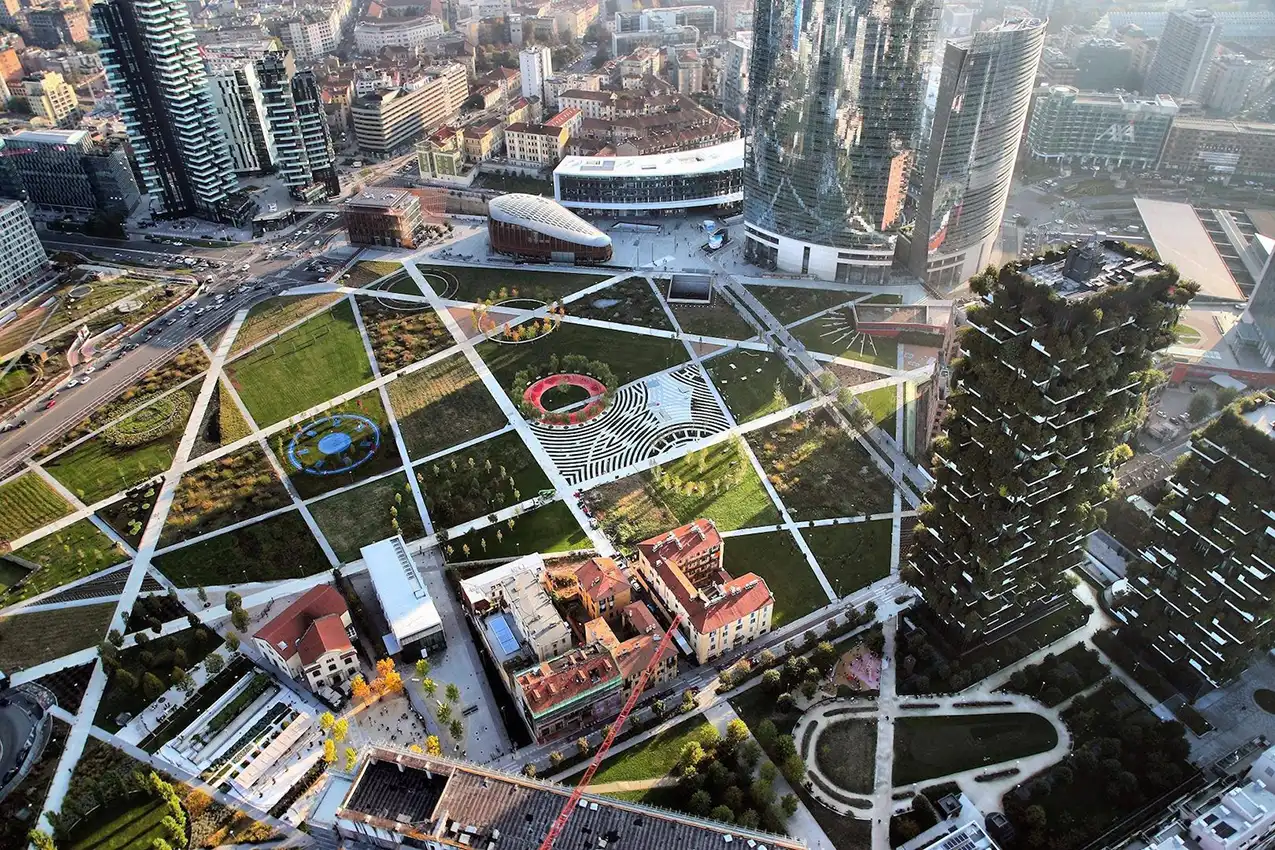
On a sweltering July afternoon in Milan’s Porta Nuova district, the leaves of two hundred oaks, beeches, and maples rustle high above the pavement. They belong to the Bosco Verticale (Vertical Forest), a pair of residential towers wrapped in a living exoskeleton of more than twenty thousand plants. At ground level, the thermal contrast is sharp. Stepping from the sun-baked granite of Piazza Gae Aulenti into the immediate shade of these towers feels like crossing an invisible microclimatic border. For structural architects and design magazines, this is the ultimate poster child for twenty-first-century biophilic urbanism.
Yet if you travel four kilometres southwest to the peripheral neighborhood of Giambellino, the language of the forest thins out completely. Here, the landscape belongs to post-war social housing blocks, unshaded sidewalks, and wide corridors of unyielding tarmac. During southern Europe’s intensifying heatwaves, the temperature premium in these peripheral zones runs several degrees higher than in the gentrified center. The contrast reveals the core tension animating Milan’s environmental journey. The city has mastered the iconography of the green transition, yet it remains structurally pinned inside one of the most challenged ecological landscapes on the continent. What Milan faces is not a lack of imagination, but the hard physics of its geography and the uneven geometry of its social space.
The City Before the Turn: The Po Valley Trap
To understand Milan’s ecological predicament, one must look at the geography of the Pianura Padana—the Po Valley. Nestled in a giant basin hemmed in by the Alps to the north and the Apennines to the south, the region suffers from a permanent atmospheric handicap. Wind speeds are among the lowest in Europe, creating a chronic inversion layer that traps winter smog and holds summer heat close to the ground. For centuries, this geography was an economic blessing, rich in alluvial soils and sheltered from northern gales, which powered Milan’s rise as an industrial powerhouse.
During the mid-twentieth-century economic boom, Milan grew outwards in dense, concentric rings of concrete and asphalt. The city’s planners built for the automobile, culverting old historic canals (navigli) and transforming medieval arteries into multi-lane thoroughfares. By the turn of the millennium, Milan had become a highly sealed, hyper-dense metropolis with one of the highest car-ownership rates in Europe and an urban heat island effect that grew more punishing with every summer season. The true cost of this developmental model is respiratory. ARPA Lombardia, the regional environmental protection agency, has documented decades of systemic breaches of European air quality standards for particulate matter (PM10 and PM2.5) and nitrogen dioxide (NO2). Milan’s air is a complex, toxic cocktail generated not only by city tailpipes and domestic gas boilers but also by heavy industrial clusters and intensive livestock farming across the wider Lombardy plain. It is a pollution problem that does not respect municipal borders, making the city a victim of an entire region’s metabolism.
Figure 1: The Anatomy of the Po Valley Trap
The Alpine barrier creates a systemic atmospheric trap, deflecting cleansing wind systems over the basin and locking particulate matter down at ground level.
The Pressures: Heatwaves and Hard Infrastructure
The climate emergency has accelerated these long-standing vulnerabilities into an acute public health crisis. Climate projections show that Milan is warming at a rate significantly faster than the global average. The number of tropical nights—where temperatures refuse to drop below 20°C—has risen sharply, depriving the human body of nocturnal cooling and stretching hospital capacity during summer peaks.
This heat interacts brutally with the city’s built environment. Densely packed historic brickwork and modern concrete facades act as giant thermal batteries, storing solar radiation during the day and radiating it back into the streets long after dusk. For the elderly, children, and families living in poorly insulated apartments without air conditioning, the urban heat island is not an abstract statistical metric. It is an ambient threat to cardiovascular stability and cognitive health. At the same time, the financial and regulatory pressures on the city administration have shifted. The European Union’s tightened air quality directives and carbon-neutrality targets mean that municipal governments can no longer rely on incremental adjustments. Milan has been forced to rethink its hard infrastructure, testing whether a dense historic core can be fundamentally re-engineered to breathe under the weight of a changing climate.
Figure 2: The Thermal Divide — Center vs. Periphery
The stark microclimatic divergence between highly managed vertical architectures and unshaded, asphalt-heavy peripheral neighborhoods during seasonal peaks.
What the City Is Doing: The Forest and the Plaza
Milan’s policy response is anchored in a twin strategy: massive urban forestry and rapid, low-cost tactical urbanism[cite: 10]. The headline intervention is Forestami, an urban forestry project launched in partnership with the Politecnico di Milano and overseen by architect Stefano Boeri[cite: 10]. The initiative aims to plant three million new trees across the Metropolitan City of Milan by 2030[cite: 10]. Rather than confining trees to traditional parks, Forestami focuses on inserting canopy cover into infrastructure margins: disused railway yards, school grounds, industrial buffer zones, and grey parking lots[cite: 10]. The project treats trees as active municipal infrastructure designed to intercept stormwater, filter fine particulates, and lower local surface temperatures through evapotranspiration.
Concurrently, the city has deployed its Piazze Aperte (Open Plazas) program to reclaim street space from the car. Utilizing the principles of tactical urbanism—cheap paint, planters, benches, and rapid layout adjustments—the municipality has transformed dozens of asphalt intersections into vibrant pedestrian plazas. By late 2025, the program had altered thousands of square metres of public space across neighborhoods like NoLo, Isola, and Dergano. These quick interventions serve a dual purpose: they break up vehicular priority while providing immediate, localized relief from the sensory overload and heat retention of the car-dominated street. Supporting these spatial changes are regulatory tools. The city’s Area C congestion charge and the broader Area B low-emission zone place strict environmental filters on vehicles entering the metropolitan core. Furthermore, Milan’s Air and Climate Plan (Piano Aria e Clima) mandates the phased elimination of diesel heating systems in private buildings and establishes strict energy-efficiency baselines for all new renovations.
What Is Working—and for Whom
The evidence of improvement is real, but it is highly localized. The Piazze Aperte program has achieved a remarkable cultural shift in neighborhood dynamics. In squares like Piazzale Loreto and up through the northern districts, reclaimed asphalt has successfully fostered community interaction, reduced local traffic speeds, and given families safe spaces to sit outdoors without the commercial obligation of buying a coffee. In terms of green infrastructure, the expansion of regional metropolitan parks—such as Parco Nord and Parco Agricolo Sud—has created vital ecological anchors. Systematic monitoring by the Forestami scientific committee suggests that where new woodland patches have matured, local soil moisture retention has improved and ambient summer temperatures have dropped measurably compared to unplanted reference sites. The integration of academic data from the Politecnico di Milano into municipal planning ensures that sapling selection is tailored to survive changing rainfall patterns. Furthermore, the city’s investments in public transit electrification are yielding results. ATM, Milan’s transport authority, has committed to running an entirely zero-emission bus fleet by 2030, with hundreds of electric buses already operating out of upgraded, energy-efficient depots. This transition has materially lowered tailpipe emissions along dense urban transit routes, delivering immediate public health benefits to commuters and roadside residents alike.
Contradictions, Failures, and Greenwashing Risks
Yet, Milan’s celebrated green image is frequently undermined by systemic execution failures and acute spatial inequities. The Bosco Verticale, while an engineering marvel, highlights the risks of environmental policy hardening into an exclusive amenity for the wealthy. The towers require heavy, energy-intensive concrete cantilevers to support the deep soil beds, and their ongoing maintenance—undertaken by flying arborists—demands substantial private funding. It is an architecture that scales elegantly on Instagram but cannot be easily replicated for ordinary social housing without exploding municipal budgets.
Meanwhile, the Forestami initiative has suffered from severe management bottlenecks[cite: 10]. During the intense summer droughts of recent years, thousands of newly planted saplings died in fields across the metropolitan periphery due to inadequate watering infrastructure and poorly coordinated maintenance contracts[cite: 10]. Local environmental groups have criticized the administration for focusing too heavily on headline planting numbers while underfunding the long-term care required to ensure canopy survival[cite: 10]. A dead sapling absorbs no carbon and cools no street[cite: 10].
Figure 3: The Urban Forestry Lifecycle Bottleneck
Deconstructing the operational gap between initial tree-planting initiatives and the long-term regional maintenance ecosystems required to guarantee canopy survival[cite: 10].
Air pollution also remains stubbornly high. Despite the restrictions of Area C and Area B, Milan has frequently run into issues with microparticulate counts. The municipality’s policies can control inner-city traffic, but they cannot stop the drift of secondary ammonium nitrates generated by agricultural fertilizers in the surrounding Lombardy region. Without a coordinated, binding regional treaty that forces the entire Po Valley to decarbonize its farming and logistics networks, Milan’s urban greening efforts function as decorative patches on a broken regional ecosystem. Finally, the geography of environmental justice in Milan remains starkly divided. The greening of public spaces has historically followed the pathways of private capital and gentrification. While the central districts enjoy shaded promenades and sophisticated biophilic developments, industrial suburbs remain heavily asphalted and exposed to the worst of the urban heat island effect. The distribution of tree canopy continues to align with real estate values, leaving lower-income communities and migrant populations disproportionately vulnerable to thermal stress.
The Future Vision: Reconnecting the Yards
The next phase of Milan’s environmental adaptation centers on the monumental task of rewriting its industrial legacy. The Scali Milano project—the master plan to regenerate seven disused railway yards encircling the city—represents the most significant spatial transformation available to the metropolis over the coming decades. The plan proposes converting over one million square metres of former rail track into a continuous ecological filter of parks, wetlands, and active transit corridors.
By transforming these linear scars into green infrastructure, Milan aims to create a continuous “green river” capable of breaking up the urban heat island effect at a metropolitan scale. The vision is to link these regenerated nodes with the surrounding agricultural plain, providing migratory pathways for wildlife and continuous shaded paths for active commuters. Whether this vision materializes as a democratic environmental asset or collapses into another high-end real estate development depends on the city’s political will. The targets for 2030 and 2050 are clear: complete neutrality, a significant reduction in private automobile ownership, and a resilient canopy cover that protects every citizen regardless of income. But the timeline is short, and the climate is moving faster than the bureaucracy.
Figure 4: Scali Milano — Reconnecting the Yards
The projected schematic configuration of Milan’s seven legacy railway infrastructure hubs transforming into biophilic connectors linked straight into the outer agricultural valley plain.
Conclusion: The Leaf and the Asphalt
Milan is an indispensable study in modern urban sustainability because it illustrates the limits of architectural showpieces[cite: 10]. It proves that a city cannot design its way out of climate vulnerability by vertical landscaping alone. The green city is not an aesthetic triumph to be unveiled; it is an administrative, regional, and redistributive struggle that must be fought square metre by square metre beneath the surface of the street.
The Bosco Verticale will remain a beautiful, provocative statement about what is possible when architecture invites nature into the vertical plane. But Milan’s true environmental future will be decided in less glamorous terrain—in the design of municipal watering schedules for peripheral saplings, in the conversion of industrial rail yards into public wetlands, and in the political courage required to replace thousands of parking spaces with cooling shade trees[cite: 10]. Back in Porta Nuova, the wind drops, and the afternoon heat presses down on the surrounding blocks. The leaves of the vertical forest continue their quiet work, processing carbon and cooling their private terraces. But out on the hot asphalt of the outer rings, the rest of the city is waiting for the canopy to arrive.