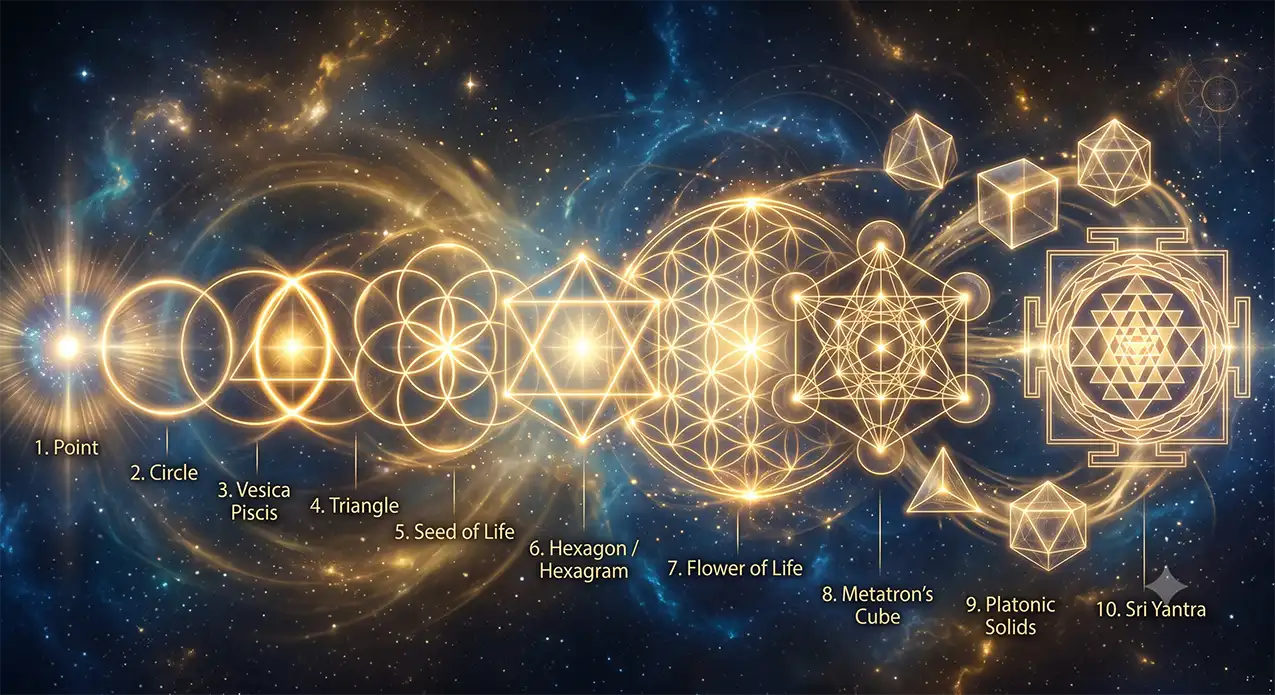

1. Point
Sacred geometry from the point to the amplituhedron: what the tradition actually claimed, what nature actually does, and what physics has lately found in the shape of things.
Set a compass point on a sheet of paper. Open the legs to any width, and turn. You now have a circle: every point on it exactly as far from the centre as every other. Move the point to the edge of that circle, keep the width, and turn again. The two circles cross at two places. Join those crossings to the two centres and you have made an equilateral triangle without measuring anything at all.
That sequence is the first proposition of Euclid’s Elements, written around 300 BCE and taught more or less continuously ever since.1 It is also, almost move for move, the opening of every text ever written on sacred geometry. The two traditions share an origin, a toolkit and a set of figures. They part company over what the figures mean.
For the geometer, the construction is a proof: a demonstration that certain relations hold necessarily, given the definitions. For the mystic, it is a revelation: a glimpse of the pattern by which unity becomes multiplicity, an architecture underlying the world rather than merely describing it. The same ink, radically different claims.
Modern sacred geometry — the term itself is a twentieth-century coinage, popularised in English largely through a small shelf of illustrated books published between 1969 and 19822 — presents a canonical sequence of ten or so forms, running from the dimensionless point to the intricacy of the Sri Yantra. That sequence is genuinely elegant. It is also, in places, historically invented, and its central metaphysical claim is untestable.
And yet. Over the past four decades, physicists and mathematicians have kept finding that deep structural questions about reality answer to geometry in ways that would have delighted Kepler and unsettled the positivists. Fivefold symmetry, long held impossible in crystals, was found in an aluminium alloy. The shape of space itself — whether it is finite, whether it loops back on itself — is a live observational programme. And a school of theoretical physics now computes quantum amplitudes, and the wavefunction of the universe, by reading off the volumes of abstract polytopes.
None of that vindicates the rosette. All of it makes the tradition’s underlying intuition — that form is not decoration but structure — considerably harder to dismiss. This investigation follows the ten forms through history, through nature, and into contemporary physics, and tries to be precise about what each pass can honestly support.
Part I: The Long Apprenticeship
Geometry began as a practical art and acquired its sanctity by stages. The unfurling took about three thousand years, and it did not happen in one place.
Measurement before mysticism
The earliest surviving mathematics is administrative. Egyptian and Babylonian scribal texts of the second millennium BCE deal in field areas, granary volumes, ramp slopes and the division of loaves. The Egyptian seked is a builder’s slope ratio, not a symbol. No pharaonic text sets out a doctrine of sacred geometry, and the confident modern claims about deliberately encoded proportions in the pyramids rest on measurements taken from eroded monuments and interpreted after the fact.
The Neolithic that wasn’t
One claim deserves separate treatment because it is repeated so often. Several hundred carved stone balls, most of them from north-east Scotland and dating from roughly 3200 to 2500 BCE, have been presented since the 1970s as evidence that Neolithic craftsmen modelled the five Platonic solids two millennia before Plato. A widely circulated photograph appears to show all five.
The claim does not hold. The overwhelming majority of the balls have six knobs; the distribution of knob counts is what you would expect from carving symmetrically on a sphere without any polyhedral theory; the celebrated photograph has been shown to be misdescribed; and no unambiguous icosahedral example has been produced — a point conceded, to his credit, by the writer who first advanced the idea.3 These are beautiful, deliberate, highly symmetrical objects made by people with excellent hands and eyes. That is a genuinely interesting fact about the Neolithic. It is not the same fact as knowing there are five regular solids and no more.
The clearest early case of geometry that really is religious comes not from Egypt but from India. The Śulbasūtras, ritual manuals compiled in the centuries around 800–500 BCE, give rules for laying out sacrificial altars: how to construct a square equal in area to a given circle, how to double an altar while preserving its shape, how to build the right angle that the rite requires.4 Here geometry is genuinely liturgical. Get the construction wrong and the sacrifice is void. It is also, notably, entirely constructive: no cosmic diagrams, just instructions.
The Greek turn
What the Greeks added was the idea that mathematical form is more real than the things that instantiate it. The Pythagoreans are the traditional source, though almost nothing survives from them directly and what we have is filtered through Aristotle and much later commentators; the tradition is far more securely attested than its content.
Plato is the pivot. In the Timaeus he assigns four of the five regular solids to the four elements — tetrahedron to fire, cube to earth, octahedron to air, icosahedron to water — and reserves the dodecahedron for the cosmos as a whole.5 It is a physical theory, wrong in every particular, and one of the most consequential ideas ever written down: that the properties of matter follow from the shapes of its parts.
Even the tradition’s favourite epigram is a little less ancient than it looks. “God always geometrises” is not in Plato; it is Plutarch, several centuries later, reporting what he takes to be a Platonic sentiment.6
Euclid then does something different again. Book XIII of the Elements ends by proving that there are exactly five regular solids and no more.7 That is not a mystical statement but it is a startling one: the list is closed, not by observation or authority, but by necessity. Whatever else the universe contains, it cannot contain a sixth Platonic solid.
Geometry is the only place in the tradition where a metaphysical claim can be checked. Plato was wrong about fire being a tetrahedron. Euclid was right that there are five solids. Two and a half thousand years later, both verdicts still stand.
Ornament, craft and cathedral
The overlapping-circle lattice that modern writers call the Flower of Life is genuinely old, though not as old as usually advertised. The earliest known example is an Assyrian threshold slab from the palace of Ashurbanipal at Nineveh, carved around 645 BCE.8 It is a floor decoration — which is not to say it carried no meaning, but the meaning is not recorded.
The often-cited examples at the Osireion at Abydos, offered as evidence that Egyptian priests knew the figure, do not survive scrutiny. The designs sit high on two granite pillars, at a height only reachable once the chamber had silted up, and they are accompanied by Greek and later Christian inscriptions. They are visitors’ graffiti, plausibly Ptolemaic and possibly as late as the fifth or sixth century CE, rather than pharaonic design.9 The pattern is ancient. That particular provenance is not.
Meanwhile the working traditions flourished. Vitruvius codified architectural proportion in the first century BCE, including the figure of a man inscribed in a circle and a square that Leonardo would later draw.10 From roughly 800 CE, craftsmen across the Islamic world developed geometric ornament of extraordinary sophistication, and by about 1200 they had reconceived star-and-polygon patterns as tilings of a small set of decorated equilateral polygons — the girih tiles — a modular method whose consequences we will come back to.11
European masons worked to comparable disciplines. The debates recorded at Milan Cathedral in 1391–92, where the chapter argued over whether to set out the section ad quadratum or ad triangulum, are the closest thing we have to a transcript of medieval design geometry in use.12 These men were not encoding secrets. They were using the compass because it was the only reliable way to transfer proportion from a drawing to a building site.
The Renaissance, and a beautiful failure
Luca Pacioli’s De divina proportione of 1509, illustrated by Leonardo, gave the ratio of extreme and mean its enduring theological branding.13 A century later Johannes Kepler built an entire cosmology on nested Platonic solids, publishing it in 1596 as the Mysterium Cosmographicum: six planets, five solids, one divine geometer.14
The model is wrong. Kepler found out, and it is to his lasting credit that he followed the data instead. But the same instinct produced his 1611 essay on the six-cornered snowflake, which asks why snow crystals are hexagonal, considers packing as an answer, and effectively founds the study of natural pattern formation.15 Sacred geometry, applied honestly, turned into science.
Kepler is the tradition’s best argument and its sharpest warning. The conviction that the cosmos is geometrical drove him to the laws of planetary motion. It also cost him twenty years on a model of nested solids that was never going to work. The conviction is productive. It is not evidence.
The modern synthesis
The canon most people now encounter is barely a century old. Theosophy in the late nineteenth century reintroduced geometric diagrams as objects of clairvoyant investigation. The Alsatian esotericist R. A. Schwaller de Lubicz spent fifteen years at Luxor and published Le Temple de l’Homme in 1957, arguing that the temple encoded a complete science of proportion — an influential book whose methods most Egyptologists reject.16
Then came the codifiers. Keith Critchlow’s Order in Space and John Michell’s The View Over Atlantis, both 1969, and Robert Lawlor’s Sacred Geometry of 1982 assembled the sequence, the vocabulary and the visual language now taken as traditional.17 The terms “Seed of Life”, “Flower of Life” and “Metatron’s Cube” as names for specific figures reached a mass audience later still, largely through Drunvalo Melchizedek’s The Ancient Secret of the Flower of Life in 1999.18
This matters, and not as a debunking. A tradition can be recent and still valuable. But a recent tradition that presents itself as immemorial has made a factual claim, and factual claims can be checked.
An unfurling awareness
A chronology distinguishing documented practice from later interpretation. Dates for the earlier entries carry the uncertainty normal to the period.
- c. 1850 BCEPractical geometry. Egyptian and Babylonian problem texts handle areas, volumes and slopes. Geometry as land measure and building trade.
- c. 800–500 BCEŚulbasūtras. Indian ritual manuals give altar constructions, including the right-triangle relation. Geometry as liturgy.
- c. 645 BCENineveh threshold. Earliest known overlapping-circle rosette of the “Flower of Life” type, carved for Ashurbanipal’s palace.
- c. 360 BCEPlato’s Timaeus. The five regular solids assigned to the elements and the cosmos. Form as physics.
- c. 300 BCEEuclid’s Elements. Book I opens with two intersecting circles; Book XIII closes by proving the solids number exactly five.
- c. 25 BCEVitruvius. Proportion systematised for architects, including the human figure in circle and square.
- c. 1200 CEGirih tiles. Islamic designers reconceive star patterns as tilings of decorated polygons; by the fifteenth century, near-quasiperiodic patterns result.
- 1391–92Milan Cathedral. Documented argument over setting out the section ad quadratum or ad triangulum: craft geometry in the record.
- 1509Pacioli, De divina proportione. The golden section acquires its theological reputation, with Leonardo’s illustrations.
- 1596 & 1611Kepler. A cosmos of nested solids, then an enquiry into why snowflakes have six corners. One wrong, one foundational.
- 1917D’Arcy Thompson, On Growth and Form. Natural pattern explained by physical constraint rather than design.
- 1957Schwaller de Lubicz. Luxor read as an encoded science of proportion. Influential; methodologically contested.
- 1969–1982The canon assembled. Critchlow, Michell and Lawlor establish the modern sequence, vocabulary and illustrations.
- 1984Quasicrystals. Fivefold symmetry, long held impossible in solids, is observed in an aluminium–manganese alloy.
- 1999Mass popularisation. “Flower of Life” and “Metatron’s Cube” enter general circulation as names for specific figures.
- 2003–2024The shape of space. A dodecahedral cosmic topology is proposed, then constrained; systematic searches for the topology of the universe continue.
- 2013–2026Positive geometry. Amplitudes and the cosmological wavefunction computed from the geometry of polytopes.
Gold — documented practice or established result. Indigo — modern interpretive tradition.
Part II: The Ten Forms
What follows is the canonical sequence, taken on its own terms and then tested. Each form gets three questions: how is it made, what has it been taken to mean, and what is mathematically true of it?
The generative cascade
Eight stages, each drawn with nothing but a compass and a straight edge, and each following necessarily from the one before. Every figure here is computed rather than sketched: the circles are the same radius throughout, and the lattice points fall where the construction puts them.
Stages 1–8. Note that no stage requires measurement. The hexagonal symmetry in stages 5 to 8 is not chosen; it is forced by the fact that the radius, used as a chord, divides its own circle into exactly six parts.
1. The point, or monad
Euclid’s first definition states that a point is that which has no part.1 It has position and nothing else: no extent, no direction, no interior. In the esoteric reading it is the unmanifest, the source, undifferentiated potential — a thing that is nothing and from which everything comes.
Mathematically the point is a genuine oddity, and modern mathematics has not entirely settled its status. Dimension zero is a strange place: a point has no length, yet lengths are made of them. There are respectable formulations of geometry and topology in which regions, not points, are the primitive objects, and points are reconstructed afterwards as limits. The tradition’s instinct that the point is paradoxical rather than trivial is, for once, well founded.
2. The circle
A point moved at constant distance in every direction. Every culture that has drawn has drawn it; it symbolises wholeness, eternity, cycle and return with such consistency that the symbolism looks less like a convention than a reflex.
Two mathematical facts about the circle deserve to be better known in this context. First, it is the solution to a genuine optimisation problem: of all closed curves of a given perimeter, the circle encloses the greatest area. That is why bubbles, cells and droplets are round — not because roundness is exalted, but because surface tension minimises boundary. Second, the circle defeated the compass. Squaring the circle with straight edge and compass was proved impossible in 1882, when Lindemann showed that π is transcendental.19 The most perfect figure in the tradition cannot be reconciled with the square by the tradition’s own instruments.
3. The vesica piscis
Two circles of equal radius, each passing through the other’s centre. The lens where they overlap has a width-to-height ratio of exactly 1 to √3, and the traditional readings are consistent across cultures: the meeting of two makes a third; spirit and matter; the threshold, the gate, the womb. In Christian art the shape becomes the mandorla that frames Christ in majesty.
It is worth pausing on what happens here mathematically, because it is the most important structural fact in the whole sequence. From two circles you get, for free and without measurement: the equilateral triangle, the perpendicular bisector, the hexagon, √3, and the entire triangular lattice. The vesica is not a symbol of generativity. It is generative, in the strict sense that almost everything else in the canon can be constructed from it.
4. The equilateral triangle
The first shape that can enclose an area. Three points, three lines, absolute rigidity: it is the only polygon that cannot be deformed without changing the length of a side, which is why it dominates structural engineering. In symbolic terms it carries the triads — Trinity, Trimurti, the three gunas, thesis and antithesis resolved.
And here is the coincidence the tradition never quite gets credit for noticing: constructing an equilateral triangle from two intersecting circles is not a mystical procedure. It is Proposition 1 of Book I of the Elements.1 The most rigorous text in the Western canon and the most exuberant esoteric tradition begin with the same drawing.
5. The seed of life
Seven circles: one centre and six around it, each of the same radius, each passing through the centre of its neighbours. The usual gloss is the seven days of creation, or seven stages of emergence.
That gloss is modern. The six-petalled rosette this figure produces, however, is genuinely ancient and almost universally distributed — Assyrian, Roman, Byzantine, Jewish, Islamic, Celtic, Ethiopian. The reason is embarrassingly simple. A circle’s radius, stepped around it as a chord, divides the circumference into exactly six equal parts — so six is what you get when you walk the compass round a circle without adjusting it. The rosette recurs across unconnected cultures not because of shared doctrine or lost contact, but because anyone who plays with a compass finds it within about a minute.
6. The hexagon and the hexagram
Join the six outer centres and a regular hexagon appears; take alternate vertices and two interpenetrating triangles give the hexagram. Symbolically, the hexagram is one of the most widely distributed figures in the world: the śaṭkoṇa of Hindu tantra, where downward and upward triangles are Shakti and Shiva; the Seal of Solomon in Islamic and Jewish talismanic use; and, only from around the seventeenth century and decisively in the nineteenth, the Star of David as a specifically Jewish emblem. Before that it was a general-purpose ornament.
The hexagon is where sacred geometry’s claims about nature come closest to being simply correct, and we will return to it in Part III.
7. The flower of life
Continue the lattice outward and the pattern usually shown as the Flower of Life appears: nineteen complete circles on a triangular lattice, conventionally bounded by two concentric rings. It is beautiful, it tiles indefinitely, and the modern claim made for it — that it is the blueprint of creation, found in sacred sites worldwide — is a mixture of the true and the invented.
True: the pattern occurs very widely, from Nineveh onward, and appears in Egypt, the Levant, Anatolia, Spain, China and Japan. Invented: the name, the numbering, the association with the seven days, and most of the specific archaeological provenances offered as proof. What the lattice really is, mathematically, is the densest packing arrangement of equal circles in the plane — the same arrangement oranges fall into, at a density of π/√12, or about 90.7 per cent. It is the blueprint of nothing. It is the answer to a packing problem.
8. Metatron’s cube
Take thirteen circle centres from the lattice — one central, six at one radius, six further out — and connect every centre to every other. Thirteen points yield seventy-eight lines, and within the resulting web one can pick out flat projections of a cube, an octahedron and a star tetrahedron.
Two corrections are needed. First, the figure does not contain projections of all five Platonic solids in any strict sense: the vertices of the icosahedron and dodecahedron do not land on the thirteen centres, so those readings require choosing lines that were not put there by the construction. Second, the name. Metatron is a real and important figure in Jewish mystical literature, the transformed Enoch of the Hekhalot texts and of 3 Enoch, studied seriously by historians of religion.20 But no known pre-modern Jewish source depicts or names this diagram. The pairing of the angel with the figure appears to be a twentieth-century development.
This is the clearest case in the canon of a modern invention presented as ancient wisdom, and it is worth being blunt about, because the figure is genuinely handsome and does not need the false pedigree.
9. The Platonic solids
Five, and only five, convex solids can be built from identical regular faces meeting identically at every vertex. Euclid proved the list closed; Plato assigned them to the elements; Kepler tried to make planets out of them.
What is remarkable is how often they do turn up, and how often the near-misses matter. Salt really does crystallise in cubes and fluorite in octahedra. Pyrite forms handsome twelve-faced crystals that are not regular dodecahedra but pyritohedra, with pentagonal faces of unequal edges — a distinction that matters, because true fivefold symmetry is forbidden in periodic crystals. Radiolarian skeletons approximate icosahedral shells. Most viruses build icosahedral capsids, for reasons worked out in 1962: an icosahedron is the most economical way to enclose volume with many copies of a single protein.21 And the carbon molecule C60, discovered in 1985, is a truncated icosahedron — Archimedean rather than Platonic, which is precisely the point.22 Nature is constrained by the same geometry, but it is not restricted to the tradition’s five favourites.
The five, and why there are only five
Wireframes computed from exact vertex coordinates and projected orthographically; near edges solid, far edges dashed. Plato’s elemental assignments are given alongside each solid’s dual.
The proof of closure is elementary. At least three faces must meet at each vertex, and their angles must sum to less than 360°. Equilateral triangles (60°) allow three, four or five; squares (90°) and regular pentagons (108°) allow three only; regular hexagons (120°) allow none, because three already make a flat plane. That exhausts the possibilities: five solids, no sixth.
10. The Sri Yantra
The most intricate figure in the canon, and the one with the best-documented religious function. Nine interlocking triangles — four oriented upward, five downward — generate a web of forty-three smaller triangles arranged around a central point, the bindu, enclosed by lotus rings of eight and sixteen petals and a triple-gated square precinct.
In the Śrīvidyā tradition of Hindu tantra it represents the totality of the cosmos and the union of Shiva and Shakti, and it functions as an instrument of practice: the meditator moves inward through the enclosures toward the bindu, or outward from it, in a structured sequence of visualisation.23 This is the one place in the sequence where the geometry is unambiguously operative in a living tradition rather than interpreted after the fact.
It also poses a real mathematical problem. For the figure to be correct, large numbers of triangle vertices must fall exactly on other lines and circles at once, and satisfying all those concurrences simultaneously is genuinely hard — hard enough that surviving historical yantras differ from one another, and that the construction has been the subject of published mathematical analysis.24 The diagram is not a doodle. It is an over-constrained problem that traditional draughtsmen solved approximately, by eye and by rule of thumb, for centuries.
The Sri Yantra, schematically
Nine interlocking triangles about the bindu, with the eight- and sixteen-petalled lotus rings and the gated bhūpura. Upward triangles in aqua, downward in rose.
A schematic approximation, and honestly labelled as one: here the eighteen base vertices are placed on the inner circle, which produces the right structure but not the exact concurrences of a canonical yantra. That the approximation is necessary is itself the point of the paragraph above.
Ten forms, three columns of evidence
For each form: how it is constructed, what the esoteric tradition reads in it, the earliest firm attestation of the figure or its name, and the mathematical or natural fact it actually corresponds to.
| Form | Construction | Traditional reading | Firm attestation | Mathematical / natural correlate |
|---|---|---|---|---|
| Point | Given | Unity, source, the unmanifest | Euclid, def. 1 (c. 300 BCE) | Dimension zero; primitive or derived, depending on the axioms |
| Circle | One compass turn | Wholeness, eternity, cycle | Universal, prehistoric | Isoperimetric optimum; π transcendental (1882) |
| Vesica piscis | Two circles through each other’s centres | Duality generating a third; the threshold | Figure ancient; the Latin name modern | Lens ratio 1:√3; generates the triangular lattice |
| Triangle | Join two centres to one intersection | Trinity, balance, fire | Euclid I.1 | Only rigid polygon; basis of trusses and tessellation |
| Seed of life | Seven circles, one radius | Seven stages or days of creation | Rosette c. 645 BCE; the name is 20th century | Six radii fit one circumference exactly |
| Hexagon / hexagram | Join the six outer centres | Harmony; union of opposites | Very wide and very old, in many traditions | Least-perimeter partition of the plane (proved 1999) |
| Flower of life | Extend the lattice; bound with a ring | Interconnection; blueprint of creation | Pattern from c. 645 BCE; name 20th century | Densest circle packing, density π/√12 ≈ 0.907 |
| Metatron’s cube | Connect 13 lattice centres: 78 lines | Order and the architecture of creation | No known pre-modern source for the figure or name | Complete graph K13; contains some, not all, solid projections |
| Platonic solids | Identical regular faces, identical vertices | The elements; the structure of the cosmos | Euclid XIII; some forms known earlier | Exactly five; capsids, crystals, fullerene near-relatives |
| Sri Yantra | Nine triangles, lotus rings, precinct | The cosmos entire; Shiva and Shakti united | Śrīvidyā textual and ritual tradition | Over-constrained construction; 43 triangles about a bindu |
Read the fourth column carefully. Several of the most famous names in sacred geometry are younger than the electric light, which does not make the figures less interesting, only differently interesting.
Part III: What Nature Actually Does
The strongest evidence offered for sacred geometry is the observation that its forms recur throughout the natural world. The observation is correct. The inference usually drawn from it is not.
Nature is full of hexagons, spirals, spheres, icosahedra and branching lattices. But these are not quotations from a template. They are what you get when a small number of physical constraints act on matter that is growing, cooling, packing or being pulled by surface tension. The forms recur because the problems recur. This was the great insight of D’Arcy Thompson’s On Growth and Form in 1917, and a century of work has confirmed it in detail.25
Hexagons: the least-perimeter answer
Why is a honeycomb hexagonal? Because if you must divide a plane into regions of equal area using the least possible total wall, hexagons win. Pappus of Alexandria asserted it in the fourth century; Kepler wondered about it in 1611; it was finally proved by Thomas Hales in 1999.26 Bees are not geometers. They are wax economists, and hexagonal cells cost the least wax per unit of storage.
The mechanism is more interesting still. Bees build cells that begin close to circular, and there is good evidence that the hexagonal geometry emerges partly through the flow and reorganisation of warm wax at the cell junctions — the bees supply the heat and the packing, and physics supplies the corners.27 The same least-perimeter logic gives soap froth its hexagonal tendency, and the same contraction geometry cracks cooling basalt into the columns at Fingal’s Cave and the Giant’s Causeway. Snowflakes are hexagonal for a different reason again: the molecular lattice of ice itself is hexagonal, so the crystal inherits the symmetry of its own bonding.
One form, at least four unrelated mechanisms. That is convergence, not transmission.
Spirals and the golden angle
The best case for the tradition, and also the most overstated. Many plants arrange successive leaves or seeds at an angular increment of about 137.5° — the circle divided in golden proportion. The result is that no two elements shadow each other and packing is efficient, and it produces the interlocking spiral families visible in a sunflower head or a pine cone, whose counts are usually consecutive Fibonacci numbers.
This is real, and there is a physical explanation. In 1992 Stéphane Douady and Yves Couder produced the pattern without any biology at all, dropping magnetised ferrofluid droplets into a dish with a radial field: the droplets, repelling one another and drifting outward, spontaneously arranged themselves at the golden angle.28 The angle is what you get when new elements appear at intervals in a repelling field — a dynamical outcome, not an instruction.
But now the correction. In 2016 a large citizen-science study counted spirals in 657 sunflowers. Of 768 reliable spiral counts, 565 were Fibonacci numbers and a further 67 showed Fibonacci structure of a defined type — leaving roughly one count in five that was something else entirely, including clearly ordered patterns that are not Fibonacci at all.29 The golden angle is a strong tendency of a noisy developmental process. It is not a law, and the popular claim that it governs the growth of all living things is simply false.
Shells, cells and the geometry of enclosure
Icosahedral symmetry dominates the world of the very small for a straightforward engineering reason: it is the most economical way to build a closed shell from many identical parts. Viral capsids exploit this, as Caspar and Klug explained in 1962, and the same principle governs the geodesic dome and the fullerenes.21
At a larger scale, when regions grow outward from scattered centres until they meet, the result is a nearest-neighbour partition: the Voronoi tessellation. It describes the pattern of cells in an epithelium, the polygons of dried mud, the patches on a giraffe, and — with some sophistication added — the arrangement of voids and filaments in the large-scale structure of the universe. It is one of the most scale-indifferent constructions in nature, and it is not on the canonical list of sacred forms at all.
Four mechanisms, not four symbols
Each panel is computed from the rule that generates it: hexagonal partition, the golden-angle spiral with its 21 and 34 parastichy families traced, an icosahedral shell, and a nearest-neighbour tessellation of jittered seed points.
The spiral panel places 340 points at successive increments of 137.5°, with the two visible spiral families highlighted. Nothing in the code knows about Fibonacci numbers; the counts of 21 and 34 emerge from the angle alone.
What the canon leaves out
The most telling criticism of the traditional sequence is not that it is wrong but that it is incomplete, and incomplete in a revealing way. Every figure in it is Euclidean: straight lines, circles, whole-number symmetries, forms that can be drawn exactly with two instruments. That is a description of what a compass can do, not of what nature does.
Consider what is missing. Fractal geometry — structures that repeat at every scale, quantified only from the 1970s onward — describes coastlines, river networks, fern fronds, the branching of bronchi and blood vessels, and the florets of a Romanesco far better than any circle lattice.30 A lung has a fractal dimension, not a Platonic one. Minimal surfaces, the shapes soap films adopt to minimise area across a boundary, generate forms of great beauty that no compass will produce, and they turn up in insect cuticles, in butterfly-wing nanostructure and in block copolymers. Topology — the study of what survives deformation — asks the question about the shape of space that Part V returns to, and it does not care about proportion at all. Aperiodic order, as we shall see, was not merely absent from the canon but formally excluded by the mathematics available.
So the canon is best understood as a historical artefact: the set of forms that were reachable with the tools available to draughtsmen before analysis, computation and the twentieth century. That is no small set, and everything in it is real. But treating it as the complete inventory of nature’s forms mistakes the limits of an instrument for the limits of the world.
Nature is not copying a diagram. It is solving the same short list of problems over and over, with the same physics, and arriving at the same answers. The forms in the canon are not a blueprint. They are a list of good solutions.
Part IV: The Sceptic’s Ledger
An honest account has to set out the case against, and it is stronger than enthusiasts usually admit.
The golden ratio has been oversold
The number φ ≈ 1.618 is a legitimate and interesting mathematical object. The claims made for its presence in art and architecture are, in the great majority of cases, unsupported. George Markowsky catalogued the misconceptions in 1992: the Parthenon does not fit a golden rectangle without choosing convenient edges, the Great Pyramid ratio depends on which dimensions you select, and the nautilus shell — the single most reproduced example — is a logarithmic spiral whose growth ratio is nowhere near φ.31 Mario Livio’s book-length treatment reached the same conclusion a decade later, and also traced the popular claim about Leonardo’s use of the ratio to an attribution made long after his death.32
Even the psychological claim is shaky. Fechner’s nineteenth-century experiments suggesting a preference for golden rectangles have had a chequered replication history, with results sensitive to how the choice is presented.
The method has too many degrees of freedom
This is the deeper objection. Overlay a rich diagram on a complex object and you have an enormous number of free choices: which features to treat as significant, where exactly to place the lines, what tolerance to accept, which units to use. With enough freedom, a match is guaranteed. The procedure cannot fail, which is precisely why a success carries no information.
Human perception makes this worse. We are superb symmetry detectors — it is one of the oldest jobs the visual cortex has, since symmetry in a cluttered scene usually means an animal — and we are correspondingly prone to seeing structure in noise. The pleasure of recognising a pattern is not evidence that the pattern is there.
The remedy is not to abandon the question but to ask it properly, and this is entirely possible. State in advance which dimensions will be measured and why. Fix the tolerance before looking. Compare the result against a null hypothesis — the proportions of a large sample of buildings, paintings or shells chosen without regard to the theory — and see whether the claimed ratio appears more often than chance would supply. Publish the cases that fail alongside those that succeed. Almost none of the popular literature does any of this, which is why almost none of it can be assessed. Where the discipline has been applied, as in the analysis of Islamic tiling geometry, the results have been spectacular and durable.
The central claim makes no predictions
“The Flower of Life is the blueprint of creation” is not a false statement. It is worse than false: it is a statement with no consequences. Nothing could be observed that would count against it. Compare Plato, who said fire is made of tetrahedra — a claim so specific that it could be, and was, refuted. Plato was doing physics badly. Much modern sacred geometry is not doing physics at all, while borrowing its prestige.
Three kinds of claim, three different verdicts
Most arguments about sacred geometry are confused because these are treated as one claim. Separated, they receive very different assessments — and two of the three come out well.
The descriptive claim
Certain forms recur across nature, art and mathematics, and are worth studying as a family.
Demonstrably true, and more interesting than the tradition realises: the recurrence has explanations, and the explanations are beautiful.
The contemplative claim
Constructing and attending to these figures orders attention, rewards patience and carries meaning for practitioners.
Not a scientific claim and does not need to be. The yantra tradition has used geometry this way, deliberately and effectively, for centuries.
The tradition’s error is not enthusiasm but conflation: it argues for the third claim using evidence that only establishes the first.
Part V: The Physicist’s Surprise
Having conceded all that, we come to the genuinely strange part. Over the last forty years, the deepest layers of physics have turned out to be more geometrical, not less — and in ways nobody anticipated.
Symmetry became the organising principle
The single most important structural fact about modern physics is that its laws are statements about symmetry. Emmy Noether proved in 1918 that every continuous symmetry of a physical system corresponds to a conserved quantity: the invariance of the laws under shifts in time is the conservation of energy.33 Conservation laws are not additional facts about the world. They are shadows of its symmetries.
The Standard Model of particle physics is specified, essentially, by naming a group of symmetries. Particles are classified by how they transform under those groups, and the resulting weight diagrams are literally geometrical figures — triangles, hexagons and lattices — that predicted particles before they were found. Plato’s ambition, that the properties of matter should follow from the properties of form, was fulfilled. Just not with the tetrahedron.
Forbidden symmetry turned out to be permitted
Classical crystallography proved that a periodic arrangement of atoms can have two-, three-, four- or six-fold rotational symmetry, and nothing else. Fivefold symmetry was impossible, in the same way a sixth Platonic solid is impossible.
In 1982 Dan Shechtman found a diffraction pattern with tenfold symmetry in an aluminium–manganese alloy. He was disbelieved for years; the paper appeared in 1984 and the Nobel Prize followed in 2011.34 The resolution was that the material was ordered without being periodic — a quasicrystal, structurally related to the aperiodic tilings Roger Penrose had constructed for entirely recreational reasons in 1974.35
Then the historical sting. In 2007 Peter Lu and Paul Steinhardt showed that Islamic designers, using their girih tiles and self-similar subdivision, had produced very nearly perfect quasiperiodic patterns by the fifteenth century — five hundred years before the mathematics existed in the West.11 That is the strongest historical vindication sacred geometry can point to, and it is worth being precise about what it vindicates: not secret cosmic knowledge, but the fact that sustained, disciplined play with pattern can reach mathematical territory before formal theory gets there.
The point was made again in 2023, when the long-sought “einstein” tile — a single shape that tiles the plane but never periodically — was found by David Smith, a retired printing technician and self-described shape hobbyist, working with paper and scissors. The proof came from three mathematicians he contacted afterwards. The tile is built from kites cut out of a hexagonal grid: the tradition’s favourite lattice, yielding a shape that never repeats.36
Higher-dimensional packing, and the shape of space
Sphere packing is the honest descendant of the Flower of Life, and it turns unexpectedly deep in higher dimensions. In 2016 Maryna Viazovska proved the optimal packing in eight dimensions, using a remarkable object called the E8 lattice; the proof, and its extension to twenty-four dimensions, was among the work recognised by her Fields Medal.37 Dimensions eight and twenty-four are special, for reasons still not fully understood, and E8 also appears in string theory and in the algebra of exceptional symmetries. This is as close to a genuine numerological mystery as mathematics gets, and it is entirely rigorous.
Meanwhile a question the tradition would recognise is under active observational investigation: what shape is space? General relativity fixes the local curvature but says nothing about global topology. Space could be infinite, or it could be finite and multiply connected, so that travelling far enough in one direction returns you to where you began.
In 2003 a group led by Jean-Pierre Luminet proposed that anomalies in the cosmic microwave background could be explained if the universe were a Poincaré dodecahedral space — a finite cosmos built from a dodecahedron with its opposite faces glued together.38 A literal dodecahedral universe, in a leading journal, twenty-four centuries after the Timaeus. Subsequent searches for the matched circles such a topology would print on the microwave sky did not find them, and the specific model is not favoured. But the general programme is very much alive: the COMPACT collaboration reported in 2024 that existing constraints leave a large space of possible topologies untested, and that detectable signatures may exist even without matched circles.39 A 2026 review sets out how forthcoming microwave-background polarisation data could extend the search.40
Note what is and is not being claimed. Nobody has found a sacred figure written on the sky. What is true is that the question “is the cosmos a finite solid with identified faces?” is not a mystical question. It is an empirical one, currently unresolved.
Positive geometry: the polytope beneath the particles
The most startling development is the most technical, and it deserves careful handling.
Calculating what happens when particles collide is, in the traditional method, monstrously laborious: thousands of Feynman diagrams whose vast intermediate expressions collapse into short answers. That collapse suggested something was being computed the hard way. In 2013 Nima Arkani-Hamed and Jaroslav Trnka proposed that certain scattering amplitudes are encoded in the volume of a single geometric object in an abstract kinematic space, which they named the amplituhedron.41 The answer is a property of a shape.
What makes this more than a computational trick is where locality and unitarity come from. In the usual formulation they are assumed. In the geometrical formulation they appear as consequences of the shape’s boundary structure — which raises the possibility that spacetime and quantum mechanics are not fundamental, but are features of something more primitive that happens to be geometrical.
The programme has since been extended to cosmology. Cosmological polytopes, introduced in 2017, encode the wavefunction of the universe for expanding spacetimes.42 In 2024 the same school described “cosmohedra”, polytopes obtained by systematically blowing up the faces of the associahedron, whose geometry yields the cosmological wavefunction directly; the paper appeared in the Journal of High Energy Physics in 2025, and a substantial follow-up on their combinatorics appeared in early 2026.43
Three cautions, stated plainly. These polytopes live in abstract spaces of kinematic data, not in the physical space of the room you are sitting in. The programme is a research direction, not settled physics, and it currently applies to simplified model theories rather than to the real world in full. And it is the opposite of mystical: the work is severe combinatorics, and its practitioners would be dismayed to be enlisted here.
With those caveats: the leading edge of theoretical physics is, right now, seriously entertaining the possibility that the deepest description of reality is the shape of a polytope. That is a remarkable sentence to be able to write.
Geometry that turned out to be physics
Four structures from the last four decades of research: the filamentary architecture of the cosmic web; the matched-circle signature a finite topology would leave on the microwave sky, with a two-dimensional analogue of edge identification; a Penrose tiling of the kind realised in quasicrystals; and the three-dimensional associahedron, the polytope from which cosmohedra are built.
The associahedron is computed here from Loday’s realisation and verified to have exactly 14 vertices, 21 edges and 9 faces — six pentagons and three squares. The Penrose patch is generated by four rounds of Robinson triangle subdivision, which is why it has tenfold symmetry about the centre and never repeats.
The unresolved question underneath
Galileo wrote in 1623 that the book of the universe is written in the language of mathematics, and that without that language one wanders in a dark labyrinth.44 In 1960 Eugene Wigner published an essay whose title has outlived its argument: “The Unreasonable Effectiveness of Mathematics in the Natural Sciences”.45 His point was that mathematics developed for its own reasons keeps turning out to describe the physical world with accuracy far beyond anything the original work could justify, and that nobody has a satisfying account of why.
Sixty-five years later, nobody does. That is the honest residue at the bottom of this subject: a real and unexplained fit between abstract form and physical reality. It is not the same as the claim that the world was drawn with a compass. But it is not nothing, and anyone who finds the tradition’s intuition merely silly has not sat with the problem for long.
Part VI: What It Is Good For
Strip away the false pedigrees and the unfalsifiable claims, and a good deal remains — arguably more than before, because what remains can be defended.
As a contemplative discipline. The Sri Yantra is not a diagram about meditation; it is an instrument for it, and it works by structuring attention over an extended sequence. Drawing a Flower of Life by hand takes perhaps twenty minutes of precise, repetitive, unhurried work in which nothing can be rushed and errors compound visibly. Whatever one believes about the cosmos, that is a real practice with real effects on the practitioner, and it needs no metaphysics to justify it.
As craft technique. Proportional systems set out by compass are how buildings were coordinated before dimensioned drawings and reliable arithmetic. The Milan debates, the Topkapı scroll and the girih tiles are records of working method, and the method still teaches something: constraint as a design tool rather than an obstacle.
As a way into mathematics. Euclid I.1 needs no equipment and no prior knowledge, and it delivers, in about ninety seconds, the experience of something being necessarily true. Geometry remains the most hospitable frontier in mathematics for people without formal training — which is not a sentimental claim. It is why an amateur with paper and scissors solved the einstein problem in 2022.
As aesthetic vocabulary. These forms are used in contemporary design, tattooing, textiles and architecture because they are genuinely good forms: balanced, scalable, non-arbitrary, and pleasing across cultures. That is a sufficient reason. It does not require them to be cosmic.
There is also a decent working explanation for why these forms please us, and it is not mystical. Symmetrical, regular figures are unusually easy for the visual system to encode: fewer independent parameters, more redundancy, faster processing. The experience of effortless recognition is reliably experienced as pleasure, and rewarded — which is presumably why symmetry detection was worth evolving in the first place. On this account the appeal of a rosette is a fact about the observer rather than the cosmos. That is not a deflation. It means these figures are keys cut to a lock we already carry.
What should be dropped is the invented provenance. The figures do not need Atlantis, or a priesthood, or a suppressed archive. The true history — Assyrian floor slabs, Vedic altar builders, Isfahan tile-cutters, a Yorkshire hobbyist — is better than the invented one, because it is a story about what human beings can find with almost no equipment and a great deal of patience.
Coda: Two Circles and the Space Between
Return to the compass. Two circles, each through the other’s centre. The lens between them has been called a threshold, a gateway, a womb, the union of heaven and earth; and it is also, and without contradiction, the reason you can construct a perpendicular without a protractor.
Both readings are responses to the same surprising fact: that a very simple constraint, applied honestly, produces far more structure than was put in. That surplus is what the tradition experienced as revelation and what the mathematician experiences as proof. They are not the same experience. But they are provoked by the same thing.
The tradition’s error was to treat the surplus as a message — to assume that because the pattern was not arbitrary, it must have been addressed to us. The stricter disciplines have shown that no such assumption is needed. The forms are not communications. They are what necessity looks like when you draw it.
That is, in the end, a larger claim than the one it replaces. It says that the world is intelligible, that its intelligibility runs deeper than anyone had reason to expect, and that a person with a compass and enough patience can reach some part of it unaided. The hexagon in the honeycomb, the golden angle in the seed head, the icosahedron in the virus, the polytope beneath the particles: none of these was drawn for our benefit, and all of them can be understood.
The point at the centre of the first circle turns out to be the reader.
A note on sources and method. Where this article distinguishes attested practice from later interpretation, the distinction rests on the earliest datable appearance of a figure or its name, and readers should treat the earlier dates as approximate in the way all such dates are. The Nineveh attribution follows Malcolm Stewart’s identification; the late dating of the Abydos designs follows field reports of the associated Greek and Christian epigraphy, and would be strengthened by a full published study of the inscriptions. Claims about the absence of pre-modern sources — particularly for the name “Metatron’s Cube” — are claims about what is currently attested, not proofs of non-existence. The physics in Part V is reported from the primary literature; the positive-geometry programme in particular is an active research direction whose scope is at present limited to model theories, and it is described here as such. Any mathematical statement in this piece can be checked with a compass, a straight edge, or a short computation, and readers are warmly encouraged to do so.
Notes
- Euclid, Elements, Book I, definition 1 and proposition 1. See Thomas L. Heath, trans., The Thirteen Books of Euclid’s Elements, 2nd ed. (New York: Dover, 1956). ↩
- Robert Lawlor, Sacred Geometry: Philosophy and Practice (London: Thames & Hudson, 1982). ↩
- David R. Lloyd, “How Old Are the Platonic Solids?” BSHM Bulletin: Journal of the British Society for the History of Mathematics 27, no. 3 (2012): 131–40. The claim it examines is advanced in Keith Critchlow, Time Stands Still (London: Gordon Fraser, 1979). ↩
- S. N. Sen and A. K. Bag, The Śulbasūtras of Baudhāyana, Āpastamba, Kātyāyana and Mānava (New Delhi: Indian National Science Academy, 1983). ↩
- Plato, Timaeus 53c–56c. ↩
- Plutarch, Quaestiones convivales 8.2, where the maxim ἀεὶ ὁ θεὸς γεωμετρεῖ is offered as Platonic in spirit rather than quoted from Plato. ↩
- Euclid, Elements XIII.18 and the remark following it, which establishes that no further regular solid can be constructed. ↩
- Malcolm Stewart, Patterns of Eternity: Sacred Geometry and the Starcut Diagram (Edinburgh: Floris Books, 2009). The carved threshold slabs from Ashurbanipal’s palace at Nineveh are held by the British Museum. ↩
- David Furlong, “The Osirion and the Flower of Life,” field report and photographic survey, recording the associated Greek lettering (Θεός Νεῖλος) and later Christian monogram on the same pillars, together with the height of the designs above the original floor level. ↩
- Vitruvius, De architectura III.1. ↩
- Peter J. Lu and Paul J. Steinhardt, “Decagonal and Quasi-crystalline Tilings in Medieval Islamic Architecture,” Science 315, no. 5815 (2007): 1106–10. ↩
- James S. Ackerman, “‘Ars Sine Scientia Nihil Est’: Gothic Theory of Architecture at the Cathedral of Milan,” Art Bulletin 31, no. 2 (1949): 84–111. ↩
- Luca Pacioli, De divina proportione (Venice: Paganino Paganini, 1509), with illustrations after Leonardo da Vinci. ↩
- Johannes Kepler, Mysterium Cosmographicum (Tübingen, 1596). ↩
- Johannes Kepler, Strena, seu de nive sexangula (Frankfurt, 1611). ↩
- R. A. Schwaller de Lubicz, Le Temple de l’Homme, 3 vols. (Paris: Caractères, 1957). ↩
- Keith Critchlow, Order in Space (London: Thames & Hudson, 1969); John Michell, The View Over Atlantis (London: Sago Press, 1969); and Lawlor, Sacred Geometry. ↩
- Drunvalo Melchizedek, The Ancient Secret of the Flower of Life, vol. 1 (Flagstaff, AZ: Light Technology, 1999). ↩
- Ferdinand Lindemann, “Über die Zahl π,” Mathematische Annalen 20 (1882): 213–25. ↩
- Andrei A. Orlov, The Enoch-Metatron Tradition (Tübingen: Mohr Siebeck, 2005). ↩
- D. L. D. Caspar and A. Klug, “Physical Principles in the Construction of Regular Viruses,” Cold Spring Harbor Symposia on Quantitative Biology 27 (1962): 1–24. ↩
- H. W. Kroto, J. R. Heath, S. C. O’Brien, R. F. Curl and R. E. Smalley, “C60: Buckminsterfullerene,” Nature 318 (1985): 162–63. ↩
- Madhu Khanna, Yantra: The Tantric Symbol of Cosmic Unity (London: Thames & Hudson, 1979). ↩
- A. P. Kulaichev, “Sriyantra and Its Mathematical Properties,” Indian Journal of History of Science 19, no. 3 (1984): 279–92. ↩
- D’Arcy Wentworth Thompson, On Growth and Form (Cambridge: Cambridge University Press, 1917). ↩
- Thomas C. Hales, “The Honeycomb Conjecture,” Discrete & Computational Geometry 25, no. 1 (2001): 1–22. The proof was completed and circulated in 1999. ↩
- B. L. Karihaloo, K. Zhang and J. Wang, “Honeybee combs: how the circular cells transform into rounded hexagons,” Journal of the Royal Society Interface 10, no. 86 (2013): 20130299. The relative contributions of building behaviour and wax flow remain under discussion. ↩
- Stéphane Douady and Yves Couder, “Phyllotaxis as a Physical Self-Organized Growth Process,” Physical Review Letters 68, no. 13 (1992): 2098–2101. ↩
- Jonathan Swinton, Erinma Ochu and the MSI Turing’s Sunflower Consortium, “Novel Fibonacci and non-Fibonacci structure in the sunflower: results of a citizen science experiment,” Royal Society Open Science 3, no. 5 (2016): 160091. ↩
- Benoit B. Mandelbrot, The Fractal Geometry of Nature (San Francisco: W. H. Freeman, 1982). ↩
- George Markowsky, “Misconceptions about the Golden Ratio,” College Mathematics Journal 23, no. 1 (1992): 2–19. ↩
- Mario Livio, The Golden Ratio: The Story of Phi, the World’s Most Astonishing Number (New York: Broadway Books, 2002). ↩
- Emmy Noether, “Invariante Variationsprobleme,” Nachrichten von der Gesellschaft der Wissenschaften zu Göttingen (1918): 235–57. ↩
- D. Shechtman, I. Blech, D. Gratias and J. W. Cahn, “Metallic Phase with Long-Range Orientational Order and No Translational Symmetry,” Physical Review Letters 53, no. 20 (1984): 1951–53. ↩
- Roger Penrose, “The Role of Aesthetics in Pure and Applied Mathematical Research,” Bulletin of the Institute of Mathematics and its Applications 10 (1974): 266–71. ↩
- David Smith, Joseph Samuel Myers, Craig S. Kaplan and Chaim Goodman-Strauss, “An Aperiodic Monotile,” Combinatorial Theory 4, no. 1 (2024); preprint arXiv:2303.10798, March 2023. A chiral version, the “spectre,” followed within months. ↩
- Maryna Viazovska, “The Sphere Packing Problem in Dimension 8,” Annals of Mathematics 185, no. 3 (2017): 991–1015. ↩
- Jean-Pierre Luminet, Jeffrey R. Weeks, Alain Riazuelo, Roland Lehoucq and Jean-Philippe Uzan, “Dodecahedral Space Topology as an Explanation for Weak Wide-Angle Temperature Correlations in the Cosmic Microwave Background,” Nature 425 (2003): 593–95. ↩
- Yashar Akrami et al. (COMPACT Collaboration), “Promise of Future Searches for Cosmic Topology,” Physical Review Letters 132, no. 17 (2024): 171501. ↩
- COMPACT Collaboration, “The Topology of the Universe,” arXiv:2606.24886, June 2026. ↩
- Nima Arkani-Hamed and Jaroslav Trnka, “The Amplituhedron,” Journal of High Energy Physics 2014, no. 10 (2014): 030; preprint arXiv:1312.2007, December 2013. ↩
- Nima Arkani-Hamed, Paolo Benincasa and Alexander Postnikov, “Cosmological Polytopes and the Wavefunction of the Universe,” arXiv:1709.02813, September 2017. ↩
- Nima Arkani-Hamed, Carolina Figueiredo and Francisco Vazão, “Cosmohedra,” Journal of High Energy Physics 2025, no. 11 (2025): 029; preprint arXiv:2412.19881, December 2024. On their combinatorics see arXiv:2603.03425, March 2026. ↩
- Galileo Galilei, Il Saggiatore (Rome, 1623), §6. ↩
- Eugene P. Wigner, “The Unreasonable Effectiveness of Mathematics in the Natural Sciences,” Communications in Pure and Applied Mathematics 13, no. 1 (1960): 1–14. ↩
Download a copy of the Compass and the Cosmos: Sacred Geometry