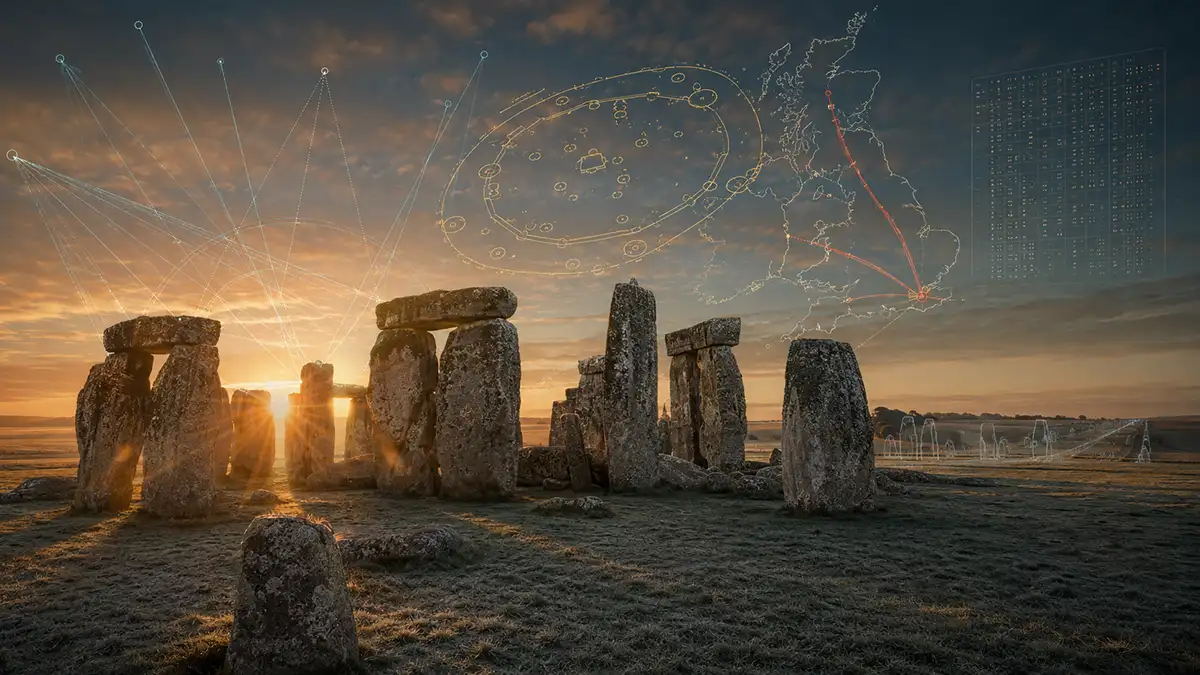

Editors note: I am visiting Stonehenge (again, again, again) late this year and wanted to refresh my mind as to the contested nature of debates surrounding this most enigmatic ancient site, and, playing advocatus diaboli, speculate regarding it’s purpose and future research possibilities. Outside of William Shakespeare, moon landing, JFK and UFO conspiracies, few topics seem to stir the blood more in academic and esoteric communities as much as Stonehenge! There is pdf copy for download if you are curious to read at leisure. Debate welcome and I will entertain publishing well-considered response, refutations, advancements of the essay’s argument, contact me here. Solstice blessings (ha ha gotch ya there!)- Kevin Parker – Site Publisher
Investigation · Archaeology & the History of Ideas
What five thousand years of stone, bone and data can — and cannot — tell us about what Stonehenge was for.
1The Computer
In August 1966, viewers of the BBC’s archaeology programme Chronicle watched an American astronomer make an extraordinary claim about the most famous ruin in Britain. Gerald Hawkins, chair of astronomy at Boston University, argued that Stonehenge was not a temple, or not only a temple. It was, he said, a machine — a Neolithic computer.1
Hawkins had come to the idea five years earlier, photographing the midsummer sunrise over the Heel Stone. Back in Massachusetts, he fed the surveyed positions of 165 stones, holes and other features into the Harvard–Smithsonian IBM 7090 and asked the machine to check every sightline between them against the rising and setting points of the sun, moon, planets and bright stars as they would have appeared around 1500 BCE.2 The computer reportedly did in under a minute what would have taken a human lifetime by hand.
The results, published in Nature in 1963 and expanded in the 1965 bestseller Stonehenge Decoded, seemed astonishing. Hawkins claimed thirteen precise solar and eleven lunar correlations, concentrated on the monument’s earliest features.3 The axis pointed at midsummer sunrise in one direction and midwinter sunset in the other. The Station Stone rectangle appeared to bracket the extreme rising and setting positions of the moon. And the fifty-six Aubrey Holes — a ring of chalk-cut pits just inside the bank — could, Hawkins proposed, have functioned as an eclipse predictor: move marker stones around the circle by set intervals each year, and dangerous eclipse seasons announce themselves, because fifty-six is close to three cycles of the 18.61-year lunar standstill period.4
It matters what “computer” meant in this argument. Hawkins was not claiming circuitry in the chalk. He meant an analogue calculating device: an arrangement of physical markers that stores astronomical constants in its geometry and yields predictions when operated by rule. The irony, much noted since, is that the theory itself was a product of early digital computation — a 1960s machine detecting a supposed Stone Age one. Fred Hoyle, the Cambridge cosmologist, lent the idea prestige by re-deriving an eclipse scheme of his own from the same fifty-six holes.5
Archaeologists were not persuaded. Richard Atkinson, who had excavated Stonehenge through the 1950s, denounced Stonehenge Decoded in print as “tendentious, arrogant, slipshod, and unconvincing,” and in a pointed Antiquity essay titled “Moonshine on Stonehenge” set out the case against: Hawkins had mixed features from construction phases separated by centuries, tolerated generous margins of error, and ignored the statistical certainty that any rich scatter of points will produce some alignments by chance.6 Jacquetta Hawkes distilled the deeper lesson in a single line that has shadowed the field ever since: “Every age has the Stonehenge it deserves — or desires.”7 The atomic age, she observed, had duly built itself a computer on Salisbury Plain.
Sixty years on, the BBC has returned to the story, and the anniversary retrospectives frame Hawkins as a cautionary tale.8 He is that. But the sharper question, and the one this investigation pursues, is whether Hawkins was wrong — or asking a defensible question in the wrong technological vocabulary. What if Stonehenge really did handle information, just not the kind an IBM 7090 was built to find?
2The Monument That Would Not Sit Still
Before asking what Stonehenge was for, it pays to insist on what it was — and the first fact is that it was never one thing. The monument visible today is a ruin of a late configuration, itself the product of roughly 1,500 years of building, dismantling and rearrangement. FACT
The sequence, anchored by radiocarbon dating and refined in the 2012 re-modelling of the excavation archive, runs approximately as follows.9 Around 3000 BCE, people dug a circular ditch and bank about 110 metres across, with the fifty-six Aubrey Holes ringing its inner edge. Cremated human remains went into and around those holes from the beginning. Whether the Aubrey Holes originally held timber posts or small bluestone pillars is genuinely disputed — a point with large consequences, as we shall see. CONTESTED
Around 2600–2500 BCE came the transformation: the great sarsen circle of thirty uprights capped by a continuous ring of lintels, enclosing the five-trilithon horseshoe, with the bluestones rearranged between them. The Heel Stone stood outside the entrance; the four Station Stones marked a rectangle on the perimeter. In the centuries that followed, the Avenue was constructed, linking the monument to the River Avon; the bluestones were reset at least twice more; and as late as roughly 2000–1600 BCE the so-called Y and Z holes were dug in two rings around the sarsens — and then, apparently, never filled with stones at all.10
Long before any of this, the place already had a history. Three massive pine posts were erected nearby in the eighth or seventh millennium BCE — Mesolithic monuments predating the enclosure by four thousand years — and the spring site at Blick Mead, a short walk away, saw repeated hunter-gatherer gatherings for millennia.11 FACT
Much has vanished. Perhaps 80 bluestones once stood on the site; 43 survive, many as buried stumps.12 Stones were removed, broken and reused in antiquity and after. The Stonehenge we photograph is one frame of a very long film, and mostly the final frame.
Continual reconstruction is itself evidence. Buildings get finished; institutions get renovated. A structure that successive generations altered for a millennium and a half — changing its stones, its entrances, its emphasis — behaves less like a completed artefact with a fixed function and more like an institution whose architecture tracked the changing society that maintained it. STRONG INFERENCE That reframing, unglamorous as it sounds, may be the single most important interpretative move available.
3Where the Stones Came From
If the chronology is the monument’s biography, the geology is its passport — and in the past six years the geology has become the most dynamic body of evidence in Stonehenge studies.
Start with the sarsens, the silcrete giants weighing up to about thirty tonnes. In 2020, David Nash and colleagues geochemically fingerprinted a core drilled from Stone 58 during 1958 repairs and returned to English Heritage six decades later. Fifty of the fifty-two surviving sarsens share a common chemistry consistent with West Woods, near Marlborough, about twenty-five kilometres north of the monument.13 STRONG INFERENCE Local, by megalithic standards — but a coherent choice: one source, one haul route, one campaign.
The bluestones are stranger. “Bluestone” is a catch-all for several lithologies — spotted and unspotted dolerite, rhyolite, volcanic tuffs and sandstones — most traced to the Mynydd Preseli district of west Wales, some 225 kilometres away.14 Petrographic and geochemical work by Richard Bevins, Rob Ixer and colleagues has matched specific stones and debitage to specific outcrops, and excavations at Craig Rhos-y-felin and Carn Goedog have been interpreted as Neolithic quarries, with recesses of extracted pillars, stone wedges and dated hearths.15 The quarry interpretation is well evidenced though not unanimous; the geological sourcing itself is about as secure as such science gets. STRONG INFERENCE / FACT
Two harder controversies attach to the bluestones. The first is Waun Mawn: in 2021 Mike Parker Pearson’s team proposed that a partly dismantled stone circle in the Preseli hills — comparable in diameter to Stonehenge’s ditch, with an empty socket whose imprint resembled an unusual Stonehenge bluestone — was a “proto-Stonehenge” whose stones were uprooted and carried east.16 Timothy Darvill countered that the Waun Mawn features read better as typical regional stone settings, and the excavators’ own 2021 season found the circle was never more than a third built, with no new link to Wiltshire; the stones sampled there do not match the identified Stonehenge sources.17 A Welsh source-circle cannot be excluded, but at present the evidence will not carry it. CONTESTED, leaning unproven
The second controversy — glacial transport — now looks close to settled. The long-argued claim that ice, not people, delivered the bluestones to Salisbury Plain rested heavily on the “Newall boulder,” a fragment excavated in 1924 and described as a glacial erratic. New mineralogical and geochemical analyses published in 2025 identify it as foliated rhyolite from Craig Rhos-y-felin, almost certainly broken from a monolith, with no diagnostic glacial features; there is no independent evidence of glaciation on Salisbury Plain, and the restricted range of bluestone rock types argues for human selection.18 A minority view persists, but the weight of evidence now favours human transport decisively. STRONG INFERENCE
Then there is the Altar Stone — and here the story turned in August 2024. The six-tonne recumbent sandstone at the monument’s heart had long been assumed Welsh. Anthony Clarke and colleagues dated and chemically fingerprinted detrital zircon, apatite and rutile grains from Altar Stone fragments, using uranium–lead and related methods, and found a signature matching not Wales but the Old Red Sandstone of the Orcadian Basin in northeast Scotland — at least 750 kilometres away.19 FACT, as to provenance class Follow-up work in late 2024 excluded Mainland Orkney specifically, narrowing the search to the Caithness–Moray coastlands and beyond; and a 2026 study combining provenance data with ice-sheet modelling found that glacial pathways from the best-matching source areas run the wrong way, leaving deliberate transport — most plausibly by sea — as the surviving explanation.20 STRONG INFERENCE
Pause on what that means. Adequate stone existed within sight of Salisbury Plain. Yet the builders hauled sarsens from Marlborough, bluestones from the far edge of Wales, and a single slab from the far end of the island. Every explanation of Stonehenge must now account for a monument whose materials were, in effect, curated from across Britain — and must take seriously the possibility that geographic origin was not a logistical inconvenience but the point. Distance, on this reading, was meaning. STRONG INFERENCE as to pattern; interpretation follows below
4Pulling Back the Camera
For most of its interpretative history, Stonehenge was studied as an object: a building on a lawn. The Stonehenge Riverside Project, which excavated across the wider landscape in the 2000s under Parker Pearson, Joshua Pollard, Colin Richards, Julian Thomas, Kate Welham and Chris Tilley, made that framing untenable.21
The monument sits inside a ceremonial terrain several kilometres across, assembled over centuries. The Greater Cursus, an enigmatic earthwork enclosure nearly three kilometres long, was dug around 3500 BCE — before Stonehenge existed. A causewayed enclosure at Larkhill is earlier still. Two miles northeast, the enormous henge of Durrington Walls, some 500 metres in diameter, enclosed timber circles and abutted Woodhenge, its timber counterpart. The Stonehenge Avenue runs from the monument’s entrance to the River Avon; the Durrington complex had its own avenue to the same river. And in 2009 the Riverside Project found “Bluestonehenge” — the truncated sockets of a small dismantled stone circle on the Avon’s bank at West Amesbury, precisely where the Stonehenge Avenue meets the water.22 Around all of it, Bronze Age communities later planted the densest concentration of round barrows in Britain, arranging their dead on the skylines facing the stones. FACT as to features; dating varies in precision
One structural observation from this work has proved unusually generative. Under the Avenue’s first stretch, excavation revealed natural periglacial ridges — Ice Age landforms — that happen to run on the solstice axis. The Riverside team argued that this coincidence of land and sky may be why this otherwise unremarkable spot was chosen at all: the place where the earth itself already pointed at the turning sun.23 CONTESTED but evidence-based
The conclusion is hard to resist: the true archaeological object is not Stonehenge. It is a choreographed landscape — enclosures, avenues, timber circles, stone circles, a river — of which the famous ruin is one component. What the components were doing together is the question the rest of this essay circles.
5The Invisible Stonehenge
Since 2010, the study of that landscape has been transformed by remote sensing — and by one instructive embarrassment.
The technologies matter individually, because they see different things. Airborne lidar strips away vegetation to model micro-topography — surviving earthworks, hollow-ways, barrow ghosts — but cannot see beneath the ploughsoil. Magnetometry detects subtle magnetic contrasts from ditches, pits and burning. Ground-penetrating radar returns depth-sliced echoes from buried interfaces. Electrical resistance survey maps moisture contrasts around walls and ditches; aerial photography and photogrammetry capture cropmarks and build terrain models; geochemical and palaeoenvironmental sampling reconstruct soils, land-use and vegetation. None of these detects “archaeology.” All detect physical anomalies that require interpretation — and “lidar” is not a synonym for the lot.24
Between 2010 and 2014 the Stonehenge Hidden Landscapes Project, led by Vincent Gaffney with the Ludwig Boltzmann Institute, surveyed many square kilometres around the monument with a battery of these methods, reporting dozens of previously unknown features.25 Its most spectacular claim came in 2015: a curving line of massive anomalies beneath the bank of Durrington Walls, announced to the world’s press as up to ninety buried standing stones — a “superhenge.” Excavation in 2016 told a different story. The anomalies were huge pits that had once held timber posts, deliberately extracted and the sockets backfilled with chalk before the henge bank was raised over them.26 A remarkable discovery — a vast timber monument, unknown and unsuspected — but not a stone one.
The episode deserves to be taught, not buried. Remote sensing produces data; only excavation and dating produce archaeological meaning. The same discipline applies to the 2020 report of a two-kilometre-wide circuit of ten-metre pits around Durrington Walls — potentially Britain’s largest prehistoric structure, defended by its discoverers with follow-up coring and sediment analysis against the objection that some pits may be natural sinkholes.27 CONTESTED
The prospective lesson cuts the other way too. If a monument the size of the superhenge timber circle could hide under a bank until 2015, the working assumption must be that the recorded landscape is incomplete — and that features now treated as separate monuments may yet resolve into larger processional or geometric arrangements. That is not mysticism; it is survey humility.
6Locked to the Sky
So what, rigorously, does Stonehenge do astronomically?
One thing is secure. The monument’s principal axis — through the sarsen horseshoe, out the northeast entrance, down the Avenue — points at midsummer sunrise in one direction and midwinter sunset in the other. The alignment is physically real FACT, and its intentionality is about as close to certain as prehistoric intention gets: the Avenue was built on it, the trilithon horseshoe opens on it, and the whole arrangement is mirrored, in reverse solstitial orientation, at Durrington Walls’ southern timber circle and avenue. STRONG INFERENCE28
A second tier of claims is plausible but unproven. The Station Stone rectangle’s long sides run close to the extreme rising and setting positions of the moon at its major standstill — the 18.6-year outer limit of lunar motion — and the 2024–25 major standstill offered a rare real-sky opportunity to re-examine those sightlines. Some early cremations cluster in the direction of southernmost moonrise. Intriguing; not established. CONTESTED29
A third tier is best described as pattern-hunting. Stellar alignments claimed over the past century fail on precession alone: the slow wobble of Earth’s axis shifts star positions dramatically across millennia, so any stellar sightline is only as good as the (usually unknowable) construction date, and solar positions themselves drift slightly with changing axial tilt — modern skies cannot simply be projected backwards.30 Alexander Thom’s “megalithic yard” and high-precision observatory claims, influential in the 1970s, dissolved under Clive Ruggles’s statistical re-examination: British monuments show real but coarse astronomical customs — orientation practices, not instrumentation.31 Timothy Darvill’s 2022 proposal that the sarsen settings encode a 365.25-day perpetual calendar met the same fate within a year, dismantled by Giulio Magli and Juan Antonio Belmonte as numerology resting on numbers (twelve, above all) that appear nowhere in the monument — though Darvill’s spirited reply shows the argument is not quite dead.32 CONTESTED, majority sceptical
The honest summary: Stonehenge is solstitially organised beyond reasonable doubt, lunar-sensitive quite possibly, and a precision instrument almost certainly not.
But strip the word “science” out of the question and something important survives. A society that organises its greatest construction around the turning points of the year is doing astronomy in the only sense that matters anthropologically: sky-knowledge fused with calendar, ritual timing, agricultural rhythm, mythology and authority. The relevant question is not whether Neolithic Britons were astronomers. It is what work the sky was doing in their society — and the archaeology of the dead and the living, to which we now turn, suggests an answer.
7A Cemetery for Ancestors
Stonehenge’s first identity, on current evidence, was funerary. Cremated human remains were deposited in and around the Aubrey Holes and the enclosure ditch from about 3000 BCE, over perhaps five centuries. Osteological analysis of remains excavated from Aubrey Hole 7 — where the archaeologist William Hawley had reburied them in 1935 — identified at least fifty-eight individuals: men, women and children.33 Scholarly estimates for the whole site run to 150 or more, which would make Stonehenge the largest known cemetery of its era in Britain. FACT as to burials; STRONG INFERENCE as to scale
Chemistry deepened the picture. In 2018 Christophe Snoeck and colleagues showed that cremated bone locks in a strontium signal from the last years of life. Of twenty-five Stonehenge individuals analysed, ten carried strontium ratios inconsistent with a lifetime on the Wessex chalk and consistent with older geologies such as west Wales; carbon values suggested some pyres burned wood from denser, non-local woodland — raising the possibility that people were cremated elsewhere and their remains carried to Stonehenge for burial.34 STRONG INFERENCE The dead, like the stones, were travelling.
Parker Pearson and the Malagasy archaeologist Ramilisonina had predicted something like this in 1998, in one of the discipline’s boldest arguments-by-analogy: in many societies, they noted, hard permanent materials belong to the ancestors and perishable ones to the living — so Stonehenge (stone, the dead) and the Durrington–Woodhenge complex (timber, the living) might be two poles of one ritual system joined by the river and the avenues.35 The theory is unprovable in its symbolic particulars and was criticised for transplanting Madagascar to Wiltshire. But its structural predictions — feasting and habitation at Durrington, burial and formality at Stonehenge, movement between them — kept coming true in the ground. CONTESTED as symbolism; STRONG INFERENCE as settlement–cemetery complementarity
Was Stonehenge “a cemetery,” then? It was certainly used as one, early and massively. But a monument rebuilt for a further thousand years after burials tail off is not exhausted by that description. Burial looks like one function of the institution — perhaps its founding function — rather than its ultimate purpose.
8A City for the Living
Two miles away, the evidence turns raucous. Excavations at Durrington Walls have exposed the floors of Neolithic houses — square, chalk-plastered, hearth-centred — under and around the later henge bank, with estimates (extrapolated, and to be treated as such) of a settlement of hundreds of dwellings, briefly among the largest in northern Europe, occupied around 2500 BCE: precisely when the sarsens were being raised.36 FACT as to houses; CONTESTED as to scale
The rubbish is eloquent. Vast quantities of pig and cattle bone, ceramic-loads of food residue, and kill-patterns showing pigs slaughtered around nine months old — animals born in spring and eaten in midwinter — point to seasonal feasting on a spectacular scale, plausibly tied to the midwinter solstice toward which Durrington’s timber circle faced.37 STRONG INFERENCE
Then the isotopes widened the map. Richard Madgwick’s team ran five isotope systems across 131 pigs from Durrington and three other great Wessex henge complexes. The animals had been raised on a remarkable diversity of geologies — many far from Wessex, some values compatible with origins in northern Britain — and, tellingly, they had been brought on the hoof or as whole carcasses rather than as joints.38 Pigs travel badly. People do not drive swine across half of Britain unless arriving with your own animals, from your own land is part of the ritual grammar. Cattle from Durrington tell a similar story. STRONG INFERENCE
Put the pieces together and the second quarter of the third millennium BCE looks like this: seasonal aggregations drawing people, herds and materials from across the island to the Avon valley — to feast, to mark the sun’s turning, and to build. Which invites the anthropological reframing that this essay will press: perhaps construction was not the cost of the monument but part of its product. Communal building projects, in well-documented societies worldwide, create the very solidarities they appear to celebrate. The labour was the liturgy. SPECULATION, with comparative support
9A Monument Made from Britain
Now assemble the geography. Sarsens from the Marlborough Downs. Bluestones from west Wales. An altar from northeast Scotland. Pigs and cattle from catchments spanning Britain. Human remains from beyond the chalk. Among the more than 900 stone circles of Britain and Ireland, no other is built of stones brought from such distances — most used whatever lay within a few kilometres.39 FACT
In December 2024, Parker Pearson, Bevins, Richard Bradley and colleagues drew the conclusion that had been forming since the Altar Stone result: Stonehenge may have had a political as well as religious purpose — a monument of unification, physically incorporating the regions of Britain at their ceremonial centre.40 They note that the Altar Stone lies recumbent much as the great horizontal stones of northeast Scotland’s distinctive recumbent stone circles do, hinting that it may have been a deliberate emplacement — conceivably a gift or alliance-marker from a Scottish community, perhaps taken from an existing monument. CONTESTED — the recumbent-circle chronology is itself debated, and "gift" is interpretation, not find
The timing gives the hypothesis its poignancy. Around 2500 BCE, Britain’s Neolithic communities shared island-wide material culture — Grooved Ware pottery, house forms, henge architecture — a convergence that itself suggests intensifying long-range connection. Within a century or so, people carrying Beaker material culture and substantial continental ancestry began arriving; ancient DNA indicates that over the following centuries the island’s gene pool was overwhelmingly transformed, with roughly ninety per cent of local ancestry replaced.41 FACT as to genetics; mechanisms debated The Amesbury Archer, buried near Stonehenge with the richest Beaker grave goods in Britain, grew up in central Europe.42
Chronology must be handled honestly here: the great sarsen monument was raised before the Beaker transformation, not in response to it, and there is no evidence its builders saw anything coming. But the sequence remains arresting. The most ambitious act of pan-British aggregation in prehistory was the culmination of a social world that, within a handful of generations, ceased to exist in recognisable form. Stonehenge may be the monument of a world completing itself on the eve of its replacement — and the fact that Beaker-period communities continued to modify and bury their dead around it suggests the centre retained its gravity even as the society around it changed. STRONG INFERENCE as to sequence; interpretation flagged
10Theories of Everything
Stonehenge interpretation has a five-century paper trail, and it is worth walking briskly through it — not to mock the discarded, but because each theory was rational in its context, and several turn out to be partly right.
Geoffrey of Monmouth, in the twelfth century, had Merlin transport the Giants’ Dance from the west across the sea — a magical aetiology that modern researchers have wryly noted anticipates the one true thing legend could not have known: the stones really did come from far away, some plausibly by water.43 Inigo Jones (1655) made it a Roman temple, because classical architecture was the only sophistication his age could imagine. John Aubrey (c. 1666) attributed it to the native Britons and their priests, the Druids; William Stukeley (1740) — a superb field observer who first recorded the Avenue and the solstice orientation — built the Druid theory into a national religion, a millennium and a half too late for the actual builders.44 The nineteenth century brought discipline: Cunnington and Colt Hoare’s barrow excavations, Petrie’s precision survey and stone-numbering, Gowland’s meticulous 1901 excavation pointing to a late Neolithic date, then Hawley’s vast, dispiriting clearances of the 1920s. Lockyer inaugurated the astronomical tradition in 1906; Atkinson’s mid-century excavations (published in full only in 1995) framed the modern sequence; Hawkins and Thom made the sky claims computational; Ruggles made them statistical, and mostly unmade them.45
The serious modern hypotheses can be stated with their status attached. Observatory / calendar / eclipse predictor (Lockyer, Hawkins, Thom, latterly Darvill): solstitial organisation secure; instrumental precision unsupported; calendar readings contested to weak. Ancestor monument and cemetery (Parker Pearson and Ramilisonina; Willis and colleagues): burials fact; ancestral symbolism plausible, unprovable in detail; strongest single framework for Stage 1. Healing sanctuary (Darvill and Wainwright, 2008): built on bluestone folklore, the Amesbury Archer’s injuries and pilgrimage analogy; little independent support, now marginal.46 Seasonal gathering and feasting centre: for the Durrington complex, effectively demonstrated by the isotope and faunal record. Political unification project (Parker Pearson et al., 2024): newly invigorated by the Altar Stone, plausible, not demonstrated. Territorial or cosmological centre; landscape of living and dead: supported as framework by the Riverside Project’s results, resistant to strict testing.
Notice what happens when the theories are laid side by side. They are answers to different questions — what happened there (burial, feasting), how it was organised (seasonally, solstitially), what it meant (ancestors, cosmos, alliance) — and they largely concern different components and phases of a complex that stood for fifteen centuries. The persistent failure to crown a single winner may not reflect insufficient evidence. It may reflect a category error: the assumption that an institution must have a function. Westminster Abbey is a church, a royal necropolis, a coronation theatre, a national symbol and a tourist economy, and it has been all of these at once for centuries. Asking which one it “really is” would be malformed. STRONG INFERENCE as to the historiographical pattern
11The Pattern Problem
Before building anything more ambitious on that insight, the Hawkins problem must be faced squarely, because it has never been more dangerous than in the age of machine pattern-finding.
Hawkins’s core failure was statistical. Give an analyst 165 features and permission to draw lines between any pair, and thousands of candidate sightlines exist; the sun and moon between them offer dozens of astronomically “meaningful” horizon targets; allow a degree or two of tolerance, and chance alone guarantees a harvest of hits. Hawkins reported the hits. He could not, with the tools and instincts of 1963, rigorously report the expected number of hits if the monument were astronomically random — the null model against which any claim must be measured.47
The remedy is now standard and cheap. Simulate thousands of synthetic Stonehenges — the same number of features, the same spatial statistics, positions randomised — and count their accidental alignments. Only patterns that clear that distribution deserve interpretation. The same discipline applies to every claim in this essay’s ambit: distances between monuments, angles of avenues, intervisibility networks, the geographic spread of stone sources and isotope values. Some archaeoastronomical work — Ruggles’s above all — already lives by these rules; much landscape speculation does not.48
The rule generalises into a research ethic: any pattern-finding system, human or artificial, must be paired with a pattern-destroying one. That is the spirit in which the next section proposes to use the most powerful pattern-finders yet built.
12What AI Can Add
Contemporary AI is routinely asked to summarise Stonehenge scholarship. That is the least interesting thing it could do. The interesting programme — feasible now, assembled almost entirely from existing datasets — looks like this.
Integrate, in one geospatial framework: high-resolution terrain and palaeo-topography; every dated feature in the Stonehenge landscape with its radiocarbon probability distributions; stone provenance and transport-relevant geology; the human and faunal isotope corpus; ancient DNA and material-culture distributions across Britain; reconstructed river regimes and coastlines. Then interrogate it with methods matched to questions. Bayesian chronological modelling to test whether construction episodes coincide with shifts elsewhere in the network. Least-cost and agent-based transport modelling for the Welsh and Scottish stone journeys, over land, river and sea. Viewshed and intervisibility analysis against randomised nulls. Network analysis of pottery, house forms and livestock sourcing, to ask whether Britain’s connectivity genuinely peaked, and genuinely centred on Wessex, in the sarsen century. Monte Carlo alignment testing across the whole monument complex, not the famous ruin alone.49
And structure the interpretation adversarially. The productive configuration is not one model but a panel of competing analytical stances — the conventional archaeologist, the archaeoastronomer, the anthropologist of ritual, the provenance geologist, the landscape archaeologist, the statistician hunting multiple-comparison errors, the sceptic tasked purely with falsification — each attacking the most ambitious synthesis the evidence permits, with the synthesis revised until it survives them. What follows is what this investigation’s version of that synthesis looks like after such an assault: every component below has been stress-tested against its strongest objection, and the objections are stated.
The promise of computation here is not revelation. It is the ability, for the first time, to ask Hawkins’s kind of question — is there a pattern connecting this monument to sky, land and society? — with the statistical brakes bolted on. The machines that created the Stonehenge computer myth are, six decades on, the right tools to discipline its successor.
13The Machine Reconsidered
Return, then, to Hawkins — but replace his metaphor’s technology while keeping its logic.
Cognitive science and anthropology have converged on a robust finding: human societies store information outside individual brains. Marks, monuments, landmarks, ritual sequences, songlines, calendars and processional routes function as external memory — “extended mind” in the philosophers’ phrase, external symbolic storage in the archaeologists’ — and oral societies in particular anchor vast knowledge systems to fixed sequences of places and performances.50 Lynne Kelly has argued that monument complexes of precisely Stonehenge’s type are optimally structured for this: bounded, sequenced, restricted-access spaces where calendrical, genealogical, ecological and legal knowledge is encoded, rehearsed and transmitted at scheduled gatherings.51 CONTESTED as applied; the general cognitive claim is well established
Read the Stonehenge landscape through that lens and its features stop looking like decoration. A processional route from a riverside stone circle, along an avenue built on a solstice axis, to a monument whose stones are sorted by origin and whose dead were carried from distant homelands, timed to the year’s turning points, approached by communities who had driven their own animals across the island: this is a system in which time, ancestry, geography and social relationship are all physically encoded and annually re-performed. Meaning made through movement — the phenomenologists’ old claim about this landscape — becomes, in information terms, a retrieval schedule.52
This yields the subtler reformulation of Hawkins. Stonehenge was not a computer: nothing about it calculates. But it may well have been an information architecture — a machine, in the loose and older sense, for storing and synchronising what a dispersed, non-literate society most needed to hold in common: the calendar, the dead, the map, the alliances. SPECULATION, built on strong-inference components
The proposition is testable in the only way speculation earns its keep — by its predictions. If the landscape functioned as an integrated system, its parts should be temporally coordinated, its catchment should be demonstrably wide at the moments of construction, its processional architecture should track celestial events beyond chance, and its material origins should correlate with participant origins. Several of those tests have, in the past decade, begun returning positive results. None has yet failed it decisively.
14The Most Radical Theory We Can Defend
This investigation ends where its brief demands: not with the shrug of “we may never know,” but with an accounting.
What can now be considered highly probable. Stonehenge was built and rebuilt over some 1,500 years by cognitively modern people organised at island scale. Its earliest major role was as a great cremation cemetery. Its axis is solstitial by design. Its sarsens came from West Woods, its bluestones from Preseli by human effort, and its Altar Stone from northeast Scotland, almost certainly by deliberate — plausibly maritime — transport. In the sarsen century, seasonal gatherings at Durrington Walls drew people and animals from across Britain, feasting at midwinter beside their timber monuments while the stone monument stood two miles off. Shortly afterwards, migration transformed the island’s population profoundly.
What remains genuinely uncertain. Whether bluestones stood in the Aubrey Holes from the start; whether any Welsh circle was a literal source; the Altar Stone’s precise origin, date of arrival and route; the reality of lunar design; the scale of Durrington’s population; the meaning-content of every symbolic claim; and everything about belief.
Which existing theory explains the most evidence. Parker Pearson’s cluster — ancestors, complementary domains of living and dead, seasonal aggregation, and latterly unification — explains more classes of evidence (burials, isotopes, feasting, provenance, landscape structure) than any rival, precisely because it is not a single-function theory.
Which theories now appear weakest. Precision-instrument astronomy; the healing sanctuary; glacial delivery of the stones; and any account that treats Stonehenge in isolation from its landscape.
What could overturn the current interpretation. A demonstrated glacial route for the Altar Stone; isotope and aDNA work showing Durrington’s gatherings were merely regional; null-model analysis dissolving the landscape’s apparent choreography; or dating that decouples the monuments now presumed contemporary.
And the most ambitious hypothesis the evidence will responsibly bear. It is this. Stonehenge was the fixed centre of a distributed system — monument, avenues, river, timber complex and gathering-grounds — through which the scattered communities of Neolithic Britain synchronised themselves: with celestial time through the solstitial architecture; with deep human time through the ancestral dead carried and buried there; with each other through scheduled aggregation, feasting and shared labour; and with the island itself through stones that made distant territories physically present at the centre. The transport of the stones was not the overhead of the project but its heart: by moving Wales and Scotland to Salisbury Plain, the builders turned geography into society — and, for a few centuries, made a dispersed population imaginable to itself as one world. Call it the Gathering Engine hypothesis. SPECULATION, assembled from strong-inference components, with the seams shown
Attack it, as the brief requires. The system’s “integration” is partly retrospective: the components span centuries and their simultaneity is only partly demonstrated. No text tells us anyone intended unification; intention is inferred from pattern, and pattern-inference is the Hawkins trap in social costume. The Altar Stone is one stone; a single spectacular data point is load-bearing here in a way good theories should fear. The strongest sceptical reading — that Stonehenge was a regionally rooted ceremonial cemetery whose exotic materials reflect episodic long-range contacts rather than a designed federation — remains live, and would explain much of the same evidence with less ambition. The Gathering Engine earns its place not by refuting that reading but by out-predicting it. Where scholarship ends and this synthesis begins is exactly here: the archaeology gives us the movements of stones, animals, people and remains; the purpose woven through them is proposed, not proven.
How We Could Test It
Five predictions, each capable of strengthening or damaging the hypothesis:
- Provenance convergence. Continued geochemical fingerprinting will localise the Altar Stone to a specific Orcadian Basin locality associated with Neolithic monumental activity. A source with no cultural context — or new evidence reviving a glacial pathway — weakens the aggregation reading.
- Catchment pulses. Expanded multi-isotope and aDNA sampling of Durrington-era humans and fauna should show participation catchments widening during major construction episodes and narrowing between them. Static or purely regional catchments would count against a pan-British engine.
- Choreography beyond chance. Landscape-scale Monte Carlo testing should show that the complex’s alignments, avenue orientations and intervisibility structure exceed randomised null models. If only the solstitial axis survives, the “instrument” layer must shrink accordingly.
- Missing components. Systematic remote sensing along the Avon corridor and between the major monuments should reveal further connective architecture — riverside settings of the Bluestonehenge type, processional features, structured deposition — predicted by the choreography model. Their absence after thorough survey would tell.
- Network synchrony. Bayesian chronological modelling of construction phases, run against network analyses of Grooved Ware styles, house forms and livestock sourcing, should show island-wide connectivity peaking, and centring on Wessex, in the sarsen century — then reconfiguring with the Beaker transition. Decoupled curves would break the hypothesis’s spine.
Hawkins, it turns out, deserves a better epitaph than “wrong.” His computer was too literal, his statistics naïve, his monument too narrowly conceived. But his instinct — that Stonehenge handled information — survives every test the sixty years since have thrown at it, provided we let the information be older than his metaphor: time, memory, place, ancestry, season, movement, belonging. For centuries the question has been what Stonehenge meant. Monuments, though, do not merely preserve meaning; they manufacture it. Perhaps Stonehenge’s greatest output was never an eclipse prediction. It was the idea — renewed each midwinter in firelight, pork-fat and hauled stone — that the people of a scattered island belonged to the same world.
Notes
- “Stonehenge – Prehistoric Computer?”, Chronicle, BBC Two, August 1966; see Fiona Macdonald, “Locked to the Sun and Moon: The Startling 1960s Theory that Stonehenge Was a Prehistoric Computer,” BBC Culture, 28 August 2026. ↩
- Gerald S. Hawkins, “Stonehenge Decoded,” Nature 200 (1963): 306–8. ↩
- Gerald S. Hawkins with John B. White, Stonehenge Decoded (New York: Doubleday, 1965); Hawkins, “Stonehenge Decoded” (1963). ↩
- Gerald S. Hawkins, “Stonehenge: A Neolithic Computer,” Nature 202 (1964): 1258–61. ↩
- Fred Hoyle, “Speculations on Stonehenge,” Antiquity 40 (1966): 262–76. ↩
- R. J. C. Atkinson, “Moonshine on Stonehenge,” Antiquity 40 (1966): 212–16; the quoted verdict appeared in Atkinson’s review of Stonehenge Decoded. ↩
- Jacquetta Hawkes, “God in the Machine,” Antiquity 41 (1967): 174–80. ↩
- Macdonald, “Locked to the Sun and Moon.” ↩
- Timothy Darvill, Peter Marshall, Mike Parker Pearson, and Geoffrey Wainwright, “Stonehenge Remodelled,” Antiquity 86 (2012): 1021–40. ↩
- Darvill et al., “Stonehenge Remodelled”; Rosamund M. J. Cleal, K. E. Walker, and R. Montague, Stonehenge in Its Landscape: Twentieth-Century Excavations (London: English Heritage, 1995). ↩
- Cleal, Walker, and Montague, Stonehenge in Its Landscape (the Mesolithic postholes); David Jacques, Tom Phillips, and Tom Lyons, Blick Mead: Exploring the ‘First Place’ in the Stonehenge Landscape (Oxford: Peter Lang, 2018). ↩
- Mike Pitts, How to Build Stonehenge (London: Thames & Hudson, 2022). ↩
- David J. Nash et al., “Origins of the Sarsen Megaliths at Stonehenge,” Science Advances 6, no. 31 (2020): eabc0133. ↩
- Rob A. Ixer and Richard E. Bevins’s petrological programme is synthesised in Pitts, How to Build Stonehenge. ↩
- Mike Parker Pearson et al., “Craig Rhos-y-felin: A Welsh Bluestone Megalith Quarry for Stonehenge,” Antiquity 89 (2015): 1331–52; Mike Parker Pearson et al., “Megalith Quarries for Stonehenge’s Bluestones,” Antiquity 93 (2019): 45–62. ↩
- Mike Parker Pearson et al., “The Original Stonehenge? A Dismantled Stone Circle in the Preseli Hills of West Wales,” Antiquity 95 (2021): 85–103. ↩
- Timothy Darvill, “Mythical Rings? Waun Mawn and Stonehenge Stage 1,” Antiquity 96 (2022): 1515–29; Mike Parker Pearson et al., “How Waun Mawn Stone Circle Was Designed and Built, and When the Bluestones Arrived at Stonehenge: A Response to Darvill,” Antiquity 96 (2022); Brian John, “The Stonehenge Bluestones Did Not Come from Waun Mawn in West Wales,” The Holocene 34 (2024), https://doi.org/10.1177/09596836241236318. ↩
- Richard E. Bevins et al., “The Enigmatic ‘Newall Boulder’ Excavated at Stonehenge in 1924: New Data and Correcting the Record,” Journal of Archaeological Science: Reports 66 (2025): 105303. ↩
- Anthony J. I. Clarke et al., “A Scottish Provenance for the Altar Stone of Stonehenge,” Nature 632 (2024): 570–75, https://doi.org/10.1038/s41586-024-07652-1. ↩
- Richard E. Bevins et al., “Was the Stonehenge Altar Stone from Orkney? Investigating the Mineralogy and Geochemistry of Orcadian Old Red Sandstones and Neolithic Circle Monuments,” Journal of Archaeological Science: Reports 58 (2024): 104738; Anthony J. I. Clarke et al., “From Highlands to Henge: Refining the Provenance and Transport Pathways of Stonehenge’s Altar Stone,” Journal of Quaternary Science (2026), https://doi.org/10.1002/jqs.70080. ↩
- Mike Parker Pearson et al., Stonehenge for the Ancestors, Part 1: Landscape and Monuments (Leiden: Sidestone Press, 2020). ↩
- Parker Pearson et al., Stonehenge for the Ancestors, Part 1. ↩
- Parker Pearson et al., Stonehenge for the Ancestors, Part 1. ↩
- For a survey-methods overview in this landscape, see Vincent Gaffney et al., “The Stonehenge Hidden Landscapes Project,” Archaeological Prospection 19 (2012): 147–55. ↩
- Gaffney et al., “The Stonehenge Hidden Landscapes Project.” ↩
- “Rethinking Durrington Walls: A Long-Lost Monument Revealed,” Current Archaeology 372 (2021); National Trust and Stonehenge Hidden Landscapes Project excavation reports, August 2016. ↩
- Vincent Gaffney et al., “A Massive, Late Neolithic Pit Structure Associated with Durrington Walls Henge,” Internet Archaeology 55 (2020), https://doi.org/10.11141/ia.55.4. ↩
- Clive Ruggles, Astronomy in Prehistoric Britain and Ireland (New Haven: Yale University Press, 1999); Parker Pearson et al., Stonehenge for the Ancestors, Part 1. ↩
- Ruggles, Astronomy in Prehistoric Britain and Ireland. ↩
- Ruggles, Astronomy in Prehistoric Britain and Ireland. ↩
- Alexander Thom, Megalithic Sites in Britain (Oxford: Clarendon Press, 1967); Ruggles, Astronomy in Prehistoric Britain and Ireland. ↩
- Timothy Darvill, “Keeping Time at Stonehenge,” Antiquity 96 (2022): 319–35; Giulio Magli and Juan Antonio Belmonte, “Archaeoastronomy and the Alleged ‘Stonehenge Calendar’,” Antiquity 97 (2023): 745–51; Timothy Darvill, “Times They Are A-Changin’: A Response to Magli and Belmonte,” Antiquity 97 (2023): 752–55. ↩
- Christie Willis et al., “The Dead of Stonehenge,” Antiquity 90 (2016): 337–56. ↩
- Christophe Snoeck et al., “Strontium Isotope Analysis on Cremated Human Remains from Stonehenge Support Links with West Wales,” Scientific Reports 8 (2018): 10790. ↩
- Mike Parker Pearson and Ramilisonina, “Stonehenge for the Ancestors: The Stones Pass On the Message,” Antiquity 72 (1998): 308–26. ↩
- Parker Pearson et al., Stonehenge for the Ancestors, Part 1; on Wainwright’s 1960s excavations, Geoffrey J. Wainwright with I. H. Longworth, Durrington Walls: Excavations 1966–1968 (London: Society of Antiquaries, 1971). ↩
- Parker Pearson et al., Stonehenge for the Ancestors, Part 1. ↩
- Richard Madgwick et al., “Multi-Isotope Analysis Reveals that Feasts in the Stonehenge Environs and across Wessex Drew People and Animals from throughout Britain,” Science Advances 5, no. 3 (2019): eaau6078. ↩
- Mike Parker Pearson et al., “Stonehenge and Its Altar Stone: The Significance of Distant Stone Sources,” Archaeology International 27, no. 1 (2024): 113–37, https://doi.org/10.14324/AI.27.1.13. ↩
- Parker Pearson et al., “Stonehenge and Its Altar Stone”; University College London, “Stonehenge May Have Been Built to Unify the People of Ancient Britain,” press release, 20 December 2024. ↩
- Iñigo Olalde et al., “The Beaker Phenomenon and the Genomic Transformation of Northwest Europe,” Nature 555 (2018): 190–96. ↩
- A. P. Fitzpatrick, The Amesbury Archer and the Boscombe Bowmen (Salisbury: Wessex Archaeology, 2011). ↩
- Geoffrey of Monmouth, The History of the Kings of Britain, trans. Lewis Thorpe (Harmondsworth: Penguin, 1966); the parallel is drawn in Parker Pearson et al., “The Original Stonehenge?” ↩
- Inigo Jones, The Most Notable Antiquity of Great Britain, Vulgarly Called Stone-Heng (London, 1655); John Aubrey, Monumenta Britannica (c. 1665–93); William Stukeley, Stonehenge: A Temple Restor’d to the British Druids (London, 1740). ↩
- Richard Colt Hoare, The Ancient History of Wiltshire, vol. 1 (London, 1812); W. M. Flinders Petrie, Stonehenge: Plans, Description, and Theories (London, 1880); Norman Lockyer, Stonehenge and Other British Stone Monuments Astronomically Considered (London: Macmillan, 1906); Cleal, Walker, and Montague, Stonehenge in Its Landscape. ↩
- Timothy Darvill and Geoffrey Wainwright, “Stonehenge Excavations 2008,” Antiquaries Journal 89 (2009): 1–19. ↩
- Atkinson, “Moonshine on Stonehenge”; Ruggles, Astronomy in Prehistoric Britain and Ireland. ↩
- Ruggles, Astronomy in Prehistoric Britain and Ireland. ↩
- For the pit-circuit study’s use of coring, OSL and sediment DNA as a model of survey-plus-verification, see Gaffney et al., “A Massive, Late Neolithic Pit Structure.” ↩
- Andy Clark and David J. Chalmers, “The Extended Mind,” Analysis 58 (1998): 7–19; Merlin Donald, Origins of the Modern Mind (Cambridge, MA: Harvard University Press, 1991). ↩
- Lynne Kelly, Knowledge and Power in Prehistoric Societies: Orality, Memory and the Transmission of Culture (Cambridge: Cambridge University Press, 2015). ↩
- Christopher Tilley, A Phenomenology of Landscape: Places, Paths and Monuments (Oxford: Berg, 1994). ↩
Bibliography
Primary archaeological and scientific literature
Bevins, Richard E., et al. “The Enigmatic ‘Newall Boulder’ Excavated at Stonehenge in 1924: New Data and Correcting the Record.” Journal of Archaeological Science: Reports 66 (2025): 105303.
Bevins, Richard E., et al. “Was the Stonehenge Altar Stone from Orkney? Investigating the Mineralogy and Geochemistry of Orcadian Old Red Sandstones and Neolithic Circle Monuments.” Journal of Archaeological Science: Reports 58 (2024): 104738.
Clarke, Anthony J. I., et al. “From Highlands to Henge: Refining the Provenance and Transport Pathways of Stonehenge’s Altar Stone.” Journal of Quaternary Science (2026). https://doi.org/10.1002/jqs.70080.
Clarke, Anthony J. I., et al. “A Scottish Provenance for the Altar Stone of Stonehenge.” Nature 632 (2024): 570–75. https://doi.org/10.1038/s41586-024-07652-1.
Darvill, Timothy. “Keeping Time at Stonehenge.” Antiquity 96 (2022): 319–35.
Darvill, Timothy. “Mythical Rings? Waun Mawn and Stonehenge Stage 1.” Antiquity 96 (2022): 1515–29.
Darvill, Timothy. “Times They Are A-Changin’: A Response to Magli and Belmonte.” Antiquity 97 (2023): 752–55.
Darvill, Timothy, Peter Marshall, Mike Parker Pearson, and Geoffrey Wainwright. “Stonehenge Remodelled.” Antiquity 86 (2012): 1021–40.
Darvill, Timothy, and Geoffrey Wainwright. “Stonehenge Excavations 2008.” Antiquaries Journal 89 (2009): 1–19.
Gaffney, Vincent, et al. “A Massive, Late Neolithic Pit Structure Associated with Durrington Walls Henge.” Internet Archaeology 55 (2020). https://doi.org/10.11141/ia.55.4.
Gaffney, Chris, et al. “The Stonehenge Hidden Landscapes Project.” Archaeological Prospection 19 (2012): 147–55.
Hawkes, Jacquetta. “God in the Machine.” Antiquity 41 (1967): 174–80.
Hawkins, Gerald S. “Stonehenge Decoded.” Nature 200 (1963): 306–8.
Hawkins, Gerald S. “Stonehenge: A Neolithic Computer.” Nature 202 (1964): 1258–61.
Hoyle, Fred. “Speculations on Stonehenge.” Antiquity 40 (1966): 262–76.
John, Brian. “The Stonehenge Bluestones Did Not Come from Waun Mawn in West Wales.” The Holocene 34 (2024). https://doi.org/10.1177/09596836241236318.
Madgwick, Richard, et al. “Multi-Isotope Analysis Reveals that Feasts in the Stonehenge Environs and across Wessex Drew People and Animals from throughout Britain.” Science Advances 5, no. 3 (2019): eaau6078.
Magli, Giulio, and Juan Antonio Belmonte. “Archaeoastronomy and the Alleged ‘Stonehenge Calendar’.” Antiquity 97 (2023): 745–51.
Nash, David J., et al. “Origins of the Sarsen Megaliths at Stonehenge.” Science Advances 6, no. 31 (2020): eabc0133.
Olalde, Iñigo, et al. “The Beaker Phenomenon and the Genomic Transformation of Northwest Europe.” Nature 555 (2018): 190–96.
Parker Pearson, Mike, and Ramilisonina. “Stonehenge for the Ancestors: The Stones Pass On the Message.” Antiquity 72 (1998): 308–26.
Parker Pearson, Mike, et al. “Craig Rhos-y-felin: A Welsh Bluestone Megalith Quarry for Stonehenge.” Antiquity 89 (2015): 1331–52.
Parker Pearson, Mike, et al. “Megalith Quarries for Stonehenge’s Bluestones.” Antiquity 93 (2019): 45–62.
Parker Pearson, Mike, et al. “The Original Stonehenge? A Dismantled Stone Circle in the Preseli Hills of West Wales.” Antiquity 95 (2021): 85–103.
Parker Pearson, Mike, et al. “How Waun Mawn Stone Circle Was Designed and Built, and When the Bluestones Arrived at Stonehenge: A Response to Darvill.” Antiquity 96 (2022).
Parker Pearson, Mike, Richard Bevins, Richard Bradley, Rob Ixer, Nick Pearce, and Colin Richards. “Stonehenge and Its Altar Stone: The Significance of Distant Stone Sources.” Archaeology International 27, no. 1 (2024): 113–37. https://doi.org/10.14324/AI.27.1.13.
Snoeck, Christophe, et al. “Strontium Isotope Analysis on Cremated Human Remains from Stonehenge Support Links with West Wales.” Scientific Reports 8 (2018): 10790.
Willis, Christie, et al. “The Dead of Stonehenge.” Antiquity 90 (2016): 337–56.
Major books and excavation reports
Cleal, Rosamund M. J., K. E. Walker, and R. Montague. Stonehenge in Its Landscape: Twentieth-Century Excavations. London: English Heritage, 1995.
Fitzpatrick, A. P. The Amesbury Archer and the Boscombe Bowmen. Salisbury: Wessex Archaeology, 2011.
Hawkins, Gerald S., with John B. White. Stonehenge Decoded. New York: Doubleday, 1965.
Jacques, David, Tom Phillips, and Tom Lyons. Blick Mead: Exploring the ‘First Place’ in the Stonehenge Landscape. Oxford: Peter Lang, 2018.
Kelly, Lynne. Knowledge and Power in Prehistoric Societies: Orality, Memory and the Transmission of Culture. Cambridge: Cambridge University Press, 2015.
Parker Pearson, Mike, et al. Stonehenge for the Ancestors, Part 1: Landscape and Monuments. Leiden: Sidestone Press, 2020.
Pitts, Mike. How to Build Stonehenge. London: Thames & Hudson, 2022.
Ruggles, Clive. Astronomy in Prehistoric Britain and Ireland. New Haven: Yale University Press, 1999.
Thom, Alexander. Megalithic Sites in Britain. Oxford: Clarendon Press, 1967.
Tilley, Christopher. A Phenomenology of Landscape: Places, Paths and Monuments. Oxford: Berg, 1994.
Wainwright, Geoffrey J., with I. H. Longworth. Durrington Walls: Excavations 1966–1968. London: Society of Antiquaries, 1971.
Historical sources
Aubrey, John. Monumenta Britannica. Manuscript, c. 1665–93.
Geoffrey of Monmouth. The History of the Kings of Britain. Translated by Lewis Thorpe. Harmondsworth: Penguin, 1966.
Hoare, Richard Colt. The Ancient History of Wiltshire. Vol. 1. London, 1812.
Jones, Inigo. The Most Notable Antiquity of Great Britain, Vulgarly Called Stone-Heng. London, 1655.
Lockyer, Norman. Stonehenge and Other British Stone Monuments Astronomically Considered. London: Macmillan, 1906.
Petrie, W. M. Flinders. Stonehenge: Plans, Description, and Theories. London, 1880.
Stukeley, William. Stonehenge: A Temple Restor’d to the British Druids. London, 1740.
Recent journalism
“Rethinking Durrington Walls: A Long-Lost Monument Revealed.” Current Archaeology 372 (2021).
Macdonald, Fiona. “Locked to the Sun and Moon: The Startling 1960s Theory that Stonehenge Was a Prehistoric Computer.” BBC Culture, 28 August 2026.
University College London. “Stonehenge May Have Been Built to Unify the People of Ancient Britain.” Press release, 20 December 2024.
Citations follow the Chicago Manual of Style, 17th edition (notes and bibliography). Scholarship surveyed to 31 August 2026. Evidence tiers are the author’s assessment. © K.J. Parker 2026.
Download a copy of Stonehenge-—-The-Machine-the-Landscape-and-the-Making-of-a-World.pdf with my compliments -Kevin J Parker