
THE SMART CITY | ESSAY 1
Cities were instrumented long before anyone sold them the word. Around 2008 it acquired a proprietor.
Cities have been instrumented, networked and managed from above since the first main sewer and the first computer-timed traffic light. What changed around 2008 was not the technology but the tenancy: the word “smart” acquired a proprietor, and the city became something that could be sold. This essay follows the word from the drawing office to the trade fair, through four cities built or promised as products, to a banner in Kyoto whose wording has not changed in ten years while everything beneath it has.
In April 2011, on a raised concrete undercroft at the edge of the Abu Dhabi desert, an electric pod car ran back and forth between the only two stations it would ever serve.
The vehicle had been styled by Zagato, an Italian coachbuilder, and built in the Netherlands by a small firm called 2getthere. It was meant to be the showpiece of Masdar City: a fleet of 1,800 driverless pods running non-stop between 87 stations on a 23-mile network beneath a car-free city of 50,000, the whole settlement lifted about seven metres off the ground so that the pods could pass underneath. At the World Future Energy Summit in January 2009 visitors had sat on the cushioned seats and been told this was the future of the commute.1
What was built was one route. It ran from the Masdar Institute — a graduate school where about a hundred students lived on campus — to the car park outside. The guideway had been poured in concrete from the site’s own recycling plant rather than the asphalt the supplier had asked for, and it was rough enough to trouble the suspension. Sand collected in the door runners. If a bird flew into the guideway the supervisory system stopped everything, on the assumption that the pod was about to hit something.
The anthropologist Gökçe Günel, who spent 2010 and 2011 at Masdar, was taken for a ride by two students who called the system an expensive toy. They also said it was fun. When Masdar held an open day for the residents of Abu Dhabi, some four thousand people ignored the shuttle buses and queued for twenty or thirty minutes to ride a pod to a car park, as though it were a fairground attraction. The operations manager for 2getthere, whom Günel calls Sylvia, counted the queue as a victory. An architect on the project counted it as the afternoon the system’s failure became visible: a transport system that could not transport people.
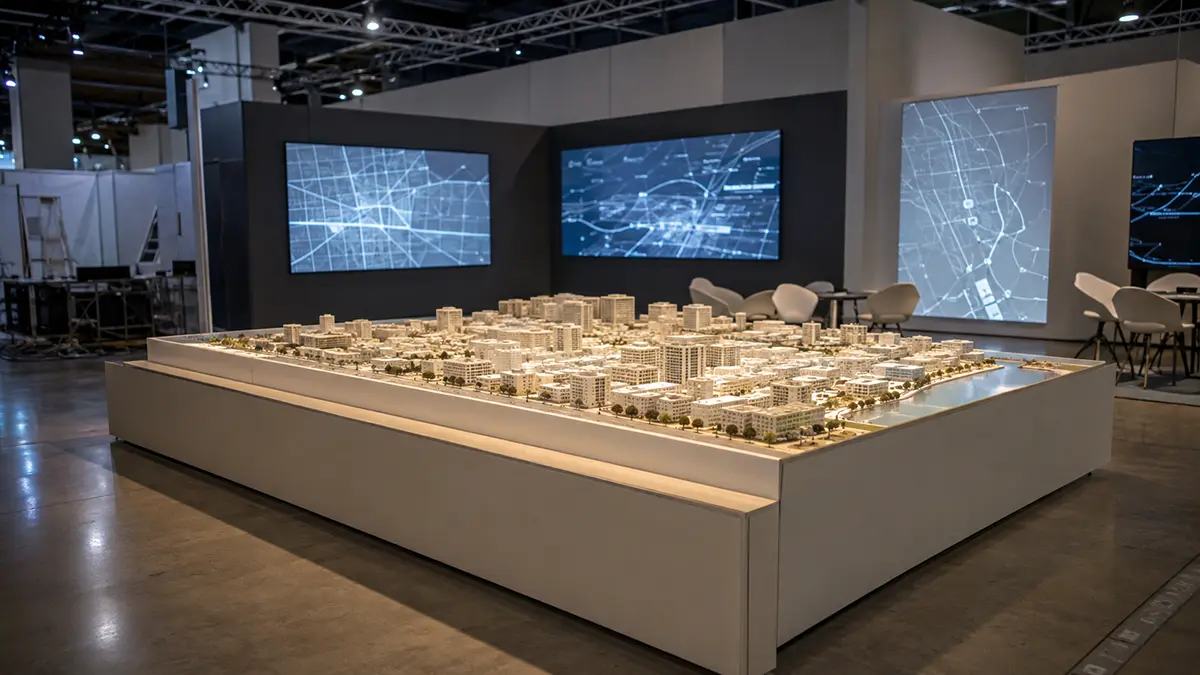
Sylvia said something else that day, standing in the station beside the large model Foster + Partners had supplied for the first phase. The model still showed the pods running everywhere, through every building. The network had been cancelled months earlier. It was still being advertised.2
The model in the station is the smart city in miniature: a rendering that outlived the thing it rendered, in the only inhabited building of a city announced five years earlier as the first on earth with no carbon emissions at all. The pod worked. It was the city that did not.
It is also a fair place to start asking what the word has been worth. The question behind this series is a plain one. What is a smart city — and after fifteen years of announcements, pilots, expos and control rooms, is the idea producing places that are better to live in? It is easy to put and has proved oddly hard to get answered, because the people best placed to answer it have mostly been the people doing the selling.
The five essays come at it from different sides. This one follows the word: where it came from, who paid for it, and what became of four cities that were built or promised as products. The others ask whether the smart city has anything to offer a city that is overheating or running dry; what has actually changed at a trade fair in Kyoto that has kept the same words on its banner for a decade; what the equipment now on sale — sensors, digital twins, driverless vehicles, the systems that decide who is watched — does in practice; and whether a city with more instruments is any wiser than one with fewer.
Cities Were Always Smart
Before the word had an owner it had a history, and the history is mostly plumbing.
In 1858 the smell of the Thames drove Parliament to fund Joseph Bazalgette’s main drainage of London: 82 miles of intercepting sewers, two great pumping stations, embankments that carried the pipes inside them. It was a control system in the only sense that mattered — it moved the city’s effluent according to a design. London’s last cholera epidemic, in 1866, struck the part of the East End the sewers had not yet reached.3
Baron Haussmann, prefect of the Seine, did the same to Paris with boulevards, and added something Bazalgette had not needed: a theory of the city as a system to be reorganised from above, with the residents’ consent assumed rather than sought. Ebenezer Howard’s Garden City of 1898 was a diagram before it was a place: a ring of towns of 32,000 people each, drawn as a machine for social reform. Le Corbusier’s Plan Voisin of 1925 proposed clearing the centre of Paris for towers in parkland. Every one of these was smart in the sense the word would later carry. Each treated the city as a problem in systems, and each was certain that the system knew better than the street.4
The computers arrived in the 1950s and went straight to traffic. In June 1963 Metropolitan Toronto installed what its own records describe as the world’s first full-scale, real-time computer traffic control system: a thousand vehicle detectors in the roads and a machine on the ground floor of Old City Hall that the Globe and Mail called the traffic brain. By the following summer it had become a tourist attraction and the city was employing guides to show it off. It also, the paper reported that October, stalled.5
Los Angeles built its equivalent for the 1984 Olympics. The Automated Traffic Surveillance and Control system — ATSAC — used induction loops cut into the pavement and a control room four floors below a City Hall annex; by 2013 it had reached every one of the city’s 4,398 signalised intersections. It has been running for 42 years. Almost nobody calls it smart-city technology.6
And in 1961 Jane Jacobs argued that the intelligence of a city lay not in any plan but in the unplanned density of ordinary attention: the eyes on the street, the shopkeeper who knows whose children are whose. The Death and Life of Great American Cities is the founding text of the argument that a city already thinks, and that the instruments imposed on it from above mostly get in the way.7
Put these together and a claim follows. “Smart” is not a stage that cities reach. It names a permanent condition of cities: they have always been instrumented, networked and managed by whoever had the means, and the interesting question at any moment is not whether a city is smart but whose instruments they are, who reads them, and who is allowed to switch them off.
That question was easy to answer in 1963. The machine belonged to the city. Half a century later it was harder.
The Word Finds an Owner
The plumber and the planet
The first company to put money behind the phrase was not IBM. In September 2006, at the Clinton Global Initiative in New York, Cisco’s chief executive John Chambers pledged US$15 million over five years to a programme called Connected Urban Development, with San Francisco, Amsterdam and Seoul as its founding cities. Its stated purpose was to cut carbon emissions by making traffic move better; its unstated one was to move Cisco from selling the routers of the internet to selling the network itself. By 2009 the programme had been absorbed into a business unit called Smart+Connected Communities, whose president told an engineering magazine that smart cities were a $13 billion market opportunity over the next three to five years.
Cisco had a city to point at. It had been brought into Songdo, in South Korea, by the developer Gale International, and was spending US$47 million wiring it from the foundations up. The company liked to describe itself as the plumber of the internet. The phrase is worth holding on to, because plumbing is exactly the register in which the smart city has always made its most credible claims.8
IBM’s contribution was not a city but a story. On 6 November 2008, two days after Barack Obama’s election and seven weeks after Lehman Brothers failed, Sam Palmisano addressed the Council on Foreign Relations in New York under the title “A Smarter Planet: The Next Leadership Agenda”. Its argument was that the world’s systems — power, water, food, traffic, health care — had become instrumented, interconnected and intelligent, and that the crisis was the moment to act on the fact. Eleven days later the first full-page Smarter Planet advertisement ran in the Wall Street Journal.9
The city was the natural next unit of sale. In 2009 IBM published A Vision of Smarter Cities, which set out the thesis consultants would repeat for a decade: cities are systems of systems, the systems can be instrumented, and instrumented systems can be optimised. In 2010 IBM launched the Smarter Cities Challenge, sending its staff to write strategies for cities at no charge; by 2016 it had reached 130 cities, spent more than $66 million, and become the largest philanthropic programme in the company’s history. And on 4 November 2011 the phrase “smarter cities” was registered as IBM’s trademark.
That date is the hinge of this essay’s title. The campaign was not, primarily, a description of anything. It was a story built so that a city which wanted to become the thing the word described would have to pass through one company’s door, and it borrowed two much older ideas — the city as a system, and the city as a utopia to be drawn — and attached them to a product line.10
Siemens came third and built the most literal monument. In 2011 the company gathered its urban products into a new Infrastructure & Cities sector, and on 19 September 2012 it opened The Crystal on the Royal Victoria Dock in east London: £30 million, 6,300 square metres, billed as the world’s largest exhibition on the future of cities, and the showroom for what the sector’s chief executive described as a €300 billion addressable market. Since 2022 it has been London’s City Hall: the Greater London Authority now sits inside a former corporate exhibition for the smart city, which is either an irony or a diagnosis.11
The trade fair and the critic
The vendors needed somewhere to meet the buyers. In November 2011 — the month of IBM’s trademark — Fira de Barcelona held the first Smart City Expo World Congress: 6,160 visitors from more than fifty countries. By 2025 the figures were more than 25,000 visitors, 1,100 exhibitors and delegations from 850 cities, and the 2026 edition expects more than 27,000. Barcelona’s fair became the field’s parliament, and in 2016 the much smaller Kyoto Smart City Expo — founded two years earlier under a banner of green innovation — began collaborating with it. The Catalan government is among the organisers of the Kyoto event to this day.12
It is tempting to write this history as marketing that ran ahead of criticism. The record says otherwise. The first academic paper to ask which of the self-described smart cities was real appeared in 2008, the year IBM began buying its advertisements, and its complaint — that the label was self-congratulatory, undefined, and favoured business over residents — has not needed much revising since. By 2013, before most of the deployments had matured, there was a shelf of books and papers against the smart city, one of them by a man who had helped build it. The critique was contemporaneous with the marketing, not a later correction of it.13
Who owned the word
The vendors did not invent the phrase, and it matters that they did not. Industry Canada ran a Smart Communities programme from 1998. American planners argued about “smart growth” through the 1990s. Amsterdam’s De Digitale Stad, a civic network for a city that did not yet have the internet, went online in 1994. Songdo was marketed as a ubiquitous city — a u-city — from early in its development, in a Korean policy vocabulary that owed nothing to IBM.14
What the companies did was not coin the word but take possession of it. Before 2008, “smart” described a municipal aspiration with many owners and no proprietor. After 2011 it was a registered trademark, a product category, a trade fair and a business unit with a revenue target, and a city that wanted to be described that way had to buy something from someone. That is this essay’s claim: cities used the word first, and vendors were the first to own it. The distinctive act of the era was not coinage but possession.
The clearest early case of the sale is Rio de Janeiro. In April 2010 rain and mudslides killed about seventy people in the city and many more in the surrounding state, most of them in favelas on the hillsides. In December the city signed with IBM to build a Centro de Operações: a control room in Cidade Nova consolidating feeds from some thirty agencies, opened on 31 December 2010, with an IBM Research weather model promised to forecast heavy rain 48 hours ahead. The mayor was Eduardo Paes, with a World Cup and an Olympics on his calendar. The floods were real; the need was real; and the sale was made to a man who needed above all to be seen to be doing something before the next rains. That is the shape of the transaction, and it would be repeated.15
The City as a Product
Four cities in four countries were built or promised as products between 2001 and 2021. Each has one person in it.
Songdo: technology before residents
Songdo began, by its developer’s own telling, in 2001 in a helicopter over a tidal flat off Incheon, with the mayor pointing at nothing and asking whether the Americans could see it. Gale International signed on to build a turnkey city on reclaimed land, in a joint venture with the steelmaker POSCO’s construction arm and the city, with Cisco later brought in as the systems partner. The cost was put at $35 billion. The International Business District was planned for 65,000 residents and 300,000 commuters, with a pneumatic waste system piping rubbish from every kitchen to a central plant, video-conferencing units in the apartments, and a single control centre for traffic, crime, fire and facilities.
The city was built. By 2016 the district had about 45,000 residents; the wider Songdo International City reported a population of around 210,000 in 2024 against an original target of 300,000. The pneumatic tubes work. What did not take was the layer that justified the word. A Korean smart-city consultant, asked by the Korea Times in 2019 what was smart about it, listed the park, the bike path, the vacuum tubes and the cameras, and asked what else there was.16
The residents are the person here. A team from the Technical University of Berlin conducted 43 interviews in Songdo, 24 of them with people who live there, and found not a smart city but an enclave: semi-gated tower compounds for an upwardly mobile middle class, whose residents valued safety, distinction and the view, and for whom the sensor network’s main everyday function was oversight of the compound. The team’s phrase for the arrangement was “seeing like a corporation”. The technology had been installed before there was anyone to want it, and when people came they wanted something else.17
Masdar: a target set by rendering
Masdar was announced in 2006 by the Abu Dhabi government and budgeted at $22 billion: six square kilometres for 50,000 residents and 1,500 clean-technology companies, zero carbon, zero waste, no cars. The financial crisis arrived with the first buildings, and in 2010 the pod network was cut to the single route described above. By 2016 the design manager, Chris Wan, was telling The Guardian that the city would not force renewable generation inside its boundary to satisfy a definition; the target became carbon neutrality, and then, by the project’s own account, something like half of what the word had implied. By 2023 about 15,000 people lived and worked there, roughly 5,000 of them residents, on less than a sixth of the intended site, around the headquarters of the International Renewable Energy Agency and a free zone of more than a thousand companies. It is a successful business park.
The geographer who studied its origins titled his paper “How to Build a Sandcastle”. His argument was that Masdar’s sustainability target had been set by the rendering and the brand rather than by any calculation of what the site, the budget or the emirate could bear; when the numbers were run, the rendering lost. It is the clearest case of a city whose environmental promise was a marketing specification.18
Toronto: governing before the city decided
Sidewalk Toronto lasted two years, six months and three weeks. On 16 October 2017 the board of Waterfront Toronto, the public agency that owns the land, endorsed Sidewalk Labs — an Alphabet company run by the former New York deputy mayor Dan Doctoroff — as its partner for Quayside, a twelve-acre site on the waterfront. The announcement the next day, with the prime minister present, promised a neighbourhood built from the internet up.
What followed was the best-documented failure of the era, because the city documented it. Ann Cavoukian, the former Ontario privacy commissioner advising the project, resigned in October 2018 when it became clear that data collected in the district would not automatically be de-identified at source. Early in 2019 a group of residents formed #BlockSidewalk. In June 2019 Sidewalk published its master plan — some 1,500 pages proposing that the company’s remit extend from twelve acres to 190, with a role in transit, governance and data across a substantial part of the waterfront. On 31 October 2019 Waterfront Toronto forced the plan back to Quayside and took control of data governance itself. On 7 May 2020, citing unprecedented economic uncertainty, Doctoroff withdrew.19
The organiser here is Bianca Wylie, an open-government advocate and a founding member of #BlockSidewalk, who wrote in the week the company left that calling the withdrawal a pandemic casualty erased two and a half years of public work. Her argument throughout was not about privacy in the narrow sense but about jurisdiction: a company had been invited to propose how a neighbourhood would be governed before the city had decided what it wanted governed, and the public had been asked to comment on a plan it had no power to reject. The book on the affair is called Sideways: The City Google Couldn’t Buy.20
Quayside is being built anyway. In 2022 Waterfront Toronto chose Dream Unlimited and Great Gulf; the first phase is about 2,800 homes in three towers and a mass-timber building, several hundred of them affordable. Building starts late this year and the first residents are expected around 2031. There is no platform. The site was cleared this August.21
The Line: an image financed by a commodity
NEOM was announced in the same month as Sidewalk Toronto, October 2017, and its centrepiece, the Line, was unveiled in January 2021: a mirrored city 170 kilometres long and 500 metres high for 1.5 million people, financed by Saudi Arabia’s Public Investment Fund. In 2024 the first phase was cut to 2.4 kilometres and about 300,000 people. Construction was paused in September 2025. In May 2026 Semafor reported that the Line had been deferred beyond 2030 and the 2030 population target cut to about 100,000; the fund has written down its investment, and the Wall Street Journal has reported an internal audit projecting a total cost of $8.8 trillion — a figure this essay treats as reported, not established.22
The person is a worker who has no name. In October 2024 ITV broadcast Kingdom Uncovered: Inside Saudi Arabia, in which an undercover reporter filmed labourers at the Line describing sixteen-hour shifts, fourteen days without rest, and an unpaid three-hour bus ride each way that left about four hours to sleep. The programme put the number of Indian, Bangladeshi and Nepali workers who had died in Saudi Arabia since Vision 2030 began at 21,000. That figure counts all recorded deaths of nationals of three countries across the whole kingdom, most of them classed as natural; Saudi authorities called it misinformation, and an independent investigator has argued that it misleads in both directions. What the footage shows is not in dispute.23
The Line differs from the other three. Songdo, Masdar and Quayside were attempts to sell a city to residents or investors; the Line was an image, financed by the price of oil, whose audience was the world, and when the price and the appetite for the image changed it was deferred. It is the outer limit of the city as a product: a rendering for five years, then a fragment, then a write-down.
Who Was Buying
The seller is easy to describe. The buyer is the more important figure.
In every case above, the counterparty to the vendor was a public body with a problem it could not solve alone and a date it could not move: a flood and an Olympics in Rio; a tidal flat and a free-economic-zone target in Incheon; a post-oil diversification strategy in Abu Dhabi; a derelict parcel and a housing crisis in Toronto; a crown prince’s economic vision in Riyadh. The smart city was sold, in each instance, to someone who needed to be seen to act, and it offered a way of acting that came with its own story, its own consultants and its own renderings.
The first instrument of purchase is the public–private partnership, which shifts design authority to the party that brings the money and the drawings: Rio’s control room was built with IBM money and IBM software; Sidewalk was to finance the infrastructure it would then help govern. The second is procurement run as a competition for a vision rather than a tender for a specified service, which is how Toronto asked for ideas and received a claim on its jurisdiction. The third is lock-in. A company that owns the word can make itself the door a city walks through, and IBM’s Smarter Cities Challenge — a strategy written by IBM staff, at no charge, for 130 cities — is philanthropy that produces requirements documents.
The fourth instrument is the trade fair, and it is the one that can be watched in person. Kyoto’s expo returns to Keihanna Plaza this October. Its sponsors this year include Dassault Systèmes, which sells digital twins; Pony.ai, which sells autonomous vehicles; and SoftBank. Its special programmes are physical AI, an autonomous-driving summit with the national Digital Agency, delivery robots, and a cybersecurity strand run with the prefectural police. The fair is where cities go to find out what they need, and the exhibitors are the ones who tell them. It is the political economy of the smart city drawn as a floor plan.24
The buyer in this section is Eduardo Paes, because his purchase is the one that can be judged on its own terms. Rio’s operations centre has outlasted the vendors’ interest in it: by its own account it now integrates some fifty agencies and has added resilience to its name. Whether it has saved lives in a flood is a question nobody outside it has answered. It gave a mayor a room to stand in front of, with screens behind him, on the night of the next storm. That is not a small thing in a city where people die on hillsides. It is also not the same thing as a smarter city.
The Graveyard
Read together, the failures repeat four causes, and the repetition matters more than any one case.
Governing before the city decided. Toronto is the pure instance: a company was asked to propose a government for a district before the district’s owner had decided what it wanted, and the withdrawal came when the owner finally said. Songdo’s operating model was likewise fixed by the developer’s joint venture years before any resident arrived to object.
A target set by rendering. Masdar’s zero carbon, the Line’s 170 kilometres, Songdo’s 300,000: each was a number that appeared in a drawing before it appeared in a budget, and each was quietly replaced when the budget was written. A figure in a rendering is imagined; a figure in an audit is measured; and the smart city’s characteristic failure is to publish the first as if it were the second.
Technology installed before residents. Songdo’s telepresence units and Masdar’s pod cars share a fate: they were fitted before anyone had asked for them, and the people who came wanted safety, a park and a bus.
An image financed by a commodity price. Abu Dhabi’s oil in 2008, Riyadh’s in 2025: the image lasts exactly as long as the price.
What the four have in common is an underestimate of the actual city — its politics, its price, and its residents’ indifference to being optimised. Jacobs said as much in 1961. The traffic brain in Toronto’s Old City Hall knew it in 1963, when the Globe reported that it had stalled. The difference is that in 1963 the machine belonged to the city, and when it failed the city could switch it off and send the traffic police back into the intersections. Songdo cannot switch off its developer. Masdar cannot un-render itself. Quayside, which finally can, is building towers.
The Banner
On 8 October 2026 the Kyoto Smart City Expo will open at Keihanna Plaza, in the science city laid out in the hills between Kyoto, Osaka and Nara, in the hall where it was founded in 2014.
Its theme was adopted in 2016: regions and industries creating a sustainable and liveable future. In 2017 the organisers added a clause about a smart society of “meta-comfort”, which in 2021, during the second online edition, became “super-comfortable” in the English. Otherwise the wording has not changed in ten years. It hung over halls of green-innovation hardware in 2014, over ICT design in 2015, over the internet of things and big data, over start-ups and food technology, over two years of virtual booths, and this October it will hang over autonomous vehicles, delivery robots and a police cybersecurity programme.25
The banner stayed. Everything under it was replaced. That is what a word looks like once it has had three owners, and it is where the rest of this series begins.
Endnotes
1. Gökçe Günel, “An ‘Expensive Toy’,” Limn 7 (2016), drawing on fieldwork in 2010–11; the network specification (23 miles, 87 stations, 1,800 vehicles) is from the Foster + Partners scheme as reported there. See also Günel, Spaceship in the Desert: Energy, Climate Change, and Urban Design in Abu Dhabi (Duke University Press, 2019).↩
2. Günel, “An ‘Expensive Toy’,” on the guideway surface, the door runners and the bird-detection halt, as described by the 2getthere operations manager in April 2011; on the Market @ Masdar open day (the figure of about 4,000 riders is the operator’s); and on the Foster + Partners model. The cancellation of the full network was reported in 2010; Günel’s interview took place in April 2011.↩
3. Stephen Halliday, The Great Stink of London: Sir Joseph Bazalgette and the Cleansing of the Victorian Metropolis (Sutton, 1999). The 1866 cholera outbreak in the East End preceded the connection of that district to the intercepting system.↩
4. Ebenezer Howard, To-morrow: A Peaceful Path to Real Reform (1898), reissued as Garden Cities of To-morrow (1902); Le Corbusier, Urbanisme (1925) for the Plan Voisin; David Harvey, Paris, Capital of Modernity (Routledge, 2003) on Haussmann.↩
5. City of Toronto, “Types of Traffic Signal Systems: History of Traffic Systems in Toronto” (toronto.ca), which records the June 1963 installation, the 1,000 detectors and the Old City Hall location. Headlines from the Globe and Mail, 1963–64, as listed by Toronto Public Library, “Remembering Toronto’s First Automated Traffic Lights” (August 2019): “Traffic Brain Stalls” (2 October 1963), “Traffic Computer Tourist Attraction” (17 June 1964), “Automation Provides Work for Guides” (22 July 1964).↩
6. Los Angeles Department of Transportation, “ATSAC” (ladot.lacity.gov); Governing, “Inside Los Angeles’ Quest to Fix the Nation’s Most Congested City” (2013), for the 4,398-signal milestone and the control-room location.↩
7. Jane Jacobs, The Death and Life of Great American Cities (Random House, 1961).↩
8. Clinton Foundation, “Connected Urban Development to Reduce Carbon Emissions,” Clinton Global Initiative commitment record (2006); Cisco newsroom, “Cisco’s Connected Urban Development Program Signposts the Future Era of Sustainable Work” (23 September 2008); The Register, 22 September 2006, on Chambers’ announcement; IEEE Spectrum, “Cisco Bets on South Korean Smart City” (2010), quoting Anil Menon of Smart+Connected Communities on the $13 billion estimate, and for the US$47 million Songdo figure and the in-apartment TelePresence units. The $13 billion is a corporate projection.↩
9. Samuel J. Palmisano, “A Smarter Planet: The Next Leadership Agenda,” prepared remarks to the Council on Foreign Relations, New York, 6 November 2008 (event record at cfr.org; text reproduced by Government Technology). The 17 November 2008 Wall Street Journal advertisement is reproduced in Orit Halpern, Robert Mitchell and Bernard Dionysius Geoghegan, “The Smartness Mandate: Notes toward a Critique,” Grey Room 68 (2017).↩
10. Susanne Dirks and Mary Keeling, A Vision of Smarter Cities: How Cities Can Lead the Way into a Prosperous and Sustainable Future (IBM Institute for Business Value, 2009); Philanthropy News Digest, “IBM Launches $50 Million Smarter Cities Challenge” (2010); Tooran Alizadeh, “An Investigation of IBM’s Smarter Cities Challenge: What Do Participating Cities Want?,” Cities 63 (2017), for the programme’s scale by 2016 (more than US$66 million, 130 cities) and its description as IBM’s largest philanthropic effort. The trademark date of 4 November 2011, and the reading of the campaign as a story designed to make one company an “obligatory passage point” for cities, are from Ola Söderström, Till Paasche and Francisco Klauser, “Smart Cities as Corporate Storytelling,” City 18, no. 3 (2014): 307–320.↩
11. Siemens press releases, “The Crystal Takes Shape” (2011) and “Siemens Opens the Crystal in London” (19 September 2012), the latter quoting Roland Busch, chief executive of the Infrastructure & Cities Sector, on the €300 billion addressable market, a corporate projection; on the building’s conversion to City Hall, Greater London Authority records and Wikipedia, “City Hall, London” (relocation in 2022).↩
12. Smart City Expo World Congress, “Past Editions” (smartcityexpo.com), for the 2011 figures (6,160 visitors, 50-plus countries, 100 cities); the organiser’s published 2025 figures (25,000-plus visitors, 1,100-plus exhibitors, 850-plus cities) as reported by Cities Today, which also carries the 3–5 November 2026 projection of 27,000-plus. Kyoto’s collaboration with Barcelona from 2016 and the Catalan government’s role as co-organiser are recorded on the Kyoto Smart City Expo archive and 2026 site (smartcity.kyoto).↩
13. Robert G. Hollands, “Will the Real Smart City Please Stand Up? Intelligent, Progressive or Entrepreneurial?,” City 12, no. 3 (2008): 303–320. The 2013 shelf: Anthony M. Townsend, Smart Cities: Big Data, Civic Hackers, and the Quest for a New Utopia (Norton, 2013), by a former participant in the industry; Adam Greenfield, Against the Smart City (Do projects, 2013); Orit Halpern, Jesse LeCavalier, Nerea Calvillo and Wolfgang Pietsch, “Test-Bed Urbanism,” Public Culture 25, no. 2 (2013): 272–306, on Songdo; and, in 2015, Taylor Shelton, Matthew Zook and Alan Wiig, “The ‘Actually Existing Smart City’,” Cambridge Journal of Regions, Economy and Society 8, no. 1 (2015): 13–25.↩
14. Industry Canada, Report of the Panel on Smart Communities (Ottawa, 1998) and Smart Communities: Program Guide (1999); on smart growth, Gregory K. Ingram et al., eds., Smart Growth Policies: An Evaluation of Programs and Outcomes (Lincoln Institute, 2009); on De Digitale Stad (launched January 1994), the Waag Society and Amsterdam Museum archives; on the Korean u-city concept, Jang and Suh, “U-City: New Trends of Urban Planning in Korea,” in Computational Science and Its Applications (Springer, 2010).↩
15. C40 Cities, “Rio Operations Center” case study (for the December 2010 opening, the roughly thirty agencies and the April 2010 death toll in the city); IBM press release, “City Government and IBM Close Partnership to Make Rio de Janeiro a Smarter City” (27 December 2010), which gives the 31 December opening, the Cidade Nova location and the 48-hour forecasting system. The 48-hour forecast was a projection at signing. The centre’s current title (Centro de Operações e Resiliência) and the figure of about fifty integrated agencies are from the centre’s own published account and secondary summaries, including Centre for Public Impact, “Rio de Janeiro’s Centre of Operations: COR,” and are reported rather than independently verified.↩
16. Worldcrunch, “Welcome to Songdo, South Korea: The Smartest of Smart Cities,” reporting Tom Murcott of Gale International at the New Cities Summit on the 2001 helicopter flight; Engineering News-Record, “Korea’s Songdo IBD Is Model for Sustainable, High-Tech Living,” for the $35 billion cost, the 65,000-resident and 300,000-commuter plan and the pneumatic waste system; on the joint venture’s ownership (Gale a majority stake, POSCO E&C, Morgan Stanley Real Estate), Kim and Choi, “Contracting-Out Public–Private Partnerships in Mega-Scale Developments: The Case of New Songdo City in Korea,” Cities. Gale International press release via PR Newswire, 4 October 2016 (45,000 residents); the wider Songdo International City’s population of about 210,000 in 2024 is derived from Incheon municipal figures as reported in secondary sources and should be read as approximate. Korea Times, “Smart City Expert Unimpressed with Songdo” (November 2019).↩
17. Dominik Bartmanski, Seonju Kim, Martina Löw, Timothy Pape and Jörg Stollmann, “Fabrication of Space: The Design of Everyday Life in South Korean Songdo,” Urban Studies 60, no. 4 (2023): 673–695 (online 2022). The interview count (43, of which 24 residents) is from the authors’ project reports; “seeing like a corporation” is their phrase, after James C. Scott.↩
18. Günel (note 1) for the 2006 launch, the $22 billion budget and the 50,000-resident, 1,500-company plan; Suzanne Goldenberg, “Masdar’s Zero-Carbon Dream Could Become World’s First Green Ghost Town,” The Guardian, 16 February 2016, for Chris Wan’s remarks; Popular Science, “Is Masdar City a Ghost Town or a Green Lab?” (2018), on the shift from carbon-free to carbon-neutral; Wikipedia, “Masdar City,” citing 2023 reports, for the 15,000 who live and work there, the 5,000 residents and the less-than-a-sixth of planned area, all approximate and drawn from secondary summaries; Masdar City fact sheet (2021) for the free zone’s organisation count and IRENA’s headquarters. Federico Cugurullo, “How to Build a Sandcastle: An Analysis of the Genesis and Development of Masdar City,” Journal of Urban Technology 20, no. 1 (2013): 23–37.↩
19. Infrastructure Canada, Question Period note “Waterfront Toronto Quayside Development” (2020), recording the 16 October 2017 board endorsement, the June 2019 draft plan, the threshold issues and the 31 October 2019 resolution; Goodman and Powles (note 20, below) for the “internet up” phrasing and the 17 October 2017 launch; Global News, “Waterfront Toronto Names New Partners” (15 February 2022), on the 1,500-page plan and the proposed expansion to 77 hectares (about 190 acres), sixteen times the original site; StateScoop, “Sidewalk Labs Pulls Out of Toronto Quayside Project” (7 May 2020), on Cavoukian’s de-identification condition and #BlockSidewalk; CBC News, “Sidewalk Labs Cancels Plan” (7 May 2020), for Doctoroff’s statement.↩
20. Bianca Wylie, “In Toronto, Google’s Attempt to Privatize Government Fails — For Now,” Boston Review (May 2020); Ellen P. Goodman and Julia Powles, “Urbanism Under Google: Lessons from Sidewalk Toronto,” Fordham Law Review 88, no. 2 (2019): 457–498, also on procurement as a competition for a vision; Josh O’Kane, Sideways: The City Google Couldn’t Buy (Random House Canada, 2022).↩
21. Waterfront Toronto, “Quayside” project page (2026), for the February and December 2022 selection and agreement, the 2026 construction start and the 2031 first-residents target; Daily Commercial News, “First Phase of 2,800 Units Approved for Quayside in Toronto” (August 2024), for the 24 July 2024 rezoning; blogTO, “Futuristic New Community About to Sprout from Toronto Waterfront” (August 2026), on site clearance.↩
22. NEOM company documentation; Bloomberg (2024) on the reduction to 2.4 kilometres and about 300,000 residents; reporting on the September 2025 construction pause; Semafor, 22 May 2026, on deferral beyond 2030 and the revised 100,000 target; Wall Street Journal reporting on the internal audit’s $8.8 trillion projection. Fund write-downs are from Public Investment Fund disclosures as reported. All figures beyond the 2024 reduction are treated as reported.↩
23. ITV, Kingdom Uncovered: Inside Saudi Arabia (broadcast 27 October 2024); Middle East Eye, “Neom Workers Speak of ‘16-Hour Work Days’ in ITV Undercover Film” (24 October 2024); New Civil Engineer, “Saudi Arabia Calls Reports of 21,000 Construction Worker Deaths ‘Misinformation’” (6 November 2024); Nick Harris, Sporting Intelligence, “Saudi 2034 Death Data Wrong” (13 November 2024), on the construction of the 21,000 figure from Indian, Bangladeshi and Nepali records of all deaths.↩
24. Kyoto Smart City Expo 2026: dates, venue, sponsors, special programmes and the Catalan government’s role from the official site (smartcity.kyoto/expo2026), accessed August 2026. On the Smarter Cities Challenge, note 10; on Songdo’s ownership, note 16; on Toronto’s procurement, note 20.↩
25. Kyoto Smart City Expo Steering Council, after-event reports 2014–2025 and the 2026 programme (smartcity.kyoto): 2014 theme of next-generation cities through green innovation; 2015, Designing Smart Cities; 2016, regions and industries creating a sustainable and liveable future; 2017, the addition of a “meta-comfort” smart society (超快適); 2020 and 2021 online; 2021 English rendering “super-comfortable”; 2026, physical AI, autonomous-driving summit with the Digital Agency, delivery robots and cybersecurity with Kyoto Prefectural Police.↩
Source Note
This essay rests on primary corporate and municipal records where they exist — Palmisano’s 2008 remarks as published by the Council on Foreign Relations, IBM and Cisco press releases and reports, Siemens press releases, Waterfront Toronto’s project record and the Canadian government’s Question Period note, the organiser’s own attendance figures for the Barcelona and Kyoto expos — and on the critical literature that formed alongside the marketing, cited in the notes. The opening scene is taken from Gökçe Günel’s published ethnography and is not reconstructed beyond what she reports. Where a figure is a corporate projection (Cisco’s $13 billion, Siemens’ €300 billion), a target (Songdo’s 300,000, Masdar’s 50,000), or a reported figure not independently confirmed (the Line’s audit, the ITV death toll, Rio’s fifty agencies), the prose says so. Current population figures for Songdo and Masdar are drawn from secondary summaries of municipal and developer statements and should be read as approximate. Direct quotations are kept under fifteen words and to one per source; paraphrase is preferred throughout. The Kyoto Expo archive is used here only for its theme wording.
Further Reading / Watching
Reading: Anthony Townsend, Smart Cities: Big Data, Civic Hackers, and the Quest for a New Utopia (Norton, 2013) remains the best single narrative of the corporate origin, written by a participant who became a sceptic. Adam Greenfield, Against the Smart City (2013) is the sharpest short polemic. Shannon Mattern, A City Is Not a Computer (Princeton, 2021) is the counter-tradition. Josh O’Kane, Sideways (2022) is the fullest account of Toronto. Gökçe Günel, Spaceship in the Desert (Duke, 2019) is the Masdar ethnography from which the opening scene is taken. Orit Halpern and Robert Mitchell, The Smartness Mandate (MIT Press, 2023) sets the word in its longer intellectual history.
Watching: ITV’s Kingdom Uncovered: Inside Saudi Arabia (2024) is the essential document on the Line’s labour conditions. Bloomberg Quicktake’s 2022 film on the Line is worth watching alongside the 2024 and 2026 retrenchment reporting. The Council on Foreign Relations retains video of Palmisano’s 6 November 2008 address. Rob Kitchin’s Programmable City project blog (Maynooth University) carries field reports on the actually existing smart city, including Songdo.