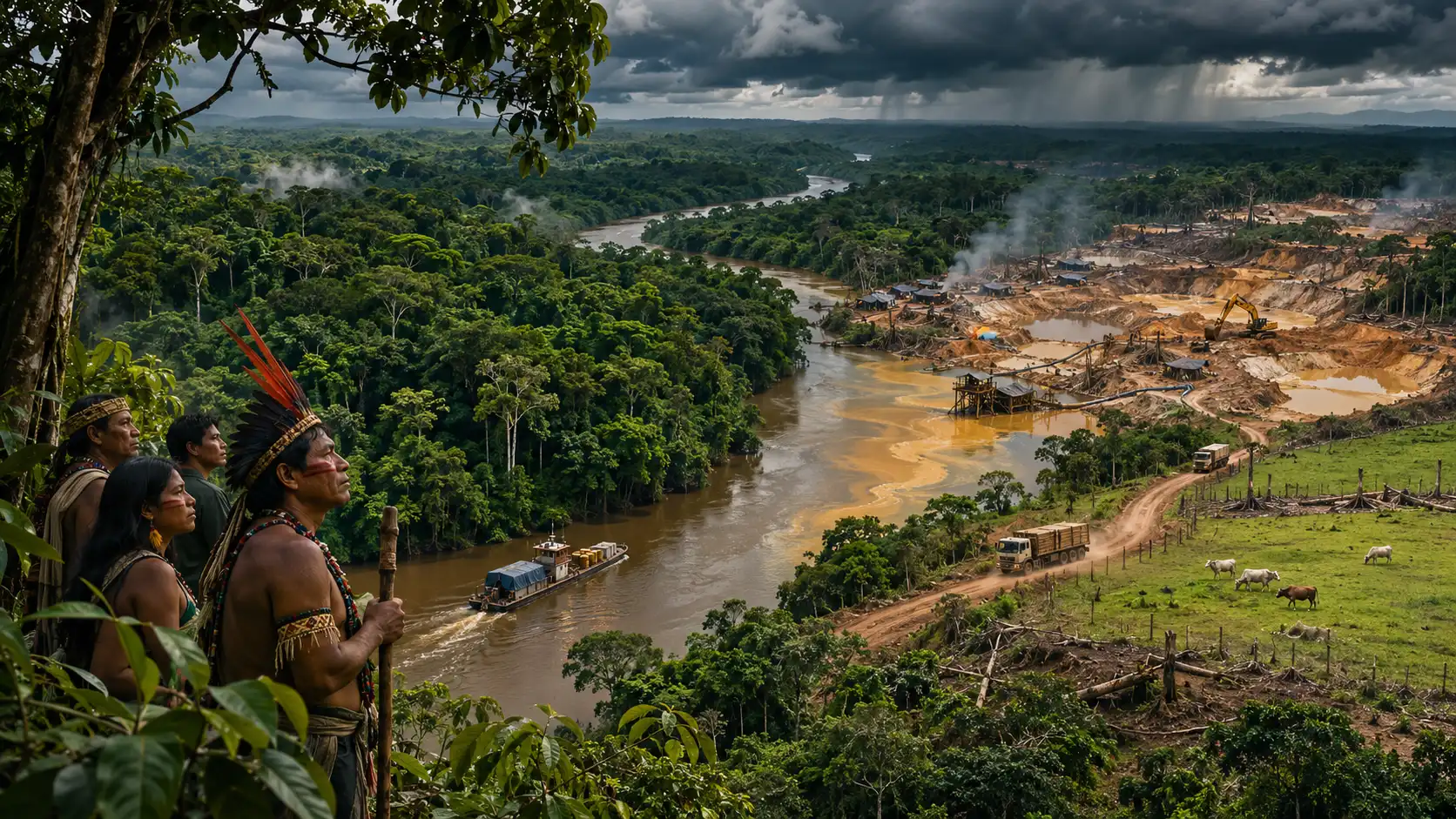

From a shell cooperative in Roraima to the courts of Belo Horizonte and London, a new legal movement is asking who should answer for the destruction of the world’s greatest tropical forest — and whether anyone can be made to.
The cooperative with no members
In the Pupunha region of the Yanomami Indigenous Territory, in the basin of the Mucajaí River in Brazil’s far north, excavators opened the forest. A clandestine airstrip followed. Then, according to Brazilian federal prosecutors, came the paperwork.
The ore was cassiterite, from which tin is smelted: the metal that holds the solder on every circuit board. Between March 2021 and December 2022, prosecutors allege, cassiterite and gold dug from Yanomami land were flown out, registered by a cooperative’s branch office in Boa Vista as the output of its own members, issued with tax invoices, sent to a smelter in Rondônia and poured into certified tin ingots that were sold in Brazil and abroad with every appearance of lawful origin.1
The branch office, investigators found, had no members, no employees and no working mine.1 Yet in the National Mining Agency’s own yearbooks, prosecutors say, the cooperative figured as the largest tin producer in Brazil in 2021 and 2022.2 Seized accounts recorded 525 tonnes of cassiterite and R$54.2 million moving through the scheme between May and August 2021 alone; over five months the smelting company transferred R$166.3 million to the cooperative.1
The forest paid in the usual currency: more than twenty hectares degraded, a trail of destruction a kilometre and a half long beside a stream, silted watercourses, mercury used to separate the gold.1 On a map of the Amazon it is a scratch. It was made during the worst of the Yanomami humanitarian emergency, when malnutrition and malaria were killing children in a territory that illegal mining had overrun.
In August 2026 a federal judge in Boa Vista accepted criminal charges against six people and four companies, among them the smelter, White Solder Metalurgia e Mineração, and the cooperative, Coopertin.3 In September the Federal Public Prosecutor’s Office (MPF) filed a civil action seeking R$1.7 billion — restoration of the land, compensation for mineral and environmental loss, and R$1.62 billion in collective moral damages — and a federal court, in a preliminary ruling, ordered both companies to stop buying, receiving, registering or selling cassiterite without documents proving its lawful origin.4
White Solder describes itself as one of the world’s largest tin producers and displays on its website certifications from its customers Sony and Panasonic. It did not respond to journalists’ questions about the charges.5 Every allegation here remains an allegation. No court has found any defendant guilty, and the presumption of innocence applies to each of them.
One fact, though, needs no trial. Brazil has systems for tracing gold, diamonds and timber to their origin. For cassiterite none is operating: no federal body can say where a shipment of tin ore came from.2 The MPF has now sued the federal government and five of its agencies to build one.
“The gold and the cassiterite leave the Indigenous land, and they sell it as if it were clean,” Dário Kopenawa of the Hutukara Yanomami Association, which monitors the territory, told Repórter Brasil.5
That sentence is the question driving Latin America’s accelerating debate about ecocide. If the devastation of a forest becomes profitable through an organised chain of decisions — an excavator, an aircraft, an invoice, a furnace, a certificate — why should accountability stop with whoever drove the excavator?
A model law lands in a region of old wounds
On 1 October 2026, in Mexico City, a different kind of instrument was unveiled: a Model Ecocide Law for Latin America.
It was led by Stop Ecocide International with the Mexican Center for Environmental Law (CEMDA), the Universidad Iberoamericana, the Association of Researchers in Environmental and Climate Criminal Law, the Transdisciplinary Center for Sustainability and the region’s alliance of environmental law clinics, through a public consultation, online working sessions with 74 experts from 14 countries, and a two-day drafting conference of more than thirty legal experts.6 The text runs to eighteen articles. It adapts the 2021 Independent Expert Panel definition examined in Article 1 — unlawful or wanton acts committed with knowledge of a substantial likelihood of severe and either widespread or long-term damage — to the region’s legal traditions, proposes prison terms of eight to twenty years, treats ecocide as a crime of both result and endangerment, and calls for protection, including police escort, for whistleblowers, witnesses and experts in ecocide cases.7
“We are champions at passing beautiful laws that are then not enforced,” Rodrigo Lledó, the Chilean lawyer who directs Stop Ecocide International’s work in the Americas, told AFP at the launch.8 The model law’s answer is to insist that the difficulty of identifying perpetrators does not relieve the state of its duty to stop the destruction and repair the damage.
A model law is not a law. It arrests no one, creates no prosecutor and establishes no court. Its value is practical: legislators who want to put the gravest environmental destruction into a criminal code need a technically coherent text, or they will write offences too vague to survive a constitutional challenge and too narrow to use.
The Amazon is not one country. It is a mosaic of forests, rivers, wetlands, settlements, Indigenous territories and nine national jurisdictions, and its peoples share neither one politics nor one relationship with the forest. What unites many of its conflicts is a recurring imbalance: commercial decisions are taken by those who expect to capture the benefits, while the ecological and social costs are transferred to those with the least power to refuse them. A credible ecocide law would try to change that calculation.
The inconvenient good news from Brazil
Environmental reporting is tempted to marshal every statistic into an uninterrupted story of decline. The latest Brazilian evidence does not permit it.
On 16 October 2026, Brazil’s National Institute for Space Research (INPE) reported that 3,335 square kilometres of forest had been cleared in the Legal Amazon between August 2025 and July 2026. That was 41.8 per cent less than the previous year’s 5,731 square kilometres, the lowest annual figure since the PRODES satellite series began in 1988, and the fifth consecutive annual fall. In the Cerrado savanna, clearing fell to 5,517 square kilometres, also a record low.9 Over four years the Amazon figure has dropped by more than 70 per cent; in the four years to 2022 the series had recorded 45,612 square kilometres.10
These numbers matter beyond Brazil. They show that political choices, satellite monitoring, enforcement and public money can reduce destruction. The Amazon is not doomed by some immutable law of development.
But 3,335 square kilometres is still 333,500 hectares of forest in a year. Pará alone lost 1,130 square kilometres; Mato Grosso 849; Amazonas 525. Roraima, which holds most of the Yanomami territory, recorded a marginal increase.10 And clear-cutting is not the whole story: degradation, fire, fragmentation and pressure on rivers are measured separately or not at all.
Inside the Yanomami territory the lesson is sharper. After the federal government declared a public-health emergency and sent in the security forces in 2023, new mining clearance collapsed, from roughly 1,800 hectares in 2022 to 45 hectares in 2025, according to monitoring by the Instituto Socioambiental and the Monitoring of the Andes Amazon Program, with the Hutukara Yanomami and Wanasseduume Ye’kwana associations. The cumulative scar stands at 5,564 hectares.11 Yet the miners have not gone. They have fragmented, moved towards the Venezuelan border and reorganised around record gold prices; and the pressure has shifted east, where illegal mining on Kayapó land in the Xingu basin has now cleared about 7,940 hectares, the largest such footprint in the Brazilian Amazon.12
“Illegal mining activity, the invaders, continue on Yanomami land, but the rest have already been expelled,” Dário Kopenawa told Mongabay. “The government has to continue operations until illegal mining activity ends.”12
This is an argument for institutions, not despair. Enforcement works. Investigation can reach organised networks. Territorial monitoring, much of it Indigenous-led, can find incursions before they become scars. The task is to strengthen those capacities and to draw a clearer criminal line around the worst damage, so that what is won by one government cannot be quietly surrendered by the next.
Follow the cattle, follow the money
The Amazon is not destroyed by a single industry. Roads give access; loggers take the valuable timber; fire finishes the job; pasture or speculation claims the ground. When forest becomes pasture the economic story runs on to slaughterhouses, lenders, traders, retailers and consumers.
A 2025 analysis by Trase, which maps commodity supply chains against deforestation, found that Brazil’s three largest beef exporters — JBS, Marfrig and Minerva — accounted for 67 per cent of the country’s beef exports in 2023 and 54 per cent of the deforestation-and-conversion exposure associated with those exports. China took 59 per cent of exports and carried the largest exposure.13
These figures describe exposure to deforestation risk in supply chains. They do not establish that any company or executive committed a crime, and they do not mean that every hectare was cleared illegally. The complication cuts both ways: about 70 per cent of Brazilian beef is eaten in Brazil, so blaming foreign consumers alone misdescribes the problem.13 The harder question is how cattle move between properties before slaughter. A direct supplier can be monitored; animals born or fattened on a farm that was cleared, embargoed or overlapping Indigenous land, and then sold on through intermediaries, are far harder to trace.
That question is now being asked in European financial-crime offices. In the first week of November 2026 a group of organisations calling itself the Transnational Legal Coalition filed fourteen coordinated complaints in the United Kingdom, Ireland, Germany and the Netherlands. They allege that JBS’s revenues include the proceeds of cattle raised on illegally deforested Amazon land, and that the European banks, asset managers, law firms and accountants paid from those revenues failed in their duties under anti-money-laundering law. JBS N.V., the group’s Dutch-domiciled parent, was reported to Dutch prosecutors; JBS Global (UK) Limited to the National Crime Agency and the Financial Conduct Authority; twelve further complaints went to financial regulators. The coalition cites a commissioned analysis by the Dutch consultancy AidEnvironment associating the company with more than 6.5 million hectares of Amazon deforestation since 1988, roughly half through direct suppliers and half through indirect ones.14
JBS replied that the campaign had omitted the data on which its allegations rest, preventing the company from addressing them, and that its monitoring system scans more than 600,000 square kilometres of Brazilian territory daily and automatically blocks farms with illegal deforestation, embargoes, overlap with Indigenous or quilombola lands or conservation units, or slave-like labour.14 The complaints are complaints. No regulator has made a finding, and none may.
Their significance for this series lies elsewhere. Anti-money-laundering law is being used to reach financiers because there is no ecocide offence that could reach the chain of decisions directly. A criminal court must never infer individual guilt from a commodity chain’s deforestation exposure; prosecutors must prove the acts and the mental element the offence requires. But neither should corporate complexity become a sanctuary from scrutiny. Where evidence exists — records of warnings, finance, operational control, procurement, deliberate concealment — it should be able to follow the money to the people who made the decisions.
Mariana: a conviction, almost eleven years on
Latin America does, occasionally, convict. On 3 September 2026 the Second Panel of the Federal Regional Court in Belo Horizonte unanimously convicted Samarco Mineração and three of its former managers over the collapse of the Fundão tailings dam at Mariana in November 2015, which killed nineteen people (families count twenty, one victim being pregnant), destroyed the village of Bento Rodrigues and sent mining waste down the entire Rio Doce. Two engineers received eight years and nine months; a third, a little over seven years and three months. Samarco was fined and barred from public contracts for ten years.15
It was the first criminal finding of guilt in Brazil’s worst environmental disaster, and it reversed a November 2024 ruling that had acquitted every defendant for lack of proof of direct and individual criminal responsibility. The convictions are not final; the defendants can appeal, and Samarco has maintained throughout that it had no knowledge of any risk that the dam would fail. And the panel left in place the acquittals of Samarco’s two parent companies, Vale and BHP.15
In London, by contrast, the High Court found BHP liable under Brazilian law for the same collapse in November 2025, in a group action brought on behalf of hundreds of thousands of Brazilians; the judge held that continuing to raise the dam when it was unsafe to do so was the direct cause of its failure. BHP, which argued the case duplicated Brazilian reparations, was refused permission to appeal by the Court of Appeal in May 2026, and a damages trial is expected to begin in April 2027.16
Set the two courts side by side and the shape of the problem appears. Civil liability can cross borders and reach the parent; criminal liability, after almost eleven years, reached the operator and three engineers. “If what happened here today had happened back in 2015, when the dam collapsed,” Mônica dos Santos, who lost her home at Bento Rodrigues, said outside the court, “I’m certain Brumadinho would never have broken and 272 lives could have been spared.”15
Brumadinho, which opened Article 1, is still awaiting a verdict. BHP is an Australian company; its accountability is where this series will turn next.
Colombia: the word on the statute book
Colombia offers the region’s most instructive experiment, because it already has the word.
In 2018 its Supreme Court recognised the Colombian Amazon as a subject of rights in a case brought by twenty-five young people, and ordered the state to act against deforestation.17 Three years later, Law 2111 of 2021 rewrote the environmental chapter of the Penal Code. Article 333 is headed “Damage to natural resources and ecocide”. It punishes anyone who, in breach of existing regulations, destroys, renders useless, causes to disappear, inflicts grave environmental impact on or otherwise damages natural resources, with five to just over eleven years’ imprisonment and heavy fines, and it defines ecocide as “massive damage and serious, generalised and systemic destruction of ecosystems”.18 The Constitutional Court rejected a challenge to the article’s precision in 2023.19
Note what the article requires: breach of existing regulations. Like Belgium’s law, examined in Article 1, it reaches unlawful conduct only. Lawful but wanton destruction, the heart of the 2021 panel definition, is untouched. And this investigation could not identify a reported conviction in which the ecocide definition itself altered an outcome; on the public record, its practical weight remains untested.
Meanwhile the forest keeps falling. Colombia’s monitoring agency, IDEAM, reported 119,483 hectares of national deforestation in 2025, up 5.2 per cent on 2024, with 77,805 hectares — 65 per cent — in the Amazon. Caquetá and Meta alone accounted for a quarter and nearly a fifth of the national total; a single municipality, Cartagena del Chairá, lost nearly 17,000 hectares. The drivers IDEAM names are the conversion of forest to pasture for land appropriation, extensive cattle ranching and unplanned roads.20 In these landscapes clearing forest is itself a claim: a way of occupying public land, consolidating control and converting disputed territory into an asset. The man with the chainsaw is often poor. The person who ends up owning the pasture usually is not.
This is precisely the distinction effective law must learn to make. A criminal response that reaches only the frontier worker, while the organisers, financiers and beneficiaries of large-scale clearance go uninvestigated, punishes the visible end of the chain and leaves the incentives intact. Colombia has pioneered rights-of-nature reasoning and written ecocide into its code. Its deforestation figures show that legal innovation is tested against budgets, prosecutors, land registries and results on the ground.
Peru: mercury in the rivers, extensions in Congress
Further south, Madre de Dios shows what an extractive frontier looks like when the state licenses it by default.
Between January 2021 and March 2024, satellite monitoring recorded more than 30,000 hectares of mining deforestation in the southern Peruvian Amazon, nearly three-quarters of it inside the designated mining corridor.21 Mercury used to amalgamate the gold moves through river food webs into the people who eat the fish. In the same region, seven years after a military operation cleared the notorious La Pampa site, monitoring in 2026 found miners pushing back into the Tambopata National Reserve.11
The money explains the impunity. The Peruvian Institute of Economics projected that illegal gold exports would reach a record US$6.84 billion in 2024, and the country’s Financial Intelligence Unit attributes 60 per cent of the assets laundered in Peru over a decade — some US$9 billion — to illegal mining.22 Human Rights Watch has documented how Congress has repeatedly extended a “temporary” registry, REINFO, that allows informal miners to operate pending formalisation, so that the registry has become a shield for illegal operations; the president of Congress in 2024, a member for Madre de Dios, called the charge that he defended illegal mining baseless and argued that the sector creates jobs.22
Something unprecedented has followed. In October 2025 the General Secretariat of the Andean Community found Peru in breach of Andean Community law, citing the repeated REINFO extensions and inadequate measures to seize the assets of illegal mining; in July 2026 the Andean Court of Justice admitted a case against Peru, the first time it will judge whether a member state has met its obligations to combat illegal mining. The complaint was brought by an organisation of Indigenous and rural communities from the basin of the Nanay River, near Iquitos, where their lawyer says more than a hundred dredges are working.23 A regional court sitting in judgment on a state’s failure to confront illegal mining is not an ecocide prosecution. It is a sign of how far the pressure for accountability has travelled.
Peru’s own ecocide bill, a text consolidating three proposals with penalties of ten to fifteen years, cleared the Justice and Human Rights Commission in November 2024 by fourteen votes to five, with two abstentions. As this article went to press it had not, on the public record, reached a plenary vote.24
The categories need care. Informal miners are not all members of criminal organisations; many households depend on precarious extraction for survival, and any honest account must include poverty and the absence of lawful livelihoods. That is no defence of the networks that finance dredges, move mercury, launder gold and intimidate communities. An ecocide offence should be designed to reach those who knowingly direct such conduct, not to become one more instrument used against the powerless. A mine is not the whole business; the business includes equipment, credit, transport, buyers and the channels through which a mineral acquires a price. A statute written without a strategy for those channels will leave the people who profit most untouched.
The people between the forest and the frontier
There is a cost of the extractive economy that appears on no balance sheet: the danger faced by those who resist it.
In September 2026 Global Witness reported that at least 124 land and environmental defenders were killed worldwide in 2025, and that 85 per cent of those killings — 105 — took place in Latin America. Colombia was the deadliest country for the fourth consecutive year, with 39; Brazil’s toll of 26 was more than double the year before. More than three-quarters of the dead were Indigenous people, small-scale farmers or Afro-descendants; land disputes were linked to 84 of the killings and organised crime suspected in more than a third. Since 2012 the organisation has recorded 2,375 killings and disappearances.25
These are verified cases, not a census; under-reporting is severe, and the figures cannot be used to imply that every killing involved the same kind of actor or industry. But the pattern is intolerable: in the region with the world’s most ambitious proposals for ecocide law, defending a forest or a river can be fatal.
The Amazon’s Indigenous peoples are not a single constituency. Communities differ in language, law, livelihood and politics; some oppose particular developments, others seek negotiated participation, and their rights cannot be reduced to a romantic image of untouched guardianship. What is beyond dispute is that territorial rights, meaningful consultation and protection from violence shape ecological outcomes. The Yanomami monitoring, combining satellite imagery with observations from Yanomami and Ye’kwana communities, is not charity extended to local people; it is territorial intelligence the state should be funding.11
A strong ecocide regime cannot operate while witnesses are intimidated and communities are excluded from decisions about their lands. The model law’s provision for police protection of witnesses and experts recognises that. Protection of defenders, access to justice and independent evidence-gathering are not accessories to ecocide law. They are its foundations.
A forest approaching its thresholds
The danger reaches beyond the area directly cleared. The Amazon generates much of its own rainfall; forest, moisture and climate hold one another in place. A study in Nature in 2024 estimated that by 2050 between 10 and 47 per cent of Amazonian forests could be exposed to compounding disturbances — warming, drought, deforestation and fire — that raise the risk of transitions difficult or impossible to reverse.26 Colombia’s own monitoring agency warns, in plainer language, that if Amazon deforestation is not halted the forest could reach a point at which it can no longer regenerate.20
A range is not a prediction that half the Amazon will collapse; the outcome depends on land use, emissions, governance and restoration. Precisely because it remains open, the finding sharpens the case for prevention. Criminal law is usually visible after the harm. An ecocide offence should also change decisions before it: strengthening internal warnings, penalising the wilful disregard of known risk, and making it harder to treat destruction as a calculable cost of production.
There is a legal limit here too. A planetary threshold is not proof of any individual’s guilt. Prosecutors would still have to connect defined conduct, the required knowledge and the specified damage. That is not an argument against a new offence. It is the argument for drafting one that can be enforced.
Where the law stands: Latin America, November 2026
The series test, set out in Article 1, is not whether the word “ecocide” appears in a statute but whether anyone could realistically be prosecuted under it. Stages follow the series vocabulary: proposal (bill introduced) → advancing (committee or first-stage approval) → adopted (passed) → in force.
| Jurisdiction | Instrument | Stage | What it would actually reach |
|---|---|---|---|
| Colombia | Penal Code art. 333 (Law 2111 of 2021) | In force since July 2021 | Damage caused in breach of regulations; ecocide defined within the offence rather than as a standalone crime; no reported conviction turning on the definition identified18 |
| Chile | Law 21.595 (August 2023) | In force | Economic-crimes statute introducing environmental offences with elements of the panel definition; not an ecocide crime by name27 |
| Brazil | PL 2933/2023 (PSOL–Rede), Chamber of Deputies | Advancing: Environment Committee approved 8 Nov 2023 | Standalone offence, 5–15 years; favourable report filed in the Constitution and Justice Committee in Nov 2025, vote pending27 |
| Peru | Unified bill (new art. 305-A), 10–15 years | Advancing: Justice Commission approved 27 Nov 2024 | No plenary vote on the public record; Peru returned to a two-chamber Congress in July 2026 and the bill’s path through it is unclear24 |
| Argentina | Senate bill S-1064/25 (Terenzi) | Stalled: committee approval 9 June 2026 withdrawn 23 June 2026 | Governing-party senators withdrew support after objections from productive sectors; a heavily revised text is promised28 |
| Mexico | Ecocide bill, Chamber of Deputies | Proposal (9 Sept 2026) | Federal offence, 15–30 years; the state of Jalisco has listed ecocide in its penal code since 202227 |
| Regional | Model Ecocide Law for Latin America | Non-binding template (1 Oct 2026) | 18 articles; 8–20 years; result and endangerment; witness protection7 |
| Regional | Inter-American Court, Advisory Opinion OC-32/25 (published 3 July 2025) | Advisory | Declares the duty to prevent irreversible environmental harm a peremptory norm; creates no crime29 |
Argentina deserves a sentence of its own, because it shows the politics in miniature. Senator Edith Terenzi’s bill, which would have created a chapter of environmental crimes with ecocide at its head and heavier penalties for public officials, was approved by two Senate committees on 9 June 2026. Fourteen days later senators of the governing La Libertad Avanza withdrew their signatures from the committee report; Senator Patricia Bullrich said the report would be lifted and the affected sectors consulted, and the bill will not reach the floor in its current form.28 A bill can clear committee and still be felled by the agricultural lobby.
What a serious ecocide law must actually do
Latin America’s model law will be judged not by the applause it drew in Mexico City but by what governments build around it. Seven tests follow from the cases above.
First, the threshold must be precise: severe and widespread or long-term damage, distinguished from the ordinary impacts that regulation manages, with the mental element and the relationship between unlawful and wanton conduct spelt out.
Second, responsibility must be personal and provable. Suspicion, corporate association and public outrage are not evidence. The accused are entitled to a fair hearing, the presumption of innocence and a genuine opportunity to challenge the science.
Third, investigation must follow chains of command and finance. A law that can reach the operator of a machine but not the organiser, the financier or the certifier who signed off on a dam has missed its point.
Fourth, protection of Indigenous peoples, defenders and witnesses must be built in, not bolted on.
Fifth, penalties must carry weight where the benefits of destruction are immense: proportionate custodial sentences for individuals where guilt is proved, and corporate sanctions — exclusion from public contracts, loss of subsidies, suspension of activity — of the kind the Argentine bill proposed and the Mariana court imposed.
Sixth, prosecution must complement prevention and restoration. No sentence resurrects a species or returns an ancient forest to its former complexity.
Seventh, enforcement must reach those with economic and political influence. An ecocide statute applied only to the poor or the politically expendable would be an injustice wearing environmental clothing.
These requirements are demanding. They should be. The aim is not the broadest possible offence but an exacting one that can withstand challenge and deter the gravest decisions.
The choice concealed inside the word “development”
There is a familiar defence of the extractive frontier: societies need jobs, food, materials, exports and revenue. Of course they do. The Amazon is inhabited; its economies are real; blanket condemnation of agriculture, transport or mining is neither credible nor fair to the people whose livelihoods are involved.
But development is not an ethical exemption. A transaction can be profitable and still be destructive. A permit can be formally valid while exposing a failure of public decision-making. Not every such failure belongs in a criminal court; some demand better regulation, civil liability, political reform or the enforcement of land rights. Where decision-makers knowingly cross a legally defined threshold of extreme ecological harm, however, the fact that money was made should not excuse the act. The strongest case for ecocide law is not that it will solve every environmental problem. It is that some forms of destruction must cease to be negotiable.
Consider the record of 2026 in this one region. A cooperative with no members laundered ore from the Yanomami forest into certified tin, and only now, nearly three years after the police operation, is anyone before a court. A meat company faces money-laundering complaints in four European countries because no law exists to try the decisions that cleared the pasture. An operator was convicted for Mariana after almost eleven years, while its owners’ acquittals stood in one court and one of them was found liable in another. A regional trade court agreed to judge Peru for failing to confront illegal mining. A Senate bill cleared committee and was withdrawn in a fortnight.
And yet. Brazil’s deforestation fell to the lowest level in thirty-eight years because a government decided it would. New mining clearance on Yanomami land fell by more than 90 per cent because soldiers, prosecutors and Indigenous monitors made it fall. A model law exists where none existed before, drafted by the region’s own lawyers for the region’s own courts. Hope here is not optimism about outcomes. It is the record of what institutions have already done when they chose to act.
Latin America does not need another grand declaration that fails to protect a single river. It needs thresholds that are rigorous, prosecutors who are independent, evidence that follows the money, and public institutions with the nerve to confront the powerful. It needs Indigenous peoples and local communities secure in their rights rather than expendable in the name of somebody else’s prosperity. And it needs other nations — Australia among them, as the home of BHP and a market for the region’s beef and minerals — to recognise that consumption, finance and trade bind distant destruction to ordinary economic life.
The Amazon cannot testify. Its rivers file no affidavits. The species vanishing from its fragments cannot appeal an approval. But scientists can document what has happened, communities can give evidence, investigators can trace decisions, and legislatures can set limits.
The question is whether those with power will be required to answer before the forest, and the lives bound to it, have paid the final price.
Coming next: Article 3
Australia’s Ecocide Problem: The Destruction We Continue to Legalise
The third investigation turns home. If severe and foreseeable environmental destruction can attract criminal accountability in Belo Horizonte or London, what would the principle mean for Australia’s native forests, rivers, reefs and threatened species — and for the Australian companies whose decisions reach into Brazil? We will test the country’s approvals and accountability systems against the 2021 definition, show where it would and would not bite, and ask whether legality has too often been mistaken for ecological legitimacy. No Australian ecocide bill exists. That absence is where the inquiry begins.
Notes and references
- Ministério Público Federal (MPF), Procuradoria da República em Roraima, “MPF cobra R$ 1,7 bilhão e providências de mineradora por garimpo ilegal de cassiterita na Terra Indígena Yanomami (RR),” 10 September 2026, https://www.mpf.mp.br/o-mpf/unidades/pr-rr/noticias/mpf-cobra-r-1-7-bilhao-e-providencias-de-mineradora-por-garimpo-ilegal-de-cassiterita-na-terra-indigena-yanomami-rr; Adriele Lima, “Ação do MPF cobra R$ 1,7 bilhão de grupo acusado de explorar minério na Terra Yanomami,” Folha BV, 10 September 2026, https://www.folhabv.com.br/cotidiano/acao-do-mpf-cobra-r-17-bilhao-de-grupo-acusado-de-explorar-minerio-na-terra-yanomami/. ↩a ↩b ↩c ↩d
- MPF, “MPF cobra na Justiça sistema nacional para rastrear a origem da cassiterita e do estanho,” 27 October 2026, https://www.mpf.mp.br/o-mpf/unidades/pr-rr/noticias/mpf-cobra-na-justica-sistema-nacional-para-rastrear-a-origem-da-cassiterita-e-do-estanho. ↩a ↩b
- MPF, “Justiça recebe denúncia do MPF por esquema de exploração ilegal de cassiterita e ouro em terra indígena em RR,” 31 August 2026, https://www.mpf.mp.br/o-mpf/unidades/pr-rr/noticias/justica-recebe-denuncia-do-mpf-por-esquema-de-exploracao-ilegal-de-cassiterita-e-ouro-em-terra-indigena-em-rr. The criminal case is no. 1003352-22.2022.4.01.4200, 4ª Vara Federal Criminal, Boa Vista. ↩
- MPF, “MPF obtém decisão que determina comprovação da origem de cassiterita ligada a garimpo na Terra Indígena Yanomami (RR),” 22 September 2026, https://www.mpf.mp.br/o-mpf/unidades/pr-rr/noticias/mpf-obtem-decisao-que-determina-comprovacao-da-origem-de-cassiterita-ligada-a-garimpo-na-terra-indigena-yanomami-rr. The civil action is no. 1010705-74.2026.4.01.4200. ↩
- Isabel Harari and Murilo Pajolla, “Mineradora White Solder vira ré na Justiça por garimpo ilegal na TI Yanomami,” Repórter Brasil, 28 August 2026, https://reporterbrasil.org.br/2026/08/mineradora-vira-re-justica-garimpo-cassiterita-ti-yanomami/. ↩a ↩b
- Stop Ecocide International, “Top Experts from 14 Latin American Countries Launch Legal Framework to Prevent ‘Ecocide’,” 1 October 2026, https://www.stopecocide.earth/content/top-experts-from-14-latin-american-countries-launch-legal-framework-to-prevent-ecocide; El Economista (Mexico), “ONGs proponen desde México marco legal común contra el ecocidio en América Latina,” 1 October 2026, https://www.eleconomista.com.mx/politica/ongs-proponen-mexico-marco-legal-comun-ecocidio-america-latina-20261001-836420.html. ↩
- Noticias Ambientales, “Un grupo de más de 30 expertos presentan una ley modelo contra el ecocidio para toda América Latina,” 12 October 2026, https://noticiasambientales.com/medio-ambiente/un-grupo-de-mas-de-30-expertos-presentan-una-ley-modelo-contra-el-ecocidio-para-toda-america-latina/; Independent Expert Panel for the Legal Definition of Ecocide, “Legal Definition of Ecocide: Commentary and Core Text,” Stop Ecocide Foundation, June 2021, https://www.stopecocide.earth/legal-definition. ↩a ↩b
- Agence France-Presse, “Latin America Campaigners Unveil Model ‘Ecocide’ Law,” CTV News, 2 October 2026, https://www.ctvnews.ca/climate-and-environment/article/latin-america-campaigners-unveil-model-ecocide-law/. ↩
- Instituto Nacional de Pesquisas Espaciais (INPE) and Ministério do Meio Ambiente e Mudança do Clima, PRODES 2026 estimates, released 16 October 2026, https://www.gov.br/inpe/pt-br/assuntos/ultimas-noticias/brasil-alcanca-menores-taxas-de-desmatamento-da-serie-historica-na-amazonia-e-no-cerrado; “Desmatamento cai na Amazônia e no Cerrado em 2026,” Poder360, 16 October 2026, https://www.poder360.com.br/poder-sustentavel/desmatamento-cai-na-amazonia-e-no-cerrado-em-2026/. The Amazon figure is an estimate to be consolidated in 2027. ↩
- “Desmatamento na Amazônia e no Cerrado atinge menor nível da série histórica,” Correio 24 Horas, 16 October 2026, https://www.correio24horas.com.br/brasil/desmatamento-na-amazonia-e-no-cerrado-atinge-menor-nivel-da-serie-historica-1026; Greenpeace Brasil, “Prodes 2026 registra menor taxa da história,” 16 October 2026, https://www.greenpeace.org/brasil/imprensa/prodes-2026-registra-menor-taxa-da-historia-mas-futuro-da-meta-de-desmatamento-zero-depende-de-continuidade-e-vontade-politica-alerta-greenpeace/. ↩a ↩b
- Monitoring of the Andes Amazon Program (MAAP), “MAAP #242: Illegal Gold Mining in Yanomami Indigenous Territory (Northern Brazilian Amazon),” 22 May 2026, https://www.maapprogram.org/gold-mining-brazil-yanomami/; Amazon Conservation, “Report Shows Illegal Mining Has Declined in the Yanomami Indigenous Territory, but Invaders Are Shifting Tactics to Stay Active,” 22 May 2026, https://www.amazonconservation.org/report-shows-illegal-mining-has-declined-in-the-yanomami-indigenous-territory-but-invaders-are-shifting-tactics-to-stay-active/; Amazon Conservation, “Illegal Mining Is Once Again Pushing Deeper into One of Peru’s Most Iconic Protected Areas,” May 2026, https://www.amazonconservation.org/illegal-mining-is-once-again-pushing-deeper-into-one-of-perus-most-iconic-protected-areas/. ↩a ↩b ↩c
- Rubens Valente, “Illegal Miners Adapt Their Strategies in Yanomami Amazon Territory,” Mongabay, 17 June 2026, https://news.mongabay.com/2026/06/illegal-miners-adapt-their-strategies-in-yanomami-amazon-territory/; Associated Press, “A Gold-Fueled Mining Rush Scars Brazil’s Amazon, Spiking Deforestation and Mercury Risks,” 5 May 2026, https://wtop.com/world/2026/05/a-gold-fueled-mining-rush-scars-brazils-amazon-spiking-deforestation-and-mercury-risks/. ↩a ↩b
- Osvaldo Pereira and Paula Bernasconi, “Brazilian Beef Exports and Deforestation,” Trase, 14 October 2025, https://trase.earth/insights/brazilian-beef-exports-and-deforestation-2025, https://doi.org/10.48650/6VK3-2S18. ↩a ↩b
- Igor Ojeda, “JBS é denunciada na Europa por lavagem de dinheiro ligada a desmatamento ilegal,” Repórter Brasil, 5 November 2026, https://reporterbrasil.org.br/2026/11/jbs-europa-lavagem-dinheiro-desmatamento/; JBS, statement to Repórter Brasil, 5 November 2026, https://reporterbrasil.org.br/2026/11/posicionamento-da-jbs-para-reportagem-sobre-denuncias-de-lavagem-de-dinheiro-ligada-a-desmatamento-ilegal/; European Center for Constitutional and Human Rights (ECCHR), “Criminal Deforestation: Beef Giant JBS and Its Financial Backers Face Coordinated Transnational Legal Actions Alleging Money Laundering,” press release, 5 November 2026, https://www.ecchr.eu/en/press-release/criminal-deforestation-beef-giant-jbs-and-its-financial-backers-face-coordinated-transnational-legal-actions-alleging-money-laundering. Reports date the filings variously to 4 and 5 November. ↩a ↩b
- Both ENDS, “Unprecedented Criminal Conviction in the Mariana Disaster Case Breaks Mining Industry’s Cycle of Impunity,” 7 September 2026, https://www.bothends.org/en/Whats-new/News/Unprecedented-criminal-conviction-in-the-Mariana-disaster-case-breaks-mining-industrys-cycle-of-impunity/; Leonardo Leão, “TRF-6 condena Samarco e três ex-gerentes por rompimento da barragem de Fundão, em Mariana,” Diário do Comércio, 4 September 2026, https://diariodocomercio.com.br/legislacao/trf6-condena-samarco-barragem-mariana/; Ministério Público Federal, “TRF6 condena Samarco e três ex-gerentes por rompimento de barragem em Mariana (MG),” 4 September 2026, https://www.mpf.mp.br/o-mpf/unidades/prr6/noticias/trf6-condena-samarco-e-tres-ex-gerentes-por-rompimento-de-barragem-em-mariana-mg. ↩a ↩b ↩c
- Sam Tobin, “BHP Liable for 2015 Brazil Dam Collapse, UK Court Rules in Mammoth Lawsuit,” Reuters, 14 November 2025, https://www.thestar.com.my/news/world/2025/11/14/bhp-liable-for-2015-brazil-dam-collapse-uk-court-rules-in-mammoth-lawsuit; Reuters, “BHP Can’t Appeal UK Judgment over 2015 Brazil Dam Collapse,” Mining Weekly, 6 May 2026, https://www.miningweekly.com/article/bhp-cant-appeal-uk-judgment-over-2015-brazil-dam-collapse-2026-05-06. ↩
- Colombia, Corte Suprema de Justicia, Sala de Casación Civil, Sentencia STC4360-2018, 5 April 2018. ↩
- Colombia, Ley 2111 de 2021, art. 1, substituting Código Penal art. 333, Diario Oficial no. 51.759, 29 July 2021, https://www.minambiente.gov.co/wp-content/uploads/2021/06/ley-2111-2021.pdf. Penalty: sixty to 135 months’ imprisonment and a fine of 167 to 18,750 monthly minimum wages. ↩a ↩b
- Colombia, Corte Constitucional, Sentencia C-021 de 2023 (expediente D-14835), summary at https://www.ambitojuridico.com/sites/default/files/2023-02/Com-Sent-C-021-23.pdf. ↩
- Instituto de Hidrología, Meteorología y Estudios Ambientales (IDEAM), Resultados del monitoreo de la deforestación en Colombia: resumen ejecutivo, año 2025, 31 July 2026, https://www.ideam.gov.co/file-download/download/public/21833; “Creció la deforestación en Colombia: en 2025 el país perdió 119.000 hectáreas,” El Espectador, 1 August 2026, https://www.elespectador.com/ambiente/amazonas/crecio-la-deforestacion-en-colombia-en-2025-el-pais-perdio-119000-hectareas/; “Deforestación creció 5%, pero se mantuvo estable en la Amazonía,” La Silla Vacía, 31 July 2026, https://www.lasillavacia.com/en-vivo/deforestacion-en-colombia-crecio-un-5-y-1-en-la-amazonia/. ↩a ↩b
- MAAP, “MAAP #208: Gold Mining in the Southern Peruvian Amazon, Summary 2021–2024,” 8 May 2024, https://www.maapprogram.org/maap-208-gold-mining-in-the-southern-peruvian-amazon-summary-2021-2024/. ↩
- Dan Collyns, “In Peru, a Gold Mining Battle Rages over Registry of ‘Impunity’,” Context (Thomson Reuters Foundation), 29 November 2024, https://www.context.news/nature/in-peru-a-gold-mining-battle-rages-over-registry-of-impunity; Human Rights Watch, Congress in Cahoots: How Peru’s Legislature Is Allowing Organized Crime to Thrive (New York: HRW, July 2025), https://www.hrw.org/report/2025/07/08/congress-in-cahoots/how-perus-legislature-is-allowing-organized-crime-to-thrive. ↩a ↩b
- Secretaría General de la Comunidad Andina, Dictamen No. 007-2025, October 2025, reported in “Comunidad Andina determina que Perú vulneró normas,” El Búho, October 2025, https://elbuho.pe/?p=401768; Steven Grattan, “South American Trade Bloc’s Top Court Takes Up Unprecedented Peru Illegal Mining Case,” Associated Press, 23 July 2026, https://wtop.com/world/2026/07/south-american-trade-blocs-top-court-takes-up-unprecedented-peru-illegal-mining-case/; “Tribunal Andino admite demanda contra Perú por minería ilegal,” Infobae, 26 August 2026, https://www.infobae.com/peru/2026/08/26/tribunal-andino-admite-demanda-contra-peru-por-mineria-ilegal-cuestionan-el-reinfo-y-alertan-de-mas-de-100-dragas-en-el-rio-nanay/. ↩
- Congreso de la República del Perú, “Aprueban dictamen que tipifica el delito de ecocidio y lo incorpora en el Código Penal,” 27 November 2024, https://comunicaciones.congreso.gob.pe/noticias/aprueban-dictamen-que-tipifica-el-delito-de-ecocidio-y-lo-incorpora-en-el-codigo-penal; Stop Ecocide International, “Peru: Unified Ecocide Bill Advances,” 21 May 2025, https://www.stopecocide.earth/content/peru-unified-ecocide-bill-advances. ↩a ↩b
- Global Witness, “At Least 124 Land and Environmental Defenders Killed Globally in 2025,” press release, 16 September 2026, https://globalwitness.org/en/press-releases/at-least-124-land-and-environmental-defenders-killed-globally-in-2025/; Global Witness, Collective Power: The Struggle for Protection for Land and Environmental Defenders (2026), https://globalwitness.org/en/campaigns/land-and-environmental-defenders/collective-power/; Steven Grattan, “Latin America Accounted for 85% of Environmental Defender Killings in 2025, Report Says,” Associated Press, 16 September 2026, https://www.wlrn.org/americas/2026-09-16/latin-america-accounted-for-85-of-environmental-defender-killings-in-2025-report-says. ↩
- Bernardo M. Flores et al., “Critical Transitions in the Amazon Forest System,” Nature 626 (2024): 555–564, https://doi.org/10.1038/s41586-023-06970-0. ↩
- Stop Ecocide International, Breaking News index (entries “Chile: New Laws Introduce Elements of Ecocide Definition,” 24 October 2023, “Brazil ‘Ecocide Bill’ Takes First Step toward Law,” 8 November 2023, “Mexico: Ecocide Bill Introduced in Congress,” 9 September 2026, and “Mexico: Ecocide Included as a New Crime in the State Penal Code of Jalisco,” 24 March 2022), https://www.stopecocide.earth/breaking-news; Câmara dos Deputados (Brazil), PL 2933/2023, https://www.camara.leg.br/propostas-legislativas/2367513 (status checked 12 November 2026); Chile, Ley 21.595, Diario Oficial, 17 August 2023. ↩a ↩b ↩c
- Stop Ecocide International, “Argentina: Ecocide Bill Advances Following Senate Committee Approval,” 9 June 2026, with update of 23 June 2026, https://www.stopecocide.earth/content/argentina-ecocide-bill-advances-following-senate-committee-approval; “Marcha atrás: La Libertad Avanza retiró las firmas de un polémico proyecto de ecocidio,” La Nación, 23 June 2026, https://www.lanacion.com.ar/economia/campo/marcha-atras-la-libertad-avanza-retiro-las-firmas-de-un-polemico-proyecto-de-ecocidio-que-preveia-nid23062026/; Senado de la Nación Argentina, expediente S-1064/25, https://www.senado.gob.ar/parlamentario/comisiones/verExp/1064.25/S/PL. ↩a ↩b
- Inter-American Court of Human Rights, Advisory Opinion OC-32/25, Climate Emergency and Human Rights, 29 May 2025 (notified 3 July 2025); Stop Ecocide International, “Inter-American Court of Human Rights: Preventing Destruction of Nature Is a Global Legal Duty,” 3 July 2025, https://www.stopecocide.earth/content/inter-american-court-of-human-rights-preventing-nature-destruction-a-global-legal-duty. ↩
Sources and legal statuses verified 12 November 2026. Jurisdictional statuses change frequently; readers should treat “proposal”, “advancing”, “adopted” and “in force” as distinct stages and check the primary sources linked above. Court proceedings described here are at the stages stated and may have moved since.
Follow the movement
This series was inspired by the ongoing international work of Stop Ecocide International, advancing recognition of severe environmental destruction as a serious crime. Follow updates, legal resources and campaigns at https://www.stopecocide.earth/. This is an independent editorial series; its interpretations are those of the author, and nothing in it should be taken as sponsored, endorsed or approved by Stop Ecocide International.
Editorial transparency
Research, source identification, structural development and drafting of this article were assisted by ChatGPT, an artificial intelligence system developed by OpenAI, with subsequent fact-checking, source verification and editorial revision assisted by Claude, an artificial intelligence system developed by Anthropic, both working under the direction of the author. The author retains responsibility for editorial decisions, interpretation, verification, accuracy and the final published text.
© 2026 Kevin Parker | kevinparker.com.au