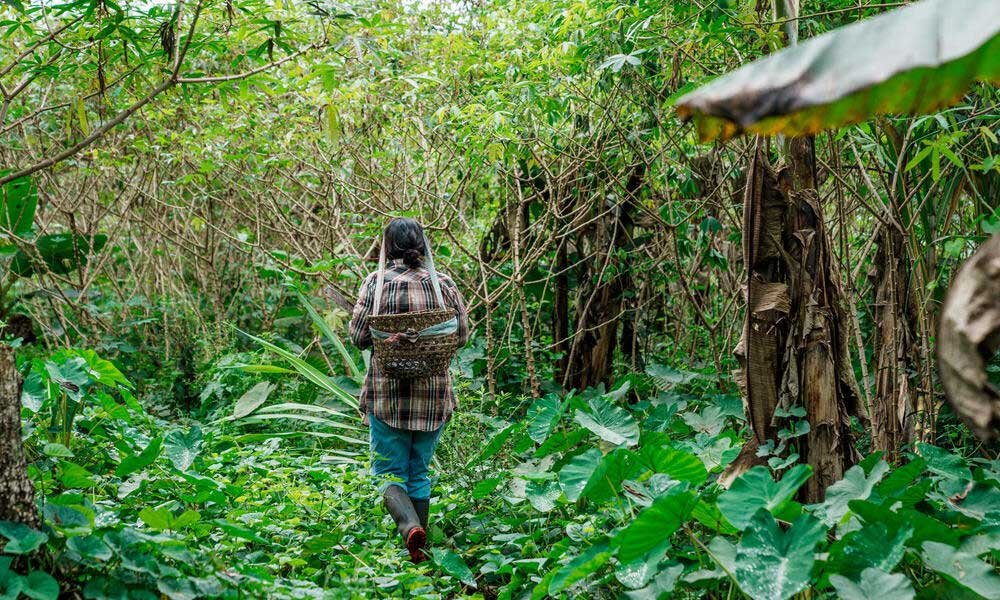

The Palora–Pastaza corridor will be the largest of its kind in Ecuador’s Amazon, linking protected forests with Indigenous territories, and helping wildlife migration.
Press Release – QUITO, Ecuador (July 29, 2025) – Ecuador’s government, in collaboration with Conservation International-Ecuador, World Wildlife Fund (WWF) and the Global Environment Facility (GEF), has officially recognized a vast stretch of Amazonian forest as a climate adaptation and connectivity corridor, designed to help wildlife migrate to cooler elevations as global temperatures rise.
Read this release in Spanish here | Lea este comunicado en Español aquí
Spanning 316,323 hectares (781,650 acres), the Palora–Pastaza corridor connects Sangay National Park with ancestral territories of the Shuar, Achuar and Kichwa Indigenous peoples. With altitudes ranging from 358 to 1,700 meters (1,175 to 5,577 feet), the corridor will offer routes for jaguars, Amazonian tapirs, woolly monkeys and other species to move in search of food, mates and suitable habitat.
“Climate change is driving species from their traditional habitats toward cooler, higher-elevation refuges – making unbroken corridors essential for their survival. This connectivity corridor serves as a vital migration pathway, enabling Amazon wildlife to adapt and persist as our planet transforms,” said Carolina Rosero, Vice President and Executive Director of Conservation International in Ecuador.
Unlike traditional protected areas, connectivity corridors are designed to link fragmented ecosystems while supporting sustainable, community-led land use. In Palora–Pastaza, 84 percent of the corridor lies within ancestral Indigenous territories, where Achuar, Kichwa and Shuar communities — along with two provincial and six municipal governments — are leading conservation efforts rooted in local governance and traditional knowledge.
“The forest is important to us. Our father always told us to share it with other communities — show others the importance of protecting the forest,” said José Vargas, president of the Arutam Protected Forest, a Shuar area located within the corridor. “It makes me happy to see other nationalities participating, because unity will help us conserve nature.”
The work to develop the Palora–Pastaza corridor began in 2023. Indigenous communities, through a process of free, prior and informed consent, collectively chose to include their territories in the corridor. Conservation International-Ecuador supported the creation of a working group of Indigenous and local government representatives to manage the corridor and ensure its long-term sustainability.
An analysis by Conservation International-Ecuador and EcoCiencia-Kolibria identified optimal wildlife migration routes based on forest cover, topography and roads. “The connectivity analysis considered the most viable routes for animal movement, considering various factors, like the distance between areas of primary forest, to determine which paths are less difficult for species to travel,” Woolfson said.
According to Santiago Moreno, Undersecretary of Natural Heritage in Ecuador’s Ministry of Environment, “The country’s national regulations allow the creation of connectivity corridors, considered a regional territorial strategy within special areas for biodiversity conservation. These corridors function as a local planning and management tool aimed at reducing the effects of landscape fragmentation.” This initiative will also contribute to sustainable development.
Key impacts of the Palora–Pastaza corridor:
- 2,000 local people will benefit directly through sustainable production programs. The project will advance community-led conservation by establishing field schools to promote land management, and by providing funding and technical assistance for bioeconomy initiatives that provide sources of income.
- The corridor provides habitats for more than 1,910 animal species and 2,600 plant species.
- Key endangered or vulnerable species include the jaguar, mountain tapir, Andean bear, giant anteater, woolly monkey, channel-billed toucan and Andean eagle.
- The corridor is part of the Amazonian Connectivity Corridors project, led by Ecuador’s Ministry of Environment, Water and Ecological Transition and Conservation International–Ecuador, with support from World Wildlife Fund (WWF) and funding from the Global Environment Facility (GEF).
- The Amazonian Connectivity Corridors project is part of the Amazon Sustainable Landscapes Program, an initiative funded by the GEF and led by the World Bank to protect globally significant biodiversity and implement policies to foster sustainable land use and restoration of native vegetation cover.
“The Palora–Pastaza Corridor reflects the leadership and commitment of Ecuador and its Indigenous communities to conserve the Amazon and build resilience,” said Carlos Manuel Rodríguez, GEF CEO. “It’s an example of how investments in nature deliver real benefits for people and the planet.”
The Amazon is a priority landscape for WWF Ecuador, where they have been working for years in close collaboration with local and international partners. That’s why the Palora–Pastaza corridor is a key step towards strengthening ecological connectivity and advancing our conservation efforts in this priority landscape. “This project shows what’s possible when Indigenous leadership, conservation organizations and political will come together to protect nature,” said Tarsicio Granizo, Director of WWF-Ecuador. “This corridor not only helps wildlife adapt as the climate changes but also safeguards the future of the Amazon.”
The dossier, jointly developed through a participatory process by CI-Ecuador, WWF, EcoCiencia, Kolibria, and Ecuador’s Ministry of the Environment, Water and Ecological Transition, together with the provincial autonomous decentralized governments of Pastaza and Morona Santiago, the cantonal governments of Pastaza, Palora, Pablo Sexto, Huamboya, Morona, and Taisha, as well as the organizations of the Shuar, Achuar, and Kichwa peoples present in the area (FENASH-P, NAE, NASHE, and the Chiwias, Uyuimi, and Copataza associations), was submitted to the Ministry at the end of March 2025 as part of the official procedure for the corridor’s recognition.
This effort was also made possible thanks to Re:wild and its support in strengthening MAATE’s technical and institutional capacities, in line with its commitment to Target 3 of the Global Biodiversity Framework.
About Conservation International: Conservation International protects nature for the benefit of humanity. Through science, policy, fieldwork and finance, we spotlight and secure the most important places in nature for the climate, for biodiversity and for people. With offices in 30 countries and projects in more than 100 countries, Conservation International partners with governments, companies, civil society, Indigenous peoples and local communities to help people and nature thrive together. Go to Conservation.org for more, and follow our work on Conservation News, Facebook, Twitter, TikTok, Instagram and YouTube.
About WWF: For more than 60 years, WWF has been protecting the future of nature. The world’s leading conservation organization, WWF works in 100 countries and is supported by more than 1.3 million members in the United States and close to 5 million globally. In Ecuador, it’s been working for more than 20 years in different regions such as the Amazon, costal marine ecosystems and Galapagos. WWF’s unique way of working combines global reach with a foundation in science, involves action at every level from local to global, and ensures the delivery of innovative solutions that meet the needs of both people and nature. For more information go to worldwildlife.org and wwf.org.ec.
About GEF: The Global Environment Facility (GEF) includes several multilateral funds working together to address the planet’s most pressing challenges in an integrated way. Its financing helps developing countries address complex challenges and work towards meeting international environmental goals. Over the past three decades, the GEF has provided more than $26 billion in financing, primarily as grants, and mobilized another $148 billion for country-driven priority projects. For more information go to thegef.org and follow GEF social media: LinkedIn, Twitter, Instagram and Facebook.