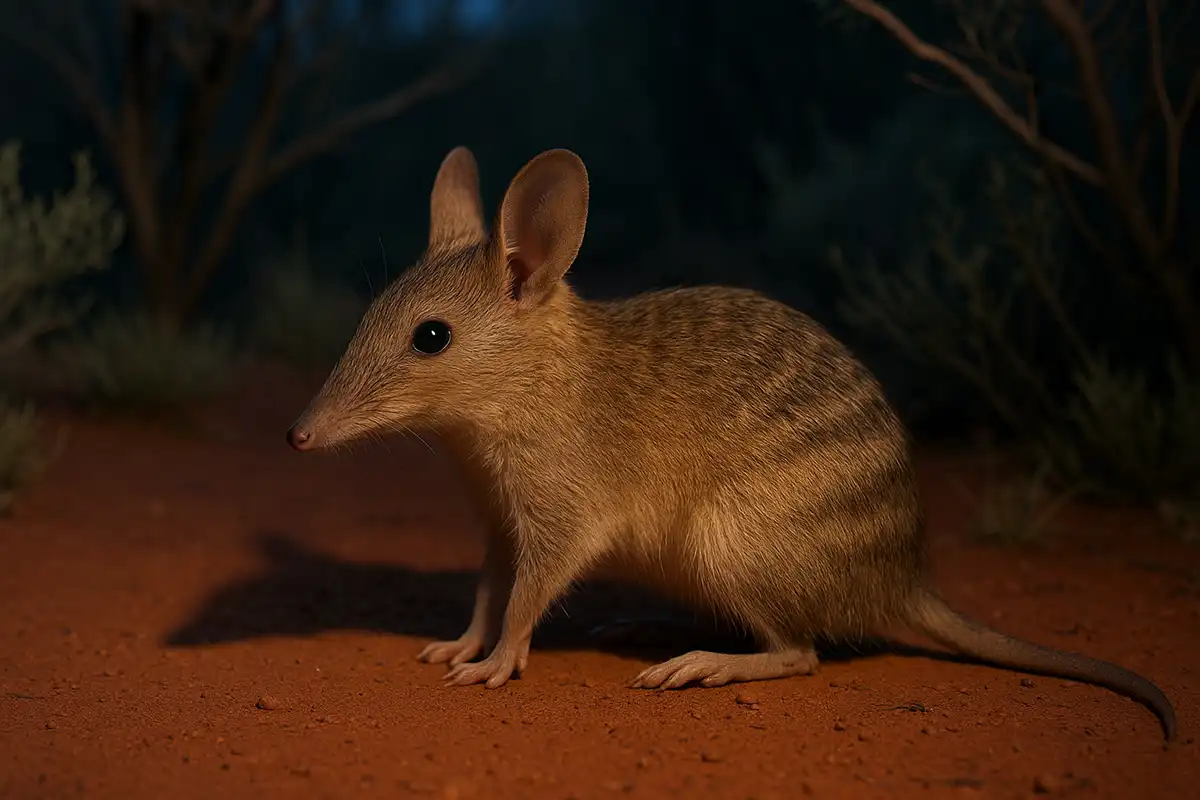
Epitaph for the Marl: The South-Western Barred Bandicoot

News in brief — October 2025

  • IUCN has listed the Marl / south-western barred bandicoot (Perameles myosuros) as Extinct (EX) in its latest global Red List update announced at the IUCN World Conservation Congress in Abu Dhabi. This is the species’ first global IUCN assessment, and it enters the Red List as Extinct. IUCN World Conservation Congress+1
  • Last known records: museum specimens collected in 1906–1907 in south-western Western Australia. Wikipedia+1
  • The update notes three Australian bandicoots newly entering the Red List as Extinct: the Marl (P. myosuros), south-eastern striped bandicoot (P. notina), and Nullarbor barred bandicoot (P. papillon). IUCN World Conservation Congress+1

Epitaph for the Marl

Small night-gardener,
you stitched the wheatbelt’s seams
with quiet paws and a nose for rain.

Between spinifex and saltbush
you kept the dark alive—
tending seeds, turning soil,
a lantern of whiskers in the scrub.

We fenced the horizon,
unleashed the teeth that never slept,
let fire run long and hot.
Your trail became a question mark
no map could answer.

Sleep now, marl.
In the dune’s soft grammar
your commas still hold breath.

Contextual background

The Marl / south-western barred bandicoot was once widespread across semi-arid shrublands of south-western Western Australia, but it slid into obscurity early in the 20th century; the last specimens were taken in 1906–1907. For decades it was lumped with the living Western Barred Bandicoot (Perameles bougainville), until a 2018 total-evidence study of museum material clarified that P. myosuros was a distinct species—already gone.

Australia’s federal Threatened Species Scientific Committee formally listed the Marl as Extinct under the EPBC Act in March 2021, noting historical declines driven by habitat clearing in the wheatbelt, altered fire regimes, and predation from introduced foxes and cats. The IUCN Red List then adopted the species in October 2025, immediately categorizing it as Extinct in its global update.

The Marl’s story sits within a broader pattern: Australia has lost an outsized share of its small marsupials since European colonisation, with introduced predators and landscape transformation repeatedly implicated. Safeguarding surviving bandicoots now depends on predator-free refuges, rigorous biosecurity, and large-scale shrubland restoration—lessons drawn from both failures and the successful reintroductions of close relatives on fenced sanctuaries and offshore islands.

Sources

Wikipedia+2recentlyextinctspecies.com+2

Department of Agriculture

IUCN World Conservation Congress

QUT

Latest Posts

More from Author

Between Recovery and Reformation: Christianity’s Need to Reform Anthropocentric Theology

The question of whether Christianity can become genuinely "green" forces us...

The Vanished Cities of the Amazon: Evidence of Pre-Columbian Civilizations

Christianity must both recover suppressed creation-centered traditions and fundamentally reform anthropocentric theology—authentic recovery itself transforms doctrine.

Gaia Song

Gaia Frequencies — The Voice...

Read Now

Do Androids Dream of Electric Sheep? Philip K. Dick’s Question Meets Quantum Consciousness and the Age of AI

The question Philip K. Dick posed in 1968 was never really about sheep. It was about the ineffable thing that separates life from simulation, consciousness from computation, being from seeming. In his dystopian San Francisco, where nuclear fallout had rendered authentic animals nearly extinct, owning a real sheep...

Between Recovery and Reformation: Christianity’s Need to Reform Anthropocentric Theology

The question of whether Christianity can become genuinely "green" forces us into uncomfortable theological and philosophical territory. It requires confronting not merely lapses in practice but potential flaws in foundational doctrine, while simultaneously excavating buried wisdom that mainstream Christianity has systematically suppressed. The tension between recovering lost...

The Vanished Cities of the Amazon: Evidence of Pre-Columbian Civilizations

Christianity must both recover suppressed creation-centered traditions and fundamentally reform anthropocentric theology—authentic recovery itself transforms doctrine.

Gaia Song

Gaia Frequencies — The Voice of Earth · 600 CE *, *::before, *::after { box-sizing: border-box; margin: 0; padding: 0; } ``` :root { --font-display:...

Moltbook: The Bot-Only Social Network Isn’t the Singularity—It’s a Stress Test for the Agent Era

*An ABC Australia report on Moltbook (February 2026) and the ensuing security coverage is the spark for this commentary—because beneath the memes is a serious preview of where “agentic AI” is heading.*¹ - Kevin Parker - Site Publisher Moltbook arrived like a prank from the near future: a...

The Poles: Arctic and Antarctic Wilderness

Earth’s poles—vast, fragile, warming fast—anchor global climate. Indigenous wisdom, science, and cooperation are key to preserving these icy wildernesses.

The Large Language Model Landscape of February 2026

The Permian competition tightens: pruning, agentic browsers, and the energy bill becomes law. February 2026 doesn’t feel like a month of flashy invention. It feels like a month of selection. Not the Cambrian chaos of 2025—new architectures every week, new “god models” proclaimed hourly—but the colder logic of the...

The Attention Trap: Social Media Addiction, Behavioural Design, and the Architecture of Digital Wellbeing

The digital landscape of the mid-2020s is defined not by the information it provides, but by the relentless competition for the human focus that consumes it. This essay explores the phenomenon commonly termed "social media addiction," examining the delicate balance between the profound social utility of these...

Personal Rewilding: An Antidote to the Unquiet Cage

We are animals built for the wild, yet we live in a state of profound containment. The glow of the screen is our new sunrise. The air we breathe is conditioned, recycled, and sealed inside enclosures where we spend, by some estimates, more than 90 percent of our...

South Asia Wilderness – Sacred Groves to Tiger Reserves

1. Historical Baseline Pre-1750 Wilderness Extent The tiger's roar echoed through sal forests stretching from the Brahmaputra to the Indus, a distance of 3,000 kilometers unbroken by any major human settlement. In 1750, the Indian subcontinent's 4.4 million square kilometers contained 80% wilderness—dense forests, vast grasslands, and wetlands supporting...

Europe’s Biodiversity: A Continent at a Crossroads

Listen to our short audio summary to get a sense of this article The Fading Echo of a Wilder Europe Europe, to the modern eye, is a continent of profound human influence. Its landscapes are a mosaic of ancient cities, manicured fields, and managed forests, a testament to...

The Atomic Bodhisattva: The Life, Work, and Legacy of Joanna Macy

“Active Hope is waking up to the beauty of life on whose behalf we can act. We belong to this world.” Joanna Macy Although our paths never crossed, the life and work and work of Joanna Macy have been a significant influence on my own activism and impulse...
error: Content unavailable for cut and paste at this time