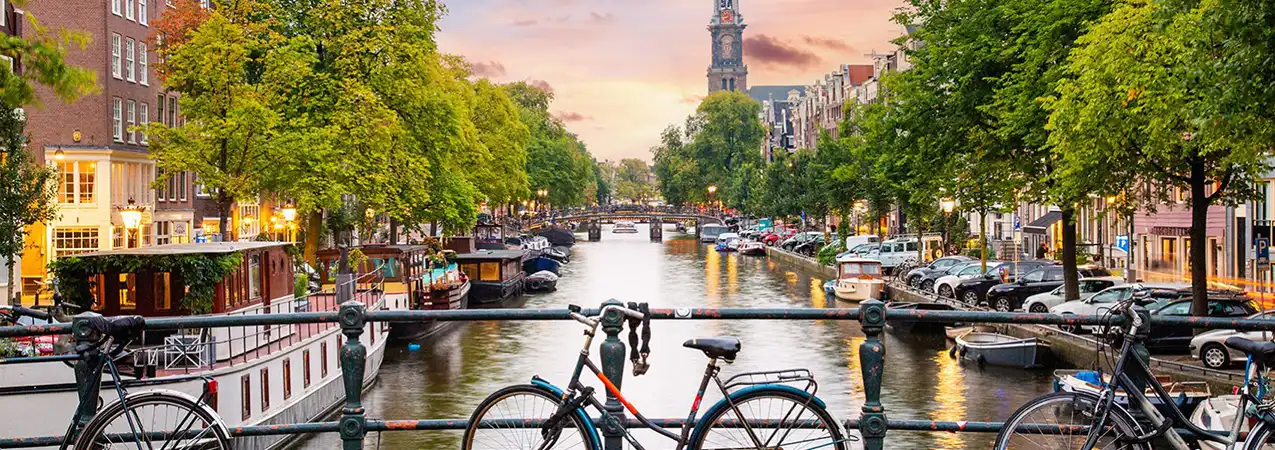

Amsterdam is the city that other cities dream of becoming. Its cycling culture is imitated on every continent; its canal ecology has been recovered from near-death to become a European benchmark; its commitment to public space and human-scale urbanism has generated a literature of admiration so extensive that separating the myth from the measurable achievement has become its own analytical challenge. But the city that urban planners celebrate as a model is simultaneously a city in acute housing crisis, under extraordinary tourist pressure, and confronting the deep question of whether its celebrated environmental gains can survive the social and economic forces that its own success has unleashed.
On a Tuesday morning in October, on the Prinsengracht between the Westerkerk and the Looiersgracht, the canal is doing several things at once. A grey heron stands on a houseboat mooring, patient as only herons can be, watching the water with the focused attention of a fisher who knows the water is worth fishing. Two great crested grebes are working the deeper channel near the bridge, diving with the unhurried efficiency of birds that have no reason to hurry. A cormorant hangs its wings out to dry on a bollard, its posture somewhere between heraldic and exhausted. Beneath the surface, which is clear enough this morning to show the green shimmer of aquatic vegetation, there are perch and bream and occasionally pike — species that had no business being in this canal fifty years ago, when the water they would have needed to breathe was not available to them.
The ecological recovery of Amsterdam’s canal system is one of the less celebrated but more instructive environmental achievements in European urban history. In the 1960s and 1970s, the grachten — the 165 kilometres of canal that define the city’s physical character and give it its UNESCO World Heritage designation — were, by most accounts, functionally dead: oxygen-depleted, polluted with domestic sewage, industrial discharge, and the accumulated nutrients of a century of inadequate wastewater treatment, their water the colour and smell that proximity to nine hundred years of urban metabolism produces when the infrastructure for removing that metabolism’s products has not kept pace with its generation.1 The herons and grebes and cormorants that have made the canal system their home are not decorative. They are indicators: species that require a food web sufficiently functional to support them, which requires water quality sufficiently good to support the fish that require it. Their presence is a measurement.
That measurement matters more than it might seem, because Amsterdam’s reputation in the international green city discourse rests primarily on its cycling infrastructure — which is genuine, and which deserves the attention it receives — while the city’s ecological achievements are less often discussed and the city’s failures are less often examined than its successes. This article attempts a more complete account.
A City Built Against Water and For It
Amsterdam’s entire existence is a hydraulic argument. The city was founded in the thirteenth century on a peat bog at the mouth of the Amstel River, its earliest inhabitants driving timber piles through the soft ground to reach the firm sand below and building on those foundations a city that has been fighting — and cooperating with, and engineering, and arguing about — water ever since.2 The canal ring of the seventeenth century — the Herengracht, Keizersgracht, and Prinsengracht, the three great arcs of the Golden Age city — was not built for aesthetic reasons, though it produced aesthetic consequences of extraordinary durability. It was built for the movement of goods: a hydraulic logistics system that made Amsterdam the centre of the global trading economy at a moment when maritime trade was the mechanism by which the world was commercially integrated. The canal houses that line these waterways — the narrow, tall, gable-fronted buildings whose reflections have been reproduced in approximately forty million tourist photographs — were warehouses as well as residences, their attic hoists still projecting over the water because the canals were how things arrived and how they left.
The polder system that underlies the entire city — the network of pumped drainage that keeps the reclaimed land on which Amsterdam sits above the water table — is the largest and most complex hydraulic infrastructure in the Netherlands, which is itself the most hydraulically engineered nation on Earth. More than half of the Netherlands lies below sea level or in flood-prone river floodplains. The water boards — the waterschappen — are the oldest democratic institutions in the country, predating the national state, because managing water has always required collective governance: one farmer’s decision to drain their field is another farmer’s flood, and the coordination problem that water management poses has been the forcing function for civic institution-building in the Low Countries since the medieval period.3 Amsterdam is not simply a city that happens to have water in it. It is a city constituted by the social and political organisation that water management requires.
The twentieth century treated this relationship carelessly. The postwar decades brought the car to Amsterdam on the same terms that it arrived in most European cities: as a liberation technology whose space requirements were accommodated by filling canals, demolishing buildings, and converting public space to roads and parking. Approximately a third of the inner-city canal system was filled in during the 1950s and 1960s to create roads and car parks.4 The Nieuwmarkt neighbourhood was partially demolished to make way for a metro line and a motorway in the 1970s — an intervention that provoked one of the most significant episodes of urban civic resistance in Dutch history, with squatters and residents fighting police in street battles that became known as the Battle of the Nieuwmarkt, and that permanently altered the political culture of Amsterdam’s relationship with large-scale infrastructure projects and citizen participation in planning decisions.
The cycling culture that Amsterdam is now famous for was not an inheritance or a natural expression of Dutch character. It was a political choice, made in the 1970s in response to precisely the car-dominated future that the Nieuwmarkt demolitions represented. The Stop de Kindermoord — Stop the Child Murder — movement, which took its name from the unacceptable rate of child road deaths in Dutch cities and its energy from the oil crisis of 1973 and the broader countercultural politics of the period, pressured successive Amsterdam administrations to reverse the prioritisation of cars in the city’s streets. The result, over the following four decades, was the progressive construction of the cycling infrastructure that the world now admires: not a natural feature of a flat landscape but a hard-won political achievement.5
The Bicycle: What the Achievement Actually Is
Amsterdam has approximately 900,000 bicycles for a population of approximately 930,000 residents — a ratio that has been widely cited and that is, even accounting for the imprecision of bicycle counts, indicative of something structurally different from the relationship between cycling and daily life in comparable European cities.6 Cycling accounts for approximately 38 percent of all trips within the city — a modal share that is the highest of any major city in the world — with some studies suggesting it reaches 48 percent of trips within the canal ring. The cycling infrastructure that supports these numbers comprises approximately 800 kilometres of dedicated cycle paths, a network of traffic-light priority systems, extensive secure parking at transit hubs, and a street design culture in which cyclists are the assumed primary user and cars are managed as guests rather than hosts.
The health dividend from this modal share is substantial and documented. Research published in the British Medical Journal estimated that the cycling levels in the Netherlands as a whole contribute approximately 6,500 premature deaths avoided annually, primarily through the cardiovascular and metabolic benefits of regular physical activity embedded in the daily commute rather than extracted as separate exercise.7 The air quality benefit is also real: a city in which more than a third of journeys are made by bicycle is a city with significantly lower traffic-generated nitrogen dioxide, particulate matter, and noise pollution than it would otherwise be. Amsterdam’s air quality still exceeds WHO guideline levels for NO2, primarily from remaining traffic and from the regional industrial background of the Rhine-Ruhr corridor that its geography cannot escape. But the counterfactual — Amsterdam without its cycling infrastructure, with equivalent trips made by car — would be substantially worse.
The bicycle infrastructure has also shaped Amsterdam’s urban form in ways that are difficult to disentangle from the cycling statistics themselves but that represent the deeper environmental achievement. A city in which cycling is the primary mode for most journeys does not need the road width, the parking provision, or the low-density land use patterns that car-dependent cities require. Amsterdam’s inner city is dense, mixed-use, walkable, and economically diverse at street level in ways that are structurally enabled by the absence of the car-storage requirements that have hollowed out the street-level experience of comparable cities. The canal houses that were once warehouses are now apartments, offices, galleries, and small shops, at a density and a grain that only survives without large car parks and arterial roads consuming the adjacent space.
The Fietsbrug — the cycling bridge — has become an architectural type in Amsterdam in the way that the overpass is an architectural type in Los Angeles: a piece of infrastructure that expresses the city’s priority ordering. The new cycling bridge across the IJ waterway, connecting the central station to the Noord district, carries approximately 10,000 cyclists per day and was designed and built with a quality of civic attention usually reserved for road infrastructure in cities less committed to cycling.8 It is a banal but revealing comparison: the infrastructure a city spends money on, and spends it carefully on, is the infrastructure the city believes in.
The Canal Ecology: A Recovery Worth Examining
The recovery of Amsterdam’s canal ecology since the 1980s is a more demanding story to tell than the cycling achievement, because it involves infrastructure that most visitors do not see, science that is not easily summarised in a modal share statistic, and an ongoing management challenge that is less triumphant than the cycling narrative and more honestly complex.
The primary driver of the recovery was wastewater. Amsterdam completed a programme of combined sewer separation — the physical separation of domestic sewage drainage from stormwater drainage, so that rainwater runoff no longer carries raw sewage into the canal system during heavy rain events — across much of the inner city from the 1980s onwards.9 The Waternet organisation, which manages Amsterdam’s water cycle from drinking water production to wastewater treatment and canal water quality, has operated a flushing system since the 1990s: sluices at the periphery of the canal ring that regulate the exchange of water between the canals and the IJ and Amstel, pushing fresh water through the system to dilute the nutrient loading and maintain the oxygen levels that aquatic life requires. The combination of reduced sewage input and active water management has been the foundation of the ecological recovery.
By the 2010s, the canal system had achieved a water quality classification that allowed public swimming in designated areas — a transformation from conditions that would have made swimming a serious health risk thirty years earlier.10 The Amsterdam Open Water Swim, the swim across the IJ that has been held annually since 2000, and the designated swimming zones in the Sloterplas and Gaasperplas recreational lakes, reflect a genuine and measured improvement in water quality rather than a promotional claim. Independent monitoring by Waternet and the Rijnland water authority documents dissolved oxygen levels, biological oxygen demand, E. coli concentrations, and aquatic macroinvertebrate diversity at regular intervals across the canal system, and the trend lines are unambiguously positive.
The ecological complexity of the canals, however, reveals the limits of water quality improvement as a sufficient goal. The canal system’s sediment — the accumulated layer of historic pollutants, heavy metals, and organic material deposited across a century of industrial and domestic use — remains in place beneath the improved water column.11 Dredging is necessary for navigation but disturbs the sediment, temporarily degrading water quality. The ratio of hard to soft edges in the canal system — concrete walls versus naturalised banks — limits the marginal habitat available for the aquatic and semi-aquatic species that water quality improvement could, in principle, support. The canal ring is a heritage landscape managed under UNESCO conservation constraints that limit the physical modifications that would most benefit its ecological function: naturalised banks, variable water depths, emergent vegetation zones. The herons and grebes are genuine, but the canal system’s ecological potential is constrained by the very heritage status that protects its architectural character.
The microplastics problem is an emerging concern that Amsterdam’s water managers are beginning to address with the seriousness it deserves. Research by the Vrije Universiteit Amsterdam and the Amsterdam Institute for Advanced Metropolitan Solutions has identified microplastic concentrations in the city’s canal system at levels that are, while not yet at acute ecological risk thresholds, sufficiently elevated to warrant concern about long-term accumulation in the food web.12 The primary sources are the tyre wear particles, synthetic textile fibres, and packaging fragments that enter the canal system through stormwater runoff and direct littering. The cycling culture that has done so much for Amsterdam’s air quality does not solve the microplastics problem; bicycle tyres, like car tyres, shed particles that enter the drainage system.
Tourism: The Paradox of the Model City
Amsterdam received approximately 22 million overnight visitors in 2023, in a city of 930,000 permanent residents — a ratio of nearly 24 visitors per resident that is among the most extreme of any major European city.13 The canal ring that gives the city its character, the cycling infrastructure that has made it an international model, the public squares and the brown cafes and the vibrant street life that make it so legible as a liveable city: these things have been marketed so effectively, to such a large global audience, that the city is in significant danger of being consumed by its own reputation.
The mechanism is direct and familiar from Barcelona, from Venice, from Prague, and from every city that has successfully marketed its environmental and cultural heritage to a global tourism market. Short-term rental platforms — Airbnb and its equivalents — have converted a substantial fraction of Amsterdam’s housing stock from residential use to tourist accommodation, particularly in the canal ring and the Jordaan and De Pijp neighbourhoods whose architectural and social character is the primary attraction. The conversion reduces the supply of housing available to residents, raises rents across the wider market as the most desirable areas become effectively tourist-only enclaves, and displaces the local commercial and social ecology — the butchers, the bakers, the neighbourhood associations, the informal public life — that constituted the lived character the tourists arrived to experience.
The Amsterdam municipality’s response has been more sustained and more legally sophisticated than most comparable cities have managed. The city has imposed a cap on the number of nights per year that a primary residence can be let through short-term rental platforms — reduced from 60 nights to 30 nights in 2019, and to zero in parts of the canal ring — and has deployed enforcement technology including platform data-sharing agreements and neighbourhood inspectors to identify non-compliant listings.14 A complete ban on new short-term rental licences in the canal ring neighbourhoods, implemented in 2020, has reduced the number of tourist apartments in the most affected areas. In 2023, the city announced that it would phase out cruiseship terminal operations from the city centre by 2035 — a decision that addressed both the canal system’s pollution loading from large vessels and the concentrated tourist flows that cruiseships generate in a port city with limited space to absorb them.
The effectiveness of these measures has been partial. Short-term rental platforms have adapted their platforms to route around the tightest restrictions, and the administrative capacity to enforce consistently across the tens of thousands of listings that operate across the metropolitan area at any given time is genuinely limited. The displacement of tourist accommodation from the canal ring into adjacent neighbourhoods — Oud-West, Bos en Lommer, the eastern docklands — has extended the spatial footprint of tourism’s housing market impact without eliminating it. The underlying economics — the gap between what a tourist apartment generates per week and what a residential tenant pays per month — is not closed by a 30-night cap unless enforcement is sufficiently consistent to prevent the gap from being exploited.
The cruiseship decision is more structurally significant, because it addresses a form of tourist infrastructure that is more clearly within the city’s direct control than the distributed market of short-term rental platforms. The ships that dock at the NDSM wharf and the Java Island terminal bring passengers in volumes — the largest vessels carry over 5,000 people — that are difficult to absorb into the canal ring’s spatial and ecological capacity. The nitrogen oxide and particulate emissions from auxiliary diesel generators running at berth have been a documented source of air quality degradation in the docklands area, affecting residential communities in the Noord and Oostenburg districts that are not primarily tourist destinations.15 The phaseout, if implemented on schedule, will represent the most tangible physical expression of the city’s willingness to trade tourism revenue for resident welfare and environmental quality.
Housing: The Affordability Crisis and Its Ecological Consequences
Amsterdam’s housing crisis is, by European standards, severe. Average house prices in the city reached approximately €600,000 in 2023 for a mid-range apartment — prices that, in a city where the median household income is approximately €45,000 per year, place homeownership beyond the reach of most residents without inherited wealth or exceptional earnings.16 The private rental market has responded to the gap by producing rents that are equally inaccessible to the median income earner, particularly for the larger apartments that families require. The result is a sustained and accelerating demographic shift: younger residents, families with children, and lower-income households are being displaced from the inner city — and increasingly from the inner suburbs — to the outer metropolitan ring and beyond, to satellite towns like Almere and Purmerend that have the land supply for affordable housing but lack the cycling infrastructure, the canal ecology, the social density, and the environmental quality of the city whose population they are absorbing.
The displacement has direct environmental consequences that are underappreciated in the literature on Amsterdam’s urban model. A resident displaced from the canal ring to Almere, thirty kilometres to the east, is a resident whose daily commute has been transformed from a cycling journey to a car or train journey, whose access to the canal swimming zones and the IJ waterfront has been reduced from a short cycle to a half-hour commute, and whose relationship with the city’s cycling culture — which is enabled by proximity and convenience rather than by preference alone — has been structurally weakened.17 The environmental benefits of Amsterdam’s urban form are not portable: they cannot be taken to Almere. They accrue to the people who live within the city’s cycling-distance geography, and the housing market is progressively ensuring that those people are disproportionately the wealthy.
Amsterdam has a substantial social housing sector — approximately 45 percent of its housing stock is in social housing, managed by the woningcorporaties, the housing associations that are among the largest social landlords in Europe.18 This provision has historically been the mechanism that maintained Amsterdam’s social heterogeneity — the presence of lower-income residents in central and inner-city neighbourhoods — against the pressures of a gentrifying property market. But the social housing sector has faced its own pressures: the 2013 decision by the national government to restrict the woningcorporaties to housing residents below a certain income threshold, which was intended to improve targeting of social housing toward those most in need, inadvertently removed the mixed-income character of many social housing estates by preventing the associations from housing middle-income residents. The waiting list for social housing in Amsterdam has reached twelve to fifteen years in many categories — a figure that makes it functionally inaccessible to anyone in acute housing need and that represents a failure of provision at the scale the city requires.
Water, Climate, and the City Below Sea Level
The Netherlands faces the most acute sea level rise challenge of any wealthy European nation, and Amsterdam faces it from a position of particular exposure: much of the city sits one to three metres below mean sea level, protected by a combination of dikes, pumps, and the institutional machinery of the water boards that has managed the Dutch hydraulic system for seven centuries.19 The IPCC’s sea level rise projections for the North Sea — ranging from approximately 0.3 metres under optimistic scenarios to more than a metre under high-emissions scenarios by 2100, with higher values possible if marine ice sheet instability accelerates — represent a challenge that Dutch water engineers have been planning for since the Delta Works were completed in 1986, and that has generated the most sophisticated long-term flood risk governance in the world.
The Delta Programme — the Netherlands’ national adaptive water management strategy, updated annually — commits approximately €1 billion per year to flood protection infrastructure, freshwater supply management, and spatial planning that reduces flood risk exposure.20 Amsterdam’s specific contribution to this national programme includes the ongoing reinforcement of the ring dike that protects the city, the management of the IJ Lake water level to buffer flood risk from North Sea surge events, and a spatial planning framework that restricts the most flood-sensitive land uses in the lowest-lying polders of the metropolitan area. The Netherlands’ management of the sea level rise challenge is the most credible in the world not because its engineers have found a technical solution that others lack, but because it has built the institutional framework — the water boards, the Delta Programme, the culture of long-term collective investment in hydraulic infrastructure — that allows the management of a challenge that requires action on decadal timescales within governance systems that operate on annual or quadrennial cycles.
The urban heat island is a more recent and less institutionally embedded concern. Amsterdam’s climate is oceanic rather than continental, and its summer temperatures are moderated by the North Sea in ways that give it a lower heat mortality risk than Milan, Barcelona, or London. But the summers of 2018, 2019, and 2022 brought heat events to the Netherlands that exceeded the design assumptions of the built environment — the poorly insulated housing stock that performs adequately in the cool, wet conditions it was built for becomes a significant heat trap when ambient temperatures exceed 35 degrees Celsius for multiple consecutive days.21 The Netherlands recorded its all-time temperature record of 40.7 degrees Celsius in July 2019 at Gilze-Rijen, and the excess mortality during the 2019 heat wave — several hundred above the seasonal baseline nationally — demonstrated that the country’s heat adaptation measures, which were designed for a climate that is no longer reliably present, require updating.
Amsterdam’s response to urban heat has been organised around a combination of green roof installation incentives, street tree planting, and the greening of school playgrounds — often heat islands themselves, with dark asphalt surfaces and minimal shade — through the City in a Park programme.22 The city’s urban heat island map, produced by the KNMI (Royal Netherlands Meteorological Institute) and the municipality, identifies the hottest urban pockets with a spatial precision that the cooling and greening investment is being directed toward. The analysis is well-designed and the direction is correct. The pace of implementation — constrained by budget, by the logistical complexity of greening a dense historic city, and by the heritage restrictions that limit tree planting in the canal ring — is slower than the warming climate requires.
Energy, Food, and the Circular Ambition
Amsterdam’s climate strategy commits the city to carbon neutrality by 2050, with interim targets of 55 percent reduction in greenhouse gas emissions by 2030 relative to a 1990 baseline.23 The strategy is most advanced in the areas where the city has direct operational control: its own buildings and vehicles are progressively being electrified, renewable electricity procurement for city facilities is largely complete, and the municipal fleet has been substantially converted from diesel. The building stock — Amsterdam’s version of the mineral inheritance problem that confronts every northern European city — is the hardest component. The city’s characteristic canal houses are often listed buildings subject to heritage restrictions that limit or complicate standard insulation and heat pump installation. Cavity walls do not exist in seventeenth-century brick construction. The interaction between heritage protection and energy performance is a genuine tension that Amsterdam’s planning authorities are managing with increasing sophistication but without having resolved it.
The city has been an early and relatively serious adopter of circular economy principles in its procurement and waste management. The Amsterdam Circular Strategy 2020–2025 — developed with the Ellen MacArthur Foundation and Metabolic, the sustainability consultancy — set targets for the reduction of new material consumption in the built environment and food system, the extension of product lifetimes through repair and reuse, and the elimination of waste-to-landfill from the city’s own operations.24 The programme’s most visible expression has been in the construction sector, where the city has required circular procurement standards on a number of major public building projects — the renovation of the Stadsarchief, the construction of new social housing — and has developed a materials passport system for buildings that allows structural elements to be tracked, valued, and reused at end of building life rather than demolished to landfill.
Urban food production has a longer and more embedded history in Amsterdam than in most comparable European cities. The city’s allotment garden network — the volkstuinen — provides approximately 4,500 plots distributed across parks and peripheral land, available to residents at low-cost annual rental and constituting both a food production system and a social institution of considerable longevity.25 The Buiksloterham neighbourhood in Amsterdam-Noord — a former industrial area undergoing residential and mixed-use redevelopment — has become the location of the city’s most ambitious circular urbanism experiment, with a nutrient loop that connects food waste composting, urban agricultural production, and wastewater treatment in a closed-cycle system that eliminates organic waste rather than exporting it to landfill. The neighbourhood is small, and the circular systems that work at its scale face significant challenges of replication across the full metropolitan area. But it is a functional demonstration rather than a rendering, and functional demonstrations at small scale are where structural changes in urban metabolism tend to begin.
The Contradictions of the Celebrated City
Amsterdam’s environmental story, told honestly, contains a tension that its international reputation does not always reflect: the city is simultaneously a genuine model for urban cycling, water ecology, and circular economy ambition, and a city whose housing crisis, tourism pressure, and carbon emissions from its port and airport are generating social and environmental damage that the cycling statistics cannot offset.
Schiphol Airport — one of the busiest cargo and passenger hubs in Europe, located twelve kilometres southwest of the city centre — is the largest single source of nitrogen emissions in the Netherlands, and its relationship with the nitrogen deposition problem that has become one of the most consequential environmental-political crises in recent Dutch history is direct.26 The nitrogen crisis — in which the European Court of Justice ruled that Dutch nitrogen deposition levels were incompatible with the EU’s Habitats Directive, triggering a cascade of legal restrictions on agricultural operations, construction projects, and infrastructure development that has reshaped Dutch politics since 2019 — has its roots in the same geography that makes the Netherlands environmentally productive: the combination of intensive livestock farming, industrial activity, and the weather patterns that concentrate their emissions in the air over one of the most biodiverse wetland and dune systems in northwestern Europe. Schiphol’s contribution to this chemistry is substantial, and the airport’s expansion plans — which the Dutch government has been attempting to reduce for political as well as environmental reasons — represent one of the most significant environmental governance battles in the country’s recent history.
The Port of Amsterdam — now the fourth largest port in Europe — generates diesel shipping emissions, industrial activity associated with the oil terminals and the cacao processing operations that make Amsterdam one of the world’s largest cacao trading hubs, and freight traffic that places a significant burden on the road and rail network of the metropolitan area.27 The port is undergoing a transition: the oil terminal volumes have been declining as European refining capacity consolidates, and the port authority is investing in shore power infrastructure and hydrogen bunkering that would reduce direct vessel emissions. But the port’s ecological footprint — in air quality, in noise, in water contamination from shipping operations — is not easily read from the cycling statistics of the canal ring seven kilometres to the east.
The ecological footprint of Amsterdam’s consumption — measured by the material flows that sustain the city’s population and economy, including the agricultural land, water, energy, and materials embedded in what Amsterdam’s residents eat, use, and discard — is estimated at several times the city’s own territorial area.28 This is not unique to Amsterdam; it is a feature of all wealthy city economies whose consumption draws on global supply chains. But it is a necessary corrective to any account of Amsterdam’s environmental achievement that rests primarily on the cycling modal share and the improved canal water quality, because those achievements are real and local while the ecological footprint is large and global. A city of cyclists who eat meat, fly regularly, and consume the output of global manufacturing supply chains is not ecologically sustainable in any meaningful sense of the term, however pleasant its public realm.
The Heron and the Housing Market
The heron on the Prinsengracht mooring is, in the end, a measure of something real. The canal water it is fishing is genuinely cleaner than it was fifty years ago. The cycling infrastructure that surrounds it is genuinely among the best in the world. The water management institutions that have kept this city, built below sea level on reclaimed peat, habitable and functional for nine centuries are genuinely among the most impressive pieces of collective governance anywhere on Earth. These achievements are not performative. They are structural, and they are durable, and they represent the accumulated result of political choices — the Stop de Kindermoord movement, the Nieuwmarkt resistance, the sustained investment in wastewater treatment and active canal management — that were not easy or inevitable.
The housing market that is displacing the families who would take their children cycling along those same canals is also real. The cruise ships that deposit five thousand passengers per vessel into streets designed for cyclists and pedestrians are real. The Schiphol nitrogen problem is real. The microplastics accumulating in the canal sediment are real. The circular economy ambitions, admirable as they are in design, are real at the scale of a single neighbourhood in Amsterdam-Noord and aspirational at the scale of a metropolitan area of a million people.
Amsterdam’s most honest contribution to the global green city discourse is not the cycling modal share, though that figure is genuinely instructive. It is the demonstration that environmental achievements are not self-sustaining — that a city can build the best cycling infrastructure in the world and still lose the social character that made cycling the natural choice, if the housing market prices out the residents who cycled and replaces them with residents who arrive by plane. Environmental quality and social equity are not separable projects. The city that neglects one while advancing the other does not have an environmental success. It has an environmental asset that is, over time, being privatised.
The heron does not know this. It is fishing. The canal is good enough to fish in. For as long as the city maintains the water quality that the heron requires, and manages the tourism that would otherwise crowd the mooring, and houses the residents who give the canal its human ecology, the heron will return. That conditional — for as long as — is the honest grammar of Amsterdam’s environmental story. It is a story about things that can be lost as well as things that have been gained.
Endnotes
1. Amsterdam canal water quality history: Waternet, Waterkwaliteitsrapportage Amsterdam (annual); and historical documentation in: Joop Schaminée and Jan Willems, Aquatische ecologie van de Amsterdamse grachten (KNNV, 2000). On the UNESCO designation (1987, extended 2010): UNESCO World Heritage Committee, Amsterdam Defence Line and Canal Ring documentation.
2. Amsterdam’s medieval founding and hydraulic origins: Herman Moscoviter, Amsterdam: A History (Boom, 2008); and Geert Mak, Amsterdam: A Brief Life of the City (Harvill Press, 1999). On the timber pile foundations: Amsterdam Monuments and Archaeology Service (Bureau Monumenten en Archeologie), archaeological survey data.
3. The Dutch water boards (waterschappen) as Europe’s oldest democratic institutions: Petra van Dam, ‘Denken over natuur en water in de Nederlanden,’ Tijdschrift voor Waterstaatsgeschiedenis (2010); and Rijkswaterstaat historical documentation. On the coordination problem in polder management: Piet Hoekstra, ‘Water Governance in the Netherlands,’ Water Policy (2012).
4. Canal filling in postwar Amsterdam: Michiel Wagenaar, Amsterdam 1876–1914: Economisch herstel, ruimtelijke expansie en de veranderende ordening van het stedelijk grondgebruik (Historisch Seminarium UvA, 1990); and Amsterdam Municipal Archives, canal filling records 1950s–1970s. The fraction of the canal system filled is contested; most estimates suggest approximately one-third of the pre-war system was lost to road-building.
5. Stop de Kindermoord and the origins of Dutch cycling culture: Pete Jordan, In the City of Bikes: The Story of the Amsterdam Cyclist (Harper, 2013) — the most accessible English-language account. On the 1973 oil crisis as a catalyst: Carlton Reid, Roads Were Not Built for Cars (Island Press, 2015). On the Nieuwmarkt resistance: Eric Duivenvoorden, Maagdenhuisbezetting 1969 en de Provo-beweging (De Bezige Bij, 2005).
6. Amsterdam cycling statistics: Gemeente Amsterdam, Onderzoek, Informatie en Statistiek (OIS), Fietsfeiten Amsterdam (annual). The 900,000 bicycle estimate is from the most recent OIS survey. The 38% modal share figure is from the 2022 Mobiliteitsonderzoek Amsterdam. On cycling’s dominance within the canal ring: data from the Amsterdam Metropolitan Area transport model.
7. Health benefits of Dutch cycling levels: Hartog et al., ‘Do the Health Benefits of Cycling Outweigh the Risks?’ Environmental Health Perspectives (2010) — the study estimating 6,500 deaths avoided annually in the Netherlands from cycling. On Amsterdam-specific air quality benefits of cycling: RIVM (National Institute for Public Health and Environment), Luchtkwaliteitsrapportage Amsterdam (annual).
8. Amsterdam cycling bridge across the IJ: the Westerdoksdijk cycling bridge and the NDSM cycling ferry routes. On the general design culture of Dutch cycling infrastructure: Mark Wagenbuur, Bicycle Dutch (blog and publications) — the most systematic English-language documentation of Dutch cycling design principles. On the 10,000 daily crossings figure: Gemeente Amsterdam, Fietstellingen (cycle counts), published annually.
9. Amsterdam combined sewer separation and Waternet management: Waternet, Jaarverslag (annual); and Waternet, Waterplan Amsterdam 2040. On the flushing system mechanics: Waternet, Beheer en onderhoud van de Amsterdamse grachten — technical documentation. On the timeline of sewer separation works: Amsterdam Public Works Department (Ingenieursbureau Amsterdam), infrastructure documentation.
10. Amsterdam canal swimming designation: Waternet, Zwemwaterrapportage; and Gemeente Amsterdam, Openlucht zwemmen in de grachten documentation. The Amsterdam Open Water Swim across the IJ: organisational history from 2000. On E. coli monitoring and EU Bathing Water Directive compliance: RIVM, Zwemwaterkwaliteit Nederland (annual).
11. Canal sediment contamination: Waternet, Baggerprogramma documentation; and scientific literature: Van Houte-Mast et al., ‘Sediment quality in Amsterdam canals,’ Aquatic Ecosystem Health and Management (2008). On UNESCO heritage constraints on ecological modification: Amsterdam World Heritage Office, heritage management framework.
12. Microplastics in Amsterdam canals: research by Vrije Universiteit Amsterdam, Water and Climate Risk group; and Amsterdam Institute for Advanced Metropolitan Solutions (AMS Institute), microplastics monitoring programme. On tyre wear particles as an urban microplastic source: Baensch-Baltruschat et al., ‘Tyre and road wear particles (TRWP),’ Science of the Total Environment (2020).
13. Amsterdam tourism statistics: Amsterdam Marketing and Gemeente Amsterdam, Toerisme in Amsterdam (annual report 2023). Overnight visitor figures and resident population ratio from this report. On European overtourism comparisons: European Travel Commission, City Tourism Performance Research (2023).
14. Amsterdam short-term rental regulation: Gemeente Amsterdam, Regels voor vakantieverhuur documentation; and platform data-sharing agreements between the municipality and Airbnb (from 2021). On the 30-night cap and canal ring ban: Gemeente Amsterdam, Raadsbesluit vakantieverhuur 2019, 2020. On the cruiseship decision: Gemeente Amsterdam press statement, Cruise Terminal Amsterdam phaseout (2023).
15. Cruiseship air quality impacts in Amsterdam: RIVM and Port of Amsterdam, Luchtkwaliteit zeeschepen (2019) — a joint study on nitrogen oxide and particulate emissions from vessels at berth in Amsterdam. On the NDSM and Java Island terminals: Port of Amsterdam, Cruise Sustainability Plan.
16. Amsterdam housing prices: NVM (Dutch Association of Real Estate Agents), regional housing price data Q3 2023. Median income: CBS (Statistics Netherlands), Income Statistics 2022. On the housing waiting list: Woningnet Amsterdam, Jaarrapportage inschrijvingen (annual).
17. Displacement and commuting consequences: Gemeente Amsterdam, Woononderzoek Amsterdam (housing research), documenting demographic change in inner-city neighbourhoods; and research by OTB Research for the Built Environment (TU Delft) on displacement to satellite cities. On Almere’s cycling infrastructure deficit compared to Amsterdam: Fietsberaad comparative municipal cycling analysis.
18. Amsterdam social housing sector: Federatie Woningcorporaties, sector statistics; and Woningcorporatie Amsterdam (AFWC), jaarverslag. The 45% social housing share is from AFWC and OIS data. On the 2013 national government restriction (Woningwet 2015 reform): Ministry of the Interior, Herzieningswet toegelaten instellingen (2015) and subsequent evaluation reports.
19. Netherlands sea level and flood risk: KNMI Climate Change Scenarios for the Netherlands 2023 (NL2023 scenarios); Delta Programme, Deltaprogramma 2024. On Amsterdam’s elevation profile: AHN (Actueel Hoogtebestand Nederland) digital elevation model. IPCC AR6 Working Group I, Chapter 9, sea level projections for the North Sea region.
20. The Delta Programme: Deltaprogramma, Synthesedocument (annual). Annual budget of approximately €1 billion: Delta Fund (Deltafonds), national budget allocation. On the Delta Works and the 1953 flood that prompted them: Johan van Veen, Dredge, Drain, Reclaim: The Art of a Nation (Nijhoff, 1955); and Water Museum Nieuw Land documentation.
21. Netherlands heat events and excess mortality: RIVM, Surveillance of excess mortality during heat waves in the Netherlands (2019, 2022 reports). The 40.7°C record at Gilze-Rijen: KNMI, Klimaatatlas Nederland, temperature records. On heat performance of Dutch housing stock: TNO (Netherlands Organisation for Applied Scientific Research), Gebouwenwijzer energy and thermal performance data.
22. Amsterdam urban heat and cooling measures: Gemeente Amsterdam, Hittestressanalyse Amsterdam (2020); and City in a Park (Stad in een Park) programme documentation. On schoolyard greening: Gemeente Amsterdam, Groene Schoolpleinen programme. KNMI urban heat island mapping: KNMI, Stadsklimaat Nederland (2020).
23. Amsterdam climate strategy and carbon neutrality target: Gemeente Amsterdam, Klimaatplan Amsterdam 2020–2025. On 55% emissions reduction by 2030: Amsterdam climate reporting to the Covenant of Mayors. On renewable electricity procurement: Gemeente Amsterdam, Energieplan. On heritage constraints on insulation: Monumenten en Archeologie Amsterdam, Energietransitie en monumenten (2021).
24. Amsterdam Circular Strategy 2020–2025: Gemeente Amsterdam, in partnership with Metabolic and Ellen MacArthur Foundation. The materials passport system for buildings: Amsterdam’s implementation of the Madaster platform. On circular construction procurement: Gemeente Amsterdam, Inkoop- en aanbestedingsbeleid circulair (2020).
25. Amsterdam volkstuinen network: Federatie Volkstuinen Amsterdam, documentation and allotment statistics. On Buiksloterham circular neighbourhood: AMS Institute, Buiksloterham Circulair: A Circular Area Development (2016); and academic assessment in: Vernay et al., ‘Positioning urban metabolism in the circular city,’ Journal of Cleaner Production (2021).
26. Schiphol nitrogen emissions and the Dutch nitrogen crisis: RIVM, Stikstofdepositie in Nederland (annual); and European Court of Justice, Case C-293/17 (Coöperatie Mobilisation for the Environment) — the PAS ruling that triggered the crisis. On Schiphol as the largest single nitrogen emitter: RIVM data cited in Aerius Calculator documentation. On the aviation reduction debate: Luchtvaart in Cijfers, Schiphol Group annual reporting and government reduction proposals.
27. Port of Amsterdam: Port of Amsterdam, Havenbedrijf Amsterdam NV, Annual Report 2023. On oil terminal volumes and transition planning: Port of Amsterdam, Energy Transition programme. On the cacao trade: Amsterdam is the world’s largest cacao port by volume, documented in International Cocoa Organization trade statistics. On shore power and hydrogen bunkering: Port of Amsterdam, Duurzaamheidsverslag (sustainability report).
28. Amsterdam ecological footprint: Van Vuuren and Bouwman, ‘Exploring past and future changes in the ecological footprint for world regions,’ Ecological Economics (2005) for methodology; and Metabolic, Amsterdam Metabolic Study (2015), which estimated Amsterdam’s material footprint at 8–10 times its territorial area. On the general relationship between urban consumption and global ecological impact: William Rees and Mathis Wackernagel, Our Ecological Footprint (New Society Publishers, 1996).
Source Note
This article draws on Waternet’s canal water quality reporting, Gemeente Amsterdam’s annual cycling and mobility surveys, and the OIS (Onderzoek, Informatie en Statistiek) statistical service, which provides the most comprehensive and transparent data on Amsterdam’s environmental and social conditions of any comparable European city administration. The Delta Programme and KNMI climate science provide the climate adaptation framework. Academic sources include research from Vrije Universiteit Amsterdam, the AMS Institute, TU Delft, and the University of Amsterdam’s urban studies programmes. Dutch journalism — NRC Handelsblad, de Volkskrant, and the English-language DutchNews.nl — provides ongoing critical reporting on housing, tourism, and environmental governance. International sources include Pete Jordan’s In the City of Bikes for cycling history, and the Ellen MacArthur Foundation’s work on Amsterdam’s circular economy programme. The nitrogen crisis draws on RIVM scientific reporting and the legal documentation of the European Court of Justice ruling. The article does not rely on Amsterdam Marketing material as an evidential source.
Further Reading / Watching / Listening
Reading: Geert Mak, Amsterdam: A Brief Life of the City (Harvill Press, 1999) — the essential cultural and urban history, written with the intimacy of a lifelong resident. Pete Jordan, In the City of Bikes: The Story of the Amsterdam Cyclist (Harper, 2013) — the most thorough and entertaining account of how Amsterdam became a cycling city, and why the story is political rather than cultural. Rutger Bregman, Utopia for Realists (Bloomsbury, 2017) — not an urban environmental text, but the most widely read statement of the Dutch progressive tradition within which Amsterdam’s urban model sits. For the water management dimension: Tom Standage, A History of the World in Six Glasses (Walker, 2005) is too broad, but Piet Nienhuis, Environmental History of the Rhine-Meuse Delta (Springer, 2008) provides the ecological and hydraulic background. The Delta Programme’s own Synthesedocument, published annually and available in English, is the most authoritative current statement of Dutch water management strategy.
Watching: The VPRO (Dutch public broadcaster) documentary archive contains extensive material on Amsterdam’s urban development, housing crisis, and water management — much of it available with English subtitles via YouTube. The documentary De verloren stad (The Lost City) covers the postwar canal-filling and urban demolition that provoked the civic resistance movements of the 1970s. For the nitrogen crisis: EenVandaag and RTL Nieuws have produced accessible journalism on the Schiphol dispute and the broader agricultural nitrogen problem. The AMS Institute’s documentary shorts on the Buiksloterham circular neighbourhood provide the best available visual account of the circular urbanism experiment examined in this article.
Listening: De Correspondent’s podcast output — in Dutch but often covering Amsterdam urban issues with unusual depth — is the best ongoing audio journalism on the city’s environmental and social politics. For English-language content: the LSE Cities podcast has examined Amsterdam’s housing and cycling model in comparative context. Sustainable Cities Collective and the Congress for New Urbanism both produce podcast content that has covered Dutch urban planning in terms accessible to a non-specialist audience. For the water management dimension: BBC Radio 4’s series on the Netherlands and sea level rise, and the podcast output of the Deltares research institute, provide the most accessible English-language audio on a topic that deserves far more international attention than it typically receives.