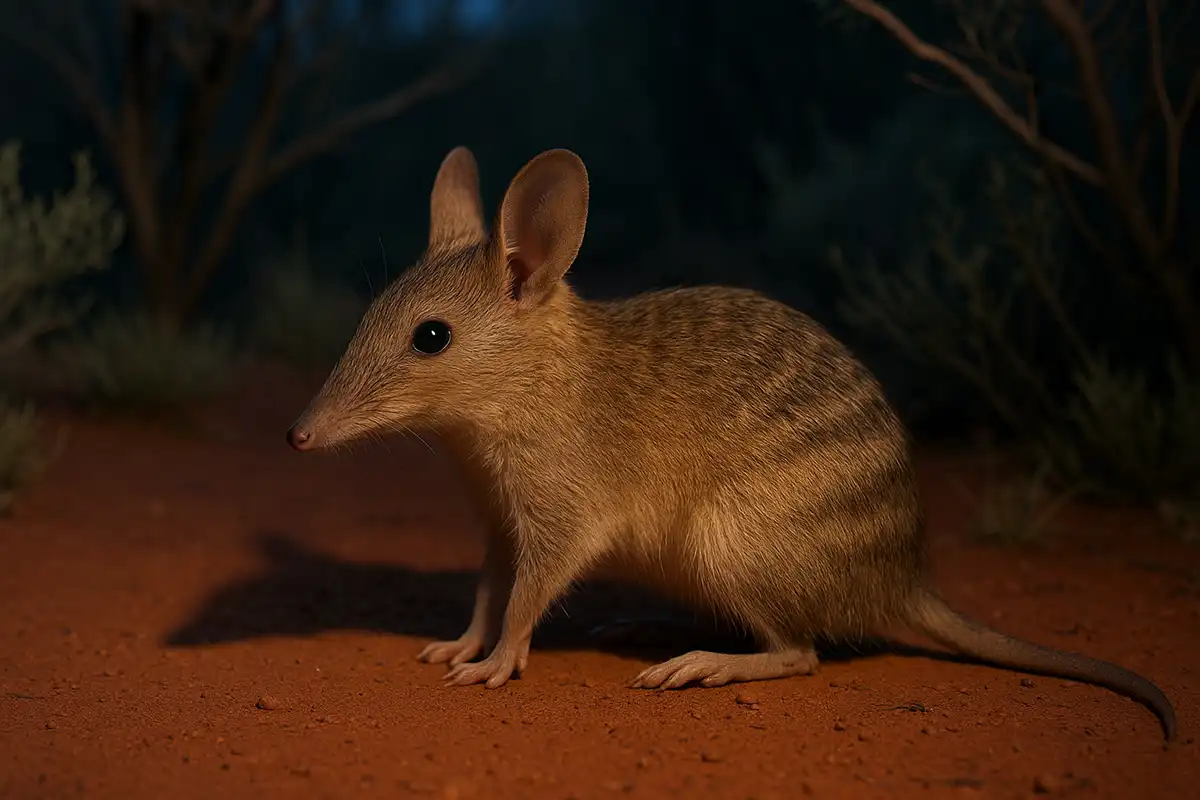
Epitaph for the Marl: The South-Western Barred Bandicoot

News in brief — October 2025

  • IUCN has listed the Marl / south-western barred bandicoot (Perameles myosuros) as Extinct (EX) in its latest global Red List update announced at the IUCN World Conservation Congress in Abu Dhabi. This is the species’ first global IUCN assessment, and it enters the Red List as Extinct. IUCN World Conservation Congress+1
  • Last known records: museum specimens collected in 1906–1907 in south-western Western Australia. Wikipedia+1
  • The update notes three Australian bandicoots newly entering the Red List as Extinct: the Marl (P. myosuros), south-eastern striped bandicoot (P. notina), and Nullarbor barred bandicoot (P. papillon). IUCN World Conservation Congress+1

Epitaph for the Marl

Small night-gardener,
you stitched the wheatbelt’s seams
with quiet paws and a nose for rain.

Between spinifex and saltbush
you kept the dark alive—
tending seeds, turning soil,
a lantern of whiskers in the scrub.

We fenced the horizon,
unleashed the teeth that never slept,
let fire run long and hot.
Your trail became a question mark
no map could answer.

Sleep now, marl.
In the dune’s soft grammar
your commas still hold breath.

Contextual background

The Marl / south-western barred bandicoot was once widespread across semi-arid shrublands of south-western Western Australia, but it slid into obscurity early in the 20th century; the last specimens were taken in 1906–1907. For decades it was lumped with the living Western Barred Bandicoot (Perameles bougainville), until a 2018 total-evidence study of museum material clarified that P. myosuros was a distinct species—already gone.

Australia’s federal Threatened Species Scientific Committee formally listed the Marl as Extinct under the EPBC Act in March 2021, noting historical declines driven by habitat clearing in the wheatbelt, altered fire regimes, and predation from introduced foxes and cats. The IUCN Red List then adopted the species in October 2025, immediately categorizing it as Extinct in its global update.

The Marl’s story sits within a broader pattern: Australia has lost an outsized share of its small marsupials since European colonisation, with introduced predators and landscape transformation repeatedly implicated. Safeguarding surviving bandicoots now depends on predator-free refuges, rigorous biosecurity, and large-scale shrubland restoration—lessons drawn from both failures and the successful reintroductions of close relatives on fenced sanctuaries and offshore islands.

Sources

Wikipedia+2recentlyextinctspecies.com+2

Department of Agriculture

IUCN World Conservation Congress

QUT

Latest Posts

More from Author

Greening Oslo: Discipline of the Possible

How Norway’s capital turned climate policy into budgets, procurement, and quieter...

Amsterdam, Netherlands: Water, Bicycles, and the Price of Success

Amsterdam is the city that other cities dream of becoming. Its...

Vienna – Green Social Housing as Climate Policy

GREEN CITIES SERIES  |  ARTICLE 3 For a century, Vienna has built...

The Cryosphere in Flux: Glaciological Systems, Dynamics, and Climatic Response

1. Introduction: The Global Cryosphere and Glaciological Significance The cryosphere, derived from...

Read Now

Greening Oslo: Discipline of the Possible

How Norway’s capital turned climate policy into budgets, procurement, and quieter streets — and why even Oslo is not yet a finished green city Standfirst Oslo is often invoked as proof that urban decarbonisation can move from aspiration to administration. The Norwegian capital has electrified large parts of its...

Amsterdam, Netherlands: Water, Bicycles, and the Price of Success

Amsterdam is the city that other cities dream of becoming. Its cycling culture is imitated on every continent; its canal ecology has been recovered from near-death to become a European benchmark; its commitment to public space and human-scale urbanism has generated a literature of admiration so extensive...

Vienna – Green Social Housing as Climate Policy

GREEN CITIES SERIES  |  ARTICLE 3 For a century, Vienna has built homes that shelter half its population from the market. Now the same political tradition that gave the city its Gemeindebauten is attempting something even more ambitious: to decarbonise a metropolis of two million people without making...

The Cryosphere in Flux: Glaciological Systems, Dynamics, and Climatic Response

1. Introduction: The Global Cryosphere and Glaciological Significance The cryosphere, derived from the Greek word kryos meaning cold, constitutes the frozen water component of the Earth system. It is a fundamental regulator of the global climate, a primary reservoir of freshwater, and a potent geomorphological agent that has...

The Sapphire Empire: A Chronicle of Britain’s Blue Belt and the Resurrection of the Wild

Introduction: The Map and the Territory The ocean is a memory. It remembers the iron taste of the harpoon and the heavy drag of the trawl. It remembers the silence of the extinction and the cacophony of the hunt. But it also remembers how to heal. Beneath the...

The AI Landscape of April 2026: Agents, Alignment, and the Quiet Politics of Machine Intelligence

The artificial intelligence industry has always oscillated between the roar of spectacle and the cold logic of consolidation. If late 2025 was defined by a "Cambrian explosion" of frontier models—a dizzying period of multimodal breakthroughs and benchmark obsession—then April 2026 represents the arrival of a "Permian" maturity....

The Chromatic Deception: The Systemic Degradation of the Global Salmon Commons

A forensic autopsy of Big Salmon, exposing the ecological collapse, regulatory rot, and colonial theft behind the industry's dyed pink flesh.

The Architects of Memory: An Investigative Report on the Elephant in the Anthropocene

From the deep-time silence of the Eocene swamps to the seismic rumblings of the modern savanna, the elephant is not merely a charismatic giant but the keystone of our planetary machinery—and its dismantling is a crisis of both biology and conscience. Introduction: The Silence of the Giants In the...

David Abram: Perception, Language, and the More-Than-Human World

I. The Prestidigitator at the Edge of the World In the landscape of contemporary ecological philosophy, David Abram cuts a figure both enigmatic and essential. He is not a scientist in the conventional sense, tallying parts per million of carbon dioxide or cataloguing extinction rates, though his work...

The Large Language Model Landscape of March 2026

The agent economy emerges: browsers, sovereign stacks, and the quiet consolidation of intelligence March 2026 feels strangely calm for an industry that only months ago seemed permanently electrified. The headlines have slowed. The benchmark fireworks have dimmed. Yet beneath the surface the machinery of artificial intelligence is turning faster...

Singapore: Engineered Nature in a Tropical City-State

GREEN CITIES SERIES  |  ARTICLE 4 Singapore has spent sixty years turning a cleared island into a green city, and the results are, in many respects, extraordinary. But the question the city-state now faces is different from the ones it has already answered: how do you make a...

Paris, or the Hard Work of a Breathing City

Green Cities Series | Article 02 How the French capital turned against the car, rewrote its streets, and discovered that a green city is not a mood but a struggle Paris has become one of the emblematic urban transformations of the climate era. In the space of two decades,...