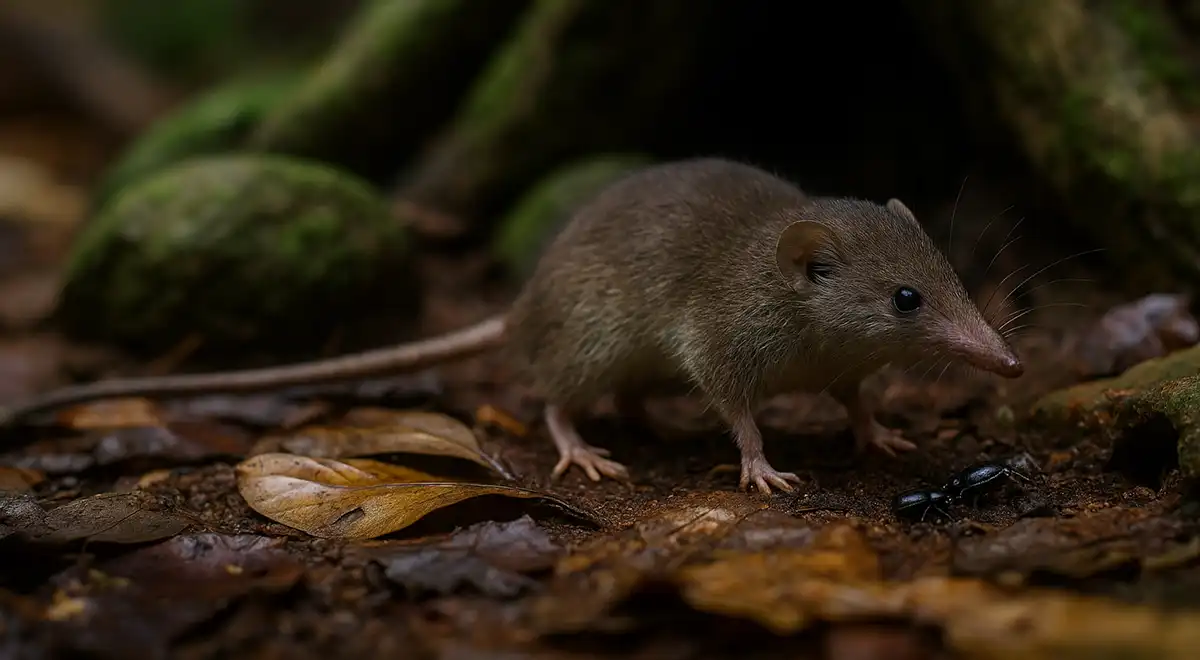
Epitaph for the Christmas Island Shrew

News in brief — 10 October 2025

  • The International Union for Conservation of Nature (IUCN) has officially declared the Christmas Island shrew (Crocidura trichura) extinct, in a Red List update released at the IUCN World Conservation Congress in Abu Dhabi. IUCN World Conservation Congress
  • Last confirmed records of the species were in 1985 (only four records since 1900), underscoring a long, quiet decline. CSIRO Publishing
  • The listing raises Australia’s known mammal extinctions since 1788 to 39, according to analysis accompanying the announcement. The Independent+1

Epitaph for the Christmas Island Shrew

Small whiskered pilgrim,
keeper of beetle-lanterns,
you read the rainforest by touch—
root and rock, leaf and loam—
a heartbeat threading the dark.

You asked for little:
a cool crevice, a damp morning,
the choir of insects to harvest and hush.
We answered with absence—
a silence that spreads like rust.

Go softly now, little one.
In the soil’s old library
your name is a marginal note—
smudged, but still legible
to those who kneel to read.

Sleep where the red crabs once marched,
beneath strangler figs and falling rain.
We did not count you in time.
We will carry you instead—
as a vow we owe the living.

By Kevin Parker

Contextual background

Christmas Island, part of Australia, a speck of rainforest rising from the Indian Ocean, is famed for its scarlet tides of migrating land crabs and for an extraordinary density of endemic life—species found nowhere else. Among its least conspicuous residents was a tiny shrew: fine-haired, sharp-nosed, with a tail longer than most of its kin. It foraged in the leaf litter and among buttress roots, nosing for beetles and other invertebrates, slipping into rock holes and root crevices at the edge of sight. It was the kind of creature you notice only when you pause and let the forest speak first.

Like many island endemics, the shrew’s world was small and exquisitely tuned. That tight fit made it vulnerable. Over the last century, Christmas Island’s biota has been battered by a suite of pressures: habitat disturbance from mining and settlement, predation and competition from introduced species (especially rats and cats), and ecological upheavals triggered by invasive insects—most infamously the yellow crazy ant—whose supercolonies have transformed forest dynamics and cascaded harm through the food web. On islands, such pressures don’t just add up; they amplify each other. For a creature that lived close to the ground and relied on rich, stable invertebrate communities, those changes were existential.

For decades, the shrew slipped from record into rumor. Surveys failed to find it. Hope narrowed, then became mostly ceremonial—the kind of hope biologists carry as a professional ethic. Its recent formal listing as extinct does not so much end a story as acknowledge the quiet way we can lose a thread until an entire tapestry thins. Extinction is not a single moment; it is a long unravelling that we too often notice only when the last fibre parts.

What remains is obligation. Christmas Island still shelters other irreplaceable lives—its flying-fox, hawk-owl, white-eye, emerald doves, geckos, skinks, and the crabs that aerate its soils. The shrew’s epitaph should therefore read like a work plan: stronger biosecurity to keep new invaders out; relentless control of established pests; sustained funding for on-the-ground monitoring (because you cannot save what you do not routinely see); protection and restoration of intact rainforest; and the humility to treat “small” species as large responsibilities. We also owe it our stories—teaching our children that a forest is made as much by the whisker-thin lives as by the towering trees.

If you ever walk there in rain, pause by a tangle of roots and listen. The forest carries memory in its damp. What we call gone, it sometimes calls by name.

Latest Posts

More from Author

Amsterdam, Netherlands: Water, Bicycles, and the Price of Success

Amsterdam is the city that other cities dream of becoming. Its...

Vienna – Green Social Housing as Climate Policy

GREEN CITIES SERIES  |  ARTICLE 3 For a century, Vienna has built...

The Cryosphere in Flux: Glaciological Systems, Dynamics, and Climatic Response

1. Introduction: The Global Cryosphere and Glaciological Significance The cryosphere, derived from...

Read Now

Amsterdam, Netherlands: Water, Bicycles, and the Price of Success

Amsterdam is the city that other cities dream of becoming. Its cycling culture is imitated on every continent; its canal ecology has been recovered from near-death to become a European benchmark; its commitment to public space and human-scale urbanism has generated a literature of admiration so extensive...

Vienna – Green Social Housing as Climate Policy

GREEN CITIES SERIES  |  ARTICLE 3 For a century, Vienna has built homes that shelter half its population from the market. Now the same political tradition that gave the city its Gemeindebauten is attempting something even more ambitious: to decarbonise a metropolis of two million people without making...

The Cryosphere in Flux: Glaciological Systems, Dynamics, and Climatic Response

1. Introduction: The Global Cryosphere and Glaciological Significance The cryosphere, derived from the Greek word kryos meaning cold, constitutes the frozen water component of the Earth system. It is a fundamental regulator of the global climate, a primary reservoir of freshwater, and a potent geomorphological agent that has...

The Sapphire Empire: A Chronicle of Britain’s Blue Belt and the Resurrection of the Wild

Introduction: The Map and the Territory The ocean is a memory. It remembers the iron taste of the harpoon and the heavy drag of the trawl. It remembers the silence of the extinction and the cacophony of the hunt. But it also remembers how to heal. Beneath the...

The AI Landscape of April 2026: Agents, Alignment, and the Quiet Politics of Machine Intelligence

The artificial intelligence industry has always oscillated between the roar of spectacle and the cold logic of consolidation. If late 2025 was defined by a "Cambrian explosion" of frontier models—a dizzying period of multimodal breakthroughs and benchmark obsession—then April 2026 represents the arrival of a "Permian" maturity....

The Chromatic Deception: The Systemic Degradation of the Global Salmon Commons

A forensic autopsy of Big Salmon, exposing the ecological collapse, regulatory rot, and colonial theft behind the industry's dyed pink flesh.

The Architects of Memory: An Investigative Report on the Elephant in the Anthropocene

From the deep-time silence of the Eocene swamps to the seismic rumblings of the modern savanna, the elephant is not merely a charismatic giant but the keystone of our planetary machinery—and its dismantling is a crisis of both biology and conscience. Introduction: The Silence of the Giants In the...

David Abram: Perception, Language, and the More-Than-Human World

I. The Prestidigitator at the Edge of the World In the landscape of contemporary ecological philosophy, David Abram cuts a figure both enigmatic and essential. He is not a scientist in the conventional sense, tallying parts per million of carbon dioxide or cataloguing extinction rates, though his work...

The Large Language Model Landscape of March 2026

The agent economy emerges: browsers, sovereign stacks, and the quiet consolidation of intelligence March 2026 feels strangely calm for an industry that only months ago seemed permanently electrified. The headlines have slowed. The benchmark fireworks have dimmed. Yet beneath the surface the machinery of artificial intelligence is turning faster...

Singapore: Engineered Nature in a Tropical City-State

GREEN CITIES SERIES  |  ARTICLE 4 Singapore has spent sixty years turning a cleared island into a green city, and the results are, in many respects, extraordinary. But the question the city-state now faces is different from the ones it has already answered: how do you make a...

Paris, or the Hard Work of a Breathing City

Green Cities Series | Article 02 How the French capital turned against the car, rewrote its streets, and discovered that a green city is not a mood but a struggle Paris has become one of the emblematic urban transformations of the climate era. In the space of two decades,...

GREEN CITIES

The City Must Breathe An introduction to the Green Cities series: what we mean, how we will judge, and why the urban future is now the decisive environmental story StandfirstThe green city has become one of the great promises of the twenty-first century. Yet the phrase is often used...