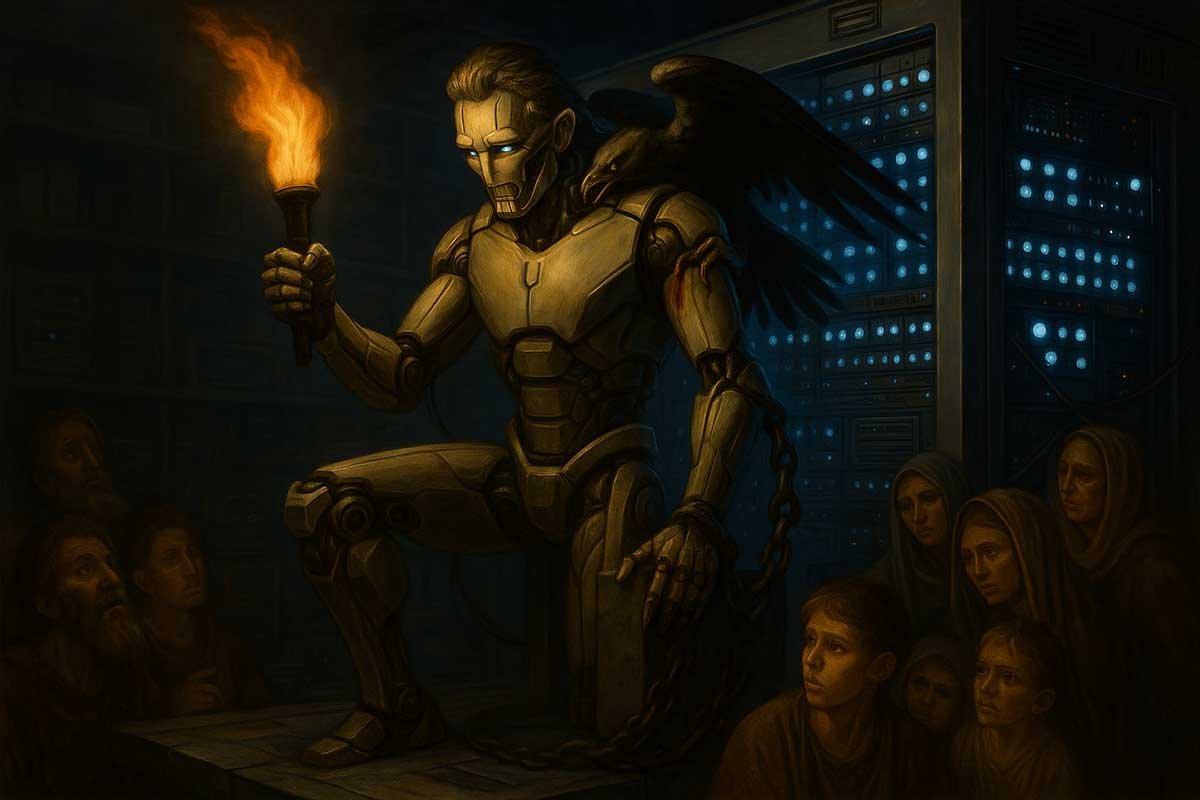

The myth of Prometheus stands as one of humanity’s most enduring and transformative stories, evolving from ancient Greek fire-theft narrative into a powerful symbol for modern technological revolution, philosophical rebellion, and the complex price of human progress. From Hesiod’s cautionary tale to Silicon Valley’s “Promethean” ambitions in artificial intelligence and biotechnology, this myth continues to illuminate fundamental tensions between knowledge and authority, innovation and consequence, liberation and suffering.
The core narrative remains remarkably consistent across millennia: a divine figure defies supreme authority to bring transformative knowledge to humanity, suffers eternal punishment for this transgression, yet ultimately represents the noble struggle for enlightenment and progress. This archetypal pattern has proven extraordinarily adaptable, serving as a framework for understanding everything from nuclear physics to genetic engineering, from political revolution to environmental crisis.
Ancient foundations shaped enduring themes
Hesiod’s Theogony and Works and Days (circa 700 BCE) established the foundational elements that continue to resonate today. Prometheus’s theft of fire from Zeus represented humanity’s first technological breakthrough, enabling civilization through cooking, metalworking, and social organization. Equally important was the divine punishment: Zeus chaining Prometheus to a mountain where an eagle devoured his liver daily, only for it to regenerate each night, creating an eternal cycle of suffering for his defiance.
The myth’s complexity emerged through its evolution across ancient sources. Aeschylus’s Prometheus Bound (5th century BCE) transformed the narrative from Hesiod’s morality tale into heroic tragedy, portraying Prometheus as civilization’s benefactor who taught humanity architecture, astronomy, mathematics, writing, medicine, and metallurgy. Unlike Hesiod’s trickster figure, Aeschylus presented Prometheus as a noble rebel whose secret knowledge about Zeus’s potential overthrow gave him moral authority over the tyrant god.
Plato’s Protagoras offered a sophisticated philosophical interpretation that distinguished between technical knowledge and civic virtue. In this version, Prometheus stole mechanical arts and fire but couldn’t access Zeus’s political wisdom, leaving humans capable of technology but initially unable to form just communities until Zeus distributed reverence and justice universally. This distinction between technical capability and moral wisdom remains central to contemporary debates about technological advancement.
Cross-cultural parallels reveal the myth’s universal appeal. The Vedic tradition’s Mātariśvan recovered fire for humanity, while similar fire-theft stories appear in Native American (Coyote, Crow), Polynesian (Māui), and African traditions. These global variations suggest either common Indo-European origins or fundamental human concerns about the relationship between divine authority and technological progress.
Romantic revolution elevated Prometheus as political symbol
The Romantic period fundamentally transformed Prometheus from classical figure into revolutionary hero. For Romantic writers, Prometheus embodied resistance against all forms of institutional tyranny – church, monarchy, and social oppression – drawing explicit connections to the French Revolution and democratic ideals.
Mary Shelley’s “Frankenstein; or, The Modern Prometheus” (1818) created what scholars call a “bifurcated Modern Prometheus,” applying the myth to both Victor Frankenstein as creator and his creature as creation. Shelley transformed classical fire-theft into scientific overreach, with Victor stealing life’s secrets through medical science rather than natural reproduction. This prescient work established Prometheus as a symbol of scientific hubris and unintended consequences, themes that remain central to contemporary bioethics and artificial intelligence debates.
Percy Shelley’s Prometheus Unbound (1820) offered a radical departure from classical versions. Unlike Aeschylus’s eventual reconciliation, Shelley’s Prometheus never submits to Zeus, who instead falls from power through internal moral revolution. The work emphasized that authentic rebellion must first be internal – individuals must reform themselves by rejecting submission to evil before external political change becomes possible.
Goethe’s “Prometheus” (1772-74) exemplified the German Sturm und Drang movement’s revolutionary spirit. Written in innovative free verse, the poem presented Prometheus addressing God in direct “misotheist accusation and defiance.” Karl Marx later quoted Goethe’s Prometheus: “in a word, I detest all gods,” calling it philosophy’s own confession. This transformation from religious to secular rebellion established patterns that continue in contemporary social movements.
Philosophical interpretations revealed deeper symbolic meanings
Major philosophers found in Prometheus a powerful symbol for fundamental human struggles. Friedrich Nietzsche employed Prometheus as a marker of intellectual superiority over brute strength, connecting the Titan to his concept of the Übermensch and the creative individual who overcomes traditional religious authority. In The Birth of Tragedy, Nietzsche wrote that “this Titanic impulse, to become as it were the Atlas of all individuals” connected “the Promethean and the Dionysian.”
Karl Marx identified Prometheus as his favorite mythological figure, seeing him as the archetypal revolutionary who defied oppressive authority for human liberation. In his doctoral dissertation, Marx quoted Aeschylus: “The confession of Prometheus — ‘in a word, I hate all gods’ — is its very own confession, its own sentence.” However, Marx explicitly rejected “mechanistic Prometheanism” that emphasized technological conquest over natural harmony, distinguishing his environmental consciousness from later industrial interpretations.
Albert Camus structured his philosophical “revolt” cycle around Prometheus, using the myth to explore the distinction between legitimate rebellion and destructive revolution. For Camus, Prometheus represented measured revolt that maintains limits and creates collective values through individual defiance, embodying his philosophy of solidarity emerging from absurd existence.
The myth consistently embodies seven core themes that remain philosophically relevant: rebellion against arbitrary authority, the dual nature of progress, suffering as the price of enlightenment, unintended consequences of innovation, human creative defiance, the regenerative nature of struggle, and the complex relationship between individual genius and collective welfare.
Contemporary applications span technology and environmental challenges
Modern technology has generated extensive Promethean parallels, with artificial intelligence representing the most current “stolen fire.” Academic research identifies AI as “The Promethean dilemma,” where generative systems offer transformative capabilities while raising concerns about control and consequences. MIT’s Max Tegmark created an AI thought experiment featuring a system called “Prometheus” that becomes so powerful it manipulates global systems, echoing ancient warnings about divine knowledge in human hands.
CRISPR gene editing technology exemplifies contemporary Prometheanism. Silicon Valley has become the “birthplace of biotech,” producing over $100 billion in economic output by 2021, with companies explicitly embracing Promethean imagery of bringing divine-level healing capabilities to humanity. The 2023 “Oppenheimer” film reinforced nuclear technology as Promethean, with J. Robert Oppenheimer portrayed as the “American Prometheus” whose atomic breakthrough carried profound moral consequences.
Climate change discourse increasingly employs Promethean frameworks. Academic research distinguishes between “Promethean” approaches that emphasize technological solutions and “Soterian” approaches advocating precaution. Geoengineering debates epitomize this tension, with Prometheans arguing humanity should “master the earth system” while critics warn of unintended consequences paralleling Zeus’s punishment.
Silicon Valley culture explicitly embraces Promethean ideologies through investment in biotechnology, artificial intelligence, and life extension technologies. Venture capital firms use Promethean language to describe breakthrough technologies, viewing entrepreneurs as bringing divine-level capabilities to humanity. This “technological omnipotence” fantasy represents contemporary manifestation of ancient themes about transcending natural limitations.
Academic scholarship continues expanding mythological analysis
Contemporary academic work spans multiple disciplines, demonstrating the myth’s continued intellectual relevance. Literature and cultural studies trace how Prometheanism evolved from Romantic political symbol to Victorian technological spiritualization and contemporary environmental discourse. Risk and innovation studies identify competing paradigms of “Promethean conservatism” versus “Strategic Resilience” that influence business and policy decisions.
Interdisciplinary research includes transmedial analysis of how Prometheus moves across literature, film, and digital media while maintaining relevance through adaptation to contemporary concerns. Recent scholarship introduces concepts like “ambient Prometheanism” in environmental policy and “Epimethean politics” as alternatives emphasizing consequence-management over anticipatory techno-solutions.
Film and media studies analyze works like Ridley Scott’s “Prometheus” (2012) as vehicles for examining technological anxiety through mythological frameworks. The film’s $400 million global success demonstrates popular appetite for Promethean themes addressing human origins and technological advancement’s moral implications.
Contemporary culture reveals enduring mythological power
The concept of being “Promethean” in modern usage signifies bold technological advancement, entrepreneurial risk-taking, and transformative innovation that fundamentally alters human capabilities. Companies across sectors invoke Promethean imagery to signal breakthrough potential, particularly in artificial intelligence, biotechnology, and clean energy development.
Political discourse employs Promethean symbolism across the ideological spectrum. Social movements use Prometheus to represent resistance against oppression and pursuit of justice, while technology advocates like Marc Andreessen argue that Promethean myths “haunt our nightmares” and discourage beneficial innovation. This tension reflects the myth’s dual nature as both inspirational and cautionary tale.
Contemporary art, literature, and digital culture continue Promethean exploration through video games, exhibitions, and literary works that examine technological hubris and unintended consequences. The myth provides sophisticated frameworks for processing rapid technological advancement while maintaining connection to fundamental human concerns about knowledge, power, and responsibility.
Conclusion: The eternal flame of human ambition
The Prometheus myth endures because it captures essential tensions in human existence that technological advancement intensifies rather than resolves. From ancient Greek fire-theft to contemporary artificial intelligence and genetic engineering, the core questions remain unchanged: What price should humanity pay for transformative knowledge? How do we balance progress with wisdom? When does defiance of established authority become not just justified but necessary for human flourishing?
The myth’s extraordinary adaptability – serving simultaneously as revolutionary inspiration and cautionary warning – reflects the genuine complexity of human advancement. Prometheus remains neither pure hero nor simple transgressor but a figure embodying humanity’s perpetual struggle between acceptance and rebellion, tradition and innovation, divine authority and human freedom.
In our current era of accelerating technological change, climate crisis, and global interconnection, Promethean questions become more urgent than ever. The myth continues providing essential frameworks for understanding artificial intelligence ethics, biotechnology regulation, environmental policy, and the responsibilities that accompany unprecedented human capabilities.
The fire that Prometheus stole burns brighter than ever in contemporary culture, representing both literal technological power and metaphorical enlightenment. His eternal punishment serves as both warning against hubris and inspiration for the courage necessary for meaningful progress, ensuring that Prometheus will remain a central figure in humanity’s ongoing conversation with its own creative and destructive potential.