HomeNews2.5 Million Trees Planted...

2.5 Million Trees Planted in Minnesota by The Nature Conservancy

TNC has planted more than 13 million trees in Minnesota since 2005 to benefit people and nature.

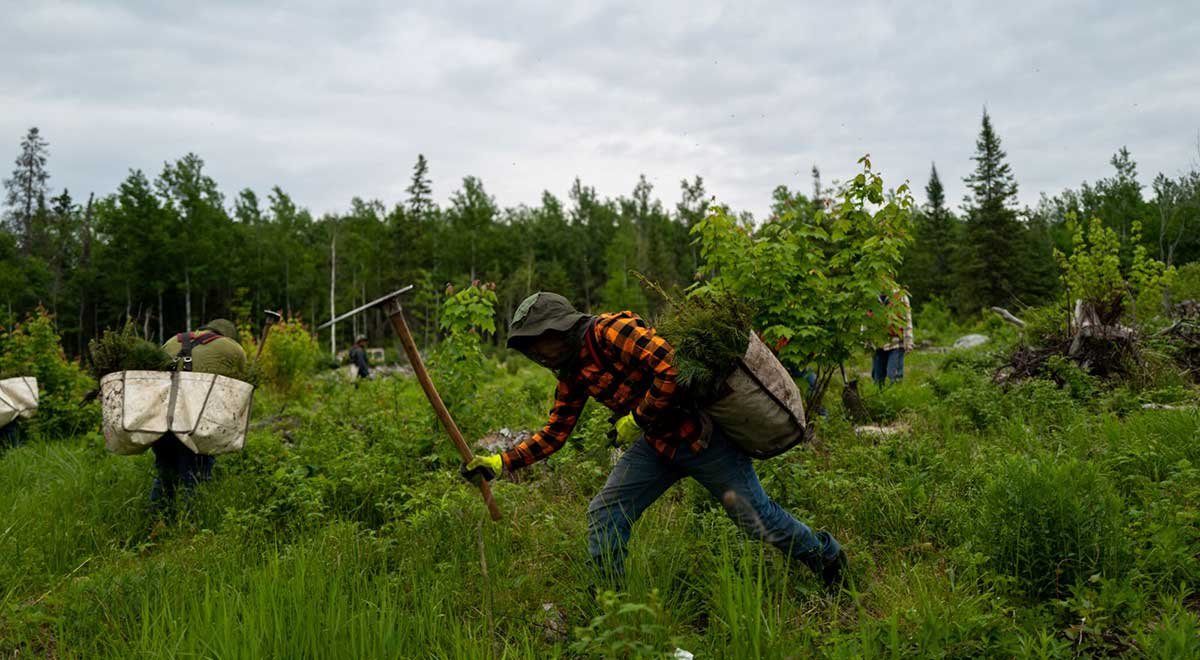
MINNEAPOLIS, Minn. – The Nature Conservancy (TNC) announced it planted 2.5 million trees in northern Minnesota this year in partnership with the U.S. Forest ServiceMinnesota Department of Natural Resources and three county land departments. This is a record number for the organization, and the second consecutive year the program has planted more than 2 million tree seedlings.

The tree seedlings were planted on public lands—across 5,810 acres of national forest, state forest, state park and county-managed forest lands—and covered six counties, including Cook, Lake, Saint Louis, Itasca, Cass and Carlton County.

The planting areas included 1.8 miles along scenic Highway 61 and 41 miles of stream, river and lakeshore that connect to Lake Superior. It also included 1,740 acres of moose habitat enhancement, completed in partnership with the Ruffed Grouse Society and Minnesota Moose Habitat Collaborative—whose tribal representation is critical in maintaining habitat for this species of cultural importance to Indigenous communities.

“Our Northwoods are an essential part of our state,” said Ann Mulholland, TNC’s director in Minnesota, North Dakota and South Dakota. “They absorb and store carbon from the atmosphere, filter our water, support our economy, offer wildlife habitat and give us places to hike, hunt and relax. We’re planting trees to improve the diversity and resilience of our Northwoods for generations to come.”

Warming temperatures, pressure from development, and pests like spruce budworm are rapidly changing Minnesota’s forests. As the forests become more fragmented and less diverse, they grow increasingly vulnerable to disease and wildfire. In response to this spring’s devastating wildfires, the team also planted 5,100 trees on 11 acres that were burned in the Camp House wildfire.

TNC uses science-based methods to carefully select and plant trees that will thrive in future climate conditions and enhance the health of the forest. This year, the team planted 14 different native and climate-hardy tree species, including white pine, white spruce, red pine, jack pine, red oak and yellow birch.

“Diversity is the superpower of our forests. Like a diverse stock portfolio, we want a diverse mix of tree species to ensure that enough survive different stresses like drought, pests and warmer temperatures,” said Jim Manolis, TNC’s director of forest strategy and stewardship in Minnesota.

Tree planting at this scale requires an enormous amount of planning, collaboration and effort. The team orders tree seedlings two years in advance and coordinates with agencies and partners to ensure the trees are planted on time during the six-week spring planting season.

“Strong partnerships with the DNR, Forest Service and local counties are the reason we have been able to plant more than 13 million trees across northern Minnesota since 2005,” said Manolis.

This accomplishment was only possible with the hard work of 65 seasonal guest workers who specialize in tree planting and tending. Non-immigrant guest workers from Latin America plant more than 85% of the trees planted in the U.S. each year on temporary visas. An important pillar of TNC’s program is ensuring these highly skilled workers are well compensated, cared for and appreciated while helping TNC achieve its forestry goals.

Learn more about TNC’s work to protect Minnesota’s forests at nature.org/mnforests

The Nature Conservancy is a global conservation organization dedicated to conserving the lands and waters on which all life depends. Guided by science, we create innovative, on-the-ground solutions to our world’s toughest challenges so that nature and people can thrive together. We are tackling climate change, conserving lands, waters and oceans at an unprecedented scale, providing food and water sustainably and helping make cities more resilient. The Nature Conservancy is working to make a lasting difference around the world in 81 countries and territories (40 by direct conservation impact and 41 through partners) through a collaborative approach that engages local communities, governments, the private sector, and other partners. To learn more, visit nature.org or follow @nature_press on X.

Latest Posts

More from Author

Shenzhen, China: Electrifying the Megacity

GREEN CITIES SERIES  |  ARTICLE 10 In 2017, Shenzhen became the first...

World Environment Day 2026: Climate Action – Why It’s Still So Hard — and What Works

Clean energy is booming, yet emissions keep breaking records. A clear-eyed 2026 look at climate action—what's working, what's failing, and what it will take.

Barcelona Superblocks: The Radical Battle for Quiet, Green Cities

Inside Barcelona's radical push to reclaim streets from cars. How the superblock grid battles noise, heat, and tourism to recover Cerdà's vision.

The Large Language Model Landscape of May 2026: The Architecture of Alignment and Narrative Ethics

May 2026 LLM Landscape: AI becomes vital infrastructure, forcing a pivot to narrative ethics as global challengers disrupt Big Tech's oligopoly

Read Now

Shenzhen, China: Electrifying the Megacity

GREEN CITIES SERIES  |  ARTICLE 10 In 2017, Shenzhen became the first city in the world to operate a fully electric public bus fleet. In 2019, its entire taxi fleet followed. These are not incremental improvements or pilot schemes — they are structural transformations, achieved at a speed...

World Environment Day 2026: Climate Action – Why It’s Still So Hard — and What Works

Clean energy is booming, yet emissions keep breaking records. A clear-eyed 2026 look at climate action—what's working, what's failing, and what it will take.

Barcelona Superblocks: The Radical Battle for Quiet, Green Cities

Inside Barcelona's radical push to reclaim streets from cars. How the superblock grid battles noise, heat, and tourism to recover Cerdà's vision.

The Large Language Model Landscape of May 2026: The Architecture of Alignment and Narrative Ethics

May 2026 LLM Landscape: AI becomes vital infrastructure, forcing a pivot to narrative ethics as global challengers disrupt Big Tech's oligopoly

Bogotá, Colombia: Mobility as Democratic Space

GREEN CITIES SERIES  |  ARTICLE 8 Every Sunday, Bogotá returns the streets to its people. That act — repeated for fifty years, in a city of nine million at 2,600 metres above sea level, in a country still reckoning with decades of violence — is both a practical...

The Great Unraveling: A Requiem for the Democracy?

Global democracy is in a high-velocity retreat. Explore the 2026 V-Dem data on systemic autocratisation and blueprints for democratic resilience.

Seoul, and the Return of Water

GREEN CITY SERIES| ARTICLE 11 How river daylighting changed the argument in South Korea’s capital — and why the harder work of a green city lies beyond one celebrated stream Few urban projects have entered the global planning imagination as forcefully as Seoul’s restoration of the Cheonggyecheon. The removal...

Curitiba, Brazil: The Classic Model Revisited

GREEN CITIES SERIES  |  ARTICLE 9 For fifty years, urban planners have travelled to Curitiba to study what happened when a young architect-mayor decided that a city was not, fundamentally, for cars. What they found was real, was replicable, and was also — when examined carefully — more...

Gaia’s Great Turning: A 50-Year Climate Reversal Blueprint (2025–2075. Updated)

This is an updated and revised version of a piece that I published last year. Regrettably, all is not well in the golden valley of apricots when it comes to climate change reversal, it just keeps getting hotter and the weather wilder. All is not lost though...

The Friction of Progress: Why the Global Climate Transition is Catching Up to Markets, but Lagging Behind the Earth

In May 2026, the international climate arena presents a striking paradox. It is alive, highly active, and structurally transformed, yet it remains profoundly underpowered relative to the physical systems it seeks to govern. The institutional architecture established by the Paris Agreement has not collapsed; on the contrary,...

London. Clean Air, Congestion, and Retrofit Burdens

GREEN CITIES SERIES  |  ARTICLE 6 London has done something that most cities only talk about: it has used road pricing to change behaviour at scale, and it has used air quality regulation to drive a measurable improvement in the health of nine million people. But the city...

Greening Oslo: Discipline of the Possible

How Norway’s capital turned climate policy into budgets, procurement, and quieter streets — and why even Oslo is not yet a finished green city Standfirst Oslo is often invoked as proof that urban decarbonisation can move from aspiration to administration. The Norwegian capital has electrified large parts of its...