HomeNewsGreenpeace: Microplastics in Geneva...

Greenpeace: Microplastics in Geneva Air

Press Release 11th August, 2025 – Geneva, Switzerland — A new Greenpeace International investigation confirms that airborne microplastics are present in the urban air of Geneva, after sampling outdoors and in indoor spaces like cafés, public transport, and shops. As governments enter the second week of the Global Plastics Treaty negotiations, the research highlights an invisible but widespread part of the plastic pollution crisis.

Graham Forbes, Global Plastics Campaign Lead for Greenpeace USA and Greenpeace Head of Delegation for the Global Plastics Treaty negotiation said: “Investigations like this show why we need to cut plastic production at the source. But the petrochemical industry continues to push for massive expansion in plastic production, which could triple by 2060. Just by walking around their cities, fossil fuel and petrochemical lobbyists are inhaling the plastics that they have produced, giving themselves potential health issues – and that includes here in Geneva as they hammer out the treaty.”

Key findings include:

  • 165 total particles, analysed under high magnification and infrared spectroscopy, including:
    • 94 fragments, many under 20 microns — too small to be seen with the naked eye.
    • 71 fibres, ranging in length and diameter, with a majority made from cellulose or modified natural materials.
    • 12 confirmed microplastic particles (6 fibres, 6 fragments) and 3 more tentatively identified as synthetic polymers.
  • Confirmed microplastics include polyester, nylon, polyethylene, vinyl copolymers, and cellulose acetate,  typical of clothing, packaging, and furnishings.

These particles were collected over 8 hours with a sample volume of 1.7 m³, a person typically breathes much more air in the same time [1]. Also, we only analysed particles larger than 10 microns; recent research suggests much smaller microplastics (1–10 µm) are likely to be present in even greater quantities, which are small enough to penetrate deep into the lungs, raising serious health concerns.

Switzerland ranks 8th globally in waste management, yet Geneva’s air contains microplastic pollution, revealing just how pervasive and uncontainable plastic has become once released into the environment. As plastic production continues to grow, so will the scale and severity of this pollution.

Joëlle Hérin, expert and campaigner on consumption systems at Greenpeace Switzerland, said: “Even the best waste management systems can’t stop plastic from turning into air pollution. We are breathing in plastic, and it’s getting into our lungs. That should be a wake-up call for any government serious about public health and planetary survival.”

Greenpeace is calling for a legally binding treaty that cuts plastic production by at least 75% by 2040. Currently, the petrochemical industry continues to push for massive expansion in plastic production, which could triple by 2060 [2]. Much of this is for short-lived products like single-use packaging and fast fashion, leading to a future of escalating plastic waste and microplastic exposure, regardless of how it is managed or recycled.

Hérin added: “We need political courage. Every year we delay means more plastic in the air, water, and our bodies. The science is clear: the time to act is now. We need a strong Global Plastics Treaty that cuts plastic production at the source, or it will fail.”

ENDS

Full report: Living in Plastic Air

Photos and videos can be accessed in the Greenpeace Media Library

Notes: 

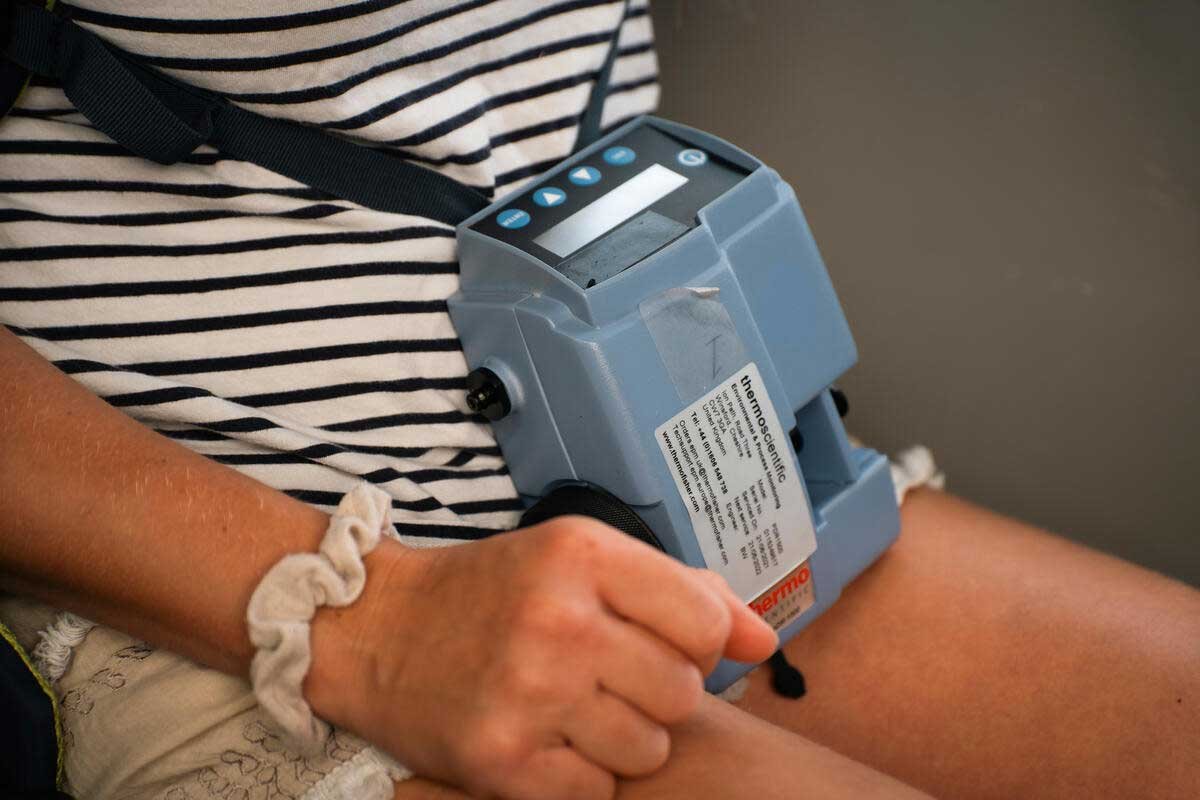
[1] A researcher wore a modified personal air quality monitor (PDR-1500) which collected airborne particles over eight hours in various points in Geneva. The locations visited were the  Greenpeace Switzerland office, a coworking space, railway station, clothes shops, an indoor shopping centre, a restaurant and a coffee shop, using public transport and on foot. Outdoor air between these locations was also part of the sample.

[2] Scenario is from a baseline of 428 MT in 2019, in OECD. Global Plastics Outlook: Policy Scenarios to 2060; Organisation for Economic Co-operation and Development: Paris, 2022. https://doi.org/10.1787/aa1edf33-en

Contacts:

Fanny Eternod, Press Officer, Greenpeace Switzerland, fanny.eternod@greenpeace.org, +41 78 662 07 31

Angelica Carballo Pago, Global Plastics Campaign Media Lead, Greenpeace USA, angelica.pago@greenpeace.org, +63 917 1124492

Greenpeace International Press Desk, +31 (0) 20 718 2470 (available 24 hours), pressdesk.int@greenpeace.org

Latest Posts

More from Author

The Life and Legacy of Martin Luther King

Martin Luther-King was a profound influence on my peace activism and...

Labor–Greens Deal: A New Era for Australia’s Environment Laws

CANBERRA — For a quarter of a century, the silence of...

Nature Positive November 2025: Inside Australia’s Historic Environmental Law Overhaul

Executive Summary In November 2025, the Australian Parliament enacted a transformative suite...

Read Now

The Algorithm Will See You Now: Your Doctor’s AI Assistant Can’t Read Handwriting But Might Save Your Life

The first drug ever discovered entirely by artificial intelligence is working its way through human trials as I write this (November, 2025), a molecule dreamed up by silicon that may soon flow through human veins. Its name is rentosertib—a word that sounds like something out of a...

The Life and Legacy of Martin Luther King

Martin Luther-King was a profound influence on my peace activism and I still stand in-awe of his courage, his faith, vision and passion. A blessing on this most extraordinary human. I believe that I got into two jobs, one as State Co-Ordinator of People For Nuclear Disarmament...

Labor–Greens Deal: A New Era for Australia’s Environment Laws

CANBERRA — For a quarter of a century, the silence of the Australian bush—broken only by the crash of falling timber and the quiet disappearance of species—was matched by a deafness in the halls of Parliament. The Environment Protection and Biodiversity Conservation Act 1999 (EPBC), a legislative...

Nature Positive November 2025: Inside Australia’s Historic Environmental Law Overhaul

Executive Summary In November 2025, the Australian Parliament enacted a transformative suite of environmental legislation, fundamentally reshaping the Commonwealth’s approach to biodiversity conservation, project assessment, and regulatory enforcement. This report provides an analysis of the Environment Protection Reform Bill 2025, the National Environment Protection Agency Bill 2025, and...

Artificial Intelligence: Prospects, Progress, and Perils by 2035

Abstract Artificial intelligence (AI) stands at a pivotal juncture, poised for a decade of unprecedented evolution. This report reflects on AI's projected trajectory by 2035, exploring the profound roles and functions it is anticipated to fulfill across industries, from augmenting human capabilities in the workforce and revolutionizing healthcare...

Slow Living: Temporal Resistance in an Accelerated Age

Slow living resists speed-driven society, blending sustainability, urban design, and mindfulness to reclaim time, balance, and ecological harmony.

The Silent General: The Algorithm of War and the Need for Boundaries

AI warfare: autonomous weapons, cyber attacks, and algorithmic targeting transform modern conflict. What moral boundaries must we establish before war becomes fully automated?

Amazonia and South American Wilderness

1. Historical Baseline Pre-1750 Wilderness Extent South America contained 1.7 billion acres of wilderness in 1500—95% of the continent's land area.¹ The Amazon basin alone encompassed 1.4 billion acres of continuous rainforest, Earth's most biodiverse terrestrial ecosystem. This was not pristine wilderness but a cultural landscape shaped by...

Montessori Education: History, Philosophy, and Current Status

When Revolutionary Observation Transforms Pedagogy In January 1907, something extraordinary unfolded in Rome's impoverished San Lorenzo district—a physician's experimental classroom for sixty slum children would revolutionize global education. Within months, these economically disadvantaged five-year-olds were reading, writing, and demonstrating sustained concentration that drew international visitors. By 2022, this...

North America Wilderness: From Tundra to Desert

1. Historical Baseline Pre-1750 Wilderness Extent North America contained 3.9 billion acres of wilderness when Europeans first arrived—98% of the continent's land area.¹ From Arctic tundra to Sonoran desert, from Atlantic forests to Pacific rainforests, the continent supported Earth's most diverse temperate ecosystems. This wasn't empty wilderness but homeland...

The Enduring Majesty: Exploring the World of Birds

Listen to our five-minute summary of the article below before you fly-in! Birds, with their vibrant plumage, melodious songs, and breathtaking aerial acrobatics, have captivated human imagination across millennia. From the smallest hummingbirds to the towering ostriches, these feathered marvels inhabit nearly every corner of our planet, showcasing...

The Deceptive Bite: Unmasking Ultra-Processed Foods

The Quiet Takeover of the Global Diet The modern global diet is undergoing a quiet, pervasive transformation, one driven not by nutritional science or consumer need, but by engineered profitability. Public attention, recently highlighted by media reports concerning the dangers of processed foods, is beginning to align with...
error: Content unavailable for cut and paste at this time