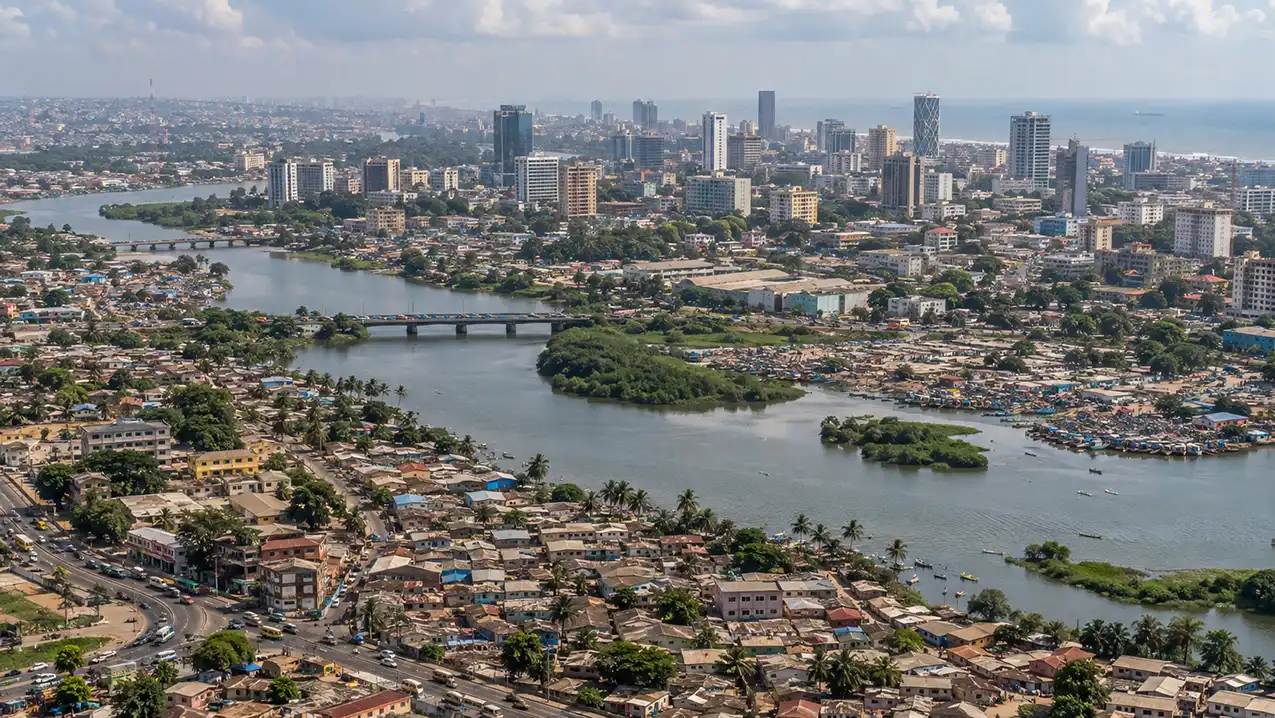

To understand Accra’s ecological metabolism is to trace the flow of water, air, and humanity through a rapidly shifting coastal topography. Positioned on the Gulf of Guinea, Ghana’s capital is a delta city grappling with the intersecting forces of breakneck urbanisation, compound flooding, and a warming equatorial climate. In the context of global climate adaptation, Accra offers a profoundly different framework from the highly capitalised, heavily engineered infrastructure models of an Oslo or a Paris. Here, climate policy cannot be merely an exercise in carbon accounting, municipal branding, or aesthetic greening; it is, fundamentally and urgently, an exercise in public health, spatial justice, and survival.1
Accra is a city in a permanent state of arrival. Originally a collection of Ga coastal settlements, the Greater Accra Metropolitan Area (GAMA) has swollen into a sprawling agglomeration home to an estimated five million people, with the central Accra Metropolitan Assembly (AMA) housing over two million within its immediate administrative boundaries.2 This demographic explosion—driven by rural-to-urban migration and a burgeoning youth population—has far outpaced the city’s formal planning capacity. Consequently, up to sixty per cent of Accra’s residents live in densely populated informal settlements, such as Nima, Jamestown, and Chorkor.3 In these neighbourhoods, the abstract threat of global atmospheric warming translates into the visceral, daily realities of extreme heat, uncollected refuse, and the terrifying velocity of monsoon floodwaters.
The Governance Tapestry: Municipal Action and National Mandates
The architecture of environmental governance in Accra is complex, defined by a delicate and sometimes frictional interplay between municipal authorities and the national government. At the local level, the Accra Metropolitan Assembly (AMA) is the primary engine of urban policy. In 2020, the AMA released the ambitious Accra Climate Action Plan, committing the city to an emissions-neutral and climate-resilient future by 2050.4 The plan aligns municipal goals with both the Paris Agreement and the Sustainable Development Goals, prioritising waste management, transport emissions, and spatial planning.
However, the AMA does not operate in a vacuum. It is nested within the Greater Accra Regional Coordinating Council and is heavily reliant on the national ministries—specifically the Ministry of Environment, Science, Technology and Innovation (MESTI) and the national Environmental Protection Agency (EPA).5 The national government holds the purse strings for major infrastructural projects and dictates the Nationally Determined Contributions (NDCs) submitted to the United Nations.
This dual-layered governance can result in bureaucratic bottlenecks, but it has also birthed vital national programmes that impact the city. For instance, the national ‘Green Ghana’ initiative, launched by the Ministry of Lands and Natural Resources, aims to restore the country’s depleted forest cover by planting tens of millions of trees nationwide. Within Accra, this national mandate translates into municipal efforts to plant shade trees along arterial roads and within community spaces, an essential intervention in a city suffering from an intense urban heat island effect.6 Yet, the persistent challenge remains enforcement: national environmental standards are rigorous on paper, but the municipal assembly often lacks the capital and personnel to enforce these bylaws within sprawling, largely informal local economies.
The Odaw River and the Hydrology of Crisis
Any serious ecological assessment of Accra must begin at the Korle Lagoon and the Odaw River basin. Historically, this coastal wetland served as the city’s ecological heartbeat. It was a thriving estuarine habitat comprising sand dunes, salt pans, and marshes that naturally filtered stormwater before it reached the sea, regulating the local microclimate and providing a buffer against tidal surges.7
Today, it is widely recognised as one of the most degraded water bodies on Earth. As Accra expanded, the Odaw River basin became heavily industrialised and aggressively encroached upon by informal housing. Without adequate municipal drainage or sanitation infrastructure, the river became an unofficial conduit for solid waste, agricultural runoff, and untreated industrial effluent.8
This hydrological dysfunction has birthed an existential threat: catastrophic compound flooding. Because the city’s drainage network is frequently choked with single-use plastics and silt, heavy monsoon downpours cannot reach the sea. The tragic zenith of this crisis occurred on the 3rd of June 2015, when torrential rains caused the Odaw River to burst its banks, inundating the city centre. The floodwaters, carrying leaked fuel from a petrol station, ignited, resulting in a dual disaster of fire and water that claimed over 150 lives.9 This event violently shifted the national consciousness, cementing the reality that drainage and waste management are not merely civic amenities, but matters of national security.
In response, the government, backed by the World Bank, initiated the Greater Accra Resilient and Integrated Development (GARID) project and the Korle Lagoon Ecological Restoration Project (KLERP). Beyond the mechanical dredging of silt and refuse from the channel, these projects represent a multi-million-dollar attempt to reclaim the wetland’s natural hydrology.10
Accra: Restoring Hydrological Health
The long-term vision seeks to transform the concrete banks into landscaped ecological corridors and retention basins that can absorb flood shocks while reviving the estuarine habitat. The sheer scale of the pollution means progress is painfully iterative. Yet, the restoration of the Odaw underscores a vital urban reality: in delta cities, managing climate-induced flooding requires restoring the dignity of natural watercourses, accommodating water rather than attempting to pave it into submission.
Breathing the City: Air Quality and the Urban Health Initiative
Accra’s most pervasive environmental crisis, however, is airborne. The city’s atmosphere is a complex particulate soup, combining the seasonal Sahara dust of the Harmattan winds with the toxic exhausts of an ageing vehicular fleet—dominated by the ubiquitous tro-tros (informal minibuses)—and the smoke from thousands of domestic wood and charcoal cookstoves. According to the World Health Organisation (WHO), Accra’s average annual air pollution levels have historically hovered at roughly five times the recommended guideline for fine particulate matter (PM2.5).11
For the urban poor, this combination of ambient and household pollution has resulted in a quiet epidemic of respiratory crises, particularly childhood pneumonia and chronic obstructive pulmonary disease. Addressing this, Accra became a pioneering pilot city for the WHO’s Urban Health Initiative (UHI). The genius of the UHI approach is its rejection of abstract climate modelling in favour of immediate public health data. By mapping the health and economic co-benefits of climate-friendly policies, municipal planners found that shifting households to clean fuels could avert nearly two thousand premature deaths annually.12
The Cycle of Air Quality Policy in Accra
This empirical framing birthed localised interventions, supported by both national and municipal agencies, such as the Gas Cylinder Recirculation Programme. This initiative actively transitions households and informal street food vendors away from biomass and towards liquified petroleum gas (LPG) and biogas, drastically reducing black carbon emissions.13 By tying the somewhat ethereal goals of greenhouse gas reduction to the immediate, measurable metrics of hospital admissions and childhood lung health, Accra has managed to mobilise political and public will in a way that carbon targets alone never could. Indeed, as a direct result of data gathered on the streets of its capital, Ghana became the first nation to formally include short-lived climate pollutants in its National Greenhouse Gas Inventory submitted to the UNFCCC.14
The Justice of Waste: Beyond Agbogbloshie
A truly breathing city must metabolise its waste without relying on sacrifice zones. For years, Accra was internationally infamous for Agbogbloshie, a sprawling scrap market on the banks of the Korle Lagoon often cited as the world’s largest informal e-waste dump. Thousands of migrant workers dismantled discarded computers, cables, and appliances from the Global North, frequently burning the plastic casings in the open air to extract valuable copper and aluminium.15 The resultant toxic plumes poisoned the soil, the river, and the lungs of the workers, creating a dystopian emblem of globalised environmental injustice.
In 2021, the Greater Accra Regional Coordinating Council initiated the decongestion and clearing of the Agbogbloshie site. While the clearing of the site eliminated a massive source of toxic emissions, it also disrupted the livelihoods of thousands of informal workers, highlighting the inherent tensions in urban environmentalism: policies that heal the land can simultaneously fracture fragile economic ecosystems if not handled with profound social care.16
Recognising this, the AMA’s contemporary climate strategy attempts to reframe waste management through the lens of a circular economy. The city has gained international recognition—earning an accolade from C40 Cities—for its efforts to integrate informal waste pickers into the formal municipal waste management system.17 Rather than criminalising these workers, the city, in partnership with private enterprises and NGOs, has begun providing protective equipment, standardised wages, and safer processing facilities. This formalisation drastically reduces the informal burning of refuse, cutting a major source of localised toxic particulate matter.
It is here that the concept of “climate justice” moves from academic theory into municipal practice. By acknowledging that the city’s resilience relies on the labour of its most vulnerable citizens, Accra is attempting to engineer a climate solution that is inherently socially redistributive.
Accra is not without its profound vulnerabilities. The sheer velocity of its population growth threatens to outpace its infrastructural retrofits, and the friction between national planning and municipal reality remains a daily hurdle. Yet, the city proves that ecological intelligence does not require the capital reserves of the Global North. By treating public health, waste equity, and hydrological restoration as the core pillars of its climate strategy, Accra offers a blueprint for thrivability in the Global South—a vital reminder that a city must be healthy before it can ever be truly green.
- City of Accra, Accra Climate Action Plan: Towards a Resilient and Carbon-Neutral City (Accra, Ghana: City of Accra, 2020), 12–15.
- Ghana Statistical Service, Ghana 2021 Population and Housing Census: General Report (Accra: GSS, 2021), 45.
- World Bank, “Ghana: Urbanisation Review,” World Bank Group, Washington, D.C., 2015.
- City of Accra, Accra Climate Action Plan, 8.
- Ministry of Environment, Science, Technology and Innovation (MESTI), Ghana National Climate Change Policy (Accra: Government of Ghana, 2013).
- “Green Ghana Day: Millions of Trees Planted to Restore Forest Cover,” Daily Graphic, June 10, 2023.
- David Kwaku Sakyi, “Reviving the Korle Lagoon—Restoring the Heartbeat of Accra’s Natural Beauty,” Citi Newsroom, October 22, 2025.
- Institute of Statistical, Social and Economic Research, “Revamping the Korle Lagoon in Ghana,” University of Ghana, March 29, 2023.
- Raymond N. Osei, “The June 3 Disaster: Lessons in Urban Planning and Flood Management in Accra,” Journal of West African Urban Studies 14, no. 2 (2018): 112–115.
- World Bank, “Greater Accra Resilient and Integrated Development Project: Project Appraisal Document,” World Bank Group, 2019.
- World Health Organisation, “Urban Health Initiative in Accra, Ghana,” Climate & Clean Air Coalition, accessed September 19, 2026, https://www.ccacoalition.org.
- Clean Air Fund, “Accra—Clean Air for Health,” accessed September 19, 2026, https://www.cleanairforhealth.org.
- Environmental Protection Agency Ghana, National Action Plan to Mitigate Short-Lived Climate Pollutants (Accra: EPA, 2018).
- United Nations Framework Convention on Climate Change (UNFCCC), “Ghana’s Integration of SLCPs in NDCs,” 2021.
- Richard Grant and Martin Oteng-Ababio, “Mapping the Invisible and Real ‘African’ Economy: Urban E-waste Circuitry,” Urban Geography 33, no. 1 (2012): 1–21.
- “Agbogbloshie Demolition: An End to the Toxic Threat or a Displacement of Poverty?” Ghana Business News, July 5, 2021.
- C40 Cities, “Accra’s Inclusive Climate Action: Integrating the Informal Waste Sector,” C40 Knowledge Hub, 2019.