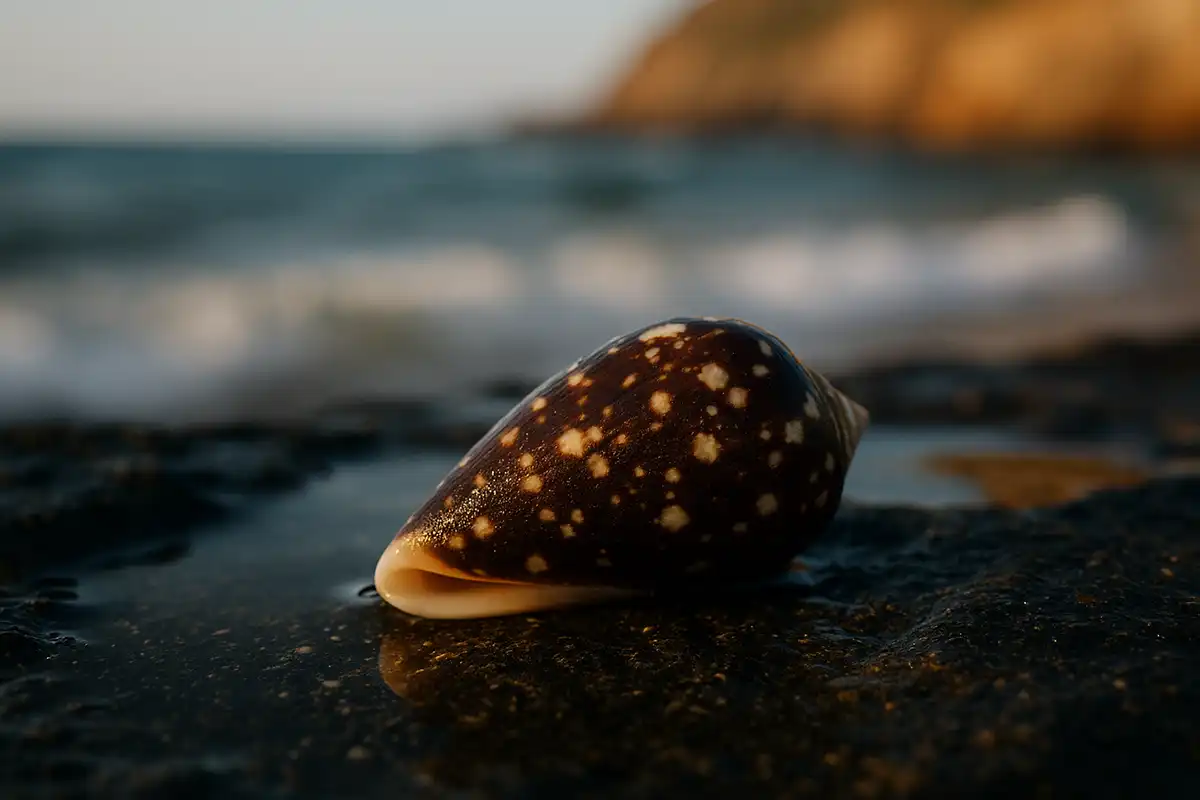
Epitaph for the Cape Verde Cone Snail

News in brief — October 2025

  • IUCN has listed the Cape Verde cone snail (Conus lugubris) as Extinct (EX) in its latest global Red List update released at the World Conservation Congress in Abu Dhabi. IUCN
  • Endemic to the north shore of São Vicente, Cape Verde; last seen alive in 1987. Researchers link its loss to coastal development destroying its narrow habitat. senckenberg.de
  • Cape Verde’s cone snails are a global hotspot of endemism (over 50 of 56 species occur only there), making shoreline protection pivotal. ScienceDirect

Epitaph for the Cape Verde Cone

Little spiral of night,
you drank the sea through a needle of light,
hunter in the tide’s hem.

A harbor grew where your shadow fed,
cement and glare replacing surge and stones.
We called it progress; your silence kept the bill.

Now the reef remembers in whispers—
a salt syllable, lugubris,
rolling back and back with the swell.

Contextual background

Conus lugubris was a tiny, peanut-sized marine snail known only from the north shore of São Vicente in the Cape Verde archipelago. It lived among wave-washed rocks in a postage-stamp range that left it exceptionally vulnerable to local change. No live animal has been recorded since 1987, despite targeted annual searches; in October 2025 the IUCN Red List formally classified it Extinct, with habitat loss from coastal development cited as the decisive factor.

The loss lands in a place famous among malacologists: Cape Verde harbors one of the world’s richest radiations of cone snails, with ~53 of 56 species found nowhere else. Endemism so concentrated means any hardening of shorelines, quarrying, port works, or pollution can erase entire evolutionary lineages in a single cove.

Cone snails are predatory and venomous, using a harpoon-like tooth to inject potent conotoxins into prey (worms, small fish, or other mollusks). While dramatic, that biology is also fragile: it depends on intact microhabitats and clean, structured shores. Protecting the remaining Cape Verde Conus species now requires strict coastal planning, safeguarding rocky intertidal zones, and long-term monitoring before rarity slips into rumor.

SOURCES

senckenberg.de+1

ScienceDirect

Animal Diversity Web

Latest Posts

More from Author

The Chromatic Deception: The Systemic Degradation of the Global Salmon Commons

A forensic autopsy of Big Salmon, exposing the ecological collapse, regulatory rot, and colonial theft behind the industry's dyed pink flesh.

The Large Language Model Landscape of March 2026

The agent economy emerges: browsers, sovereign stacks, and the quiet consolidation...

Read Now

The Chromatic Deception: The Systemic Degradation of the Global Salmon Commons

A forensic autopsy of Big Salmon, exposing the ecological collapse, regulatory rot, and colonial theft behind the industry's dyed pink flesh.

The Architects of Memory: An Investigative Report on the Elephant in the Anthropocene

From the deep-time silence of the Eocene swamps to the seismic rumblings of the modern savanna, the elephant is not merely a charismatic giant but the keystone of our planetary machinery—and its dismantling is a crisis of both biology and conscience. Introduction: The Silence of the Giants In the...

David Abram: Perception, Language, and the More-Than-Human World

I. The Prestidigitator at the Edge of the World In the landscape of contemporary ecological philosophy, David Abram cuts a figure both enigmatic and essential. He is not a scientist in the conventional sense, tallying parts per million of carbon dioxide or cataloguing extinction rates, though his work...

The Large Language Model Landscape of March 2026

The agent economy emerges: browsers, sovereign stacks, and the quiet consolidation of intelligence March 2026 feels strangely calm for an industry that only months ago seemed permanently electrified. The headlines have slowed. The benchmark fireworks have dimmed. Yet beneath the surface the machinery of artificial intelligence is turning faster...

Singapore: Engineered Nature in a Tropical City-State

GREEN CITIES SERIES  |  ARTICLE 4 Singapore has spent sixty years turning a cleared island into a green city, and the results are, in many respects, extraordinary. But the question the city-state now faces is different from the ones it has already answered: how do you make a...

Paris, or the Hard Work of a Breathing City

Green Cities Series | Article 02 How the French capital turned against the car, rewrote its streets, and discovered that a green city is not a mood but a struggle Paris has become one of the emblematic urban transformations of the climate era. In the space of two decades,...

GREEN CITIES

The City Must Breathe An introduction to the Green Cities series: what we mean, how we will judge, and why the urban future is now the decisive environmental story StandfirstThe green city has become one of the great promises of the twenty-first century. Yet the phrase is often used...

Compassion: The Architecture of Human Connection

There is a peculiar alchemy that occurs when one human heart turns toward another’s suffering—not to fix it, not to flee from it, but simply to acknowledge it. This turning, this quiet revolution of attention, is what we have come to call compassion. It is neither sentiment...

From Vertical Jungles to Deep-Sea Cooling: Ten Green Hotels Rewriting the Rules of Regeneration

The global hospitality sector is facing an existential reckoning. As international tourist arrivals climb toward 1.4 billion annually, the industry’s massive carbon footprint and its strain on local resources have moved from the periphery to the centre of the climate conversation. Yet, a vanguard of properties is...

The Mountain Sage: Arne Naess and the Deep Ecological Turn

Arne Naess's Deep Ecology: Life-centered philosophy on the intrinsic value of all life, urging a shift from Shallow Ecology to Ecological Self-realization.

Celestial Harmony: The Music of the Spheres

The ancient concept of celestial harmony has found unexpected resonance in modern quantum physics, creating a remarkable intellectual bridge spanning over two millennia of scientific thought. From Pythagorean mathematical mysticism to contemporary string theory, the notion that fundamental vibrations underlie cosmic order has persisted, evolved, and ultimately...

The Prometheus Myth: From Ancient Fire to Modern Relevance

The myth of Prometheus stands as one of humanity's most enduring and transformative stories, evolving from ancient Greek fire-theft narrative into a powerful symbol for modern technological revolution, philosophical rebellion, and the complex price of human progress. From Hesiod's cautionary tale to Silicon Valley's "Promethean" ambitions in...