
Come, sit. Let the dust of the road settle. Before we speak of the Way, we must first find our way to stillness. The mind is a tireless traveler, always seeking, always naming, always grasping. For this journey, we must ask it to rest. We are about to use words to point to that which is beyond them, a task as foolish as trying to carry the river in a sieve.
This is the central challenge, and also the first lesson. The very text we are about to explore, the Tao Te Ching, begins by announcing its own inadequacy. It is a hallmark of this kind of wisdom to be honest about the shortcomings of language when faced with the ineffable.1 The opening line is not a warning to turn back, but an instruction on how to proceed. It tells you that the grasping, defining mind will not succeed here. You are being invited not to conquer a concept, but to enter a mystery. The words I offer are not the destination; they are a raft. Use them to cross the river, but do not mistake them for the other shore. When you arrive, the raft must be left behind. The goal is not to understand the words, but to experience the silence to which they point.
The Verse in Its Original Form – The Uncarved Block
Here are the words as they have come down through the ages. In their earliest form, discovered on bamboo slips, they flowed without the commas and periods we add today, leaving even more space for the breath and for meaning to pool in unexpected ways.2
道可道,非常道。
名可名,非常名。
無名天地之始;
有名萬物之母。
故常無欲,以觀其妙;
常有欲,以觀其徼。
此兩者,同出而異名,
同謂之玄。
玄之又玄,
衆妙之門。3
What you must understand is that any translation of these lines is an interpretation, a single path carved into a vast landscape. The classical Chinese characters are like smooth river stones; they hold multiple, layered meanings that shift as you turn them in the light.4 This is why there are hundreds of translations, from the scholarly to the poetic, and none can be called definitive.6 Translators like Stephen Mitchell, influenced by his Zen practice, offer a clear, accessible path, though some scholars feel he strays from the original text.8 Others, like the poet Sam Hamill, strive to capture the meditative resonance and poetic ambiguity of the original, honoring its many possible meanings.4
The beautiful irony is that this proliferation of translations is a living demonstration of the verse’s second line: “The name that can be named is not the eternal Name.” Each attempt to capture the verse in English proves its point. The library of translations is a monument to the truth it contains.
So, let us not seek a perfect translation. Instead, let us use one as a guide for our contemplation today. Here is a rendering for our contemporary path:
The Way that can be mapped is not the ever-present Way.
The identity that can be defined is not the eternal Identity.
From the Unnamed, the cosmos takes its beginning.
Through the Named, the ten thousand things are mothered into being.
Therefore, be ever without wanting, and see the subtle mystery.
But be ever with wanting, and see only the outer shell.
These two, though we call them by different names, spring from the same dark source.
This darkness, and the darkness within this darkness—
This is the gateway to all wonder.
Unpacking the Lines – A Guided Contemplation
Let us walk through these lines together, not as a scholar dissects a text, but as one walks through a garden, paying attention to each plant and the soil from which it grows.
The Path You Cannot Pave (道可道,非常道)
The first character, 道 (dào), is the key to this entire book. It is a picture of a “head” or “leader” (首) on a path or “to walk” (辶).12 It means the Way, the path, the road. But it is also a verb: to speak, to guide, to lead, to explain.5 The genius of this first line is that it uses 道 as both a noun and a verb: “The Way (dào) that can be spoken of (kě dào)…”
So, it can be read as:
- “The Way that can be spoken of is not the eternal Way”.14
- “The path that can be trodden is not the enduring path”.3
- “The truth that can be understood is not the eternal Truth”.5
The second key character is 常 (cháng), which means “constant,” “eternal,” “enduring,” or “unvarying”.14 It does not mean static or frozen. It points to a living, dynamic permanence, like the constant flow of a river, which is never the same from moment to moment yet is always the river.
This opening statement is a profound warning that applies not only to the great cosmic Tao but to everything in your life. The moment a living process—your own spiritual path, a relationship, a creative impulse—is fully codified, mapped, and made predictable (可道, kě dào), it loses its connection to the living, ever-present source (非常道, fēi cháng dào). Think of a wild river. You can create a map of it, but the map is not the flowing water. If you try to force the river to conform perfectly to your map, you must build dams and concrete channels; you must kill its living, adaptable nature to make it fit your definition. The Way is found in suppleness and flow, not in the rigidity of dogma.16
The Name That Holds No Thing (名可名,非常名)
Just as the first line deals with the limits of paths, the second deals with the limits of names (名, míng). Naming is the fundamental act of the human intellect. It carves the seamless whole of reality into manageable pieces. As Stephen Mitchell renders it, “Naming is the origin of all particular things”.17 It is how the “ten thousand things”—a poetic term for all of creation—are born into our perception.3
But in this act of naming, we make a crucial mistake: we confuse the label with the reality. We see the word “tree” and we stop seeing the actual, unique, living being before us, with its textured bark and rustling leaves. The name creates a boundary, separating the “tree” from the “earth” and “sky” that it is woven into. As one commenter wisely noted, naming has everything to do with the person doing the naming and very little to do with the thing itself.19
Our language does not merely describe the world we live in; it actively constructs it. This world of names and concepts becomes a comfortable prison, preventing us from experiencing the undivided, nameless whole from which it arises. The path to wisdom, then, requires a kind of “unlearning,” a letting go of our concepts, so that we may glimpse the world as it is before we have plastered a label upon it.
The Two Faces of Reality: Nameless and Named (無名天地之始;有名萬物之母)
The verse now presents two aspects of this one reality.
First is the Nameless (無名, wú míng), called the “originator of heaven and earth” (天地之始).3 This is the unmanifest, the formless potential from which everything arises. Do not think of it as empty nothingness. It is a pregnant void, a deep well “filled with infinite possibilities”.16 It is the Tao in its pure, undifferentiated state, before it has been carved into forms.21
Second is the Named (有名, yǒu míng), called the “Mother of the ten thousand things” (萬物之母).3 This is the Tao made manifest. This is the world of form, color, sound, and distinction that we perceive with our senses. It is the vibrant, dynamic, ever-changing universe.
It is crucial to understand that this is not a linear story of creation, as in “first there was the Nameless, and then it created the Named.” The verse later states, “These two spring from the same source” (此兩者,同出).3 They are not sequential but simultaneous, like two sides of a single coin. Think of silence and sound. Sound arises from silence and returns to it, but the silence is always present, even underneath the sound. The Nameless is the eternal silence; the Named is the symphony that plays within it. At every moment, reality is both.
The Two Gates of Perception: Desire and Desirelessness (故常無欲,以觀其妙;常有欲,以觀其徼)
Here, the verse pivots. The character 故 (gù) means “therefore” or “for this reason.” It connects the grand philosophical statements of the first half to the intimate, practical instructions of the second. This is where metaphysics becomes psychology.
To be “ever desireless” (常無欲, cháng wú yù) allows one to “observe its mystery” or “subtle essence” (以觀其妙, yǐ guān qí miào). This is not a call to become a passionless stone. It is about releasing the grasping, clinging, wanting mind. It is a state of open, allowing awareness, the state of wu wei (doing-not-doing).16 When you are still in this way, without demanding that reality be anything other than what it is, its subtle, interconnected nature reveals itself to you.
Conversely, to be “ever desiring” (常有欲, cháng yǒu yù) means you see only the “manifestations” or the “outer fringe” (以觀其徼, yǐ guān qí jiào). When the mind is full of wanting, it can only see the world as a collection of separate objects that can either satisfy or frustrate those wants. You see the surface, the boundaries, the shell of things.3
This is not a moral judgment against desire. It is a profound lesson in how we know what we know. The verse teaches that what you can perceive is a direct function of your inner state of being. You are not being told to be “good” by eliminating desire. You are being shown that you possess two gates of perception, and the one you look through determines the world you see. The following table maps these two ways of seeing:
| The Way of Mystery (The Nameless) | The Way of Manifestation (The Named) |
| Source: The Unnamed (無名), Origin of Cosmos (天地之始) | Source: The Named (有名), Mother of All Things (萬物之母) |
| Inner State: Desirelessness (常無欲) | Inner State: Desiring (常有欲) |
| Perception: The Subtle Essence / Mystery (其妙) | Perception: The Outer Fringe / Manifestations (其徼) |
| Nature: The Uncarved Block, Unity, Potentiality | Nature: The Ten Thousand Things, Duality, Actuality |
| Experience: Being, Allowing, Wu Wei (無為) | Experience: Having, Striving, Grasping |
The Dark Within the Dark: The Gateway to All Wonders (此兩者,同出而異名,同謂之玄。玄之又玄,衆妙之門)
Now, the great reconciliation. “These two,” the verse says—the mystery and the manifestations, the world seen through desirelessness and the world seen through desire—”spring from the same source, but differ in name” (此兩者,同出而異名).3 The duality that seems so real is a product of our perception, our naming. It is not a fundamental feature of reality itself.
This single, unified source is called 玄 (xuán). The character is often translated as “dark,” “deep,” “profound,” or “mysterious”.3 This is not the darkness of fear or ignorance. It is the fertile darkness of the deep ocean, of rich soil, of the womb, of the night sky from which the stars emerge. It is the color of pure potential.
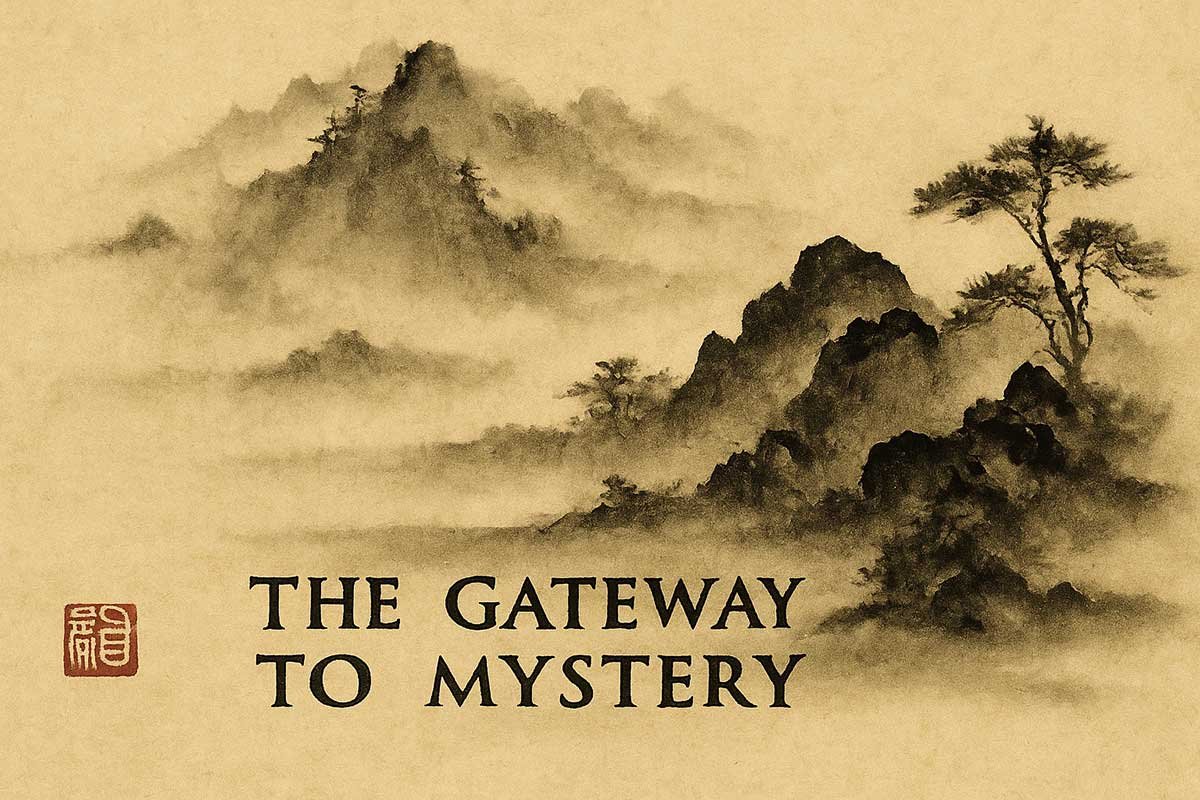
The final line is the culmination of the entire verse: “Darkness within darkness” or “Mystery of mysteries” (玄之又玄, xuán zhī yòu xuán). This is the “gateway to all wonders” (衆妙之門, zhòng miào zhī mén). The teaching does not resolve the dualities of existence by having one side conquer the other—light defeating dark, spirit overcoming matter. Nor does it collapse them into a bland, featureless unity. It holds them in a dynamic, creative tension, revealing that their very opposition arises from a single, mysterious source. The ultimate destination is not a simple answer that dispels the darkness. The ultimate wisdom is to go deeper into the mystery. The acceptance of this profound, generative paradox is itself the gateway. It is not an exit from mystery, but a doorway that leads you further into its heart, which is the source of all wonder.
Living the Verse – A Return to the Path
We have spent this time with words. We have carved and named and analyzed. Now, let it all go. The verse is not a philosophy to be memorized, but a posture to be embodied. Its teaching is lived in the smallest moments of your day.
When you feel the urge to label someone, to judge a situation, to define an experience—pause. Can you, just for a breath, experience the moment without the name?
When you are caught in wanting, in striving, in the frustration of a desire unmet—pause. Can you feel the energy of the desire without being consumed by it? Can you sense the deep stillness (無欲) that lies beneath the turbulent surface of your wanting (有欲)?
Look at a simple flower. First, see it as “flower,” a named thing, a manifestation. Then, try to see it without the name. See only a pattern of color and form, a living process connected to the earth, the air, the water, and the sun. In that moment, you may glimpse its “mystery.”
The gateway to all wonder is not in a distant land or an ancient text. It is here. It is now. It is the space between your thoughts, the silence beneath the noise, the fertile darkness from which your own life springs. Do not seek the Way. Simply be still, and let the Way find you.