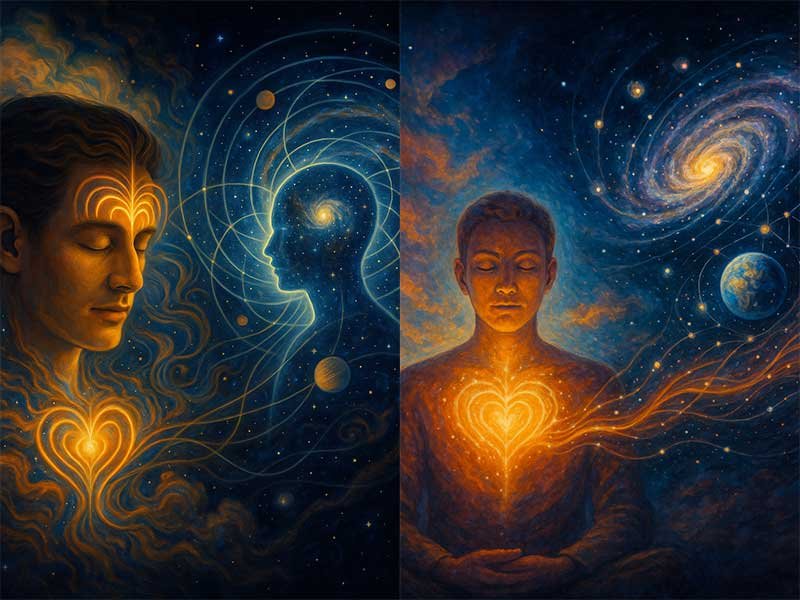

The intricate dance of energies that pervades the cosmos has fascinated humanity for millennia, drawing interest from poets, philosophers, scientists, and spiritual leaders alike. At its core lies the profound connection between energy, emotion, and our collective destiny. This relationship, explored deeply by thinkers such as the Persian mystic Rumi and physicist Albert Einstein, reveals an interconnected web of vibrational realities influencing personal and universal outcomes.
Rumi, whose poetic insights bridge the gap between the mystical and the tangible, famously articulated, “What you seek is seeking you.” This phrase encapsulates more than mere poetic resonance; it points towards an ancient and intuitive understanding of emotional energy as a magnetic force, attracting experiences that reflect its vibrational quality. When emotions are harmonized and coherent, they resonate clearly, drawing experiences that align with higher spiritual purposes and intentions. Conversely, chaotic emotional states attract discordant experiences, perpetuating cycles of disharmony.
This idea, historically rooted in spiritual traditions, aligns remarkably with modern scientific understanding. Dr. Joe Dispenza, who bridges neuroscience and quantum mechanics, emphasizes that “The more coherent our brain and heart, the more we feel connected to a future reality in the present moment.” Dispenza’s research suggests that emotional coherence—characterized by synchronized heart-brain interactions—results in measurable and stable electromagnetic fields around the human body. These fields have tangible effects, influencing personal well-being and even altering immediate environments. Dispenza’s synthesis of ancient wisdom and contemporary science underscores the profound link between emotional coherence and the unfolding of destiny.
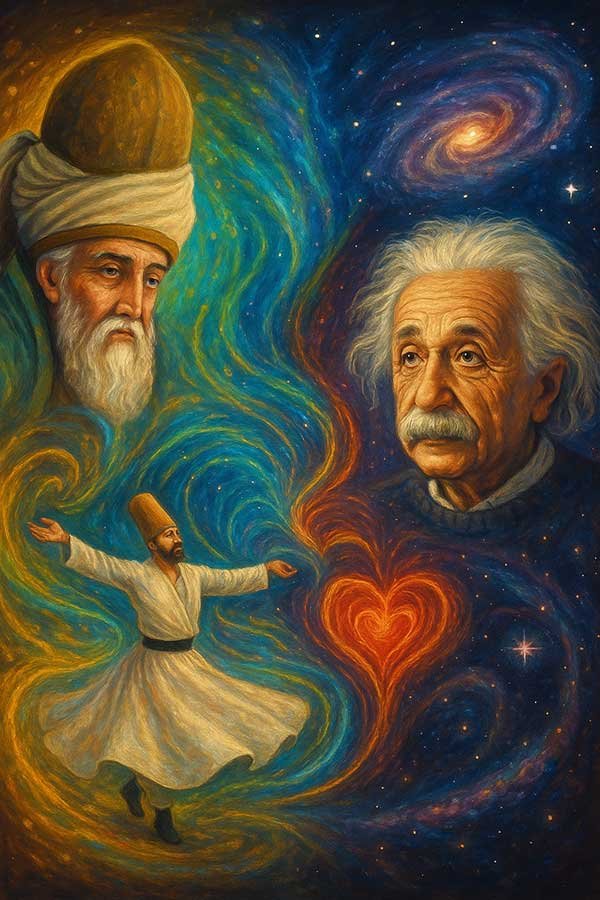
Einstein’s groundbreaking theories further illuminate this energetic dance. Through his famed equation E=mc², Einstein demonstrated the interchangeability of mass and energy, fundamentally altering our understanding of reality. His insights suggest that everything, from the stars above to the emotions we experience, consists fundamentally of energy vibrating at specific frequencies. If matter and energy are interchangeable, then emotional states—being energy states—may indeed have tangible impacts, not only psychologically but physically, shaping the destiny of individuals and collectively influencing societies.
Ancient scriptures echo similar sentiments. The Bhagavad Gita articulates, “We are kept from our goal not by obstacles but by a clear path to a lesser goal.” This scripture reinforces the concept that emotional and spiritual coherence align us with a higher purpose. When emotional coherence falters, we deviate from our intended path, often settling for lesser realities. Thus, the alignment of emotions with a clearly envisioned spiritual objective becomes a pathway towards fulfilling individual and collective destinies.
The Dalai Lama adds to this discourse by asserting, “World peace begins with inner peace.” Emotional coherence, as proposed by the Dalai Lama, is not merely a private virtue but a foundational pillar for global harmony. Individuals who cultivate emotional coherence become agents of positive change, their stable and positive electromagnetic fields affecting others subtly yet powerfully. The energetic ripples from coherent individuals can intersect and amplify, producing widespread shifts in collective consciousness.
Practical pathways to emotional coherence include meditation, mindfulness, and gratitude practices. These methods cultivate self-awareness, compassion, and clarity, effectively aligning the heart and mind. Neuroscientific studies support these practices, indicating profound changes in brain activity, hormonal balance, and emotional regulation when regularly practiced. Meditation, for instance, has been scientifically validated as an effective tool for reducing stress, improving cognitive function, and enhancing emotional stability. Through such intentional practices, individuals tap into deeper reservoirs of universal energy, fostering coherence and promoting alignment with their highest potential.
The coherence sought through these practices extends beyond mere self-improvement; it forms the cornerstone of spiritual evolution and destiny realization. This sentiment echoes the broader philosophical traditions of many spiritual paths, from the contemplative traditions of Buddhism to the mystical teachings of Sufism. Emotional coherence allows individuals to participate consciously in shaping their destiny, contributing actively to the evolutionary narrative of humanity.
The quantum physics perspective offers compelling support for the interconnectedness of all life forms. Quantum entanglement, a phenomenon wherein particles remain connected regardless of distance, metaphorically aligns with the interconnectedness of human emotions and experiences. Emotions are not isolated phenomena but integral components of an interconnected energetic web. Through emotional coherence, individuals tap into this network, aligning their personal energies with greater universal energies and contributing to a collective destiny shaped by interconnected vibrations.
Furthermore, recent advancements in the field of epigenetics provide additional support for the power of emotional coherence. Epigenetics—the study of how environmental factors affect gene expression—reveals that emotional and psychological environments directly impact physical health at a genetic level. Consistently coherent emotional states foster optimal physical conditions, influencing health, longevity, and vitality. Consequently, emotional coherence is not merely a spiritual endeavor but a holistic approach integrating body, mind, and spirit, reshaping one’s genetic expression and health trajectory.
The intersection of emotional coherence, quantum physics, and spiritual wisdom also highlights the profound potential for societal transformation. Societies composed of emotionally coherent individuals are likely to be resilient, compassionate, and oriented toward collective well-being. Positive emotional coherence thus holds the potential to revolutionize societal norms, fostering communities grounded in empathy, collaboration, and harmony. As emotionally coherent states proliferate, they create resonant collective fields capable of supporting profound social, environmental, and political transformations.
In conclusion, the interplay of energy, emotion, and destiny explored through Rumi’s mysticism and Einstein’s scientific insights reveals a powerful and coherent framework for understanding human existence. The deliberate cultivation of emotional coherence positions individuals not merely as passive participants but as active creators in their destinies. By harmonizing emotions through intentional practices such as meditation and mindfulness, individuals contribute to a collective energetic shift capable of transforming societies and actualizing humanity’s highest potentials. Thus, emotional coherence emerges not merely as personal aspiration but as a universal imperative, profoundly influencing individual and collective destinies.
References
Dalai Lama. The Art of Happiness. New York: Riverhead Books, 1998.
Dispenza, Joe. Becoming Supernatural: How Common People Are Doing the Uncommon. Carlsbad, CA: Hay House Inc., 2017.
Einstein, Albert. Relativity: The Special and General Theory. Translated by Robert W. Lawson. New York: Crown Publishers, 1961.
Lipton, Bruce. The Biology of Belief: Unleashing the Power of Consciousness, Matter & Miracles. Carlsbad, CA: Hay House Inc., 2015.
Rumi. The Essential Rumi. Translated by Coleman Barks. San Francisco: HarperOne, 2004.
Sargeant, Winthrop, trans. The Bhagavad Gita. Albany: State University of New York Press, 2009.