

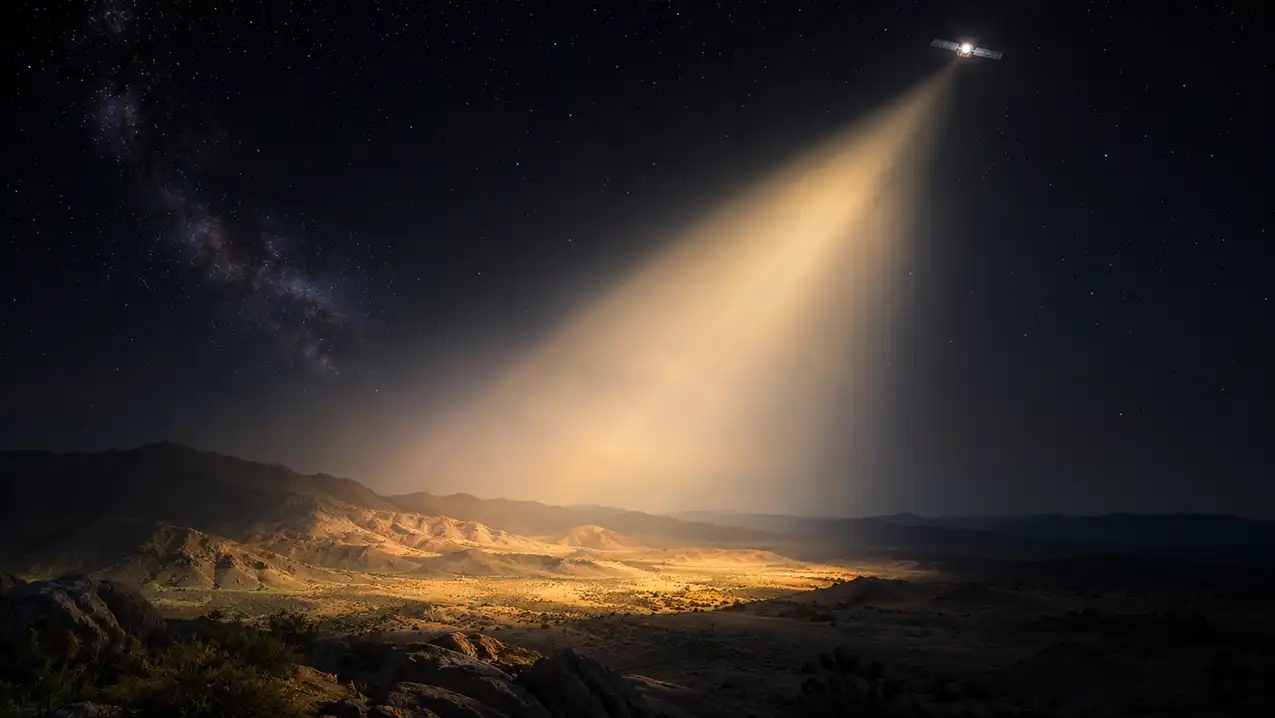
The company that wants to sell sunlight after dark — and the ecological price of rewriting nature’s oldest clock
A Californian technology company wants to place tens of thousands of giant mirrors in orbit, selling sunlight to customers long after sunset. Its promise is cleaner energy, safer communities and lives saved. But as scientists warn of threats to wildlife, astronomy and the natural rhythms of life, a larger question emerges: who gave private enterprise the authority to commercialise the darkness we all share?
When the mountains refused to go dark
On the evening of 10 October 2026, something extraordinary happened in California’s Owens Valley.
As darkness settled over the Sierra Nevada, an expanse of mountainside suddenly blazed with an unfamiliar light. Residents accustomed to the dark desert landscape looked towards the mountains in bewilderment. Some wondered whether a film crew was working nearby.
The illumination came from powerful floodlights installed near Lone Pine by a technology company called Reflect Orbital.
Its engineers were demonstrating what they hope to accomplish on an altogether more ambitious scale: illuminating the Earth after sunset using enormous mirrors orbiting hundreds of kilometres overhead.
Two local search-and-rescue organisations had been invited to test the illumination. Nearby residents and astronomers, however, reported receiving no advance notification. According to reporting by Sky & Telescope, even some local government officials were unaware of the demonstration.1
The light was slightly brighter than a full Moon. For rescuers searching difficult terrain, the visibility was potentially useful.
For astronomers and environmental scientists, it was a warning.
The California experiment did not involve a satellite. It used conventional ground-based lights to simulate the proposed technology.
Yet it raised a question considerably larger than the experiment itself.
What happens when the illumination of the natural world becomes a commercial service, purchased by one party but experienced by everyone?
A business plan written across the heavens
Reflect Orbital, headquartered in Hawthorne, California, is developing what might be called sunlight on demand.
Its proposed satellites would carry enormous deployable reflective surfaces, positioned in low-Earth orbit where they could intercept sunlight and redirect it towards selected locations experiencing darkness.
The company’s first mirror-bearing demonstrator, Eärendil-1, has received authorisation from the US Federal Communications Commission. Its planned reflector measures 18 by 18 metres, directing light towards a ground area approximately five kilometres across.
But the ambitions extend far beyond one spacecraft.
Reflect Orbital envisages eventually operating more than 50,000 satellites, with future mirrors potentially measuring 54 metres across. Its published projections suggest that, by 2035, coordinated orbital reflectors could deliver illumination approaching daylight intensity for extended periods.
For now, those figures remain projections, not operational achievements.
Indeed, on 30 October the company announced an additional preliminary satellite, Eärendil-0, planned for launch no earlier than April 2027. It will carry no reflector, testing spacecraft control and communications before the mirror technology reaches orbit.2
The eventual system would operate through a customer-facing digital platform. Approved users could purchase illumination for specified locations, durations and intensities.
Potential customers include solar farms, emergency services, agriculture, industrial facilities, cities and defence organisations.
It is a remarkable commercial proposition.
For centuries, businesses have sold the machinery and electricity that produce artificial light.
Reflect Orbital proposes selling access to sunlight itself.
There is, however, a fundamental physical complication. Satellites travel rapidly around Earth. A single mirror would illuminate a particular location for only a few minutes before moving beyond useful range.
Continuous illumination would require successive satellites taking over, while clouds, atmospheric conditions and orbital geometry would constrain delivery.
And light directed towards a particular customer does not necessarily remain within the customer’s property boundaries.3
Our long struggle against darkness
Humanity’s relationship with artificial light stretches back to the controlled use of fire.
Oil lamps, candles and torches extended human activity beyond sunset. They provided warmth, security and companionship, but remained relatively limited in reach.
The industrial revolution changed that relationship dramatically.
In 1807, gas lamps illuminated London’s Pall Mall. Within decades, gas lighting transformed urban streets, factories, theatres and commercial life.
Electric lighting accelerated the transformation. Joseph Swan and Thomas Edison developed practical incandescent lamps during the nineteenth century, while electrical distribution eventually brought reliable illumination into homes and workplaces.
The twentieth century delivered fluorescent lighting, floodlights and illuminated highways. The twenty-first brought increasingly efficient LEDs.
Each technological advance offered genuine benefits: safer travel, medical care, education, greater productivity and more freedom to organise daily life.
But illumination also enabled factories and businesses to extend working hours, weakening the ancient distinction between labour and rest.
The idea of orbital mirrors is not entirely new.
In February 1993, Russia’s Znamya 2 experiment deployed a 20-metre reflector from a spacecraft associated with the Mir space station. It briefly redirected sunlight across parts of Europe. A later attempt failed after deployment difficulties.
The experiment demonstrated technical possibility, not commercial viability.4
Reflect Orbital’s innovation is therefore less the invention of space-based illumination than its proposed industrialisation.
What was once an extraordinary experiment could become a permanent business model.
The promise: cleaner electricity and lives saved
The attractions deserve serious consideration.
Solar energy has become one of humanity’s most important tools for replacing fossil fuels. Yet conventional photovoltaic systems stop producing electricity after sunset.
If orbital mirrors could direct sufficient sunlight onto existing solar farms economically, they might extend electricity generation without requiring additional land.
The company projects that a mature constellation could significantly improve solar-farm output. Such additional renewable electricity could, in principle, displace fossil-fuel generation and reduce greenhouse emissions.
Emergency response offers another potentially valuable application.
Earthquakes, floods, wilderness searches and industrial accidents frequently demand dangerous operations after dark. Additional illumination could improve visibility and reduce reliance on portable lighting equipment.
Reflect Orbital also envisages agricultural applications and illumination for remote communities lacking reliable infrastructure.
These are legitimate possibilities.
But possibility is not proof of practicality.
Australian astronomer Michael Brown, from Monash University, has questioned the economics. In calculations reported by the ABC, he estimated that thousands of large mirrors would be required to deliver even a fraction of midday sunlight, with sustained illumination potentially costing millions of dollars.
The comparison with battery storage, conventional floodlighting and other terrestrial technologies is therefore unavoidable.5
A technology is not environmentally beneficial simply because its energy ultimately comes from the Sun.
Its total cost, resource demands, alternatives and unintended consequences must be examined.
Nature’s clock has no off switch
The greatest ecological concern is not that artificial light is inherently destructive.
It is that living organisms have evolved complex biological systems regulated by natural cycles of illumination and darkness.
Daylength helps determine when plants flower, birds reproduce, animals migrate and organisms enter periods of dormancy.
Human beings have circadian rhythms regulating sleep, hormones, metabolism and alertness.
For nocturnal species, darkness is not an absence of opportunity.
Darkness is their habitat.
Bats leave their roosts to hunt. Moths pollinate flowers. Small mammals forage while avoiding predators. Birds navigate extraordinary migrations beneath the stars.
Suddenly illuminating these environments could alter relationships developed over evolutionary time.
A major meta-analysis published in Nature Ecology & Evolution found that artificial light at night produces substantial changes in animal physiology, behaviour and life-history traits.
These effects were not confined to unusually bright illumination. Biological responses vary across species, exposure durations and light spectra.6
A 2026 meta-analysis of avian studies found that artificial nighttime lighting was associated with reduced sleep, increased metabolic activity and extended daily activity periods.
Migratory birds were particularly sensitive in several measured responses.7
In a landmark Swiss field experiment, artificially illuminated habitats experienced 62 per cent fewer nocturnal pollinator visits. Fruit production in one studied plant fell by 13 per cent.
The damage was not confined to insects active at night. Disrupting nocturnal pollination could also affect the wider ecological relationships supporting daytime pollinators.8
Marine environments offer equally troubling evidence.
Australian conservation authorities recognise artificial coastal lighting as a serious threat to sea turtles. Hatchlings ordinarily move towards the brighter horizon over the ocean. Artificial illumination can send them inland, exposing them to exhaustion, dehydration and predators.
Coral reproduction, too, is closely linked to lunar cycles. Research has associated coastal light pollution with changes in the timing of mass spawning events.9
None of these studies proves that Reflect Orbital’s proposed system would produce precisely the same effects.
A brief overhead beam differs from continuous illumination by streetlights or buildings.
Nevertheless, the existing research establishes that altering nighttime light exposure is biologically consequential.
That finding demands caution before experimenting on entire landscapes.
And unlike a streetlight, an orbital mirror cannot simply be shielded by directing its illumination downwards. Its very purpose is to illuminate the landscape from above.
The invisible consequences beyond the beam
One of the most revealing scientific investigations appeared in The Astrophysical Journal Letters in September 2026.
Researchers Miroslav Kocifaj, Gáspár Bakos and František Kundracik modelled the atmospheric effects of Reflect Orbital’s proposed mirrors.
Their results challenge the reassuring idea that illumination could remain confined to a narrowly defined commercial customer.
When sunlight enters the atmosphere, molecules and airborne particles scatter it. Illuminated ground surfaces reflect additional light upwards.
The resulting skyglow can extend substantially beyond the intended target.
For a proposed 54-metre mirror, the researchers calculated that the diffuse sky could become comparable to twilight within the illuminated area.
At 14 kilometres from the beam’s centre, much of the sky could appear brighter than under a full Moon. Significant brightness could remain visible farther away.
The calculations concern proposed future mirrors under modelled atmospheric conditions, not measurements of an operational system.
Nevertheless, they highlight the difficulty of guaranteeing that non-customers will remain unaffected.3
A mining company might purchase illumination for a remote industrial operation.
A neighbouring nature reserve might receive unwanted skyglow.
An astronomical observatory tens of kilometres away could lose valuable observing time.
The customer pays. Others experience the consequences.
A new climate solution — or another environmental burden?
Reflect Orbital presents its technology partly as a response to climate change.
Its reasoning is understandable: more solar electricity could mean less fossil-fuel combustion.
But the climate argument must be evaluated across the entire technology’s life cycle.
Redirected sunlight does not itself release greenhouse gases. Nor is there evidence that a proposed orbital-mirror network would produce substantial global warming simply by adding light to selected nighttime locations.
Although redirected radiation can add energy locally, the global climatic effect of the proposed system has not been established. It should not be confused with planetary-scale solar geoengineering.
The more substantial questions concern manufacturing, launch emissions, satellite replacement and the electricity actually generated.
Rockets emit pollutants into atmospheric layers where their effects differ from conventional surface emissions.
Research published in Earth’s Future in 2026 examined the atmospheric consequences of growing satellite megaconstellations. It identified climate and ozone-related effects associated with launch and re-entry emissions, particularly black carbon from rocket exhaust.
Other atmospheric research has warned that expanding launch activity could delay recovery of the ozone layer.10
A constellation numbering tens of thousands of satellites would also introduce manufacturing demands, orbital debris risks and eventual re-entry pollution.
The relevant calculation is therefore not simply how much sunlight a mirror can deliver.
It is how much fossil-generated electricity the system demonstrably displaces, compared with the environmental costs of constructing, launching, operating and replacing the spacecraft.
Until independent life-cycle assessments and practical energy demonstrations are available, claims of substantial greenhouse benefits remain unproven.
Astronomy faces an unfamiliar threat
For astronomers, the consequences could be especially severe.
A dark sky is not an aesthetic luxury. It is essential scientific infrastructure.
Ground-based observatories depend upon detecting extremely faint signals from distant stars, galaxies and other celestial objects.
A sufficiently bright orbiting reflector could overwhelm sensitive instruments, interfere with observations and compromise measurements.
The American Astronomical Society has also warned of potential eye injuries when intense reflected sunlight unexpectedly enters a telescope.
These are specific optical risks, not evidence that ordinary naked-eye observation would necessarily cause permanent injury.11
Astronomers have already struggled with the rapid proliferation of communications satellites whose reflected sunlight produces streaks across telescope images.
Purpose-built orbital mirrors would introduce a more deliberate source of brightness.
Importantly, the scientific threat is not limited to observatories directly beneath the light.
Atmospheric scattering could compromise observations far outside the intended beam.
In 2016, a global atlas estimated that more than 80 per cent of humanity lived beneath light-polluted skies.12
The remaining dark places are therefore increasingly precious.
Who gave permission to change the night?
This brings us to the most important question.
What legal right does a private corporation have to impose artificial illumination upon people, communities and ecosystems that have not requested it?
In July 2026, the Federal Communications Commission approved Reflect Orbital’s Eärendil-1 demonstration satellite.
But the approval was not a comprehensive environmental licence authorising the wholesale commercialisation of the night sky.
The FCC’s decision principally addressed satellite communications and associated regulatory requirements. The agency maintained that several concerns about optical astronomy and deliberate reflected sunlight were outside its regulatory remit.
Environmental organisations challenged that approach.
On 6 August, DarkSky International, the American Bird Conservancy, Environment America and Public Employees for Environmental Responsibility, represented by Earthjustice, requested a review of the approval.13
The company has responded that its service would require customer checks, local approvals and safeguards intended to prevent unwanted illumination.
Such commitments matter. But voluntary assurances are not equivalent to independent environmental regulation, particularly when scattered light can cross jurisdictional boundaries.
International law offers principles, though not a complete solution.
Under the 1967 Outer Space Treaty, governments bear responsibility for national space activities, including those undertaken by private corporations. The treaty also requires due regard for other countries’ interests and provides for consultation where potentially harmful interference may occur.
It does not establish a straightforward universal right to darkness or give every affected community a direct veto over satellite activities.14
Reflect Orbital’s October agreement for future launches using Indian rockets makes the jurisdictional problem even more apparent.
An American corporation could launch satellites from India, directing light towards a third country’s territory, with atmospheric effects crossing still more borders.
Who assesses the consequences? Which government is accountable? Whose environmental standards apply?
These questions cannot be settled merely by obtaining approval to use radio frequencies.
Nor should a regulatory gap be mistaken for an unlimited corporate entitlement.
The precaution that progress requires
There is no compelling reason to dismiss orbital-reflector technology before its capabilities have been properly investigated.
But neither is there a compelling justification for deploying a vast commercial network before its ecological effects are independently understood.
A responsible regulatory framework would require comprehensive environmental impact assessments, including wildlife, human health, astronomical and atmospheric consequences.
It would establish enforceable limits on brightness, duration, timing and light spill; protect sensitive ecological areas and observatories; provide advance public notification; and require effective emergency shutdown mechanisms.
International coordination would be essential because orbital illumination does not respect national borders.
Crucially, the burden of demonstrating safety should rest with the operator, not with communities forced to prove harm after deployment.
The history of industrial development repeatedly teaches the same uncomfortable lesson.
Technologies introduced as instruments of human progress can generate costs that societies recognise only after substantial damage has occurred.
Artificial illumination has enriched civilisation immeasurably.
It has also transformed ecological landscapes, altered human habits and progressively erased the stars from much of our experience.
Reflect Orbital’s ambitions bring us to another frontier.
For billions of years, the rhythms of sunlight, moonlight and darkness have structured life on Earth. No corporation invented them. No government created them. No species holds exclusive title to them.
The night is not empty territory awaiting commercial development.
It is an ancient, functioning part of the living world.
Before we begin selling pieces of it by the hour, perhaps we should establish whether darkness itself deserves protection.
The question is not simply whether humanity can manufacture additional daylight. It is whether we have acquired the wisdom to recognise when the world is better left in darkness.
Endnotes and sources
Chicago-style numbered references. Checked to 3 November 2026.
- Hannah Richter, “A Satellite Company Tests ‘Sunlight As A Service’—Without Astronomers’ Knowledge,” Sky & Telescope, 26 October 2026. Source ↗
- Reflect Orbital, “Eärendil-0: Testing the Foundations First,” 30 October 2026; American Astronomical Society, “AAS Public Policy Experts Available to Comment on FCC Approval of Reflect Orbital’s Earendil-1 Mission,” 13 July 2026. Source ↗
- Miroslav Kocifaj, Gáspár Bakos, and František Kundracik, “Atmospheric Light Pollution by Proposed Reflect Orbital Space Mirrors,” The Astrophysical Journal Letters 1008, no. 1 (2026): L25. Source ↗
- London Museum, “How Gas Lamps Illuminated London”; NASA, Mir Hardware Heritage, historical account of the Znamya experiment. Source ↗
- James Purtill, “Reflect Orbital Wants to Turn Night into Day with Mirrors in Space,” ABC News, 19 July 2026. Source ↗
- Dirk Sanders et al., “A Meta-analysis of Biological Impacts of Artificial Light at Night,” Nature Ecology & Evolution 5 (2021): 74–81. Source ↗
- “Artificial Light at Night Consistently Impacts Avian Physiology and Behaviour: A Meta-Analysis,” Ecology Letters 29, no. 4 (2026): e70382. Source ↗
- Eva Knop et al., “Artificial Light at Night as a New Threat to Pollination,” Nature 548 (2017): 206–209. Source ↗
- Australian Government, Department of Climate Change, Energy, the Environment and Water, “Reducing the Effect of Light Pollution on Wildlife—Turtles”; “Global Disruption of Coral Broadcast Spawning Associated with Artificial Light at Night,” Nature Communications (2023). Source ↗
- Connor R. Barker et al., “Radiative Forcing and Ozone Depletion of a Decade of Satellite Megaconstellation Missions,” Earth’s Future 14 (2026): e2025EF007229; Laura E. Revell et al., “Near-future Rocket Launches Could Slow Ozone Recovery,” npj Climate and Atmospheric Science 8 (2025): 212. Source ↗
- American Astronomical Society, “AAS Public Policy Experts Available to Comment on FCC Approval of Reflect Orbital’s Earendil-1 Mission,” 13 July 2026. Source ↗
- Fabio Falchi et al., “The New World Atlas of Artificial Night Sky Brightness,” Science Advances 2, no. 6 (2016): e1600377. Source ↗
- DarkSky International, “DarkSky and Allies Ask the FCC to Reverse Its Approval of the Reflect Orbital ‘Space Mirror’,” 6 August 2026; Federal Communications Commission, Order DA 26-706, 9 July 2026. Source ↗
- United Nations, Treaty on Principles Governing the Activities of States in the Exploration and Use of Outer Space, 1967, articles VI and IX. Source ↗


