

Feature · The Living World
The world’s remaining wetlands, the work they do for the planet, and the intelligence of water
At first light, the marsh breathes. Mist rises off black water in slow exhalations, and the reeds shiver under the weight of birds too small to see — only their movement gives them away. Somewhere in the sedges a frog begins its pulsing call. Another answers. Then another, until the whole wetland sounds less like a place than an orchestra tuning itself to the dawn.
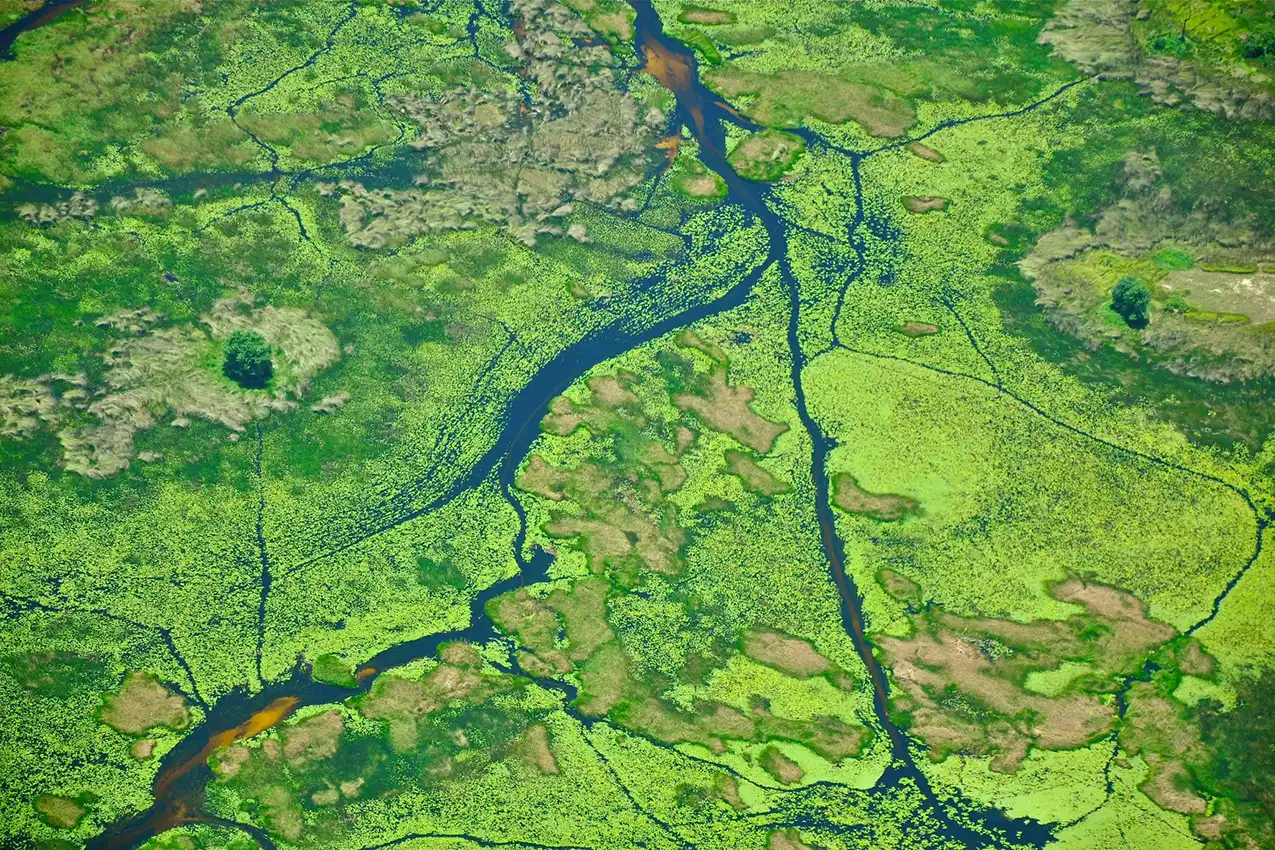
The world is soft here. Not fixed, not rigid, neither wholly land nor wholly water. Tidal channels fill and empty to the pull of the moon. Peat shifts underfoot, holding the compressed memory of centuries. Mangrove roots climb out of the estuarine mud like vascular systems turned inside out, and waterbirds spiral up from floodplains that, only weeks ago, lay cracked and dry beneath the heat.
A marsh is never still. It pulses and filters, absorbs and stores, exchanges and remembers. We have struggled, as a civilisation, to understand such places, because they refuse the industrial appetite for permanence. They overflow their boundaries. They move with the seasons. They blur the line we like to draw between earth and river, ocean and forest, decay and fertility — and in that blurring we have too often read disorder, and reached for the drain.
Neither Land nor Water
We were wrong. These unstable places are among the most stable systems on Earth, and we are losing them faster than we are losing anything else. Wetlands are now the planet’s most threatened ecosystem, vanishing roughly three times faster than forests; more than a third of the world’s wetlands disappeared between 1970 and 2015 alone, and the rate of loss is still climbing. More than a quarter of all the species that depend on them are now sliding toward extinction.¹ Long before we raised our reservoirs and levees, our canals and seawalls and desalination plants, the marsh was already doing this work — regulating the planet’s water through an intelligence evolved across hundreds of millions of years.
To lose them is not to lose scenery. It is to lose the organ that keeps the rest of the body alive. And to understand what is at stake, you have first to understand what a wetland actually is — and how spectacularly we have underestimated it.
The Architecture of Wetness
The word wetland conceals an astonishing range of worlds. It holds the reed marsh and the acid peat bog, the mineral-fed fen and the mangrove forest standing in its own reflection. It holds the river floodplain that pulses once a year like a slow heart, the tidal flat alive with microbial cities invisible to the eye, and the ephemeral inland swamp that arrives after rain and vanishes into memory when the heat returns. Each works through a quiet negotiation between water and soil, oxygen and microbe, sediment and root and time.
What makes a wetland is not rain but retention — water that lingers long enough to change the ground beneath it. Where water saturates the soil it drives out the air, and in that oxygen-starved dark the ordinary rules of decay are suspended. Leaves and roots and stems fall faster than the slowed microbes can consume them, and so the marsh begins to accumulate its own body: peat, the half-made coal of a living landscape. This single fact — waterlogging that arrests decay — is the hinge on which everything turns, the reason a wetland can hoard the carbon of ten thousand years and surrender it in a single careless decade.
What they share is a way of behaving. A wetland is a living sponge. Vegetation slows the water; sediments settle out; nutrients turn through dense communities of microbes that no laboratory has fully catalogued. When the floods come, the marsh swallows them and lets the water go again, gradually, back into the rivers and the aquifers below — flood control and water purification performed for free, on a scale no engineer has matched.² This is the first thing to grasp about a wetland: its stability is not the rigidity of a wall but the suppleness of a sponge.
Hold that image — porous, patient, endlessly exchanging — because it explains everything that follows: why wetlands are worth so much to us, why they hold so much carbon, and why, when we treat them as waste ground to be filled, they fail in ways that concrete never anticipates.
What the Marsh Does for Us
Set sentiment aside for a moment and simply tally the work. Wetlands supply, directly or indirectly, almost all of the fresh water that humanity drinks. More than a billion people earn their living from them — fishers, herders, rice farmers, reed-cutters. Two of every five species on Earth live or breed in them.³ No other ecosystem of comparable size does so much for so many, so quietly, and asks so little in return.
Consider the water itself. A marsh is the planet’s kidney, and it performs the filtration for nothing: as run-off slows among the reeds, sediment drops out, and dense communities of microbes strip away the nitrogen and phosphorus that would otherwise choke a river into a dead and reeking bloom. Cities that have paved over their wetlands must now build treatment plants to do badly, and at vast expense, what the marsh did for free. And from that cleaned and quickened water comes protein: the world’s inland fisheries, concentrated in floodplains and wetlands, feed hundreds of millions of people who can afford no other meat — the catch of a morning carried home in a single net.
Take the coasts. A belt of mangroves is a sea wall that plants itself, repairs itself, and grows taller as the sea rises. By dampening storm surge and breaking waves, the world’s mangroves prevent more than sixty-five billion US dollars in flood damage every year and shield over fifteen million people from inundation; lose them, and the water comes for cities that thought themselves safe.⁴ Inland, the same logic holds in a different key: floodplains and peat bogs are the reason a downpour in the hills becomes a slow, survivable river-rise rather than a wall of water in the valley.
Then there is the sheer economic weight of it. Wetlands cover only around six per cent of the Earth’s land surface, yet the services they provide — clean water, flood defence, fisheries, carbon storage — are reckoned to contribute more than seven and a half per cent of global GDP, with inland wetlands valued, hectare for hectare, at several times the worth of the world’s most precious forests.⁵ We have spent centuries draining our cheapest and most sophisticated infrastructure and calling the destruction development.
And not all of what the marsh gives can be weighed. For as long as we have told stories, the wetland has haunted them — as threshold and underworld, as the uncanny ground where the solid world gives way, as sanctuary and as the dwelling place of the dead. People walk the boardwalks of a restored fen to feel their pulse slow; they come to the estuary at dusk to watch the waders feed and find, without quite naming it, something repaired in themselves. A civilisation that prices only the measurable will always undervalue a marsh, because the deepest of its services is one no ledger has a column for.
One way to hold all of this at once is to stop thinking of a wetland as a place and start thinking of it as a body — a set of working organs the living Earth cannot do without.
Carbon Beneath the Water
The climate crisis is, beneath everything, a crisis of water — and the marsh sits at its centre. Peatlands cover barely three per cent of the Earth’s land surface, yet they hold twice as much carbon as all the world’s forests combined,⁶ roughly thirty per cent of all the carbon stored on land, locked in waterlogged ground that has been accumulating, leaf by leaf and root by root, for ten thousand years.⁷ The peat does not merely store carbon. It remembers. In the bogs of northern Europe, the same chemistry that hoards carbon has held human bodies intact for two millennia — faces still calm, skin tanned to leather, the marsh keeping what the world above had forgotten.⁸
Nor is this a northern story alone. Beneath the rainforests of the Congo Basin lies the Cuvette Centrale, the largest tropical peatland on Earth — a waterlogged vault of carbon the size of a country that the wider world scarcely knew existed a decade ago. The peat-swamp forests of Borneo and Sumatra hold their own enormous reserves. Yet where the northern bogs are threatened by warming, these are threatened by the blade and the flame: drained for oil palm and pulpwood, then burned, until the ground itself catches and smoulders underground for months, breathing the carbon of millennia into a haze that closes airports and sickens cities across South-East Asia. A drained tropical peatland is not a neutral loss. It is a fire that need never go out.
On the coasts, the mangroves, the salt marshes and the seagrass meadows perform their own version of the trick. Blue carbon, scientists call it — carbon drawn down into coastal sediments at rates that can run up to fifty-five times faster than a tropical rainforest of the same area.⁹ Acre for acre, these are the most efficient carbon-burying machines on the planet, and they do it while nursing fish and breaking storms.
But the marsh keeps a stranger ledger, too. The same oxygen-starved ground that hoards carbon also breathes methane: the world’s wetlands release perhaps a fifth to a quarter of all the methane entering the atmosphere, a potent warming gas exhaled by microbes working in the dark, and as the planet warms, thawing northern peatlands threaten to exhale still more.¹⁰ This is the genuine ambiguity at the heart of the wetland — neither simple villain nor simple saviour. Yet the lesson is not that wetlands are dangerous; it is that they are powerful. Storage is a covenant, not a vault. Drain a peatland, clear a mangrove, and the carbon of millennia oxidises into the sky: the kidney becomes a wound, and the system that steadied the climate begins, instead, to unmake it.
The Great Wetlands
The surviving wetlands of the world form a single dispersed organ, stitched across continents. The Okavango spreads its delta like a green hand across the Kalahari’s thirst; each winter its floodwaters arrive from rains that fell a thousand kilometres and several months away, a pulse so reliable that the whole delta has organised its life around the timing of distant weather. The Pantanal, the largest tropical wetland on Earth, floods and drains over an area larger than many nations. The Sundarbans hold the tiger and the tide together in one breath of mud. The Everglades creep, a river of grass, toward the sea. And in the south of this continent, the Coorong and the Lower Lakes of the Murray — Ngarrindjeri country — meet the ocean where the great river finally exhales, while in the north the floodplains of Kakadu, cared for over millennia by Bininj and Mungguy peoples, fill and empty with the monsoon.
And these are only the famous ones. Far to the north lies the greatest wetland of all — the vast peat-soaked lowland of western Siberia, an inland sea of bog and mire wider than most of us can picture, holding carbon enough to lean on the climate of the whole planet. The boreal world is stitched with such places: the muskeg of Canada, the mires of Fennoscandia, ground that reads as empty wilderness and is in truth the Earth’s largest carbon bank. Closer to the cradle of the drainage age, only fragments survive — the Camargue at the mouth of the Rhône, the Coto Doñana on the Spanish flyway, the broads and washes that are all that remain of England’s once-limitless fens — each a remnant, each a reminder of how much water the modern world has taught itself to live without.
Each of these places is intensely local, a particular marriage of water and ground. Together they are planetary infrastructure — and nowhere is this clearer than in the sky. Every year, tens of millions of birds thread the invisible highways we call flyways, and the wetlands are the staging posts that keep them aloft. A single conservation effort along the East Asian–Australasian flyway now works to protect more than a hundred and forty key wetlands used by some fifty million migratory birds — and by nearly two hundred million people who share the same water.¹¹ Drain one marsh, and a sandpiper that breeds in the Siberian Arctic may never reach the mudflats of Australia. The network is only as strong as its wettest links.
The Kinship We Forgot
For as long as there have been people beside them, wetlands have been read not as wasteland but as wealth — and the most eloquent answer to the drainage engineers lies in the south-west of Victoria, on Gunditjmara country, at a place called Budj Bim.
There, across the lava flows of an old volcano, the Gunditjmara built one of the oldest and most extensive aquaculture systems known anywhere on Earth. Reading the seasonal rise and fall of the water, they shaped the basalt into channels, weirs and ponds, and set woven baskets in the gaps to trap kooyang, the short-finned eel, as it moved.¹² This is not a story of foraging. It is hydrological engineering, sustained for at least six and a half thousand years — older than the pyramids, older than Stonehenge — productive enough to support permanent stone-walled villages and to send smoked eel out along trade routes that reached far inland. In 2019, Budj Bim became the first place in Australia inscribed on the World Heritage List solely for its Aboriginal cultural value.¹³
The significance runs deeper than antiquity. Budj Bim dismantles the colonial fiction that the people of this continent merely wandered across an untouched wild, that its wetlands were empty larders waiting to be improved by drainage. Here was a people who did not drain the marsh but conversed with it, who multiplied its abundance by working with the water’s own logic rather than against it. To Gunditjmara, as to Ngarrindjeri, to Bininj, to the Ma’dan of southern Iraq and countless other peoples of the water, the wetland was never one thing. It was food and fishery, calendar and ceremony, road and kin — Country, in the fullest sense: a web of living relations to which people belonged.
The draining itself has a history, and it is worth naming, because the instinct to empty a wetland is not human nature but a particular inheritance. In seventeenth-century England, Dutch engineers were brought in to drain the great Fens — a vast living country of eel and fowl and fen-folk — converting it to farmland and dispossessing the commoners who had lived from its abundance for generations. That template, marsh as obstacle and drainage as improvement, was then carried across an empire and laid over floodplains from the Murray to the Mesopotamian south. What the Gunditjmara understood as relationship, the imperial surveyor saw only as wasteland with the water still in it. Industrial modernity did not improve on the older knowledge. It bulldozed it, and called the levelling progress.
The Species of the Marsh
Few places on Earth rival a wetland for sheer abundance of life.¹⁴ Stand at the edge of a healthy marsh and the catalogue announces itself: cranes stepping through the shallows on stilted legs, herons folded into patience, spoonbills sweeping the water, flamingos staining a lake pink at dawn. In warmer marshes the crocodile holds its ancient stillness while the jaguar moves through the Pantanal reeds and the capybara grazes the margins; otters work the channels; dragonflies stitch the air in shards of blue-green light. Below the surface, the marsh is a nursery — frogs, and the young of salmon and barramundi, fattening in the shelter of the reeds before the rivers and the oceans claim them.
Yet the charismatic life is only the visible crown of the marsh’s abundance, and the true engine lies out of sight. In the mud and the thin film of water, in numbers beyond counting, the invisible majority does the work: bacteria and microscopic algae, the larvae of midge and mayfly and dragonfly, the snails and worms and shrimp-like creatures that turn dead reed back into living tissue. They are the base of the pyramid on which every visible thing stands — the food of the fingerling that feeds the heron, the engine of the cycle that turns last season’s decay into this season’s flight. Damage that hidden foundation, and the cranes and the otters vanish for reasons no one thinks to photograph.
And some of this life does not merely inhabit the marsh; it builds it. Where the beaver works, the wetland follows — dams slowing the stream, ponds spreading, water tables rising until a whole community of frogs and dragonflies and wading birds assembles around the architecture of a single industrious rodent. Europe hunted the beaver almost to vanishing, and its marshes drained away behind it; now, as beavers return to British and European rivers, the wetlands return with them, unbidden, as though the land had only been waiting. The frogs are the marsh’s barometer: thin-skinned, breathing through their skins, they register the first poison and the first drought, and across the world their falling silence is a warning we have been slow to hear. Protect the engineer, and the engineering rebuilds itself; lose the indicator, and you have lost the marsh before you noticed it was dying.
The State of the Water
So where does the water stand now? Wetlands still cover something like six per cent of the planet’s land, but the trend beneath that figure is grim. The most recent global assessment estimates that more than a fifth of the world’s wetlands have been lost since 1970 — over four hundred million hectares, an area the size of half a billion football pitches — and that they are still draining away at around half a per cent every year. The steepest losses now fall on Latin America, the Caribbean and Africa, the very regions where wetlands feed and shelter the most people.¹⁵
The drivers are no mystery. Agriculture is the single largest force, as marshes are drained for cropland and grazing; behind it come the damming and diversion of rivers, the relentless spread of cities across coastal deltas, pollution from farms and factories, the cutting of peat for fuel and horticulture, and the conversion of mangroves to shrimp ponds. Climate change threads through all of it, shifting the rains, raising the seas and warming the ground.¹⁶ These are not accidents. They are the predictable output of a way of organising the world that counts a drained marsh as an asset and a living one as nothing.
The consequences run straight through the web of life. Populations of freshwater and wetland species have collapsed since 1970 — among inland wetland species, the great majority of monitored populations are in decline — and more than a quarter of all wetland species now face extinction.¹⁶ When the marsh goes, it does not go alone. It takes the fish that fed the village, the birds that crossed the hemisphere, the buffalo and the frog and the reed-cutter’s livelihood, and the quiet planetary services we never thought to price until the bill arrived.
And the losses do not fall evenly. They fall hardest on the deltas and floodplains of the global South, where the marsh is not an amenity but a larder and a livelihood, and where its draining writes itself directly into hunger and flight. When the fish go and the flood-fed gardens fail, people move — first to the slums of the nearest city, then sometimes across borders, climate migrants whose first loss was a wetland no government had thought to count. For these places remain, even now, half-mapped and barely watched; we are losing wetlands we never properly inventoried, draining systems whose worth we will learn only from the shape of their absence. To manage what we refuse to measure is to gamble with the foundations of our own survival.
Water Memory
Water remembers the shape of a landscape long after we have paved over it. Floodplains reclaimed for housing flood again, with a persistence that reads almost like intent. Rivers pressed between levees seek their old channels in the first extreme rain. Coastal cities raised on drained marshes subside, year by year, back into the hydrological memory beneath their foundations. We treat these as failures of engineering — surprises to be answered with more concrete — but they are nothing of the kind. They are the marsh, insisting. Its stability was never the rigid stability of a wall; it was the deeper stability of something supple enough to bend with the season and spring back. Resilience through flexibility, not control — the intelligence industrial civilisation has found hardest to grasp, because it is the opposite of how we have learned to hold power.
The Killing of the Marsh
We have also shown how completely a marsh can be killed. Between the Tigris and the Euphrates, in the wetlands some traditions remember as the garden of Eden, the Ma’dan — the Marsh Arabs — lived among the reeds for five thousand years, raising buffalo, moving by punt across a watery world. Their guest-halls, the mudhif, were built entirely of cut reed, arched and ribbed like the inside of a whale and raised in a single day on islands the people wove themselves from the marsh. In the 1990s, the regime of Saddam Hussein set out to destroy that world, draining the marshes with canals and embankments to punish the people who had sheltered rebellion there. Within a few years, more than ninety per cent of the Mesopotamian marshes had become cracked and salt-burnt desert, and hundreds of thousands of Ma’dan were driven from a homeland their families had held since before recorded history.¹⁷ It was one of the most deliberate acts of ecological destruction in modern memory — the killing of home, which is the literal meaning of the word ecocide.
What was done in Iraq with deliberate cruelty, the world has done elsewhere through mere indifference. The Aral Sea, once the fourth-largest lake on Earth, was drained to a poisoned dust-bowl by the diversion of the rivers that fed it, its fishing fleets left to rust on sand a half-day’s drive from the nearest water. The pattern holds whether the motive is malice or profit or simple carelessness: take the water a living system needs to live, and the system dies, and the people who belonged to it scatter. Ecocide rarely announces itself. More often it arrives as an irrigation scheme, a development plan, a line ruled across an engineer’s map.
The Return of the Marsh
And then, astonishingly, the marsh came back. After 2003, the Ma’dan themselves breached the embankments, and the water returned to ground that had been desert for a decade. The speed of the recovery stunned the scientists who watched it: within months the reeds were rising again, the fish returned, and migratory birds that had bypassed the dead land for years came down once more to feed. By 2020, around a quarter of a million Marsh Arabs had come home.¹⁸ In 2016 the marshlands were inscribed on the World Heritage List, and for the herders who returned to their buffalo among the reeds, more water carries a single unembellished meaning: life.¹⁹
This hope must be held honestly, because the same marshes are drying again now beneath drought and the upstream dams of their neighbours — recovery and loss braided together, as they so often are.²⁰ Yet the wider current is turning. Across Europe, drained peatlands are being deliberately rewetted, among the cheapest climate actions a nation can take. In the Netherlands, engineers who spent centuries walling water out now practise “Room for the River,” handing floodplains back to the water on purpose. In China, cities are being redesigned as “sponge cities,” built to drink the rains they once flushed to the sea.
Some of the most hopeful work is the humblest. Around the world, engineers now build wetlands on purpose — beds of reed and gravel that take a town’s grey wastewater and hand back clean water at the far end, the marsh’s ancient chemistry enlisted as municipal infrastructure. Others are relearning the older lesson: that the surest steward of a wetland is the people whose kin it has always been. From the Murray to the Mesopotamian south, restoration led by the communities of the water — Ngarrindjeri rangers reading the health of the Coorong, Ma’dan herders breaching the embankments with their own hands — succeeds where engineering imposed from above has failed, because it begins from relationship rather than control. The marsh, it turns out, comes back fastest for those who never stopped regarding it as family.
And for the first time, the world has set itself a target equal to the loss. Under the global biodiversity framework agreed at Kunming and Montreal, nations have committed to protect thirty per cent of land and water and to bring thirty per cent of degraded ecosystems — wetlands explicitly among them — into restoration by 2030.²¹ The Ramsar Convention, the world’s oldest treaty devoted to a single kind of ecosystem, now safeguards more than two and a half thousand wetlands across a quarter of a billion hectares, and has begun, at last, to place Indigenous peoples and local communities at the centre of that work rather than its edge; the theme it has chosen for the next World Wetlands Day is, simply, traditional knowledge.²² After a century spent fighting the water, we are beginning — unevenly, reluctantly, late — to negotiate with it instead.
The Earth’s Soft Places
At dusk the marsh changes again. The light sinks to bronze across still water, the frogs resume their hidden chorus, and a heron crosses the reeds with the slow precision of a thing perfectly evolved for shallow water and patience. Wetlands endure for the same reason they have always endured: because they stay open to exchange, because they answer the world rather than wall it out.
The marshes that remain are not relics of a primitive Earth awaiting our improvement. They are among the most sophisticated living systems the planet has produced — its kidneys and its lungs, its memory and its shock absorbers, the soft organs of a body we are only now beginning to recognise as a body at all.²³ And despite everything — despite the canals and the carbon, the drainage and the drought — they remain astonishingly, stubbornly alive. The living Earth is still conducting its ancient conversation with itself, in the language of water and reed and wingbeat. The only question left is whether we will, at last, learn how to listen.
Endnotes
¹ Ramsar Convention on Wetlands, Global Wetland Outlook: Special Edition 2021 (Gland: Secretariat of the Convention on Wetlands, 2021), global-wetland-outlook.ramsar.org.
² Millennium Ecosystem Assessment, Ecosystems and Human Well-being: Wetlands and Water Synthesis (Washington, DC: World Resources Institute, 2005).
³ Ramsar Convention, Global Wetland Outlook 2021.
⁴ Pelayo Menéndez et al., “The Global Flood Protection Benefits of Mangroves,” Scientific Reports 10 (2020), nature.com.
⁵ Ramsar Convention on Wetlands, Global Wetland Outlook 2025: Valuing, Conserving, Restoring and Financing Wetlands (Gland: Secretariat of the Convention on Wetlands, 2025), global-wetland-outlook.ramsar.org.
⁶ Hans Joosten, Marja-Liisa Tapio-Biström and Susanna Tol, eds., Peatlands: Guidance for Climate Change Mitigation through Conservation, Rehabilitation and Sustainable Use, 2nd ed. (Rome: FAO and Wetlands International, 2012).
⁷ Ramsar Convention, Global Wetland Outlook 2021.
⁸ P. V. Glob, The Bog People: Iron-Age Man Preserved (London: Faber & Faber, 1969).
⁹ Ramsar Convention, Global Wetland Outlook 2021.
¹⁰ Ramsar Convention, Global Wetland Outlook 2021.
¹¹ Ramsar Convention, Global Wetland Outlook 2025.
¹² “Budj Bim Cultural Landscape,” UNESCO World Heritage Centre, inscribed 2019, whc.unesco.org/en/list/1577.
¹³ “Budj Bim Cultural Landscape,” UNESCO World Heritage Centre.
¹⁴ Ramsar Convention, Global Wetland Outlook 2021.
¹⁵ Ramsar Convention, Global Wetland Outlook 2025.
¹⁶ Ramsar Convention, Global Wetland Outlook 2021.
¹⁷ “World of Change: Mesopotamia Marshes,” NASA Earth Observatory, earthobservatory.nasa.gov.
¹⁸ Jane Braxton Little, “After Comeback, Southern Iraq’s Marshes Are Now Drying Up,” Yale Environment 360 (2023), e360.yale.edu.
¹⁹ “Mesopotamian Marshes: Cradle of Iraqi Ecosystem Faces Decay,” The New Arab (2021), newarab.com.
²⁰ Little, “Southern Iraq’s Marshes.”
²¹ “Kunming-Montreal Global Biodiversity Framework,” Convention on Biological Diversity (2022), Targets 2 and 3, cbd.int/gbf.
²² “Convention on Wetlands COP15 Summary,” Earth Negotiations Bulletin (IISD, 2025), enb.iisd.org.
²³ James Lovelock, Gaia: A New Look at Life on Earth (Oxford: Oxford University Press, 1979).
Download a copy of The Living Marsh pdf with my compliments


