

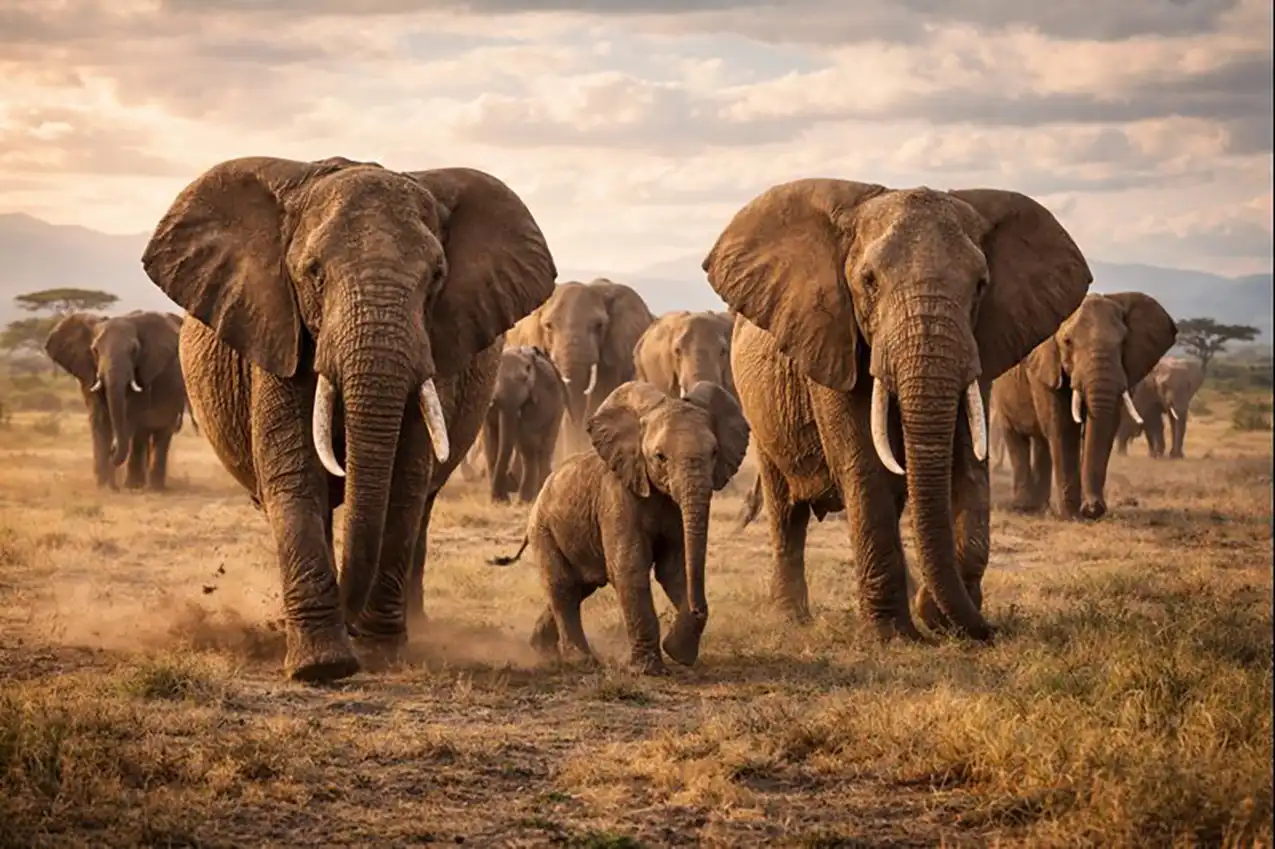
From the deep-time silence of the Eocene swamps to the seismic rumblings of the modern savanna, the elephant is not merely a charismatic giant but the keystone of our planetary machinery—and its dismantling is a crisis of both biology and conscience.
Introduction: The Silence of the Giants
In the cathedral-like gloom of the Congo Basin, beneath a canopy that knits together to blot out the equatorial sun, a sound exists that is felt before it is heard. It is a shudder in the air, a vibration in the sternum, a seismic whisper traveling through the root systems of ancient trees. This is the “rumble,” the infrasonic language of the African forest elephant (Loxodonta cyclotis), a creature so elusive that for centuries it was dismissed as a mere shadow of its larger savanna cousin. Yet, as modern science peels back the layers of our ignorance, we are discovering that these animals are not just passive inhabitants of the forest; they are its architects, its gardeners, and its librarians. They are the keystone upon which the carbon capacity of the planet rests, and their silence, should it become permanent, would resonate far beyond the boundaries of the rainforest.
To consider the elephant in 2025 is to confront a profound paradox. They are the largest terrestrial mammals on Earth, the “megafauna” that define our conception of the wild, possessing a physical presence that is impossible to ignore. Yet, they are vanishing with a speed that belies their mass, dissolving into the history books alongside the mastodon and the mammoth. We are living through the flickering twilight of the Proboscidea, an order of mammals that once conquered every continent save Australia and Antarctica. Today, only three distinct species remain—the African Savanna Elephant (Loxodonta africana), the African Forest Elephant (Loxodonta cyclotis), and the Asian Elephant (Elephas maximus)—and all stand on the precipice of extinction.^1
This report is an investigation into the state of the elephant in the Anthropocene. It is an inquiry that spans deep time and immediate crisis, moving from the Eocene swamps where the elephant’s ancestors first waded to the heated debates of the ivory trade, and back to the neural pathways of a matriarch making a life-or-death decision on the savanna. We will navigate the controversial “Wood-Pasture Hypothesis” of prehistoric Europe to understand what the continent lost when it lost its elephants. We will examine the biochemical miracle of “Peto’s Paradox,” which shields these giants from cancer, and the complex cognitive landscape of creatures that mourn their dead and address one another by individual names. Finally, we will assess the precarious status of their populations today, parsing the success of the KAZA transfrontier conservation area against the silent massacre occurring in the forests of Central Africa.
Part I: The Long March – Evolutionary History and Taxonomy
The Proboscidea: A Global Dynasty
The lineage of the elephant does not begin with majesty, but with modesty. Approximately 60 million years ago, in the Paleocene epoch of what is now North Africa, a creature named Eritherium scurried through the vegetation. Weighing no more than a few kilograms, it lacked a trunk and looked nothing like its descendants, yet its dental structure betrayed its destiny.^2 This was the dawn of the Proboscidea, an order that would become one of evolution’s most successful experiments in gigantism and adaptation.
The trajectory from Eritherium to Loxodonta was not a straight line but a bush of explosive radiation. Over the last 60 million years, the proboscideans diversified into over 185 described species, adapting to nearly every ecological niche available to a large herbivore.^3 The true conquest of the globe began with the Gomphotheres. Emerging in the Oligocene and flourishing in the Miocene, these animals were the great travelers of the order. They possessed a bewildering variety of tusk arrangements and their migration out of Africa fundamentally altered the ecosystems of Eurasia and the Americas.^4 The gomphotheres were the first to cross the land bridges, eventually storming into South America during the Great American Interchange.^5
The Gomphotheres eventually succumbed to the changing climates of the Pleistocene and the rise of the specialized Elephantidae—the family that includes mammoths (Mammuthus), Asian elephants (Elephas), and African elephants (Loxodonta). Recent genomic analysis has clarified the timeline of this succession. The African elephant lineage diverged from the Asian elephant/Mammoth lineage approximately 7.6 million years ago.^6 Interestingly, the Asian elephant is more closely related to the Woolly Mammoth (Mammuthus primigenius) than it is to its African counterpart, with their split occurring roughly 6.7 million years ago.^7 This reveals the Asian elephant as the last survivor of a northern, Holarctic radiation, a lonely tropical remnant of the lineage that once walked the frozen steppes.
The Schism: Two Africas, Two Elephants
For the better part of the 20th century, science treated the elephants of Africa as a single monolithic entity: Loxodonta africana. The smaller, elusive elephants found in the rainforests were regarded merely as a subspecies (L. a. cyclotis). This classification masked the distinct biological reality of the forest elephant and allowed its catastrophic decline to go unnoticed within the broader statistics of the savanna populations.
Comprehensive genomic studies have revealed that the divergence between the African Savanna Elephant and the African Forest Elephant is ancient, dating back approximately 500,000 to 5 million years depending on the genetic markers used, with deep separation suggesting they are distinct biological entities.^8 In 2021, the International Union for Conservation of Nature (IUCN) formally assessed the African Forest Elephant (Loxodonta cyclotis) as Critically Endangered and the African Savanna Elephant (Loxodonta africana) as Endangered.^9 This distinction is vital because forest elephants have a slower reproductive rate, with a median age of primiparity (first birth) at 23 years—significantly later than their savanna cousins.^10 They are biologically fragile, despite their physical power.
Prehistoric Europe: The Wood-Pasture Controversy
To understand the full ecological potential of the elephant, we must look backward to the Europe of the Last Interglacial. During the warm periods of the Pleistocene, Europe was ruled by the Straight-Tusked Elephant (Palaeoloxodon antiquus), a titan that stood up to 4 meters at the shoulder.^11
The presence of this megaherbivore is at the heart of the “Wood-Pasture Hypothesis,” proposed by Dutch ecologist Frans Vera. Vera challenged the traditional “High Forest” theory, which held that prehistoric Europe was a dense, closed-canopy forest. Instead, he argued that the landscape was a dynamic mosaic of open parkland and groves, maintained by the grazing and browsing of large herbivores like the straight-tusked elephant.^12
Vera’s hypothesis suggests that P. antiquus acted as an “ecosystem engineer,” smashing through forests to create light gaps that allowed oaks and hazels to regenerate.^13 While pollen records often suggest closed forests, critics of the High Forest theory argue these records are biased against open grassland species.^14 Fossil beetle assemblages from Britain support Vera, showing species dependent on open ground and dung that would be absent in a closed forest.^15 Recent isotopic analysis of Palaeoloxodon enamel confirms they were mixed feeders, consuming both graze and browse, further supporting their role in maintaining open habitats.^16
Part II: The Architects of the Biosphere – Ecological Roles
The Savanna Engineer: Water and Wood
On the African savanna, the elephant is the primary driver of heterogeneity. Its influence radiates outward from water, creating a phenomenon known as the “piosphere.” In arid landscapes, elephants congregate at waterholes, creating a gradient of impact that alters vegetation structure.^17
In the immediate vicinity of the water (the “sacrifice zone”), elephants trample the soil and denude vegetation. Further out, they create a “browse line” on trees and a network of trails.^18 While high densities of elephants can transform woodland into grassland—a point of contention in places like Botswana—this destruction is also creation. By pushing over trees, elephants prevent bush encroachment and maintain the open plains upon which grazers like zebras and wildebeest rely.^19
The Forest Gardener: The Carbon Giant
Deep in the Congo Basin, Loxodonta cyclotis plays a role so specific that its removal triggers a collapse of the forest’s architectural integrity. Forest elephants are the obligate seed dispersers for “megafaunal fruits”—trees like Balanites wilsoniana and Tiliacora dinklagei which produce fruits too large for other animals to handle.^20 The elephant swallows these fruits whole, scarifying the seeds in its gut and depositing them kilometers away in a nutrient-rich mound of dung.^21
Beyond planting, forest elephants are critical to the carbon cycle. A 2019 study in Nature Geoscience revealed that by preferentially browsing on fast-growing softwood trees, elephants reduce competition for light and water, allowing slow-growing, high-density hardwoods to thrive.^22 These hardwoods store significantly more carbon. The study estimates that the extinction of forest elephants would result in a loss of approximately 3 billion tons of carbon storage across Central Africa.^23 In the language of carbon markets, the service provided by these “gardeners” is worth billions.
The Ghosts of Evolution: Anachronistic Fruits
The concept of the “Megafaunal Dispersal Syndrome” helps explain botanical mysteries in parts of the world where elephants no longer roam. In the Neotropics and parts of Asia, plants with massive fruits—like avocados and honey locusts—seem ill-adapted to any living disperser. Ecologists Daniel Janzen and Paul Martin termed these “anachronisms,” arguing they evolved to be eaten by the extinct Gomphotheres of the Pleistocene.^24 Today, these plants are “ecological widows,” relying on inefficient dispersal or human intervention.^25
Part III: The Mind of the Matriarch – Behavior, Physiology, and Cognition
Peto’s Paradox: The Genetic Shield
Elephants possess a staggering resistance to cancer, a phenomenon known as Peto’s Paradox. Theoretically, large animals with more cells should have a higher risk of cancer. Yet, elephants have a cancer mortality rate of less than 5%.^26 The secret lies in the TP53 gene, known as the “guardian of the genome.” While humans possess one copy, elephants possess 20 copies.^27
Furthermore, elephants have resurrected a “zombie gene” called LIF6. Activated by p53 in response to DNA damage, LIF6 produces a protein that destroys the mitochondria of damaged cells, ensuring they do not become cancerous.^28 This evolutionary innovation was a prerequisite for gigantism.
Social Structure: The Matriarchal Repository
Elephant society is a fission-fusion system held together by the Matriarch. Her value is not merely reproductive; she is a living library. Playback experiments by Karen McComb in Amboseli National Park demonstrated that groups led by older matriarchs (60+ years) were significantly better at assessing threats, such as distinguishing the roars of male lions from less dangerous females.^29
These matriarchs also possess superior social memory, capable of distinguishing the contact calls of over 100 other individuals.^30 The poaching of these elders is a “social lobotomy” for the herd, leaving survivors without the navigational and social maps necessary for survival.
The Acoustic World: Names and Seismic Whispers
Elephants communicate using infrasound, low-frequency rumbles that travel for kilometers. They also listen with their feet. The elephant foot contains a specialized fat pad similar to the acoustic fat in dolphins, allowing them to detect seismic vibrations from other herds or thunderstorms.^31
In 2024, a groundbreaking study by Mickey Pardo added a new dimension to our understanding: elephants appear to use individually specific “names.” Unlike dolphins, which mimic the signature whistle of the individual they address, elephants use arbitrary vocal labels.^32 When a recording of a specific “name” was played, the target elephant responded energetically, while others ignored it.^33 This suggests a level of symbolic abstraction previously thought unique to humans.
Grief and Self-Medication
The emotional life of the elephant is evident in their response to death. They conduct “vigils” over bodies and have been observed touching the bones of dead elephants with a quiet intensity.^34 This behavior has led many scientists to conclude they experience a form of grief.^35
Elephants also practice zoopharmacognosy (self-medication). They have been observed ingesting specific plants to induce labor or treat parasites.^36 For example, elephants will consume bio-active plants like Vernonia amygdalina (bitter leaf) which are known to have anti-parasitic properties.^37
Part IV: The Crises of the Anthropocene – Status and Threats
The Great Decline
The trajectory of elephant populations is a grim downward curve. The Great Elephant Census, completed in 2016, revealed a 30% decline in African savanna elephant populations between 2007 and 2014, equating to 144,000 elephants lost.^38 The rate of decline was 8% per year, largely driven by poaching.^39
The situation for the Forest Elephant is even more dire, with populations collapsing by more than 86% over three decades.^40 The Asian Elephant, with a global population of only 30,000 to 50,000, faces threats primarily from habitat loss and conflict rather than ivory poaching.^41
The KAZA Anomaly
Amidst the decline, the Kavango-Zambezi Transfrontier Conservation Area (KAZA) in Southern Africa presents a stark anomaly. The 2022 KAZA Elephant Survey estimated a population of 227,900 elephants, representing more than 50% of all remaining savanna elephants.^42 Here, the challenge is not extinction but coexistence. High densities in Botswana lead to intense human-elephant conflict, while corridors into Angola are slowly reopening as herds move into former war zones.^43
Threats: Ivory and Conflict
The CITES ban on the international ivory trade, enacted in 1989, provided a temporary respite, but demand in Asia fueled a resurgence in poaching in the 2000s.^44 While poaching rates have stabilized in some regions recently, the Monitoring the Illegal Killing of Elephants (MIKE) program continues to report unsustainable levels of killing in Central Africa.^45
Part V: The Coexistence – Solutions and Futures
The Beehive Solution
Dr. Lucy King developed Beehive Fences—a perimeter of hives suspended on wires—based on the discovery that elephants are terrified of African honeybees. Field trials in Kenya have shown these fences to be 80% to 86% effective in deterring crop raids.^46 This solution protects crops, generates income through “Elephant-Friendly Honey,” and maintains pollination services.^47
Engineering Connectivity: The Mt. Kenya Corridor
To survive, elephants need room to move. The Mt. Kenya Elephant Corridor, which includes a purpose-built underpass beneath a major highway, has successfully reconnected the elephant populations of Mt. Kenya and the Samburu ecosystem.^48 Tracking data confirmed that hundreds of elephants now use this route, proving that green infrastructure can restore genetic connectivity.^49
Conclusion
The elephant stands at the intersection of our highest aspirations and our basest failures. In their genes, they carry the history of the planet—from the swamps of the Eocene to the ice of the Pleistocene. In their minds, they carry a map of the world that includes the locations of water, the graves of their kin, and the names of their friends.
We now know that they are the engineers of the forest carbon cycle, a service worth billions. We know they are the architects of the savanna and the ghosts of the European wood-pasture. The tragedy of the Anthropocene is that we are dismantling this complexity before we have even fully understood it. If the elephant falls silent, the world does not just become quieter; it becomes smaller, simpler, and profoundly more lonely.
Timeline of the Proboscidea
- ~60 MYA: Appearance of Eritherium in North Africa, the earliest known proboscidean.^50
- ~24 MYA: Emergence of Gomphotheres and their migration out of Africa, colonizing Eurasia.^51
- ~7.6 MYA: Divergence of African (Loxodonta) and Asian (Elephas/Mammoth) lineages.^52
- ~6.7 MYA: Divergence of Asian Elephant (Elephas) and Woolly Mammoth (Mammuthus).^53
- ~800,000 YA: Palaeoloxodon antiquus dominates European interglacials, shaping the “wood-pasture” landscape.^54
- ~4,000 YA: Extinction of the last Woolly Mammoths on Wrangel Island.^55
- 1989: CITES bans international commercial ivory trade.^56
- 2016: Great Elephant Census reveals 30% decline in savanna elephants in just 7 years.^57
- 2021: IUCN lists African Forest Elephant as Critically Endangered.^58
- 2022: KAZA Elephant Survey estimates 227,900 elephants in Southern Africa.^59
- 2024: Discovery of individual “names” in elephant calls.^60
Glossary
- Allomothering: The behavior where individuals other than the biological mother assist in caring for a calf, critical for calf survival and social learning.^61
- Fission-Fusion Society: A dynamic social structure where group size and composition change over time based on resource availability.^62
- Infrasound: Sound waves with frequencies below human audibility (<20 Hz) used by elephants for long-distance communication.^63
- Megafaunal Dispersal Syndrome: Fruit traits (large size, tough skin) evolved to attract large herbivores for seed dispersal.^64
- Musth: A periodic physiological condition in bull elephants characterized by a massive surge in testosterone and aggression.^65
- Peto’s Paradox: The observation that large, long-lived animals do not have higher cancer rates than smaller animals, due to tumor-suppressor mechanisms like TP53.^66
- Piosphere: The zone of ecological impact radiating from a water source, characterized by gradients of grazing and trampling.^67
- Zoopharmacognosy: The self-medication behavior of animals selecting specific plants to treat disease.^68
What We Still Don’t Know
- Deep Forest Society: The social structure of forest elephants remains largely obscure due to the difficulty of observation in dense canopies. Are their hierarchies as strict as savanna elephants?^69
- Seismic Vocabulary: While we know they detect vibrations, the extent of a specific “seismic language” remains unmapped.^70
- The Full Lexicon: With the discovery of names, the question arises: what else are they saying? Do they have words for specific threats, locations, or other species?^71
- Epigenetic Trauma: How does the stress of poaching and social collapse affect the gene expression of future generations of elephants?^72
Download a copy of this report with my compliments- Kevin Parker Publisher – The Architects of Memory: An Investigative Report on the Elephant in the Anthropocene
Produced with the help of Gemini Pro 3.0
Endnotes
- IUCN, “African elephant species now Endangered and Critically Endangered – IUCN Red List,” IUCN News, March 25, 2021, https://iucn.org/news/species/202103/african-elephant-species-now-endangered-and-critically-endangered-iucn-red-list.
- Natural History Museum, “The rise and fall of elephant ancestors,” NHM News, July 2021, https://www.nhm.ac.uk/discover/news/2021/july/the-rise-and-fall-of-elephant-ancestors.html.
- Steven Zhang, “The rise and fall of elephant ancestors,” University of Bristol News, July 2021, https://www.bristol.ac.uk/news/2021/july/elephants-evolution.html.
- “Gomphothere,” Encyclopaedia Britannica, accessed 2025, https://www.britannica.com/animal/gomphothere.
- Dimila Mothé et al., “The South American Gomphotheres,” Journal of Paleontology (via PMC), https://pmc.ncbi.nlm.nih.gov/articles/PMC8693454/.
- Nadin Rohland et al., “Proboscidean mitogenomics: Chronology and mode of elephant evolution using mastodon as outgroup,” PLoS Biology (via PMC), 2007, https://pmc.ncbi.nlm.nih.gov/articles/PMC1925134/.
- Ibid.
- IUCN, “African elephant species now Endangered and Critically Endangered.”
- Ibid.
- Turkalo et al., “Slow intrinsic growth rate in forest elephants indicates recovery from poaching will require decades,” Journal of Applied Ecology, cited in IUCN Red List assessment, https://globalconservation.org/endangered-species/african-forest-elephant.
- “Straight-tusked elephant,” Wikipedia, accessed 2025, https://en.wikipedia.org/wiki/Straight-tusked_elephant.
- “Wood-pasture hypothesis,” Wikipedia, accessed 2025, https://en.wikipedia.org/wiki/Wood-pasture_hypothesis.
- University of Bayreuth, “Straight-tusked elephant could still live in Europe today,” ScienceDaily, April 29, 2025, https://www.sciencedaily.com/releases/2025/04/250428221914.htm.
- Frans Vera, “Grazing Ecology and Forest History,” discussed in The Old Man of Wytham, https://theoldmanofwytham.com/2018/10/28/the-nature-of-the-first-forests-in-north-west-europe/.
- Nicki J. Whitehouse and David Smith, “How fragmented was the British Holocene wildwood? Perspectives on the ‘Vera’ grazing debate from the fossil beetle record,” Quaternary Science Reviews, 2010, https://pure-oai.bham.ac.uk/ws/portalfiles/portal/8226165/Whitehouse_and_Smith_QSR_2010.pdf.
- Chiara Capalbo, “Multiproxy-based reconstruction of the feeding habits from the late Middle Pleistocene straight-tusked elephant,” Alpine and Mediterranean Quaternary, 2018, https://amq.aiqua.it/index.php/amq/article/download/199/179.
- Ivan Thrash, “Review of literature on the nature and modelling of piospheres,” Koedoe, 1999, https://www.researchgate.net/publication/252426221_Review_of_literature_on_the_nature_and_modelling_of_piospheres.
- Ibid.
- Ibid.
- Colin A. Chapman et al., “Balanites wilsoniana: elephant dependent dispersal,” Journal of Tropical Ecology, 1992, http://colin-chapman-8wtt.squarespace.com/s/Balanites-wilsoniana-elephant-dependent-dispersal.pdf.
- Ibid.
- Fabio Berzaghi et al., “Carbon stocks in Central African forests enhanced by elephant disturbance,” Nature Geoscience, 2019, summarized in FAPESP News, https://agencia.fapesp.br/african-forest-elephant-helps-increase-biomass-and-carbon-storage/31151.
- Augusta Dwyer, “The carbon sequestration powers of the near-extinct forest elephant,” Global Landscapes Forum, February 3, 2020, https://thinklandscape.globallandscapesforum.org/42482/the-carbon-sequestration-powers-of-the-near-extinct-forest-elephant/.
- Daniel Janzen and Paul Martin, “Neotropical Anachronisms: The Fruits the Gomphotheres Ate,” Science, 1982, discussed in Arnoldia, https://arboretum.harvard.edu/arnoldia-stories/anachronistic-fruits-and-the-ghosts-who-haunt-them/.
- Ibid.
- Michael Sulak et al., “TP53 copy number expansion is associated with the evolution of increased body size and an enhanced DNA damage response in elephants,” eLife, 2016, https://pmc.ncbi.nlm.nih.gov/articles/PMC5061548/.
- Ibid.
- Juan Manuel Vazquez et al., “A zombie LIF gene in elephants is upregulated by TP53 to induce apoptosis in response to DNA damage,” Cell Reports, 2018, summarized in Cancer Research UK, https://news.cancerresearchuk.org/2023/08/12/can-elephants-get-cancer/.
- Karen McComb et al., “Leadership in elephants: the adaptive value of age,” Proceedings of the Royal Society B, 2011, https://www.researchgate.net/publication/50409036_Leadership_in_elephants_The_adaptive_value_of_age.
- Karen McComb et al., “African elephants remember and recognize the voices of at least 100 other elephants,” discussed in Famous Trials, https://famous-trials.com/animalrights/2598-what-elephants-can-do-the-cognitive-capacities-of-elephants.
- Caitlin O’Connell-Rodwell, “Keeping an ‘ear’ to the ground: seismic communication in elephants,” Journal of the Acoustical Society of America, 2007, https://www.semanticscholar.org/paper/Keeping-an-%22ear%22-to-the-ground%3A-seismic-in-O%E2%80%99Connell-Rodwell/5125331264bc5a8a23c1c2be986f0e93457a8526/figure/3.
- Mickey Pardo et al., “African elephants address one another with individually specific name-like calls,” Nature Ecology & Evolution, 2024, https://source.colostate.edu/african-elephants-address-one-another-with-name-like-calls-similar-to-humans/.
- Ibid.
- “Dzanga Bai Forest Elephant Study,” Pachyderm, https://pachydermjournal.org/index.php/pachyderm/article/download/826/805.
- Barbara J. King, “The Truth About Animal Grief,” BBC Earth, https://www.bbcearth.com/news/the-truth-about-animal-grief.
- “Zoopharmacognosy,” Wikipedia, https://en.wikipedia.org/wiki/Zoopharmacognosy.
- Michael A. Huffman, “Animal self-medication and ethno-medicine,” Proceedings of the Nutrition Society, 2003, https://www.cambridge.org/core/services/aop-cambridge-core/content/view/7F3DFBB1BEE144895048E04F0613E038/S0029665103000521a.pdf/animal-self-medication-and-ethno-medicine-exploration-and-exploitation-of-the-medicinal-properties-of-plants.pdf.
- “Great Elephant Census Final Results,” Vulcan, August 31, 2016, https://en.wikipedia.org/wiki/Great_Elephant_Census.
- Ibid.
- IUCN, “African elephant species now Endangered and Critically Endangered.”
- “Asian Elephant,” WWF, accessed 2025, https://www.wwf.org.uk/learn/wildlife/asian-elephants.
- “KAZA Elephant Survey 2022 Results,” KAZA TFCA Secretariat, 2023, https://kavangozambezi.org/wp-content/uploads/2024/11/KAZA-Elephant-Survey-Fact-Sheet.pdf.
- “KAZA Elephant Survey Fact Sheet,” https://conservationnamibia.com/articles/kaza-elephant-survey.php.
- “Worldwide ban on ivory trading imposed,” EBSCO Research Starters, https://www.ebsco.com/research-starters/law/worldwide-ban-ivory-trading-imposed.
- “Monitoring the Illegal Killing of Elephants (MIKE) Programme,” CITES, https://www.eeas.europa.eu/node/11793_en.
- Lucy King et al., “Beehive fences effectively reduce human-elephant conflict,” Conservation Science and Practice, 2024, https://www.ox.ac.uk/news/2024-10-30-new-study-confirms-beehive-fences-are-highly-effective-reducing-human-elephant.
- “Future For Nature Winner: Dr. Lucy King,” https://futurefornature.org/ffn_winner/dr-lucy-king/.
- “Historic Passage: First Elephant Passes Through New Mt Kenya Underpass,” Save the Elephants, https://savetheelephants.org/news/historic-passage-first-elephant-passes-through-new-mt-kenya-underpass/.
- “Mt Kenya – Lewa – Northern Rangelands Trust Corridor,” UNESCO World Heritage Centre, https://whc.unesco.org/document/154309.
- “The rise and fall of elephant ancestors,” NHM News.
- “Gomphothere,” Encyclopaedia Britannica.
- Rohland et al., “Proboscidean mitogenomics.”
- Ibid.
- “Straight-tusked elephant,” Wikipedia.
- “Woolly Mammoth,” Wikipedia, https://en.wikipedia.org/wiki/Woolly_mammoth.
- “Worldwide ban on ivory trading imposed,” EBSCO.
- “Great Elephant Census Final Results,” Vulcan.
- IUCN, “African elephant species now Endangered and Critically Endangered.”
- “KAZA Elephant Survey 2022 Results,” KAZA TFCA Secretariat.
- Pardo et al., “African elephants address one another with individually specific name-like calls.”
- Phyllis C. Lee, “Allomothering among African elephants,” Animal Behaviour, 1987, https://www.semanticscholar.org/paper/Allomothering-among-African-elephants-Lee/ee98699ef4df0bfaaab6aa4d0dfecdd28d31620a.
- “African Forest Elephant,” Wildlife Animal Pedia, https://wildlife-animal-pedia.fandom.com/wiki/African_Forest_Elephant.
- “Elephant Communication,” Wikipedia, https://en.wikipedia.org/wiki/Elephant_communication.
- “Evolutionary anachronism,” Wikipedia, https://en.wikipedia.org/wiki/Evolutionary_anachronism.
- Ganswindt et al., “Musth in male African elephants,” Hormones and Behavior, 2004, https://pubmed.ncbi.nlm.nih.gov/15579269/.
- “Peto’s Paradox,” International Society for Evolution, Medicine, and Public Health, https://isemph.org/Peto-Elephants.
- Thrash, “Review of literature on the nature and modelling of piospheres.”
- “Zoopharmacognosy,” Wikipedia.
- “Long-term monitoring of Dzanga Bai forest elephants,” PLoS ONE, https://journals.plos.org/plosone/article?id=10.1371/journal.pone.0231832.
- O’Connell-Rodwell, “Keeping an ‘ear’ to the ground.”
- Pardo et al., “African elephants address one another with individually specific name-like calls.”
- “Epigenetic consequences of poaching,” speculative research question discussed in National Wildlife, https://www.nwf.org/Magazines/National-Wildlife/2018/Feb-Mar/Animals/When-Animals-Grieve.


