

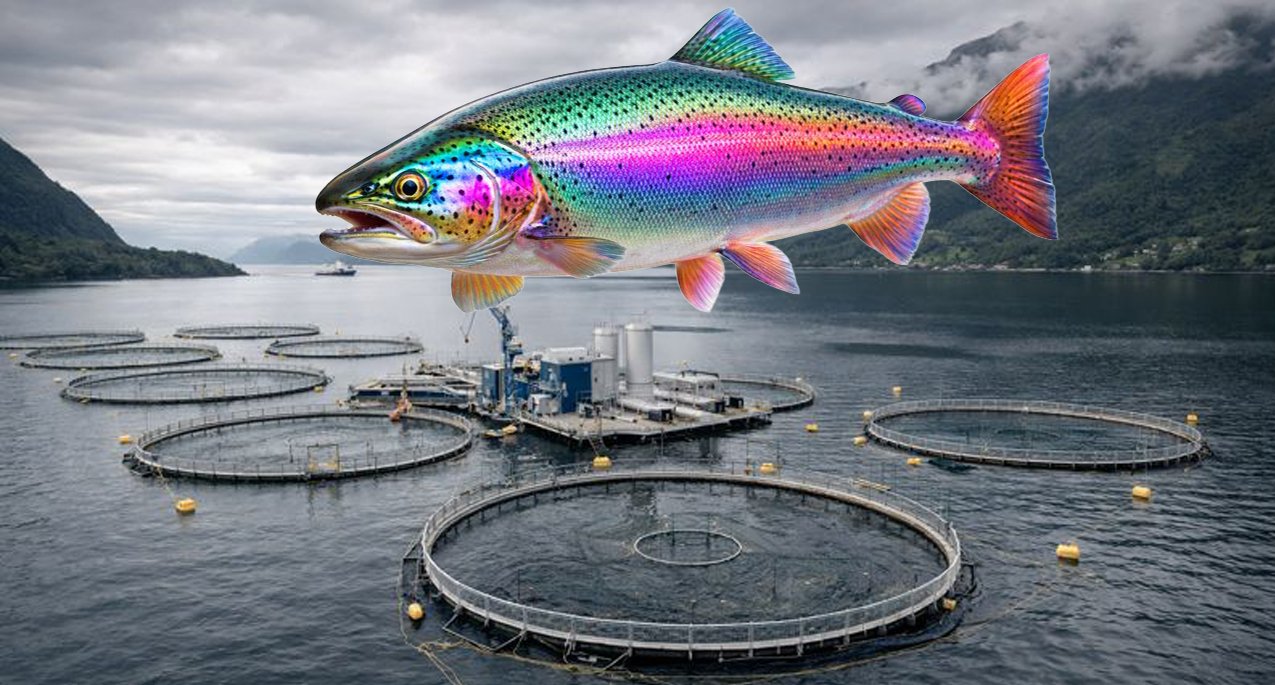
I. The SalmoFan and the Industrial Simulacrum
In the sterile, fluorescent-lit aisles of the modern Western supermarket, the Atlantic salmon (Salmo salar) presents itself not as an animal, but as an aesthetic triumph. It lies upon its bed of crushed ice, glowing with a hue that consumers have been trained, through decades of marketing osmosis, to recognise as the colour of health, vitality, and wildness. It is a specific, appetizing shade of reddish-orange. Yet, this colour is not a biological inevitability; it is a manufacturing decision. It is a choice made in a boardroom, selected from a patented colour-matching fan deck known as the SalmoFan, originally developed by the Swiss pharmaceutical giant Hoffmann-La Roche and now marketed by DSM.¹ ²
The SalmoFan is the perfect artifact of our time—a paint chart for flesh. It offers a gradient of pigmentation ranging from a pale, anaemic pink (score 20) to a deep, vibrant red (score 34), allowing producers to dictate the precise visual frequency of their product by adjusting the concentration of synthetic astaxanthin in the feed pellets.³ Without this petrochemical additive—derived from the processing of fossil fuels or synthesized in chemical plants—the flesh of the farmed salmon would be a pallid, unappetising grey, the colour of wet concrete or “polystyrene.”⁴ ⁵ Confined to high-density pens and denied their natural diet of crustaceans and krill, these animals are biological simulacra: living industrial products designed to mimic the wild king of fish, yet severed entirely from the ecological processes that created it.
The salmon farming industry, or “Big Salmon,” is an exercise in the commodification of nature that has metastasized into a planetary crisis. It is a system that relies on the “enshittification” of the marine commons—transforming public waters into private sewers, stripping the oceans of their foundational biodiversity to create a luxury protein for the affluent Global North. From the fjords of Norway to the lochs of Scotland, and from the archipelagos of Chile to the bays of Tasmania, the industry operates on a model of privatized profit and socialized loss.
This report acts as an autopsy of the “Blue Revolution.” It combines forensic financial analysis, systemic ecological review, and an unflinching examination of the regulatory failures that have allowed this industry to flourish at the expense of the planet. We will trace the supply chains that link the starving artisanal fisheries of West Africa to the dinner plates of London and New York; we will expose the “revolving door” of corruption that turns environmental watchdogs into industry lapdogs; and we will document the biological horrors of the “zombie salmon” rotting alive in their cages.
II. The Architecture of Extraction: From Blue Revolution to Oligopoly
The Promise and the Perversion
The narrative of aquaculture was seductively simple. As wild fish stocks collapsed under the weight of industrial trawling in the late 20th century, the United Nations and industry boosters heralded the coming of a “Blue Revolution.”⁶ Just as the Green Revolution had industrialized agriculture to feed the world, aquaculture would industrialize the seas. It was pitched as the saviour of the wild salmon—a way to separate the demand for seafood from the limits of nature.
However, the history of aquaculture demonstrates that the industry is largely a manifestation of concern over environmental and economic costs of the capture fishery industry, yet the current practice has begun to resemble the tortured past of wild-caught fish. Instead of relieving pressure on wild stocks, the industry has become a parasitic entity. It has not transcended the limits of the ecosystem; it has financialized them.
The trajectory of the industry follows Garrett Hardin’s rubric of The Tragedy of the Commons, but with a twisted neoliberal corollary: the Tragedy of the Privatized Commons. By enclosing public waterways for private gain, the industry has created a system where the “carrying capacity” of the environment is treated not as a biological limit, but as a flexible regulatory hurdle to be overcome by lobbying and chemical intervention.⁷
The Consolidation of the Titans
The idyllic image of the rugged, small-scale fish farmer battling the elements is a myth. The modern salmon industry is a high-finance oligopoly, a monolithic structure dominated by a handful of multinational conglomerates, primarily headquartered in Norway, whose tentacles stretch across every major ocean.
As of 2024, the market is hegemonically controlled by Mowi ASA (formerly Marine Harvest), the undisputed leviathan of the sector. With harvest volumes reaching 475,000 tonnes in 2023 and a market share hovering around 20%, Mowi is the standard-bearer for the industrialisation of the ocean.⁸ Following closely are SalMar ASA, Lerøy Seafood Group, Cermaq Group (owned by the Japanese giant Mitsubishi), and Grieg Seafood.¹⁰ ¹¹
These entities operate not merely as food producers but as sophisticated financial vehicles. Their operations are vertically integrated to a degree that would make Standard Oil envious. They control the genetics of the roe, the production of the feed, the manufacturing of the cages, the processing of the harvest, and the vacuum-sealed packaging in the display cabinet.¹² This consolidation gives them immense power to dictate terms to governments, suppress dissent, and manipulate market prices.
Table 1: The Oligarchs of the Ocean (2024 Market Dominance)
| Conglomerate | Headquarters | Global Reach | 2023/24 Harvest Vol. | Key Financial Backers |
| Mowi ASA | Bergen, Norway | Norway, Scotland, Chile, Canada, Faroe Islands, Ireland | 475,000 tonnes¹³ | Rabobank, ABN Amro, DNB, Folketrygdfondet¹⁴ |
| SalMar ASA | Frøya, Norway | Norway, Iceland (Icelandic Salmon), Scotland (Scottish Sea Farms) | ~299,000 tonnes (Guidance)¹⁵ | State Street Bank, Citibank, Folketrygdfondet¹⁶ |
| Lerøy Seafood | Bergen, Norway | Norway, Scotland (via Scottish Sea Farms JV) | 160,000+ tonnes | Austevoll Seafood ASA |
| Cermaq | Oslo, Norway | Norway, Chile, Canada | Undisclosed (Pvt) | Mitsubishi Corporation¹⁷ |
| Cooke Aquaculture | New Brunswick, Canada | Canada, Scotland, Chile, Tasmania (Tassal) | Undisclosed (Pvt) | Syndicated Loans |
This concentration of power has profound implications. When Mowi or SalMar sneezes, coastal communities from Puerto Montt to the Outer Hebrides catch a cold. Decisions made in Oslo boardrooms regarding “biomass limits” or “dividend payouts” translate directly into oxygen-depleted dead zones in Tasmanian harbours and lice-infested wild trout in Scottish rivers.
The Financialization of Biology
The life of a farmed salmon is dictated not by the seasons, but by the quarterly report. The industry is driven by a relentless “biological clock” attuned to the stock market. “Fishy Finances”, a seminal 2025 investigative report, revealed the vast arterial network of capital that sustains this biological machine.¹⁸
The largest creditors to the sector are not Norwegian banks, but Dutch institutions. Rabobank ($1.8 billion) and ABN Amro ($1.3 billion) have pumped billions into the sector since 2015.¹⁹ Even banks with “sustainable” images, such as Triodos, have been found investing in companies like Bakkafrost.
This financialization means that the fish in the pen is treated as an asset class first and a living being second. The drive for “Return on Capital Employed” (ROCE)—which Mowi proudly reported at 15.5% in 2024²⁰—forces companies to stock cages at unsustainable densities, pushing biological limits to the breaking point. When SalMar reports a record Q3 harvest of 93,200 tonnes, the market celebrates the volume, willfully ignoring that this “efficiency” was achieved amidst rising mortality rates and a degradation of animal welfare.²¹ The financial incentives are perfectly aligned to externalize costs: pollution is free, wild fish inputs are cheap, and dead fish are tax-deductible losses.
III. Protein Imperialism: The Feed Crisis and the West African Plunder
The most damning indictment of the salmon industry is its reliance on “reduction fisheries.” Salmon are carnivores. To grow a salmon in a cage, you must feed it protein and fat. The industry’s narrative is that they have reduced their dependency on marine ingredients, citing improved “Fish In: Fish Out” (FIFO) ratios. They claim they are net producers of protein. This is a statistical lie.
The “Fish In: Fish Out” (FIFO) Fraud
The industry often quotes FIFO ratios as low as 0.82:1, suggesting they produce more fish than they consume.²² However, a landmark October 2024 study published in Science Advances shattered this metric. The study revealed that the industry’s calculations routinely “launder” the data by averaging carnivorous fish with herbivorous species (like carp) and by ignoring the mortality of wild fish during capture.²³
When accounting for the “biomass laundering” and focusing strictly on carnivorous species like salmon, the ratio of wild fish inputs to farmed fish outputs is 27% to 307% higher than previous estimates.²⁴ For salmon specifically, the input of wild fish likely exceeds twice the farmed biomass produced. This means the industry is not creating food; it is reducing it. It is taking high-quality, perfectly edible wild fish—sardines, anchovies, herring—and grinding them down to produce a luxury product for the rich.
The Theft of the Yaboi
This dynamic has birthed a form of neocolonial “protein imperialism.” Nowhere is this more visceral than in West Africa. The coasts of Senegal, Mauritania, and The Gambia are being plundered by foreign-owned trawlers and fishmeal factories to feed the salmon farms of Norway and Scotland.²⁵
In Senegal, the sardinella (locally known as yaboi) is more than just a fish; it is the “fish of the poor,” the primary source of animal protein for a population where food security is precarious.²⁶ Traditionally, this fish was landed by artisanal pirogues and processed by women—tens of thousands of them—who smoked and dried the catch for distribution across the Sahel.
Today, those women stand in empty smoke-yards. “We go months without seeing yaboi,” says Maty Ndao, a processor from Cayar.²⁷ The fish are gone, siphoned off by industrial trawlers that supply the fishmeal factories—huge, stinking installations often owned by Chinese or European capital—that grind the fresh catch into powder.
It takes approximately 4 to 5 kilograms of fresh fish to produce just 1 kilogram of fishmeal.²⁸ This extraction is a direct transfer of nutrients from the bellies of West African children to the bellies of Norwegian salmon, and ultimately to the plates of diners in London and Paris. The industry is literally manufacturing hunger in the Global South to manufacture profit in the Global North.
- The Displacement of Women: The fishmeal industry has decimated the female-dominated processing sector. As the factories corner the market, prices skyrocket, and the women are priced out. They are losing their livelihoods, their economic independence, and their ability to feed their communities.²⁹
- The Food Security Void: Investigations by The Guardian and DeSmog have traced the supply chain from these factories directly to major feed producers like Skretting (owned by Nutreco) and Cargill Aqua Nutrition, who supply Mowi and Scottish Sea Farms.³⁰ While these companies claim to use “certified” ingredients (often via MarinTrust), reports reveal that the certification schemes are riddled with loopholes, allowing fish caught in “Data Poor” zones or via illegal fishing to enter the supply chain.
The Deforestation Pivot: Soy and the Amazon
Facing criticism for depleting the oceans, the industry has pivoted to soy. But this merely shifts the destruction from the seascape to the landscape. Salmon feed is now heavily dependent on soy protein concentrate (SPC). Major feed suppliers have been implicated in sourcing soy from the Brazilian Cerrado and Amazon, driving the deforestation of critical biomes.³¹
While companies like Mowi and Grieg Seafood have pledged to use “deforestation-free” soy and have pressured suppliers like Cargill to commit to cut-off dates, the supply chains remain murky.³² Cargill, a giant in the feed sector, has been described by environmental NGOs as “the worst company in the world” for its role in driving land clearance.³³ The salmon industry’s demand for soy provides a lucrative market for this destruction, converting the rainforest into fish feed.
IV. The Chemical Archipelago: Disease, Resistance, and the Arms Race
Confining millions of migratory animals in static, high-density cages creates a perfect epidemiological storm. The open-net pen acts as a petri dish for pathogens, which incubate within the farm and then “spill back” into the wild environment. The industry is locked in a biological arms race against nature, using an escalating arsenal of chemicals to keep their stock alive.
The Sea Lice Plague
The defining scourge of the industry is Lepeophtheirus salmonis—the sea louse. These ectoparasites graze on the skin, mucus, and blood of the salmon. In the wild, lice are present but rare; in a farm, where hosts are packed like sardines, they multiply exponentially. They eat the fish alive.
To combat this, farms bathe their fish in pesticides. The most notorious is Emamectin Benzoate (trade name: Slice), a neurotoxin administered in feed. Slice is indiscriminate; it kills lice, but it is also lethal to non-target crustaceans. Evidence from Scotland suggests that the chemical plumes from salmon farms are killing lobsters, crabs, and prawns in the surrounding waters, devastating inshore creel fisheries.³⁴
The lice, following Darwinian logic, have developed resistance. The industry has responded not by changing the system, but by increasing the dosage and introducing harsher chemicals like Azamethiphos and Hydrogen Peroxide. In 2023, Scottish Sea Farms reported using nearly 1 million litres of hydrogen peroxide—a bleaching agent—to treat their fish.³⁵
The Chilean Antibiotic Abuse
If Scotland is the capital of lice, Chile is the capital of antibiotics. The Chilean industry is plagued by Piscirickettsia salmonis (SRS), a bacterial disease that thrives in the crowded pens of Patagonia. To suppress it, the industry uses astronomical quantities of antibiotics.
At its peak, Chilean salmon farming used 600 times more antibiotics per tonne of fish than Norway.³⁶ While the industry claims to be reducing usage, reports from 2024 indicate that antibiotic use remains a critical issue. The industry pumped 385 tonnes of antibiotics into the ocean in a single year during peak production crises.³⁷ Drugs like Florfenicol and Oxytetracycline are administered in feed, leaching into the sediment and creating reservoirs of antibiotic-resistant bacteria.³⁸
This massive prophylactic use of antimicrobials poses a terrifying global health risk. It contributes to the development of antibiotic-resistant “superbugs” that can enter the human food chain and the marine ecosystem.³⁹ The “One Health” approach warns that the abuse of antibiotics in aquaculture is a ticking time bomb for human medicine.
The “Zombie Salmon” Phenomenon
The welfare implications of these infestations are grotesque. In 2023 and 2024, undercover video footage released by whistleblowers and activists like Don Staniford exposed the reality inside the cages. The footage showed what have been termed “Zombie Salmon“—fish swimming with huge chunks of flesh missing, their skulls exposed, their eyes eaten out by lice, and their bodies ravaged by secondary infections like Winter Ulcer.⁴⁰ ⁴¹
These are not isolated incidents; they are systemic. In 2023, a record number of farmed salmon died in Norwegian pens—62.7 million fish, representing a mortality rate of 16.7%.⁴² In Scotland, the situation is even worse. WildFish reported that in 2023, some Scottish Sea Farms sites experienced mortality rates between 48.2% and 64.3%.⁴³
Consider the implication: nearly two-thirds of the animals on a “farm” died before harvest. In any terrestrial farming sector—be it poultry, pork, or beef—such mortality rates would trigger immediate government intervention, criminal prosecution for neglect, and a shutdown of operations. In the salmon industry, it is simply written off as a “Dead Loss,” a cost of doing business passed on to the environment.⁴⁴
V. The Capture of the Watchdogs: A Study in Regulatory Failure
How is this allowed to continue? The answer lies in the phenomenon of Regulatory Capture. The agencies tasked with protecting the environment have been colonized by the industries they are supposed to police.
Scotland: The Revolving Door
Scotland markets its salmon as a premium, world-class product, yet the industry is entrenched in a deep crisis of legitimacy. The relationship between the regulator, the Scottish Environment Protection Agency (SEPA), and the industry is incestuous.
- The SEPA Failure: Internal documents released under Freedom of Information laws revealed that SEPA shelved plans to toughen pollution controls after “intense behind-the-scenes lobbying” by industry heavyweights.⁴⁵ The agency was accused by campaigners of “rolling over” whenever challenged by corporate lawyers.
- The Revolving Door: The movement of personnel between the regulator, the government, and the industry is seamless.
- Julie Hesketh-Laird: Formerly the CEO of the Scottish Salmon Producers Organisation (SSPO), she moved from the whisky industry to champion salmon, then left amidst the crises to “take on fresh challenges,” leaving behind a legacy of closer ties between regulators and industry.⁴⁶
- Tavish Scott: A former Liberal Democrat MSP and government minister, Scott now heads Salmon Scotland (formerly SSPO). He uses his deep political connections to lobby his former colleagues. In 2023, Scott lobbied aggressively to delay SEPA’s new sea lice framework, effectively sabotaging tighter environmental controls.⁴⁷ ⁴⁸ He was even investigated for “unlawful lobbying” after allegedly threatening a Conservative MSP who dared to criticize the industry’s mortality rates.⁴⁹
- Terry A’Hearn: The former CEO of SEPA, who resigned amidst bullying allegations, had previously claimed to have “overhauled” salmon regulation, yet presided over a period where the agency allowed 196 farms to continue discharging toxic chemicals without updated assessments.⁵⁰ ⁵¹
Canada: The Dual Mandate
On the Pacific coast of British Columbia, the Department of Fisheries and Oceans (DFO) is the antagonist in a tragedy of governance. The DFO operates under a conflicting “dual mandate”: it is tasked with promoting the aquaculture industry while simultaneously regulating it to protect wild fish.⁵² ⁵³
This conflict was laid bare by the 2012 Cohen Commission, which recommended that the DFO strip its promotional mandate to resolve the “divided loyalties.”⁵⁴ The government ignored this. The DFO continues to suppress science that is inconvenient for the industry.
- The ‘Namgis Victory: In a historic battle, the ‘Namgis First Nation, along with other tribes in the Discovery Islands, fought to remove fish farms from critical wild salmon migration routes. They cited overwhelming evidence that sea lice from the farms were decimating juvenile sockeye. In 2024, despite fierce legal challenges from Mowi, Cermaq, and Grieg, the courts upheld the closure of these farms, a rare victory for Indigenous sovereignty over corporate entitlement.⁵⁵ ⁵⁶ The case exposed the DFO’s systematic bias, with the court noting the “notorious” history of regulatory capture.⁵⁷
VI. Regional Case Studies: The Global Anatomy of Collapse
The pathology of the salmon industry manifests differently across the globe, yet the underlying symptoms—greed, regulatory failure, and ecological collapse—are universal.
A. Tasmania: The Extinction Engine
In Tasmania, the industry’s expansion into Macquarie Harbour has pushed an ancient species to the brink of extinction. The Maugean Skate (Zearaja maugeana), a prehistoric relic found nowhere else on earth, is suffocating.
The biomass of salmon in the harbour—owned largely by Tassal (Cooke) and Huon Aquaculture (JBS)—has stripped the water of oxygen, creating “dead zones.”⁵⁸ ⁵⁹ 2024 reports from the Tasmanian EPA confirm that dissolved oxygen levels in the harbour’s deep waters remain critically low, often failing to meet even the interim guideline values necessary for the skate’s survival.⁶⁰ ⁶¹
Despite the federal environment minister threatening to “pause” operations, the industry’s political leverage has kept the cages in the water. They have offered technological band-aids, such as giant oxygenation pumps, rather than reducing the biomass.⁶² The choice has been made: the profits of the salmon companies are valued higher than the survival of a species that has existed since the time of the dinosaurs.
B. Chile: The Necrotic Frontier
Chile serves as the darkest timeline of the industry. The 2016 Chiloé Algal Bloom remains the defining event. Triggered by El Niño but fueled by the nutrient pollution from salmon farms, a massive “Red Tide” of neurotoxic algae swept the coast. It killed nearly 27 million salmon.⁶³ ⁶⁴
In a panic, the industry dumped 9,000 tons of rotting, chemically-laden salmon into the open ocean off the coast of Chiloé.⁶⁵ This act of environmental vandalism poisoned the fishing grounds of the artisanal fleet, triggering a social uprising. Fishermen blockaded the island, burning tires and demanding the expulsion of the salmon companies. The riot was a scream of rage against an extractive model that privatizes the water and dumps the waste on the poor.⁶⁶
Despite this, the industry is now pushing south into the pristine waters of the Magallanes region, threatening the Antarctic gateway. They are repeating the same mistakes, seeking “virgin” waters to pollute now that the northern fjords are exhausted.
C. Iceland: The New Wild West
As regulatory pressure mounts in Norway and Scotland, the industry is moving north. Iceland is the new frontier. However, the “Icelandic experiment” is already failing.
In 2024, the Icelandic industry suffered a catastrophic biological collapse. Nearly 2 million farmed salmon died in sea cages in the first five months of the year alone.⁶⁷ This mortality figure is equivalent to 100 times the entire spawning stock of wild Icelandic salmon.⁶⁸
Massive escapes of farmed fish have been recorded, threatening the genetic integrity of Iceland’s legendary wild salmon runs. Farmed salmon are genetically distinct; when they interbreed with wild stocks, they produce offspring that are less fit for survival, diluting the gene pool. The Icelandic public, witnessing the degradation, is turning against the industry. In 2024 and 2025, massive protests and legal actions led by figures like the artist Björk and the Icelandic Wildlife Fund have sought to revoke licenses and ban open-net farming.⁶⁹
VII. The Economics of “Dead Loss”
The industry defends its record by pointing to its economic contribution. “We provide jobs,” they say. “We feed the world.” But a rigorous accounting of the externalities reveals a different picture.
The report “Dead Loss”, commissioned by the Changing Markets Foundation, attempted to quantify the hidden costs of salmon farming. It estimated that the cumulative cost of the industry’s environmental and social externalities—mortalities, pollution, climate impact, and loss of wild fish—amounted to $50 billion between 2013 and 2019.⁷⁰ ⁷¹
- Mortality Costs: The sheer value of the fish that die in the cages is staggering—estimated at $15.5 billion over that period.⁷² This is waste on a planetary scale.
- Socialized Loss: More than half of these costs ($28 billion) fall on the producers, but they are absorbed as operating expenses. The remaining $19 billion is passed on to society—in the form of degraded ecosystems, lost tourism revenue, and collapsed wild fisheries.⁷³
If the salmon industry were forced to pay for the damage it causes—if it had to pay for the oxygen it depletes in Macquarie Harbour, for the yaboi it steals from Senegal, for the clean-up of the Chiloé coast—it would be bankrupt overnight. It is an industry that exists only because it is allowed to steal from the future.
VIII. Conclusion: The End of the Line
The global salmon farming industry is a house of cards built on a foundation of ecological debt. It is a “Ponzi scheme” of protein, relying on the plunder of one ecosystem to prop up another.
The “Blue Revolution” has failed. It has not saved the wild salmon; it is driving them to extinction through lice and genetic pollution. It has not fed the world; it has transferred protein from the food-insecure to the food-secure. It has created a product that is a visual lie—a grey flesh dyed pink, sold to consumers who are unaware that they are eating the manifestation of a global environmental crime.
The industry creates “Commodity Diseases”—disasters like the Chilean algal bloom or the Icelandic die-offs that are not natural events, but the inevitable result of entanglement between biological, social, and political-economic processes.⁷⁴
The Path Forward?
The current model of open-net pen farming is obsolete. It is technologically primitive and ecologically disastrous.
- Transition to Closed Containment: The only way to sever the link between the farm and the wild ecosystem is to move the fish into closed tanks, either on land (RAS) or in floating closed-containment systems. This allows for waste capture and lice exclusion. The industry resists this because it requires capital investment and eliminates their “free” waste disposal service (the ocean).
- Ban Wild-Caught Feed: A total moratorium on the use of reduction fisheries from food-insecure regions (like West Africa) for aquaculture feed. If the industry cannot feed its fish without starving people, it does not deserve to exist.
- Regulatory Divorce: The absolute decoupling of regulatory bodies (DFO, SEPA) from their mandate to promote the industry. You cannot be both the cheerleader and the referee.
Until these changes occur, every slice of farmed salmon represents a bite out of the planet’s future. The SalmoFan may offer 15 shades of pink, but the only true colour of this industry is the murky, suffocating grey of a dying ocean.
Download a copy of The Chromatic Deception: The Systemic Degradation of the Global Salmon Commons with my compliments -Kevin Parker- Publisher
Notes
Produced with the assistance of Google Gemini 3.0 Pro
- R.T. Baker, “Synthetic Astaxanthin Deposition in Fillets of Atlantic Salmon,” BMS Theses (Plymouth University, n.d.).
- DSM, “SalmoFan™: How to Measure Salmonid Flesh Color,” DSM-Firmenich, accessed December 14, 2025.
- Gwynn Guilford, “Here’s Why Your Farmed Salmon Has Color Added to It,” Quartz, July 20, 2022.
- Ibid.
- M. Davranche et al., “Polystyrene-based Rigid Packaging and Salmon Flesh Coloration,” Chemosphere 159 (2022).
- Harvard University, “History of Salmon Aquaculture and the Blue Revolution,” Dash Harvard, n.d.
- John Soluri, “Something Fishy: Chile’s Blue Revolution, Commodity Diseases, and the Problem of Sustainability,” Latin American Research Review 46 (2011): 55-81.
- Mowi ASA, “Mowi Annual Report 2024,” Mowi, 2025.
- IMARC Group, “Top 4 Players Operating Global Salmon Market,” IMARC Group, accessed December 14, 2025.
- SalMar ASA, “SalMar Annual Report 2024,” SalMar, April 9, 2025.
- Kontali Analyse, “2025 Salmon Farming Industry Handbook,” Mowi, June 2025.
- Feedback Europe, “Fishy Finances: Exposing Industrial Salmon Farming’s Biggest Financial Backers,” Fishy Finances Report, March 2025.
- Mowi ASA, “Mowi Annual Report 2024.”
- Feedback Europe, “Fishy Finances,” 19.
- SalMar ASA, “SalMar Delivers Record Q3 Harvest but Earnings Were Hit,” Seafood Source, November 2025.
- Feedback Europe, “Fishy Finances,” 20.
- BankTrack, “Fishy Finances: Billions Flooding into Toxic Salmon Farming,” March 17, 2025.
- Feedback Europe, “Fishy Finances.”
- Ibid., 20.
- Mowi ASA, “Mowi Annual Report 2024,” 4.
- SalMar ASA, “SalMar Delivers Record Q3 Harvest.”
- Scottish Sea Farms, “Sustainable Feed: Fish In Fish Out Ratio,” accessed December 14, 2025.
- David F. Willer et al., “Wild Fish Consumption Can Balance Nutrient Retention in Farmed Fish,” Nature Food 5, no. 3 (March 2024): 221-229.
- University of Miami, “Aquaculture Uses Far More Wild Fish Than Previously Estimated, Study Finds,” Science Advances, October 17, 2024.
- Don’t Cage Our Oceans, “How the Fishmeal Industry Is Gutting West Africa’s Fisheries,” May 2025.
- Ocean Risk, “Senegal Factsheet: Women Fish Processors,” Ocean Risk, May 2023.
- Sentient Media, “Fishmeal Factories Empty Plates in Senegal,” Sentient Media, accessed December 14, 2025.
- Don’t Cage Our Oceans, “How the Fishmeal Industry Is Gutting West Africa’s Fisheries.”
- Greenpeace Africa, “Historic Litigation Against Fishmeal Industry Launches in Senegal,” Greenpeace, 2024.
- Financial Times, “Fish Sold by Major Retailers in Europe is Harming Food Security in West Africa,” Financial Times, 2024.
- Rainforest Foundation Norway, “Salmon Producers’ Deforestation Risk,” Rainforest Foundation, 2021.
- Skretting, “Norwegian Salmon Delivers on Deforestation-Free Soy in Brazil,” Skretting, 2025.
- Rainforest Foundation Norway, “Salmon Producers’ Deforestation Risk.”
- The Ferret, “Row Over Timing for New Slice Limits,” Fish Farmer Magazine, January 16, 2025.
- WildFish, “The Reality Gap Report: Scottish Salmon Farming Mortality,” February 10, 2025.
- Oceana, “Official Report Reveals Salmon Aquaculture in Chile Uses 600 Times More Antibiotics,” Oceana, 2024.
- SeafoodSource, “Antimicrobial Use in Chile’s Salmon Farming Industry,” SeafoodSource, 2024.
- PMC, “Antibiotic Use in Salmon Farming: A One Health Perspective,” PMC, 2024.
- Ibid.
- Don Staniford, “Zombie Salmon on Scottish Farms,” Telecinco, May 7, 2024.
- Feedback, “Letter to Wagamama: Zombie Salmon and Welfare,” January 2024.
- Norwegian Veterinary Institute, “A Record Number of Farmed Salmon Died in Pens in Norway Last Year,” Fish Farming Expert, January 2024.
- WildFish, “The Reality Gap Report,” 18.
- Just Economics, “Dead Loss: The High Cost of Poor Salmon Farming,” Changing Markets Foundation, October 2023.
- The Ferret, “Whisky Industry Pollution Controls Shelved After Lobbying,” The Ferret, 2024.
- Scottish Salmon Producers Organisation, “SSPO Chief Executive to Step Down,” Salmon Scotland, 2020.
- The Ferret, “Salmon Industry Lobbying Regulation,” The Ferret, 2024.
- Scottish Government, “FOI Release: Sea Lice Regulation Lobbying,” June 2024.
- The Fish Site, “Salmon Scotland Chief Faces Formal Investigation,” The Fish Site, 2025.
- The Ferret, “SEPA Chief Terry A’Hearn Resigns,” The Ferret, 2022.
- Scottish Parliament, “Rural Affairs and Islands Committee Report,” November 11, 2024.
- The Narwhal, “Fisheries and Oceans Canada’s Scientific Advice and Conflict of Interest,” The Narwhal, 2025.
- Godwin et al., “The Revolving Door of DFO and Industry,” Canadian Journal of Fisheries and Aquatic Sciences, 2023.
- Cohen Commission, “The Uncertain Future of Fraser River Sockeye,” Government of Canada, 2012.
- Mandell Pinder, “We Wai Kai First Nation v. Canada Case Summary,” August 6, 2024.
- Watershed Sentinel, “Going to Court for Wild Salmon,” Watershed Sentinel, 2024.
- Fish Farming Expert, “Two First Nations Bid to Overturn Licence Renewals,” Fish Farming Expert, 2024.
- CSIRO, “Why Macquarie Harbour Has an Oxygen Problem,” June 2018.
- Environmental Defenders Office, “Why Salmon Farming Needs New Rules,” EDO, 2024.
- EPA Tasmania, “Macquarie Harbour Status Update for Dissolved Oxygen,” September 2024.
- University of Tasmania, “Oxygenation Trial in Macquarie Harbour Hits New Milestone,” September 5, 2024.
- Fish Farming Expert, “Tasmanian Salmon Farmers Encouraged by Oxygen Efforts,” Fish Farming Expert, 2024.
- Mongabay, “The Salmon Crisis in Chile’s Chiloé Island,” Mongabay, October 2016.
- The Guardian, “Chile’s Salmon Farms Lose $800m as Algal Bloom Kills Millions,” March 10, 2016.
- Mongabay, “The Salmon Crisis in Chile’s Chiloé Island.”
- CSIRO, “Transforming Chile’s Aquaculture Industry,” December 2016.
- Iceland Review, “Nearly 2 Million Fish Died in Aquaculture Pens So Far in 2024,” June 25, 2024.
- Ibid.
- Oceanographic Magazine, “Severe Mortalities Put Icelandic Salmon Under the Microscope,” April 10, 2025.
- Just Economics, “Dead Loss,” 13.
- The Guardian, “Global Salmon Farming Harming Marine Life and Costing Billions,” February 11, 2021.
- Just Economics, “Dead Loss,” 13.
- SeafoodSource, “Report Claims Salmon Farming Costing Economies Billions,” SeafoodSource, 2021.
Soluri, “Something Fishy,” 55


