

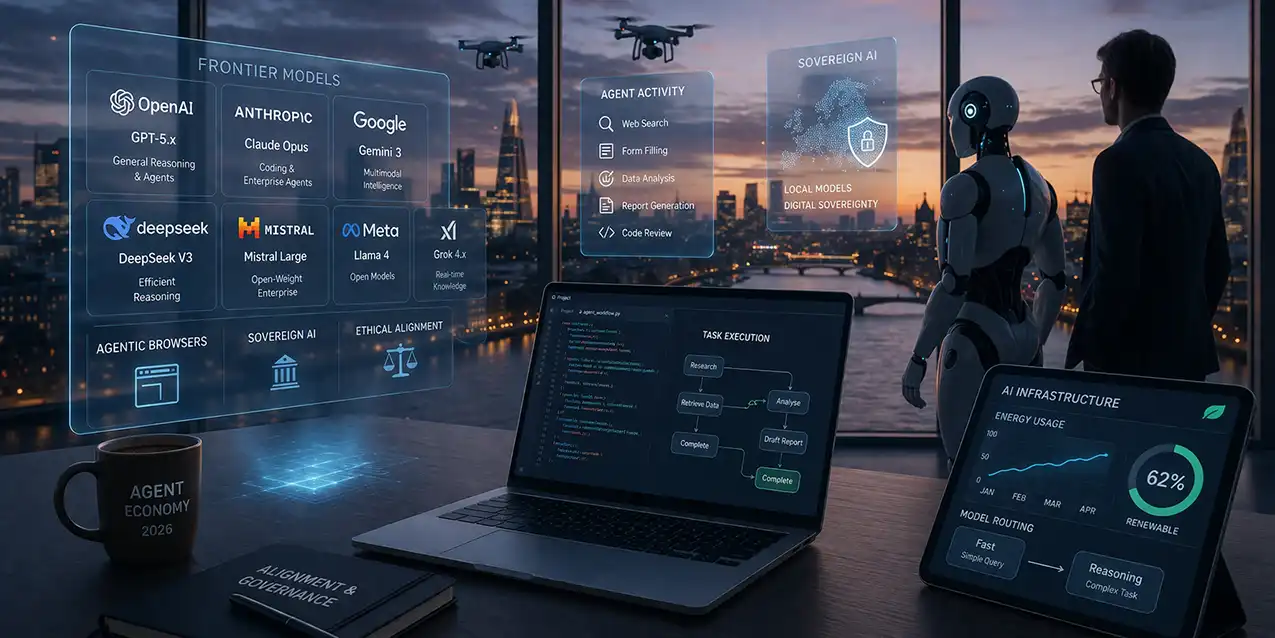
The artificial intelligence industry has always oscillated between the roar of spectacle and the cold logic of consolidation. If late 2025 was defined by a “Cambrian explosion” of frontier models—a dizzying period of multimodal breakthroughs and benchmark obsession—then April 2026 represents the arrival of a “Permian” maturity. The landscape feels less chaotic but far more consequential; the breathless question of “how smart can it get?” has finally been superseded by the pragmatic, thundering demand of “what can it actually do?”.
This moment, poised between exuberant innovation and cautious regulation, marks the beginning of a new phase in the AI era. As we look across the horizon of April 2026, we see an ecosystem whose rules are only now becoming visible—a world where the architecture of intelligence is increasingly recognised as the architecture of power.
1. The Great Pruning: From Model Menus to Default Systems
One of the most symbolic signals of this new maturity arrived on 13 February 2026. On that day, OpenAI retired multiple older models, including GPT-4o and o4-mini, from the ChatGPT experience. This “great pruning” reflects a strategic shift away from the “model zoo” era where users were expected to navigate a complex tasting menu of reasoning modes and price points.
In April 2026, the industry has largely stopped letting users “drive the gearbox”. Instead, routing and orchestration have become the default design patterns. Sophisticated systems now automatically determine—often in milliseconds—whether a query requires the lightning-fast response of a “nano” classifier or the deeper, more expensive chain-of-thought processing of a frontier reasoning engine. This consolidation is not merely UX housekeeping; it is a survival strategy in an era where every “extra” model kept alive represents an immense operational burden of evaluation, safety tuning, and compute.
2. The Agent Leaves the Chat Window: The Browser as Battleground
The most significant shift this month is the migration of AI from a conversational tool to an agentic system. For three years, the dominant metaphor of artificial intelligence was conversation: humans asked questions and models replied. Increasingly, that paradigm feels antiquated. We are no longer building oracles; we are building interns.
The frontier has shifted from conversation to execution, and the browser has become the primary battleground. Because the browser sits atop the ordinary friction of modern life—research, commerce, travel, and administration—whoever controls the agent layer can reorder how “facts” and brands reach the user.
- Google’s “Auto Browse”: Chrome has now formalised Gemini-powered capabilities that allow an agent to perform multi-step tasks, fill forms, and compare products across tabs. Crucially, with user permission, these agents can now draw on password management to act in authenticated spaces, moving beyond mere summarisation into true operation.
- Perplexity’s Comet: Marketed as an “AI browser,” Comet focuses on autonomous research and task execution, pitching web research as a native browsing behaviour rather than a separate search activity.
- The Shadow Web: To support these agents, we are seeing the emergence of a “shadow web”—structured data endpoints designed for machine consumption (like the Model Context Protocol) that bypass the messy HTML intended for human eyes.
3. The “Coworker” Era: Enterprise Integration
While the consumer browser war is public theatre, the enterprise is where the architecture of work is being rewritten. Anthropic’s “Cowork” initiative and OpenAI’s GPT-5.2 series have shifted the narrative from “writing functions” to “operating inside real environments”.
Enterprise AI has become “pluginised,” allowing companies to embed agents into the literal organs of work—inboxes, CRMs, and dashboards. These systems are designed to behave like reliable employees that can find bugs, patch code, and handle compliance paperwork. Consequently, the industry is moving away from leaderboard benchmarks and toward “work trials,” where a model’s value is measured by its failure rate in booking travel or generating invoices rather than its score on a math puzzle.
4. A Portfolio of Specialised Intelligences
The contest for frontier models continues, but it no longer resembles a winner-take-all race. The market now rewards a portfolio of specialised intelligences:
- OpenAI (GPT-5 / o-series): Positioning itself as a unified reasoning platform that combines rapid responses with “deep thinking” modes for professional knowledge work.
- Anthropic (Claude Opus 4.5): Staking its claim as the strongest model for coding and computer use, particularly following its acquisition of the Bun runtime to scale AI coding.
- Google (Gemini 3): Emphasising native multimodal reasoning and massive context windows that allow for the analysis of entire libraries of documents in a single prompt.
- DeepSeek & Qwen: Demonstrating that frontier-level performance can emerge from dramatically lower training budgets using sparse architectures.
- Mistral & Meta (Llama 4): Anchoring the open-weights ecosystem, offering models that organisations can run locally to ensure “sovereign” data handling.
5. Sovereign AI and the Politics of Sovereignty
As AI is recognised as strategic infrastructure comparable to telecommunications or energy grids, governments are increasingly investing in national models. Following the precedent set by Ukraine’s national LLM in late 2025, nations including India, France, and Brazil are moving toward “Sovereign AI” initiatives. This “Balkanisation of Intelligence” ensures that models are trained on local languages and institutional knowledge, governed by local laws rather than Silicon Valley terms of service.
6. The Physical Ceiling: Energy and Infrastructure
Gravity—in the form of physics and finance—has become the defining constraint of April 2026. The energy costs of “thinking” models are forcing a reckoning.
- Consumption: U.S. data centres now consume over 4% of national electricity, a figure projected to reach up to 12% by 2028. In Ireland, data centres already account for 21% of national electricity, reaching a staggering 79% in Dublin.
- Market Impact: In Virginia’s “Data Center Alley,” these facilities have driven up regional capacity prices, resulting in residential bill increases of $16-18 per month.
- Regulation: Energy consumption has moved from white papers to hard governance. The European Commission now mandates the reporting of energy performance and water footprints for data centres. By mid-2026, we expect “Compute Efficiency Standards” to force labs to report the energy-per-token of their flagship models.
7. The Regulatory and Ethical Reckoning
2026 began under a patchwork of new laws. In California, as of January 1st, AB 316 prohibits the “autonomous AI defence,” meaning defendants can no longer blame an AI system for harm. Nationally, the “Take It Down” Act has made the publication of non-consensual deepfakes a federal crime.
Furthermore, as agentic content floods the web, “Proof of Personhood” has become the internet’s most valuable currency. Cryptographic verification tools and “Verified Human” badges are evolving from social media vanities into necessary security clearances for banking and government services.
Comparative Model Landscape (April 2026)
| Developer | Model Family | Primary Strength | Architecture Notes | Typical Deployment | Relative Cost |
| OpenAI | GPT‑5 / o‑series | General reasoning & agents | Router (fast & deep) | Cloud APIs, enterprise | Medium–High |
| Anthropic | Claude Opus / Sonnet | Coding & enterprise agents | Constitutional alignment | Cloud & developer tools | High |
| Gemini 3 | Multimodal reasoning | Native multimodal | Search & Workspace | Medium | |
| DeepSeek | V‑series models | Efficient reasoning | Sparse architectures | Cloud APIs | Low–Medium |
| Mistral | Mistral 3 / Large | Open-weight enterprise | Mixture-of-Experts | On-premise / Hybrid | Self-hosted |
| Meta | Llama 4 | Open ecosystem | Large open-weight | Self-hosted / Cloud | Varies |
| xAI | Grok 4.x | Real-time social data | Integration with X | Platform integration | Medium |
Conclusion: Beyond the Screen
As we move deeper into 2026, the “Year of the Agent” may be remembered as the moment intelligence began to leave the screen. The emergence of “world models” like NVIDIA’s Cosmos and Google’s Genie 3 is helping AI comprehend the physical rules of reality—gravity, friction, and collisions—enabling robots to navigate three-dimensional space.
We are no longer watching the magic show from the audience; we are backstage, hauling the ropes and pulleys of a technology that is embedding itself into the bedrock of civilisation. It is less glamorous, perhaps, but infinitely more real. The question of whether powerful machine intelligence will exist is settled—it already does. The real question for the coming decade is who will shape its character and what limits we will place upon its agency.


