

Introduction: The Map and the Territory
The ocean is a memory. It remembers the iron taste of the harpoon and the heavy drag of the trawl. It remembers the silence of the extinction and the cacophony of the hunt. But it also remembers how to heal. Beneath the surface, in the crushing dark and the sunlit shallows, there is a resilience that defies the industrial weight of the Anthropocene.
We are standing at a pivotal moment in the history of this blue planet. The United Kingdom, an island nation whose history was written in the wake of ships, has turned its gaze once more to the horizon. But this time, the ambition is not conquest, but custody. Through the Blue Belt Programme, Britain has drawn a line in the water, enclosing more than 4.4 million square kilometers of the global ocean—an area larger than India, scattered like jewels across the Atlantic, the Indian, the Pacific, and the Southern Oceans.¹
This is the story of that ambition. It is a narrative that spans the globe, from the wind-scoured cliffs of Tristan da Cunha, where the albatross rides the gales of the Roaring Forties, to the recovering sandbanks of the Dogger Bank, where the ghosts of the North Sea are beginning to stir. It is a story of “glowing” corals in the twilight zone of the Pacific, of green turtles navigating by the magnetic pulse of the earth, and of the political tides that shift sovereignty in the Chagos Archipelago.
It is a story of contradictions. It involves “paper parks” that exist only in statutes, and “no-take” zones where the enforcement is as sharp as the reefs themselves. It involves the transfer of imperial power and the retention of military bases. But above all, it is a story of the water itself—the living, breathing, circulating fluid that connects us all.
As we look toward the 2030 horizon, the goal is clear: to protect 30 percent of the world’s ocean. The UK has staked its claim as a leader in this “30×30” crusade. This essay bears witness to the state of these waters, exploring the biology, the politics, and the profound moral necessity of the Blue Belt.
Part I: The Southern Sentinels – Ice, Krill, and Redemption
The Resurrection of South Georgia
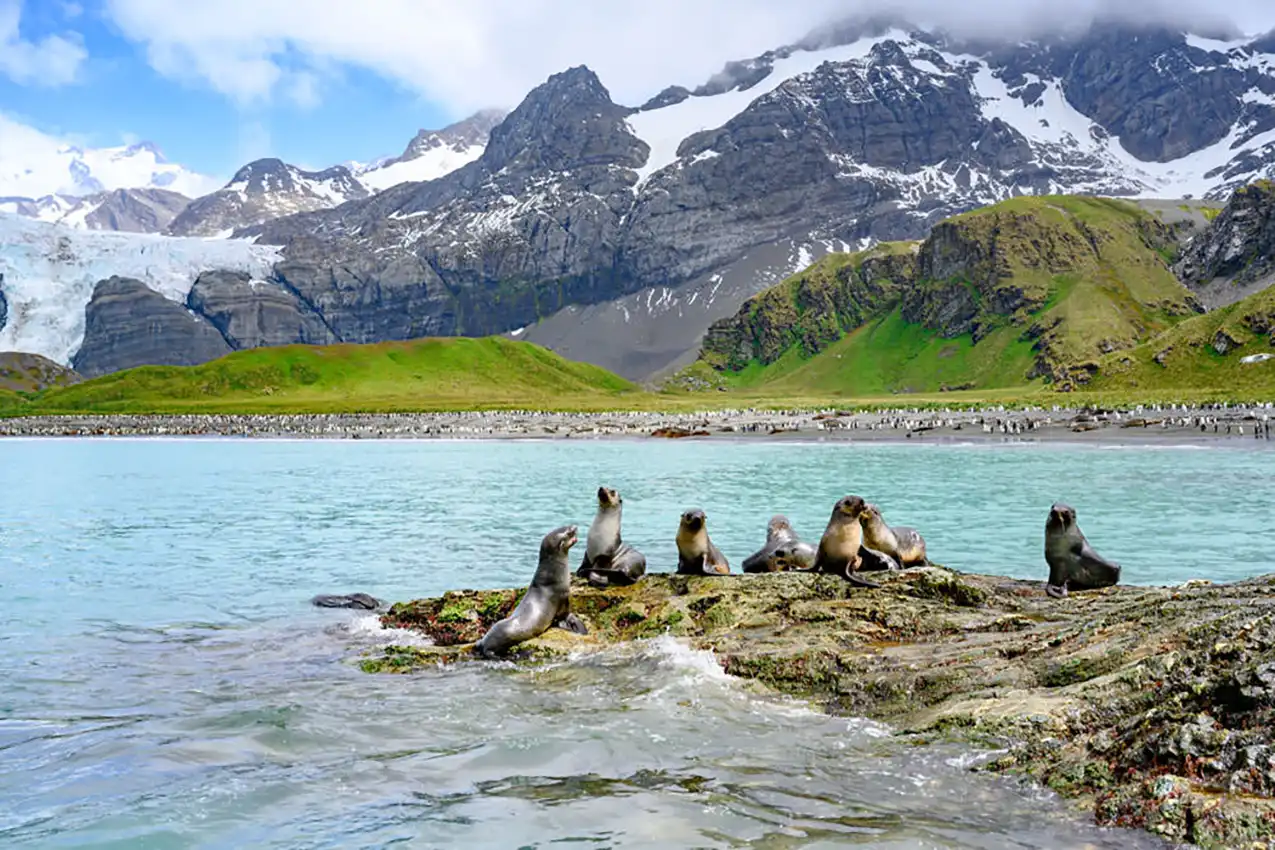
To understand the scale of the Blue Belt, one must go south. Past the Falklands, past the convergence where the cold Antarctic waters dive beneath the warmer sub-tropical currents, lies South Georgia. It is a landscape of violent beauty, a jagged spine of Alps rising straight from the freezing sea.
Once, this was the slaughterhouse of the Southern Ocean. In the 20th century, the bays of South Georgia ran red. Whaling stations like Grytviken processed the carcasses of blue, fin, sei, and humpback whales on an industrial scale. The populations collapsed. The silence that followed was deafening.
But today, South Georgia is a cathedral of recovery. The government of South Georgia and the South Sandwich Islands (SGSSI) has established one of the world’s largest Marine Protected Areas (MPAs), covering 1.24 million square kilometers.² This is not merely a line on a map; it is a fortress of cold water.
The Return of the Giants
The recovery is visceral. In the bays where whalers once sharpened their flensing knives, humpback whales have returned. They breach and slap their pectorals on the water, a communication system that spans ocean basins. Surveys indicate that humpback populations in the region have recovered to near pre-whaling levels, a biological miracle driven by the cessation of hunting and the protection of their food source.³
The food source is krill (Euphausia superba). These small, shrimp-like crustaceans are the engine of the Antarctic ecosystem. They form swarms so dense they stain the water pink, a biomass that rivals the human population of the planet in weight. Everything eats krill. The penguins, the seals, the albatrosses, the whales—all are essentially processed krill.
The management of the krill fishery in South Georgia is a study in precautionary science. While commercial fishing for krill is permitted, it is strictly confined to the winter months. This temporal restriction prevents the fishing vessels from competing with the breeding colonies of penguins and fur seals, which forage intensively during the summer.⁴ The catch limits are set far below the estimated sustainable yield, a buffer against uncertainty in a rapidly warming world.
The Expansion of 2024
In 2024, the protection was tightened. Following a five-year review, the government expanded the “No Take” zones (NTZs)—areas where all fishing is prohibited—to cover 470,000 square kilometers.⁵ This expansion includes all coastal waters shallower than 100 meters, effectively handing the nearshore environment back to the seals and the seabirds.
The science behind this is compelling. The British Antarctic Survey, operating out of King Edward Point, uses acoustic surveys to map the invisible clouds of krill. They track the “Hungry Humpbacks” using satellite tags, revealing the intimate choreography of predator and prey.⁶ They have found that the whales are not just consumers; they are engineers. Their iron-rich feces fertilize the surface waters, stimulating the growth of phytoplankton, which in turn feeds the krill. It is a virtuous cycle, a biological pump that the MPA seeks to protect.
The South Sandwich Islands: Fire and Ice
To the southeast of South Georgia lies an even wilder archipelago: the South Sandwich Islands. This volcanic arc is the edge of the world. It is shaped by fire and ice, with active volcanoes smoking above glaciers.
The waters here are deep. The South Sandwich Trench plunges to over 8,000 meters, a hadal zone where pressure creates strange forms of life. The 2024 expansion of the MPA significantly increased protection here, safeguarding 38 percent of the total maritime zone as fully protected.⁷
This protection is preemptive. The deep sea is the next frontier for industrial extraction—bioprospecting for genetic resources, mining for polymetallic nodules. By locking these doors now, the Blue Belt ensures that the chemosynthetic communities of the hydrothermal vents—ecosisms powered not by the sun but by the heat of the earth—remain undisturbed.
The Chinstrap penguins of Zavadovski Island, numbering in the millions, are the beneficiaries. They inhabit an island that smells of sulfur and guano, a chaotic metropolis of birds that relies entirely on the surrounding seas. The MPA is their guarantee of a future.
Part II: The Atlantic Chain – Loneliness and Life
Move north, into the vast, empty mid-Atlantic. Here, the Blue Belt protects a chain of islands that are defined by their isolation. Ascension, St Helena, Tristan da Cunha. They are specks of land in an ocean that is often described as a desert, yet the waters around them teem with life.
Tristan da Cunha: The Gold Standard
Tristan da Cunha is the most remote inhabited archipelago on Earth. It is a place of wind and rock, home to a community of fewer than 300 people who live by the rhythms of the sea. In 2020, this small community made a decision of planetary significance: they designated 91 percent of their waters as a Marine Protection Zone (MPZ).⁸
This zone covers 687,000 square kilometers. It is a “gold standard” conservation area where no extractive activity is permitted. No industrial fishing. No deep-sea mining. Just the ocean, functioning as it has for millennia.⁹
The Kelp Forests and the Lobster
The nearshore ecology of Tristan is dominated by giants. The giant kelp (Macrocystis pyrifera) forms underwater forests that rise from the seabed to the surface, creating a three-dimensional habitat that rivals terrestrial rainforests in complexity.¹⁰ These forests dampen the energy of the South Atlantic swells, creating a calm nursery for the Tristan rock lobster (Jasus tristani).
The lobster fishery is the economic lifeblood of the island. It is Marine Stewardship Council (MSC) certified, a model of sustainability. The islanders understand that their prosperity is linked to the health of the kelp. By protecting the wider ocean from industrial fleets, they safeguard the larvae that will eventually settle on their reefs.¹¹
The Albatross and the Sharks
Above the water, the Tristan Albatross (Diomedea dabbenena) rules the air. This critically endangered bird, with a wingspan of three meters, spends years at sea without touching land. The Blue Belt protection removes the threat of longline fishing fleets from their foraging grounds, reducing the risk of bycatch that has decimated populations elsewhere.¹²
Below the surface, the waters host the sevengill shark, a prehistoric predator that patrols the kelp margins. The deep waters around the seamounts—underwater volcanoes that rise from the abyss—create upwellings of nutrients that support a rich pelagic food web. The protection of these seamounts is crucial; they are oases in the open ocean, gathering points for tuna, sharks, and whales.¹³
St Helena: The Assembly of the Bone Sharks
North of Tristan lies St Helena. Famous as the prison of Napoleon, it is now gaining fame for a different kind of visitor. Between December and April, the waters around the island host a gathering of whale sharks (Rhincodon typus).
Locally known as “bone sharks,” these massive fish—the largest in the ocean—congregate here in equal numbers of males and females.¹⁴ This is highly unusual; most whale shark aggregations globally are dominated by juvenile males. The 50/50 split suggests that St Helena is a reproductive ground, a place where these solitary giants come to mate.¹⁵
The Blue Belt Programme supports the research that is unraveling this mystery. Scientists use acoustic telemetry to track the sharks, mapping their movements around the island. They have discovered that the sharks use the entire EEZ, but focus on the leeward side, feeding on the spawn of fish and coral.¹⁶
St Helena’s MPA, a Category VI sustainable use area, allows for traditional pole-and-line tuna fishing. This method, where one man catches one fish with one hook, is the antithesis of industrial slaughter. It produces high-quality tuna without the bycatch of dolphins, turtles, and sharks. It is a model of how human culture and wild nature can coexist.¹⁷
Ascension Island: The Turtle’s Magnet
Further north still lies Ascension Island. A jagged volcanic rock, it was terraformed in the 19th century by the Royal Navy and botanist Joseph Hooker, who planted a “Green Mountain” of cloud forest on its peak.¹⁸ But the real treasure is in the water.
Ascension is the second-largest green turtle (Chelonia mydas) nesting site in the Atlantic. Every year, huge female turtles haul themselves onto the beaches of Long Beach and North East Bay to lay their eggs.¹⁹ These turtles have migrated 2,300 kilometers from their feeding grounds in Brazil.
How they find this tiny speck of rock in the middle of the Atlantic is a marvel of sensory biology. They likely use a combination of magnetic navigation—sensing the inclination and intensity of the Earth’s magnetic field—and olfactory cues carried on the trade winds.²⁰ They are homing pigeons of the sea.
In 2019, the Ascension Island Council designated 100 percent of its EEZ as an MPA, covering 445,000 square kilometers.²¹ This decision closed the waters to the international commercial fishing fleets that targeted the migrating tuna and marlin. It created a sanctuary not just for the turtles, but for the pelagic predators that accompany them.
The MPA also protects deep-sea wonders. The seabed around Ascension is paved with cold-water coral reefs, delicate structures that grow in the dark. These reefs are fragile; a single pass of a bottom trawl can destroy thousands of years of growth. The ban on bottom trawling here is an act of preservation for a world we are only just beginning to map.²²
Part III: The Pacific Frontier – Light and Shadow
The Pitcairn Islands: The Glowing Reefs
Halfway between New Zealand and Peru, in the heart of the Pacific gyre, lies the Pitcairn Islands. This is the territory of the Bounty mutineers, a place of historical infamy and ecological purity.
The Pitcairn Islands Marine Reserve, established in 2015, covers 834,000 square kilometers. It is a fully protected, no-take zone.²³ The isolation of these islands has been their salvation. The waters here are ultra-oligotrophic—extremely low in nutrients—which makes them incredibly clear. Sunlight penetrates deep into the water column, allowing corals to grow at depths that would be impossible elsewhere.
These are the mesophotic reefs, the “twilight zone” corals. At depths of 40 to 100 meters, researchers have discovered corals that “glow”—fluorescing in vibrant oranges and greens.²⁴ This fluorescence is a biological adaptation, converting high-energy blue light into lower-energy wavelengths that the symbiotic algae inside the coral can use for photosynthesis. It is a survival mechanism that creates a psychedelic underwater landscape.
The reserve includes Ducie Atoll, the southernmost coral atoll in the world. Here, the ecosystem displays a pristine “inverted biomass pyramid.”²⁵ In most degraded reefs, small fish outnumber predators. At Ducie, top predators like grey reef sharks and whitetip reef sharks dominate the biomass. It is a glimpse of what the ocean looked like before the Anthropocene.
In 2023, a new marine science base was established on Pitcairn, allowing for sustained monitoring of these remote waters.²⁶ The islanders, numbering fewer than 50, are the custodians of a sea area larger than the United Kingdom.
The Chagos Archipelago: Sovereignty and Stewardship
In the Indian Ocean, the Blue Belt intersects with the hard realities of geopolitics. The British Indian Ocean Territory (BIOT), or the Chagos Archipelago, has been the site of a 640,000 square kilometer no-take MPA since 2010.²⁷ It creates a refuge for coconut crabs, seabirds, and the vast populations of tuna that migrate through the Indian Ocean.
However, its establishment was marred by the history of the Chagossian people, who were forcibly expelled in the 1960s and 70s to make way for the US military base on Diego Garcia.²⁸ For years, the MPA was criticized as a tool of political exclusion.
In late 2024 and 2025, the landscape shifted. The UK government agreed to transfer sovereignty of the Chagos Archipelago to Mauritius, subject to a treaty that allows the UK (and US) to retain the military base on Diego Garcia for 99 years.²⁹ Crucially, the agreement includes provisions for the continued protection of the marine environment. Mauritius has committed to establishing a marine protected area, with UK funding (£101 million annual package) and technical support.³⁰
This transition represents a new model of conservation—one that attempts to decouple ecological protection from colonial control. The challenge now is to integrate the traditional knowledge of the Chagossian people, who may soon return to the outer islands, into the management of the reefs.³¹
Part IV: The Domestic Front – Rewilding the North Sea
The Blue Belt is not just for the distant and the exotic. It applies to the grey, churning waters of the North Sea, the cradle of British maritime identity. Here, the challenge is not isolation, but congestion. These are industrial seas, crowded with wind farms, shipping lanes, and fishing fleets.
The Dogger Bank: From Hunting Ground to Sanctuary
The Dogger Bank is a ghost landscape. Ten thousand years ago, it was dry land—”Doggerland”—a tundra bridge connecting Britain to Europe, inhabited by mammoths and Mesolithic hunters. Rising sea levels drowned it, turning it into a vast, shallow sandbank.³²
Ecologically, it is the beating heart of the North Sea. The shallow waters allow sunlight to reach the seabed, driving high primary productivity. It is a nursery for sand eels (Ammodytes marinus), the silver shoals that feed the puffins, the porpoises, and the cod.³³
For decades, the Dogger Bank was a “paper park.” Designated as a Special Area of Conservation (SAC), it was nevertheless ravaged by bottom trawling.³⁴ This fishing method involves dragging heavy, weighted nets across the seafloor, plowing through the sediment, destroying the delicate communities of sea pens, shells, and worms. It creates a monoculture of mud, releasing stored carbon and obliterating biodiversity.
The Battle of the Boulders
The turning point was physical. In 2020 and 2021, Greenpeace activists sailed to the Dogger Bank and dropped giant granite boulders onto the seabed.³⁵ These boulders were anathema to trawlers—they would snag the nets, making fishing impossible. It was a controversial, direct-action tactic that forced the government’s hand.
In June 2022, the UK’s Marine Management Organisation (MMO) introduced a bylaw banning bottom-towed gear across the entire UK portion of the Dogger Bank SAC—12,331 square kilometers.³⁶
The results were immediate. By 2024, divers and remote cameras reported signs of recovery. The seabed, no longer churned daily, began to stabilize. “Dead man’s fingers” (Alcyonium digitatum), a soft coral, began to colonize the stones. The sand mason worms (Lanice conchilega) built their tube forests, stabilizing the sand and creating habitat for juvenile flatfish.³⁷
The Transboundary Victory
But the Dogger Bank crosses borders. The Dutch and German sectors remained open to trawling, creating a patchwork of protection. In late 2024, the European Union finally moved to close this gap. A ban on bottom-contacting gear in the German and Dutch sectors was announced, to take effect on November 18, 2025.³⁸
This harmonization creates a coherent, cross-border sanctuary in the middle of the North Sea. It is a triumph of “Blue Diplomacy,” recognizing that the sand eels do not check passports.
Highly Protected Marine Areas: The New Gold Standard
The UK government has recognized that “protection” is a spectrum. In July 2023, it designated the first three Highly Protected Marine Areas (HPMAs) in English waters.³⁹ These are not just MPAs; they are “no-take” zones where all extractive activity is banned.
- Allonby Bay (Irish Sea): A shallow, inshore site protecting “blue carbon” habitats and honeycomb worm reefs. It is a nursery for flatfish and a feeding ground for shorebirds.³⁹
- Dolphin Head (Eastern Channel): A complex seabed of rock and gravel, degraded by decades of trawling. The HPMA status gives it a chance to breathe, to recover the sponges and corals that once thrived here.⁴⁰
- North East of Farnes Deep (North Sea): A deep-water site protecting muddy habitats crucial for carbon storage and spawning fish.⁴¹
These sites are pilot projects for rewilding the sea. They test the hypothesis that if you leave the ocean alone, it will heal. Early monitoring in 2024 showed positive signs: increases in lobster sizes and the return of fragile sea fans.⁴²
Part V: Connectivity – The Blue Corridors
The ocean is a machine of movement. Conservation cannot just be about static boxes; it must be about flow.
The Whale Superhighways
The “Protecting Blue Corridors” initiative, supported by the Blue Belt Programme and WWF, maps the migratory routes of great whales.⁴³ These “blue corridors” are the arteries of the ocean. A humpback whale feeding in South Georgia might breed off the coast of Brazil. A blue whale might traverse the entire Indian Ocean.
The Blue Belt territories act as service stations along these highways. They provide quiet water, abundant food, and freedom from nets. The data from satellite tags is now informing shipping lane adjustments and fishing closures, trying to minimize ship strikes and entanglement in the open ocean.⁴⁴
The Turtle Tracks
The green turtles of Ascension provide the most dramatic example of connectivity. Their migration to Brazil is a genetic corridor linking the central Atlantic to the South American coast. The “Blue Corridors for Turtles” project combines tracking data with genetics to identify “Important Marine Turtle Areas” (IMTAs).⁴⁵
This science exposes the vulnerability of the high seas. A turtle protected in Ascension is vulnerable the moment it crosses the EEZ boundary. This realization is driving the UK’s support for the new UN High Seas Treaty (BBNJ), ratified in 2025, which provides a legal mechanism to create MPAs in international waters.⁴⁶
Part VI: The Critique – Paper Parks and enforcement
No essay on marine protection is honest without addressing the “paper park” critique. For years, NGOs argued that the UK’s MPA network was a facade—lines on a map that allowed industrial destruction to continue.⁴⁷
The critique was valid. In 2020, bottom trawling was legal in 97% of UK offshore MPAs.⁴⁸ The designation of HPMAs and the Dogger Bank ban are direct responses to this failure. They represent a shift from “designation” to “management.”
But enforcement remains a titanic challenge. How do you police 4 million square kilometers of ocean? The answer lies in technology. The Blue Belt “Ocean Shield” project uses satellite surveillance, machine learning, and AIS tracking to monitor vessel movements in real-time.⁴⁹
In the vastness of the Pacific or the Southern Ocean, a rogue fishing vessel can be detected from space. Patrol vessels, like those stationed in the Falklands and Diego Garcia, can be dispatched to intercept. It is a high-tech game of cat and mouse, essential to maintaining the integrity of the Blue Belt.
Part VII: A Lyrical Audit of the Deep
What does this protection look like, if you could hold your breath and descend?
It looks like the kelp forests of Tristan, swaying in the surge like a drowned cathedral, the light filtering through the fronds in shafts of gold and green. It looks like the seabed of the Dogger Bank, slowly knitting itself back together, the scars of the trawl doors softening under a blanket of new life.
It sounds like the click-trains of sperm whales hunting squid in the canyons off Dominica (a partner in the Blue Belt’s Caribbean expansion). It feels like the cold, nutrient-rich shock of the South Georgia upwelling, feeding the krill that feed the world.
It looks like the Angel Shark (Squatina squatina) off the coast of Wales. In July 2025, underwater footage confirmed the return of this “ghost of the seabed” to Cardigan Bay.⁵⁰ Flat, camouflaged, critically endangered, it was once thought lost to the UK. Its return is a whisper of hope, a signal that the seabed remembers what it once was.
Conclusion: The Architecture of Hope
The British Blue Belt is an imperfect structure. It is built on the remnants of empire, funded by a treasury under pressure, and managed across vast distances. It faces the existential threat of climate change—acidification and warming that no border can stop.
Yet, it is also an act of profound optimism. It is an assertion that the ocean is not merely a resource to be liquidated, but a heritage to be held. By locking away 4.4 million square kilometers of the blue planet, the UK has created a reservoir of resilience.
These zones are time capsules. They preserve the ocean of the past to seed the ocean of the future. When the waters of the North Sea warm, the protected deeps of the Farnes may provide a cool refuge. When the coral reefs of the tropics bleach, the mesophotic reefs of Pitcairn may hold the genetic keys to recovery.
The whale breaching off St Helena, the turtle digging her nest on Ascension, the sand eel hiding in the Dogger Bank—these are the citizens of the Blue Belt. Their survival is the only metric that truly matters. In a world of closing doors and rising walls, the Blue Belt keeps the horizon open.
Data Appendix
| Territory / Area | Size (km²) | Status (2025/2026) | Key Biodiversity |
| South Georgia & S. Sandwich Islands | 1.24 million | Expanded No-Take (2024): 470,000 km² fully protected. Seasonal krill fishery strictly regulated. | Humpback whales, Antarctic Fur Seals, Macaroni & Chinstrap Penguins, Krill. |
| Pitcairn Islands | 834,000 | Fully Protected (2015): One of the world’s largest no-take zones. | “Glowing” mesophotic corals, Ducie Atoll sharks, pristine deep-sea vents. |
| Tristan da Cunha | 687,000 | Marine Protection Zone (2020): 91% no-take. “Gold standard” protection in Atlantic. | Northern Rockhopper Penguins, Tristan Albatross, Seven-gill sharks. |
| Ascension Island | 445,000 | 100% MPA (2019): Full ban on commercial fishing. | Green Turtle nesting (2nd largest in Atlantic), Land crabs, deep-sea coral. |
| Saint Helena | 444,916 | Category VI MPA: Sustainable use allowed (pole-and-line tuna). | Whale Sharks (50/50 male-female split), endemic butterflyfish. |
| BIOT (Chagos) | 640,000 | Sovereignty Transfer (2024/25): Handing over to Mauritius; Mauritius committed to MPA maintenance. | Coconut crabs, pristine coral atolls, vast pelagic fish stocks. |
| Dogger Bank (UK Sector) | 12,331 | SAC (Bottom Trawl Ban 2022): Benthic protection. EU ban follows Nov 2025. | Sand eels, Halibut, Soft corals (Alcyonium), Sand mason worms. |
Endnotes
- Foreign, Commonwealth & Development Office, “The Blue Belt Programme,” GOV.UK, accessed January 2026. 1
- Government of South Georgia & the South Sandwich Islands, “Marine Protected Area,” gov.gs, accessed January 2026. 4
- British Antarctic Survey, “Scientists study whales and fish to protect South Georgia,” August 2024. 5
- Government of South Georgia & the South Sandwich Islands, “Conserving the Jewel of the Southern Ocean,” April 9, 2025. 6
- Government of South Georgia & the South Sandwich Islands, “Marine Protected Area Management,” 2025. 4
- British Antarctic Survey, “Scientists study whales,” 2024. 5
- Blue Belt Programme, “Annual Review 2024-25,” HM Government. 2
- Tristan da Cunha Government, “The Blue Belt Programme,” tristandc.com. 7
- Marine Conservation Institute, “Tristan da Cunha Marine Protection Zone,” Blue Parks. 8
- NASA Earth Observatory, “Remote Tristan da Cunha,” June 2024. 9
- Pew Charitable Trusts, “On a Remote Archipelago, Rich Biodiversity Faces Threats,” 2019. 10
- UK Overseas Territories Conservation Forum, “Tristan da Cunha.” 11
- National Geographic, “Pristine Seas: Tristan da Cunha Scientific Report.” 12
- St Helena National Trust, “Marine Section: Whale Sharks.” 13
- Blue Marine Foundation, “St Helena Case Study: Blueprint for MPAs,” 2024. 14
- Frontiers in Marine Science, “Whale Sharks of St Helena,” 2020. 15
- St Helena Government, “Marine Division.” 16
- Pew Charitable Trusts, “Protections for Ascension Island,” 2019. 17
- Ascension Island Government, “Green Turtle Species Action Plan.” 18
- OBIS-SEAMAP, “Ascension Island Green Turtle Migrations,” 2025. 19
- Blue Marine Foundation, “The Green Turtles of Ascension Island.” 20
- Pew Charitable Trusts, “Protections for Ascension Island,” 2019. 17
- Government of Pitcairn Islands, “Environment.” 21
- Marine Conservation Institute, “Pitcairn Islands Marine Protected Area.” 22
- National Geographic, “Pristine Seas: Pitcairn Scientific Report.” 23
- Government of Pitcairn Islands, “Environment.” 21
- Stanford University, “Marine Protected Area Mauritius Communities,” November 2025. 25
- UK Parliament House of Commons Library, “UK-Mauritius Agreement on Chagos,” 2025. 26
- Ibid. 26
- Mongabay, “A deal signals a new chapter for Chagossians,” December 2025. 27
- Stanford University, “Marine Protected Area Mauritius,” 2025. 25
- Greenpeace UK, “Dogger Bank MPA.” 28
- ORCA, “Dogger Bank Win: EU Outlaws Bottom Contact Fishing,” 2025. 29
- Blue Marine Foundation, “Dogger Bank Protected in Ban.” 30
- Greenpeace UK, “Greenpeace Expands Boulder Barrier,” 2022. 31
- GOV.UK, “Dogger Bank SAC Specified Area Bottom Towed Fishing Gear Byelaw 2022.” 32
- European Commission, “EU Takes Action to Protect Sensitive Habitats Dogger Bank,” October 2025. 33
- Ibid. 33
- GOV.UK, “Highly Protected Marine Areas Designated,” July 2023. 35
- JNCC, “English Highly Protected Marine Areas.” 36
- GOV.UK, “Highly Protected Marine Areas,” 2023. 37
- Greenpeace UK, “Marine Protected Areas Consultation Response,” 2025. 38
- WWF, “Protecting Blue Corridors,” 2022. 39
- WWF, “Bringing Whale Superhighways to Life.” 41
- WWF, “New Global Initiative to Map Blue Corridors for Turtles,” 2025. 42
- United Nations, “Agreement on Marine Biodiversity of Areas Beyond National Jurisdiction,” 2023. 35
- The Guardian, “Revealed: 97% of UK Offshore Marine Parks Subject to Destructive Fishing,” 2020. 43
- Oceana UK, “The Trawled Truth,” May 2025. 44
- GOV.UK, “Blue Belt Programme: Compliance and Enforcement,” 2021. 45
- The Guardian, “Critically Endangered Angel Shark Filmed off Welsh Coast,” July 2025. 46
Works cited
- The Blue Belt Programme – GOV.UK, accessed on January 2, 2026, https://www.gov.uk/guidance/the-blue-belt-programme
- Blue Belt Programme – Annual Review 2024/25 – GOV.UK, accessed on January 2, 2026, https://assets.publishing.service.gov.uk/media/687f57e98adf4250705c9720/Blue_Belt_Annual_Review_24-25.pdf
- accessed on January 2, 2026, https://committees.parliament.uk/writtenevidence/134776/default/
- Marine Protected Area – Government of South Georgia & the South Sandwich Islands, accessed on January 2, 2026, https://gov.gs/marine-protected-area/
- Scientists study whales and fish to protect South Georgia’s marine ecosystem, accessed on January 2, 2026, https://www.bas.ac.uk/media-post/scientists-study-whales-and-fish-to-protect-south-georgias-marine-ecosystem/
- Conserving The Jewel Of The Southern Ocean- The South Georgia & South Sandwich Islands Marine Protected Area, accessed on January 2, 2026, https://gov.gs/conserving-the-jewel-of-the-southern-ocean/
- Tristan da Cunha Blue Belt Programme, accessed on January 2, 2026, https://www.tristandc.com/wildlife/bluebelt.php
- Tristan da Cunha – Marine Conservation Institute, accessed on January 2, 2026, https://marine-conservation.org/blueparks/awardees/tristan-da-cunha/
- Remote Tristan da Cunha – NASA Science, accessed on January 2, 2026, https://science.nasa.gov/earth/earth-observatory/remote-tristan-da-cunha-152936/
- A Biophysical Profile of the Tristan da Cunha Archipelago – The Pew Charitable Trusts, accessed on January 2, 2026, https://www.pew.org/-/media/assets/2019/07/cp_on_a_remote_archipelago_rich_biodiversity_faces_threats.pdf
- Tristan da Cunha – UK Overseas Territories Conservation Forum, accessed on January 2, 2026, https://www.ukotcf.org.uk/southern-oceans/tristan-da-cunha/
- ECOSYSTEM ASSESSMENT OF THE TRISTAN DA CUNHA ISLANDS – National Geographic Society, accessed on January 2, 2026, https://images.nationalgeographic.org/image/upload/v1695129969/fusion/Pristine%20Seas/PristineSeasTristandaCunhaScientificReport.pdf
- Whale Sharks – St Helena National Trust, accessed on January 2, 2026, https://www.trust.org.sh/marine-section/
- ST HELENA – Blue Marine Foundation, accessed on January 2, 2026, https://www.bluemarinefoundation.com/wp-content/uploads/2024/11/BLUEPrint-for-MPAs_Case-Study_St-Helena_Final.pdf
- St. Helena: An Important Reproductive Habitat for Whale Sharks (Rhincodon typus) in the Central South Atlantic – Frontiers, accessed on January 2, 2026, https://www.frontiersin.org/journals/marine-science/articles/10.3389/fmars.2020.576343/full
- Marine Conservation Section – St Helena Government, accessed on January 2, 2026, https://www.sainthelena.gov.sh/st-helena/government/portfolios/environment-natural-resources-planning/environmental-management/marine-division/
- Protections for Ascension Island, the Crossroads of the Atlantic – The Pew Charitable Trusts, accessed on January 2, 2026, https://www.pew.org/-/media/assets/2019/11/pbol_protections_for_ascension_island_final.pdf
- Green turtle – Ascension Island Government, accessed on January 2, 2026, https://www.ascension.gov.ac/wp-content/uploads/2019/09/Green-turtle-SAP-edited.pdf
- Ascension Island green turtles migrations | Ocean Biodiversity Information System (OBIS), accessed on January 2, 2026, https://obis.org/dataset/d69484a6-ce0c-4d64-b2c9-6282cb9dcb94
- Green turtles in Ascension – Blue Marine Foundation, accessed on January 2, 2026, https://www.bluemarinefoundation.com/deep-dive-the-green-turtles-of-ascension-island/
- Environment — The Official Website of the Government of the Pitcairn Islands, accessed on January 2, 2026, https://www.government.pn/environment
- Pitcairn Islands Marine Protected Area, accessed on January 2, 2026, https://marine-conservation.org/blueparks/awardees/pitcairn/
- Pitcairn Islands Marine Reserve — Visit Pitcairn – Open To Explore, accessed on January 2, 2026, https://www.visitpitcairn.pn/pitcairn-islands-marine-reserve
- The Real Bounty: Marine Biodiversity in the Pitcairn Islands – PMC – PubMed Central, accessed on January 2, 2026, https://pmc.ncbi.nlm.nih.gov/articles/PMC4070931/
- Stanford expertise helps establish first-of-its-kind marine protected area, accessed on January 2, 2026, https://news.stanford.edu/stories/2025/11/marine-protected-area-mauritius-communities-resettlement-research
- 2025 treaty on the British Indian Ocean Territory/Chagos Archipelago, accessed on January 2, 2026, https://commonslibrary.parliament.uk/research-briefings/cbp-10273/
- A deal signals a new chapter for Chagossians, and one of the world’s largest marine no-fishing zones – Mongabay, accessed on January 2, 2026, https://news.mongabay.com/2025/12/a-deal-signals-a-new-chapter-for-chagossians-and-one-of-the-worlds-largest-marine-no-fishing-zones/
- Dogger Bank Illegal Fishing Dossier: Introduction – Greenpeace UK, accessed on January 2, 2026, https://www.greenpeace.org.uk/wp-content/uploads/2024/07/AIS-dark-bottom-trawling-in-the-Dogger-Bank-FINAL.pdf
- Dogger Bank win: EU outlaws bottom-contact fishing in key zones from 18 November 2025, accessed on January 2, 2026, https://orca.org.uk/news-blog/dogger-bank-win-eu-outlaws-bottom-contact-fishing-in-key-zones-from-18-november-2025
- Dogger Bank protected in ban on destructive fishing – Blue Marine Foundation, accessed on January 2, 2026, https://www.bluemarinefoundation.com/dogger-bank-protected-in-ban-on-destructive-fishing/
- Greenpeace expands boulder barrier in marine protected area as government fails to strengthen safeguards, accessed on January 2, 2026, https://www.greenpeace.org.uk/news/greenpeace-expands-boulder-barrier-in-marine-protected-area-as-government-fails-to-strengthen-safeguards/
- The Dogger Bank Special Area of Conservation (Specified Area) Bottom Towed Fishing Gear Byelaw 2022 – GOV.UK, accessed on January 2, 2026, https://www.gov.uk/government/publications/the-dogger-bank-special-area-of-conservation-specified-area-bottom-towed-fishing-gear-byelaw-2022
- EU takes action to protect sensitive habitats in the Dogger Bank – Oceans and fisheries, accessed on January 2, 2026, https://oceans-and-fisheries.ec.europa.eu/news/eu-takes-action-protect-sensitive-habitats-dogger-bank-2025-10-30_en
- EU Prohibits Bottom-Contact Gears in Specific Dogger Bank Areas – The Fishing Daily, accessed on January 2, 2026, https://thefishingdaily.com/eu-fishing-industry-news/eu-prohibits-bottom-contact-gears-in-specific-dogger-bank-areas/
- Highly Protected Marine Areas (HPMAs) – GOV.UK, accessed on January 2, 2026, https://www.gov.uk/government/publications/highly-protected-marine-areas/highly-protected-marine-areas-hpmas
- English Highly Protected Marine Areas | Advisor to Government on Nature Conservation, accessed on January 2, 2026, https://jncc.gov.uk/our-work/english-highly-protected-marine-areas/
- Highly Protected Marine Areas to be designated in English waters – GOV.UK, accessed on January 2, 2026, https://www.gov.uk/government/news/highly-protected-marine-areas-to-be-designated-in-english-waters
- Marine protected areas Stage 3 Consultation – our response – Greenpeace UK, accessed on January 2, 2026, https://www.greenpeace.org.uk/resources/marine-protected-areas-stage-3-consultation-our-response/
- Protecting Blue Corridors — WWF Protecting Whales & Dolphins Initiative, accessed on January 2, 2026, https://wwfwhales.org/protecting-blue-corridors
- PROTECTING BLUE CORRIDORS – World Wildlife Fund, accessed on January 2, 2026, https://www.worldwildlife.org/documents/684/5dcmm9jsc3_WWF_Protecting_Blue_Corridors_report_Feb2022.pdf
- Bringing whale superhighways to life – new digital platform a game-changer for ocean conservation | WWF, accessed on January 2, 2026, https://wwf.panda.org/wwf_news/?14155466/Bringing-whale-superhighways-to-life—new-digital-platform-a-game-changer-for-ocean-conservation
- New global initiative to map blue corridors for turtles – WWF SWIO, accessed on January 2, 2026, https://www.wwf-swio.org/?54022/New-global-initiative-to-map-blue-corridors-for-turtles
- Revealed: 97% of UK marine protected areas subject to bottom-trawling – The Guardian, accessed on January 2, 2026, https://www.theguardian.com/environment/2020/oct/09/revealed-97-of-uk-offshore-marine-parks-subject-to-destructive-fishing
- THE CASE FOR BANNING BOTTOM TRAWLING IN UK MARINE PROTECTED AREAS – Oceana UK, accessed on January 2, 2026, https://uk.oceana.org/wp-content/uploads/sites/14/2025/05/Oceana-UK-The-Trawled-Truth-May-2025.pdf
- Marine Protected Areas – Showing their teeth in Overseas Territories, accessed on January 2, 2026, https://marinedevelopments.blog.gov.uk/2021/06/05/marine-protected-areas-showing-their-teeth-in-overseas-territories/
- Critically endangered angel shark filmed off Welsh coast | Marine life – The Guardian, accessed on January 2, 2026, https://www.theguardian.com/environment/2025/jul/26/critically-endangered-angel-shark-filmed-off-welsh-coast-in-first-spotting-since-2021


