

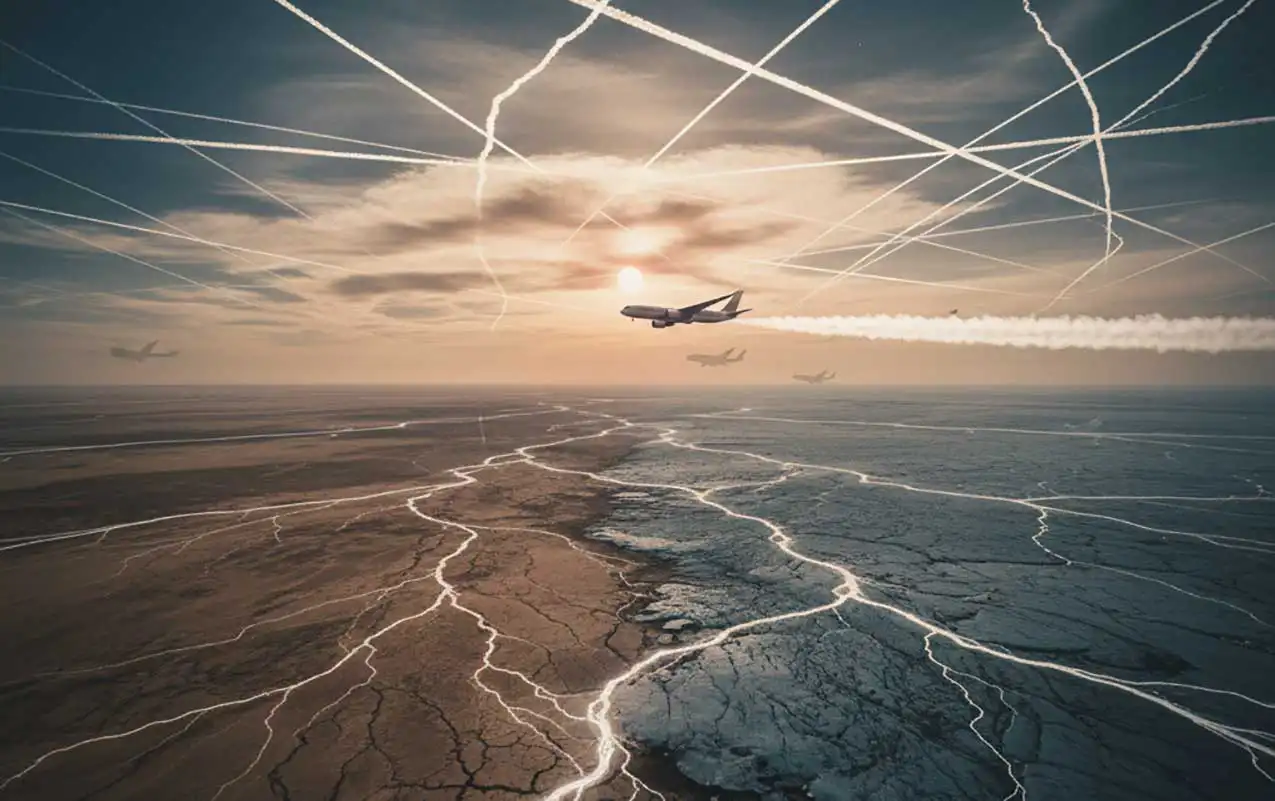
We have been taught to look down. To see the airports, the concrete, the crowds, and the queues as the footprint of flight. Or we look at the numbers, the comforting, almost negligible figures. Aviation, the industry tells us, accounts for just 2.5% of global CO2 emissions.¹
It is the most brilliant misdirection. The real story is not on the ground. It is not in the Co2.
Look up. The true impact is written across the sky in vanishing ink.
Those white streaks, the contrails that bifurcate the blue, are not harmless vapor. They are, as the Intergovernmental Panel on Climate Change (IPCC) notes, man-made “ice cirrus clouds.”² In certain conditions, these clouds, formed by engine emissions, spread and persist. They reflect some sunlight, yes, but more importantly, they trap heat radiating from the Earth. At night, with no sunlight to reflect, they act as a pure warming blanket.³
This is aviation’s open secret, the one that renders most public debate obsolete. According to a 2020 EU study, these non-CO2 effects—the contrails, the nitrogen oxides, the soot—contribute twice as much to global warming as all of aviation’s CO2 emissions combined.⁴
The full picture is even more stark. A study evaluating the warming effects from 1940 to 2018 found that the radiative forcing (the warming impact) from contrail cirrus alone is estimated to be more than three times larger than the warming effect from all of aviation’s accumulated historical CO2 emissions.⁵
The 2.5% figure is not a lie. It is simply a distraction from a far more alarming truth. We have been arguing over the match, while the industry has created a blanket. The white scar of the contrail is not a byproduct of aviation; it is its most profound wound on the climate.
The Global Synapse
Why, then, is this so hard? Why, when faced with this evidence, do we not simply stop?
The answer is that aviation is not an industry. It is the circulatory system of the modern human experiment. It is the global synapse, the high-speed connection that makes our world work.
The numbers are difficult to comprehend. The air transport sector supports a total of 86.5 million jobs worldwide. Its total global economic impact is estimated at $4.1 trillion.⁶ If aviation were a country, its direct GDP alone would rank it 20th in the world, just behind Switzerland.⁷
It is the engine of globalization and the primary enabler of tourism. A staggering 58% of all international tourists travel to their destinations by air, underwriting an interconnected travel and tourism sector that, in 2024, supported 357 million jobs and contributed $10.9 trillion to global GDP.⁸
It is the “global bridge” for our just-in-time supply chains.⁹ While it doesn’t carry bulk goods, it carries the things that matter most to a modern economy: high-value, time-sensitive cargo. Pharmaceuticals, vaccines, micro-electronics, and the urgent components that keep factories running—all move by air.¹⁰ In fiscal year 2025, FedEx alone cited a $126 billion global economic contribution.¹¹
And, crucially, it has been democratized. A 70% decrease in the real cost of flying over the last 50 years has enabled the invaluable, intangible human connections at the heart of our lives: visiting family, fostering cultural exchange, and providing a “community lifeline” for remote areas where air travel is the only link to healthcare or education.¹²
Nowhere is this paradox more acute, or more tragic, than in the Small Island Developing States (SIDS). These are the nations—the low-lying coastal countries—most vulnerable to the rising seas and extreme weather caused by climate change.¹³ They are, quite literally, being drowned by the emissions of the Global North.
Yet, their economies are wholly, existentially dependent on the very industry that is sinking them. Aviation supports $34.7 billion of economic activity in SIDS, accounting for 10.6% of their entire collective GDP and 2 million jobs.¹⁴ For these islands, tourism is the economy, and aviation is the only boat.¹⁵
To tell a nation in the Maldives, the Bahamas, or Samoa to support the “degrowth” of aviation is not an abstract moral request. It is a direct and immediate threat of economic annihilation. This is the SIDS Paradox: the industry causing the flood is also the only lifeline.
The Concrete Island
The footprint is not only in the sky. It is baked into the earth in thousands of “airport cities”—sprawling ecosystems of commerce, logistics, and infrastructure.¹⁶
To understand this, we must use a Life Cycle Assessment (LCA), an approach that analyzes the environmental impact from cradle to grave.¹⁷ The airport is a vast concrete island, and its emissions come from three distinct sources.
First is the “embodied carbon”—the skeleton. This is the massive, one-time carbon footprint “locked in” during the construction of runways, terminals, and parking garages. It is the carbon from manufacturing the thousands of tons of steel, asphalt, and concrete.¹⁸ Recognizing this, hubs like London’s Heathrow have begun mandating construction partners to use LCAs, with the aim of phasing out these high-carbon materials.¹⁸
Pioneering airports show a different path. Amsterdam’s Schiphol built a new pier using sustainable materials, including bamboo, recycled plastics, and rainwater for flushing toilets.¹⁹ San Diego International Airport has implemented a “Zero Waste Plan,” moving toward sustainable materials in its terminals.²⁰
Second is the “operational carbon”—the ground fleet. This is the swarm of diesel-powered ground support equipment (GSE) that services a plane: the tugs, baggage loaders, and mobile power units.²¹ This is a solvable problem. The industry is aggressively moving to electric GSE (eGSE). An IATA study showed eGSE can cut CO2 emissions by 35-52% and significantly reduce noise.²² A global switch to eGSE could save 1.8 million tonnes of CO2 annually.²³
Third, and largest, is “Scope 3″—the human fleet. These are the emissions from the passengers. This includes both the flights the airport exists to service and the emissions from every car, taxi, and bus traveling to and from the terminals.²⁴ The most effective solution here is not on the airport’s land, but outside it: integrating airports with high-speed, public rail links.²⁵
But these efforts conceal a “green shell game.” Airports are enthusiastically advertising their green credentials—solar panels on hangars, recycled materials in terminals, electric tugs on the tarmac.²⁶
The catch? A World Economic Forum report reveals a sobering fact: all of these “Scope 1 and 2” emissions, the ones the airport directly controls, account for only 3% of the airport’s total emissions.²⁴ The other 97% is Scope 3: the planes, and the passengers.²⁴
An airport can, therefore, become 100% “carbon neutral” in its own operations while simultaneously increasing its total climate impact by expanding its terminals and adding new runways. This isn’t a solution; it’s a marketing exercise.
The Fig Leaf of ‘Net Zero’
The industry’s global response to its climate problem is built on a similar architecture of ambitious goals and devastating loopholes.
The International Air Transport Association (IATA), the airline’s main lobby, has committed to achieving “net zero carbon emissions by 2050.”²⁷ Its flagship global policy, designed by the UN’s aviation body (ICAO), is the Carbon Offsetting and Reduction Scheme for International Aviation (CORSIA).²⁸
CORSIA is not a reduction scheme. It is an offsetting scheme. It aims to stabilize net emissions, not at zero, but at 85% of 2019 levels, by requiring airlines to purchase carbon offsets for any growth above that baseline.²⁹
Critics like the advocacy group Transport & Environment (T&E) have called it a “direct threat” to the Paris Agreement.³⁰ The scheme relies on carbon offsets from other sectors, a mechanism notoriously difficult to verify. It is nearly impossible to prove that an offset project—like a renewable energy farm—is “additional,” meaning it only happened because of the airline’s money.³¹
The European Union’s Emissions Trading System (ETS) is more aggressive. It is phasing out the free allowances it gives to airlines, moving to full auctioning by 2026.³² But it contains a loophole so large it renders the policy almost symbolic.
The EU ETS only applies to flights within the European Economic Area.³³ It excludes all long-haul, extra-European flights—the most carbon-intensive trips.
The result is a charade. T&E analysis for 2024 shows that this loophole, combined with remaining free allowances, means **70% of CO2 emissions from European aviation remained unpriced.**³⁴ This failure to apply the “polluter pays” principle amounted to €7.5 billion in lost revenue in 2024 alone—money that could have funded green aviation technology.³⁵
This gap between marketing and reality has triggered a legal backlash. Consumer groups are suing. The European Consumer Organisation (BEUC) filed a complaint against 17 airlines for misleading green claims like “Fly more sustainably.”³⁶ A Dutch court ruled that KLM’s sustainability advertisements were misleading.³⁷
The climate charity Possible filed formal complaints against British Airways and Virgin Atlantic, arguing that their “net zero” roadmaps are deceptive when, pre-pandemic, their jet fuel emissions were increasing.³⁸
But regulators are finally catching up to the science. The EU, in a seismic policy shift, is forcing the industry to confront the “white scar.” As of January 1, 2025, airlines operating in Europe are mandated to monitor and report their non-CO2 climate effects.³⁹
A new IT tool, the Non-CO2 Aviation Effects Tracking System (NEATS), has been launched to automate the tracking of contrails and nitrogen oxides.⁴⁰ This is the first step toward regulating aviation’s total warming impact, not just its CO2.
The industry’s reaction is telling. IATA’s Director General, Willie Walsh, has argued that this monitoring should be voluntary, not mandatory, claiming the “science and the proposed reporting framework cannot result in an accurate” process.⁴¹ It is a classic delay tactic—demanding perfect science to avoid confronting an inconvenient reality—one deployed by the fossil fuel industry for decades.
The Search for a Silver Bullet
The industry’s “Net Zero 2050” roadmap is not built on offsets. It is built, almost entirely, on faith in technology.
The plan projects that a staggering 65% of its 2050 goal will be met by Sustainable Aviation Fuels (SAFs). Another 13% will come from new technologies like hydrogen and electric aircraft. A mere 3% is expected from operational efficiencies.²⁷
This is the industry’s great technological wager. But is it a viable plan, or a multi-trillion-dollar mirage?
1. Sustainable Aviation Fuel (SAF) (The “Drop-in” Hope)
SAF is the industry’s great hope. It is a “drop-in” fuel, meaning it can be used in existing engines and infrastructure.⁴² It can be produced from biofuels (like used cooking oil or forestry residues) or as an “e-fuel” (using renewable electricity and captured carbon).⁴³
The problem is what one World Economic Forum contributor calls the “chicken-and-egg” dilemma.⁴⁴ Airlines want to buy it, but supply is almost non-existent. Supply won’t grow without massive investment, and investors won’t build new refineries without guaranteed, long-term demand.
The result is a “scalability gap” that is not a gap, but a chasm.
In 2025, total global SAF production is expected to reach 2 million tonnes. This sounds impressive, until you learn it represents just 0.7% of the airline industry’s total fuel needs. ⁴⁵
The cost is equally staggering. SAF is currently two to five times more expensive than conventional jet fuel.⁴⁶ That tiny 0.7% share, IATA estimates, will add $4.4 billion to the global fuel bill.⁴⁵
“While it is encouraging that SAF production is expected to double to 2 million tonnes in 2025,” said Willie Walsh, “that is just 0.7% of aviation’s total fuel needs… The pace of progress… must accelerate.”⁴⁵ In a separate statement, he was more blunt, calling the progress “disappointingly slowly.”⁴⁷
2. Hydrogen (The “Long-Term” Dream)
If SAF is the hope, hydrogen is the dream. Airbus has invested heavily in its “ZEROe” project, a concept aircraft powered by hydrogen fuel cells, which would emit only water vapor.⁴⁸
But that dream is receding. In 2020, Airbus set an ambitious target to have a hydrogen plane in service by 2035. That target is now, according to a company spokesperson, “no longer on the table.” ⁴⁹ The timeline has been delayed by at least five to ten years.⁵⁰
The barrier is not the plane; it’s the planet. A hydrogen aircraft requires a “global hydrogen economy” that simply does not exist.⁵⁰ It requires a revolution in the production of green hydrogen, new liquefaction plants, new pipelines, and a complete redesign of the world’s airport refuelling systems.⁵¹
3. Battery-Electric (The “Physics” Problem)
The third hope is the battery-electric plane. This technology is real, but it is a prisoner of physics.
The challenge is energy density. Conventional jet fuel is a miracle of physics, containing approximately 40 times more energy per kil ogram than the best lithium-ion batteries today.⁵²
This weight makes battery-electric propulsion unviable for large commercial aircraft.⁵³ It is a perfect solution for the emerging Urban Air Mobility (eVTOL) market, and it may eventually work for small, 30-passenger regional planes.⁵⁴ It will not be powering a 737 or an A380.
4. Contrail Avoidance (The “No-Regret” Solution)
While the industry wagers its future on these three long-shot technologies, it is actively ignoring the one solution that is cheap, scalable, and available today.
And it is the one solution that addresses the biggest part of the problem.
Contrail avoidance is an operational fix, not a new engine. It uses meteorological data to predict the “ice supersaturated regions” (ISSRs) where warming contrails form.⁵⁵ Airlines can then make minor, targeted flight path deviations—flying slightly higher, or lower, or around these zones.⁵⁶
The results are astonishing. Studies show that a majority of the warming from contrails is caused by a tiny fraction of flights. By targeting these, contrail warming can be reduced by 70-73%.⁵⁷
The cost? A tiny, almost immeasurable increase in fuel burn—estimated at just 0.11% to 1%.⁵⁷ It is, as T&E calls it, a “no-regret” solution.⁵⁶ It is so effective that American Airlines and Google Research are already successfully testing it on commercial flights.⁵⁸
This reveals the profound, mismatched focus of the industry’s climate strategy. Billions are being poured into CO2-only solutions (SAF, H2) that are decades away from scale, to solve the 1/3rd of the problem. Meanwhile, a cheap, scalable solution that could eliminate 2/3rds of the warming (contrails) tomorrow is met with resistance and calls for “voluntary” action.⁴¹
This suggests the “Net Zero 2050” plan is not a serious climate strategy. It is a “license to grow” strategy, designed to defer real action by pointing to a high-tech, futuristic horizon that may never arrive.
| Solution | Technology | Est. Climate Impact Reduction | Scalability & Timeline | Primary Barrier |
| Sustainable Aviation Fuel (SAF) | Biofuel / E-Fuel (CO2 only) | ~70-80% lifecycle CO2 (at-scale) | 2030-2050 | Scale & Cost: 0.7% of fuel needs in 2025; 2-5x more expensive than jet fuel. 1 |
| Hydrogen Fuel Cells | New H2-powered aircraft | ~100% CO2 (but emits water vapor) | 2040-2050 | Infrastructure: Requires a “global hydrogen economy” that does not exist. 3 |
| Battery-Electric | New battery-powered aircraft | 100% at tailpipe | 2030+ (Niche) | Physics: Batteries are ~40x less energy-dense than jet fuel. Unviable for large aircraft. 4 |
| Contrail Avoidance | Operational (Non-CO2) | ~70% reduction in contrail warming (2/3 of total impact) | Available Now | Policy Will: Industry resistance; requires mandatory adoption and regulation. 6 |
The Great Grounding
This leads to the most radical, and most logical, question: What if the solution is not a new technology, but simply… less?
What is the case for humankind, as a collective, stopping airline travel outside of absolute necessity?
The moral case is built on aviation’s profound and undeniable inequality. This is an elite activity with global consequences. While 86.5 million jobs depend on it, less than 10% of the world’s population has ever been on an airplane.⁵⁹
It is this injustice that animates the climate activist Greta Thunberg. Her words are not a plea; they are a judgment.
“I don’t want your hope,” she told the global elite at Davos. “I want you to panic. I want you to feel the fear I feel every day. And then I want you to act. I want you to act as if the house is on fire, because it is.”⁶⁰
“You have stolen my dreams and my childhood with your empty words,” she told the UN.⁶¹ Her argument is simple: “The bigger your carbon footprint is, the bigger your moral duty.”⁶²
For the degrowth movement, “green growth” is an illusion. Decades of research, they argue, show that decoupling economic growth from environmental destruction is impossible at the speed required.⁶³ Aviation, in its present form, must shrink.⁶⁴
The benefits of a “Great Grounding” would be immediate and profound. It is the only guaranteed cure for “overtourism,” the plague of “golden hordes” that is hollowing out the cultures of cities like Barcelona, Venice, and Kyoto.⁶⁵
It would stop the social displacement of local communities, the strain on public infrastructure, and the commodification of culture.⁶⁶ It would halt the environmental degradation of fragile ecosystems, the depletion of local water for resorts, and the loss of natural habitat.⁶⁷
But we have a recent, real-world case study of what happens when aviation does stop. The 2018-2019 US government shutdown, which stretched for 34 days, saw 10% of TSA staff call in sick, pushing the system to collapse.⁶⁸ The shutdown cost the US travel economy $5 billion.⁶⁹
A permanent grounding would be this, magnified to an apocalyptic scale. It would mean the evaporation of the $4.1 trillion in economic activity and the 86.5 million jobs.⁷ It would be, as established, an economic death sentence for the Small Island Developing States.⁷⁰
This reveals the “flight shame” debate, focused on individual consumer choice, as a paralyzing trap. An individual choosing not to fly is, as one commentator notes, “immaterial.” The plane flies anyway. The responsibility is not the passenger’s; it is the corporations and governments who set the rules.⁷¹
The real “Great Grounding” is not a sudden, chaotic stop. It is a planned, policy-driven contraction. The Stay Grounded network, a coalition of activist groups, has outlined the steps: eliminate the massive tax exemptions that make flying artificially cheap, such as kerosene taxes and VAT.⁷² Implement a Frequent Flyer Levy, targeting the small percentage of “hyper-fliers” who cause the most damage. And, most importantly, declare a moratorium on all new airport infrastructure.⁷³
A Return to Gentler Journeys
If the short-haul flight is a problem, the solution is already here. It is faster, more comfortable, and vastly more sustainable.
It is the train.
This is not a future technology; it is a proven alternative. On key routes across Europe and Asia, high-speed rail (HSR) is already superior to short-haul flights.⁷⁴
A Bloomberg analysis showed that on routes like London to Paris or Madrid to Barcelona, the HSR is faster door-to-door, once you account for travel to the airport, security, and boarding.⁷⁵ In terms of emissions, the comparison is not even close. T&E notes that rail emits 5 to 6 times less CO2 per passenger-kilometer than aviation.⁷⁶ Amtrak, in the US, calculates its service produces 73% fewer emissions than flying.⁷⁷
The only barrier to a massive “modal shift” from air to rail is political and economic. The playing field is deliberately skewed. Airlines enjoy massive tax exemptions on fuel and VAT; rail operators do not.⁷⁸ The short-haul aviation problem, which accounts for a significant portion of global flights, is not a technological problem. It is a political choice.
For those with more time, a “gentler” form of travel may be returning. A “romantic revival” of the airship is underway.⁷⁹
New startups like LTA Research and Hybrid Air Vehicles are building modern zeppelins, promising up to 90% lower emissions.⁸⁰ But this is a niche. The challenges are immense: billions are needed for certification, and the craft depend on helium, a non-renewable, scarce, and increasingly expensive gas.⁸¹ Their future is not mass transit, but “disaster logistics, remote freight, and luxury eco-tourism.”⁸⁰
A similar revolution is happening at sea. New, zero-emission ferries are emerging, from hydrogen fuel-cell vessels like the Sea Change in California to electric-powered hydrofoils like the Artemis EF-24.⁸² A zero-emission cruise ship, the Swap2Zero, is even in the works.⁸³
These are gentler journeys. But they are not replacements. The train is the only true, scalable alternative.
The Reckoning
We are caught between two truths.
The first truth is that aviation is the $4.1 trillion synapse of our globalized world, a lifeline for 86.5 million jobs and the sole economic hope for the world’s most vulnerable islands.⁷
The second truth is that aviation is a climate catastrophe, its “white scar” warming the planet at a rate three times greater than all its historical CO2 emissions combined.⁵
We are living in the gap between these two truths.
The industry’s plan is to bridge this gap with a “disappointingly slow” technological mirage.²⁷ ⁴⁷ The “Net Zero 2050” roadmap is a PR strategy built on unscalable fuel, distant hydrogen dreams, and a willful ignorance of its primary warming impact. The policies that support it are fig leaves, riddled with loopholes.
There is no single silver bullet. There is only a path of triage.
First, we must be honest. We must immediately adopt the EU’s new model and measure everything, especially the non-CO2 “white scars” that constitute the majority of the problem.³⁹
Second, we must mitigate. We must mandate the one “no-regret” solution that works today: contrail avoidance. This is the cheapest, fastest way to cut the majority of aviation’s warming.⁵⁷
Third, we must substitute. We must stop treating air and rail as competitors. The short-haul aviation problem is solved. We must level the tax playing field and fund a massive, global modal shift to high-speed rail.⁷⁸
Finally, we must reduce. We must accept the moral case of the 10% and the systemic case of the degrowth movement. We must fly less. This is not about individual “flight shame.”⁷¹ It is about collective, political action: ending the multi-billion-dollar subsidies that make kerosene cheaper than water, and taxing the frequent, non-essential flying that benefits the few at the expense of the many.⁷³
We can continue to believe in the technological mirage, waiting for a solution that will never arrive at scale.
Or we can face the reckoning. The house is, indeed, on fire. The solution is not to invent a new, fireproof plane to fly above the flames. It is to stop adding fuel, to use the water we have, and to begin rebuilding, finally, on solid ground.
Endnotes
- https://ourworldindata.org/global-aviation-emissions
- https://www.iata.org/contentassets/5499da2b3b7d46b3b13be4dad54a9689/policy-position-non-co2-aviation-emissions.pdf
- https://www.iata.org/contentassets/5499da2b3b7d46b3b13be4dad54a9689/policy-position-non-co2-aviation-emissions.pdf; https://www.airbus.com/en/newsroom/stories/2025-03-non-co2-emissions-and-contrails-explained; https://news.aa.com/sustainability/environment/contrail-avoidance/
- https://www.transportenvironment.org/articles/airline-contrails-warm-planet-twice-much-co2-eu-study-finds
- https://cdn.catf.us/wp-content/uploads/2023/10/18100300/contrails-brief.pdf
- https://atag.org/industry-topics/supporting-economic-social-development; https://www.iata.org/en/iata-repository/publications/economic-reports/the-value-of-air-transport-to-the-united-states-of-america/
- https://atag.org/industry-topics/supporting-economic-social-development
- https://atag.org/industry-topics/supporting-economic-social-development; https://wttc.org/research/economic-impact
- https://chandrawatpartners.com/the-role-of-aviation-in-globalization-economic-and-social-impacts/
- https://aviationbenefits.org/social-benefits/
- https://www.eplaneai.com/news/fedex-reports-16-billion-economic-impact-in-meisa-for-fiscal-year-2025; https://www.stattimes.com/aviation/fedex-reports-16-billion-economic-impact-in-meisa-for-fy25-1356995
- https://aviationbenefits.org/social-benefits/; https://www.iata.org/en/iata-repository/publications/economic-reports/the-value-of-air-transport-to-the-united-states-of-america/; https://blog.sourceonespares.com/the-skys-the-limit-exploring-the-economic-and-social-impact-of-air-transport
- https://sdgs.un.org/topics/small-island-developing-states; https://unitingaviation.com/news/economic-development/aviation-is-at-the-heart-of-sustainable-development-for-small-island-countries/
- https://aviationbenefits.org/media/167140/abbb20_sids.pdf
- https://aviationbenefits.org/media/167140/abbb20_sids.pdf; https://atag.org/news/aviations-important-role-in-small-island-state-economies
- https://publications.aecom.com/sustainable-legacies/article/ready-for-takeoff-social-value-and-equity-in-your-community/
- https://www.researchgate.net/publication/384256863_Life_Cycle_Assessment_in_Aviation_A_Comparative_Study_of_CO2_Emissions_and_Reduction_Strategies; https://www.icao.int/environmental-protection/pages/SAF_LifeCycle.aspx
- https://oneclicklca.com/en/resources/articles/en-gb/resources/articles/life-cycle-assessment-in-practice-reducing-embodied-carbon-in-airport-infrastructure
- https://www.icao.int/sites/default/files/sp-files/environmental-protection/Documents/ecoairports/Final%20Airport%20Eco%20Design%20Case%20Studies.pdf
- https://www.epa.gov/transforming-waste-tool/case-study-san-detailed
- https://www.rolandberger.com/en/Insights/Publications/Green-taxiing-initiatives-environmental-financial-business-and-operational.html
- https://www.iata.org/en/programs/ops-infra/ground-operations/ground-support-equipment/electric-gse/
- https://www.iata.org/en/programs/ops-infra/ground-operations/ground-ops-of-the-future/
- https://www.weforum.org/stories/2024/07/airports-of-tomorrow-are-tackling-carbon-emissions/
- https://www.amexglobalbusinesstravel.com/blog/sustainable-ground-transportation-program/; https://airportindustry-news.com/sustainable-airport-ground-transportation-solutions/
- https://startpac.com/blog/eco-airport/
- https://www.iata.org/en/programs/sustainability/flynetzero/
- https://aviationbenefits.org/other-environmental-challenges/climate-action/market-based-measures/corsia/corsia-explained/; https://www.icao.int/CORSIA
- https://aviationbenefits.org/other-environmental-challenges/climate-action/market-based-measures/corsia/corsia-explained/
- https://www.transportenvironment.org/articles/why-icao-and-corsia-cannot-deliver-climate; https://www.transportenvironment.org/uploads/files/2019_09_Corsia_assessement_final.pdf
- https://www.transportenvironment.org/articles/why-icao-and-corsia-cannot-deliver-climate
- https://climate.ec.europa.eu/eu-action/transport-decarbonisation/reducing-emissions-aviation_en
- https://www.transportenvironment.org/uploads/files/2019_09_Corsia_assessement_final.pdf; https://www.transportenvironment.org/uploads/files/EU-ETS-REPORT-2025_2025-04-25-143049_jjhw.pdf
- https://www.transportenvironment.org/uploads/files/EU-ETS-REPORT-2025_2025-04-25-143049_jjhw.pdf; https://www.transportenvironment.org/articles/airline-emissions-2024; https://braveneweurope.com/transport-environment-airline-emissions-soar-to-pre-covid-levels-as-europe-fails-to-price-their-pollution
- https://www.transportenvironment.org/articles/airline-emissions-2024
- https://www.beuc.eu/news/airlines-greenwashing-what-solutions
- https://www.twobirds.com/en/insights/2025/environmental-advertising-in-the-sky-european-authorities-review-the-aviation-sectors-sustainability
- https://www.theguardian.com/business/2023/nov/30/airlines-virgin-atlantic-british-airways-face-formal-complaints-over-contested-sustainability-claims
- https://normecverifavia.com/news/addressing-non-co2-impacts-in-aviation-a-path-to-sustainable-flights/; https://climate.ec.europa.eu/news-other-reads/news/new-monitoring-rules-agreed-eu-ets-including-non-co2-emissions-aviation-sector-2024-08-30_en
- https://www.emissionsauthority.nl/topics/ets-aviation/non-co2-aviation-effects; https://climate.ec.europa.eu/news-other-reads/news/commission-and-eurocontrol-launch-new-it-tool-track-non-co2-aviation-effects-climate-2025-09-29_en
- https://www.iata.org/en/pressroom/opinions/why-the-eu-mrv-on-non-co2-emissions-should-be-voluntary/
- https://industrytoday.co.uk/energy_and_environment/sustainable-aviation-fuel-market-soars-to-usd-2537151-million-by-2031-driven-by-global-push-for-net-zero-emissions; https://www.bisinfotech.com/honeywell-unveils-advanced-technology-producing-renewable-biofuels/
- https://industrytoday.co.uk/energy_and_environment/sustainable-aviation-fuel-market-soars-to-usd-2537151-million-by-2031-driven-by-global-push-for-net-zero-emissions
- https://www.weforum.org/stories/2025/07/the-cost-of-sustainable-aviation-fuel/
- https://www.iata.org/en/pressroom/2025-releases/2025-06-01-02/
- https://www.iata.org/en/pressroom/2025-releases/2025-06-01-02/; https://www.weforum.org/stories/2025/07/the-cost-of-sustainable-aviation-fuel/
- https://www.iata.org/en/pressroom/2024-releases/2024-12-10-03/
- https://www.airbus.com/en/innovation/energy-transition/hydrogen/zeroe-our-hydrogen-powered-aircraft
- https://www.flyingmag.com/report-airbus-has-spent-1-7b-on-stalled-hydrogen-ambitions/
- https://www.flyingmag.com/report-airbus-has-spent-1-7b-on-stalled-hydrogen-ambitions/
- https://www.flyingmag.com/report-airbus-has-spent-1-7b-on-stalled-hydrogen-ambitions/; https://www.ati.org.uk/wp-content/uploads/2021/08/aci-ati-hydrogen-report-1.pdf
- https://www.idtechex.com/en/research-article/getting-electric-planes-off-the-ground/32133
- https://www.mdpi.com/2673-4591/90/1/39
- https://www.faraday.ac.uk/wp-content/uploads/2024/04/Faraday_Insights_19_FINAL.pdf; https://www.intelmarketresearch.com/electric-aircraft-power-battery-2025-2032-855-5152
- https://cdn.catf.us/wp-content/uploads/2025/03/18113117/contrails-report.pdf; https://www.goldstandard.org/consultations/contrail-prevention-to-reduce-aviations-non-co2-climate-impacts
- https://www.transportenvironment.org/articles/contrail-avoidance; https://www.airbus.com/en/newsroom/stories/2025-04-how-to-mitigate-contrails-and-other-non-co2-emissions
- https://www.transportenvironment.org/uploads/files/Contrails-Briefing_2024-11-13-085919_esyc.pdf; https://www.dlr.de/en/pa/latest/news/2025/probabilities-of-success-for-contrail-avoidance-analysed
- https://news.aa.com/sustainability/environment/contrail-avoidance/
- https://stay-grounded.org/wp-content/uploads/2019/12/Degrowth-Of-Aviation_2019.pdf; https://ourworldindata.org/global-aviation-emissions
- https://www.environmentshow.com/greta-thunberg-quotes/; https://curious.earth/blog/greta-thunberg-quotes-best-21/
- https://www.youtube.com/watch?v=KAJsdgTPJpU; https://curious.earth/blog/greta-thunberg-quotes-best-21/
- https://www.environmentshow.com/greta-thunberg-quotes/
- https://www.frontiersin.org/journals/sustainability/articles/10.3389/frsus.2025.1527052/full
- https://www.greeneuropeanjournal.eu/the-case-for-not-flying/; https://studenttheses.uu.nl/bitstream/handle/20.500.12932/46057/Al-Salem_Thesis_Final_140224.pdf?sequence=1&isAllowed=y
- https://courier.unesco.org/en/articles/travel-without-leaving-trace
- https://www.globalheritagetravel.com/effects-of-overtourism/
- https://www.theworldcounts.com/challenges/consumption/transport-and-tourism/negative-environmental-impacts-of-tourism; https://sustainabletravel.org/what-is-overtourism/; https://www.tourismcares.org/tourism-cares-blog/what-is-overtourism
- https://www.cbsnews.com/news/government-shutdown-2025-travel-tsa-faa/
- https://www.altexsoft.com/travel-industry-news/what-is-the-impact-of-the-government-shutdown-on-air-travel/
- https://aviationbenefits.org/media/167140/abbb20_sids.pdf; https://unitingaviation.com/news/economic-development/aviation-is-at-the-heart-of-sustainable-development-for-small-island-countries/
- https://www.lowimpact.org/posts/debate-giving-up-flying/
- https://degrowth.info/en/blog/save-people-not-planes
- https://stay-grounded.org/wp-content/uploads/2019/12/Degrowth-Of-Aviation_2019.pdf; https://degrowth.info/en/blog/save-people-not-planes
- https://theicct.org/aviation-rail-shift-lower-carbon-mar22/; https://www.railway-technology.com/features/faster-flying-high-speed-rail-routes-taking-air-industry/
- https://theicct.org/aviation-rail-shift-lower-carbon-mar22/; https://www.alg-global.com/sites/default/files/2024-06/HSRvsAir.pdf; https://www.railway-technology.com/features/faster-flying-high-speed-rail-routes-taking-air-industry/
- https://www.transportenvironment.org/uploads/files/2020_03_Air2Rail_Koios_strategy_rev.pdf
- https://www.railpassengers.org/site/assets/files/30430/environmental_benefits_2023_final.pdf 7Next. https://theicct.org/aviation-rail-shift-lower-carbon-mar22/; https://think.ing.com/articles/from-plane-to-train-europe-is-pushing-climate-friendly-travel/
- https://oceanskycruises.com/designing-the-future-of-airship-travel/
- https://illuminem.com/illuminemvoices/why-these-startups-think-zeppelins-could-be-the-future-of-air-travel
- https://illuminem.com/illuminemvoices/why-these-startups-think-zeppelins-could-be-the-future-of-air-travel; https://www.reddit.com/r/aviation/comments/1o7qata/airships_are_back_but_whose_design_would_you/
- https://ww2.arb.ca.gov/zero-emission-hydrogen-ferry-demonstration-project; https://www.artemistechnologies.co.uk/ef-24-passenger-ferry/
- https://strategic-technologies.europa.eu/be-inspired/step-stories/swap2zero-worlds-first-zero-emission-cruise-ship_en


