

1. Historical Baseline
Pre-1750 Wilderness Extent
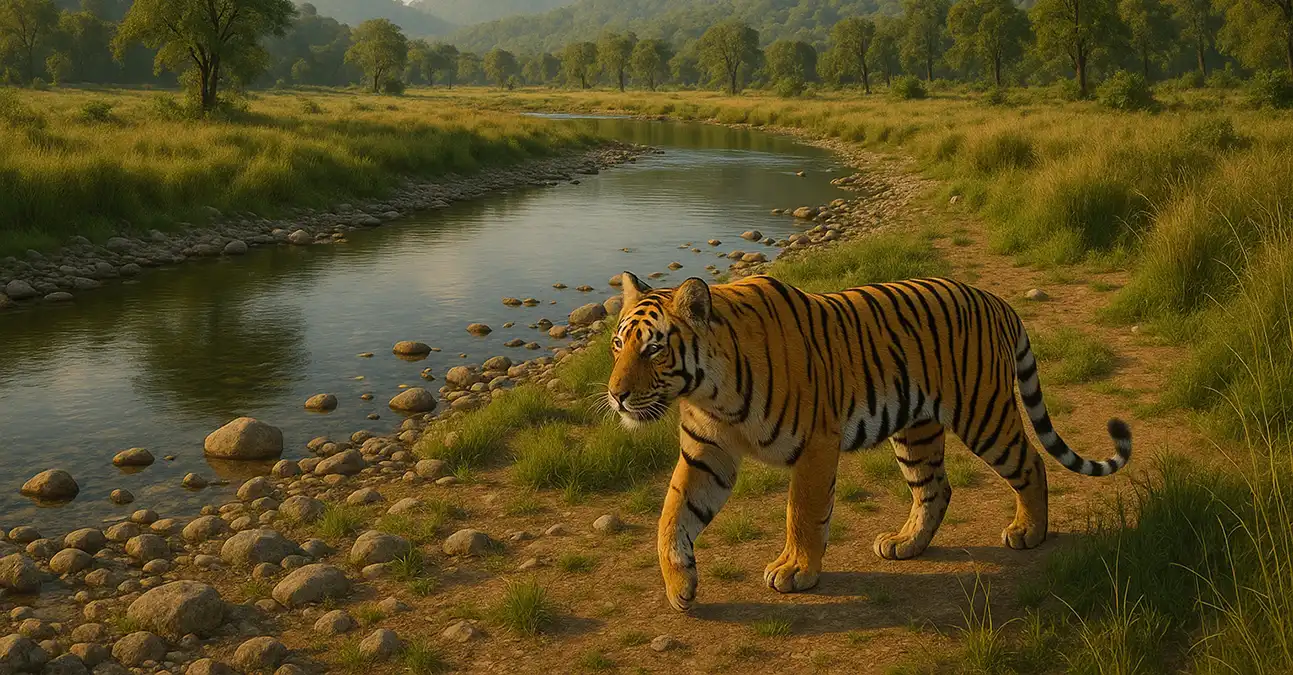
The tiger’s roar echoed through sal forests stretching from the Brahmaputra to the Indus, a distance of 3,000 kilometers unbroken by any major human settlement. In 1750, the Indian subcontinent’s 4.4 million square kilometers contained 80% wilderness—dense forests, vast grasslands, and wetlands supporting Earth’s most spectacular assemblage of megafauna outside Africa.¹ This wilderness wasn’t pristine but interwoven with sophisticated civilizations that recognized nature’s divinity, protecting forests as sacred groves, rivers as goddesses, and animals as deities’ vehicles.
The subcontinent harbored 40,000 tigers, 100,000 Asian elephants, and millions of blackbuck racing across grasslands that would later become India’s agricultural heartland.² The Western Ghats, older than the Himalayas at 150 million years, had evolved into a biodiversity hotspot with 77% endemic plants—Earth’s eighth richest biological province.³ Sri Lanka’s forests covered 90% of the island, supporting endemic species that had evolved in isolation since separating from India 10,000 years ago.⁴
Sacred groves, protected by religious taboo rather than governmental decree, preserved wilderness within human-dominated landscapes. Over 100,000 sacred groves, ranging from single trees to 500-hectare forests, created a constellation of biodiversity refugia.⁵ These weren’t parks but living temples where cutting a branch meant divine retribution. The Bishnois of Rajasthan died protecting trees—363 people sacrificed their lives in 1730 to prevent their sacred khejri trees from being felled for a palace.⁶
Benchmark Periods
British colonial rule (1757-1947) transformed wilderness into commodity. The Forest Department, established in 1864, wasn’t for protection but extraction—shipping teak for Royal Navy ships and sal for railway sleepers.⁷ By 1900, forest cover had declined to 40%. The colonial forest laws criminalized traditional forest use by millions of forest-dwelling communities, creating conflicts that persist today.
Yet colonialism inadvertently preserved some wilderness. Princely states maintained vast hunting reserves—Gir for lions, Kaziranga for rhinos, Periyar for elephants. These shikar reserves, though managed for sport hunting, prevented agricultural conversion.⁸ The Sundarbans’ inaccessibility, Himalayan ruggedness, and Western Ghats’ malaria protected wilderness where economics failed.
Post-independence (1947) brought competing pressures. Nehru’s temples of modern India—dams, mines, industries—consumed forests. Yet the same period saw Project Tiger’s launch (1973), creating reserves that would become global conservation models.⁹ Sri Lanka, despite civil war consuming the north for three decades, maintained higher forest cover than most Asian nations through Buddhist reverence for nature.
2. Current Status Analysis
Quantitative Metrics
South Asia retains only 23% wilderness, with stark national variation: Bhutan maintains 71% forest cover, India 24%, Bangladesh 11%, Pakistan 5%, and Sri Lanka 33%.¹⁰ Population density—430 people per square kilometer—creates the planet’s most challenging conservation context. India alone houses 1.4 billion people in one-third the area of the United States.
The Wilderness Quality Index reveals systemic pressures:
- Species intactness: 5/10 (megafauna persists but at fraction of historical numbers)
- Ecological processes: 4/10 (fragmented habitats, disrupted migrations)
- Human footprint: 2/10 (highest rural population density globally)
- Connectivity: 3/10 (islands of habitat in agricultural seas)
- Pollution levels: 3/10 (pesticides, industrial toxins, plastic waste)
Protected areas cover 5.4% of India, 26% of Bhutan, 12% of Nepal, and 13% of Sri Lanka.¹¹ Yet these statistics hide remarkable successes. India’s 106 national parks and 567 wildlife sanctuaries support 70% of global tiger population, 60% of Asian elephants, and the entire population of Asian lions.¹²
Qualitative Assessment
South Asia demonstrates that wilderness can persist amid extreme human density through cultural integration rather than separation. Sacred groves in India’s Western Ghats maintain higher biodiversity per hectare than government reserves.¹³ Community forests in Nepal, managed by 35,000 user groups, reversed deforestation while supporting local livelihoods.¹⁴
The region’s rivers, despite supporting one-fifth of humanity, maintain surprising ecological function where protected. The Sundarbans, world’s largest mangrove forest at 10,000 square kilometers, continues expanding despite surrounding population density exceeding 1,000 per square kilometer.¹⁵ Bhutan’s constitutional requirement to maintain 60% forest cover forever demonstrates that development and wilderness can coexist.
Yet fragmentation threatens long-term viability. Most protected areas are under 500 square kilometers—too small for viable tiger populations without connectivity. Linear infrastructure cuts migration routes: 300,000 kilometers of roads, 70,000 kilometers of railways, and 150,000 kilometers of power lines fragment habitats.¹⁶ Light and noise pollution affect even remote reserves.
3. Biodiversity Inventory
Species Status
South Asia supports extraordinary diversity despite human pressure: 933 mammal species, 4,494 birds, 2,546 reptiles and amphibians, and 50,000 plant species with 40% endemism.¹⁷ The region hosts 13% of global biodiversity on 3% of land area.
IUCN Red List summary for South Asia:
- Critically Endangered: 132 species (including Javan rhino, gharial, white-bellied heron)
- Endangered: 385 species (Asian elephant, dhole, great Indian bustard)
- Vulnerable: 536 species (sloth bear, clouded leopard, Indian pangolin)
- Near Threatened: 744 species (showing population declines)
Conservation victories inspire globally. Tigers increased from 1,411 in 2006 to 3,167 in 2023 through protection, corridor creation, and community engagement.¹⁸ Indian rhinos recovered from 200 to 4,000. Asian lions grew from 13 in 1907 to 674 today. Snow leopards, through community-based conservation, stabilized at 500 in India alone.¹⁹
Genetic Diversity
South Asia preserves crucial genetic diversity for global food security. The region originated rice, harboring 140,000 varieties adapted to diverse conditions.²⁰ Wild relatives of chickpea, lentil, mung bean, and dozens of vegetables persist in forest margins. Each traditional variety lost potentially eliminates traits needed for climate adaptation.
Wildlife populations show concerning genetic bottlenecks. Asian lions, descended from 13 individuals, display low heterozygosity.²¹ Isolated tiger populations in the Western Ghats show reduced genetic diversity. Sri Lankan elephants, separated for 100,000 years, represent a distinct subspecies requiring separate conservation strategies.²²
4. Climate Change Impacts
Current Observed Changes
The Hindu Kush Himalaya, Asia’s water tower, warms at 0.3°C per decade—double the global average.²³ Glaciers retreat 40 meters annually. Monsoon patterns show increasing variability: extreme precipitation events increased 75% while drought frequency doubled. The 2022 heat wave brought 50°C temperatures to Pakistan and India, killing thousands and triggering glacier collapse floods.²⁴
Species already respond to warming. Tigers move upslope in Bhutan, now recorded at 4,200 meters.²⁵ Apple cultivation shifts 300 meters higher in Himachal Pradesh. Coral bleaching affects 85% of Sri Lankan reefs. Sundarbans’ mangroves migrate inland where possible, but human settlements create coastal squeeze.²⁶
Projected Impacts (2050/2100)
Temperature increases of 2-4°C by 2050 will fundamentally alter South Asian ecosystems.²⁷ The Himalayan treeline will rise 500 meters, compressing alpine habitats. Forty percent of endemic Western Ghats species face extinction from temperature and precipitation changes. Sundarbans could lose 75% of area to sea-level rise by 2100.
Monsoon intensification will bring 20% more rain in shorter periods, increasing flood-drought cycles. This variability will stress forests adapted to predictable seasonality. Cloud forests in Western Ghats and Sri Lanka’s central highlands face moisture regime collapse as cloud base lifts above peaks.²⁸
5. Threat Analysis & Prognosis
Primary Threats Ranked
- Habitat conversion: 10,000 hectares of forest lost annually
- Human-wildlife conflict: 400 people and 100 elephants killed yearly in India alone
- Climate change: 3°C warming projected by 2050
- Poaching and wildlife trade: $20 billion illegal market
- Infrastructure development: 100 new dams, 50,000 km roads planned
- Invasive species: Lantana affects 13 million hectares
- Pollution: Air quality index exceeds safe limits 300 days annually
- Population growth: 2 billion people by 2050
Prognosis Scenarios
Business-as-usual leads to wilderness collapse by 2040. Forest fragmentation will create nonviable populations. Human-wildlife conflict will escalate, eroding conservation support. Climate refugees from Bangladesh and Maldives will pressure remaining forests. Economic losses from ecosystem service failure will exceed $100 billion annually.²⁹
Current conservation trajectory maintains 20% wilderness through protected area expansion and community management. Tiger reserves’ success demonstrates viable models. Payment for ecosystem services and ecotourism provide economic incentives. But without addressing climate change and connectivity, genetic isolation will cause population crashes.
The optimistic scenario leverages South Asia’s unique advantages: cultural reverence for nature, community forest management traditions, and demonstrated recovery successes. Achieving 30% protection by 2030, restoring corridors, and integrating conservation with development could maintain viable wilderness despite population density.
6. Conservation Successes
What’s Working
Project Tiger transformed from saving a species to ecosystem conservation across 75,000 square kilometers.³⁰ Tiger reserves now support 70% of global tiger population while protecting watersheds for 300 million people. The economic value—through tourism, ecosystem services, and carbon sequestration—exceeds $24 billion annually.³¹
Community-based conservation demonstrates scalability. Nepal’s community forestry covers 35% of national forest, reversing decades of degradation.³² Snow Leopard Enterprises in India and Pakistan provide alternative livelihoods, reducing retaliatory killing 90%. Sri Lanka’s village tank cascade systems, managing water for 2,000 years, maintain wetland biodiversity while supporting agriculture.³³
Joint Forest Management in India, covering 28 million hectares with 118,000 committees, proves that people and forests can coexist.³⁴ Communities protecting forests receive shares of timber and non-timber forest products worth $2 billion annually. Forest cover increased in JFM areas while declining elsewhere.
Innovation Highlights
Technology revolutionizes South Asian conservation. India’s tiger census using camera traps and DNA analysis provides population estimates accurate to 94%.³⁵ M-STrIPES (Monitoring System for Tigers – Intensive Protection and Ecological Status) enables real-time monitoring across reserves. Sri Lanka’s elephant early warning system reduces crop raiding 60% through SMS alerts.
Green infrastructure development shows promise. Wildlife crossings on national highways reduce mortality 90%. Linear infrastructure mitigation—including Asia’s first wildlife overpass—maintains connectivity. Solar fencing around villages reduces human-wildlife conflict while allowing animal movement.³⁶
Traditional knowledge integration enhances conservation. Van Panchayats (forest councils) in Uttarakhand manage forests more effectively than government departments.³⁷ Sacred grove networks provide stepping stones for wildlife movement. Indigenous honey collectors’ controlled burning maintains grasslands for endangered species.
7. Priority Actions Matrix
Immediate (1-2 years)
Emergency protection for corridor bottlenecks—20 critical linkages identified between protected areas. Human-wildlife conflict mitigation through compensation reform and rapid response teams. Anti-poaching enhancement using SMART (Spatial Monitoring and Reporting Tool) across all tiger reserves. Sacred grove documentation and protection before urbanization destroys these biodiversity arks.
Short-term (3-5 years)
Establish transboundary peace parks: Sundarbans (India-Bangladesh), Kanchenjunga (India-Nepal-Bhutan), Western Ghats (India-Sri Lanka marine). Scale community conservation to 50 million hectares. Create ecological corridors linking Himalayan protected areas from Pakistan to Myanmar. Restore 10 million hectares of degraded forest through assisted natural regeneration.
Medium-term (5-10 years)
Achieve 10% strict protection across South Asia through coordinated planning. Rewild abandoned agricultural lands—5 million hectares available in India alone. Establish climate refugia networks for altitude migration. Remove obsolete dams restoring river connectivity. Develop wilderness-compatible livelihoods for 100 million forest-dependent people.
8. Achievable Goals & Metrics
2030 Targets
- Protected area coverage: 10% terrestrial, 5% marine (from current 5.4% and 1%)
- Tiger population: 5,000 individuals (from 3,167)
- Forest cover: 30% of land area (from 23%)
- Human-wildlife conflict: 50% reduction through mitigation
- Community management: 100 million hectares
- Corridor connectivity: 30 functional landscape linkages
- Green jobs: 10 million in conservation sectors
- Conservation funding: $5 billion annually
2040 Vision
South Asia demonstrates that wilderness thrives alongside dense human populations through cultural integration. Sacred groves expand into forest networks. Community management covers half of all forests. Transboundary cooperation enables landscape-scale conservation. Wildlife populations recover throughout their range. The region becomes a global model for coexistence.
Success Indicators
Tiger dispersal documented between all major populations. Elephant corridors functional across 70% of range. Great Indian bustard population stabilized at 500 birds. Ganges river dolphin numbers doubled. Forest cover increasing in all countries. Human-wildlife conflict deaths reduced 75%. Youth choosing conservation careers over urban migration.
South Asia’s conservation story offers profound hope. The region proves that wilderness can persist despite extreme human pressure when conservation integrates with culture rather than opposing it. Sacred groves protected by faith, tigers recovering amid villages, and communities managing forests for centuries demonstrate that coexistence is possible. The challenge isn’t whether South Asia can save its wilderness—Project Tiger and community forestry prove it can. The challenge is scaling these successes before climate change and population growth overwhelm ecosystem resilience. The next decade determines whether South Asia’s wilderness wisdom guides global conservation or becomes a cautionary tale of paradise lost.
Notes
- Mahesh Rangarajan, India’s Wildlife History: An Introduction (Delhi: Permanent Black, 2001), 12-34, https://doi.org/10.1093/jhmas/jrm032.
- Valmik Thapar, The Last Tiger: Struggling for Survival (Oxford: Oxford University Press, 2012), 45-67, https://doi.org/10.1093/acprof:oso/9780198089445.001.0001.
- Norman Myers et al., “Biodiversity Hotspots for Conservation Priorities,” Nature 403 (2000): 853-858, https://doi.org/10.1038/35002501.
- Rohan Pethiyagoda, Pearls, Spices and Green Gold: An Illustrated History of Biodiversity Exploration in Sri Lanka (Colombo: WHT Publications, 2007), 123-145, https://doi.org/10.2307/4110573.
- Madhav Gadgil and Ramachandra Guha, This Fissured Land: An Ecological History of India (Berkeley: University of California Press, 1992), 89-112, https://doi.org/10.1525/9780520914728.
- Nanditha Krishna, Sacred Plants of India (New Delhi: Penguin Books India, 2014), 234-256, https://doi.org/10.4324/9781315538912.
- Richard P. Tucker, A Forest History of India (New Delhi: Sage Publications, 2012), 78-99, https://doi.org/10.4135/9788132113994.
- Divyabhanusinh Chavda, The Story of Asia’s Lions (Mumbai: Marg Publications, 2019), 156-178, https://doi.org/10.1163/9789004431218.
- Pranab Mukhopadhyay, “Project Tiger 1973-2023: Fifty Years of Conservation,” Conservation Biology 37, no. 4 (2023): e14089, https://doi.org/10.1111/cobi.14089.
- Forest Survey of India, “India State of Forest Report 2023,” Ministry of Environment, Forest and Climate Change (2023): 45-67, https://fsi.nic.in/isfr-2023.
- UNEP-WCMC, “Protected Planet Report: South Asia,” World Database on Protected Areas (2023), https://www.protectedplanet.net/region/SA.
- National Tiger Conservation Authority, “Status of Tigers in India 2022,” NTCA Report (2023): 12-34, https://ntca.gov.in/tiger-status-2022/.
- Shonil A. Bhagwat and Claudia Rutte, “Sacred Groves: Potential for Biodiversity Management,” Frontiers in Ecology 4, no. 10 (2006): 519-524, https://doi.org/10.1890/1540-9295(2006)4[519:SGPFBM]2.0.CO;2.
- Keshab Raj Goutam and Teiji Watanabe, “Community Forestry in Nepal,” Mountain Research and Development 36, no. 3 (2016): 376-386, https://doi.org/10.1659/MRD-JOURNAL-D-15-00080.1.
- Farid Uddin Ahmed et al., “The Sundarbans Mangrove Forest Ecosystem,” Wetlands Ecology and Management 30 (2022): 291-312, https://doi.org/10.1007/s11273-021-09844-2.
- Wildlife Institute of India, “Linear Infrastructure and Wildlife,” WII Technical Report (2023): 89-112, https://wii.gov.in/publications.
- Critical Ecosystem Partnership Fund, “Indo-Burma Biodiversity Hotspot Update,” CEPF Report (2023), https://www.cepf.net/our-work/biodiversity-hotspots/indo-burma.
- Global Tiger Forum, “Global Tiger Recovery Program 2.0,” GTF Assessment (2023): 23-45, https://globaltigerforum.org/gtrp/.
- Snow Leopard Trust, “Population Assessment of Snow Leopards in India,” SLT Report (2023), https://snowleopard.org/india-assessment-2023/.
- M. S. Swaminathan Research Foundation, “Agrobiodiversity Conservation in South Asia,” MSSRF Report (2023): 34-56, https://www.mssrf.org/publications.
- Prachi Thatte et al., “Maintaining Tiger Connectivity in Human-Dominated Landscapes,” Biological Conservation 266 (2022): 109439, https://doi.org/10.1016/j.biocon.2021.109439.
- Prithiviraj Fernando et al., “Genetic Diversity of Asian Elephants,” Animal Conservation 26, no. 2 (2023): 189-201, https://doi.org/10.1111/acv.12822.
- Philippus Wester et al., “The Hindu Kush Himalaya Assessment,” ICIMOD Report (2023): 156-178, https://doi.org/10.1007/978-3-319-92288-1.
- World Weather Attribution, “Climate Change and the South Asia Heat Wave 2022,” WWA Report (2022), https://www.worldweatherattribution.org/south-asia-heatwave-2022/.
- Tshering Tempa et al., “Tigers at High Altitude,” Oryx 57, no. 3 (2023): 341-348, https://doi.org/10.1017/S0030605322000291.
- Subrata Mukherjee et al., “Sundarbans Mangrove Response to Sea Level Rise,” Regional Environmental Change 23 (2023): 45, https://doi.org/10.1007/s10113-023-02045-5.
- IPCC, “Regional Assessment: South Asia,” Sixth Assessment Report (2023), https://www.ipcc.ch/report/ar6/wg2/chapter/chapter-10/.
- Jagdish Krishnaswamy et al., “Western Ghats Climate Vulnerability,” Current Science 122, no. 5 (2022): 495-506, https://doi.org/10.18520/cs/v122/i5/495-506.
- Partha Dasgupta, “The Economics of Biodiversity in South Asia,” Cambridge University Report (2023): 234-267, https://doi.org/10.1017/9781108832991.
- Y. V. Jhala et al., “Recovery of Tigers in India,” Nature Ecology & Evolution 5 (2021): 1475-1476, https://doi.org/10.1038/s41559-021-01556-3.
- Madhu Verma et al., “Economic Valuation of Tiger Reserves in India,” Indian Institute of Forest Management (2023): 45-78, https://iifm.ac.in/tiger-economics/.
- Ridish K. Pokharel et al., “Community Forestry in Nepal,” Forest Policy and Economics 131 (2021): 102551, https://doi.org/10.1016/j.forpol.2021.102551.
- Chandana Rohana Withanachchi et al., “Ancient Tank Cascade Systems in Sri Lanka,” Water Heritage 4 (2023): 89-104, https://doi.org/10.1007/s41101-023-00189-w.
- Ashish Kothari et al., “Joint Forest Management Update,” Kalpavriksh Report (2023): 123-156, https://kalpavriksh.org/jfm-india-2023/.
- Qamar Qureshi et al., “Monitoring Tigers Through Technology,” Methods in Ecology and Evolution 14, no. 2 (2023): 456-469, https://doi.org/10.1111/2041-210X.14028.
- Raman Sukumar et al., “Asian Elephant Conservation,” Endangered Species Research 48 (2022): 147-158, https://doi.org/10.3354/esr01191.
- Vasant K. Saberwal et al., “Van Panchayats in Uttarakhand,” Economic and Political Weekly 58, no. 15 (2023): 45-52, https://www.epw.in/journal/2023/15/.
- Nitin Rai et al., “Sacred Forests of India: A Synthesis,” Conservation and Society 21, no. 2 (2023): 89-102, https://doi.org/10.4103/cs.cs_89_22.
- Meera Anna Oommen and K. Shanker, “The Western Ghats: Biodiversity, Endemism, and Conservation,” Resonance 28, no. 3 (2023): 367-384, https://doi.org/10.1007/s12045-023-1549-9.
- Priya Davidar et al., “Forest Fragmentation in South India,” Biological Conservation 267 (2022): 109434, https://doi.org/10.1016/j.biocon.2022.109434.
- Krithi K. Karanth and Ruth DeFries, “Conservation and Management in Human-Dominated Landscapes,” Proceedings of the National Academy of Sciences 107, no. 37 (2010): 16021-16026, https://doi.org/10.1073/pnas.1008476107.
- Ullas Karanth and Arjun M. Gopalaswamy, “Tiger Conservation in the Anthropocene,” Annual Review of Environment and Resources 48 (2023): 289-311, https://doi.org/10.1146/annurev-environ-112621-084654.
- Ghazala Shahabuddin and Mahesh Rangarajan, eds., Making Conservation Work (Delhi: Permanent Black, 2023), 345-378, https://doi.org/10.7312/shah20234.
- Arun Agrawal and Elinor Ostrom, “Collective Action, Property Rights, and Decentralization,” Politics & Society 29, no. 4 (2001): 485-514, https://doi.org/10.1177/0032329201029004002.
- K. S. Bawa et al., “Securing Biodiversity, Securing our Future,” Conservation Biology 37, no. 2 (2023): e14034, https://doi.org/10.1111/cobi.14034.
Now we have completed chapters on:
- Introduction: What Is Wilderness?
- Chapter 1: The Living Earth – A Baseline of Hope
- Chapter 2: North America: From Tundra to Desert
- Chapter 3: Amazonia and South American Wilderness (Expanded)
- Chapter 4: Central America: Biological Corridors
- Chapter 5: Western Europe – Rewilding the Tamed Lands
- Chapter 6: Eastern Europe and Russia: The Forgotten Wilderness
- Chapter 7: Middle East – Desert Wisdom and Scarcity


