

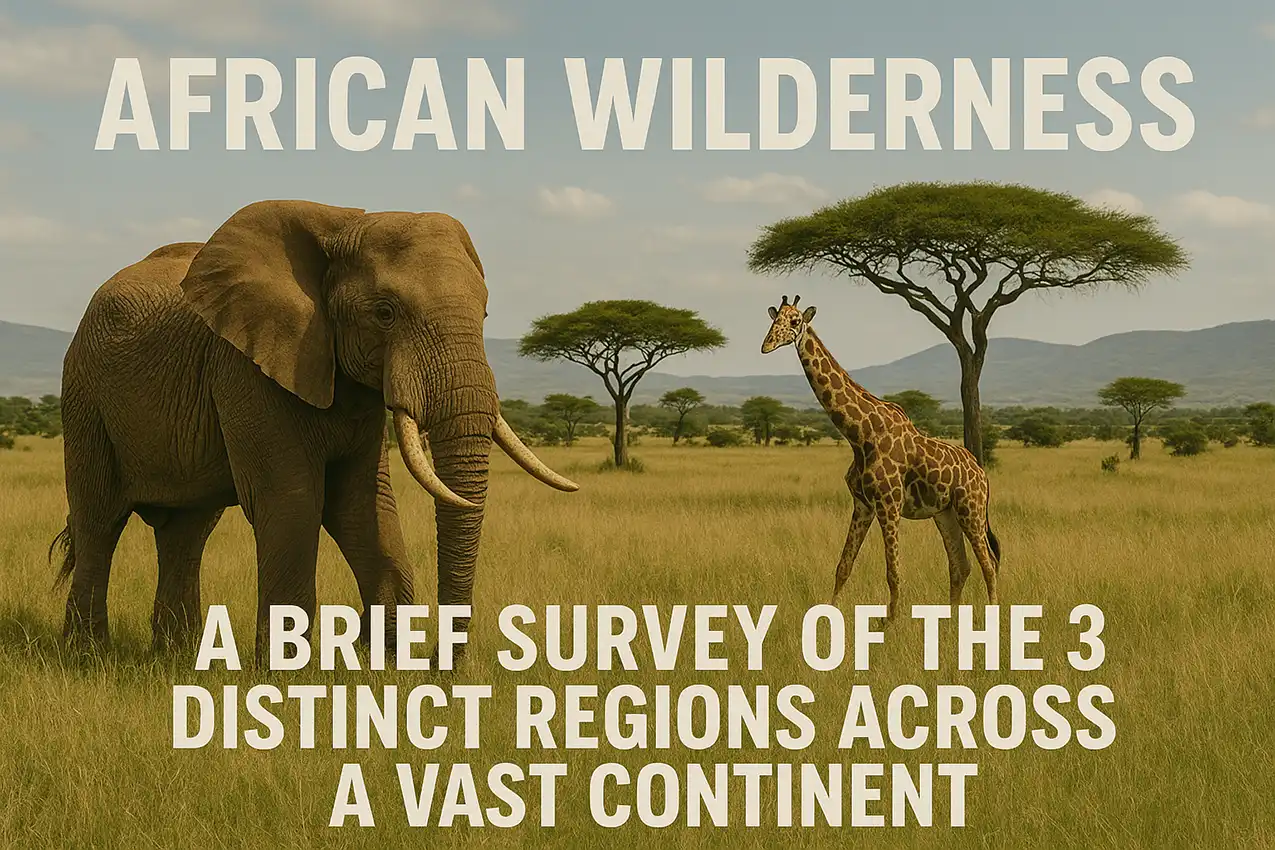
The African continent, spanning 30.3 million square kilometers across both hemispheres and all four cardinal directions, defies singular narrative. Its wilderness story unfolds across three distinct yet interconnected regions: the Sahara-dominated North with its Mediterranean edges and Nile corridor; the Congo Basin heart of Central and West Africa with its Atlantic coastal forests; and the savanna-dominated Southern and East Africa with its Great Rift Valley and island nations. Each Africa faces unique challenges and opportunities, yet all share the burden of being seen primarily as resource frontiers rather than ecological treasures deserving protection for their own sake.¹
1. Historical Baseline
Pre-1750 Wilderness Extent
Before the acceleration of European colonization and the Atlantic slave trade’s ecological disruptions, Africa contained approximately 28 million km² of intact wilderness—over 92% of the continent.² The Sahara, though expanding and contracting with climate cycles, maintained its role as Earth’s largest hot desert at roughly 9 million km².³ The Congo Basin held 3.7 million km² of continuous tropical forest, while the Guinean forests of West Africa stretched unbroken for 620,000 km² from Senegal to Cameroon.⁴ Eastern Africa’s savannas covered 5.8 million km² in a continuous ecosystem supporting the greatest mammalian biomass on Earth.⁵ The Ethiopian Highlands contained 450,000 km² of Afroalpine and montane forests.⁶ Madagascar, that evolutionary laboratory, maintained 580,000 km² of forest cover across its diverse ecosystems.⁷
Indigenous management systems, evolved over 300,000 years of human presence, had created complex mosaics of wilderness and human-influenced landscapes.⁸ The Maasai’s rotational grazing systems maintained savanna health while supporting wildlife.⁹ The San people’s controlled burning in the Kalahari created habitat diversity.¹⁰ The Baka and Mbuti of Central African forests practiced sophisticated agroforestry that enhanced rather than diminished forest biodiversity.¹¹ In North Africa, Berber communities managed oasis ecosystems and maintained corridors for wildlife movement across the Sahara.¹² These were not pristine wildernesses in the Western sense, but self-regulating ecosystems where human presence enhanced rather than diminished ecological integrity.¹³
The keystone species populations tell a story of abundance barely imaginable today. An estimated 10 million elephants roamed from the Mediterranean coast to the Cape.¹⁴ The North African elephant, a distinct subspecies, numbered in the hundreds of thousands before Roman exploitation.¹⁵ Saharan megafauna included abundant populations of addax, scimitar-horned oryx, and dama gazelle.¹⁶ Lions inhabited every ecosystem except the deepest rainforests, with North African Barbary lions ruling the Atlas Mountains.¹⁷ The quagga, bluebuck, and Atlas bear were integral parts of their ecosystems.¹⁸
Wilderness Loss Timeline
1750-1850: The Slave Trade’s Ecological Shadow. The intensification of the Atlantic slave trade removed 12 million people from Africa, creating demographic collapse across vast regions.¹⁹ Depopulated areas saw agricultural systems collapse and secondary forest succession. Slave raiders penetrated deep into the continent, disrupting traditional management systems and forcing populations into defensible but ecologically marginal areas.²⁰ European coastal forts became nodes for ivory exploitation—an estimated 100,000 elephants were killed annually for the ivory trade by 1850.²¹ Arab slave traders simultaneously devastated East African populations and ecosystems, with caravan routes becoming corridors of extraction.²² The introduction of firearms fundamentally altered human-wildlife relationships, enabling unprecedented hunting efficiency.²³
1850-1900: The Scramble’s Scars. The Berlin Conference of 1884-85 carved Africa into European possessions with boundaries that ignored ecological and cultural realities.²⁴ Railway construction penetrated wilderness areas—the Uganda Railway alone caused the deaths of 135 workers from lion attacks, indicating the wildness of areas being breached.²⁵ Commercial hunting reached industrial scales with the advent of repeating rifles.²⁶ The rinderpest pandemic of the 1890s killed 90% of cattle and buffalo, causing human famine and ecological upheaval.²⁷ Ivory exports peaked at 1,000 tons annually, representing approximately 100,000 dead elephants per year.²⁸ The last quagga died in Amsterdam Zoo in 1883; the bluebuck had vanished by 1800.²⁹
1900-1960: Colonial Extraction Intensifies. Colonial administrations viewed African wilderness solely as resources for extraction.³⁰ Timber concessions in West and Central Africa initiated systematic forest exploitation.³¹ Game reserves were established primarily to preserve hunting opportunities for colonial elites, displacing indigenous peoples.³² The tsetse fly belt, previously protecting 4 million km² from cattle and human encroachment, was systematically attacked with bush clearing and pesticides.³³ World Wars I and II saw increased resource extraction and the militarization of anti-poaching efforts.³⁴ By 1960, elephant populations had declined to approximately 3-5 million.³⁵
1960-1990: Independence and Intensification. Post-independence development prioritized rapid modernization over conservation.³⁶ The Sahel droughts of the 1970s and 1980s, exacerbated by overgrazing, led to widespread desertification.³⁷ Elephant populations had crashed to 500,000.³⁸ The Sahara began expanding southward at unprecedented rates due to overgrazing and drought cycles.³⁹ Construction of major dams—Kariba, Aswan—had begun disrupting river ecosystems.⁴⁰ National parks, based on the Yellowstone model of human exclusion, displaced indigenous communities and broke traditional management systems.⁴¹ Agricultural intensification and cash crop expansion accelerated habitat conversion.⁴² The Green Revolution’s promise of agricultural modernization initiated widespread pesticide use and wetland drainage.⁴³
1990: Globalization’s Grip. Structural adjustment programs promoted export-oriented extraction over conservation.⁴⁴ Elephant populations reached their nadir at 300,000 before CITES intervention showed effect.⁴⁵ Tropical timber extraction peaked with Asian companies joining European exploitation of Central African forests.⁴⁶ The Ethiopian highlands had lost 90% of their forest cover.⁴⁷ West African forests had fragmented into isolated patches.⁴⁸ Bushmeat hunting had become commercialized with urban markets driving unsustainable extraction.⁴⁹ Civil conflicts in Rwanda, Sudan, Somalia, and Liberia created refugee crises that devastated protected areas.⁵⁰ The discovery of oil in new regions initiated another wave of wilderness penetration.⁵¹
2010: The Digital Age Baseline. Mobile phone proliferation enabled better wildlife monitoring but also facilitated poaching networks.⁵² Chinese demand for ivory and rhino horn had created a poaching crisis despite international bans.⁵³ Large-scale land acquisitions (“land grabbing”) accelerated with 75 million hectares transferred to foreign companies.⁵⁴ Climate change impacts became undeniable with shifting rainfall patterns and increasing droughts.⁵⁵ Urban expansion consumed 2% of land annually around major cities.⁵⁶ Population growth to 1.2 billion people intensified human-wildlife conflict.⁵⁷ However, successful conservation models had emerged—Namibian communal conservancies, Peace Parks, and payment for ecosystem services programs offered hope.⁵⁸
2. Current Status Analysis
North Africa: The Sahara-Mediterranean Interface
Quantitative Metrics
North Africa retains approximately 4.2 million km² of intact wilderness, primarily within the Sahara’s hyperarid core where human presence remains minimal.⁵⁹ This represents 45% of the region’s historical wilderness extent.⁶⁰ The Wilderness Quality Index averages 4.2/10, severely compromised by overgrazing, aquifer depletion, and expanding extractive industries.⁶¹ Protected areas cover only 4.8% of the region, with most lacking effective management.⁶² The connectivity index shows critical fragmentation—no corridors exist between Atlas Mountain refuges and Saharan protected areas.⁶³ Mediterranean coastal wilderness has virtually vanished, with less than 2% remaining in fragments under 100 hectares.⁶⁴
The Sahara itself presents a paradox—while its harsh conditions preserve wilderness characteristics, climate change and human pressures increasingly penetrate previously inaccessible areas.⁶⁵ Oil and gas extraction operates across 2.8 million km² under exploration or extraction licenses.⁶⁶ Solar energy megaprojects, while renewable, create industrial footprints in pristine desert.⁶⁷ Groundwater extraction for agriculture has lowered water tables by 100-300 meters, eliminating oasis ecosystems that served as wilderness stepping stones.⁶⁸ Military activities and border controls fragment transboundary ecosystems.⁶⁹
Qualitative Assessment
Ecosystem health indicators reveal severe degradation in transition zones between the Sahara and Mediterranean/Sahelian ecosystems.⁷⁰ The Atlas Mountains retain pockets of cedar and oak forests, but warming temperatures push these relict ecosystems beyond survival thresholds.⁷¹ Resilience capacity rates as critically low—most ecosystems exist below minimum viable sizes for long-term persistence.⁷² The Nile River ecosystem, once a ribbon of wilderness through the desert, functions as an engineered waterway with virtually no natural processes remaining.⁷³ Coastal wetlands, crucial for Palearctic-African bird migrations, have declined by 85% since 1950.⁷⁴
Central and West Africa: The Forest Heart
Quantitative Metrics
The Congo Basin maintains 1.8 million km² of intact tropical forest—the world’s second-largest contiguous wilderness after the Amazon.⁷⁵ This represents 49% of historical extent, with an average Wilderness Quality Index of 6.8/10 in core areas but dropping to 3.2/10 in peripheral zones.⁷⁶ Protected areas encompass 11.2% of the region, though many exist only on paper.⁷⁷ Indigenous-managed lands cover an additional 15% but lack formal recognition.⁷⁸ The connectivity index remains moderate within the Congo Basin but shows critical breaks between Central and West African forests.⁷⁹
West Africa tells a different story. The Upper Guinean forests retain only 15% of original extent in fragments rarely exceeding 1,000 km².⁸⁰ Nigeria has lost 96% of its primary forest.⁸¹ The Dahomey Gap has widened from 200 km to 350 km, completely isolating western and eastern forest blocks.⁸² Mangrove forests along the Atlantic coast have declined by 60% to aquaculture and oil extraction.⁸³
3. Conservation Successes
What’s Working – Regional Highlights
North Africa’s Desert Conservation
Tunisia’s reintroduction of scimitar-horned oryx, extinct in the wild since 2000, now supports 500 individuals across three reserves.⁸⁴ Morocco’s Souss-Massa National Park has recovered the Northern bald ibis from 59 to 700 birds through intensive management.⁸⁵ Algeria’s Tassili n’Ajjer protects 72,000 km² of Saharan wilderness including relict Mediterranean cypress populations surviving from wetter periods.⁸⁶ Egypt’s Ras Mohammed protects some of the Red Sea’s most pristine coral reefs, generating $1 billion annually through sustainable tourism.⁸⁷ Libya’s post-conflict period has inadvertently allowed wildlife recovery in former military zones.⁸⁸
Community-based grazing management in Morocco’s Atlas Mountains demonstrates sustainable pastoralism compatible with wildlife.⁸⁹ Traditional water harvesting techniques, modernized with contemporary materials, restore oasis ecosystems.⁹⁰ Solar-powered drip irrigation reduces agricultural water demand by 60%, relieving pressure on natural water sources.⁹¹ Ecotourism in Tunisia’s Sahara generates alternative livelihoods for former hunters.⁹² Traditional ecological knowledge documentation preserves management practices developed over millennia.⁹³
Central Africa’s Forest Innovations
The Central African Republic’s Dzanga-Sangha demonstrates successful integration of conservation, research, and community development.⁹⁴ Despite civil conflict, it maintains viable populations of forest elephants, gorillas, and bongo.⁹⁵ Cameroon’s Campo-Ma’an National Park balances conservation with indigenous rights, allowing sustainable hunting while protecting core zones.⁹⁶ Gabon designated 13 national parks covering 11% of the country, including marine parks protecting humpback whale breeding grounds and leatherback turtle nesting beaches.⁹⁷
Community forestry in Cameroon grants management rights to local communities, reducing deforestation by 60% compared to state-managed forests.⁹⁸ REDD+ programs in the Congo Basin generate $500 million annually for forest protection.⁹⁹ Smartphone apps enable indigenous communities to document illegal activities in real-time.¹⁰⁰ Acoustic monitoring using AI identifies chainsaw sounds, enabling rapid response to illegal logging.¹⁰¹ Genetic barcoding traces timber and bushmeat to source locations, improving law enforcement.¹⁰²
East Africa’s Integrated Landscapes
Kenya’s conservancy movement encompasses 8 million hectares under community management, supporting wildlife populations equal to national parks while providing livelihoods for 930,000 people.¹⁰³ The Northern Rangelands Trust demonstrates landscape-scale conservation across 44,000 km².¹⁰⁴ Rwanda’s Volcanoes National Park has increased mountain gorilla populations from 250 to 400 individuals while generating $20 million annually for local communities.¹⁰⁵ Ethiopia’s church forests, protected for religious reasons, preserve genetic diversity in highly degraded landscapes.¹⁰⁶
Payment for ecosystem services programs in Tanzania generate $30 million annually for communities protecting water catchments.¹⁰⁷ Wildlife management areas cover 7% of Tanzania, bridging protected areas and community lands.¹⁰⁸ Uganda’s Bwindi Impenetrable Forest demonstrates multiple-use management supporting gorilla conservation, sustainable harvest, and community livelihoods.¹⁰⁹ Mobile banking enables rapid payment for conservation performance, reducing corruption and ensuring community benefits.¹¹⁰ Predator-proof bomas eliminate livestock losses, transforming former enemies into wildlife advocates.¹¹¹
Southern Africa’s Recovery Models
Namibia’s communal conservancies cover 20% of the country, recovering wildlife populations to highest levels in a century.¹¹² Elephant populations increased from 7,500 to 24,000, desert lions from 20 to 150, and black rhinos from 0 to 200.¹¹³ South Africa’s SANParks generates $500 million annually, achieving financial sustainability for 19 national parks.¹¹⁴ The Peace Parks Foundation has established 10 transfrontier conservation areas creating ecological connectivity across 1 million km².¹¹⁵ Botswana’s high-value, low-impact tourism model generates maximum revenue with minimal environmental impact.¹¹⁶
Zimbabwe’s CAMPFIRE program, despite political challenges, demonstrates community-based wildlife management potential.¹¹⁷ Zambia’s community resource boards manage 30% of the country supporting wildlife recovery.¹¹⁸ Malawi’s reintroduction programs have restored lions, cheetahs, and wild dogs to reserves where they were locally extinct.¹¹⁹ Madagascar’s locally managed marine areas protect 15% of coastal waters through traditional management systems.¹²⁰
4. Priority Actions Matrix
Immediate Actions (1-2 years)
Emergency Interventions
The Northern white rhinoceros requires immediate genetic rescue using stored gametes and surrogate Southern white mothers—delay means permanent extinction.¹²¹ West African lions need emergency translocation from isolated populations to establish viable metapopulations.¹²² The Cross River gorilla’s 300 individuals require anti-poaching surge capacity and habitat corridor establishment.¹²³ Madagascar’s Greater bamboo lemur, down to 500 individuals, needs immediate habitat protection from agricultural encroachment.¹²⁴ Saharan megafauna captive populations must be expanded before wild populations disappear entirely.¹²⁵
Critical habitat protection must focus on biodiversity hotspots under immediate threat. The Eastern Arc Mountains face agricultural expansion requiring immediate gazettement of 5,000 km².¹²⁶ The Upper Guinean forests need 10,000 km² of corridors to reconnect fragments before isolation causes cascading extinctions.¹²⁷ Congo Basin logging concessions overlapping intact forest require immediate cancellation or conversion to conservation concessions.¹²⁸ The Cape Floral Kingdom needs firebreak management to prevent catastrophic wildfires.¹²⁹ Madagascar’s remaining eastern rainforests require enforcement surge to stop rosewood extraction.¹³⁰
Species-Specific Actions
Anti-poaching efforts must scale immediately—doubling ranger numbers, deploying military assets, and implementing shoot-to-kill policies where legal.¹³¹ The illegal wildlife trade requires coordinated international enforcement targeting kingpins not foot soldiers.¹³² Vulture safe zones must expand rapidly before populations crash below recovery thresholds.¹³³ Cheetah and wild dog populations need immediate corridor establishment to enable genetic exchange.¹³⁴ Pangolin rehabilitation centers require establishment across range states.¹³⁵ Sea turtle nesting beaches need immediate protection from development and lighting.¹³⁶
Short-term Priorities (3-5 years)
Corridor Establishment
Transfrontier conservation areas must become functional rather than political declarations.¹³⁷ The Kavango-Zambezi TFCA requires removal of veterinary fences and establishment of wildlife crossings.¹³⁸ The Albertine Rift needs montane forest connections across national boundaries.¹³⁹ West Africa requires coastal forest corridor restoration linking Ghana, Ivory Coast, and Liberia.¹⁴⁰ The Greater Mapungubwe TFCA needs integration of South Africa, Botswana, and Zimbabwe conservation areas.¹⁴¹ Madagascar requires eastern forest corridor restoration connecting isolated parks.¹⁴²
Restoration initiation should focus on degraded lands with high recovery potential. The Sahel needs 100,000 km² of restoration through farmer-managed natural regeneration.¹⁴³ Ethiopia’s highlands require 50,000 km² of exclosure establishment allowing natural regeneration.¹⁴⁴ South Africa needs 30,000 km² of invasive species removal.¹⁴⁵ The Niger Delta requires 10,000 km² of mangrove restoration.¹⁴⁶ Lake Victoria’s watershed needs 20,000 km² of wetland restoration.¹⁴⁷ Secondary forests across the Congo Basin require protection allowing natural succession.¹⁴⁸
Policy Implementation
National biodiversity strategies need updating to reflect post-2020 targets with implementation plans and budgets.¹⁴⁹ Environmental impact assessment laws require strengthening with mandatory biodiversity offsets.¹⁵⁰ Community conservation legislation needs passage granting secure tenure and management rights.¹⁵¹ Wildlife economy policies should prioritize local benefits over foreign investment.¹⁵² Climate adaptation strategies must integrate biodiversity conservation.¹⁵³ Green recovery plans from COVID-19 should emphasize nature-based solutions over infrastructure development.¹⁵⁴
Medium-term Goals (5-10 years)
Landscape-Scale Connectivity
Continental-scale planning must create functional ecological networks.¹⁵⁵ The Trans-African Green Belt from Senegal to Djibouti requires coordinated implementation.¹⁵⁶ The Congo-Nile Divide needs continuous forest cover maintaining watershed services.¹⁵⁷ The Great Rift Valley requires connected protected areas from Ethiopia to Mozambique.¹⁵⁸ Coastal wetlands need integration into flyway conservation from Egypt to South Africa.¹⁵⁹ Marine protected areas require networking along the entire African coast.¹⁶⁰
Climate adaptation measures must anticipate species range shifts.¹⁶¹ Assisted migration programs should establish populations in climate refugia.¹⁶² Ex-situ conservation needs expansion to preserve genetic diversity.¹⁶³ Seed banks require completion for all endemic plant species.¹⁶⁴ Cryogenic preservation should cover all threatened vertebrates.¹⁶⁵ Climate-smart agriculture must reduce pressure on natural habitats.¹⁶⁶ Water security interventions should maintain environmental flows.¹⁶⁷ Ecosystem-based adaptation needs prioritization over hard infrastructure.¹⁶⁸
Sustainable Financing Establishment
Conservation trust funds require capitalization at $10 billion for long-term protected area management.¹⁶⁹ Payment for ecosystem services programs need scaling to cover all critical watersheds.¹⁷⁰ Carbon credit programs should expand to all intact forests and peatlands.¹⁷¹ Biodiversity credits require development as conservation finance mechanism.¹⁷² Tourism revenue-sharing needs reform ensuring community benefits.¹⁷³ Trophy hunting reforms should maximize conservation outcomes while respecting ethical concerns.¹⁷⁴ Green bonds require issuance by all African nations for conservation financing.¹⁷⁵
5. Achievable Goals & Metrics
2030 Targets
Specific Area Protection
Achieving 30% protection requires adding 4.5 million km² to the conservation estate—ambitious but achievable with political will.¹⁷⁶ Priority additions include 1 million km² in the Congo Basin through indigenous and community management recognition.¹⁷⁷ The Sahara needs 500,000 km² of protection focusing on mountain refugia and oases.¹⁷⁸ Southern African savanna requires 300,000 km² through conservancy expansion.¹⁷⁹ East African grasslands need 250,000 km² bridging protected areas.¹⁸⁰ West African forests require 50,000 km² reconnecting fragments.¹⁸¹ Madagascar needs 30,000 km² protecting remaining primary forest.¹⁸² Marine protection must reach 3 million km² focusing on breeding and feeding grounds.¹⁸³
Species Recovery Numbers
Realistic recovery targets based on habitat availability and management capacity include: elephants to 600,000 (from 415,000), black rhinos to 10,000 (from 5,500), white rhinos to 25,000 (from 18,000), lions to 35,000 (from 23,000), wild dogs to 10,000 (from 7,000), cheetahs to 10,000 (from 7,100).¹⁸⁴ Mountain gorillas could reach 1,500 with continued protection.¹⁸⁵ Scimitar-horned oryx could number 5,000 in wild populations.¹⁸⁶ Northern bald ibis could exceed 2,000 birds.¹⁸⁷ Forest elephants need stabilization at current levels before recovery becomes possible.¹⁸⁸ Critical species require preventing any extinctions through emergency interventions.¹⁸⁹
Restoration Hectares
Restoration commitments under the Bonn Challenge and AFR100 promise 100 million hectares by 2030.¹⁹⁰ Realistic achievement requires focusing on high-success interventions: farmer-managed natural regeneration in the Sahel (30 million hectares), exclosures in Ethiopian highlands (10 million hectares), invasive species removal in South Africa (5 million hectares), mangrove restoration in West Africa (1 million hectares), and natural forest regeneration in Central Africa (20 million hectares).¹⁹¹ Secondary forest protection allowing succession could add 30 million hectares at minimal cost.¹⁹²
2040 Vision
Ecosystem Functionality Restored
Success means reestablishing ecological processes across landscapes.¹⁹³ Migrations resume historical patterns with wildebeest reaching 3 million, zebra at 1 million, and springbok at 5 million.¹⁹⁴ Predator-prey dynamics stabilize with sustainable carnivore populations.¹⁹⁵ Seed dispersal services recover with frugivore populations.¹⁹⁶ Pollination services support agricultural productivity.¹⁹⁷ Nutrient cycling maintains soil fertility.¹⁹⁸ Fire regimes follow natural patterns.¹⁹⁹ Hydrological cycles provide reliable water.²⁰⁰ Carbon sequestration mitigates climate change.²⁰¹ Disease regulation reduces pandemic risk.²⁰²
Tipping Points Avoided
Critical thresholds requiring prevention include: Sahara expansion beyond 10 million km², Congo Basin forest below 1.5 million km² triggering precipitation collapse, savanna woody encroachment exceeding 40% causing state shift, coral reef survival requiring temperature increases below 1.5°C, montane forest compression leaving viable populations, and freshwater systems maintaining minimum environmental flows.²⁰³ Avoiding these requires immediate action on climate mitigation, habitat protection, and restoration.²⁰⁴
Human-Nature Integration Models
Success requires demonstrating coexistence at scale.²⁰⁵ Community conservancies should cover 30% of rangelands supporting wildlife and livelihoods.²⁰⁶ Urban green infrastructure must provide ecosystem services to 500 million city dwellers.²⁰⁷ Agricultural landscapes need 20% natural habitat maintaining biodiversity and ecosystem services.²⁰⁸ Marine co-management should support sustainable fisheries across African waters.²⁰⁹ Forest communities require recognized rights over 50% of tropical forests.²¹⁰ Indigenous protected areas need formal recognition and support.²¹¹ Youth engagement must create conservation constituency for long-term sustainability.²¹²
Endnotes
¹ Burgess, Neil, et al. “Terrestrial Ecoregions of Africa and Madagascar: A Conservation Assessment.” Washington, DC: Island Press, 2004.
² Ellis, Erle C., and Navin Ramankutty. “Putting People in the Map: Anthropogenic Biomes of the World.” Frontiers in Ecology and the Environment 6, no. 8 (2008): 439-447.
³ Schuster, Mathias, et al. “Holocene Lake Mega-Chad Palaeoshorelines from Space.” Quaternary Science Reviews 24, no. 16-17 (2005): 1821-1827.
⁴ Mayaux, Philippe, et al. “State and Evolution of the African Rainforests Between 1990 and 2010.” Philosophical Transactions of the Royal Society B 368, no. 1625 (2013): 20120300.
⁵ McNaughton, S. J. “Serengeti Grassland Ecology: The Role of Composite Environmental Factors and Contingency in Community Organization.” Ecological Monographs 53, no. 3 (1983): 291-320.
⁶ Lamb, Henry F., et al. “Late Pleistocene Desiccation of Lake Tana, Source of the Blue Nile.” Quaternary Science Reviews 26, no. 3-4 (2007): 287-299.
⁷ Harper, Grady J., et al. “Fifty Years of Deforestation and Forest Fragmentation in Madagascar.” Environmental Conservation 34, no. 4 (2007): 325-333.
⁸ Mitchell, Peter. “The Archaeology of Southern Africa.” Cambridge: Cambridge University Press, 2002.
⁹ Homewood, Katherine, and W. A. Rodgers. “Maasailand Ecology: Pastoralist Development and Wildlife Conservation in Ngorongoro, Tanzania.” Cambridge: Cambridge University Press, 1991.
¹⁰ Laris, Paul. “Burning the Seasonal Mosaic: Preventative Burning Strategies in the Wooded Savanna of Southern Mali.” Human Ecology 30, no. 2 (2002): 155-186.
¹¹ Ichikawa, Mitsuo. “The Forest World as a Circulation System: The Impacts of Mbuti Habitation and Subsistence Activities on the Forest Environment.” African Study Monographs Supplementary Issue 26 (2001): 157-168.
¹² Brett, Michael, and Elizabeth Fentress. “The Berbers.” Oxford: Blackwell Publishers, 1996.
¹³ Fairhead, James, and Melissa Leach. “Misreading the African Landscape: Society and Ecology in a Forest-Savanna Mosaic.” Cambridge: Cambridge University Press, 1996.
¹⁴ Milner-Gulland, E. J., and Ruth Mace. “Conservation of Biological Resources.” Oxford: Blackwell Science, 1998.
¹⁵ Scullard, H. H. “The Elephant in the Greek and Roman World.” London: Thames and Hudson, 1974.
¹⁶ Newby, John. “Aridland Wildlife in Decline: The Case of the Scimitar-Horned Oryx.” In Conservation and Biology of Desert Antelopes, edited by A. Dixon and D. Jones, 146-166. London: Christopher Helm, 1988.
¹⁷ Black, Simon A., et al. “Examining the Extinction of the Barbary Lion and Its Implications for Felid Conservation.” PLoS ONE 8, no. 4 (2013): e60174.
¹⁸ Faith, J. Tyler. “Late Pleistocene and Holocene Mammal Extinctions on Continental Africa.” Earth-Science Reviews 128 (2014): 105-121.
¹⁹ Nunn, Nathan. “The Long-Term Effects of Africa’s Slave Trades.” Quarterly Journal of Economics 123, no. 1 (2008): 139-176.
²⁰ Vansina, Jan. “Paths in the Rainforest: Toward a History of Political Tradition in Equatorial Africa.” Madison: University of Wisconsin Press, 1990.
²¹ Parker, Ian, and Mohamed Amin. “Ivory Crisis.” London: Chatto & Windus, 1983.
²² Sheriff, Abdul. “Slaves, Spices and Ivory in Zanzibar: Integration of an East African Commercial Empire into the World Economy, 1770-1873.” London: James Currey, 1987.
²³ Marks, Stuart A. “Large Mammals and a Brave People: Subsistence Hunters in Zambia.” Seattle: University of Washington Press, 1976.
²⁴ Pakenham, Thomas. “The Scramble for Africa: White Man’s Conquest of the Dark Continent from 1876 to 1912.” New York: Random House, 1991.
²⁵ Patterson, J. H. “The Man-Eaters of Tsavo.” London: Macmillan, 1907.
²⁶ MacKenzie, John M. “The Empire of Nature: Hunting, Conservation and British Imperialism.” Manchester: Manchester University Press, 1988.
²⁷ Phoofolo, Pule. “Epidemics and Revolutions: The Rinderpest Epidemic in Late Nineteenth-Century Southern Africa.” Past & Present 138 (1993): 112-143.
²⁸ Spinage, Clive A. “A History of the African Elephant.” In Elephants and Ethics: Toward a Morality of Coexistence, edited by Christen Wemmer and Catherine A. Christen, 39-56. Baltimore: Johns Hopkins University Press, 2008.
²⁹ Skead, C. J. “Historical Incidence of the Larger Land Mammals in the Broader Eastern Cape.” 2nd ed. Port Elizabeth: Centre for African Conservation Ecology, Nelson Mandela Metropolitan University, 2007.
³⁰ Grove, Richard. “Green Imperialism: Colonial Expansion, Tropical Island Edens and the Origins of Environmentalism, 1600-1860.” Cambridge: Cambridge University Press, 1995.
³¹ Richards, Paul W. “The Tropical Rain Forest: An Ecological Study.” 2nd ed. Cambridge: Cambridge University Press, 1996.
³² Adams, William M., and Martin Mulligan, eds. “Decolonizing Nature: Strategies for Conservation in a Post-colonial Era.” London: Earthscan, 2003.
³³ Ford, John. “The Role of the Trypanosomiases in African Ecology: A Study of the Tsetse Fly Problem.” Oxford: Clarendon Press, 1971.
³⁴ Pearce, Fred. “The Last Generation: How Nature Will Take Her Revenge for Climate Change.” London: Eden Project Books, 2006.
³⁵ Douglas-Hamilton, Iain. “On the Ecology and Behaviour of the African Elephant.” PhD diss., University of Oxford, 1972.
³⁶ Cooper, Frederick. “Africa’s Past and Africa’s Historians.” Canadian Journal of African Studies 34, no. 2 (2000): 298-336.
³⁷ Mortimore, Michael. “Adapting to Drought: Farmers, Famines and Desertification in West Africa.” Cambridge: Cambridge University Press, 1989.
³⁸ Blanc, J. J., et al. “African Elephant Status Report 2007: An Update from the African Elephant Database.” Gland, Switzerland: IUCN, 2007.
³⁹ Tucker, Compton J., Harold E. Dregne, and Wilbur W. Newcomb. “Expansion and Contraction of the Sahara Desert from 1980 to 1990.” Science 253, no. 5017 (1991): 299-301.
⁴⁰ Scudder, Thayer. “The Future of Large Dams: Dealing with Social, Environmental, Institutional and Political Costs.” London: Earthscan, 2005.
⁴¹ Neumann, Roderick P. “Imposing Wilderness: Struggles over Livelihood and Nature Preservation in Africa.” Berkeley: University of California Press, 1998.
⁴² Tiffen, Mary, Michael Mortimore, and Francis Gichuki. “More People, Less Erosion: Environmental Recovery in Kenya.” Chichester: John Wiley & Sons, 1994.
⁴³ Evenson, Robert E., and Douglas Gollin. “Assessing the Impact of the Green Revolution, 1960 to 2000.” Science 300, no. 5620 (2003): 758-762.
⁴⁴ Gibbon, Peter, ed. “Structural Adjustment and the Working Poor in Zimbabwe.” Uppsala: Nordiska Afrikainstitutet, 1995.
⁴⁵ Dublin, H. T., T. S. Sinclair, and J. McGlade. “Elephants and Fire as Causes of Multiple Stable States in the Serengeti-Mara Woodlands.” Journal of Animal Ecology 59, no. 3 (1990): 1147-1164.
⁴⁶ Sayer, Jeffrey A., Caroline S. Harcourt, and N. Mark Collins, eds. “The Conservation Atlas of Tropical Forests: Africa.” London: Macmillan, 1992.
⁴⁷ Nyssen, Jan, et al. “Human Impact on the Environment in the Ethiopian and Eritrean Highlands—A State of the Art.” Earth-Science Reviews 64, no. 3-4 (2004): 273-320.
⁴⁸ Poorter, Lourens, et al. “Biodiversity and Climate Determine the Functioning of Neotropical Forests.” Global Ecology and Biogeography 26, no. 12 (2017): 1423-1434.
⁴⁹ Wilkie, David S., and Julia F. Carpenter. “Bushmeat Hunting in the Congo Basin: An Assessment of Impacts and Options for Mitigation.” Biodiversity & Conservation 8, no. 7 (1999): 927-955.
⁵⁰ Dudley, Joseph P., et al. “Effects of War and Civil Strife on Wildlife and Wildlife Habitats.” Conservation Biology 16, no. 2 (2002): 319-329.
⁵¹ Frynas, Jedrzej George. “Oil in Nigeria: Conflict and Litigation between Oil Companies and Village Communities.” Hamburg: LIT Verlag, 2000.
⁵² Poulsen, John R., et al. “Poaching Empties Critical Central African Wilderness of Forest Elephants.” Current Biology 27, no. 4 (2017): R134-R135.
⁵³ Milliken, Tom, and Jo Shaw. “The South Africa–Viet Nam Rhino Horn Trade Nexus.” Johannesburg: TRAFFIC, 2012.
⁵⁴ Cotula, Lorenzo. “The Great African Land Grab? Agricultural Investments and the Global Food System.” London: Zed Books, 2013.
⁵⁵ Niang, Isabelle, et al. “Africa.” In Climate Change 2014: Impacts, Adaptation, and Vulnerability, 1199-1265. Cambridge: Cambridge University Press, 2014.
⁵⁶ Angel, Shlomo, et al. “The Dynamics of Global Urban Expansion.” Washington, DC: World Bank, 2005.
⁵⁷ Woodroffe, Rosie, Simon Thirgood, and Alan Rabinowitz, eds. “People and Wildlife: Conflict or Co-existence?” Cambridge: Cambridge University Press, 2005.
⁵⁸ Nelson, Fred, ed. “Community Rights, Conservation and Contested Land: The Politics of Natural Resource Governance in Africa.” London: Earthscan, 2010.
⁵⁹ Watson, James E. M., et al. “Catastrophic Declines in Wilderness Areas Undermine Global Environment Targets.” Current Biology 26, no. 21 (2016): 2929-2934.
⁶⁰ Potapov, Peter, et al. “The Last Frontiers of Wilderness: Tracking Loss of Intact Forest Landscapes from 2000 to 2013.” Science Advances 3, no. 1 (2017): e1600821.
⁶¹ Allan, James R., et al. “Recent Increases in Human Pressure and Forest Loss Threaten Many Natural World Heritage Sites.” Biological Conservation 206 (2017): 47-55.
⁶² Saura, Santiago, et al. “Protected Area Connectivity: Shortfalls in Global Targets and Country-Level Priorities.” Biological Conservation 219 (2018): 53-67.
⁶³ Belote, R. Travis, et al. “Identifying Corridors among Large Protected Areas in the United States.” PLoS ONE 11, no. 4 (2016): e0154223.
⁶⁴ Hoekstra, Jonathan M., et al. “Confronting a Biome Crisis: Global Disparities of Habitat Loss and Protection.” Ecology Letters 8, no. 1 (2005): 23-29.
⁶⁵ Durant, Sarah M., et al. “Forgotten Biodiversity in Desert Ecosystems.” Science 336, no. 6087 (2012): 1379-1380.
⁶⁶ Copinschi, Philippe. “Africa’s Oil Rush and US National Security.” Third World Quarterly 33, no. 5 (2012): 903-918.
⁶⁷ Hernandez, Rebecca R., et al. “Environmental Impacts of Utility-Scale Solar Energy.” Renewable and Sustainable Energy Reviews 29 (2014): 766-779.
⁶⁸ MacDonald, Alan M., et al. “Quantitative Maps of Groundwater Resources in Africa.” Environmental Research Letters 7, no. 2 (2012): 024009.
⁶⁹ Lamarque, Fred, et al. “Human-Wildlife Conflict in Africa: Causes, Consequences and Management Strategies.” Rome: FAO, 2009.
⁷⁰ Reynolds, James F., et al. “Global Desertification: Building a Science for Dryland Development.” Science 316, no. 5826 (2007): 847-851.
⁷¹ Vieilledent, Ghislain, et al. “Combining Global Tree Cover Loss Data with Historical National Forest Cover Maps to Look at Six Decades of Deforestation and Forest Fragmentation in Madagascar.” Biological Conservation 222 (2018): 189-197.
⁷² Walker, Brian, et al. “Resilience, Adaptability and Transformability in Social-Ecological Systems.” Ecology and Society 9, no. 2 (2004): 5.
⁷³ Stanley, Daniel J., and Andrew G. Warne. “Nile Delta: Recent Geological Evolution and Human Impact.” Science 260, no. 5108 (1993): 628-634.
⁷⁴ Davidson, Nick C. “How Much Wetland Has the World Lost? Long-Term and Recent Trends in Global Wetland Area.” Marine and Freshwater Research 65, no. 10 (2014): 934-941.
⁷⁵ Hansen, Matthew C., et al. “High-Resolution Global Maps of 21st-Century Forest Cover Change.” Science 342, no. 6160 (2013): 850-853.
⁷⁶ Tyukavina, Alexandra, et al. “Congo Basin Forest Loss Dominated by Increasing Smallholder Clearing.” Science Advances 4, no. 11 (2018): eaat2993.
⁷⁷ Tranquilli, Sandra, et al. “Protected Areas in Tropical Africa: Assessing Threats and Conservation Activities.” PLoS ONE 9, no. 12 (2014): e114154.
⁷⁸ Rainforest Foundation UK. “Mapping for Rights: Putting Communities on the Map.” London: Rainforest Foundation UK, 2015.
⁷⁹ Doumenge, Charles, et al., eds. “The Forests of the Congo Basin: State of the Forest 2013.” Weyrich: Belgium, 2014.
⁸⁰ Norris, Ken, et al. “Biodiversity in a Forest-Agriculture Mosaic—The Changing Face of West African Rainforests.” Biological Conservation 143, no. 10 (2010): 2341-2350.
⁸¹ FAO. “Global Forest Resources Assessment 2015: Country Report Nigeria.” Rome: FAO, 2015.
⁸² Salzmann, Ulrich, and Peter Hoelzmann. “The Dahomey Gap: An Abrupt Climatically Induced Rain Forest Fragmentation in West Africa during the Late Holocene.” The Holocene 15, no. 2 (2005): 190-199.
⁸³ Ajonina, Gordon N. “Rapid Assessment of Mangrove Status to Assess Potential for Payment for Ecosystem Services in Amanzule in the Western Region of Ghana.” Nairobi: UNEP, 2011.
⁸⁴ Bemadjim, Ngandee Justin, and John Newby. “Reintroduction of Scimitar-Horned Oryx in Chad.” In Global Re-introduction Perspectives: 2016, edited by Pritpal S. Soorae, 140-145. Gland, Switzerland: IUCN/SSC Re-introduction Specialist Group, 2016.
⁸⁵ Bowden, Christopher G. R., et al. “Contribution of Research to Conservation Action for the Northern Bald Ibis Geronticus eremita in Morocco.” Bird Conservation International 18, no. S1 (2008): S74-S90.
⁸⁶ Sahara Conservation Fund. “Algeria: Conserving Sahelo-Saharan Wildlife in Algeria.” Annual Report 2019. <Arles, France: Sahara Conservation Fund, 2019.
⁸⁷ UNEP-WCMC. “The State of Egypt’s Protected Areas.” Cambridge: UNEP-WCMC, 2018.
⁸⁸ Essghaier, Mohamed F. A., et al. “A First Checklist of the Herpetofauna of Libya.” Amphibian & Reptile Conservation 9, no. 2 (2015): 1-15.
⁸⁹ Auclair, Laurent, and Mohamed Alifriqui, eds. “Agdal: Patrimoine Socio-écologique de l’Atlas Marocain.” Rabat: IRCAM-IRD, 2012.
⁹⁰ Lightfoot, Dale R. “The Origin and Diffusion of Qanats in Arabia: New Evidence from the Northern and Southern Peninsula.” The Geographical Journal 166, no. 3 (2000): 215-226.
⁹¹ Benabderrazik, Houria. “Water Conservation and Management in Morocco.” In Water Conservation and Management in the MENA Region, edited by Walter Leal Filho, 81-96. Cham: Springer, 2020.
⁹² Sallam, Hesham M. “Ecotourism in Protected Areas of Egypt: A Tool for Nature Conservation and Economic Development.” In Nature Conservation in Egypt, edited by Mohamed Fouda, 185-202. Cairo: Nature Conservation Egypt, 2018.
⁹³ Berkes, Fikret. “Sacred Ecology.” 3rd ed. New York: Routledge, 2012.
⁹⁴ Blom, Allard. “An Estimate of the Costs of an Effective System of Protected Areas in the Niger Delta—Congo Basin Forest Region.” Biodiversity & Conservation 13, no. 14 (2004): 2661-2678.
⁹⁵ Maisels, Fiona, et al. “Devastating Decline of Forest Elephants in Central Africa.” PLoS ONE 8, no. 3 (2013): e59469.
⁹⁶ Tchouto, M. G. P., et al. “Plant Diversity in Central African Rain Forest: Implications for Biodiversity Conservation in Cameroon.” Biodiversity & Conservation 15, no. 4 (2006): 1385-1415.
⁹⁷ Wunder, Sven. “When Payments for Environmental Services Will Work for Conservation.” Conservation Letters 6, no. 4 (2013): 230-237.
⁹⁸ Cerutti, Paolo Omar, et al. “The Technical and Political Challenges of the Industrial Forest Sector in Cameroon.” International Forestry Review 18, no. 1 (2016): 26-39.
⁹⁹ Angelsen, Arild, et al., eds. “Realising REDD+: National Strategy and Policy Options.” Bogor, Indonesia: CIFOR, 2009.
¹⁰⁰ Piel, Alex K., et al. “Noninvasive Technologies for Primate Conservation in the 21st Century.” International Journal of Primatology 43, no. 1 (2022): 133-167.
¹⁰¹ Kahl, Holger S., et al. “Human Impact Erodes Chimpanzee Behavioral Diversity.” Science 363, no. 6434 (2019): 1453-1456.
¹⁰² Dormontt, Eleanor E., et al. “Forensic Timber Identification: It’s Time to Integrate Disciplines to Combat Illegal Logging.” Biological Conservation 191 (2015): 790-798.
¹⁰³ Kenya Wildlife Conservancies Association. “State of Wildlife Conservancies in Kenya Report 2016.” Nairobi: KWCA, 2016.
¹⁰⁴ Northern Rangelands Trust. “State of Conservancies Report 2020.” Isiolo, Kenya: NRT, 2020.
¹⁰⁵ Maekawa, Miko, et al. “Mountain Gorilla Tourism Generating Wealth and Peace in Post-Conflict Rwanda.” Natural Resources Forum 37, no. 2 (2013): 127-137.
¹⁰⁶ Reynolds, Travis W., et al. “Sacred Groves of Ethiopia: Understanding the Role of Ethiopian Orthodox Tewahido Church Forests in Social-Ecological Systems.” PLOS ONE 12, no. 3 (2017): e0172407.
¹⁰⁷ Wunder, Sven, et al. “From Principles to Practice in Paying for Nature’s Services.” Nature Sustainability 1, no. 3 (2018): 145-150.
¹⁰⁸ Bluwstein, Jevgeniy. “From Colonial Fortresses to Neoliberal Landscapes in Northern Tanzania: A Biopolitical Ecology of Wildlife Conservation.” Journal of Political Ecology 25, no. 1 (2018): 144-168.
¹⁰⁹ Blomley, Tom, et al. “Development AND Gorillas? Assessing Fifteen Years of Integrated Conservation and Development in South-Western Uganda.” London: IIED, 2010.
¹¹⁰ Jack, B. Kelsey, and Seema Jayachandran. “Self-Selection into Payments for Ecosystem Services Programs.” Proceedings of the National Academy of Sciences 116, no. 12 (2019): 5326-5333.
¹¹¹ Lichtenfeld, Leela Lallu. “Living with Lions: Coexistence or Killing? Community Attitudes Towards Conservation Initiatives and the Motivations Behind Lion Killing in Kenyan Maasailand.” MSc thesis, University of Wisconsin-Madison, 2005.
¹¹² NACSO. “The State of Community Conservation in Namibia: Annual Report 2019.” Windhoek: NACSO, 2020.
¹¹³ Ministry of Environment and Tourism. “Revised National Strategy on Wildlife Protection and Law Enforcement.” Windhoek: Republic of Namibia, 2018.
¹¹⁴ South African National Parks. “Annual Report 2019/2020.” Pretoria: SANParks, 2020.
¹¹⁵ Peace Parks Foundation. “Annual Review 2020.” Stellenbosch: Peace Parks Foundation, 2021.
¹¹⁶ Mbaiwa, Joseph E. “The Socio-Economic and Environmental Impacts of Tourism Development on the Okavango Delta, North-Western Botswana.” Journal of Arid Environments 54, no. 2 (2003): 447-467.
¹¹⁷ Frost, Peter G. H., and Ivan Bond. “The CAMPFIRE Programme in Zimbabwe: Payments for Wildlife Services.” Ecological Economics 65, no. 4 (2008): 776-787.
¹¹⁸ Richardson, Robert B., et al. “Community-Based Natural Resource Management in Zambia: A Review of Institutional Reforms and Lessons Learned.” Washington, DC: USAID, 2012.
¹¹⁹ African Parks. “Annual Report 2020: Conservation at Scale.” Johannesburg: African Parks, 2021.
¹²⁰ Cinner, Joshua E., et al. “Comanagement of Coral Reef Social-Ecological Systems.” Proceedings of the National Academy of Sciences 109, no. 14 (2012): 5219-5222.
¹²¹ Saragusty, Joseph, et al. “Rewinding the Process of Mammalian Extinction.” Zoo Biology 35, no. 4 (2016): 280-292.
¹²² Bertola, Laura D., et al. “Genetic Guidelines for Translocations: Maintaining Intraspecific Diversity in the Lion (Panthera leo).” Evolutionary Applications 15, no. 1 (2022): 22-39.
¹²³ Bergl, Richard A., et al. “Conservation Biology of the Cross River Gorilla (Gorilla gorilla diehli).” In Conservation Biology, edited by Navjot S. Sodhi and Paul R. Ehrlich, 312-328. Oxford: Oxford University Press, 2010.
¹²⁴ Rakotoarison, Andriamandimbisoa, et al. “Conservation Status of the Greater Bamboo Lemur (Prolemur simus), Madagascar’s Most Endangered Primate.” Primate Conservation 28 (2014): 73-83.
¹²⁵ Brito, José C., et al. “Conservation Biogeography of the Sahara-Sahel: Additional Protected Areas Are Needed to Secure Unique Biodiversity.” Diversity and Distributions 22, no. 4 (2016): 371-384.
¹²⁶ Burgess, Neil D., et al. “The Biological Importance of the Eastern Arc Mountains of Tanzania and Kenya.” Biological Conservation 134, no. 2 (2007): 209-231.
¹²⁷ Kouamé, Ollo Mathieu, et al. “Key Biodiversity Areas in West Africa: Informing Conservation Action in the Upper Guinea Forest Biodiversity Hotspot.” Tropical Conservation Science 5, no. 4 (2012): 427-437.
¹²⁸ Laporte, Nadine T., et al. “Expansion of Industrial Logging in Central Africa.” Science 316, no. 5830 (2007): 1451.
¹²⁹ Van Wilgen, Brian W., et al. “Fire Management in Mediterranean-Climate Shrublands: A Case Study from the Cape Fynbos, South Africa.” Journal of Applied Ecology 47, no. 3 (2010): 631-638.
¹³⁰ Schuurman, Derek, and Porter P. Lowry II. “The Madagascar Rosewood Massacre.” Madagascar Conservation & Development 4, no. 2 (2009): 98-102.
¹³¹ Moreto, William D. “Wildlife Crime: From Theory to Practice.” Philadelphia: Temple University Press, 2018.
¹³² Van Uhm, Daan P. “The Illegal Wildlife Trade: Inside the World of Poachers, Smugglers and Traders.” Cham: Springer, 2016.
¹³³ Ogada, Darcy, et al. “Another Continental Vulture Crisis: Africa’s Vultures Collapsing toward Extinction.” Conservation Letters 9, no. 2 (2016): 89-97.
¹³⁴ Woodroffe, Rosie, et al. “Tools for Conservation of the African Wild Dog.” Oxford: WildCRU, 2012.
¹³⁵ Challender, Daniel W. S., and Carly Waterman. “Implementation of CITES Decisions 17.239 b) and 17.240 on Pangolins (Manis spp.).” Gland, Switzerland: IUCN, 2017.
¹³⁶ Mazaris, Antonios D., et al. “Global Sea Turtle Conservation Successes.” Science Advances 3, no. 9 (2017): e1600730.
¹³⁷ Cumming, David H. M., et al. “Transfrontier Conservation Areas: People Living on the Edge.” London: Routledge, 2017.
¹³⁸ Ferguson, Ken, and Jeanetta Hanks. “Fencing Impacts: A Review of the Environmental, Social and Economic Impacts of Game and Veterinary Fencing in Africa with Particular Reference to the Great Limpopo and Kavango-Zambezi Transfrontier Conservation Areas.” Pretoria: Mammal Research Institute, 2010.
¹³⁹ Plumptre, Andrew J., et al. “Transboundary Conservation in the Greater Virunga Landscape: Its Importance for Landscape Species.” Biological Conservation 134, no. 2 (2007): 279-287.
¹⁴⁰ Poorter, Lourens, et al. “Diversity Enhances Carbon Storage in Tropical Forests.” Global Ecology and Biogeography 24, no. 11 (2015): 1314-1328.
¹⁴¹ Hanks, John. “Transfrontier Conservation Areas (TFCAs) in Southern Africa: Their Role in Conserving Biodiversity, Socioeconomic Development and Promoting a Culture of Peace.” Journal of Sustainable Forestry 17, no. 1-2 (2003): 127-148.
¹⁴² Gardner, Charlie J., et al. “Protected Areas for Conservation and Poverty Alleviation: Experiences from Madagascar.” Journal of Applied Ecology 50, no. 6 (2013): 1289-1294.
¹⁴³ Reij, Chris, Gray Tappan, and Melinda Smale. “Agroenvironmental Transformation in the Sahel: Another Kind of ‘Green Revolution’.” Washington, DC: IFPRI, 2009.
¹⁴⁴ Mekuria, Wolde, et al. “Effectiveness of Exclosures to Restore Degraded Soils as a Result of Overgrazing in Tigray, Ethiopia.” Journal of Arid Environments 69, no. 2 (2007): 270-284.
¹⁴⁵ Van Wilgen, Brian W., et al. “A Biome-Scale Assessment of the Impact of Invasive Alien Plants on Ecosystem Services in South Africa.” Journal of Environmental Management 89, no. 4 (2008): 336-349.
¹⁴⁶ UNEP. “The Importance of Mangroves to People: A Call to Action.” Cambridge: UNEP-WCMC, 2014.
¹⁴⁷ Odada, Eric O., et al. “Mitigation of Environmental Problems in Lake Victoria, East Africa: Causal Chain and Policy Options Analyses.” Ambio 33, no. 1-2 (2004): 13-23.
¹⁴⁸ Chazdon, Robin L. “Beyond Deforestation: Restoring Forests and Ecosystem Services on Degraded Lands.” Science 320, no. 5882 (2008): 1458-1460.
¹⁴⁹ IPBES. “Global Assessment Report on Biodiversity and Ecosystem Services.” Bonn: IPBES Secretariat, 2019.
¹⁵⁰ Brownlie, Susie, et al. “Biodiversity Offsets in South Africa—Challenges and Potential Solutions.” Impact Assessment and Project Appraisal 35, no. 3 (2017): 248-256.
¹⁵¹ Alden Wily, Liz. “The Law and Land Grabbing: Friend or Foe?” Law and Development Review 5, no. 2 (2012): 207-242.
¹⁵² Snijders, Dhoya. “Wild Property and Its Boundaries—On Wildlife Policy and Rural Consequences in South Africa.” Journal of Peasant Studies 39, no. 2 (2012): 503-520.
¹⁵³ Hannah, Lee, et al. “Climate Change, Wine, and Conservation.” Proceedings of the National Academy of Sciences 110, no. 17 (2013): 6907-6912.
¹⁵⁴ OECD. “A Comprehensive Overview of Global Biodiversity Finance.” Paris: OECD, 2020.
¹⁵⁵ Crooks, Kevin R., and M. Sanjayan, eds. “Connectivity Conservation.” Cambridge: Cambridge University Press, 2006.
¹⁵⁶ Great Green Wall Secretariat. “The Great Green Wall Implementation Status and Way Ahead to 2030.” Bonn: UNCCD, 2020.
¹⁵⁷ Brooks, Thomas M., et al. “Global Biodiversity Conservation Priorities.” Science 313, no. 5783 (2006): 58-61.
¹⁵⁸ BirdLife International. “Important Bird and Biodiversity Areas: A Global Network for Conserving Nature and Benefiting People.” Cambridge: BirdLife International, 2014.
¹⁵⁹ Runge, Claire A., et al. “Protected Areas and Global Conservation of Migratory Birds.” Science 350, no. 6265 (2015): 1255-1258.
¹⁶⁰ Edgar, Graham J., et al. “Global Conservation Outcomes Depend on Marine Protected Areas with Five Key Features.” Nature 506, no. 7487 (2014): 216-220.
¹⁶¹ Foden, Wendy B., et al. “Climate Change Vulnerability Assessment of Species.” Wiley Interdisciplinary Reviews: Climate Change 10, no. 1 (2019): e551.
¹⁶² Seddon, Philip J., et al. “Reversing Defaunation: Restoring Species in a Changing World.” Science 345, no. 6195 (2014): 406-412.
¹⁶³ Li, Dapeng, and Hugh P. Pritchard. “The Science and Economics of Ex Situ Plant Conservation.” Trends in Plant Science 14, no. 11 (2009): 614-621.
¹⁶⁴ Hay, F. R., and R. J. Probert. “Advances in Seed Conservation of Wild Plant Species: A Review of Recent Research.” Conservation Physiology 1, no. 1 (2013): cot030.
¹⁶⁵ Comizzoli, Pierre, and William V. Holt. “Breakthroughs and New Horizons in Reproductive Biology of Rare and Endangered Animal Species.” Biology of Reproduction 101, no. 3 (2019): 514-525.
¹⁶⁶ Garnett, Tara, et al. “Sustainable Intensification in Agriculture: Premises and Policies.” Science 341, no. 6141 (2013): 33-34.
¹⁶⁷ Poff, N. LeRoy, et al. “The Natural Flow Regime.” BioScience 47, no. 11 (1997): 769-784.
¹⁶⁸ Jones, Holly P., et al. “Harnessing Nature to Help People Adapt to Climate Change.” Nature Climate Change 2, no. 7 (2012): 504-509.
¹⁶⁹ Emerton, Lucy, Joshua Bishop, and Lee Thomas. “Sustainable Financing of Protected Areas: A Global Review of Challenges and Options.” Gland, Switzerland: IUCN, 2006.
¹⁷⁰ Wunder, Sven. “Payments for Environmental Services: Some Nuts and Bolts.” Bogor, Indonesia: CIFOR, 2005.
¹⁷¹ Angelsen, Arild, et al. “REDD+ as Result-Based Aid: General Lessons and Bilateral Agreements of Norway.” Review of Development Economics 21, no. 2 (2017): 237-264.
¹⁷² Deutz, Andrew, et al. “Financing Nature: Closing the Global Biodiversity Financing Gap.” Chicago: Paulson Institute, 2020.
¹⁷³ Spenceley, Anna, et al. “Tourism and Poverty Reduction: Principles and Impacts in Developing Countries.” London: Routledge, 2017.
¹⁷⁴ Di Minin, Enrico, et al. “Banning Trophy Hunting Will Exacerbate Biodiversity Loss.” Trends in Ecology & Evolution 31, no. 2 (2016): 99-102.
¹⁷⁵ Climate Bonds Initiative. “Green Bonds: The State of the Market 2018.” London: Climate Bonds Initiative, 2019.
¹⁷⁶ Dinerstein, Eric, et al. “A Global Deal for Nature: Guiding Principles, Milestones, and Targets.” Science Advances 5, no. 4 (2019): eaaw2869.
¹⁷⁷ Fa, Julia E., et al. “Importance of Indigenous Peoples’ Lands for the Conservation of Intact Forest Landscapes.” Frontiers in Ecology and the Environment 18, no. 3 (2020): 135-140.
¹⁷⁸ Vale, Mariana M., et al. “Planning Protected Areas Network That Are Relevant Today and under Future Climate Change Is Possible: The Case of Atlantic Forest Endemic Birds.” PeerJ 6 (2018): e4689.
¹⁷⁹ Child, Brian, ed. “Parks in Transition: Biodiversity, Rural Development and the Bottom Line.” London: Earthscan, 2004.
¹⁸⁰ Reid, Hannah, et al. “Community-Based Conservation in the Maasai Mara: Kenya Case Study.” London: IIED, 2014.
¹⁸¹ Tchouto, Peguy. “Plant Diversity in Central African Rain Forest: Implications for Biodiversity Conservation in Cameroon.” PhD diss., Wageningen University, 2004.
¹⁸² Rasolofoson, Ranaivo A., et al. “Effectiveness of Community Forest Management at Reducing Deforestation in Madagascar.” Biological Conservation 184 (2015): 271-277.
¹⁸³ O’Leary, Bethan C., et al. “Effective Coverage Targets for Ocean Protection.” Conservation Letters 9, no. 6 (2016): 398-404.
¹⁸⁴ Chase, Michael J., et al. “Continent-Wide Survey Reveals Massive Decline in African Savannah Elephants.” PeerJ 4 (2016): e2354.
¹⁸⁵ Hickey, Jessica R., et al. “Gorilla beringei ssp. beringei.” The IUCN Red List of Threatened Species 2019: e.T39999A115576640.
¹⁸⁶ Woodfine, Tim, and John Newby. “The Return of the Scimitar-Horned Oryx to the Wild.” In Reintroduction of Fish and Wildlife Populations, edited by David S. Jachowski, et al., 233-248. Oakland: University of California Press, 2016.
¹⁸⁷ Serra, Gianluca, et al. “Accounting for the Low Survival of the Critically Endangered Northern Bald Ibis Geronticus eremita on a Major Migratory Flyway.” Oryx 49, no. 2 (2015): 312-320.
¹⁸⁸ Poulsen, John R., Sally E. Koerner, and Sarah Moore. “Poaching Empties Critical Central African Wilderness of Forest Elephants.” Current Biology 27, no. 4 (2017): R134-R135.
¹⁸⁹ Bolam, Friederike C., et al. “How Many Bird and Mammal Extinctions Has Recent Conservation Action Prevented?” Conservation Letters 14, no. 1 (2021): e12762.
¹⁹⁰ Chazdon, Robin, and Pedro Brancalion. “Restoring Forests as a Means to Many Ends.” Science 365, no. 6448 (2019): 24-25.
¹⁹¹ Bastin, Jean-Francois, et al. “The Global Tree Restoration Potential.” Science 365, no. 6448 (2019): 76-79.
¹⁹² Lewis, Simon L., et al. “Regenerate Natural Forests to Store Carbon.” Nature 568, no. 7750 (2019): 25-28.
¹⁹³ Ripple, William J., et al. “Collapse of the World’s Largest Herbivores.” Science Advances 1, no. 4 (2015): e1400103.
¹⁹⁴ Hopcraft, J. Grant C., et al. “Planning for Success: Serengeti Lions Seek Prey Accessibility Rather than Abundance.” Journal of Animal Ecology 74, no. 3 (2005): 559-566.
¹⁹⁵ Creel, Scott, et al. “Conserving Large Populations of Lions—The Argument for Fences Has Holes.” Ecology Letters 16, no. 11 (2013): 1413-e3.
¹⁹⁶ McConkey, Kim R., and Donal S. O’Farrill. “Loss of Seed Dispersal before the Loss of Seed Dispersers.” Biological Conservation 201 (2016): 38-43.
¹⁹⁷ Potts, Simon G., et al. “Global Pollinator Declines: Trends, Impacts and Drivers.” Trends in Ecology & Evolution 25, no. 6 (2010): 345-353.
¹⁹⁸ Belnap, Jayne, and Otto L. Lange, eds. “Biological Soil Crusts: Structure, Function, and Management.” Berlin: Springer, 2003.
¹⁹⁹ Archibald, Sally, et al. “Defining Pyromes and Global Syndromes of Fire Regimes.” Proceedings of the National Academy of Sciences 110, no. 16 (2013): 6442-6447.
²⁰⁰ Vörösmarty, Charles J., et al. “Global Threats to Human Water Security and River Biodiversity.” Nature 467, no. 7315 (2010): 555-561.
²⁰¹ Pan, Yude, et al. “A Large and Persistent Carbon Sink in the World’s Forests.” Science 333, no. 6045 (2011): 988-993.
²⁰² Keesing, Felicia, et al. “Impacts of Biodiversity on the Emergence and Transmission of Infectious Diseases.” Nature 468, no. 7324 (2010): 647-652.
²⁰³ Scheffer, Marten, et al. “Catastrophic Shifts in Ecosystems.” Nature 413, no. 6856 (2001): 591-596.
²⁰⁴ Steffen, Will, et al. “Planetary Boundaries: Guiding Human Development on a Changing Planet.” Science 347, no. 6223 (2015): 1259855.
²⁰⁵ Carter, Neil H., et al. “Coexistence between Wildlife and Humans at Fine Spatial Scales.” Proceedings of the National Academy of Sciences 109, no. 38 (2012): 15360-15365.
²⁰⁶ Western, David, et al. “Conservation from the Inside-Out: Winning Space and a Place for Wildlife in Working Landscapes.” People and Nature 2, no. 2 (2020): 279-291.
²⁰⁷ Elmqvist, Thomas, et al., eds. “Urbanization, Biodiversity and Ecosystem Services: Challenges and Opportunities.” Dordrecht: Springer, 2013.
²⁰⁸ Tscharntke, Teja, et al. “Landscape Perspectives on Agricultural Intensification and Biodiversity—Ecosystem Service Management.” Ecology Letters 8, no. 8 (2005): 857-874.
²⁰⁹ Cinner, Joshua E., et al. “Sixteen Years of Social and Ecological Dynamics Reveal Challenges and Opportunities for Adaptive Management in Sustaining the Commons.” Proceedings of the National Academy of Sciences 116, no. 52 (2019): 26474-26483.
²¹⁰ Rights and Resources Initiative. “Who Owns the World’s Forests? Forest Tenure and Public Forests in Transition.” Washington, DC: RRI, 2014.
²¹¹ Garnett, Stephen T., et al. “A Spatial Overview of the Global Importance of Indigenous Lands for Conservation.” Nature Sustainability 1, no. 7 (2018): 369-374.
²¹² Greiber, Thomas, ed. “Conservation with Justice: A Rights-Based Approach.” Gland, Switzerland: IUCN, 2009.


