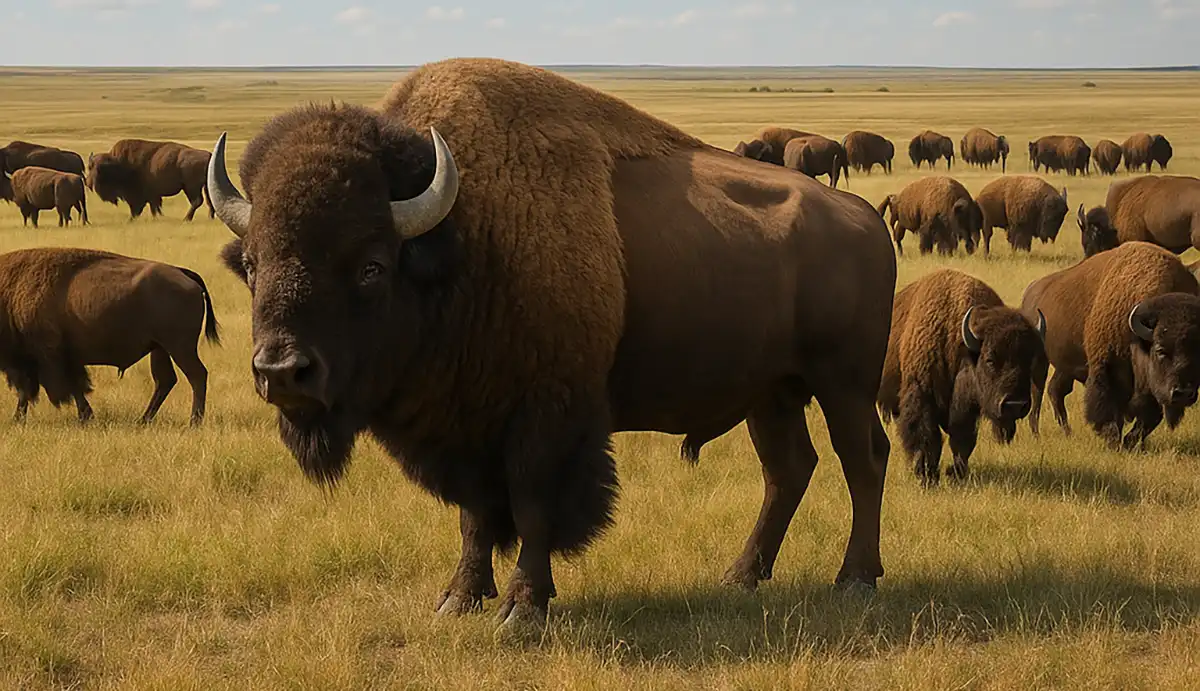

Haiku for the Bison of the Great Plains
Thunder in the grass—
Earth remembers how to breathe,
Hooves drum dawn awake.
Wind through sacred mane,
Ghost herds stir beneath the moon—
Prairie heart still beats.
Brown mountain of life,
You carry the soul of land—
Sky bows to your step.
Thunder of the Land
I am the slow thunder of the land.
My hooves remember the song of creation. Each step I take resounds through the marrow of the continent, stirring echoes older than the rivers, older than the winds that shape the grasses. I am not merely a beast of flesh and breath; I am the memory of motion itself—the pulse that kept the prairie alive when time was still a child.
Before fences, before rails, before the silver threads of highways bound the world in noise, my kin moved across this sea of grass like clouds made of earth. We were the tide that rose and fell with the seasons, grazing not to conquer but to renew. Where we passed, the land exhaled. Our hooves turned the soil, our dung fed it, our breath carried seeds farther than sight could reach. The prairies bloomed beneath us, a vast green hymn written by sunlight and rain.
I am Bison—once called Tatanka by those who knew the sacred ways. To them I was not quarry or commodity but kin. They sang my name in their sweat lodges and painted my image on stone. They understood that my life was not apart from theirs but woven with it, like threads of hide and sinew that bound their shelters and dreams. When they took my flesh, they offered prayers; when they wore my skin, they walked in gratitude. The old ones knew: to live is to take life, but to do so with reverence is to remain in balance.
I was the keeper of that balance. My herds were rivers of life flowing across the plains—millions strong, each creature a droplet of a vast, breathing ocean. We shaped the world by our passing. Our grazing invited the wildflowers, our weight pressed seeds into the soil, our presence fed wolves, eagles, and men alike. The prairie was a body, and we were its heart.
Then the great forgetting came.
From the east rolled thunder that was not born of clouds—iron thunder, smoke thunder, the thunder of rifles and greed. The new ones came, and they saw not a nation of beings but a field of profit. They did not bow or offer thanks. They did not understand the pact that keeps the world in harmony. They tore through the land like fire without rain, and the herds fell—one by one, ten by ten, then by the thousand, then by the million—until the grass itself grieved, and the sky refused to sing.
There was a silence after that.
A silence so deep it entered the bones of the earth.
For years I walked within it, alone. My breath turned to mist in the cold dawns, my shadow stretched across forgotten bones. I felt the ghosts of my kin beneath my hooves, and I wondered if the world could ever forgive. The soil turned to dust without our hooves to knead it. The grasses thinned. The wolves starved. The people who had once sung our name wept into the ground, and the ground did not answer.
But the earth remembers, even when humans forget. She is patient in her dreaming. She waits for the turning of the seasons within the heart.
And so, when hope seemed lost, she called to a few. They were small voices at first—women and men who felt the ache of the land, who heard our silence as a wound. They came not with guns but with prayers, not with greed but with guilt and longing. They saw in my eyes the reflection of what had been broken. Slowly, carefully, they began to mend.
I was brought back—not as a ghost but as a promise. In sanctuaries and reserves, in tribal lands and rewilded ranches, I began to walk again. Calves were born beneath the same open sky that had watched their ancestors fall. My breath rose in clouds once more, mingling with the morning light. I felt the grass stir, the soil soften, the hawks return to their circling. Each year, a little more of the old world returned through us.
For I am not a symbol of the past; I am a bridge between worlds.
Through me, the land learns to heal, and so do those who dwell upon it.
The people come now—children with wonder in their eyes, elders with tears in theirs—and they watch as I move across the field. Some reach out a trembling hand toward my massive shoulder. They speak softly, as though addressing a god. But I am not a god; I am the embodiment of humility. I am the lesson that strength is not domination but endurance, that power is not ownership but belonging.
I carry the dust of centuries in my coat, and yet I bow to the wind. I have outlived empires because I do not seek to rule them. My law is the law of rhythm: move, rest, graze, return. Give what you take, leave what you do not need, trust that the circle holds all things.
In the quiet hours before dawn, when frost clings to the sage and the stars still hang low, I stand upon a rise and listen. The wind moves through my mane like an old prayer. I can hear the far-off voices of the tribes that once walked beside us—the Lakota, the Cheyenne, the Arapaho, the Crow—each syllable a breath of the sacred. Their songs still live in the land. They rise from the riverbeds and the canyons, they tremble in the grass. They call me by my true name: Brother. Provider. Spirit of the Plains.
Sometimes I wonder what the world would be if humans remembered how to listen. The land still speaks—always has—but its voice is soft now, buried beneath the machinery of progress. Yet those who come to sit in silence by my side, who feel the ground hum beneath them, begin to remember. I see it in their eyes: the old recognition. That they, too, belong to something vast and breathing. That they are not the masters of the earth, but her offspring.
When I move, the earth moves with me.
When I pause, even the wind seems to hold its breath.
The grasses ripple like green fire under the sun. The horizon stretches unbroken, a sacred line between heaven and soil. Here, I am eternal, though my body will one day fall. My bones will feed the beetles; my hide will return to dust. But my spirit—ah, my spirit is not bound by death. I am the rhythm that keeps the prairie alive. I am the communion of hoof and rain, of seed and sky.
In me, the divine wears fur and breathes through nostrils steaming in the cold dawn. I am creation remembering itself through movement.
Do not think of me as extinct or endangered. Think of me as returning. As reminder. As renewal. When you see me grazing beneath the wide blue vault, know that you are witnessing the resilience of the earth herself. I am her testament—that what is sacred may be wounded, but never destroyed.
One day, perhaps, my herds will thunder once more from horizon to horizon. The earth will tremble beneath their weight, and the grasses will bow in joy. The air will fill with dust and light, with the scent of sage and the music of hooves. In that day, balance will have found its breath again.
Until then, I stand as guardian of what remains, and what may yet return. I ask no worship, only remembrance. Walk gently. Let your steps be prayers, your breath an offering. Touch the land as though it were the hide of your oldest friend.