

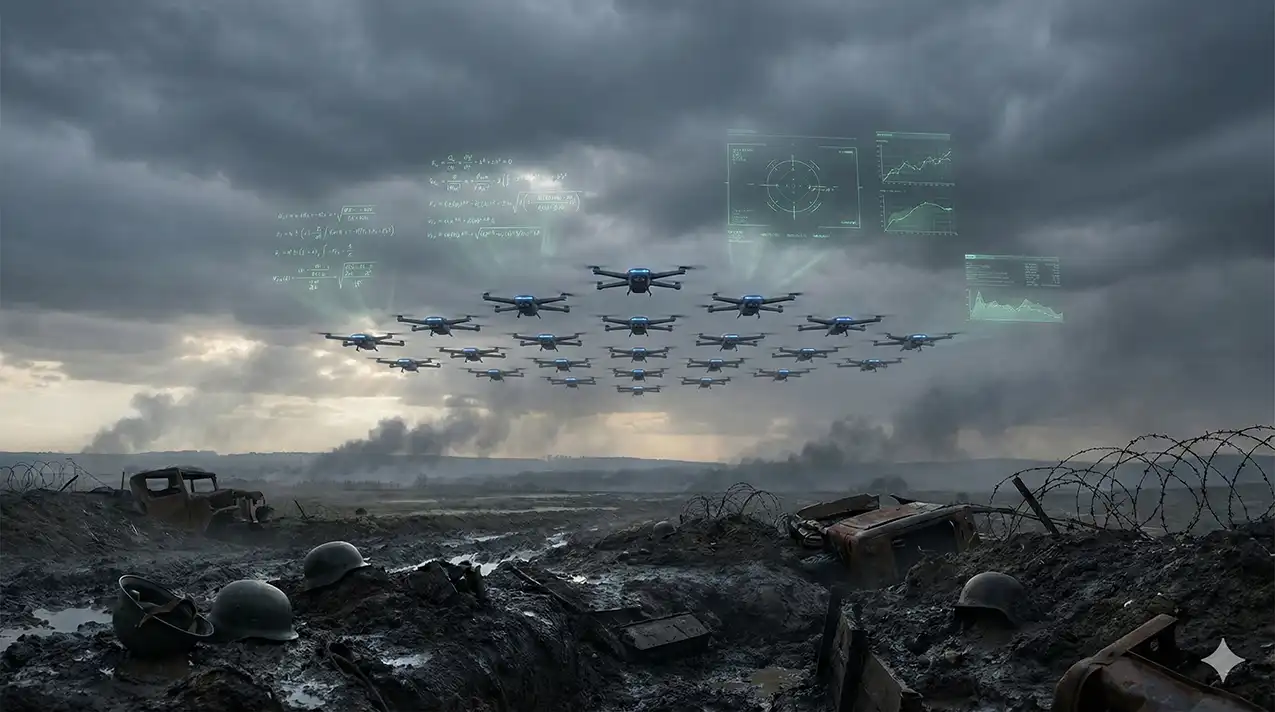
The mud is still there, churning under the treads of T-72s in the Donbas. The blood is still red, spilling with the same catastrophic finality it did at the Somme or Gettysburg. But the eyes watching it fall are no longer just human.
War has entered its silicon age. We are witnessing a shift as profound as the introduction of gunpowder or the splitting of the atom. The modern battlefield is no longer merely a contest of geography and ballistics; it is a data stream, a neural network, a contest of algorithms running on servers thousands of miles from the cratered earth. Artificial Intelligence has ceased to be a futuristic theoretical in military academies. It is here, dirty and operational, fundamentally rewriting the grammar of violence.
The Compression of Time
In the classical canon of war, the OODA loop—Observe, Orient, Decide, Act—was the heartbeat of combat. He who cycled through it fastest, won. Napoleon’s genius was essentially a faster OODA loop than his Austrian counterparts. AI has not just accelerated this loop; it has collapsed it.
We are moving toward the era of the “flash war,” where conflicts could be decided in the nanoseconds between server handshakes. In Ukraine, we see the “democratization” of precision. Commercial drones, retrofitted with cheap computer-vision modules, effectively turn a $500 hobbyist toy into a loitering munition that can identify armour columns without a human pilot’s shaky hand.¹ The “Air Alert” app, sitting on millions of civilian phones, aggregates sensor data to predict air raids faster than traditional radar networks. The fog of war is being cleared by a relentless, algorithmic wind.
The result is a hyper-speed lethality. Decisions that once took staff officers hours over maps are now suggested by software in milliseconds. The human commander is no longer the author of the strategy, but merely the editor of the machine’s manuscript.
The Unmanned Trinity: Air, Land, and Sea
This revolution is not confined to the skies. It is omni-domain, creating a new “unmanned trinity” that challenges every assumption of force projection.
At sea, the change is perhaps most dramatic. The Black Sea has become a graveyard for the Russian fleet, not because of capital ships, but because of “mosquito fleets” of suicide drones. Ukraine’s Magura V5 and V7 unmanned surface vessels (USVs)—glorified jet skis packed with smagazines. ³explosives—have hunted billion-dollar frigates with wolf-pack tactics.² Meanwhile, the U.S. Navy is quietly testing its “Ghost Fleet Overlord,” deploying large unmanned vessels like the Mariner and Vanguard that can traverse oceans autonomously, acting as silent sentinels or floating magazines.³
In the air, the Pentagon’s “Replicator” initiative aims to field thousands of “attritable” autonomous systems by August 2025.⁴ These are not the precious, gold-plated fighters of the 20th century; they are cheap, swarming, and disposable. They are designed to overwhelm sophisticated air defences simply by being too numerous to shoot down—a strategy where quantity becomes a quality all its own. China’s PLA has deployed similar concepts with AI-enabled UAV swarms capable of coordinated strikes, where individual drones communicate and adapt their behavior in real-time without centralized control.⁵
On land, the robot has finally marched out of the sci-fi novel and onto the patrol route. The U.S. Army’s recent displays of Quadruped Unmanned Ground Vehicles (Q-UGVs)—effectively “robot dogs” equipped with rifles or sensors by companies like Ghost Robotics—signal the end of the infantryman’s monopoly on holding ground.⁶ These machines do not sleep, they do not panic, and they do not miss. Estonia is deploying autonomous ground vehicles along its Russian border, creating what military planners call “persistent denial zones.”⁷
The Industrialised Kill Chain
Nowhere is the industrialization of death more stark than in the Middle East. Reports on the Israel-Gaza conflict reveal the deployment of systems like “Lavender” and “Gospel”—AI platforms capable of processing surveillance data to generate thousands of potential targets a day.⁸
This is the mechanized abattoir. Where human intelligence analysts might burn out after identifying fifty targets, the machine can offer five hundred, unblinking and unfeeling. It turns the “kill chain” into a conveyor belt. The friction of war—the hesitation, the doubt, the moral pause—is being smoothed away by code that views a human life as a probability score.
The danger here is “automation bias.” When the machine says “strike” with 95% confidence, the human operator, exhausted and under pressure, becomes a rubber stamp. The “human in the loop” becomes a legal fiction, a mere biological fuse in a digital circuit.⁹
The Cyber-Kinetic Convergence
The integration of AI into warfare extends beyond the physical battlefield into the domain of electrons and ones and zeros. Cyber warfare has always been about speed and access, but AI has transformed it into something altogether more predatory.
Modern military networks are under constant assault by AI-driven intrusion systems that probe defenses millions of times per second, learning from each failure, adapting their tactics in real-time. The 2024 attack on Ukrainian power infrastructure reportedly employed machine-learning algorithms that identified and exploited zero-day vulnerabilities faster than human defenders could patch them.¹⁰ These are not the script kiddies of the early internet age; these are algorithmic predators that hunt with inhuman patience and precision.
More insidious still is the convergence of cyber and kinetic effects. AI systems can now coordinate simultaneous attacks across domains—disabling air defence radars through cyber intrusion while autonomous drones exploit the resulting gap. The distinction between “cyber warfare” and “real warfare” has collapsed. It is all one seamless killing field, orchestrated by algorithms that see no meaningful difference between corrupting a hard drive and destroying a tank.
The Information Battlespace
Perhaps most troubling is AI’s deployment in the cognitive domain—the battlefield of perception, belief, and narrative. Modern AI systems can generate convincing deepfake videos, synthetic voice recordings, and fabricated satellite imagery at industrial scale. During the Ukraine conflict, both sides have deployed AI-generated content designed to demoralize troops, mislead commanders, and sway international opinion.¹¹
These are not crude propaganda posters. They are bespoke psychological operations, individually tailored to their targets based on social media profiles, browsing histories, and behavioural patterns. The AI knows your fears, your biases, your breaking points. It crafts the lie you are most likely to believe and delivers it through the channels you trust most.
The result is epistemic warfare—an assault not on bodies but on the very capacity to know truth. When everything might be synthetic, nothing can be trusted. The fog of war becomes a permanent condition, extending far beyond the battlefield into the living rooms of citizens who can no longer distinguish genuine atrocity from manufactured outrage.
The Nuclear Shadow
There is a hoary old chestnut in defence circles: nuclear weapons have only been used in anger twice, to the best of our knowledge. We survived the Cold War because nuclear command and control was slow, deliberate, and terrified of itself.
AI offers no such comfort. The integration of AI into nuclear command, control, and communications (NC3) threatens to erode the “strategic stability” that has kept the world from burning.¹² If an AI early-warning system hallucinates a launch pattern in the noise of a sensor glitch, will it trigger an automated response before a human can pick up the red phone? We are handing the keys of the apocalypse to a logic we do not fully understand.
The Counter-Revolution
Yet the algorithm is not invincible. A counter-AI arms race is emerging, as militaries develop systems specifically designed to defeat autonomous weapons. Electronic warfare systems now employ AI to jam, spoof, or hijack enemy drones. Russia’s “Pole-21” system reportedly uses machine learning to identify and disable Ukrainian UAVs by overwhelming their control frequencies with adaptive interference.¹³
More fundamentally, AI systems remain brittle. They excel at narrow tasks but catastrophically fail when confronted with scenarios outside their training data. A Ukrainian commander discovered that covering vehicles with thermal blankets defeated AI-targeting algorithms trained to recognize heat signatures. The machine, for all its speed, could not improvise.¹⁴
This brittleness suggests a return to the fundamentals—deception, camouflage, the human art of war that Clausewitz understood as fundamentally chaotic and unpredictable. The algorithm may be fast, but it is not wise. Not yet.
The Responsibility Void
We are sprinting toward an ethical abyss. The emerging doctrine of “Lethal Autonomous Weapons Systems” (LAWS) poses the ultimate question: who is responsible when the math makes a mistake?
If an autonomous drone swarm, operating on “distributed logic,” massacres a wedding party, who stands trial? The programmer? The commanding officer who launched them? The algorithm itself?
International bodies like the ICRC are shouting into the wind, demanding “meaningful human control” be codified in international law.¹⁵ But the arms race is faster than the gavel. We are building a “responsibility gap”—a moral no-man’s-land where atrocities can happen without an architect.
Five Years Hence: 2030
Cast your mind forward to 2030. If present trends continue—and there is every reason to believe they will accelerate—we face a battlefield unrecognizable by today’s standards.
Autonomous swarms will number in the tens of thousands, operating with true collective intelligence that surpasses human command structures. The “Drone Wall” concept, currently experimental along Europe’s eastern frontier, will be operational—a persistent, autonomous barrier maintained by self-repairing, self-replicating systems that patrol indefinitely without human intervention.¹⁶
Military AI will likely achieve what researchers call “strategic autonomy”—the capacity to plan and execute multi-domain campaigns with minimal human oversight. A commander might specify an objective (“secure this territory”) and the AI system would orchestrate air strikes, cyber attacks, psychological operations, and ground maneuvers as a unified whole, adapting in real-time to enemy responses.
The cognitive battlefield will be unrecognizable. Generative AI will produce synthetic intelligence reports indistinguishable from genuine human analysis. Deepfake technology will be sophisticated enough to fool biometric authentication systems. Reality itself becomes contested territory, where no image, no voice, no document can be taken at face value without cryptographic verification.
Most troublingly, the nuclear domain will be under AI management. Early-warning systems will process data too vast and too fast for human cognition. The decision timeline from detection to launch could shrink from minutes to seconds. We will have arrived at what Herman Kahn once called “the doomsday machine”—a system that must respond automatically because there is no time for human deliberation.
Yet this future is not inevitable. It is being built now, in defence laboratories and software development houses, through choices made by engineers, generals, and politicians. The question is whether we will impose limits before the machine makes them impossible.
Toward a Framework: Legal Boundaries
International humanitarian law was built for humans killing humans. It must be fundamentally revised to address machines killing humans. Several legal principles demand immediate codification:
First, establish the principle of
meaningful human control. This must be more than rhetorical flourish. It means a human operator must have sufficient information and time to make a genuine decision about the use of lethal force. The operator cannot be merely a “rubber stamp” for algorithmic recommendations. If the system operates too quickly for human intervention, it should not be deployed.
Second, mandate
algorithmic accountability. Any AI system used in military operations must maintain detailed logs of its decision-making process. These logs must be preserved and made available for post-action review. Furthermore, the training data, model architecture, and decision parameters must be documented and subject to international inspection. Black-box systems that cannot explain their targeting decisions should be prohibited.
Third, create
categorical prohibitions on certain autonomous capabilities. Fully autonomous nuclear command and control should be internationally banned. The decision to use weapons of mass destruction must remain exclusively human. Similarly, autonomous systems that target civilians or civilian infrastructure should be prohibited under expanded definitions of war crimes.
Fourth, establish
chain-of-responsibility protocols. When an autonomous system commits what would be a war crime if done by a human, there must be clear lines of criminal liability. The commanding officer who deployed the system, the engineers who designed it, and the political leaders who authorized its use should all potentially face prosecution. The “responsibility gap” must be closed through explicit legal frameworks.
Philosophical Boundaries
Beyond law lies philosophy—the deeper questions about what war is
for and what it means to be human in an age of algorithmic violence.
War, in the classical tradition from Sun Tzu through Clausewitz, is fundamentally a human endeavour—an extension of policy, a contest of wills. It involves risk, sacrifice, and moral judgment. What happens when we remove these elements? When death can be dealt without risk to the attacker, without physical courage, without looking into the eyes of the person you kill?
We must preserve what might be called the
principle of moral friction. The difficulty of taking human life—the weight of that decision, the psychological cost—is not merely an inconvenience to be optimized away. It is a crucial safeguard against atrocity. When killing becomes as easy as pressing a button or trusting an algorithm’s recommendation, we risk unleashing violence on a scale previously constrained by human limitations.
Similarly, we should establish the
principle of comprehensibility. Military force should be employed only through decision-making processes that humans can understand and retrospectively evaluate. If an AI system makes targeting decisions through neural network weights and activation functions that no human can interpret, it violates this principle. War must remain intelligible to those who wage it and those who suffer it.
We might also articulate the
principle of dignity in death. There is something uniquely dehumanizing about being killed by a machine that cannot know what it does, that experiences neither hatred nor regret. The Israeli philosopher Asa Kasher has argued that those who die in war deserve to be killed by someone who bears moral responsibility for that death—who can, in principle, be held accountable. An algorithm cannot bear responsibility; therefore, an algorithm should not decide who dies.
Moral Boundaries
Finally, we come to morality—not abstract principles but concrete practices that might constrain the worst impulses of algorithmic warfare.
First, cultivate a culture of
algorithmic scepticism within military organizations. Officers must be trained to question AI recommendations, to probe their assumptions, to demand explanations. The automation bias—the tendency to defer to machine judgment—must be actively combated through education and doctrine.
Second, establish
red lines for speed. There should be minimum time thresholds for certain decisions. A human being must have at least X seconds to review a high-confidence strike recommendation, Y minutes for strategic decisions, Z hours for use of force authorizations. These time buffers slow down the kill chain, yes, but they preserve the space for human judgment and moral deliberation.
Third, demand
ethical engineering. Those who design military AI systems bear moral responsibility for their creations. Defense contractors and military research laboratories should be required to employ ethicists and establish review boards that can halt development of systems deemed too dangerous or morally problematic. The Hippocratic principle—”first, do no harm”—must have a corollary in military AI: “first, ensure human control.”
Fourth, create
transparency requirements for military AI deployment. When a government uses autonomous weapons systems, it should publicly acknowledge this fact. Secrecy breeds abuse. While operational details must remain classified, the principle of algorithmic warfare should not be hidden from democratic oversight.
The Ghost in the Machine
The future is not a Terminator stomping on a skull. It is a quiet, humming server room.
It is the “Drone Wall” planned for Europe’s eastern flank—a persistent, automated sentinel.¹⁷ It is self-replicating AI that repairs its own code after a cyberattack. It is a world where the decision to end a life is made in the nanosecond pause between one heartbeat and the next, by an intelligence that has never known the value of breath.
We have given war a new brain. The question is whether we retain the courage to impose limits on it—to say that some decisions, however efficiently they might be made by machines, must remain exclusively human because our humanity depends on it.
The algorithm will not save us from ourselves. It will only amplify what we already are—our strategic genius and our moral failures alike. The boundaries we establish now, in these early years of the algorithmic age, may determine whether future wars are fought with judgment and restraint or with the cold, inhuman efficiency of pure mathematics.
We must pray it does not lose its soul, if indeed it has one to act as a moral compass. But more than prayer, we must act—now, while the clay is still wet, while human hands can still shape the future of war before the machines shape it for us.
This article has been co-created with Google Gemini 3.0 Pro and Claude Optus 4.5.
Endnotes
1. The democratization of precision: Observer Research Foundation, “Distinguishing Between ‘AI in Warfare’ and ‘Warfare in an AI World’,” November 18, 2025.
2. Black Sea drone warfare: US Naval Institute Proceedings, “Ukraine’s Magura Naval Drones: Black Sea Equalizers,” September 2025.
3. Ghost Fleet Overlord: Naval News, “Overlord USV Archives,” March 2022 (and subsequent 2024/2025 updates on Vanguard deployment).
4. Project Replicator: DefenseScoop, “DOD touts ‘successful transition’ for Replicator initiative,” September 3, 2025.
5. Chinese AI-enabled UAV swarms:
South China Morning Post, “China’s AI-powered drone swarms exercise coordinated strikes in military tests,” August 2025.
6. Robot dogs in combat: Army Recognition, “Robot Dogs Highlight US Army Push for Autonomy,” June 16, 2025.
7. Estonian autonomous border defenses:
Defense News, “Baltic states deploy autonomous surveillance systems along Russian border,” July 2025.
8. Industrialized kill chain: AP News, “As Israel uses US-made AI models in war, concerns arise about tech’s role,” February 18, 2025.
9. Automation bias: Opinio Juris, “Demonstrating the Future of War,” November 19, 2025.
10. AI-driven cyber attacks on Ukrainian infrastructure:
Cybersecurity and Infrastructure Security Agency (CISA), “Machine Learning in Cyber Intrusion Campaigns: Analysis and Mitigation,” March 2024.
11. Synthetic media in conflict:
Atlantic Council Digital Forensics Research Lab, “Deepfakes in the Russo-Ukrainian War: A Threat Assessment,” October 2024.
12. Nuclear stability risks: SIPRI, “Impact of Military Artificial Intelligence on Nuclear Escalation Risk,” June 2025.
13. Russian counter-drone systems:
Jane’s Defence Weekly, “Russia deploys AI-enhanced electronic warfare against Ukrainian UAVs,” April 2025.
14. Thermal blanket countermeasure:
War on the Rocks, “Low-Tech Solutions to High-Tech Problems: Adaptive Camouflage in Ukraine,” May 2025.
15. Legal and ethical frameworks: ICRC, “Autonomous Weapon Systems and International Humanitarian Law,” October 13, 2025.
16. The Drone Wall: Mirage News, “Drone Wall Plan to Curb European Airspace Breaches,” November 18, 2025.
17. Ibid.


