

Green Cities Series | Article 20
Greening the Desert Metropolis
In the furnace of the Najd, a kingdom is betting its capital on 7.5 million trees, the largest urban park under construction anywhere on Earth, and a metro delivered at extraordinary cost and speed. Riyadh now has a World Expo to host in 2030 and a World Cup in 2034, and those dates — not any climate target — are the clock the city is actually running against. The trees are real and the metro is filling. But the ecological arithmetic of water, heat and event-driven urbanism is unforgiving, and the harder question is what survives after the visitors go home.
The heat in Riyadh is not a weather condition. It is a structural fact of the built environment, of the city’s relationship with its own desert, and of the political choices that produced a metropolis of some eight million people in a landscape that could, without extraordinary intervention, sustain almost none of them. In the height of summer, temperatures routinely breach 45 degrees Celsius. The asphalt of the King Fahd Road — the artery of a city built around the private car, its six lanes in each direction serving the logic of a place where outdoor movement has historically been not merely uncomfortable but medically dangerous — absorbs that heat and radiates it upward in waves visible to anyone standing at the roadside, which almost no one does. For decades the only rational response to a Riyadh summer was retreat: behind the tinted glass of SUVs, into the refrigerated corridors of the malls, behind the compound walls of the wealthy.
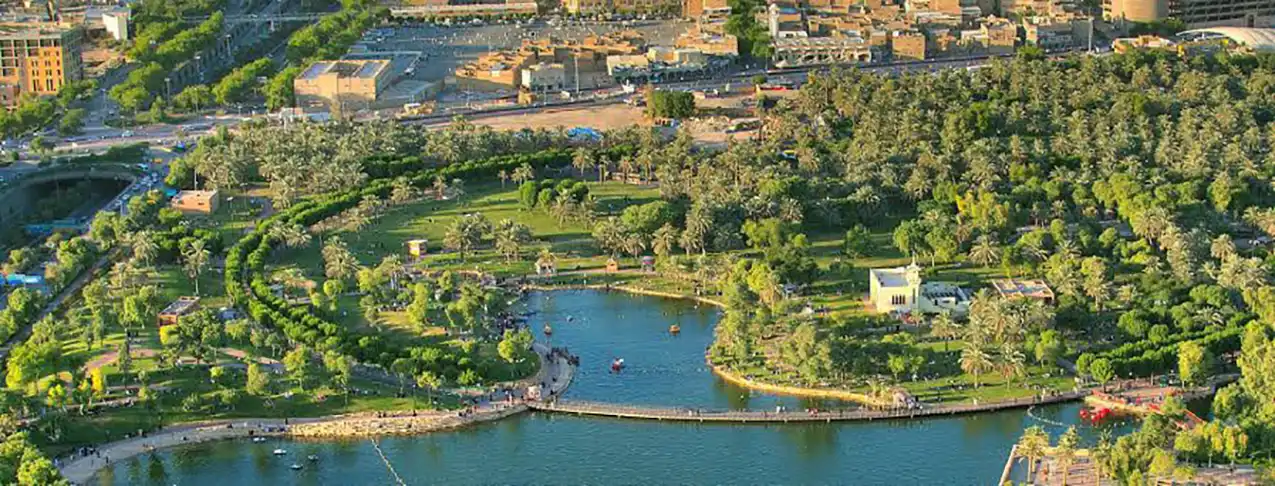
That logic is now being deliberately, expensively and at enormous scale contradicted. Under the Green Riyadh initiative — one of four grand projects launched in 2019 under the Saudi Vision 2030 programme — the government is planting 7.5 million trees across the capital. The stated goal is to raise green space per capita from 1.7 square metres, one of the lowest figures recorded for any large city in the world, to 28 square metres by 2030.1 At the centre of the transformation is King Salman Park, a 16.6-square-kilometre public landscape rising on the site of the old Riyadh airbase — roughly seven times the area of Hyde Park, nearly five times Central Park, the largest urban park under construction anywhere. The projected effect is a reduction in ambient city temperature of somewhere between 1.5 and 2 degrees Celsius, delivered through shade canopy, evapotranspiration and the albedo change that comes from replacing dark asphalt with planted surface.2
Whether those degrees can be delivered, at what cost to the water system, at what cost to the grid, and for whose benefit — these are the questions Riyadh’s green transformation is still in the process of answering. Seven years into the programme, the answers are more complicated, and in places more interesting, than either the promotional material or its critics allow.
The oasis that the oil boom erased
Riyadh’s environmental starting point is not, as the Green Riyadh narrative sometimes implies, a city that has always been surrounded by barren desert. The Wadi Hanifa — the natural drainage basin running north to south through the Najd plateau on which the city sits — was for centuries the agricultural and ecological backbone of the region. Groundwater shallow enough to reach by hand-dug well supported date palms, orchards and grain in a landscape that pre-oil travellers described as genuinely verdant by desert standards.3 The Diriyah settlement that preceded modern Riyadh, now being reconstructed as a cultural destination on the city’s western edge, was built in the wadi precisely because water and shade were available there. The wadi was not an amenity. It was the reason settlement was possible at all.
The oil boom erased this hydrology within two generations. Between the 1950s and the 1990s, Riyadh grew from a compact mud-brick settlement of roughly 80,000 people to a metropolitan area of several million, its expansion funded by oil revenue and designed, with American planning consultants and almost no ecological constraint, on the model of the mid-century American city: low density, car-dependent, served by an ever-expanding motorway network and cooled entirely by mechanical air conditioning.4 The aquifers that had sustained the wadi’s agriculture were pumped for urban supply and for the irrigated wheat production the kingdom pursued as a food-security strategy from the 1970s, at rates far exceeding recharge. The wadi itself was converted to a concrete-lined flood channel for most of its urban length, managed as stormwater infrastructure rather than as a living system.
By the 2000s the city had reached a condition its own planners described with unusual candour as unsustainable: six million people spread across roughly 1,750 square kilometres, with virtually no public transit, car ownership among the highest in the world, per-capita energy consumption for cooling that placed Saudi Arabia among the most energy-intensive nations on Earth, and green space provision a fraction of any planning standard’s minimum.5 The Wadi Hanifa Wetlands Restoration — completed in 2010 after seven years of work, recovering a 13-kilometre section through ecological engineering and constructed wetlands — won the Aga Khan Award for Architecture and demonstrated, at modest scale, that ecological recovery in an arid city was possible. It did not change the trajectory of the city’s growth. That required a different political impetus.
Vision 2030 and the architecture of ambition
The Vision 2030 programme, announced by Crown Prince Mohammed bin Salman in 2016, is the most comprehensive attempt to redesign Saudi Arabia’s political economy since the oil boom that created its original distortions. Its environmental dimensions — Green Riyadh, the Saudi Green Initiative’s national target of 10 billion trees, and the Net Zero by 2060 commitment made at COP26 — are genuine in the sense that they represent substantial financial commitment and binding institutional mandate.6 They are also embedded in a wider project whose primary objectives are economic diversification, social liberalisation and the management of a demographic challenge that has as much to do with the politics of legitimacy as with environmental conviction.
That context matters for assessing the programme honestly. The environmental goals are real, in that they are being acted upon at genuine scale and cost. They are also instruments of a nation-branding exercise designed to attract investment, tourism and the global sporting and cultural events that require the international community to accept Saudi Arabia as a modern and globally engaged state. The trees are genuinely being planted. The political functions they serve are not separable from their ecological ones.
Green Riyadh, managed by the Royal Commission for Riyadh City, has four pillars: 7.5 million trees; King Salman Park; a network of neighbourhood parks distributed across residential districts; and green corridors connecting the major open spaces into a continuous landscape system. Official material describes an investment of around eleven billion dollars over a decade, planting along roughly 1,200 kilometres of main roads and through 120 residential neighbourhoods, and a target of raising total green cover from 1.5 to 9 percent of the city.7 King Salman Park alone carries an estimated development cost above 23 billion riyals, making it one of the most expensive urban park projects in history.
Delivery has been slower than the early announcements implied, though not by the standards of comparable projects anywhere. Construction on the park site began in 2019; by late 2025 more than ninety percent of construction packages were under contract with over thirteen thousand workers on site; the first section, the Art Park, is due to admit the public in late 2026, with substantial completion targeted for 2027.8 One quieter revision is more telling than any of this. The Crown Prince’s stated ambition to grow Riyadh’s population to between fifteen and twenty million by 2030 has disappeared from the Royal Commission’s own materials, and independent forecasts have settled around nine million.9 The city is still growing quickly. It is no longer pretending it will triple.
The clock: Expo 2030 and what comes after
The most important thing to understand about the pace of Riyadh’s greening is that it is not being driven by a climate target. It is being driven by a guest list.
In November 2023 Riyadh won the right to host World Expo 2030. The event runs from October 2030 to March 2031 on a six-square-kilometre site north of the city, near the planned King Salman International Airport, and organisers expect it to draw more than 42 million visits from 197 participating nations. By mid-2026 some 6.2 million cubic metres of earthworks had been completed and 77 percent of the development area handed over for construction.10 Four years later, in 2034, Saudi Arabia hosts the FIFA World Cup. Between them these two dates constitute the real delivery schedule for everything else: the metro extensions, the park phases, the tree planting along the arterial roads that visitors will travel, the shaded pedestrian routes that the Expo masterplan describes as cool corridors.
This is not, in itself, a criticism. Event deadlines have produced some of the most durable urban infrastructure of the past century, from Barcelona’s reclaimed waterfront to the London Olympic park’s wetlands. A hard date concentrates institutional attention in a way that a 2060 net-zero commitment cannot, and the residents who use the results will not care why the deadline existed.
The criticism arrives afterwards, and it is specific. Event-driven urbanism systematically overfunds capital and underfunds maintenance. A tree planted in 2028 for an Expo in 2030 is at its most demanding — in irrigation, pruning and replacement of failures — between 2031 and 2040, precisely the decade when the institutional urgency and the dedicated budget line have both evaporated. Riyadh’s canopy will not be mature by the time the visitors arrive; the shade promised is a function of crowns that take fifteen to twenty-five years to close. The question for any city in this position is whether the maintenance obligation has been endowed rather than merely assumed, and on that Riyadh’s documentation is silent.
The water equation: the loop that does not close
The central paradox of greening Riyadh is water. In a region with no permanent rivers, no significant surface catchment and annual rainfall averaging under 100 millimetres — falling in brief winter storms rather than the slow, infiltrating rain that replenishes aquifers — every leaf the programme sustains requires a deliberate, energy-intensive hydraulic intervention.
The programme’s designers understood this and made a decision that is, in principle, the correct one: to base urban irrigation on treated sewage effluent rather than on fresh water from desalination or the already-depleted aquifers. Green Riyadh includes a 1,350-kilometre irrigation network delivering treated wastewater to the city’s parks, street trees and green corridors — official figures for daily volume have been stated variously at around one million and around 1.7 million cubic metres.11 This is a circular-economy intervention at a scale very few cities have attempted: capturing the city’s wastewater, treating it to a standard fit for landscape irrigation, and routing it back into the urban fabric as a resource rather than discharging it as waste.
The ecological logic is sound. But the circular framing requires qualification, because the system is not self-contained. The treated effluent irrigating Riyadh’s parks originates as water desalinated from the Arabian Gulf — desalination supplied around half of all distributed water nationally in 2023 — at roughly three to five kilowatt-hours per cubic metre, then pumped some four hundred kilometres inland and around six hundred metres uphill to reach the Najd plateau.12 Riyadh treats an estimated sixty percent of the wastewater it generates. And the water reaching the tree canopy leaves the system entirely: evapotranspiration returns it to the atmosphere, not to the aquifer beneath.
The net energy accounting of the green cooling strategy — the difference between energy saved through reduced air-conditioning demand and energy consumed by the water system that enables the cooling — is not prominently featured in the programme’s public documentation, and independent analysts have not been positioned to verify it. That accounting is improving, though from a very low base. Renewables generated around two percent of Saudi electricity in 2024, on installed capacity under five gigawatts. In 2025 the kingdom connected 12.3 gigawatts in a single year, more than doubling capacity and lifting renewables to roughly twelve percent of generation. The 2030 target is fifty percent, on 130 gigawatts of capacity.13 The direction of travel is real; the destination remains distant. Every year that the desalination and pumping chain runs on gas is a year in which Riyadh’s trees are, in carbon terms, more expensive than they look.
The arithmetic that does not reconcile
There is a further difficulty, and it is one the programme has not addressed. Green Riyadh states two headline targets that do not describe the same outcome. Raising green space to 28 square metres per capita implies, at a population of seven million, around 196 square kilometres of green space. Raising total green cover from 1.5 to 9 percent of an urban area given at roughly 540 square kilometres implies around 49 square kilometres.14 These are not variants of one goal. They differ by a factor of four, and no published document reconciles them.
The per-capita figure carries a second problem, which is that Riyadh is deliberately growing its denominator. A ratio target in a city actively recruiting residents is a target that recedes as the city succeeds. At seven million people the commitment is 196 square kilometres; at the roughly eight million living there now it is 224; at the 9.6 million some forecasts project for 2030 it is 269 — more than twenty times the city’s estimated provision today.
The aquifer question remains equally unresolved. Saudi Arabia’s fossil aquifers, accumulated over geological time and drawn down within a single human lifetime, are not being replenished. The city’s long-term water security rests on the continued viability of desalination, which rests in turn on energy remaining available at costs that keep desalination economic. In a world of climate disruption and energy-transition uncertainty, the assumption that desalinated water will remain indefinitely affordable is not a safe one.15
The right tree in the right place
Among the more technically serious aspects of Green Riyadh is species selection. The landscape architects working on the initiative have, at least in official documentation, prioritised drought-tolerant native and near-native species suited to the Najd: Ziziphus spina-christi, the Christ’s thorn jujube, a deep-rooted tree of remarkable heat and drought tolerance that has been part of the Arabian landscape for millennia; several Arabian Acacia species; Prosopis cineraria, the ghaf tree of the Gulf; and a range of native shrubs and ground covers adapted to alkaline soils and extreme radiation. Published species lists have appeared variously as seventy-two and ninety-nine approved types.16
The ecological argument for native selection is strong and consistent across every city in this series that has confronted the challenge. Native species support substantially higher invertebrate diversity, require less irrigation once established, are more resilient to the disease and pest pressures that monocultures attract, and are likelier to survive the summers climate change is delivering. In Riyadh the argument is particularly compelling, because the irrigation demand of non-native species in a desert climate is not a marginal concern but the primary driver of the programme’s water and energy cost.
The gap between policy and implementation is, however, a persistent concern. The neighbourhood parks programme — where most residents will actually encounter Green Riyadh, rather than in the flagship park — has in many cases deployed a palette that includes irrigated lawn, ornamental non-native palms and tropical shrubs that are visually lush but ecologically demanding and thermally less effective than the native woodland canopy the programme’s own modelling uses to project its cooling benefits.17 A planted area of lawn and ornamental palm is not the same, thermally or ecologically, as closed-canopy woodland of Ziziphus and Acacia. Both are described as green space in a programme report. Their contribution to the promised temperature reduction is not equivalent.
There is a more basic accountability problem behind this. Seven years into a programme to plant 7.5 million trees, there is no published figure for how many trees are actually in the ground. The programme reports inputs — nursery production capacity, kilometres of irrigation pipe, approved species lists, neighbourhoods entered — but not delivered canopy. This is a meaningful omission rather than a pedantic one, because tree planting and tree survival are very different things in a climate like Riyadh’s, and the difference between them is the entire value of the investment. Melbourne, Barcelona and Adelaide all publish canopy cover as a measured percentage, updated on a stated cycle, which is what allows their claims to be tested. Until Riyadh does the same, its central environmental promise remains unauditable.
The wider biodiversity question — what the initiative means for the fauna of the Najd, not merely for the thermal comfort of its human residents — is barely addressed in the documentation. The peninsula has a distinctive desert ecology: sand gazelles, Gordon’s wildcat, migratory birds using the region as a corridor between the Palearctic and Africa, and specialist invertebrates adapted to extreme conditions. Whether Riyadh’s new forest can function as habitat for any of them, or produces a sanitised landscape that is greener to the eye but ecologically no richer than the asphalt it replaced, depends on choices being made now.
The metro: what 200 million trips actually show
Riyadh’s green transformation cannot be separated from its transport transformation, because the city’s heat, air quality and emissions are inseparable from its car dependence. A metropolitan area of eight million served, until the end of 2024, by no public transit of any significance, and with more than 8,000 kilometres of road built to move private vehicles efficiently, is a city organised against the goals Green Riyadh is pursuing.18
The Riyadh Metro, which began revenue operations on 1 December 2024 after more than a decade of planning and construction, is the most significant structural change to that dynamic. Six lines, 85 stations, 176 kilometres of track, at a cost exceeding 22 billion dollars — the largest driverless network in the world, and the most expensive metro built in a single phase in history.19 The air-conditioned stations, a non-negotiable requirement in a city where ten minutes at an outdoor stop in summer is a health risk, were designed by six architectural practices in a programme intended to signal Riyadh’s metropolitan ambitions to the world.
When this article was first drafted, the honest verdict on ridership was that early results were mixed. The record since has been more interesting than that. The network carried more than 18 million passengers in its first eleven weeks. It passed 100 million in under nine months, with an on-time performance rate of 99.7 percent. By March 2026 cumulative trips had moved beyond 200 million.20 Those are the figures of a system being genuinely adopted, at a pace that places Riyadh among the fastest-growing new metros anywhere.
They are also, converted into daily averages, well short of what the system was planned for.
The composition of that ridership is more revealing than the total. Of the first 100 million trips, the Blue Line alone carried 46.5 million — against 17 million on the Red Line and 12 million on the Orange.21 The Blue Line runs the Olaya–Batha axis, north to south through the one part of Riyadh with something approaching continuous density, mixed use and street-level activity. Nearly half the network’s use is concentrated on the single corridor that has urban form.
That is not a failure of the metro. It is a precise diagnosis of the city. The land-use patterns of low-density villa suburbs, malls reached by car and workplaces connected by roads rather than streets are not navigable by rail, and the first- and last-mile problem is acute in a city without footpaths, without cycling infrastructure and without the ground-floor activity that makes walking viable. Where Riyadh has built a walkable corridor, the metro fills. Where it has not, the metro waits. The implication for policy is unusually clear: the binding constraint on transit ridership is not the rail network, which is now built, but the zoning and street design around the stations.22
The surface network faces the same constraint in harder form. Bus rapid transit corridors achieve respectable journey times, but ridership is limited by land use, by cultural resistance to public transport among households with cars available, and by the plain fact that a bus stop in a Riyadh July is physiologically untenable for prolonged waiting. Ride-hailing has filled part of the gap, providing mobility for residents who do not drive, but it has not reduced the number of vehicles on the road. It has added drivers, and offered a private-car alternative at lower cost than ownership.
Heat, health, and who the green city is for
Riyadh’s urban heat island is among the most severe documented anywhere. Research in Urban Climate found that the differential between the urban core and the surrounding desert — typically a few degrees in European cities — can exceed 8 to 10 degrees Celsius on calm summer nights, when heat stored in asphalt and concrete is released into the lower atmosphere in the absence of daytime convective mixing.23 The irony is precise. Riyadh’s urban fabric is hotter than the desert it was built on, because desert surface has lower thermal mass and higher albedo than the dark impervious surfaces of the city. Riyadh has created a heat trap inside a landscape that, severe as its heat is, at least does not amplify it.
The consequences fall most heavily on the population the city’s environmental narrative least features. Migrant workers constitute roughly 38 percent of Saudi Arabia’s population and a substantially higher share of Riyadh’s outdoor workforce.24 The construction workers building King Salman Park, the Expo site and the metro stations; the landscape crews who will keep the plantings alive through the summer; the delivery drivers and domestic workers — the people whose presence in the outdoor environment is not discretionary — are those for whom Riyadh’s heat is not a nuisance managed from an air-conditioned car but a physiological emergency managed beside 45-degree asphalt. The kafala sponsorship system, which ties a worker’s legal status to a specific employer, limits their ability to change conditions they find intolerable without risking deportation. Reforms in 2021 allowed some categories of worker to change employer or leave the country without consent — a real change, welcomed by human rights organisations while being characterised as insufficient to the system’s structural vulnerabilities.25 The programme’s documentation does not address the heat exposure of the workers who will maintain its plantings. The canopy will eventually cool them too. The timescale is measured in decades, not in the summer of the worker planting the tree.
Access to the new green infrastructure is not uniform either. Riyadh’s residential geography is sharply segregated by income and nationality: the northern and western districts house wealthier Saudi and expatriate professionals in compounds and villas with private green space, while the eastern and southern districts and the dense older neighbourhoods around Batha and Aziziyah house lower-income residents, including most of the migrant population, at considerably higher densities.26 Whether the neighbourhood parks programme is delivering equivalent quality across that geography is not a question the public reporting answers. King Salman Park raises the issue differently again: a park reached primarily by private car, in a city with limited cycling infrastructure and a climate in which walking a few hundred metres in summer is dangerous, is not practically accessible to residents without cars. Its design includes metro connectivity and a dedicated bus route, which matters. Whether it becomes a space used by the families of construction and domestic workers as well as by residents of the nearby Diplomatic Quarter will be the measure of whether its stated aspiration is real.
Against that, one gain is unambiguous. The social liberalisation of the Vision 2030 period — entertainment venues, the lifting of the ban on women driving, mixed-gender public space — has made the new parks genuinely new kinds of space in Riyadh, where families can sit together and women can walk without a male guardian.27 That is a real environmental justice gain, even as other parts of the population remain outside its reach.
After The Line
When this piece was first drafted, the argument of this section was a prediction: that Riyadh’s grounded, inhabited greening would prove more durable than the desert giga-projects it shared a promotional ecosystem with. That prediction has now been tested.
The Line — the 170-kilometre mirrored linear city announced in 2017 as the centrepiece of NEOM — is not being built. The Public Investment Fund halted construction in September 2025 pending a strategic review, after an internal audit leaked to the Wall Street Journal projected costs on a scale that made the original specification unbuildable. NEOM’s residency target for 2030 has been cut to as few as 100,000 people, from 1.5 million and then 300,000. The Trojena mountain resort, which was to have hosted the 2029 Asian Winter Games, has been deferred. PIF construction contracts fell from 71 billion dollars to 30 billion, with capital reallocated toward Expo 2030 infrastructure and 2034 World Cup stadiums.28
Green Riyadh survived. So did the metro, the park and the Expo. The distinction between what continued and what stopped is not a distinction between green and ungreen projects — The Line marketed itself relentlessly as the more environmental proposition. It is a distinction between infrastructure serving a population that already exists and infrastructure premised on a population that would have to be summoned. The trees being planted in Riyadh are being planted for eight million people who are already there. That, more than any design feature, is why they are still being planted.
It would be too neat to read this as vindication of ecological modesty. The projects that survived are themselves enormous, and they survived partly because they serve two international events. But the pattern is instructive for any city tempted by the giga-project register, and it is the strongest argument in Riyadh’s favour that this article can make: the city’s greening is grounded in a real place with real inhabitants, and that groundedness has proved to be a financial characteristic as well as an ecological one.
The desert and the long game
What is genuinely working deserves stating plainly, because dwelling only on shortcomings is its own form of distortion. The recycled wastewater system is, in conception and scale, a serious response to a challenge every city in the arid world will face in some version, and cities across the Middle East, North Africa, Central Asia and the American Southwest could learn from Riyadh’s implementation, including from its difficulties. The species selection policy, insofar as it is followed in practice, is ecologically sound. And the metro is an asset whose significance will grow as the city densifies around its stations — a generational change, but one whose enabling investment has now been made.
In the Wadi Hanifa, at the edge of the restored wetland that won the Aga Khan Award in 2010 and predates the Vision 2030 ambitions by nearly a decade, an Egyptian vulture circles above cliff faces where a small colony has held on through the decades of Riyadh’s growth. The bird — a scavenger of exceptional intelligence, listed as Endangered by the IUCN, its global population in long-term decline — is here because the wadi’s ecological function has been partially recovered: the wetland supports the small mammals and invertebrates that support the food chain that supports a bird requiring, above almost anything else, a landscape with enough complexity to feed it.
The vulture does not know that 7.5 million trees are being planted in the city above it, or that recycled wastewater is paying for them, or that the government planting them halted a mirrored city in the desert to the north last September. It knows the wadi has water in it, and food near it, and cliff faces suitable for nesting. It is working with what is available.
Riyadh’s transformation is, in its most honest form, an attempt to provide more of what is available — more shade, more water in the landscape, more ecological complexity in a city that reduced that complexity to near zero within a single human lifetime. The ambition is real, the financial commitment extraordinary, the ecological intelligence in the programme’s best elements genuine. What remains unresolved is the question every ambitious green city programme eventually reaches, and which the Expo deadline sharpens rather than softens: whether a transformation built with centralised authority and hydrocarbon revenue can develop the institutional culture, the civic engagement and the distributed constituency that would maintain it once the authority is less absolute, the revenue less available, and the guests have gone. The cities in this series that have made the most durable progress — Vienna, Amsterdam, Bogotá, Singapore — did so by building the social infrastructure that carries programmes through political change. Riyadh is building the physical infrastructure at extraordinary speed. Whether it is also building the other kind is the question on which its environmental legacy depends.
The vulture, for now, continues to circle. The wadi is there. That is not nothing. In a city that seventy years ago barely existed, and that thirty years ago had erased the ecology which sustained the settlement before it, the presence of a threatened species in a recovered landscape is evidence that the direction of travel, at least in this valley, is correct. Whether the city above it can travel the same way, at a scale matching the ambition of its plans, is what the decade to 2030 will begin to answer — and what the decade after 2031, when the visitors have gone, will actually decide.
Notes
- Green Riyadh targets: Royal Commission for Riyadh City (RCRC), Green Riyadh programme documentation; Saudi Vision 2030 materials. The 1.7 m² per capita baseline and 28 m² target are from RCRC official documentation. On the global comparison: WHO, Urban Green Space and Health (2016), which identifies 9 m² per capita as a minimum standard.
- King Salman Park scale: King Salman Park Foundation and Omrania project documentation; area given variously as 16.6 and 16.9 km². Comparators: Hyde Park approx. 1.4 km²; Central Park approx. 3.4 km². Temperature projection of 1.5–2°C at city level: RCRC, Green Riyadh programme documentation.
- Wadi Hanifa ecology and historical hydrology: Khaled Asfour, ‘The Wadi Hanifa Wetlands: Landscape Restoration in the Heart of Riyadh,’ Aga Khan Award for Architecture documentation (2010). On early European description of the Najd settlements: William Palgrave, Narrative of a Year’s Journey through Central and Eastern Arabia (Macmillan, 1865). On Diriyah: UNESCO World Heritage nomination documentation.
- Riyadh’s twentieth-century growth: Mashary Al-Naim, Identity in Transitional Societies (2008); Steffen Hertog, Princes, Brokers, and Bureaucrats: Oil and the State in Saudi Arabia (Cornell University Press, 2010). Metropolitan extent: RCRC, Riyadh Metropolitan Area Master Plan.
- Pre-Vision 2030 conditions: World Bank, Urban Development in Saudi Arabia (2012); RCRC baseline documentation. Per capita energy consumption: IEA, Saudi Arabia Energy Profile (2023).
- Saudi Green Initiative and Vision 2030 environmental commitments: Saudi Green Initiative documentation (sgi.gov.sa); Saudi Arabia’s Nationally Determined Contribution (updated 2021); COP26 national statement (2021). On national progress: Ministry of Environment, Water and Agriculture, reported via Saudi Press Agency, March 2026 — one million hectares of degraded land restored and more than 159 million trees planted nationally since 2021.
- Green Riyadh pillars, investment and scope: RCRC, Green Riyadh programme documentation; Arab News reporting on the $11 billion decade-long investment, the 3,300-plus parks target and the 9.1 percent green coverage goal; ArabUrban project documentation on planting along approximately 1,204 km of main roads and across 120 neighbourhoods. King Salman Park cost: Saudi Public Investment Fund documentation and reporting by Bloomberg and MEED.
- King Salman Park delivery: ArchDaily, February 2026, reporting initial phases opening late 2026 with substantial completion targeted for 2027; Retail & Leisure International interview with King Salman Park Foundation CEO George Tanasijevich, December 2025/January 2026, on contracting and workforce. The Art Park is identified as the first section to open.
- Riyadh population: General Authority for Statistics, 2022 census (city just over 7 million; Riyadh region 8.6 million); AGBI analysis, 2024, on the withdrawal of the 15–20 million target from RCRC materials and revised forecasts of approximately 9.2 million by 2030; Knight Frank projection of 9.6 million by 2030.
- Expo 2030 Riyadh: Expo 2030 Riyadh Company statements reported by Arab News, Saudi Gazette and AGBI, 2026, on the six-square-kilometre site, 197 participating nations, 42 million expected visits, 6.2 million m³ of earthworks and 77 percent handover of development areas. Event dates 1 October 2030 to 31 March 2031. Masterplan by LAVA; delivery consultancy including Buro Happold.
- Green Riyadh irrigation infrastructure: RCRC and Riyadh Water and Wastewater Authority documentation. The 1,350 km network figure is consistent across sources; daily reuse volume is stated as approximately 1 million m³ in Arab News reporting of official material and as 1.7 million m³ elsewhere. The discrepancy is unresolved in public documentation.
- Desalination energy intensity: International Desalination Association, industry-standard figures of 3–5 kWh/m³ for seawater reverse osmosis. Desalination share of national distributed water (approximately 50 percent in 2023): General Authority for Statistics. On inland transmission: Saudi Water Authority documentation on the Ras Al-Khair to Riyadh pipeline system. Riyadh wastewater treatment coverage of approximately 60 percent: peer-reviewed literature summarised in industry reporting.
- Saudi renewable energy: Climate Action Tracker, Saudi Arabia country assessment — approximately 2 percent of electricity from renewables in 2024 on 4.7 GW installed capacity. Climate Scorecard, July 2026 — 12.3 GW connected during 2025 and renewables at approximately 12 percent of generation. Targets of 130 GW and 50 percent of generation by 2030: Ministry of Energy and KACARE documentation.
- The reconciliation problem is the author’s calculation from published RCRC targets: 28 m² per capita against stated population figures, and 9 percent green cover against the 540–545 km² urban area given in Green Riyadh programme materials. No official document reconciling the two has been identified.
- Fossil aquifer depletion: World Resources Institute, Aqueduct Water Risk Atlas; Saudi Geological Survey, Groundwater Resources in Saudi Arabia (2020). The Saq and Umm Er Radhuma aquifers are non-renewable on any human timescale.
- Species selection: RCRC urban forestry documentation, which gives the approved list as seventy-two types in some materials and ninety-nine in others. On Ziziphus spina-christi: Al-Rowaily et al., ‘Plant Diversity in Saudi Arabia,’ Saudi Journal of Biological Sciences (2015). On Prosopis cineraria and Arabian Acacia: IUCN, Regional Assessment of Dryland Ecosystems in the Arabian Peninsula (2020).
- On the thermal difference between lawn and closed-canopy woodland: Bowler et al., ‘Urban greening to cool towns and cities: a systematic review of the empirical evidence,’ Landscape and Urban Planning (2010). The implementation gap is assessed from site documentation and independent ecological reporting. On comparative canopy accountability: City of Melbourne and City of Adelaide Urban Forest Strategies; Barcelona Urban Forest Plan 2017–2037.
- Riyadh road network and car dependence: RCRC, Riyadh Transportation Master Plan; Ministry of Transport statistics. On fuel subsidies: partially reformed since 2016 under Vision 2030 fiscal consolidation.
- Riyadh Metro: RCRC and Arriyadh Development Authority documentation. Six lines, 85 stations, 176 km. Cost above $22 billion: Bloomberg, MEED and contractor announcements. Revenue service began 1 December 2024. Station design by six practices including Zaha Hadid Architects, whose King Abdullah Financial District station functions as the principal interchange.
- Ridership milestones: Saudi Press Agency and Arab News — more than 18 million passengers in the first eleven weeks (February 2025); more than 100 million in under nine months at 99.7 percent on-time performance (August 2025); cumulative trips beyond 200 million by March 2026. Daily averages in Figure 3 are the author’s derivation from these cumulative milestones and elapsed days, not official daily counts. Initial planned demand of 1.2 million per day and design capacity of 3.6 million per day: Bechtel and RCRC project documentation.
- Line-by-line split of the first 100 million trips: Royal Commission for Riyadh City via Saudi Press Agency, August 2025 — Blue Line 46.5 million, Red Line 17 million, Orange Line 12 million.
- Transit-oriented development challenges: RCRC, Riyadh 2030 Urban Development Strategy. On the relationship between station-area density and ridership generally: standard transit planning literature, consistent with the corridor concentration observed here.
- Riyadh urban heat island: Alshayef and Almahmoud, ‘Urban Heat Island Assessment in Riyadh, Saudi Arabia,’ Urban Climate (2021). On albedo comparison between desert surface and urban fabric: Taha, ‘Urban climates and heat islands,’ Energy and Buildings (1997).
- Migrant worker population: General Authority for Statistics, Population Statistics (2023). On heat exposure and sponsorship systems: Human Rights Watch and Amnesty International reporting on Gulf migrant labour conditions.
- Kafala reforms: Ministry of Human Resources and Social Development, Labour Reform Initiative (2021); assessment of adequacy in Human Rights Watch, ‘Saudi Arabia: Significant Steps on Labor Reform’ (2021) and Migrant-Rights.org analysis.
- Residential segregation: Saleh Al-Hathloul, The Arab-Muslim City (Dar Al Sahan, 1996); Al-Muftah et al., ‘Socio-spatial Segregation in Riyadh,’ Journal of Urban Affairs (2019).
- Social liberalisation: Human Rights Watch, Saudi Arabia country reports (2018–2024), documenting both genuine reform and continuing restriction; reporting by The Guardian, BBC and Al-Monitor on changes in Saudi public life since 2017.
- NEOM and The Line: Public Investment Fund suspension of construction, 16 September 2025; internal audit reporting by the Wall Street Journal, March 2025; revised NEOM residency targets reported by Bloomberg and Semafor, 2025–2026; Trojena deferral and the postponement of the Asian Winter Games; reduction in PIF construction contracts from $71 billion to $30 billion with reallocation toward Expo 2030 and FIFA 2034 infrastructure. On earlier ecological and human rights concerns: Amnesty International, ‘Saudi Arabia: Mass Forced Evictions in Tabuk Region’ (2020).
Source note
This article draws on official Saudi Vision 2030 documentation, Royal Commission for Riyadh City programme reports, Saudi Water Authority and Riyadh Water and Wastewater Authority material, and Expo 2030 Riyadh company statements. Ridership and delivery figures are drawn from Saudi Press Agency releases and their reporting in Arab News and Saudi Gazette; where daily averages appear they are the author’s derivation from cumulative milestones and are identified as such. The Aga Khan Award documentation on the Wadi Hanifa Wetlands Restoration provides the ecological baseline for the historical analysis. Academic sources include urban heat island research from Urban Climate, Arabian Peninsula ecology from Saudi Journal of Biological Sciences and IUCN assessments, and international comparative urban forestry research. Independent assessment of energy and climate performance draws on Climate Action Tracker and Climate Scorecard. Critical analysis draws on Human Rights Watch and Amnesty International reporting on migrant worker conditions and NEOM-related displacement, and on architectural and planning criticism in The Architectural Review, Middle East Institute publications and Dezeen. Bloomberg, Semafor, MEED, AGBI and the Wall Street Journal provide the commercial and giga-project reporting. The article acknowledges the difficulty of independent verification of programme delivery data in a governance context with limited press freedom, notes several unreconciled discrepancies in official figures, and treats government statistics with corresponding analytical caution.
Further reading, watching and listening
Reading. Steffen Hertog, Princes, Brokers, and Bureaucrats: Oil and the State in Saudi Arabia (Cornell University Press, 2010) — the most rigorous analysis of the political economy that produced modern Riyadh, without which the Vision 2030 environmental programme cannot be understood. Madawi Al-Rasheed, A History of Saudi Arabia (Cambridge University Press, 3rd ed., 2021) — the essential political history. The Aga Khan Award documentation on the Wadi Hanifa Wetlands Restoration is freely available and provides the most credible ecological baseline against which subsequent claims can be assessed. For the megaproject framework: Bent Flyvbjerg, How Big Things Get Done (Macmillan, 2023), indispensable for reading King Salman Park and the Expo programme with appropriate realism about cost and schedule.
Watching. The Aga Khan Award documentary on the Wadi Hanifa restoration provides a rare ground-level account of ecological recovery in Riyadh’s landscape. VICE News and BBC Arabic have both produced documentary coverage of migrant worker conditions in Saudi Arabia that supplies the human context for the heat exposure section. On NEOM, the Bloomberg Quicktake documentary on The Line (2022) remains the most analytically rigorous broadcast treatment, and its juxtaposition with the 2025 suspension reporting is instructive.
Listening. The Middle East Institute’s podcast output includes economic and environmental analysis of Vision 2030 from researchers with direct access to Saudi planning documentation. For the desalination context, the Water Values podcast has covered the economics and sustainability of desalination in arid regions in terms directly relevant to the water arithmetic above. Isabel Hilton’s work on China–Gulf energy relationships, accessible via China Dialogue, provides useful context for the intersection of Saudi renewable ambitions and Chinese clean technology supply chains.
Download a copy of Riyadh, Saudi Arabia: The Greening of a Desert Metropolis with my compliments – Kevin J Parker


