

GREEN CITIES SERIES | ARTICLE 4
Singapore has spent sixty years turning a cleared island into a green city, and the results are, in many respects, extraordinary. But the question the city-state now faces is different from the ones it has already answered: how do you make a highly managed, deeply unequal ecological showpiece into a city that is genuinely resilient — for everyone who lives in it?
The otters arrived without permission. In a city where almost nothing happens without a plan, the return of smooth-coated otters to Singapore’s waterways over the past decade has been one of the few genuinely unscripted ecological stories. They were last recorded in the 1970s, when the rivers were too polluted for fish. By the time they reappeared — at the Botanic Gardens in 2014, then spreading to reservoirs and canals across the island — the water quality had recovered to the point where their prey was abundant. Families of otters are now tracked on social media by hundreds of followers. They nap on the steps of the Bishan-Ang Mo Kio Park waterfront. They have become, improbably, a symbol: not of wilderness regained, because Singapore has never had wilderness to regain, but of something perhaps more interesting — of a city that, in repairing its infrastructure, accidentally created conditions for life it had not anticipated.
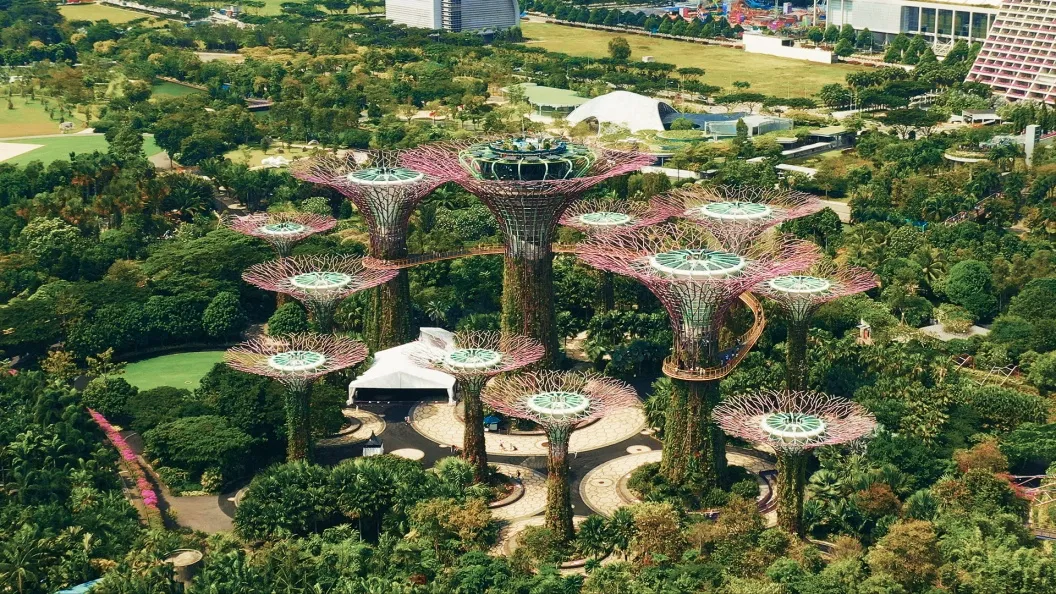
It is a useful story to hold in mind when examining Singapore’s environmental record. The island-state’s reputation as a green city rests on real achievement. Nearly half its land surface is covered in green space. More than half a million trees have been planted since 2020 under the OneMillionTrees movement. Concrete canals have been naturalised into rivers. An elaborate network of ecological corridors is being threaded through the urban fabric to reconnect nature reserves that suburbanisation fragmented. The Green Plan 2030, launched in 2021, sets ambitious targets across energy, transport, biodiversity, and waste. Singapore is, in measurable ways, greener than most cities of comparable density and income.
It is also a city warming faster than global averages, whose 30% of land sitting below five metres above sea level faces projections that grow more sobering with each national climate study. And it is home to roughly a million migrant workers — construction workers, cleaners, domestic helpers — who do the physical labour of maintaining Singapore’s greenery, and who are among those least protected from the heat it is meant to mitigate. Any honest account of Singapore’s ecological future must hold all of these things simultaneously.
The Garden City: A Planned Beginning
Singapore’s relationship with urban nature is not a recent conversion. It was a political project from the beginning. When Lee Kuan Yew declared his intention to make Singapore a ‘Garden City’ in 1967, the country was three years into independence, still poor, and struggling with pollution, overcrowding, and an infrastructure deficit that would have preoccupied most leaders entirely. The tree-planting programme Lee launched — personally, obsessively, with documented impatience about its pace — was partly about aesthetics and partly about attracting foreign investment, on the theory that a clean and green city would signal the kind of governance quality that multinationals sought. It was pragmatic idealism: nature in service of development.
That political logic shaped what Singapore’s greenery became. It was, for decades, precisely what the name suggested: a garden. Manicured, maintained, controlled. Trees were selected for tidiness as much as ecological function. Parks were managed to be pleasant and inoffensive. The city became famous for the cleanliness of its surfaces — a reputation enforced through fines — rather than for the complexity of its ecology. What grew in those years was an extraordinary quantity of green cover, but coverage is not the same as biodiversity, and tidiness is not the same as resilience.
The first important conceptual shift came gradually. By the 2000s, planners at the National Parks Board (NParks) were increasingly asking not just how many trees Singapore had but what kinds, and how they were connected. Over 95% of Singapore’s original native forest had been cleared by the late 19th century, eliminating more than a third of its original species. What survived was preserved in a handful of nature reserves — principally the Central Catchment Nature Reserve and Bukit Timah — but these fragments were ecologically isolated, surrounded by the dense urban matrix of HDB housing estates, roads, and industrial zones. Wildlife could not move between them. Genetic exchange was minimal. The reserves were, in a meaningful sense, islands within an island.
The response was to think in corridors. The Long-Term Plan Review, completed over several years and drawing on NParks’ systematic Ecological Profiling Exercise, mapped the island’s green and blue spaces for their biodiversity function rather than just their recreational value. It identified priority connections: places where a nature way — a street planted with multi-layered native vegetation — or a new nature park could serve as a bridge between areas of higher ecological value. The vocabulary shifted, almost imperceptibly, from Garden City to City in Nature. The difference matters. A garden is something humans make for humans. Nature, in the newer formulation, has interests and processes of its own.
Heat, Water, and the Warming City
Singapore is heating up at roughly twice the global average rate. From 1989 to 2020, mean annual temperature rose from 26.9 to 28.0 degrees Celsius. Urban heat island effects amplify this further: in the densely built downtown, temperatures can run up to 10 degrees above the forested fringes. Projections from Singapore’s Third National Climate Change Study, released in January 2024, suggest maximum daily temperatures could reach 35 to 37 degrees by 2100, against a current average of 28.6. That trajectory is not a forecast for a distant future. It is already measurable in the bodies of the people who work outdoors.
Those people are disproportionately migrant workers. About 38% of Singapore’s workforce are migrants from South Asia, Southeast Asia, and China, the majority employed in construction, cleaning, and domestic service. They are, by definition, outdoors or in poorly cooled environments for much of their working lives. Heat stress is a documented contributor to work-related deaths. Singapore’s government has introduced sector-specific guidelines — mandatory shade breaks of at least ten minutes per hour for workers doing heavy physical activity when the Wet Bulb Globe Temperature reaches 32 degrees or above, enhanced ventilation requirements in dormitories, ice machines in recreation centres — but the structural exposure remains. The green city that helps a Singaporean professional walk through shaded parks to their air-conditioned office has a different relationship to heat than it does for the worker who laid the path.
Then there is the water. Singapore’s founding problem was water: the island has no rivers of meaningful length and insufficient rainfall storage to be self-sufficient. The political vulnerability this created — dependence on Malaysia for a large portion of water supply — drove decades of investment in desalination, water recycling (NEWater), and reservoir creation that together have reduced that dependence substantially. What is less well understood internationally is that the same water infrastructure is now a primary instrument of both flood management and ecological restoration.
The ABC Waters Programme, launched by PUB in 2006, has gradually transformed Singapore’s approach to its drainage network. Rather than treating waterways purely as conduits to move stormwater out of the city as quickly as possible, the programme integrates water bodies with parks and public spaces, creating wetlands, rain gardens, and naturalised riverbanks that slow, filter, and store water while providing habitat and recreation. Over 100 sites have been identified for implementation by 2030.
The most celebrated example is Bishan-Ang Mo Kio Park. What was, until 2012, a straight concrete drainage channel — the Kallang River reduced to an engineered water highway, 2.7 kilometres of smooth walls and grilles — was transformed, at a cost of 76 million Singapore dollars, into a 3.2-kilometre naturalised river meandering through a redesigned 62-hectare park. The banks were re-shaped using soil bioengineering techniques adapted from Scandinavian practice — the first such application in a tropical environment — with vegetation and natural materials stabilising the contoured edges against erosion. The river widens to 100 metres at peak flood, accommodating monsoon flows that the old concrete channel could not. The approach cost 15% less than a conventional concrete rebuild. Biodiversity in the park increased by 30% after construction. Visitation doubled, from three million to six million annually. And the otters appeared.
The Architecture of a City in Nature
The Singapore Green Plan 2030 is a multi-ministry document spanning energy, transport, food, buildings, and nature. Its City in Nature pillar sets out specific targets: more than 200 hectares of new nature parks, 300 hectares of new or redeveloped parks and gardens, 300 kilometres of nature ways, and 500 kilometres of park connectors, so that every household will be within a 10-minute walk from a park by 2030. NParks’ OneMillionTrees movement aims to plant, as the name indicates, one million trees across the island by the end of the decade. Native species are prioritised — at least 50% of planting palettes in new developments must comprise species native to Southeast Asia. Multi-tiered planting, replicating the layered structure of tropical forest, is now a requirement rather than a design choice.
The nature corridor programme represents an attempt to reconnect what development fragmented. Six major corridors are being developed or planned: Lornie, Bukit Batok, Bukit Timah-Clementi, Khatib, the Kranji Corridor, and the Western catchment. Each is shaped by an Ecological Profiling Exercise that maps how species actually use the landscape — where they move, where they shelter, what vegetation structures they require. The corridors work at multiple scales: large nature parks as anchor habitats, nature ways as connectors, and individual building facades and roof gardens as stepping-stone habitats in the densest areas. Springleaf Residence, an upcoming development, is incorporating a corridor of native trees that extends the adjacent Springleaf Forest directly into the residential site. The principle — that individual development projects should contribute positively to the ecological network rather than merely minimise their damage to it — is now embedded in the planning system.
On the water, the ABC Waters Programme continues to expand. Jurong Lake Gardens, opened in phases, transforms the western equivalent of Bishan’s linear park into a constructed wetland landscape managing stormwater while providing habitat for waterbirds and otters. Singapore has also committed to restoring and enhancing 30 hectares of forest, marine, and coastal habitats, and to recovering 100 plant and 60 animal species by 2030. The new marine park planned at Lazarus South and Kusu Reef would be Singapore’s second, adding to the Sisters’ Islands Marine Park in the south.
Coastal protection has moved from a long-term planning consideration to an acute engineering challenge. Singapore’s Third National Climate Change Study, released in January 2024, projects mean sea-level rise of up to 1.15 metres by 2100 and around 2 metres by 2150 under high-emissions scenarios — with local factors, including the gradual sinking of reclaimed land, potentially amplifying that further. About one-third of Singapore’s land area is within one metre of current sea level. In February 2025, Prime Minister Lawrence Wong injected an additional five billion Singapore dollars into the Coastal and Flood Protection Fund, bringing its total to ten billion. The City-East Coast site-specific study, completed in 2025, has recommended coastal barriers at the Greater Southern Waterfront and a combination of raised structures and tidal gates at Changi. A ‘Long Island’ concept — three reclaimed tracts off East Coast Park, roughly twice the size of Marina Bay, enclosing a new reservoir — is under active study. The total cost of Singapore’s coastal protection programme over the coming decades is estimated at around 100 billion Singapore dollars.
What Is Working — And the Limits of the Model
The ecological results are real. Singapore’s smooth-coated otter population, now distributed across multiple river systems, is the most visible indicator of long-term water quality improvement. The Kallang River’s naturalisation produced a documented 30% increase in park biodiversity. The progressive replacement of non-native ornamental planting with native species is slowly rebuilding the ecological relationships — between plants, pollinators, seed dispersers, and predators — that a century of clearing had severed. Research published in 2025 on the equity of heat-mitigating green space in Singapore found measurable cooling benefits from park provision, though also found these benefits were unevenly distributed, with migrant construction workers facing the most severe thermal exposure relative to access.
The planning system that enables these outcomes is arguably Singapore’s most distinctive contribution to urban ecology globally. The integration of NParks’ ecological profiling into the master plan means that biodiversity corridors are not retrofitted afterthoughts but structural elements of land use decisions made decades before a single tree is planted. The requirement that new developments assess and mitigate biodiversity impact, conduct Environmental Impact Assessments for sites near sensitive nature areas, and incorporate native multi-tiered planting as a baseline rather than a bonus, creates an ecological floor below which development cannot go. Singapore has no equivalent of a planning approval that simply ignores the ecology of its surroundings.
The car ownership system also has genuine environmental consequences. Singapore’s Certificate of Entitlement — the permit required to own a private vehicle, purchased at auction and priced by market demand — currently costs around 106,000 Singapore dollars for a standard car. This is not an environmental policy; it is primarily a space management policy, designed to limit congestion on a dense island. But its effect on emissions and land use is real. Per-capita car ownership in Singapore is substantially lower than in comparable income countries, and the dense MRT and bus network that serves as the alternative is well-funded and reasonably comprehensive. New diesel car registrations ceased in 2025. All new car and taxi registrations must be of cleaner-energy models from 2030.
These are genuine achievements. They represent decades of patient institutional investment. But they also carry the marks of the political system that produced them: comprehensive, technically sophisticated, and shaped by state priorities in ways that are not always legible or contestable to those most affected.
The Contradictions: Who the Green City Is For
Singapore’s green reputation is built, in significant part, on labour that is invisible in the public narrative. The workers who plant, prune, and maintain the island’s extraordinary green infrastructure are overwhelmingly low-wage migrants from South Asia and Southeast Asia, living in dormitories that were harshly exposed during the COVID-19 pandemic — when clusters in worker dormitories drove some of the country’s worst case counts. The conditions in those dormitories are regulated; they are not equivalent to slums. But they are, for hundreds of thousands of people, a form of accommodation structured around their utility to Singapore’s economic project rather than their wellbeing as urban residents.
The heat equity question runs in parallel. Research on green space cooling benefits in Singapore has documented that the populations with the highest thermal exposure — outdoor construction workers, street cleaners, delivery workers — are precisely those with the least access to air-conditioned spaces or green space proximity during working hours. The government’s heat management framework addresses this through sector-specific workplace regulations. Mandatory shade breaks, limits on outdoor work during peak heat advisories, and enhanced dormitory ventilation are genuine policy responses. But they are adjustments to conditions rather than transformations of them. A city that generates heat through construction while exposing its construction workers to the heat it creates occupies an uncomfortable moral position, even when the regulatory framework is relatively serious.
There is also the question of ecological authenticity. Over 95% of Singapore’s original native forest was cleared by the late 19th century. What Singapore has is not recovered nature but carefully constructed facsimile — beautiful, increasingly sophisticated, and in many ways genuinely functional, but not wild in any meaningful sense. The otters in Bishan park are real; the otter-cam followers who track their daily movements are genuinely enchanted. But the park is 62 hectares of managed landscape in a city of nearly 6 million people, and the ‘nature’ it contains is the product of the same state planning apparatus that cleared the original forest. Singapore’s ecological restoration is better described as ecological construction: nature built from scratch, to specifications, with biodiversity targets and performance indicators.
That is not necessarily a criticism. In a city of this density, on an island of this size, with this history, constructed nature is the only nature available. The question is whether the construction is honest about what it is. Singapore’s shift from ‘Garden City’ to ‘City in Nature’ represents a genuine attempt to move from decorative green cover to functional ecological systems. NParks’ species recovery programme, with targets for 100 plant and 60 animal species by 2030, is more ambitious than most cities anywhere have attempted. The Ecological Profiling Exercise represents a serious scientific effort to understand how the urban landscape functions as habitat. These are not greenwashing exercises.
But Singapore’s governance model also limits the kinds of contestation that effective environmental stewardship sometimes requires. When development decisions are made that affect ecologically significant sites, the channels for public challenge are constrained. The nature groups that have been consulted extensively on corridor boundaries and park development have operated within frameworks the state controls. Over 30 engagement sessions were held with nature groups during the Long-Term Plan Review — a genuine improvement on earlier practice. But consultation within a pre-set framework is different from the power to shape or block decisions that conflict with conservation priorities. Singapore’s nature advocates work with and through the government in ways that have produced real results; they do not have the adversarial legal standing that courts in New Zealand, Colombia, or Spain have begun to extend to ecosystems.
The Shape of 2030 and Beyond
The coastal protection challenge will define the next generation of Singapore’s environmental policy in ways that the greening agenda has not. Long Island — if it proceeds — will be a multi-decade project of extraordinary engineering ambition, creating roughly 800 hectares of new land while enclosing a freshwater reservoir and providing a coastal barrier for East Coast Park and the densely settled neighbourhoods behind it. The project combines climate adaptation with land creation in a way that is distinctly Singaporean: turning a defence problem into a development opportunity. It also carries real ecological risks. Reclamation in tropical marine environments causes direct habitat loss. The Sisters’ Islands Marine Park exists precisely because some of Singapore’s reef systems still have ecological value; the cumulative pressure of reclamation on those systems is real and incompletely understood.
Singapore’s net-zero target is 2050, with a 2035 Nationally Determined Contribution committed to reducing emissions to between 45 and 50 million tonnes of CO2 equivalent. Those are meaningful commitments for a small, highly urbanised city-state with almost no land available for large-scale renewable generation. Solar is the primary domestic option — the Green Plan targets at least 2 gigawatt-peak of solar deployment by 2030, enough for around 350,000 households — but Singapore’s land constraints and equatorial cloud cover limit how far solar alone can take decarbonisation. The country is investing in hydrogen research, exploring regional electricity grids, and building carbon capture competency. Whether these technologies can deliver at the scale and timeline required remains uncertain.
The fundamental tension in Singapore’s environmental story will not be resolved by technology or by planning frameworks, however sophisticated. It is a tension about who the city is built for. Singapore has created, through six decades of investment, a city that is genuinely greener, cleaner, and more ecologically thoughtful than most of its peers. It has also created a city in which the people who do the physical work of maintaining that environment live in conditions that are separately governed, separately housed, and separately vulnerable. The otter has legal rights of a kind — its habitat is protected, its prey sustained by clean water — that the construction worker who naturalised the river it swims in does not enjoy in any comparable sense.
The Nature That Plans Cannot Produce
There is a useful distinction to be made between a city that has been greened and a city that has become ecological. The first is primarily a matter of investment, political will, and technical competence — all of which Singapore has in abundance. The second requires something harder: an acceptance that nature is not fully manageable, that living systems will surprise you, and that the people most exposed to environmental risks have the most at stake in environmental decisions, and therefore the most to contribute to them.
Singapore is somewhere between these two positions, moving, unevenly, from the first toward the second. The Bishan otters are a small piece of evidence. The Ecological Profiling Exercise is a larger one. The willingness to naturalise a concrete canal, accepting the messiness and flood variability that comes with it, rather than simply replacing one hard infrastructure with another, suggests a planning culture capable of learning. The Green Plan 2030’s species recovery targets suggest an ambition that goes beyond amenity.
What Singapore has not yet found is a way to make the ecological project fully democratic — to extend to the workers who maintain its gardens, and to the nature groups who study its corridors, and to the communities displaced by reclamation projects, the kind of standing in decision-making that matches their stake in outcomes. That is partly a consequence of Singapore’s political structure, which has produced extraordinary competence at the cost of ordinary contestation. It is also, perhaps, the next frontier. The otters arrived without permission. The city’s ecological future may require more of that kind of surprise: nature and people asserting themselves in ways that no Green Plan fully anticipated.
Endnotes
1. Singapore Green Plan 2030, ‘City in Nature’ pillar targets: 200 ha new nature parks, 300 ha parks and gardens, 300 km nature ways, 500 km park connectors; all households within 10-minute walk of a park by 2030. NParks, ‘City in Nature: Key Strategies’. Singapore Green Plan website, greenplan.gov.sg.
2. On the smooth-coated otter’s return: multiple news reports from 2014 onwards. The Bishan-Ang Mo Kio Park otter colony is widely tracked; see Ramboll Studio Dreiseitl project documentation on the park’s ecological outcomes, and Henning Larsen project description (2024).
3. Singapore’s temperature warming rate and urban heat island: from 1989 to 2020, mean annual temperature rose from 26.9°C to 28.0°C — roughly twice the global average. Urban areas can run up to 10°C above forested fringes. See Climate Impact Tracker, ‘Heat Waves Become Singapore’s Scorching Reality’ (2023); Peterson Indonesia analysis of UHI effects (2024).
4. Singapore’s Third National Climate Change Study (V3), released January 2024: mean sea-level rise projections of up to 1.15 metres by 2100 and ~2 metres by 2150 under high-emissions scenarios. See PUB press release ‘Urgency to Strengthen Coastal Defences’ (March 2025) and Budget 2025 announcement of an additional S$5 billion for the Coastal and Flood Protection Fund.
5. Bishan-Ang Mo Kio Park restoration: 2.7 km concrete Kallang River channel naturalised into 3.2 km meandering river, 62 ha park, cost S$76 million under PUB and NParks’ ABC Waters Programme. 30% biodiversity increase; park visitation doubled from 3 million to 6 million annually. 15% cheaper than a concrete rebuild. See C40 Cities case study; Ramboll Studio Dreiseitl project documentation; NSW Government Architect case study (2024).
6. Over 95% of Singapore’s original native forest cleared by the late 19th century, eliminating over a third of its original species. Source: Castelletta et al. (2004), as cited in global-e journal analysis ‘A Look at Singapore: The Green-Branded City-State’ (July 2025). NParks species recovery target: 100 plant and 60 animal species by 2030.
7. Migrant workers and heat exposure: ~38% of Singapore’s workforce are migrants. An average of 34 migrant workers have died yearly in work-related incidents since 2020, with heat stroke a contributing factor. Source: Peterson Indonesia / Climate Impact Tracker analysis. On dormitory conditions and workplace heat regulations: Ministry of Sustainability and the Environment, Adjournment Motion on ‘Building a Heat-Resilient Singapore’; Ministry of Manpower enhanced heat stress measures.
8. NParks’ Ecological Profiling Exercise (EPE): findings used to guide Long-Term Plan Review, identify nature corridors, and direct development sensitivity. Six major corridors: Lornie, Bukit Batok, Kranji, Khatib, Bukit Timah-Clementi, and Western Catchment. See URA Draft Master Plan, ‘A City in Nature’; NParks Annual Report 2023/24.
9. ABC Waters Programme: launched by PUB 2006; over 100 sites identified for implementation by 2030. Jurong Lake Gardens as western companion to Bishan’s linear water park. New marine park planned at Lazarus South and Kusu Reef (NParks engaging nature groups from July 2024). NParks target: restore and enhance 30 ha of forest, marine and coastal habitats.
10. Long Island concept: three reclaimed tracts off East Coast Park, ~800 ha, roughly twice the size of Marina Bay, enclosing a new freshwater reservoir. Five years of technical and environmental studies commenced early 2024; decades of phased implementation to follow. Source: Wild Shores of Singapore blog citing Straits Times Budget 2025 reporting; structures.com.sg coastal protection analysis (2025).
11. Certificate of Entitlement (COE) price: approximately S$106,000 for a standard car as of late 2023 (Reuters, Xinghui Kok, October 2023). Diesel car registrations ceased 2025; all new car and taxi registrations to be cleaner-energy from 2030. Source: Singapore Green Plan 2030 targets page.
12. Singapore’s 2035 NDC: committed to reducing emissions to 45-50 MtCO2e in 2035, submitted to UNFCCC February 2025. Net-zero target: 2050. Solar deployment target: at least 2 GWp by 2030. Source: Singapore Ministry of Foreign Affairs, Climate Change page; Singapore Green Plan 2030 targets.
13. On equity of green space cooling benefits and migrant workers: ScienceDirect, ‘Assessing equity in heat mitigation ecosystem services of urban green space in Singapore’ (2025). Findings indicate lower-income subgroups, including migrant construction workers, face greater heat mitigation inequity.
14. Engagement of nature groups in Long-Term Plan Review: over 30 engagement sessions held by NParks with nature groups to discuss corridor boundaries and park development. See URA Draft Master Plan, ‘A City in Nature’ section. On the broader limits of consultation vs. contestation in Singapore’s planning system, see global-e journal, ‘A Look at Singapore’ (July 2025).
Source Note
This article draws primarily on official Singapore government sources — the Singapore Green Plan 2030 website, NParks Annual Report 2023/24, PUB’s ABC Waters Programme documentation, the Third National Climate Change Study (2024), and PUB’s coastal protection press releases and site-specific study summaries — supplemented by project-level documentation from Ramboll Studio Dreiseitl, Henning Larsen, and C40 Cities on the Bishan-Ang Mo Kio Park restoration. Academic literature on heat equity and urban biodiversity is cited throughout, including Castelletta et al. on original forest loss and ScienceDirect research on cooling equity. Critical perspectives on migrant worker conditions, ecological authenticity, and governance constraints draw on the global-e journal analysis (July 2025), the Climate Impact Tracker, and Peterson Indonesia’s UHI research.
Further Reading / Watching
Timothy Barnard (ed.), Nature Contained: Environmental Histories of Singapore (NUS Press, 2014) — the essential scholarly treatment of how Singapore transformed its ecology from colonial clearing to planned greenery.
NParks, CityGreen journal — a biannual publication covering urban ecology and greening practice in Singapore and the region; particularly useful for technical documentation of projects like the ABC Waters Programme.
PUB, Active, Beautiful, Clean Waters Design Guidelines, 4th Edition — the technical manual for Singapore’s water-sensitive urban design approach, widely cited internationally.
Singapore’s ‘Cooling Singapore 2.0’ digital urban climate twin project (Singapore-ETH Centre): the most sophisticated attempt currently underway to model urban heat intervention at city scale in a tropical environment.


