

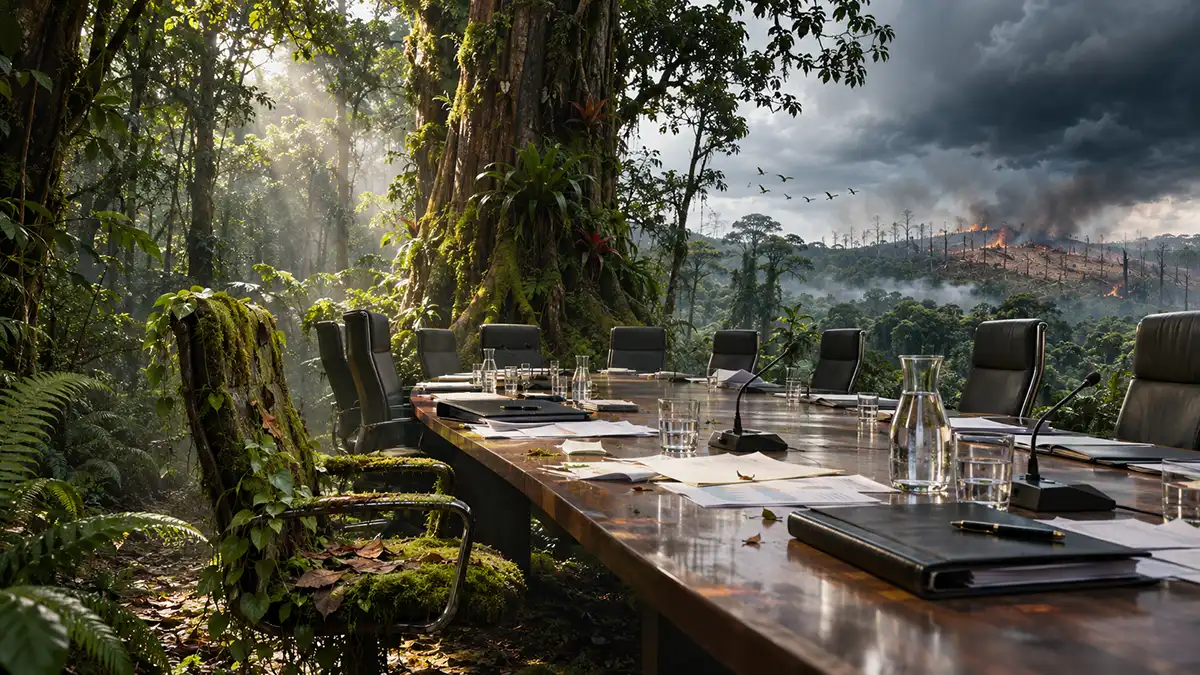
As the world’s climate negotiators leave Antalya without an overarching agreement, the true consequences will be measured not in diplomatic communiqués, but in disappearing species, collapsing ecosystems and a steadily diminishing capacity of the Earth to sustain life.
Opinion | 23 November 2026
There were no coral reefs at the negotiating table in Antalya. No ancient forests, no migratory birds, no struggling pollinators. No representatives of the great whales, the alpine meadows, the tropical wetlands or the countless organisms whose existence makes our planet a living world rather than merely a habitable rock.
Yet all have an extraordinary stake in what happened there.
On Sunday, 22 November 2026, the thirty-first United Nations Climate Change Conference ended without an overarching agreement. After two weeks of negotiations and two additional days of increasingly strained diplomacy, nearly 200 countries could not reach consensus on a central question: how explicitly the world should commit itself to moving away from the fossil fuels driving global warming.
The proposed Antalya Pact failed to secure sufficient support. Some governments objected because the final text did not even mention fossil fuels. Others resisted such language, defended the continuing role of oil and gas, or regarded the draft as an imperfect but worthwhile compromise. Disagreements over climate finance deepened the impasse.
Certain technical decisions and initiatives survived. Existing international climate obligations remain in force. The architecture of global cooperation has not disappeared.
But the failure to reach a broader agreement is significant, not least because of the message it sends at a moment when the physical evidence of planetary disruption is becoming increasingly difficult to ignore.
The atmosphere, unfortunately, has no obligation to recognise diplomatic disagreement.
Nor do the oceans, the forests or the species already struggling to survive.
A climate crisis is also a crisis of life
Much of the public conversation about climate change remains stubbornly human-centred.
We measure the crisis in degrees of warming, economic losses, insurance premiums, infrastructure damage and the costs of transforming energy systems. We discuss national emissions, carbon budgets, investment opportunities and the commercial viability of new technologies.
All are important.
But this language often obscures a deeper reality. Climate change is reorganising the conditions under which life on Earth has evolved.
A degree of additional warming is not simply an inconvenient adjustment to the global thermostat. It changes rainfall patterns, disrupts seasonal relationships, alters ocean chemistry, transforms habitats and shifts the geographical boundaries within which plants and animals can survive.
Consider a flowering plant that responds to increasing spring temperatures, opening its flowers before the insects that pollinate it have emerged. Or a seabird whose breeding season has evolved around the predictable arrival of fish that warming currents have now displaced. Or an alpine species steadily retreating upslope until there is nowhere higher to go.
These are not isolated curiosities. They illustrate the extraordinary complexity of ecological relationships that climate change can disrupt.
Nature is not a collection of independent species conveniently arranged across the landscape. It is a vast, interdependent network of relationships among organisms, soils, water, nutrients, climate and evolutionary history.
Damage to one component can reverberate through many others.
The Intergovernmental Panel on Climate Change has repeatedly warned that rising temperatures increase the risks of biodiversity loss, ecosystem transformation and species extinction. For some particularly vulnerable ecosystems, adaptation has hard physical limits.
The consequences are not always gradual or easily reversible.
A species driven to extinction cannot be restored by a subsequent reduction in atmospheric carbon dioxide. An ancient forest destroyed by repeated fires cannot be recreated simply by planting seedlings. A complex coral reef ecosystem, assembled through centuries of biological interaction, cannot be reconstructed on demand.
This is the ecological dimension of climate change that remains inadequately represented in international negotiations.
And time matters enormously.
The terrible arithmetic of half a degree
The difference between 1.5°C and 2°C of warming can appear almost trivial in ordinary experience.
For the world’s coral reefs, it is potentially catastrophic.
The IPCC has estimated that coral reefs could decline by a further 70–90 per cent at 1.5°C of warming, with losses exceeding 99 per cent at 2°C.
These are projections, not predictions that every reef will die simultaneously. Nevertheless, they reveal how seemingly modest differences in global temperature can produce profoundly different ecological futures.
Coral reefs occupy less than one per cent of the ocean floor yet support an estimated quarter of marine species. They are nurseries, refuges, feeding grounds and intricate biological communities of almost unimaginable complexity.
Their disappearance would therefore be far more than the loss of spectacular underwater scenery.
It would mean the dismantling of entire ecological communities, with consequences extending through fisheries, coastal food webs and the lives of people who depend upon them.
Australia has an especially intimate relationship with this predicament.
The Great Barrier Reef has endured repeated marine heatwaves and bleaching episodes. Encouragingly, the Australian Institute of Marine Science reported signs of recovery across much of the Reef during its 2025–26 surveys. Coral cover increased in the northern and central regions and remained broadly stable in the south.
That resilience deserves recognition.
But recovery between disturbances is not evidence of immunity to continuing warming. Indeed, the same scientific assessment warned that the Reef’s long-term future depends upon limiting additional warming and preserving sufficient time for damaged ecosystems to recover.
Every fraction of a degree matters because recovery requires time, and increasingly frequent disturbances diminish the opportunity to recover.
The negotiations in Antalya did not directly kill a coral colony. But the failure to strengthen collective emissions-reduction efforts increases the danger that the warming trajectory threatening coral reefs will persist.
For the living world, that distinction is fundamental.
Forests at the edge of transformation
The world’s great forests face a similarly unsettling future.
From the Amazon and Congo Basin to the boreal forests of Canada and Siberia, trees are integral to the regulation of regional and global climate. Through photosynthesis, they absorb carbon dioxide. Through transpiration, they influence rainfall and atmospheric moisture. Their soils, vegetation and associated communities sustain an immense diversity of life.
Yet forests themselves are increasingly vulnerable to the climate changes they help moderate.
Rising temperatures can intensify drought, increase evaporative demand, alter the distribution of pests and diseases, and contribute to conditions favourable to destructive fires.
The relationship is not simple. Climate impacts differ across forest types and regions. Some forests may initially benefit from longer growing seasons or increased atmospheric carbon dioxide. Others are already experiencing severe stress.
But the wider danger is unmistakable.
As forest ecosystems are damaged, their capacity to store carbon can decline. Dead and burning vegetation releases carbon previously held in living biomass and soils. In some circumstances, this creates a feedback in which warming increases ecological damage, which in turn contributes to further warming.
The Amazon is particularly important because of the relationship between forest cover, rainfall recycling and regional climate stability.
Deforestation, fragmentation, drought and fire do not operate independently. They can reinforce one another, potentially changing the character and functioning of large areas of forest.
Scientists continue to debate precisely where critical thresholds may lie. That uncertainty should not be confused with reassurance.
Indeed, one of the most troubling characteristics of complex ecological systems is that they may appear resilient until accumulated pressures push them into a substantially different state.
No diplomatic formula can guarantee that such transformations will remain reversible.
And while international discussions continue, forest destruction remains driven by several interacting forces: agricultural expansion, extractive industries, infrastructure development, commercial demand, weak governance and a changing climate.
Climate agreements alone cannot resolve all these pressures.
But an increasingly unstable climate makes the task of conserving and restoring forests profoundly more difficult.
The silent extinction crisis
Perhaps the greatest tragedy of COP31 lies in the consequences that will never generate international headlines.
A forest fire is visible. A bleached reef can be photographed. A flooded city attracts television cameras.
The gradual disappearance of a freshwater invertebrate, a mountain orchid, an endemic frog or an obscure forest insect is rarely noticed beyond the scientific community.
Yet these losses matter.
The IPCC has found that extinction risks rise substantially with increasing warming, particularly for species confined to limited geographical ranges.
Many species cannot simply move to cooler locations.
An alpine plant may be trapped at the summit of its mountain. A freshwater species may be confined to a single river system. An island endemic may have nowhere to migrate. A specialist organism may depend on a host, food source or seasonal relationship that itself is disappearing.
Climate change compounds existing pressures from land clearing, pollution, invasive species, overexploitation and habitat fragmentation.
The result is not merely a collection of threatened species. It is the progressive weakening of ecological communities.
And extinction is not a temporary inconvenience. It is the permanent termination of an evolutionary lineage.
A creature may represent millions of years of adaptation, carrying genetic information and ecological relationships that exist nowhere else in the universe.
Its disappearance is not adequately described as an economic externality.
There is a profound ethical question here.
What gives one species, particularly one generation of that species, the authority to impose irreversible losses upon so many others?
We have developed elaborate systems for recognising national interests, commercial rights and property ownership. Yet the living systems upon which all these arrangements ultimately depend possess almost no direct voice within the institutions making decisions about their future.
The consequences of this imbalance are increasingly apparent.
The oceans are absorbing our failure
The oceans deserve particular attention because they have, in a very real sense, been protecting terrestrial life from the full consequences of our emissions.
According to the World Meteorological Organization, the oceans absorb approximately 90 per cent of the excess heat accumulating within the Earth’s climate system.
Its November 2026 assessment found that ocean heat content continued to rise, with preliminary measurements indicating further increases following record levels in 2025.
This enormous accumulation of energy has consequences far beyond coral bleaching.
Warming seas can alter ocean circulation, change the distribution of marine species, intensify marine heatwaves and affect the availability of oxygen in seawater. Increasing carbon dioxide also drives ocean acidification, challenging organisms that construct shells and skeletons from calcium carbonate.
Marine ecosystems are being altered from the surface to the deep sea.
The implications for whales, seabirds, fisheries, plankton communities and the countless organisms inhabiting coastal and offshore waters are complex and far-reaching.
Even where individual species adapt or shift their distributions, the relationships connecting marine ecosystems may change.
The oceans are not simply passive reservoirs into which humanity can deposit the unwanted heat of industrial civilisation.
They are living environments with physical, chemical and biological limits.
It is worth remembering that the scale and duration of ocean warming mean that many changes will continue long after any successful agreement begins to reduce emissions.
The natural world is already committed to a degree of further disruption.
That makes delay especially costly.
The great injustice of adaptation
The failure to strengthen climate finance arrangements at COP31 has another important ecological dimension.
For many developing countries, adaptation is not an abstract future concern. It involves protecting mangroves against rising seas, restoring degraded watersheds, conserving coastal wetlands, maintaining forest corridors and helping agricultural and freshwater ecosystems withstand increasingly unpredictable climatic conditions.
These measures benefit human communities precisely because they protect the living systems upon which those communities depend.
Yet the financial imbalance is extraordinary.
The United Nations Environment Programme’s 2026 Adaptation Gap Report estimated that international public adaptation finance reaching developing countries amounted to approximately US$28–32 billion in 2024, compared with projected annual needs of around US$305 billion by 2035.
Even achieving the previously stated ambition to triple international public adaptation finance would leave a substantial shortfall.
This matters particularly in regions where biodiversity is exceptionally rich but financial resources are constrained.
Small island nations, tropical forest countries and many Indigenous territories face overlapping pressures from climate change, commercial exploitation and historical inequities.
Indigenous Peoples and local communities frequently hold sophisticated ecological knowledge derived from generations of close interaction with particular landscapes. Their rights, authority and participation are essential to effective conservation, although their circumstances and approaches are diverse and should never be romanticised.
Protecting biodiversity requires secure land rights, effective institutions, locally appropriate management and sustained financial resources.
It also requires recognising that the countries and communities least responsible for historical emissions are often those with the fewest resources to respond to their consequences.
A climate finance debate that treats these realities merely as negotiating costs misses an essential point: functioning ecosystems are themselves a foundation of climate resilience.
Was no agreement better than a weak agreement?
It would be too simplistic to suggest that every country opposing the final Antalya proposal was obstructing climate action.
The positions were more complicated.
The European Union, the United Kingdom and several climate-vulnerable countries rejected language they believed failed to acknowledge the principal driver of global warming.
Other countries regarded the proposed agreement as a compromise that could preserve cooperation and permit further progress. Oil-producing states defended the continuing economic role of fossil fuels, while some developing countries emphasised the absence of adequate financial support for transition and adaptation.
These differences reflect genuine economic dependencies, competing priorities, unequal historical responsibilities and deeply contested approaches to global development.
It is also possible to argue that adopting an agreement that retreats from previous commitments would have weakened international confidence.
But we should resist confusing the quality of a diplomatic outcome with its ecological consequences.
Nature gains nothing from an agreement that exists only on paper. Equally, it gains nothing from the inability to agree.
The decisive question is whether global greenhouse gas emissions decline quickly enough to reduce future warming, alongside direct efforts to protect and restore ecosystems.
The scientific arithmetic remains daunting.
UNEP’s Emissions Gap Report 2026 found that full implementation of countries’ current nationally determined contributions would still leave the world on a trajectory of approximately 2.6°C of warming this century.
The report concluded that even a pathway involving the lowest feasible overshoot of 1.5°C would require global greenhouse gas emissions to fall by approximately 45 per cent by 2035 relative to 2025 levels.
These figures reveal the enormous distance between international aspirations and the scale of transformation required.
They also reveal why the failure at Antalya matters.
It did not erase the Paris Agreement, cancel existing commitments or bring all climate cooperation to an end. Decisions relating to a just transition were adopted, and initiatives involving electrification, tropical forest protection and ocean conservation continued to make progress.
But the conference failed to deliver the broader collective political signal that might have accelerated action at a critical moment.
It is a setback in a much longer struggle, not the cause of the entire crisis.
That distinction is necessary for intellectual honesty.
The future is not yet written
There is a danger in writing about ecological catastrophe that deserves acknowledgement.
Despair can become another form of paralysis.
The scientific evidence does not support the conclusion that every forest is doomed, every reef will perish or every ecosystem has passed the point of recovery.
Nor does climate change operate as a simple switch that turns a living planet into a dead one at a predetermined temperature.
Risks accumulate. Thresholds differ. Responses vary. Ecological recovery remains possible in many places, particularly where other pressures are reduced and sufficient habitat survives.
Every avoided increment of warming reduces some risks. Every surviving population preserves evolutionary possibilities. Every restored wetland, protected forest or connected habitat can improve ecological resilience.
There are also reasons to recognise progress.
Renewable energy has expanded considerably. Technologies once regarded as prohibitively expensive have become commercially competitive. Conservation programmes, ecological restoration and community-led environmental initiatives are demonstrating what sustained attention can accomplish.
These developments are real.
But their existence does not diminish the urgency of the predicament.
Indeed, they illustrate the gap between what humanity is capable of doing and what it has collectively managed to achieve.
The natural world does not require perfection from us. It requires conditions within which life can continue to evolve, recover and flourish.
Those conditions are becoming increasingly difficult to maintain.
The judgement of the living world
The history of international climate negotiations is generally written in the language of treaties, diplomatic breakthroughs, disputes, emissions targets and financial commitments.
The history of the natural world will be written differently.
It will be recorded in the retreat of glaciers, the changing composition of forests, the disappearance of endemic species, the transformation of ocean ecosystems and the ecological legacies inherited by generations yet unborn.
It will be recorded in places where life persists, adapts and recovers.
And in places where it no longer can.
There is something profoundly revealing about a civilisation capable of observing the Earth from space, decoding genomes, constructing artificial intelligence and modelling climate change with extraordinary sophistication, yet struggling to organise an adequate collective response to the disruption it has created.
We possess remarkable knowledge of the relationships that sustain us.
We are far less accomplished at allowing that knowledge to shape our collective behaviour.
Perhaps this is the deeper lesson of Antalya.
The crisis is not simply that nations could not agree upon the wording of a document. It is that the world’s most consequential environmental negotiations continue to struggle to reflect the full value of the living systems at stake.
Climate change is not solely a problem of atmospheric chemistry or economic transition.
It is a crisis in humanity’s relationship with the rest of life.
The forests, oceans, rivers, grasslands and countless other communities of living organisms are not decorative surroundings for the human enterprise. They are the biological foundations that make it possible.
Their destruction diminishes the planet itself, not simply the resources available for human use.
COP31 has ended. Negotiators will return home. Governments will reconsider their positions. Attention will shift to the next summit, the next financial commitment, the next technological breakthrough.
But outside the conference halls, the processes driving ecological transformation continue.
There is no diplomatic overtime for a species pushed beyond its capacity to survive.
No appeal against the collapse of an ecosystem.
No future conference capable of resurrecting an extinguished evolutionary lineage.
The tragedy of Antalya is not simply that humanity failed to agree on how to protect its future. It is that the living world, upon which that future depends, will continue to bear the consequences of decisions in which it had no voice.
And unlike the negotiators, nature cannot simply walk away from the table.
Research and supporting sources
• UNFCCC — Closing remarks of Simon Stiell, COP31, 22 November 2026 Source link
• Reuters — COP31 climate talks collapse, 22 November 2026 Source link
• UNEP — Emissions Gap Report 2026 Source link
• UNEP — Adaptation Gap Report 2026 Source link
• IPCC — Sixth Assessment Report, Synthesis Report Source link
• UNEP — Coral Reefs and Climate Change Source link
• WMO — State of the Climate 2026 Update Source link
• Australian Institute of Marine Science — Great Barrier Reef Condition 2025–26 Source link


