

Dossier · Cryosphere · Loss and damage
The Earthquake That Wasn’t
On a dry morning in August a Himalayan glacier let go, dammed a river and drowned a valley. The seismographs recorded the collapse itself. What the Lhende Khola tells us about a world shedding its ice.
I. Eight-forty in the morning
It was not raining. That is the detail local editors keep returning to, and it is the detail this story turns on.1
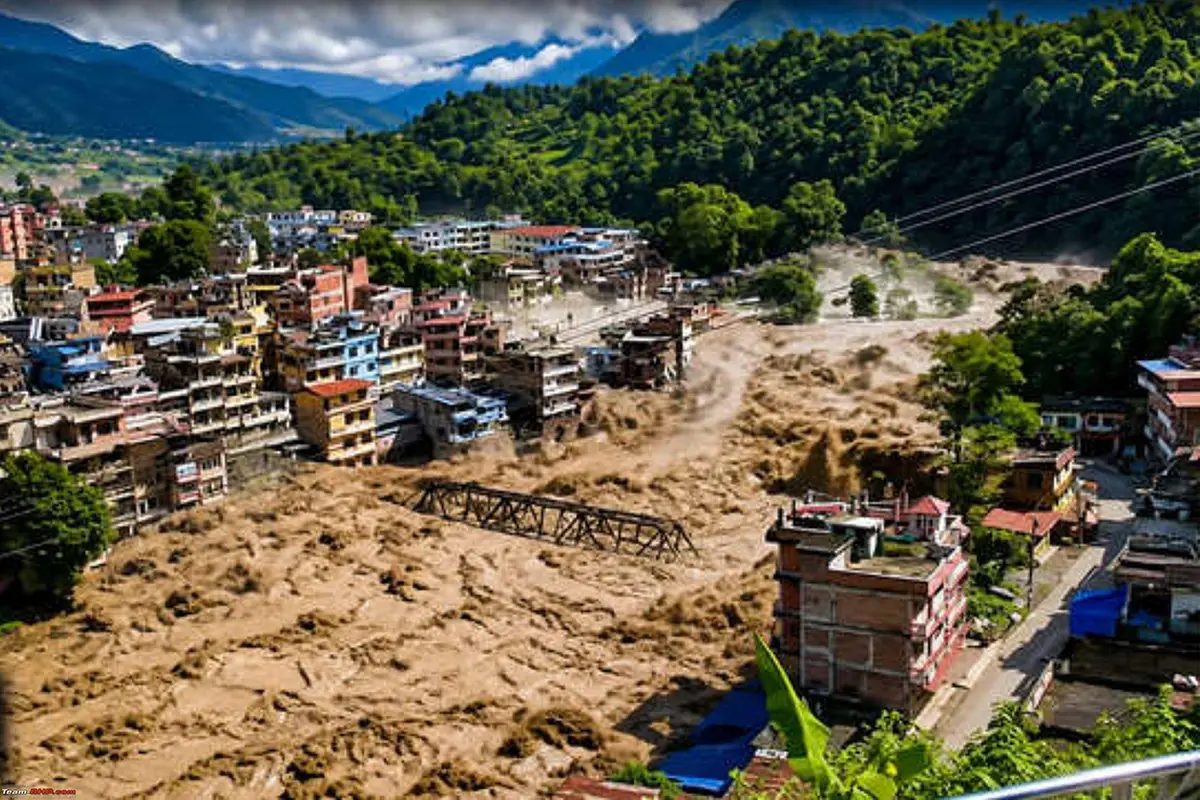
At about 8:40 on Wednesday morning, 26 August, a wall of water, ice, mud and boulders came down the Lhende Khola, a steep tributary that meets the Bhote Koshi at the Rasuwagadhi crossing between Nepal and Tibet. It tore south through Timure, the trading village that serves the border, past Syabrubesi at the head of the Langtang treks, and on into the Trishuli. Downstream at Galchhi the river rose by as much as nine metres in half an hour.2 Jeffrey Kargel of the Planetary Science Institute has since calculated that the flood wave — water, pulverised ice and rock — covered its first 22 kilometres at an average of 193 kilometres per hour. Fourteen miles in under seven minutes.3
By Friday the toll had passed 469 confirmed dead across both sides of the frontier, and police were saying plainly that it would climb as searchers reached the buried villages. More than 1,000 people remained missing, among them over 500 foreign nationals from 32 countries: pilgrims bound for Kailash, trekkers, hydropower workers, border police and customs staff. Ninety Americans were unaccounted for; Prime Minister Anthony Albanese confirmed 34 Australians among the missing. Whether China and Nepal are counting some of the same people across the closed border is itself not yet clear.4 Those figures are provisional. They are cited here as the state of knowledge on the day of writing, not as a final ledger, and they will almost certainly rise.
Nineteen bridges are gone, along with some forty kilometres of road, the hydrological monitoring stations that were supposed to give warning, and an unknown amount of the hydropower infrastructure strung along the Bhote Koshi. Across the border, mud and debris buried Gyirong port. And upstream, on the line itself, a mass of ice and rock still sat lodged in the river, with evacuation orders issued on the Chinese side against a second surge.5
What we know, what we don’t — as at 28 August 2026
- Established: no significant rainfall in Rasuwa on 25–26 August; the surge originated in the Lhende Khola; the US Geological Survey has withdrawn its earthquake determination. Satellite imagery has hardened the trigger from hypothesis to finding: a substantial portion of the glacier’s snout collapsed from about 5,200 metres, and a large volume of snow melted around the source in the 24 hours beforehand.
- Preliminary: that debris temporarily dammed the river and the impounded water burst through, magnifying the surge; that thawing permafrost beneath the glacier was the destabilising agent.
- Unresolved: the volume released; which side of the frontier the source sits on — Nepal’s disaster authority now places the avalanche on the Nepali side, where earlier satellite analyses had put the impact zone in Tibet.
- New threat: Chinese authorities report a barrier lake of roughly two million cubic metres impounded upstream and already overflowing, with several million more expected to drain into it within days.
- Not established: any direct attribution of this specific event to climate change. The background trend is another matter.
II. The signal
The first reports, including the framing that prompted this piece, described an earthquake. The US Geological Survey had logged a magnitude 4.4 event north of Kathmandu early on Wednesday morning, and the inference was natural.6 This is Gorkha country. In April 2015 an earthquake on this same stretch of the Himalayan front sent an avalanche onto Langtang village, a few valleys east, and erased it. A quake shaking loose a weakened glacier fitted the region’s recent memory.
Then the USGS looked again. Analysis of nearby seismic stations, long-period waves and satellite imagery led its analysts to a different conclusion: “No earthquake had occurred.” The signal was the collapse itself, and the agency reclassified the event as a magnitude 5.2 glacial collapse.7
That correction matters beyond pedantry. An earthquake is an act of tectonics, indifferent to temperature. A glacier that lets go on a still, dry morning with no quake beneath it belongs to a different category of hazard, one whose probability is shaped by heat. Ice-rock avalanches of sufficient mass shake the ground like small earthquakes, and seismologists have used precisely that signature to reconstruct the 2021 Chamoli disaster in Uttarakhand and the 2025 Blatten collapse in Switzerland. The mountain did not need a trigger. It wrote its own seismogram.
III. Anatomy of a cascade
Here is the sequence as satellite analysts and the Kathmandu-based International Centre for Integrated Mountain Development (ICIMOD) have so far reconstructed it. A substantial section of the lower tongue of a glacier at about 5,200 metres broke away and fell some 1,200 metres onto the valley floor, scouring up rock and monsoon-saturated sediment as it went. The avalanche struck the Lhende hard against the frontier itself, and dammed it. The dam held long enough to pond a lake, then failed.8 Even the geography is contested: Nepal’s disaster authority describes an ice-rock avalanche on the Nepali side, while early satellite analyses placed the impact zone in Tibet, some twenty kilometres north-east of the crossing. On a border drawn along a watershed, the distinction matters more to lawyers than to the water.9
ICIMOD’s first-day language was careful — a large volume of ice and rock debris may have entered the river — and its caution has been rewarded with corroboration rather than correction.10 Within two days the picture had firmed. Vikram Gupta of Sikkim University says the imagery now confirms that a substantial portion of the glacier snout collapsed, entraining rock and sediment as it fell. Dan Shugar of the University of Calgary reads the same imagery as showing heavy snowmelt around the source in the twenty-four hours before the failure.11 Jakob Steiner of the University of Graz is blunter still: a lower part of the glacier has simply come off.12
Scientists call this a multi-hazard cascade, and the Himalaya has been producing them with a regularity that no longer looks like coincidence. In October 2023, 14.7 million cubic metres of frozen moraine slid into South Lhonak Lake in Sikkim, raised a wave some twenty metres high, breached the moraine dam, and drained roughly fifty million cubic metres of water. The flood eroded about 270 million cubic metres of sediment, demolished the Teesta III hydropower dam sixty-odd kilometres downstream, and ran 385 kilometres into Bangladesh. Fifty-five people died and 74 were never found.13 In February 2021 a rock-and-ice avalanche from 5,600 metres in Chamoli, Uttarakhand, travelled more than seventeen kilometres and dropped over four vertical kilometres, taking two hydropower projects and around two hundred lives with it.14
Nor is this a Himalayan monopoly. On 28 May 2025 the Birch Glacier above the Swiss village of Blatten, overloaded by weeks of rockfall from the thawing Kleines Nesthorn, collapsed and buried most of the village. One man died. The rest of the population had been evacuated nine days earlier because someone was watching.15
And the Lhende itself has form. In July 2025 the same river flooded when a supraglacial lake on the Tibetan side drained without warning, killing at least nine people, sweeping away the Friendship Bridge and stranding the container depot that anchors Nepal’s overland trade with China.16 ICIMOD’s disaster-risk specialist Saswata Sanyal put it bluntly this week: the Lhende Khola has now flooded twice in fourteen months.17 His colleague Mohd. Farooq Azam went further, saying the pace of change had outrun the region’s capacity to respond and that cross-border hazards of this kind demand joint action by governments, not parallel monologues.18 The record is thicker than two floods: an ice-rock avalanche struck elsewhere in the area in 2024, and the surrounding Langtang region was devastated by earthquake-triggered avalanches in 2015.19 The environmental anthropologist Austin Lord, who has worked in these valleys, describes the 2025 flood as what it now looks like in hindsight: a warning of instability in the upstream reaches, delivered fourteen months before this one.20
IV. What the climate did, and what we cannot yet say
Honesty first. Nobody can tell you today that climate change caused Wednesday’s collapse. Attribution of a single glacier failure is slow, technical work, and the analysts who have looked at the satellite record are saying only that conditions around the glacier were unusually warm in the weeks before it fell, that snow cover had thinned enough to expose bare ice, and that they are investigating whether melt contributed to instability.21 That is the honest ceiling of the evidence.
Within that ceiling, a leading hypothesis has emerged. Alton Byers of the University of Colorado, who has spent a career on Himalayan hazards, suggests the permafrost beneath the glacier may have thawed until it could no longer hold what sat on it. Göran Ekström, a Columbia geophysicist who studies exactly these seismic signatures, judges that melting ice and degrading permafrost probably contributed, while cautioning that formal attribution will take time. And Byers adds the detail that should unsettle every planner in the region: this glacier was essentially unstudied. Nobody was watching it, and failures of this kind cannot at present be predicted.22
But the question was never really whether one glacier read the thermometer. It is whether the odds have moved. And on that the record is not ambiguous.
ICIMOD’s 2023 assessment of the Hindu Kush Himalaya found that the region’s glaciers lost mass 65 per cent faster in 2011–2020 than in the decade before: 0.28 metres of water equivalent a year against 0.17. Nepal’s glaciers have shed close to a third of their ice volume in roughly thirty years.23 The report’s lead author, Philippus Wester, told AFP at the time that the melting itself was expected; the speed was not. “This is going much faster than we thought.”24
The physics that turns a warming trend into a falling mountain is well understood, even when the timing of any single failure is not. As a glacier thins, it loses the lateral support of its valley walls and its own internal cohesion. Steep hanging glaciers that were once frozen to their beds warm toward the melting point and begin to slide. Permafrost, the ice that cements high rock faces, degrades, and the rockfalls that follow load whatever ice sits below, which is exactly what happened at Blatten. Meltwater collects behind moraines in lakes that did not exist a generation ago, or ponds on the surface of debris-covered glaciers, as it did above the Lhende in 2025. Each mechanism raises the probability of a cascade. None of them requires an earthquake.
The mountain did not need a trigger. It wrote its own seismogram.
V. The global ledger
Step back from one valley and the numbers acquire a different weight.
The World Glacier Monitoring Service, the Zurich-based clearing house for the world’s ice measurements, reported in April that the planet’s glaciers, excluding the Greenland and Antarctic ice sheets, lost 408 billion tonnes in the 2025 hydrological year, give or take 132 billion. That is about 1.1 millimetres of sea-level rise in a single year. Every one of the nineteen glacier regions lost mass. Michael Zemp, the service’s director, offered the image that the year’s loss “would have filled five Olympic pools in every second of that year.”25
The acceleration is the point. Global loss ran below 100 billion tonnes a year between 1976 and 1995, with occasional years of modest gain. It rose to around 230 billion a year over 1996–2015, and to 390 billion a year over 2016–2025. Since 1975 the cumulative loss is 9,583 billion tonnes, equivalent to 26.4 millimetres of sea-level rise, and six of the highest-loss years on record fall within the past seven.26 The 2023 hydrological year was the worst in five decades of record-keeping, and the three years 2022–2024 together were the largest three-year loss ever measured.27
Two independent lines of evidence corroborate the trend. A community intercomparison published in Nature in early 2025, drawing on every major satellite and field method, found that glaciers lost about five per cent of their remaining ice between 2000 and 2023, ranging from two per cent in the Antarctic islands to almost forty per cent in Central Europe.28 An earlier global satellite study put the 2000–2019 average at roughly 267 billion tonnes a year, with clear acceleration across the period.29 Different methods, different teams, the same slope.
The uncertainty deserves plain statement. Plus or minus 132 billion tonnes on a 408-billion-tonne annual figure is a wide band: a third of the signal. But the band applies to the size of the loss in a given year, not to its sign, and not to the decadal acceleration. There is no reading of the data under which the world’s mountain ice is stable.
VI. Hotspots
Where the ice is going, and who lives beneath it, are two different maps. Overlaying them is how you find the danger.
High Mountain Asia. The largest single contributor to 2025’s global loss, and the most consequential. The Hindu Kush Himalaya feeds twelve major rivers across sixteen countries, sustaining some 240 million people in the mountains and a further 1.65 billion downstream. On current emissions trajectories ICIMOD projects the region will lose up to 80 per cent of its present glacier volume by 2100; holding warming to 1.5 degrees would limit that loss to around 30 per cent. Water availability is expected to peak around mid-century and then decline. Snow cover could fall by a quarter, cutting flows in rivers that depend on it heavily: the Amu Darya draws up to 74 per cent of its flow from snowmelt, the Helmand 77 per cent, the Indus 40 per cent.30
The Andes. The most under-examined hotspot on Earth. A 2023 global assessment of glacial-lake outburst exposure found fifteen million people living within reach of a potential flood, more than half of them in just four countries: India, Pakistan, Peru and China. Nine million of the fifteen are in High Mountain Asia. But the Andes, the authors warned, carry a potential for damage comparable to the Himalaya with a fraction of the research attention.31 The region has history: the 1970 Huascarán rock-ice avalanche killed more than six thousand people in Peru’s Cordillera Blanca, and in April 2025 a rockfall into a lake beneath Vallunaraju sent a flood down the Casca that killed three and destroyed more than a hundred homes.32
The Alps. Central Europe has lost close to forty per cent of its ice this century and recorded among the largest area-averaged losses again in 2025.33 Blatten is the emblem: a well-monitored, wealthy, heavily instrumented valley that could evacuate its people but not its medieval barns and chapels. What the Alps lose is water, tourism and heritage. What they demonstrate is that monitoring works.
Western North America and Alaska. Western Canada and the United States recorded the largest area-averaged mass loss of any region in 2025 and the largest departure from the 1991–2020 baseline. Alaska was the second-largest absolute contributor to global loss after High Mountain Asia.34 In Juneau, an ice-dammed basin beside the Mendenhall Glacier has become a recurring summer hazard to a suburban city.35
The Arctic fringe and the tropics. Svalbard, Scandinavia and North Asia had their worst year on record in 2024; Svalbard was among the largest anomalies again in 2025.36 At the other end of the thermometer, the WMO expects that many glaciers in the tropics, New Zealand, the Caucasus, Scandinavia, Central Europe and western North America will not survive this century.37
VII. The environmental account
The lazy summary is that glaciers melt and rivers dry up. The reality has a shape, and the shape is a curve.
As a glacier shrinks, it first yields more water, not less: the accumulated bank balance of centuries is being spent. Hydrologists call the top of that curve peak water. A global analysis in 2018 concluded that in roughly half of the world’s large glacier-fed basins, peak water has already passed or is close; for most of the rest it arrives by mid-century.38 Beyond the peak, the buffer that glaciers provide in the driest, hottest months, when monsoon rain has not yet come or has already gone, thins year by year. That is the slow catastrophe. The Lhende is the fast one.
Between the two lie the sediment pulses that scour riverbeds and bury floodplain soils, the loss of cold-water habitat for species adapted to it, and the unravelling of ecosystems downstream that have organised themselves around a predictable pulse of meltwater. ICIMOD’s assessment is explicit that even under the lowest-emissions pathway the Himalaya faces serious losses in species and ecosystem structure.39 The 26 millimetres of sea-level rise that glaciers have contributed since 1975 sounds modest until you remember that it comes from ice sitting on mountains, not from the ice sheets that dominate the longer forecast, and that it lands on coastlines already under pressure.
VIII. The economic account
Follow the water and you find the money.
Hydropower. Nepal’s development strategy is built on it, and the Bhote Koshi–Trishuli corridor is one of its arteries. Several plants sit on the river system that flooded on Wednesday; ICIMOD notes that hydrological stations were among the first casualties.40 Early tallies attributed to the Nepal Electricity Authority put eleven hydropower projects, some 405 megawatts of combined capacity, in the damage column; sixty workers from a single 20-megawatt project, thirty-five of them inside a tunnel when the wave came, were among the missing.41 Sikkim’s Teesta III, a 1,200-megawatt asset, was destroyed in a night in 2023. Chamoli took two projects in 2021. A dam in a glacier-fed gorge is a bet on the stability of the catchment above it, and the catchment is no longer stable.
Trade. Rasuwagadhi–Gyirong is Nepal’s principal overland route to China. The 2025 flood removed the Friendship Bridge and stalled the container depot; this week’s flood buried the port on the Tibetan side and closed the crossing again.42 Two closures in fourteen months on a single corridor is not weather. It is a structural risk that lenders and insurers will price.
Tourism. Syabrubesi is the trailhead for Langtang. The road that drowned is the pilgrim road to Kailash. The nearly 600 foreign nationals missing in Nepal were not there by accident; they were the industry.43 A district whose economy is trekking cannot survive a reputation for drowning trekkers.
Agriculture. More than 120 million farmers in the Indus, Ganges and Brahmaputra basins depend on snow and ice melt for irrigation.44 Peak water arrives for them as a few good decades followed by a long thirst.
Liability. In May 2025 a German appeals court dismissed a Peruvian farmer’s decade-long suit against the utility RWE over the flood risk to his home in Huaraz, beneath the glacial lake Palcacocha. It dismissed it on the facts, finding the specific risk too remote. But the court affirmed, as a matter of German civil law, that a major emitter could in principle be held responsible for climate harms far from its smokestacks.45 The door is open. The Lhende is the kind of case that will one day walk through it.
Set against all this, the response money so far is small: a million Swiss francs from the Red Cross federation, half a million US dollars from Washington, ten tonnes of supplies from India.46 The loss-and-damage fund agreed at COP28 was designed for exactly this arithmetic. Whether it is capitalised at anything like the scale of the arithmetic is a question the people of Rasuwa are entitled to ask.
IX. The human account
The dead and the missing are the headline. The rest is quieter.
Consider the warning that never came. Nepal’s flood-warning systems are keyed to rainfall, and the Department of Hydrology and Meteorology has confirmed there was none. The first information that an ice avalanche had blocked the river reached Nepal’s disaster authority not from its own instruments but from ICIMOD, which had heard it from contacts across the border in China.47 The gauges that might have measured the surge were destroyed by it. In a cross-border cascade, the country that gets hit is not the country that could have seen it coming.
Consider the second flood. It is no longer hypothetical. Chinese authorities report that a barrier lake of roughly two million cubic metres has formed behind the debris upstream of the border and is already overflowing, with several million cubic metres more expected to drain into it within days. Nepal has restricted traffic on the corridor highway and cleared the riverbanks.48 The communities that lost everything on Wednesday are camped above a river that may do it again.49 Rasuwa is Tamang country, a district whose villages were flattened by the 2015 earthquake, rebuilt, hit by the 2025 flood, and hit again this week. There is a point at which resilience becomes a word outsiders use for the exhaustion of people who have nowhere else to go.
Consider, finally, the pilgrims: hundreds of travellers from more than two dozen countries, on the road to a sacred mountain, caught by a wave from a profane one.50 Their governments are sending rescue teams and diplomatic notes. The families of Timure are sending nothing, because there is no one left to send to.
X. What can be done
The counter-argument deserves its strongest form. Glaciers have always calved, moraines have always burst, and the Himalaya was a lethal landscape long before industrial carbon. The 1970 Huascarán disaster killed thousands in an era of negligible warming. Attributing every mountain death to climate change risks turning a scientific claim into a liturgy.
Grant all of that. It does not touch the acceleration in the WGMS ledger, and it does not touch the exposure. Since 1990 the number and size of glacial lakes have grown rapidly, and so have the populations, roads and dams beneath them.51 The Sikkim investigators were blunt that the severity of 2023 owed as much to the recent construction along the Teesta as to the volume of water.52 The hazard is rising and we are building into it. Both halves of that sentence are choices.
So: what works.
Watch the ice. Blatten proved that a monitored slope is a survivable one. Seismic precursors were detectable for weeks before the Birch Glacier fell.53 Nepal has drained dangerous lakes before, at Tsho Rolpa and Imja, and knows how. What it lacks is coverage, money and eyes on the far side of the border.
Share the data. The single most useful thing that could come from this week is a binding protocol between Kathmandu and Beijing for real-time transmission of cryosphere alerts across the Rasuwa frontier. ICIMOD presented a regional cryosphere strategy for the Hindu Kush Himalaya on 3 August, three weeks before the flood.54 It is an eight-nation body; its members include both governments. The mechanism exists. The will is the question.
Stop building in the runout. Every dam, depot and hotel in a glacier-fed gorge should carry a cascade assessment, not a rainfall-return-period calculation. The Teesta Valley’s development boom after 2006 was a decision to accept the Lhonak risk without naming it.
Cut the heat. A 2023 study in Science found that every fraction of a degree matters to glaciers in a directly measurable way: at 1.5 degrees of warming, the world loses roughly a quarter of its glacier mass by 2100 and about half of its glaciers by number; at four degrees, more than forty per cent of the mass and more than four-fifths of the glaciers.55 The Himalayan bars in Exhibit 3 tell the same story at regional scale. The difference between those bars is not a forecast. It is a decision that has not yet been made.
XI. Coda
The old cosmologies placed the gods on the summits and the dead beneath the valleys. This week the order reversed. The summit came down to the valley, and the instruments that had waited for an earthquake recorded instead the sound of the mountain releasing its ice.
That is what the Lhende Khola is telling us, in a language of magnitude and metres per second. The mountains keep their own seismographs now. They do not wait for the earth to move. They move.
The earthquake that wasn’t is the warning that is.
Notes
- Elizabeth Melimopoulos and Reuters, “Nepal-Tibet Floods: What Happened, What Caused Them and Who Is Missing?,” Al Jazeera, 27 August 2026, https://www.aljazeera.com/news/2026/8/27/nepal-tibet-floods-what-happened-what-caused-them-and-who-is-missing.↩
- International Centre for Integrated Mountain Development (ICIMOD), “Major Flash Flood Sweeps through Nepal’s Rasuwa District, Raising Fears of Further Downstream Flooding,” press release, 26 August 2026, https://www.icimod.org/press-release/major-flash-flood-sweeps-through-nepals-rasuwa-district-raising-fears-of-further-downstream-flooding.↩
- “August 26–28, 2026 — Deadly Flash Flood Hits Nepal-China Border Region,” CNN, updated 28 August 2026, https://www.cnn.com/2026/08/26/world/live-news/nepal-flash-flooding-floods-intl.↩
- “Live Updates: Massive Flash Flood on Nepal-Tibet Border Leaves More than 1,000 Missing, Including U.S. Tourists,” NBC News, 28 August 2026, https://www.nbcnews.com/world/asia/live-blog/live-updates-massive-flash-flood-nepal-tibet-border-hundreds-missing-rcna594643; “Nepal–Tibet Floods: 35 Australians among the Missing as Death Toll Climbs — As It Happened,” ABC News, 28 August 2026, https://www.abc.net.au/news/2026-08-27/nepal-flooding-live-updates-australians-missing/107082946.↩
- Melimopoulos and Reuters, “Nepal-Tibet Floods”; ICIMOD, “Major Flash Flood.”↩
- US Geological Survey, event page us7000tbwb, accessed 27 August 2026, https://earthquake.usgs.gov/earthquakes/eventpage/us7000tbwb/executive.↩
- CNN, “Deadly Flash Flood Hits Nepal-China Border Region.”↩
- Melimopoulos and Reuters, “Nepal-Tibet Floods.”↩
- “Nepal-Tibet Floods: What Is a Glacial Collapse, How Common Is It?,” Al Jazeera, 27 August 2026, https://www.aljazeera.com/features/2026/8/27/nepal-tibet-floods-what-is-a-glacial-collapse-how-common-is-it.↩
- ICIMOD, “Major Flash Flood.”↩
- Al Jazeera, “What Is a Glacial Collapse.”↩
- “Nepal Floods Highlight Increased Risks of Melting Glaciers as Himalayas Warm,” PBS News, 27 August 2026, https://www.pbs.org/newshour/science/nepal-floods-highlight-increased-risks-of-melting-glaciers-as-himalayas-warm.↩
- Ashim Sattar et al., “The Sikkim Flood of October 2023: Drivers, Causes, and Impacts of a Multihazard Cascade,” Science 388 (2025), https://doi.org/10.1126/science.ads2659.↩
- Tiantian Zhang et al., “Characteristics and Dynamic Analysis of the February 2021 Long-Runout Disaster Chain Triggered by Massive Rock and Ice Avalanche at Chamoli, Indian Himalaya,” Journal of Rock Mechanics and Geotechnical Engineering 15, no. 2 (2023): 296–308, https://doi.org/10.1016/j.jrmge.2022.04.003.↩
- Nazrul Islam et al., “A Growing Threat of Multi-Hazard Cascades Highlighted by the Birch Glacier Collapse and Blatten Landslide in the Swiss Alps,” Geology Today 41 (2025), https://doi.org/10.1111/gto.12526.↩
- Gopal Sharma, “Tibetan Glacial Lake Drainage Triggered Deadly Flood in Nepal, Climate Body Says,” Reuters, 9 July 2025, https://www.yahoo.com/news/tibetan-glacial-lake-drainage-triggered-053544337.html.↩
- “Videos Show Crushing Walls of Water Overtake Buildings and Bridges on Nepal-Tibet Border,” NBC News, 26 August 2026, https://www.nbcnews.com/world/asia/videos-nepal-tibet-flash-flooding-destruction-rcna594515.↩
- ICIMOD, “Major Flash Flood.”↩
- PBS News, “Nepal Floods Highlight Increased Risks.”↩
- ABC News, “35 Australians among the Missing.”↩
- Melimopoulos and Reuters, “Nepal-Tibet Floods.”↩
- “Glacier Collapse Caused Nepal’s Deadly Flash Flood — A Sign of Things to Come?,” Nature News, 27 August 2026, https://www.nature.com/articles/d41586-026-02716-w.↩
- ICIMOD, “Landmark Report on Impacts of Disappearing Snow and Ice in the Hindu Kush Himalaya,” press release, 20 June 2023, https://hkh.icimod.org/hi-wise/media/press-release/; Philippus Wester et al., eds., Water, Ice, Society, and Ecosystems in the Hindu Kush Himalaya: An Outlook (Kathmandu: ICIMOD, 2023); Nepal volume figure from Melimopoulos and Reuters, “Nepal-Tibet Floods.”↩
- AFP, “Himalayan Glaciers Melting 65 per cent Faster than Previous Decade: Study,” Gulf News, 20 June 2023, https://gulfnews.com/world/asia/himalayan-glaciers-melting-65-per-cent-faster-than-previous-decade-study-1.1687230608004.↩
- World Glacier Monitoring Service, “Global Glacier Mass Change in 2025,” 15 April 2026, https://wgms.ch/ncc_glaciers_in_2025/.↩
- The WGMS Network, “Global Glacier Mass Change in 2025,” Nature Reviews Earth & Environment 7 (2026): 213–15, https://doi.org/10.1038/s43017-026-00777-z.↩
- World Meteorological Organization, “Glacier Melt Will Unleash Avalanche of Cascading Impacts,” 20 March 2025, https://wmo.int/news/media-centre/glacier-melt-will-unleash-avalanche-of-cascading-impacts; AFP, “Half a Century of Melting,” Malay Mail, 22 March 2025, https://malaymail.com/news/life/2025/03/22/half-a-century-of-melting-un-says-many-glaciers-wont-survive-the-21st-century/170424.↩
- The GlaMBIE Team, “Community Estimate of Global Glacier Mass Changes from 2000 to 2023,” Nature 639 (2025): 382–88, https://doi.org/10.1038/s41586-024-08545-z; summarised in WMO, “Glacier Melt Will Unleash.”↩
- Romain Hugonnet et al., “Accelerated Global Glacier Mass Loss in the Early Twenty-First Century,” Nature 592 (2021): 726–31, https://doi.org/10.1038/s41586-021-03436-z.↩
- ICIMOD, “Landmark Report”; International Cryosphere Climate Initiative, “Landmark Report: Himalayan Glaciers Disappearing Two-Thirds Faster than Before,” 2023, https://iccinet.org/landmark-report-himalayan-glaciers-disappearing-two-thirds-faster-than-before/.↩
- Caroline Taylor et al., “Glacial Lake Outburst Floods Threaten Millions Globally,” Nature Communications 14, 487 (2023), https://doi.org/10.1038/s41467-023-36033-x.↩
- Islam et al., “Growing Threat”; Dave Petley, “The 28 April 2025 Glacial Outburst Flood (GLOF)/Landslide at Vallunaraju in Peru,” The Landslide Blog, Eos, 2025, https://eos.org/thelandslideblog/vallunaraju-1.↩
- GlaMBIE Team, “Community Estimate”; WGMS Network, “Global Glacier Mass Change in 2025.”↩
- WGMS Network, “Global Glacier Mass Change in 2025.”↩
- “Research Brief: The Dangers of Glacial Lake Outburst Floods,” Lake Scientist, 14 July 2023, https://www.lakescientist.com/research-brief-the-dangers-of-glacial-lake-outburst-floods/.↩
- AFP, “Half a Century of Melting”; WGMS Network, “Global Glacier Mass Change in 2025.”↩
- WMO, “Glacier Melt Will Unleash.”↩
- Matthias Huss and Regine Hock, “Global-Scale Hydrological Response to Future Glacier Mass Loss,” Nature Climate Change 8 (2018): 135–40, https://doi.org/10.1038/s41558-017-0049-x.↩
- ICCI, “Landmark Report”; Wester et al., Water, Ice, Society, and Ecosystems.↩
- ICIMOD, “Major Flash Flood.”↩
- “UPDATE: Rasuwa Flood Death Toll Climbs to 22 as Dozens Remain Missing,” Kathmandu Post, 26 August 2026, https://kathmandupost.com/national/2026/08/26/update-rasuwa-flood-death-toll-climbs-to-22-as-dozens-remain-missing; NEA figures as compiled in “Rasuwa Flash Floods 2026: Damage, Rescue & Latest Update,” High Route Adventure, 27 August 2026, https://highrouteadventure.com/rasuwa-flash-floods-nepal-2026/ — not yet verified against a primary NEA release.↩
- Sharma, “Tibetan Glacial Lake Drainage”; Melimopoulos and Reuters, “Nepal-Tibet Floods.”↩
- Melimopoulos and Reuters, “Nepal-Tibet Floods.”↩
- ICCI, “Landmark Report.”↩
- Oberlandesgericht Hamm, Lliuya v. RWE AG, Urteil vom 28. Mai 2025, Az. 5 U 15/17. The author’s characterisation of the reasoning is a lay summary and not legal advice.↩
- Melimopoulos and Reuters, “Nepal-Tibet Floods.”↩
- “Scientists Suspect Ice Avalanche Triggered Bhotekoshi Flood,” Kathmandu Post, 26 August 2026, https://kathmandupost.com/national/2026/08/26/scientists-suspect-ice-avalanche-triggered-bhotekoshi-flood.↩
- “Nepal Flash Flood at the Tibet Border, Mapped,” Mappr, updated 28 August 2026 (compiling NDRRMA, Nepal Tourism Board and Chinese water-ministry statements), https://www.mappr.co/nepal-flash-flood-rasuwagadhi/; ABC News, “35 Australians among the Missing.”↩
- ICIMOD, “Major Flash Flood”; CNN, “Deadly Flash Flood Hits Nepal-China Border Region.”↩
- Melimopoulos and Reuters, “Nepal-Tibet Floods.”↩
- Taylor et al., “Glacial Lake Outburst Floods.”↩
- Sattar et al., “Sikkim Flood.”↩
- Islam et al., “Growing Threat.”↩
- ICIMOD, “Major Flash Flood” (page references the regional cryosphere strategy presented 3 August 2026).↩
- David R. Rounce et al., “Global Glacier Change in the 21st Century: Every Increase in Temperature Matters,” Science 379, no. 6627 (2023): 78–83, https://doi.org/10.1126/science.abo1324.↩
Casualty and missing-person figures are as reported by Nepali police, the Nepal Tourism Board, national governments and Chinese state media on 28 August 2026 and are subject to revision; overlap between Nepali and Chinese counts has not been ruled out. Scientific characterisation of the trigger is preliminary pending field investigation. Nothing in this article should be read as attributing legal responsibility for the Rasuwa disaster to any person or entity.


