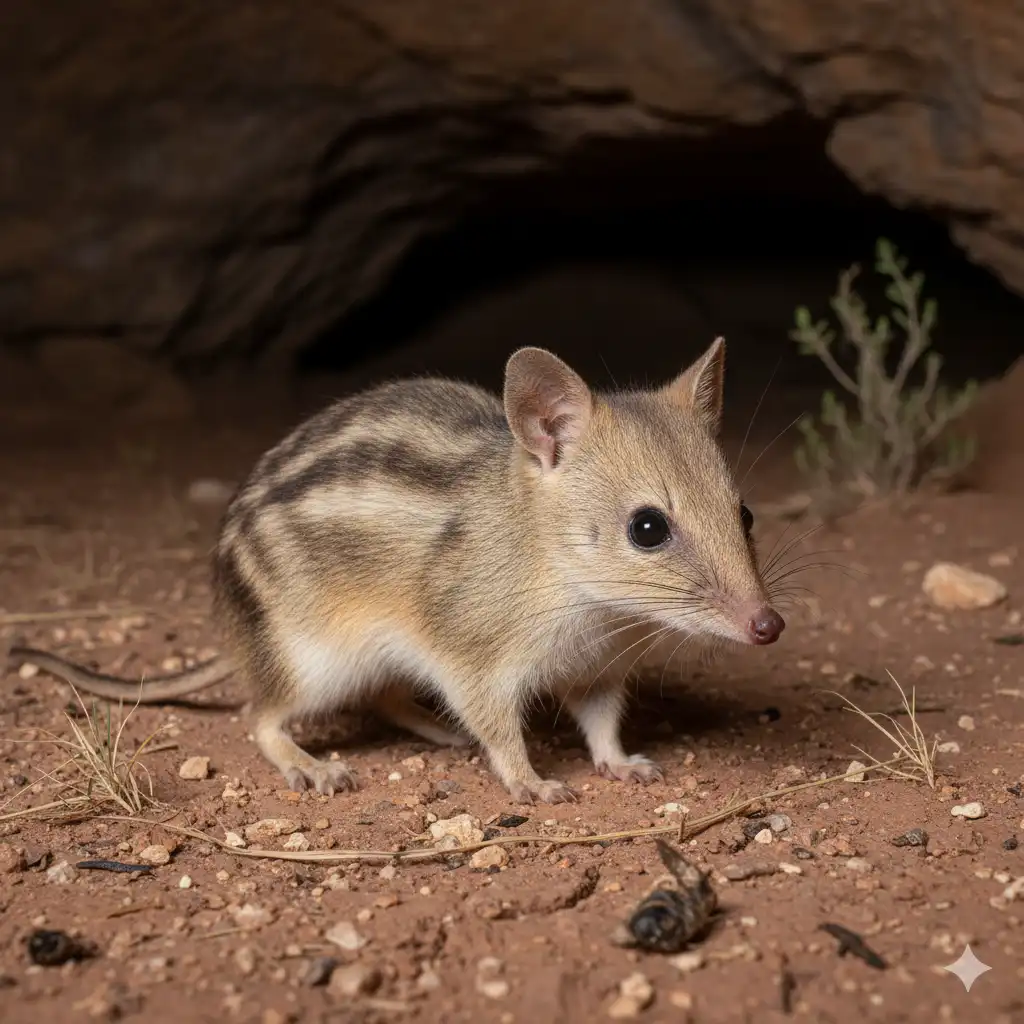
Epitaph for the Butterfly Bandicoot: Nullarbor Barred Bandicoot

Earth Voices News in brief —October 2025

  • IUCN has listed the Nullarbor barred bandicoot (Perameles papillon) as Extinct (EX) in its 2025 global Red List update, released at the IUCN World Conservation Congress in Abu Dhabi.
  • This marks the species’ first global IUCN assessment, and it joins the Marl (P. myosuros) and South-eastern striped (P. notina) bandicoots in being newly recognised as extinct Australian marsupials.
  • Known only from a handful of subfossil and historical specimens from the Nullarbor Plain region; never recorded alive by science.
  • Its extinction reflects the collapse of small mammal communities across inland southern Australia during the late 19th and early 20th centuries, driven by introduced predators, habitat degradation, and drought stress.

Epitaph for the Butterfly Bandicoot

Ghost of the limestone sea,
you wore the dust like silk—
a small, bright hush beneath the moon.

No one heard your digging songs,
the soft rain of sand you left behind.
No one marked your passing,
only the wind kept count.

You were the flutter in the desert’s breath,
a heartbeat folded under stone.
Now your name is all that flies—
papillon,
a whisper of wings that never saw the sky.


Contextual background

The Nullarbor barred bandicoot (Perameles papillon) was identified from a limited number of subfossil remains and historical specimens, collected from caves and surface deposits across the Nullarbor Plain, an immense limestone plateau spanning southern Australia. Despite its delicate name—papillon, “butterfly” in French—this small, nocturnal insectivore was never seen alive by European naturalists. Its classification emerged only through modern taxonomic re-examination of museum material in the 21st century.

The IUCN’s 2025 Red List recognised P. papillon for the first time, placing it immediately in the Extinct category. Its loss is presumed to have occurred during the late 1800s or early 1900s, coinciding with the widespread decline of small arid-zone mammals after the introduction of foxes, feral cats, and rabbits. Combined with overgrazing, vegetation loss, and the fragmentation of refugia, these pressures devastated entire ecological guilds of soil-turning marsupials.

Although little direct knowledge of P. papillon survives, its existence hints at the diversity once thriving in Australia’s deserts and plains. The “butterfly bandicoot” stands as a symbol of the quiet extinctions that reshaped the continent’s ecology before systematic wildlife records began—reminding us that absence, too, has a history worth naming.

Latest Posts

More from Author

Greening Oslo: Discipline of the Possible

How Norway’s capital turned climate policy into budgets, procurement, and quieter...

Amsterdam, Netherlands: Water, Bicycles, and the Price of Success

Amsterdam is the city that other cities dream of becoming. Its...

Vienna – Green Social Housing as Climate Policy

GREEN CITIES SERIES  |  ARTICLE 3 For a century, Vienna has built...

The Cryosphere in Flux: Glaciological Systems, Dynamics, and Climatic Response

1. Introduction: The Global Cryosphere and Glaciological Significance The cryosphere, derived from...

Read Now

Greening Oslo: Discipline of the Possible

How Norway’s capital turned climate policy into budgets, procurement, and quieter streets — and why even Oslo is not yet a finished green city Standfirst Oslo is often invoked as proof that urban decarbonisation can move from aspiration to administration. The Norwegian capital has electrified large parts of its...

Amsterdam, Netherlands: Water, Bicycles, and the Price of Success

Amsterdam is the city that other cities dream of becoming. Its cycling culture is imitated on every continent; its canal ecology has been recovered from near-death to become a European benchmark; its commitment to public space and human-scale urbanism has generated a literature of admiration so extensive...

Vienna – Green Social Housing as Climate Policy

GREEN CITIES SERIES  |  ARTICLE 3 For a century, Vienna has built homes that shelter half its population from the market. Now the same political tradition that gave the city its Gemeindebauten is attempting something even more ambitious: to decarbonise a metropolis of two million people without making...

The Cryosphere in Flux: Glaciological Systems, Dynamics, and Climatic Response

1. Introduction: The Global Cryosphere and Glaciological Significance The cryosphere, derived from the Greek word kryos meaning cold, constitutes the frozen water component of the Earth system. It is a fundamental regulator of the global climate, a primary reservoir of freshwater, and a potent geomorphological agent that has...

The Sapphire Empire: A Chronicle of Britain’s Blue Belt and the Resurrection of the Wild

Introduction: The Map and the Territory The ocean is a memory. It remembers the iron taste of the harpoon and the heavy drag of the trawl. It remembers the silence of the extinction and the cacophony of the hunt. But it also remembers how to heal. Beneath the...

The AI Landscape of April 2026: Agents, Alignment, and the Quiet Politics of Machine Intelligence

The artificial intelligence industry has always oscillated between the roar of spectacle and the cold logic of consolidation. If late 2025 was defined by a "Cambrian explosion" of frontier models—a dizzying period of multimodal breakthroughs and benchmark obsession—then April 2026 represents the arrival of a "Permian" maturity....

The Chromatic Deception: The Systemic Degradation of the Global Salmon Commons

A forensic autopsy of Big Salmon, exposing the ecological collapse, regulatory rot, and colonial theft behind the industry's dyed pink flesh.

The Architects of Memory: An Investigative Report on the Elephant in the Anthropocene

From the deep-time silence of the Eocene swamps to the seismic rumblings of the modern savanna, the elephant is not merely a charismatic giant but the keystone of our planetary machinery—and its dismantling is a crisis of both biology and conscience. Introduction: The Silence of the Giants In the...

David Abram: Perception, Language, and the More-Than-Human World

I. The Prestidigitator at the Edge of the World In the landscape of contemporary ecological philosophy, David Abram cuts a figure both enigmatic and essential. He is not a scientist in the conventional sense, tallying parts per million of carbon dioxide or cataloguing extinction rates, though his work...

The Large Language Model Landscape of March 2026

The agent economy emerges: browsers, sovereign stacks, and the quiet consolidation of intelligence March 2026 feels strangely calm for an industry that only months ago seemed permanently electrified. The headlines have slowed. The benchmark fireworks have dimmed. Yet beneath the surface the machinery of artificial intelligence is turning faster...

Singapore: Engineered Nature in a Tropical City-State

GREEN CITIES SERIES  |  ARTICLE 4 Singapore has spent sixty years turning a cleared island into a green city, and the results are, in many respects, extraordinary. But the question the city-state now faces is different from the ones it has already answered: how do you make a...

Paris, or the Hard Work of a Breathing City

Green Cities Series | Article 02 How the French capital turned against the car, rewrote its streets, and discovered that a green city is not a mood but a struggle Paris has become one of the emblematic urban transformations of the climate era. In the space of two decades,...