

GREEN CITIES SERIES | ARTICLE 8
Every Sunday, Bogotá returns the streets to its people. That act — repeated for fifty years, in a city of nine million at 2,600 metres above sea level, in a country still reckoning with decades of violence — is both a practical environmental intervention and a claim about what cities are for. The harder question is whether the claim can be made to hold for everyone who lives here.
On a Sunday morning in the Chapinero neighbourhood, the city sounds different. The diesel roar that defines Bogotá’s weekday air — and its weekday lungs — has been replaced by something closer to silence, punctuated by bicycle bells and the distant music of a free aerobics class. The avenue is 120 kilometres of it, closed to cars from seven until two: the Ciclovía, which has been happening every Sunday since 1974 and which now draws roughly two million people each week to cycle, run, skate, and walk the routes that traffic ordinarily makes impassable. A grandmother pushes a pram alongside a young man on a racing bike. A group of teenagers navigate the junction on rented scooters. Old men sit on benches watching, as if the street has temporarily become a park — which, for these seven hours, it has.
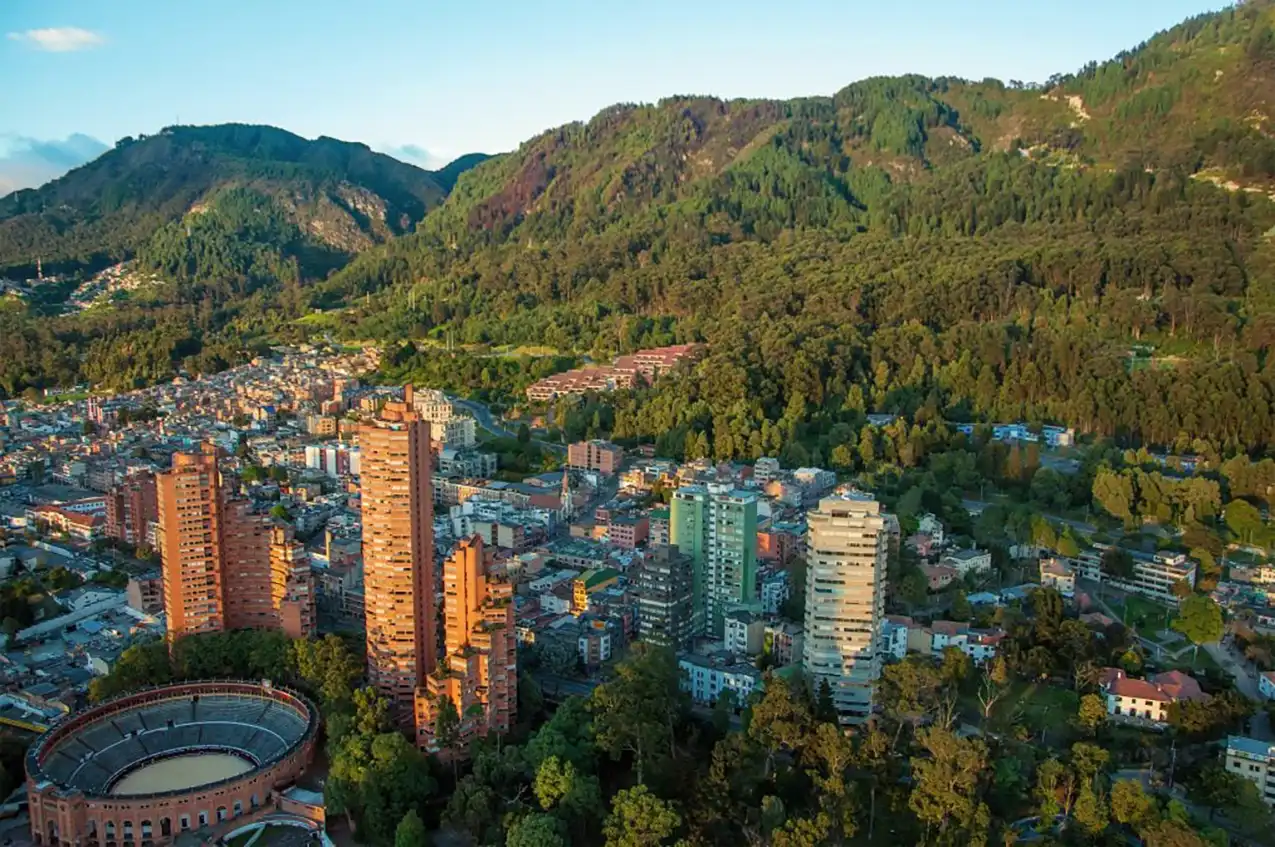
The Ciclovía is the most visited fact in Bogotá’s environmental biography, and rightly so. But it is also a fact that requires context to be properly understood. The city that opens its streets on Sundays is, on the other six days, one of the most congested and polluted in South America. In 2023, Bogotá’s average concentration of PM2.5 — fine particulate matter that lodges in lung tissue and drives cardiovascular disease — measured more than three times the World Health Organization’s recommended limit. In 2019, poor air quality was estimated to have caused around 2,300 excess deaths. The city’s mountainous geography compounds the problem: nestled in a high Andean basin, Bogotá’s terrain traps emissions the way a bowl holds water. The very landscape that gives the city its dramatic setting holds its pollution close.
What makes Bogotá worth studying is not that it has solved these problems but that it is attacking them with unusual directness, from an unusual starting point. This is a city in the Global South, with levels of poverty and inequality that most of the cities in this series do not face, which has nonetheless built the largest cycle path network in Latin America, one of the world’s biggest electric bus fleets, and a prize-winning programme to bring clean air specifically to its most polluted and most disadvantaged neighbourhoods. It has done this, moreover, without the institutional continuity or fiscal resource that Vienna or Singapore can call upon, sustained instead by episodic surges of political will separated by periods of regression. That combination of ambition and fragility is what makes the Bogotá story both instructive and unresolved.
The City That Remade Itself
To understand what Bogotá has built, you need to understand what it was rebuilding from. In the early 1990s, the city had the highest homicide rate of any capital in the world. The state functioned poorly and was mistrusted intensely. Public space was dominated by informal vendors, speeding buses, and the threat of violence. The idea that streets could be shared democratic spaces, or that cycling could be a safe option for ordinary people, would have seemed delusional. Bogotá was a city in which the wealthy moved in private cars, the poor endured chaotic informal buses, and the street was something to be crossed as quickly as possible.
The transformation that began under Mayor Antanas Mockus, elected in 1995, and was extended by Mayor Enrique Peñalosa from 1998, is one of the more remarkable episodes in the history of urban governance. Mockus, a mathematician-philosopher, came at the problem culturally: he dressed as a superhero to enforce traffic laws, hired mimes to shame jaywalkers, and distributed tens of thousands of card sets to citizens so they could signal approval or disapproval at their fellow residents’ behaviour. The approach was eccentric and, by most accounts, unexpectedly effective at reweaving civic trust in a city where it had nearly collapsed.
Peñalosa came at it physically. He banned cars from the city centre during peak hours on weekdays. He built hundreds of kilometres of cycleways, turning an idea that felt radical in Bogotá’s context into a permanent feature of the urban fabric. He constructed the TransMilenio bus rapid transit system — dedicated lanes, elevated boarding platforms, articulated buses — in a city that had never had reliable mass transit. He also built parks and libraries in the poorest peripheral neighbourhoods, on the explicit philosophical grounds that public investment in quality space was an act of civic equality: if a poor community had the same quality of library and park as a wealthy one, the city was making a statement about the equal worth of its citizens.
These mayors did not fix Bogotá. Homicide rates fell from a peak of 80 per 100,000 in the early 1990s to roughly 17 per 100,000 by 2010, but violence remained endemic. Poverty remained severe. Informal employment was pervasive. The city continued to grow rapidly and chaotically. What they changed was the relationship between the city and the idea of public space — and that change, though partial and uneven, proved durable enough to survive subsequent mayors who were less interested in sustaining it.
The Architecture of a More Breathable City
The cycling infrastructure that Peñalosa began has continued to grow. Bogotá now has more than 560 kilometres of dedicated cycle lanes — the ciclorrutas — the most extensive network in Latin America. Cycling’s share of daily trips grew from under 1% in the late 1990s to an estimated 8% by 2019, representing around 900,000 trips per day. Mayor Claudia López added 84 kilometres of emergency lanes during the COVID-19 pandemic in 2020, responding to the collapse of crowded public transport with rapid infrastructure that was widely used and substantially retained. The bicycle has become, in the space of roughly twenty years, a normalised urban transport mode for a significant minority of Bogotá’s population — a genuine cultural shift in a city where cycling was historically associated with neither recreation nor commuting.
TransMilenio, which carried 18,618 passengers on its first day of operation in December 2000, now moves more than four million people daily across a fleet of over 10,000 buses — one of the largest BRT systems anywhere. The system celebrated its 25th anniversary in December 2025 with an operating record, but also with documented overcrowding at peak hours and a reputation for unreliability that has eroded public trust over the years since its launch. Crucially, it is mid-transformation: 1,486 of its buses are now electric, with a further 705 electric vehicles contracted to arrive in 2026 and 2027. The fleet electrification, supported by partnerships with Chinese manufacturers and international climate finance, has materially reduced the system’s emissions and is expected to continue.
Three cable car lines — the TransMiCable — now connect hillside communities in Ciudad Bolívar, San Cristóbal, and other peripheral barrios to the TransMilenio network below. These are not tourist attractions. They are functional commuter infrastructure for communities that grew up on steep slopes inaccessible by road, whose residents previously faced hour-long walks down to the nearest bus stop and the corresponding ascent returning home. The cable cars have cut commute times, reduced physical exhaustion, and — by extending the public transport network into areas that had essentially been disconnected from it — begun to address the spatial inequality that has long defined Bogotá’s geography.
Then there is the metro. Bogotá has been discussing building a metro since the 1940s, and the project has collapsed into political dysfunction so many times that the residents who celebrated the first metro train’s arrival from Qingdao, China, in September 2025 were celebrating not just a construction milestone but the survival of an idea through eighty years of sabotage and neglect. Line 1 — 23.9 kilometres, 16 stations, elevated above Caracas Avenue — reached 60% construction completion by August 2025 and is committed to opening in March 2028. A World Bank loan of $530 million, approved in December 2025, is financing the most intensive phase of construction. When it opens, each six-car train will carry up to 1,800 passengers per trip, the equivalent of seven articulated buses. The system is projected to reduce 171,000 tonnes of CO2 annually.
Clean Air as a Right: The ZUMA Experiment
The most original of Bogotá’s recent environmental initiatives is also the most explicitly political. The ZUMAs — Zonas Urbanas por un Mejor Aire, urban zones for better air — are defined geographic areas in which the city coordinates multiple interventions simultaneously: greening, road paving, pedestrianisation, electric bus routing, freight restrictions, and the placement of schools and childcare facilities. The zones are selected not for their visibility or their proximity to wealthy residents, but for the intersection of two criteria: the worst air quality and the worst socioeconomic conditions.
The premise is backed by research. A study by economists Jorge Bonilla and Claudia Aravena, published in Environmental and Resource Economics and substantially influencing Bogotá’s planning policy, found that environmental inequalities in Bogotá track social and economic inequalities with uncomfortable precision: the communities facing the greatest poverty are also those breathing the most polluted air. In the southwest of the city — in barrios like Bosa and Kennedy — PM2.5 concentrations are highest, partly because of industrial activity and heavy traffic, and partly because unpaved streets generate fine dust that asphalt roads do not. The ZUMA programme treats air quality as a justice issue, not an environmental one, though it is self-evidently both.
The Bosa ZUMA, launched in 2022, has become the flagship. Greenery was installed at schools and health centres. Roads were paved. Pedestrian zones replaced through-traffic on key streets. Electric buses were given priority on local routes. The results, measured over the subsequent years, have been sufficiently compelling to attract international recognition: in November 2025, Bogotá was named one of the five winners of the Earthshot Prize, specifically for its Clean Our Air work, the city’s most prestigious environmental award to date. Mayor Carlos Fernando Galán has committed to expanding the ZUMA approach across the city by 2027, with targets including 1,500 new trees, over 2,700 gardens, 362 urban gardens, and three urban forests. His framing of the programme carries an explicit equity charge: ‘Clean air should not be a privilege. With the ZUMAs we are bringing environmental action to neighbourhoods that have carried the heaviest burden for too long.’
The 2024 Barrios Vitales initiative extended similar logic to urban redesign: in the San Felipe neighbourhood, a comprehensive co-design process led to pedestrian zones, bike lanes, green spaces, and benches that together raised public transit use by 81% and cycling and scooter use by 82%. The share of trips made on foot increased from 16% to 21%. These are striking numbers for a single neighbourhood intervention, and they suggest that place-based, community-designed environmental improvements can shift behaviour faster than infrastructure investment alone.
The Contradictions: Inequality, Politics, and Unfinished Reform
Bogotá’s achievements exist inside a city of deep and persistent inequality that they have not yet transformed. Greenpeace reported in 2020 that 80% of Bogotá’s population lived with a deficit of green areas by WHO standards. Leafy streets, well-maintained parks, truck-free zones, and good air quality remain concentrated in the wealthier northern barrios. The ZUMA programme is an explicit response to this geography of environmental injustice, but it is targeting a problem that has accumulated over decades and will not be corrected by a mayoral term’s worth of tree planting.
The cycling infrastructure, for all its extent, also reproduces elements of the city’s spatial inequality. The ciclorrutas are significantly better maintained and safer in wealthier areas of the city. Safety perception on cycling infrastructure is a documented barrier to use, particularly for women and for residents of peripheral barrios where bike lanes feed into roads that remain dangerous and poorly lit. The 8% modal share for cycling is real, but it conceals significant variation by income, gender, and geography. Cycling in Bogotá is not yet as democratic as the Ciclovía aspires to make it.
TransMilenio’s overcrowding problem is chronic and worsening as the city grows. The system was designed for a city of roughly seven million and is now serving one of nine million, with further growth projected. At peak hours on trunk corridors, conditions can be severe — long waits, dangerous crowding on platforms, and a passenger experience that has contributed to repeated violent protests against the system, most recently in 2021 when demonstrators burned stations during the social unrest triggered by a proposed tax reform. The metro will provide crucial additional capacity when it opens in 2028, but the decade-long gap between the system’s founding and the metro’s arrival has been borne disproportionately by the poorest daily commuters.
Perhaps the most serious structural challenge is political continuity. Bogotá’s mayors serve four-year terms and cannot be re-elected, and each administration has tended to define itself partly by differentiating itself from its predecessor. The cycling infrastructure and Ciclovía have survived this turnover, embedded deeply enough in civic culture that no mayor would dare remove them. But other initiatives have not fared as well. Environmental programmes launched under one administration have been deprioritised or defunded by the next. The ZUMA approach, launched under López and expanded under Galán, is serious and well-designed, but its ability to survive a change in mayoral priorities is not guaranteed. The absent ingredient in Bogotá’s environmental story — the one that Vienna has in abundance and Bogotá consistently lacks — is institutional continuity.
The city also faces its own version of the political economy that makes green investment difficult everywhere: the taxi and trucking industries, the informally organised transport sector, and the residents of wealthy northern barrios who resist through-traffic restrictions that inconvenience their cars, are all organised interests capable of obstructing reform. Peñalosa’s car restrictions in the late 1990s were watered down by subsequent administrations under pressure from precisely these groups. The metro’s delay of nearly a century is partly a story of political dysfunction and partly a story of the consistent ability of vested interests to halt infrastructure that would reduce private car dependence.
The Global South Laboratory
What Bogotá offers the world is something that Amsterdam or Vienna cannot provide: evidence that transformative urban environmental policy is possible in a context of high poverty, deep inequality, fiscal constraint, and institutional fragility. The city did not wait until it was rich to build cycling infrastructure. It did not wait until inequality was resolved to create public parks in poor neighbourhoods. It did not treat the lack of institutional continuity as a reason to avoid ambitious programmes. It tried things, measured them, and made the results visible — to its own citizens and to the hundreds of cities that have sent delegations to study TransMilenio, the Ciclovía, the ZUMAs, and the cable cars. In 2025 alone, TransMilenio hosted 30 international delegations seeking to understand how its operating model works.
The 24% reduction in air pollution between 2018 and 2024, achieved despite a growing population, is the strongest single metric of the city’s current environmental trajectory. It reflects the cumulative effect of fleet electrification, cycling modal shift, road paving in the southwest, and green space investment in the ZUMA zones. None of these interventions is individually transformative, but their combination — targeted spatially at the areas of greatest need, applied consistently across a six-year period spanning two different mayoral administrations — has produced a measurable change in the air that nine million people breathe.
The Ciclovía, now fifty years old, has done something that urban planning rarely achieves: it has changed what residents believe is possible. Two million people experiencing car-free streets every Sunday for five decades have developed a relationship with public space — a sense of entitlement to the street as shared domain, not a thoroughfare reserved for private vehicles — that is now a political resource. When mayors propose cycling infrastructure, or pedestrian zones, or bus lanes at the cost of car capacity, they can draw on an organised constituency of support that understands, from direct weekly experience, what they are being offered. The Ciclovía did not just improve health outcomes. It built civic appetite for a different kind of city.
The City the Street Promised
On a Sunday afternoon in Bosa, in the southwest of the city where the ZUMA programme has been making its most visible interventions, a group of children plays in a new pocket park adjacent to a recently paved road. Their school, a few streets away, has been planted with trees and equipped with air quality sensors. The PM2.5 readings on those sensors are still above WHO limits. The changes are real but insufficient. The distance between the Ciclovía’s vision of the street as democratic space and the daily reality of those streets — the pollution, the overcrowding on buses, the unpaved roads that have not yet been reached by the ZUMA programme, the crime that still makes cycling a calculation rather than a pleasure for many residents — is the distance between a city’s best self and its actual one.
That distance is not unique to Bogotá. What is distinctive here is that the city has chosen to measure it honestly, to state it publicly, and to pursue policies that are explicitly designed to close it from the bottom up rather than from the top down. The ZUMA framework names the places of greatest injustice and directs resources there first. The cable cars connect the hillside barrios before the wealthier flatlands get their parks upgraded. The metro, when it opens, will link the southwest — the most polluted, most densely poor quadrant of the city — to the city’s core.
Bogotá’s lesson for other cities is neither the bus rapid transit system nor the cycling network nor the Ciclovía in isolation. Those can all be copied, and many cities have copied them with varying degrees of success. The deeper lesson is about the relationship between environmental ambition and democratic commitment. The cities in this series that have achieved the most durable environmental gains — Vienna, Amsterdam, Singapore — have done so partly because they had the institutional resources and political continuity to sustain programmes through changes in administration. Bogotá has achieved comparable results, in more difficult conditions, by a different route: by embedding environmental reform in civic culture, by making the street itself the argument, and by being explicit that clean air and green space are not amenities but rights.
Every Sunday the streets open, and the argument is made again. It is not yet won. But in a city that was pulling itself apart thirty years ago, the fact that the argument is being made at all, consistently, at the scale of millions, is itself a form of proof.
Endnotes
1. Ciclovía founded December 1974 by Jaime Ortiz Mariño; made official by mayoral decree in 1976. Now covers over 120 km of routes every Sunday, drawing approximately 2 million participants weekly. Has inspired similar programmes in more than 400 cities worldwide. Source: Wikipedia, ‘Ciclovía’; World Economic Forum, ‘Ciclovía at 50’ (November 2024); Revolve Media (March 2025).
2. Bogotá PM2.5 concentration in 2023 measured more than three times the WHO recommended limit. Estimated 2,300 excess deaths from air pollution in 2019. Source: World Resources Institute, ‘Bogotá, Colombia, Uses Data and Smart Urban Design to Cut Air Pollution’ (October 2025).
3. Antanas Mockus (mayor 1995–97, 2001–03) and Enrique Peñalosa (mayor 1998–2000, 2016–19) as key transformative figures. Homicide rate peak approximately 80 per 100,000 in early 1990s. On Peñalosa’s approach to public space as civic equality, and on TransMilenio’s founding: World Economic Forum, ‘How bikes and buses helped Bogotá go green’ (2014).
4. Bogotá cycle network: over 560 km of ciclorrutas, the largest in Latin America. Cycling modal share grew from under 1% in late 1990s to approximately 8% (around 900,000 trips per day) by 2019. Source: ITDP, ‘From Transmilenio to Cycle Networks’ (2023); Secretaría Distrital de Movilidad, Encuesta de Movilidad 2019.
5. TransMilenio 25th anniversary figures (December 2025): over 4 million daily trips, fleet of 10,509 buses including 1,486 electric, 143 TransMiCable cabins, approximately 35,000 workers. 705 more electric buses contracted for 2026–27. Source: Colombia One, ‘TransMilenio Turns 25’ (December 2025).
6. Three TransMiCable cable car lines serving Ciudad Bolívar, San Cristóbal, and other hillside communities. Connecting peripheral barrios to TransMilenio network. Source: Earthshot Prize, City of Bogotá finalist profile (2025); The Optimist Daily (February 2026).
7. Bogotá Metro Line 1: 23.9 km, 16 stations, elevated viaduct. Construction reached 60% by August 2025, first train arrived from Qingdao September 2025, commercial operations targeted March 2028. World Bank $530 million loan approved December 2025. Expected to reduce 171,000 tonnes CO2 annually. Project nearly a century in planning. Source: World Bank press release (December 2025); City Paper Bogotá (March 2025); Railway Pro (January 2025).
8. ZUMA (Zonas Urbanas por un Mejor Aire) programme: zones defined by intersection of worst air quality and worst socioeconomic conditions. Research basis: Bonilla and Aravena, ‘Assessing Multiple Inequalities and Air Pollution Abatement Policies’, Environmental and Resource Economics. Bosa ZUMA as flagship. Bogotá won Earthshot Prize 2025 ‘Clean Our Air’ category. Source: Earthshot Prize profile (2025); EfD Initiative analysis; The Optimist Daily (February 2026); Bogota.gov.co (February 2026).
9. Barrios Vitales 2024 initiative in San Felipe: public transit use increased 81%, cycling and scooter use up 82%, walking share rose from 16% to 21%. Source: WRI (October 2025).
10. Greenpeace 2020 report: 80% of Bogotá’s population lived with a deficit of green areas by WHO standards. Green space and truck-free zones concentrated in wealthier northern barrios. Source: The Bogotá Post, ‘Bogotá wins Earthshot Clean Our Air Prize’ (November 2025), citing Greenpeace data.
11. 24% reduction in air pollution (PM2.5) between 2018 and 2024 despite population growth. Source: City of Bogotá official communication citing Earthshot Prize submission data; The Guardian coverage cited in Bogota.gov.co (February 2026); Earthshot Prize finalist profile (2025).
12. On political continuity as structural challenge: ITDP analysis (2023); broader context of four-year mayoral terms with no re-election in Colombian municipal governance. On 2021 protests and TransMilenio station burnings during social unrest: widely covered in Colombian media.
Source Note
This article draws primarily on official Bogotá city government sources (bogota.gov.co, including English-language communications on the metro, ZUMAs, and Earthshot Prize), supplemented by World Resources Institute reporting (October 2025) on the Barrios Vitales initiative and air quality, the Earthshot Prize finalist profile (November 2025), the World Bank’s metro loan announcement (December 2025), and Colombia One’s TransMilenio 25th anniversary analysis (December 2025). Historical context on the Mockus-Peñalosa transformation draws on World Economic Forum reporting (2014) and the ITDP’s comprehensive analysis of Bogotá’s mobility evolution (2023). Air quality inequalities are addressed through EfD Initiative research on Bonilla and Aravena’s work. Housing, security, and cycling modal share figures draw on academic sources including ScienceDirect and the Secretaría Distrital de Movilidad’s 2019 Mobility Survey. The Ciclovía’s history and global influence is drawn from the World Economic Forum’s 50th anniversary analysis (November 2024) and Wikipedia’s well-sourced article on the programme.
Further Reading / Watching
Enrique Peñalosa, ‘Why buses represent democracy’ (TED Talk, 2013) — the most concise statement of the philosophical argument behind Bogotá’s transport revolution, made by the mayor who built much of it.
Anika Goss and Sasha Tsenkova (eds.), The Urban Transformation of Bogotá (various academic publishers) — a scholarly treatment of the Mockus-Peñalosa era and its longer-term consequences.
ITDP, ‘From TransMilenio to Cycle Networks: Lessons Learned from Bogotá’s Comprehensive Urban Mobility Planning’ (2023) — a detailed technical assessment of what worked, what didn’t, and what other cities can draw from Bogotá’s experience.
Clean Air Fund, Breathe Cities programme reporting on Bogotá — the most up-to-date monitoring of PM2.5 trends and the ZUMA programme’s measured outcomes across different neighbourhoods.


