

GREEN CITIES SERIES | ARTICLE 14
Twenty-two million people live in a basin with no natural drainage, on a lakebed that is disappearing beneath their feet, in a city that floods in the rain and thirsts between storms. Mexico City’s water crisis is not a failure of technology or political will alone — it is the accumulated consequence of five centuries of fighting a hydrology that cannot be defeated, only accommodated. The question now is whether accommodation has arrived too late.
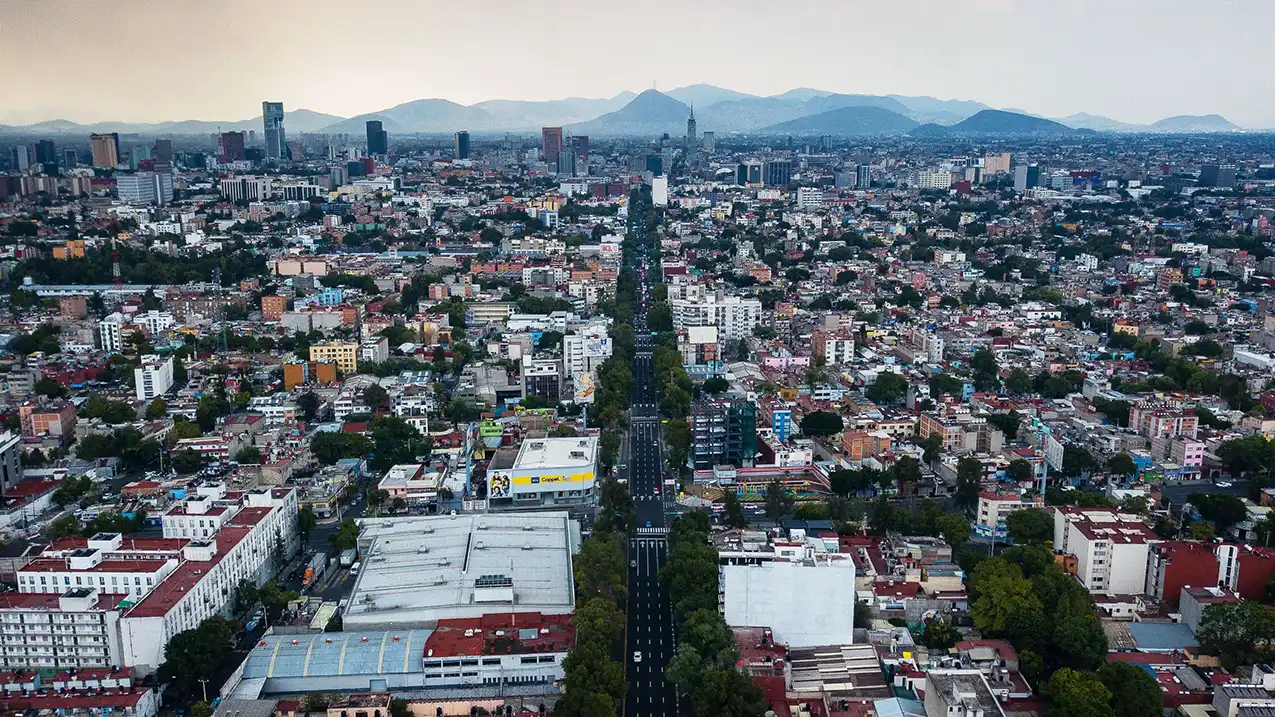
In the summer of 2023, as the rainy season built toward its August peak, a stretch of Insurgentes Avenue — the longest urban thoroughfare in the Americas, the arterial spine of Latin America’s largest city — vanished beneath two metres of water. Cars were abandoned. Buses stalled mid-street. Residents in ground-floor apartments watched the brown water rise through their doorframes with the dull recognition of something that had happened before and would happen again. Photographs circulated on social media of children wading through flooded intersections, backpacks held above their heads, navigating a cityscape temporarily restored to something closer to its original condition: a lake.
Two months later, in the dry season, the city’s water utility was rationing supply to large parts of the metropolitan area on a schedule that left some neighbourhoods without running water for days at a time. The Sistema Cutzamala — a vast network of pumps, tunnels, and reservoirs that lifts water from a watershed 127 kilometres away and more than a thousand metres below the city — was operating at roughly forty percent of its design capacity, its reservoirs depleted after a dry winter and spring.1 Residents in wealthier districts called their water delivery trucks; residents in informal settlements on the periphery lined up with plastic barrels and waited.
This is the central paradox of Mexico City’s hydrological condition: a metropolis that simultaneously floods and thirsts. It is not a paradox that admits an easy resolution, because its roots are not technical. They are historical, political, geological, and ecological — accumulated across five centuries of a single catastrophic decision: that the lake on which the city was built should be drained.
The City That Ate Its Lake
Tenochtitlán, the Aztec capital that Hernán Cortés encountered in 1519, was among the largest and most sophisticated cities in the world. Built on an island in the middle of Lake Texcoco — a vast, shallow, saline and freshwater lake system that covered much of the Valley of Mexico — it was a city of canals, causeways, floating gardens, and hydraulic engineering of extraordinary ingenuity. The Aztecs did not drain their lake. They lived with it, within it, and through it.
The Spanish destroyed the city in 1521 and immediately set about draining the lake it sat on. The logic was partly military — a drained lake was easier to control than a waterway network — and partly ideological: the lake was disorderly, unpredictable, prone to flooding, and incompatible with the rectilinear grid that Spanish colonial urbanism required. Over the following three centuries, a series of drainage works — the Gran Desagüe, a massive canal and tunnel system begun in 1607 — progressively removed water from the basin, converting the lakebed to agricultural and eventually urban land.2 By the late twentieth century, nearly all of the lake system was gone. What remained was a city of twenty-two million people sitting on the dried sediments of a vanished hydrological world.
The consequences of that vanishing were not immediately obvious and are still unfolding. Lake clay, when saturated, is buoyant; when dried and loaded with the weight of a metropolis, it compresses. Mexico City has been sinking since the beginning of the drainage project, but the rate of subsidence accelerated dramatically in the twentieth century as groundwater extraction for the growing city’s water supply emptied the aquifers beneath the lakebed sediments. In the downtown historic centre — built on the deepest lake clay — the city has sunk by as much as nine to ten metres over the past hundred years.3 The sinking continues at rates of between fifteen and thirty centimetres per year in some districts. Buildings tilt and crack. The old colonial churches of the centre list at angles that would be alarming in a new structure. The subway tunnels warp. The drainage infrastructure designed for a city at one elevation operates inefficiently in a city that has resettled itself below it.
The Aztec acequias — the canal network that carried clean water from the mainland springs of Chapultepec to the island and removed waste to the lake margins — were filled in during the nineteenth and early twentieth centuries as the city expanded and the canals became polluted and politically associated with backwardness. Xochimilco, the southern borough where a network of artificial islands and canals — the chinampas — survives as the last living remnant of Aztec lake agriculture, shrank from a continuous wetland system to an isolated fragment, cut off from the springs that once fed it and contaminated by the urban drainage that surrounds it.
What this history produced is not merely an environmental problem but a structural mismatch: a city that requires external water because it destroyed its internal water system, that floods because it removed the natural infrastructure that had managed flooding for centuries, and that sinks because it extracted the groundwater that had supported its foundations. The problems are inseparable, and they were always inseparable. Understanding that inseparability is the precondition for addressing any of them.
The Anatomy of a Crisis
Mexico City gets rain — a great deal of rain. The valley receives between 700 and 900 millimetres of precipitation annually, the vast majority falling between May and October in intense afternoon and evening storms.4 The problem is not rainfall scarcity. The problem is that the infrastructure built to remove water from the basin removes it faster than the city can benefit from it, while simultaneously failing to remove it fast enough to prevent flooding.
The Emisor Central — the Great Drainage Tunnel built between the 1960s and 1975 — is the principal piece of this infrastructure: a six-metre-diameter deep tunnel, running 50 kilometres from the city’s centre to the Tula Valley in the state of Hidalgo, designed to carry floodwaters out of the basin at high velocity.5 For decades it worked. But the tunnel was designed for a city of perhaps twelve million people, not twenty-two million, and its inlets — the drainage network of streets, gutters, and secondary tunnels that feed into it — are clogged, aged, and overwhelmed by the volume of impervious surface that urban expansion has generated. The city’s original soil, a combination of lake clay and volcanic tepetate, absorbed rainfall with some efficiency. The asphalt and concrete that replaced it absorbs almost nothing.
A second mega-tunnel, the Túnel Emisor Oriente (TEO), was completed in 2019 after a decade of construction — a 62-kilometre deep-drainage tunnel running beneath the city at depths of up to 150 metres, designed to add capacity to the drainage system and reduce flood risk across the metropolitan area.6 Its completion represented an enormous engineering achievement. It has not eliminated flooding. In heavily built-up and low-lying boroughs such as Iztapalapa and Chalco — which sit in the areas of deepest lake clay, experience the most severe subsidence, and have the lowest household incomes in the metropolitan area — flooding during heavy storms remains frequent and dangerous. The drainage infrastructure and the social geography of the city have a relationship that is not coincidental: the poorest communities live where the land sinks fastest and where the water goes when the tunnels are overwhelmed.
Meanwhile, groundwater extraction continues. Despite official restrictions, illegal and semi-legal drilling of wells remains widespread across the metropolitan area, particularly in the informal settlements of the eastern and northern periphery where connection to the formal water network is incomplete.7 Every litre extracted from the clay aquifers accelerates the subsidence that damages the drainage infrastructure that causes the flooding that makes the water shortage worse. The feedback loops are not theoretical. They are measured in centimetres of annual sinkage and in the slowly widening cracks in the walls of tens of thousands of homes.
Climate change is not creating this situation. It is intensifying it. Projections for central Mexico anticipate reduced rainfall overall, with a shorter but more intense rainy season — meaning more water arriving faster when it does arrive, and longer dry-season deficits.8 The Sistema Cutzamala, which draws its water from reservoirs in the State of Mexico and Michoacán, is already showing multi-year declines in storage that reflect shifting precipitation patterns in its highland catchments. The aquifer beneath the city cannot be replenished fast enough to compensate for what the Cutzamala system fails to deliver. The arithmetic of the water system is heading in a direction that cannot be managed simply by building another tunnel.
The Unequal Geography of Thirst
The water crisis does not present itself equally across the metropolitan area, and the unequal geography of access is inseparable from the unequal geography of the city itself.
In the wealthy districts of Lomas de Chapultepec, Polanco, and Pedregal de San Ángel — suburbs built largely on the volcanic rock of the Pedregal or on the elevated terrain of the western hills, away from the deepest lake clay — water pressure is generally adequate, service is regular, and the municipal supply is supplemented without difficulty by private water trucks whose costs are invisible in household budgets of sufficient size. Green gardens are irrigated. Swimming pools are filled. The city’s water crisis, in these neighbourhoods, is a concern expressed over breakfast rather than a condition experienced in the body.
In Iztapalapa — a borough of almost two million people in the east of the city, built on the lowest and most unstable lakebed sediments, with some of the highest rates of subsidence and the highest concentrations of poverty in the metropolitan area — the situation is different. Piped water supply has historically been intermittent and unreliable, with many households receiving water only every few days through a tandeo system that rotates supply across the borough’s distribution network.9 The cost of supplementary water truck delivery — the pipas that serve millions of households across the metropolitan area — falls hardest on the poorest families, who pay per litre rates that can be six to eight times higher than the subsidised tariff charged to wealthier households connected to continuous mains supply. Water poverty is not the absence of water; it is paying more for less, at the bottom of a social geography designed to deliver the opposite.
Iztapalapa is also where the flooding is worst. The borough’s location at the historical terminus of Lake Texcoco, combined with its extreme subsidence and its high proportion of impervious surface, means that intense storms produce inundations that can last for days. The same households that cannot always access clean water are the households most likely to have their floors and belongings destroyed by floodwater — often contaminated with sewage from the overwhelmed drainage system. The juxtaposition of simultaneous flood and thirst in the same community, affecting the same families, is not an irony. It is the logical output of a hydrology that has been managed in the interests of the wealthy and at the expense of the poor for five centuries.
The Megaprojects and Their Limits
The Mexican government’s response to Mexico City’s water crisis has historically been dominated by megaprojects: large-scale engineering works that address the symptoms of the crisis — flooding, shortage — without altering the underlying conditions that produce it. The Emisor Central, the Cutzamala system, and the TEO are all expressions of this approach. They are genuinely impressive pieces of infrastructure, and without them the metropolitan area would have faced catastrophic flooding and supply failures decades earlier. But they have also permitted successive governments to defer the harder structural changes that the basin’s hydrology demands.
The most significant recent initiative is the Plan Hídrico del Valle de México, a framework developed under successive federal and city administrations for integrating flood control, water supply, groundwater recharge, and wastewater treatment into a coherent metropolitan water strategy.10 The plan includes expansion of the Cutzamala system’s treatment capacity, investment in aquifer recharge through infiltration wells and spreading basins, rehabilitation of the secondary drainage network in the most flood-exposed boroughs, and — most significantly — a commitment to large-scale wastewater recycling that could, in principle, reduce the city’s dependence on external water sources.
The recycling of wastewater is where the most interesting technical and political work is currently concentrated. Mexico City produces enormous volumes of treated wastewater — water that is currently discharged through the drainage tunnels into the Tula Valley in Hidalgo, where it is used for irrigation with the unresolved public health issues that brings.11 The proposal to treat this water to a higher standard and reinject it into the aquifer — artificial recharge as a substitute for the natural recharge that the drained lake system once provided — is both technically viable and politically complicated. It requires coordination between the federal government, Mexico City’s administration, the State of Mexico, Hidalgo, and CONAGUA (the national water commission), each of which controls different elements of the relevant infrastructure and has different interests in the outcome.
At the scale of individual boroughs, the most ambitious programme has been in Iztapalapa. Under Mayor Clara Brugada — who governed the borough from 2019 to 2023 before running for city government — Agua Segura para Iztapalapa deployed a combination of household water storage tanks, distribution network rehabilitation, and community water brigades to substantially improve daily supply to households that had previously received water only two or three times per week.12 The programme did not resolve the borough’s structural water deficit, which ultimately depends on regional supply and aquifer replenishment that no borough-level initiative can deliver. But it demonstrated that service equity improvements are achievable within existing constraints, and it built a model of community-engaged water management that the city’s new administration has expressed an intention to scale.
On flooding, the city has begun investing — slowly, partially, and with contested results — in green infrastructure as a complement to the grey engineering of tunnels and drains. The Programa de Cosecha de Agua deploys infiltration wells — pozos de absorción — at parks, schools, and public spaces across the city to capture stormwater and direct it to the aquifer rather than to the drainage network.13 By CONAGUA’s count, several hundred such wells had been constructed across the metropolitan area by the early 2020s. Engineers debate their effectiveness: in areas of deep lake clay, with low permeability, the infiltration rates achievable through conventional wells are limited, and the recharge volumes are modest relative to the aquifer’s deficit. In the volcanic rock zones of the south and west, where the substrate is naturally porous, the same wells can deliver substantially higher recharge. The city’s hydrogeological heterogeneity means that no single intervention works everywhere with equal effect.
Xochimilco: The Last Floating Garden
In the south of the city, reached by a light railway that runs through a landscape of greenhouses, canals, and the remainders of the ancient chinampería, Xochimilco is the most vivid and most poignant symbol of what Mexico City has lost and what it might, at enormous effort, partially recover.
The chinampas — artificial islands built up from layers of aquatic vegetation, mud, and staked willow — are among the most productive agricultural systems ever developed. In their original form, covering tens of thousands of hectares across the southern basin, they produced multiple harvests per year of vegetables, flowers, and maize, supported by the nutrient-rich lake water and the fertility of accumulated organic sediment. They were also ecological infrastructure: the labyrinthine canal network filtered water, regulated temperature, supported aquatic life including the axolotl — the extraordinary neotenic salamander endemic to the lake system — and maintained the hydrological connectivity of the southern basin.
Of the approximately 20,000 hectares of chinampa that once existed in the Valley of Mexico, roughly 2,000 survive in Xochimilco, Tláhuac, and Mixquic.14 They are threatened by urban encroachment from the informal settlements that continue to expand across the southern boroughs, by the declining quality of the water in the canals — receiving treated and untreated wastewater from surrounding communities — and by the changing economics of chinampa farming, which can no longer compete in price with produce grown in Sinaloa’s industrial greenhouses and trucked to the city’s wholesale markets. The farmers who remain are aging. Their children have other options.
The axolotl — listed as critically endangered by the IUCN, its wild population now confined to the remaining Xochimilco canals — has become both a mascot for ecological recovery and a barometer of the system’s condition. Surveys in the 2010s recorded populations approaching near-extinction in the canals most affected by urban water discharge and the introduced tilapia that outcompetes the axolotl for food.15 Restoration efforts — canal rehabilitation, water quality improvement, the removal of tilapia from targeted areas, and the establishment of axolotl refugia managed by chinampa farmers in partnership with the National Autonomous University — have produced modest population recoveries in some zones. But the axolotl’s long-term survival in the wild depends on the health of the whole hydrological system, and that system cannot be saved in Xochimilco without addressing what is happening to the water quality of the entire southern basin.
Xochimilco’s World Heritage status — designated by UNESCO in 1987, covering both the chinampas and the historic centre of Mexico City — has provided political protection and some funding for restoration. It has not, by itself, stopped the encroachment or improved the water. In 2019, the Mexican government and Mexico City’s administration launched a joint restoration programme for the Xochimilco ecological zone, including water quality interventions, chinampa rehabilitation, and controls on informal urban expansion into the designated zone. Results have been partial and contested. The encroachment continues, more slowly than before but without having stopped. The water quality improves in the zones receiving direct treatment and deteriorates downstream.
Beyond Water: Air, Heat, and the City’s Other Crises
Water is the defining environmental crisis of Mexico City, but it is not the only one. The metropolitan area’s air quality — shaped by the same bowl-like topography that concentrates flood risk, by the altitude (2,240 metres above sea level) that reduces oxygen content and combustion efficiency, and by a vehicle fleet of more than six million cars — remains far below WHO standards for particulate matter and ground-level ozone.16 The city’s pre-contingencia and contingencia ambiental systems — graduated warning protocols that restrict vehicle use and industrial operations during severe pollution episodes — have been activated with increasing frequency in recent years. Climate change is extending the dry season and the frequency of thermal inversions that trap pollutants in the valley.
The Metro system — with twelve lines, 195 stations, and carrying approximately four million passengers daily — is the largest and most important piece of public transit infrastructure in Latin America.17 It is also ageing, underfunded, and operating beyond its design capacity on several lines. The partial collapse of an elevated section of Line 12 in May 2021 — which killed twenty-six passengers and injured dozens more — was the most catastrophic expression of a maintenance deficit that independent auditors and engineers had been documenting for years. The disaster revealed a governance failure that was not accidental: Metro expansion under successive administrations had been treated as a political opportunity while maintenance had been treated as a budget line to cut.
The Cablebús aerial gondola system, launched in 2021 in Iztapalapa and expanded to a second line in the Gustavo A. Madero borough, has offered a more encouraging model: low-cost, low-infrastructure elevated transit connecting hillside communities to the Metro network, built quickly, operating reliably, and producing immediate reductions in bus travel time for some of the most mobility-disadvantaged communities in the city.18 The Cablebús does not resolve the metropolitan transport problem. But it demonstrates that equitable transit investment — prioritising the communities least served by the existing network rather than the corridors most useful to the middle class — is politically achievable and operationally viable.
Heat is an increasing concern as the urban heat island intensifies and the climate warms. Mexico City’s altitude gives it a more temperate baseline than lower-latitude cities of comparable size, but the loss of tree cover and the expansion of impervious surfaces have been driving up daytime temperatures across the metropolitan area. The city’s tree canopy is heavily concentrated in wealthy western districts; the eastern boroughs built on the old lakebed — Iztapalapa, Venustiano Carranza, Gustavo A. Madero — have the lowest tree cover and the highest heat exposure.19 The national government’s Sembrando Vida and equivalent municipal reforestation programmes have planted millions of trees across Mexico, but urban tree planting requires maintenance, watering, and species selection appropriate to the clay soils and urban heat conditions of the lakebed boroughs. Trees planted without aftercare die. The canopy gap in the east of the city remains substantial.
The Gap Between Vision and Infrastructure
Mexico City is a place of sincere and sophisticated environmental diagnosis. The academic institutions — UNAM, the IPN, El Colegio de México — have produced decades of world-class research on the city’s hydrological, ecological, and public-health conditions. The planning documents, metropolitan water strategies, and climate adaptation frameworks are, in their intellectual content, credible and serious. The city is not suffering from a failure of understanding.
It is suffering from a failure of institutional capacity to act on that understanding consistently, at sufficient scale, across the bureaucratic and political boundaries that divide the metropolitan area among the federal government, Mexico City’s administration, the State of Mexico, and more than a dozen municipalities each with their own planning authority. The metropolitan area is governed by approximately sixty separate entities, none of which has authority over the whole.20 The water system crosses all of their boundaries. The air does not stop at the Cuauhtémoc borough line. The subsidence of the lakebed sediments in the State of Mexico affects the drainage infrastructure of Mexico City. The coordinating mechanisms that exist — the Metropolitan Commission on Environmental Issues, the Valley of Mexico Water Commission — have limited binding authority and uncertain funding.
The Line 12 collapse is the starkest recent example of what institutional failure looks like in practice. Engineers had raised structural concerns about the elevated section for years before the disaster. The audit trail of warnings is documented. Maintenance budgets were cut. Political accountability, when it came, was deflected through the judicial system without producing the governance reforms that would prevent the same dynamic from recurring. The city’s infrastructure — its Metro, its drainage tunnels, its water mains, its road network — is ageing at a rate that maintenance spending has not kept pace with, in a context where the political incentive to cut ribbons on new projects is always stronger than the incentive to maintain old ones quietly.
The informal settlements on the periphery of the metropolitan area represent a further dimension of governance failure that has direct environmental consequences. The expansion of urban settlement onto the hillsides of the Sierra Nevada, the Sierra de Guadalupe, and the forested slopes of the Ajusco — the ecological conservation zone that occupies the southern edge of the city — has been ongoing for decades, driven by the impossible housing economics of a city that does not produce enough formal affordable housing for its growing population.21 Each hectare of forest converted to informal settlement is a hectare of infiltration area lost, a hectare of aquifer recharge foregone, a slope made more vulnerable to landslide and erosion. The conservation zone has shrunk by thousands of hectares since the 1980s despite formal legal protection. Enforcing those protections requires a political confrontation with the communities doing the settling — communities that are poor, underserved, and without good alternatives. It is a confrontation that governments have consistently found reasons to avoid.
What the Basin Might Still Become
The grounds for cautious hope exist, and they should be acknowledged honestly.
The new mayor of Mexico City, Clara Brugada, elected in June 2024, comes from a background of community water management and environmental justice advocacy that is unusual for the office. Her administration has stated commitments to scaling the Agua Segura model from Iztapalapa citywide, to accelerating wastewater recycling for aquifer recharge, and to treating water equity as an environmental justice issue rather than a technical infrastructure problem.22 Rhetoric and governance are different things, and the city’s track record of ambitious plans that lose momentum in implementation is long. But the alignment between the mayor’s background, the nature of the crisis, and the available technical tools is closer than it has been for several administrations.
UNAM’s Environmental Engineering Institute and the Research Institute of Applied Mathematics and Systems have been developing increasingly sophisticated hydrological models of the Valley of Mexico that could, if integrated into planning decisions, substantially improve the targeting of both green infrastructure and aquifer recharge investments. The institutional knowledge exists. The missing ingredient is a governance framework capable of acting on it across the metropolitan boundary.
The chinampa system, if adequately supported, offers something remarkable: a form of urban agriculture that is simultaneously food production, water filtration, carbon storage, biodiversity habitat, and cultural heritage. The chinamperos who persist in Xochimilco are maintaining a living agricultural technology that is more ecologically sophisticated than almost anything that modern urban agriculture has developed from scratch. Supporting them — with secure land tenure, with water quality improvement, with fair market access, with recognition — is not nostalgia. It is the retention of functional ecological infrastructure that the city cannot afford to lose.
And beneath the streets of the historic centre, the work of UNAM archaeologists and hydrologists is slowly recovering the map of the Aztec acequia system — the original water infrastructure of Tenochtitlán. Some researchers have proposed that elements of this system could be rehabilitated, at small scale, as part of the stormwater management toolkit for the historic centre: not as archaeological tourism but as functional infrastructure, directing rainwater to infiltration zones rather than to the overwhelmed drainage tunnels. The idea has not moved beyond the study phase. But its existence as a serious technical proposal reflects a recognition that the city’s best environmental future may require looking more carefully at the environmental systems it destroyed.
The Lakebed Remembers
In the Zócalo — the great central square of Mexico City, built over the ceremonial heart of Tenochtitlán, sinking at a rate of several centimetres per year — the Cathedral Metropolitan lists visibly to one side, its baroque towers slightly out of plumb, its foundations a permanent engineering emergency as engineers inject concrete below the nave to reduce differential settlement.23 Nearby, the ruins of the Templo Mayor — the great pyramid-temple at the centre of the Aztec world, excavated beginning in 1978 after construction workers accidentally uncovered it — are slowly disappearing underground as the clay continues to settle around their foundations. The city is sinking into the evidence of what it destroyed.
Mexico City’s environmental condition is not a problem with a solution. It is a condition with a management strategy — a set of interventions, some structural and some symptomatic, that can make the condition more or less liveable, more or less equitable, more or less severe. The drainage tunnels will not be the last drainage tunnels. The aquifer will not be refilled to its pre-colonial level in any human timescale. The clay will not stop compressing. The lake will not return.
What can change is the rate of extraction, the equity of distribution, the quality of the water that circulates through the system, and the extent to which the city works with its remaining hydrological assets — the chinampas, the southern conservation zone, the volcanic aquifer of the Pedregal — rather than against them. That is a more modest ambition than the transformation narratives that accompany many green-city frameworks, but it is more honest about what transformation means in a city whose environmental debt is measured in centuries and whose geography is defined by the outlines of a lake that should never have been drained.
In Xochimilco, on a morning before the weekend tourist boats arrive, the canals are quiet. An ajolote — an axolotl, feathery-gilled, ancient-eyed, evolved for a world that no longer fully exists — surfaces briefly near the bank of a rehabilitated chinampa and then is gone. It is a creature adapted to living in the margin between water and land, between survival and extinction, in conditions that are less than optimal and more than nothing. In this it resembles the city above it: improbable, persistent, negotiating daily with the consequences of a history it did not choose, not yet beyond saving.
Endnotes
1. The Sistema Cutzamala supplies approximately 25–30% of Mexico City’s water, pumping water from the Cutzamala river system at elevations substantially below the city. Operational levels and reservoir storage figures are reported by CONAGUA (Comisión Nacional del Agua). On the 2023 and 2024 low-storage episodes: CONAGUA operational bulletins and reporting by El Universal, La Jornada, and El País México.
2. On the colonial drainage of Lake Texcoco: Vera S. Candiani, Dreaming of Dry Land: Environmental Transformation in Colonial Mexican History (Stanford University Press, 2014) — the definitive account of the colonial drainage project. See also Matthew Vitz, A City on a Lake: Urban Political Ecology and the Growth of Mexico City (Duke University Press, 2018) for the twentieth-century continuation.
3. Mexico City subsidence has been extensively documented using GPS geodesy, InSAR satellite radar, and levelling surveys. Cumulative historic subsidence in the historic centre has been estimated at 9–10 metres since the colonial period. Current rates of 15–30 cm/year in the deepest lake clay zones are reported in: E. Chaussard et al., ‘Sinking Cities in Mexico,’ Remote Sensing of Environment (2014); and subsequent UNAM Institute of Geophysics studies.
4. Annual precipitation for the Valley of Mexico: CONAGUA, Estadísticas del Agua en México, multiple years. The rainy season pattern (May–October) and the intensity of summer convective storms are documented in regional climate and hydrology studies published by UNAM’s Instituto de Geografía.
5. The Emisor Central (Grand Drainage Canal and deep tunnel system) was developed in multiple phases from the late nineteenth century through the completion of the deep tunnel in 1975. Its design capacity and the limitations it faces under current metropolitan conditions are discussed in: SACMEX (Sistema de Aguas de la Ciudad de México), operational documentation; and academic hydrology literature on Mexico City’s urban drainage.
6. The Túnel Emisor Oriente (TEO) was inaugurated in stages between 2019 and 2020 after approximately ten years of construction. At 62 km, it is one of the longest deep drainage tunnels in the world. On its design, construction, and post-completion performance: CONAGUA project documentation; engineering press reporting; and post-2020 flood event analyses by SACMEX.
7. On illegal and informal groundwater extraction in the Mexico City metropolitan area: Jorge Legorreta, El Agua y la Ciudad de México (UAM, 2006); and more recent reporting by ProPublica México and Agua para Todos on the political economy of clandestine well drilling.
8. Climate projections for central Mexico: INECC (Instituto Nacional de Ecología y Cambio Climático), Atlas de Vulnerabilidad Hídrica en México ante el Cambio Climático (2015 and updates); and IPCC AR6 Working Group II, Chapter 12 (Central and South America).
9. On water service inequality in Iztapalapa and the tandeo system: Wendy Jepson, ‘Measuring ‘No-Win’ Waterscapes: Experience-Based Scales and Classification Approaches to Document Household Water Insecurity in Colonias on the US-Mexico Border,’ Geoforum (2014); and specific Iztapalapa documentation in SACMEX service records and academic analyses of Mexico City water equity.
10. The Plan Hídrico del Valle de México and its predecessor documents are published by CONAGUA and the Valle de México Water Basin Authority. The plan’s technical content and political history are discussed in: María Carabias and Rosario Landa, Agua, Medio Ambiente y Sociedad (UNAM/El Colegio de México, 2005); and subsequent policy analyses.
11. On wastewater discharge to the Tula Valley and its agricultural and public health implications: the Mezquital Valley in Hidalgo has been irrigated with Mexico City wastewater for over a century, a relationship studied extensively in the public health and environmental engineering literature. See: Pay Drechsel et al. (eds.), Wastewater Irrigation and Health (IWMI/IDRC/Earthscan, 2010).
12. The Agua Segura para Iztapalapa programme was launched under Borough Mayor Clara Brugada from 2019. Results were reported by the Mexico City government and by independent journalists including coverage by La Jornada and El Universal. Brugada subsequently ran successfully for Mexico City Mayor, elected June 2024.
13. The Programa de Cosecha de Agua infiltration well programme is coordinated between SACMEX, CONAGUA, and the Mexico City government. Well installation figures and technical assessments appear in SACMEX annual reports. Academic assessments of infiltration well effectiveness in different geological zones: UNAM Institute of Engineering and IMTA (Instituto Mexicano de Tecnología del Agua) technical publications.
14. Chinampa area figures vary by methodology and boundary. The estimate of approximately 2,000 surviving hectares (from approximately 20,000 historical hectares) in the Xochimilco–Tláhuac–Mixquic zone is drawn from: INEGI land cover datasets; UNESCO World Heritage Site documentation for ‘Historic Centre of Mexico City and Xochimilco’ (1987); and academic agricultural geography literature.
15. On axolotl (Ambystoma mexicanum) conservation status and population surveys: IUCN Red List, ‘Ambystoma mexicanum,’ assessed as Critically Endangered. Population survey data from: Luis Zambrano et al., ‘Adapting the Protected Area Approach to Aquatic Ecosystems in Urban Areas,’ Biological Conservation (2010); and subsequent surveys by UNAM’s Departamento de Zoología.
16. Air quality data for the Mexico City metropolitan area: SEDEMA (Secretaría del Medio Ambiente de la Ciudad de México), Red Automática de Monitoreo Atmosférico (RAMA), real-time and annual average data. WHO air quality guideline comparisons: World Health Organization, Global Air Quality Guidelines (2021).
17. Metro ridership figures: Sistema de Transporte Colectivo Metro, annual statistics. The network’s twelve operational lines and approximately 195 stations serve an area of roughly 226 km². Ridership has varied between approximately 1.6 billion and 4 million daily trips per year depending on the period and source consulted.
18. The Cablebús Línea 1 (Cuautepec–Indios Verdes) opened in June 2021; Línea 2 (Constitución de 1917–Santa Marta) opened in 2021. Ridership and service data: Mexico City Government, Secretaría de Movilidad. On the equity dimensions: reporting by El País México and Nexos.
19. Tree canopy inequality in Mexico City: studies using satellite imagery and municipal cadastral data have documented a strong correlation between income levels and canopy cover across the city’s sixteen boroughs. SEDEMA, Inventario de Árboles de la Ciudad de México; and urban heat island mapping studies by UNAM’s Centro de Ciencias de la Atmósfera.
20. On metropolitan governance fragmentation: the Mexico City metropolitan area spans the Federal Entity of Mexico City, 59 municipalities in the State of Mexico, and 1 municipality in the state of Hidalgo. Governance coordination mechanisms include COMETRAVI and COCEF but these have limited authority. Academic analysis: Alfonso Iracheta, Gobernanza Metropolitana en México (El Colegio Mexiquense, 2009).
21. On informal settlement expansion into the Suelo de Conservación (ecological conservation zone) in the south of Mexico City: SEDUVI (Secretaría de Desarrollo Urbano y Vivienda) land use monitoring; and UNAM Institute of Geography studies on urban expansion into the conservation zone. The figure of thousands of hectares converted since the 1980s is drawn from multi-date satellite land cover analysis.
22. Clara Brugada’s platform on water equity and environmental justice: campaign documents and inaugural address, June–October 2024; Mexico City government website, Programa de Gobierno 2024–2030.
23. The Metropolitan Cathedral’s structural condition and the ongoing engineering interventions to address differential subsidence and tilting have been managed since the 1990s by a specialised team led by engineers including the late Roberto Meli Piralla. The programme of controlled subsoil extraction to level the cathedral is documented in engineering literature and reported by INAH (Instituto Nacional de Antropología e Historia).
Source Note
This article draws primarily on Mexican academic literature — UNAM, El Colegio de México, IMTA, and INECC have produced decades of technically rigorous work on the Valley of Mexico’s hydrology, subsidence, ecology, and water governance. Key published books include Vera S. Candiani’s Dreaming of Dry Land, Matthew Vitz’s A City on a Lake, María Carabias and Rosario Landa’s Agua, Medio Ambiente y Sociedad, and Jorge Legorreta’s El Agua y la Ciudad de México. Government sources include CONAGUA operational reports, SACMEX service data, SEDEMA air quality monitoring, and SEDUVI land use records. Journalistic sources include La Jornada, El Universal, El País México, Nexos, Letras Libres, and ProPublica México. UNESCO World Heritage documentation and IUCN species assessments inform the Xochimilco and axolotl sections. Engineering literature on Mexico City subsidence draws on Remote Sensing of Environment and allied journals.
Further Reading / Watching / Listening
Reading: Vera S. Candiani, Dreaming of Dry Land: Environmental Transformation in Colonial Mexican History (Stanford University Press, 2014) — essential on the colonial drainage. Matthew Vitz, A City on a Lake: Urban Political Ecology and the Growth of Mexico City (Duke University Press, 2018) — the best modern account. María Carabias and Rosario Landa, Agua, Medio Ambiente y Sociedad (UNAM/El Colegio de México, 2005). Mike Davis, Planet of Slums (Verso, 2006) — for the global context of peripheral informal settlement. Octavio Paz, The Labyrinth of Solitude (1950) — not an environmental text, but essential for understanding the relationship between Mexican identity and historical reckoning.
Watching: Roma (Alfonso Cuarón, 2018) — not an environmental film, but its depiction of 1970s Colonia Roma captures the urban texture of a city whose relationship with its own history and geography is everywhere below the surface. Various UNAM-produced documentaries on axolotl conservation and Xochimilco restoration are available via YouTube and the UNAM Canal de Televisión.
Listening: El Hilo podcast (Spanish-language, produced by Futuro Media) covers Mexican urban and environmental politics with rigour. Nexos and Letras Libres both produce audio content including environmental and urban policy analysis accessible to non-specialist audiences.


