
Culture · Doctor Who Day, 23 November 2026
A wheezing blue box, a hero who will not carry a gun, and sixty-three years of teatime terror. Why the world’s longest-running science-fiction series still matters, and what happens to it next.
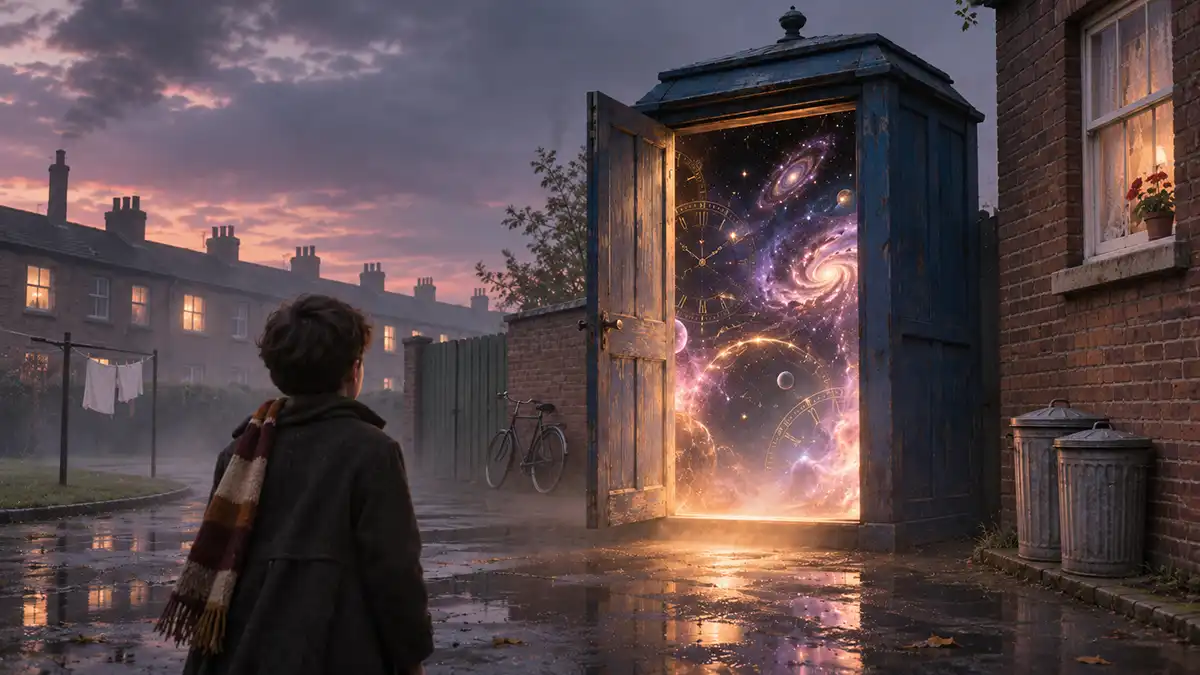
A blue box at teatime
I was five years old, in Britain, and the television was tiny, black-and-white and fed with coins. Late in 1963 it showed me a junkyard in the fog, a police box that hummed, and an old man who was plainly not from here. I was frightened. I have been grateful ever since.
That first episode, An Unearthly Child, went out on BBC television at 5.16pm on Saturday 23 November 1963,1 the day after President Kennedy was shot in Dallas.2 Today is its sixty-third birthday, kept by fans as Doctor Who Day.
The programme is, once again, off the air and between Doctors. There is no better moment to praise it.
From a junkyard to an institution
Doctor Who began as a gap in the Saturday schedule. Sydney Newman, the Canadian head of BBC drama, wanted a family serial to sit between the sports results and the pop show, and to teach a little science and history on the way.3 He gave it to Verity Lambert, the first woman to produce drama at the BBC,4 and to Waris Hussein, Indian-born, 24 years old and the corporation’s youngest drama director.5
Australians were in the engine room from the start. Anthony Coburn, who wrote the first serial, was born in Melbourne.6 Ron Grainer, who composed the theme, was a Queenslander from Atherton.7 Delia Derbyshire then realised his tune, sound by sound, at the BBC Radiophonic Workshop. It is believed to be the first electronic theme made for television, and it still sounds like the future.8
Newman wanted no “bug-eyed monsters”. Within weeks the Daleks had arrived, the audience had passed ten million, and the ban was dead.9
The masterstroke came in 1966. William Hartnell’s health was failing; rather than end the show, the producers had the Doctor collapse and rise with a new face.10 Regeneration turned a casting problem into the most ingenious renewal mechanism in television.
The original run lasted 26 years, to December 1989. A 1996 television film with Paul McGann won no series. Then in 2005 Russell T Davies brought it back from Cardiff with Christopher Eccleston, a companion from a council estate and real emotional stakes. Its first night drew 10.8 million viewers.11 It is routinely called the longest-running science-fiction series in the world.12
A mirror with a time machine
Doctor Who has always been about the year it was made in. The Britain of 1963 was losing an empire, living under the Bomb and being promised the “white heat” of technology. Its new hero was an eccentric who travelled without conquering, in a ship disguised as street furniture.
The Daleks were the war the audience’s parents had just fought. Terry Nation, a Welshman who grew up through it, wrote them as Nazis in armour: obsessed with purity, incapable of pity.13 In 1964 they were shown patrolling an occupied London, the invasion Britain had escaped by a whisker.
The 1970s stories read like a newspaper archive. The Green Death (1973) set the Doctor against a chemical company poisoning a Welsh valley, with a megalomaniac computer in the boardroom.14 The Curse of Peladon (1972) debated joining a federation of planets as Britain entered the Common Market. Doctor Who and the Silurians (1970) asked who has the prior claim on the Earth.
Later came a Thatcher caricature in The Happiness Patrol (1988), Rosa Parks and the Partition of India in 2018, and the sealed social-media world of Dot and Bubble in 2024. The complaint that the show has “become political” misreads sixty years of evidence.
The moral panic is part of the story too. In 1975 Mary Whitehouse denounced it as “teatime brutality for the tots”.15 Australian censors rated the earliest serials for adults only, which is why the ABC did not screen them until January 1965.16
Bubble wrap and brilliance
For most of its life Doctor Who was made for small change, and it turned poverty into a style.
Bernard Lodge’s swirling title sequence was “howlaround”: the feedback from a camera pointed at its own monitor.17 The Dalek voice was an actor fed through a ring modulator. Alien worlds were quarries in the Home Counties. In The Ark in Space (1975) a man turning into a giant insect was wrapped in bubble wrap sprayed green.18
Viewers forgave the wobble because the ideas did not wobble. A generation learned that imagination completes what the budget cannot.
The 2005 revival brought digital effects, and the Disney years brought budgets the old production office would have taken for a clerical error.
Yet the episodes fans rank highest remain the cheap ones. Blink (2007) frightened a nation with garden statues. Midnight (2008) never shows its monster. Heaven Sent (2015) is very nearly one actor in a castle.
Fear and wonder are written, not rendered.
Fifteen Doctors, one character
The Doctor is a single character played, so far, by fourteen leading actors across fifteen numbered incarnations. David Tennant has had the job twice.
| Doctor | Actor | Years | In a phrase |
|---|---|---|---|
| First | William Hartnell | 1963–66 | The crotchety grandfather |
| Second | Patrick Troughton | 1966–69 | The cosmic hobo |
| Third | Jon Pertwee | 1970–74 | The dandy man of action |
| Fourth | Tom Baker | 1974–81 | Scarf, grin, jelly babies |
| Fifth | Peter Davison | 1981–84 | The gentle cricketer |
| Sixth | Colin Baker | 1984–86 | Loud coat, louder voice |
| Seventh | Sylvester McCoy | 1987–89 | The clown who plays chess |
| Eighth | Paul McGann | 1996 | The romantic |
| Ninth | Christopher Eccleston | 2005 | The survivor in a leather jacket |
| Tenth | David Tennant | 2005–10 | The charmer with a temper |
| Eleventh | Matt Smith | 2010–13 | The old man with a young face |
| Twelfth | Peter Capaldi | 2014–17 | The punk professor |
| Thirteenth | Jodie Whittaker | 2018–22 | The hopeful best friend |
| Fourteenth | David Tennant | 2023 | The familiar face, tired |
| Fifteenth | Ncuti Gatwa | 2023–25 | Joy in a kilt |
Tom Baker’s seven years remain the record and, for many, the definitive portrait. John Hurt’s War Doctor (2013) and Jo Martin’s Fugitive Doctor (2020) sit outside the numbering.
A woman, and a Doctor of colour
Nothing in the fiction ever required a shape-changing alien to be a white man. In 2014 the Master returned as a woman, Michelle Gomez’s Missy. In 2017 Jodie Whittaker was cast as the Thirteenth Doctor. Her first full episode drew close to eleven million British viewers, more than Eccleston’s in 2005.19
In 2020 Jo Martin became the first Black actor to play the Doctor. In 2023 Ncuti Gatwa, born in Rwanda and raised in Scotland, became the first to lead the series.20
The reception was mixed, and honesty requires saying so. Ratings slid after Whittaker’s record launch.21 Davies himself has since written that the Disney-backed relaunch around Gatwa “didn’t work”.22 Critics with no objection to the casting argued that the scripts lectured where they should have dramatised. The strongest form of that complaint is about craft, not identity: both leads were widely praised, and the writing around them was not always worthy of them.
The people with the typewriters
Doctor Who is a writer’s programme, and its history is best told through a handful of them.
- Terry Nation created the Daleks in 1963 and their maker, Davros, in Genesis of the Daleks (1975).
- Robert Holmes was the classic era’s finest stylist: The Ark in Space, The Deadly Assassin, The Caves of Androzani. He gave the Time Lords their corrupt politics and the show its gallows wit.
- Malcolm Hulke smuggled moral ambiguity into children’s television. His monsters usually had a case.
- Terrance Dicks scripted and edited for years, then wrote dozens of the Target novelisations that taught a generation to read.
- Douglas Adams was script editor in 1979 and co-wrote City of Death. Helped by a strike that blacked out ITV, its final episode drew over sixteen million viewers, still the record.23
- Russell T Davies revived the show in 2005 and gave it a heart, a family and a working-class address.
- Steven Moffat wrote its most ingenious puzzles: The Empty Child, Blink, Heaven Sent. His scripts won four Hugo Awards.24
Honourable mentions go to Paul Cornell’s Human Nature, Rob Shearman’s Dalek, Richard Curtis’s Vincent and the Doctor and Vinay Patel’s Demons of the Punjab.
The monsters we deserve
Each of the great monsters is an idea wearing a costume.
The Daleks are fascism in a casing: hatred engineered until nothing else is left. Their catchphrase is a one-word political programme.
The Cybermen arrived in 1966, devised by a scientist, Kit Pedler, who worried where “spare-part” surgery might lead.25 They are humans who replaced so much of themselves that the feeling went too. In the age of the neural implant they have never looked more current.
The Master, introduced in 1971 with the suave Roger Delgado, is the Doctor’s Moriarty: the same brilliance without the conscience. Anthony Ainley, Derek Jacobi, John Simm, Michelle Gomez and Sacha Dhawan have all inherited the goatee, literal or spiritual.
The Weeping Angels, from Blink, are stone statues that move only when nobody is looking. Blink and they have you. They are the show’s best modern invention, and they cost almost nothing.
Behind them march the potato-headed Sontarans, the Ice Warriors, the Zygons, the Silence, and the Silurians, who were here before us and want their planet back.
The method is constant. Take something ordinary, a statue, a shop dummy, a gas mask, a shadow, and make a child look at it twice. Hence the national institution of watching from behind the sofa.
The ones who ask the questions
The companion is our seat in the TARDIS and, often, the Doctor’s conscience. The first were two schoolteachers, Ian and Barbara, and the Doctor’s granddaughter Susan.
The roll of honour is long. Jamie the Highlander. Brigadier Lethbridge-Stewart, the soldier who became a friend. Jo Grant, who left to hunt fungi up the Amazon with a radical ecologist. Sarah Jane Smith, the investigative journalist so loved that she was given her own series three decades later. Leela, Romana, Ace.
Australia supplied Tegan Jovanka, the air stewardess from Brisbane who never let a Doctor have the last word.
The modern era rebuilt the role. Rose Tyler, the shop assistant, made the companion the emotional lead. Donna Noble, the temp from Chiswick, refused to be impressed and was the better for it. Martha Jones, Amy and Rory, River Song, Clara Oswald, Bill Potts, Yasmin Khan and Ruby Sunday followed.
And there was K9, the robot dog with the prim voice. John Leeson, who supplied that voice for nearly fifty years, died on 1 November aged 83.26
Never cruel or cowardly
The Doctor’s ethic was set down by Terrance Dicks in 1976 and has held ever since: the Doctor never gives in, never gives up, and is “never cruel or cowardly”.27
In practice that means a hero who carries a screwdriver, not a gun. Problems are solved by curiosity, wit and nerve. Violence is a failure, authority is to be questioned, and nobody is unimportant.
The series tests its own creed. In Genesis of the Daleks the Doctor holds two wires that would destroy the Daleks at birth and asks, “Have I the right?” He decides he has not.28 In The Waters of Mars (2009) he bends the laws of time out of pride, and the story treats it as a fall.
Peter Capaldi’s Doctor left with the plainest statement of all: hatred is always foolish, love is always wise, and kindness is not optional.29
It is peace studies with a sonic screwdriver.
Whovians, and six decades of verdicts
A Whovian is, simply, a devoted fan of Doctor Who. The word is an American coinage of the early 1980s, from the Doctor Who Fan Club of America and its newsletter, the Whovian Times.30 British fans long preferred no label at all.
The better definition is by behaviour. Whovians have a Doctor of their own, usually the first one they saw. They can hum the theme. And between 1989 and 2005, when the BBC had given up, they kept the thing alive with novels, magazines and audio plays.
Then they took over. Davies, Moffat and Chris Chibnall were all childhood fans, as were Tennant and Capaldi. No other programme has been so thoroughly inherited by its audience.
Fans also saved its past. The BBC wiped many 1960s episodes, and 95 are still missing after two were recovered this March.31 Yet a soundtrack survives for every one, because fans taped the broadcasts at home.32
Reception has run in waves: Dalekmania in 1964, the Tom Baker peak, the mocked and underfunded 1980s, the triumphant 2005 return, a 50th-anniversary special simulcast in 94 countries,33 and the recent slide. Doctor Who has been pronounced dead before. It has a well-known answer to that.
Who owns the Doctor?
The BBC does, and always has. The rights sit with BBC Studios, the corporation’s commercial arm.34 The famous exception is the Daleks, in which Terry Nation’s estate still holds rights alongside the BBC.35
Disney never owned the show. From 2023 it streamed new episodes outside Britain and Ireland36 and backed two seasons made by Bad Wolf, the Cardiff company majority-owned by Sony.37 In October 2025 the partnership ended.38 Davies has since written that it “didn’t work”: the show was little known in America, and the launch stumbled.39
In June this year the BBC scrapped a promised 2026 Christmas special. Davies and Bad Wolf departed, and the programme was put out to competitive tender.40
About six production companies are reported to be on the shortlist. They include Jed Mercurio’s Hat Trick venture, World Productions, a BBC Studios label, and STV Studios, whose bid would move production from Wales to Scotland. A winner is expected around March 2027, with the series planned to return in 2028.41 All of this is reported, not announced; the BBC has confirmed no dates.42
Until then the Doctor has no settled face. The last one we saw, at the end of Ncuti Gatwa’s final episode in May 2025, belonged to Billie Piper, and nobody has yet explained why.43
Can it survive the age of CGI and AI?
It should, because spectacle was never what it sold. Cinema audiences now take the fantastical and the phantasmagorical for granted. Any streaming series can render a galaxy, and soon any teenager with an AI model will too. When spectacle is free, it stops being a reason to watch.
What stays scarce is what Doctor Who was built on: a voice, a moral imagination and the courage to be odd. The Disney experiment tested the alternative, more money and more gloss, and by its own showrunner’s account it did not work. The show’s audio dramas, which have run since 1999 with no pictures at all, make the same point from the other side.44
On artificial intelligence the series has sixty years of prior thought. In 1966 WOTAN, a thinking computer in London’s new Post Office Tower, set out to link up with the world’s machines and dispense with humans.45 In 1973 BOSS ran a polluting corporation with the same ambition.46 The Cybermen are a standing warning about upgrading the body and deleting the person.
Technology will help at the margins. Animation has already restored lost 1960s stories from their surviving soundtracks,47 and better tools will restore more. The temptation to resurrect dead actors by algorithm should be resisted. The whole premise of the programme is that you let the old face go.
Do the themes need to evolve?
The monsters do; the values do not. Each generation gets the Daleks it deserves. Ours might be an algorithm that feeds on attention, a corporation that strip-mines a living planet, or the loneliness of the permanently connected.
There is rich ground here that the series has only scratched. A time traveller is the one hero who can show us the climate of 2126 and bring us home in time to change it. The Silurians’ question, whose Earth is this, has never been sharper.
But the core should be left alone. A clever, kind stranger arrives where people are frightened, refuses to pick up a gun, and insists that things can be otherwise. That is hope as a practice, not a forecast, and it does not date.
Bigger on the inside
Doctor Who was multi-dimensional before the multiverse became a marketing plan. It is at once children’s adventure, political satire, gothic horror, comedy and moral philosophy, held together by a wheezing blue box and a promise to be kind.
The five-year-old at the coin-operated television knew none of that. He knew only that the box was bigger on the inside. So, it turned out, was the programme.
Happy birthday, Doctor. Come back soon.
Notes
- Matthew Kilburn, “Doctor Who at Fifty,” OUPblog, Oxford University Press, 23 November 2013, https://blog.oup.com/2013/11/doctor-who-at-fifty/. ↩
- “On This Day 55 Years Ago, the First Episode of Doctor Who Aired,” Sunday Post, accessed 23 November 2026, https://sundaypost.com/fp/on-this-day-55-years-ago-the-first-episode-of-doctor-who-aired. ↩
- “Doctor Who in the 1960s: The William Hartnell and Patrick Troughton Years,” Film Stories, accessed 23 November 2026, https://filmstories.co.uk/features/doctor-who-in-the-1960s-the-william-hartnell-and-patrick-troughton-years/; Adam James Cuthbert, “An Unearthly Child Retrospective,” Doctor Who TV, accessed 23 November 2026, https://www.doctorwhotv.co.uk/?p=33370. ↩
- Kilburn, “Doctor Who at Fifty.” ↩
- “Waris Hussein Reborn 50 Years after He Directed Dr Who,” Eastern Eye, 10 May 2013, reproduced in the Doctor Who Cuttings Archive, https://cuttingsarchive.org/index.php/Waris_Hussein_reborn_50_years_after_he_directed_Dr_Who; “Waris Hussein,” British Film Institute, accessed 23 November 2026, https://shop.bfi.org.uk/seasons/archived-pages/waris-hussein.html. ↩
- “Anthony Coburn,” AustLit, accessed 23 November 2026, https://cirrus.austlit.edu.au/austlit/page/A22889; Kilburn, “Doctor Who at Fifty.” ↩
- “Grainer, Ronald Erle (1922–1981),” Australian Dictionary of Biography, National Centre of Biography, Australian National University, accessed 23 November 2026, https://adb.anu.edu.au/biography/grainer-ronald-erle-12558. ↩
- “Doctor Who Theme: Ron Grainer (Composer) and Delia Derbyshire (Musician and Arranger),” National Film and Sound Archive of Australia, accessed 23 November 2026, https://nfsa.gov.au/collection/curated/asset/102424-doctor-who-theme-ron-grainer-composer-and-delia-derbyshire-musician. ↩
- “Evolution of the Daleks: The Evil Geniuses behind Doctor Who’s Greatest Foes,” Yahoo News UK, accessed 23 November 2026, https://uk.news.yahoo.com/evolution-daleks-evil-geniuses-behind-110931796.html; “Doctor Who in the 1960s,” Film Stories. ↩
- “Arrival of the Cybermen – Departure of a Doctor,” Doctor Who News, October 2016, https://www.doctorwhonews.net/2016/10/arrival-of-cybermen-departure-of-doctor.html. ↩
- Andrew Reynolds, “The Woman Who Fell to Earth Tops Ratings Chart,” The Doctor Who Companion, 17 October 2018, https://thedoctorwhocompanion.com/2018/10/17/the-woman-who-fell-to-earth-tops-ratings-chart/. ↩
- “Doctor Who in the 1960s,” Film Stories. ↩
- “The Little-Known Story of the Welshman Who Created Doctor Who’s Greatest Villain,” WalesOnline, via inkl, accessed 23 November 2026, https://www.inkl.com/news/the-little-known-story-of-the-welshman-who-created-doctor-who-s-greatest-villain. ↩
- “The Green Death,” BBC, accessed 23 November 2026, https://www.doctorwho.tv/stories/the-green-death; “Doctor Who (Classic): ‘The Green Death,’” The A.V. Club, accessed 23 November 2026, https://www.avclub.com/doctor-who-classic-the-green-death-1798178107. ↩
- Ken Tossell, “Curb Dr Who—Mary,” Daily Mirror, 27 March 1975, 5, reproduced in the Doctor Who Cuttings Archive, https://cuttingsarchive.org/index.php/Curb_Dr_Who-Mary. ↩
- “50 Years of Doctor Who in Australia,” Doctor Who News, 11 January 2015, https://www.doctorwhonews.net/2015/01/50-years-of-doctor-who-in-australia.html; “Australia TX 1965–1967,” BroaDWcast, accessed 23 November 2026, https://broadwcast.org/index.php/Australia_TX_1965-1967; “Doctor Who in Australia,” Wikipedia, accessed 23 November 2026, https://en.wikipedia.org/wiki/Doctor_Who_in_Australia. ↩
- “Doctor Who: 50 Years of Main Title Design,” Art of the Title, accessed 23 November 2026, https://artofthetitle.com/feature/doctor-who-50-years-of-main-title-design. ↩
- “The Ark in Space,” Television Heaven, accessed 23 November 2026, https://televisionheaven.co.uk/doctor-who/the-ark-in-space. ↩
- Reynolds, “The Woman Who Fell to Earth Tops Ratings Chart.” ↩
- “‘Sex Education’ Actor Ncuti Gatwa Will Be the First Black Lead in ‘Doctor Who,’” NPR, 8 May 2022, https://www.npr.org/2022/05/08/1097488412/ncuti-gatwa-doctor-who. ↩
- “10 Most Watched Episodes of Modern Doctor Who,” WhatCulture, accessed 23 November 2026, https://whatculture.com/tv/10-most-watched-episodes-of-modern-doctor-who?page=3. ↩
- “‘They Didn’t Know the Slightest Thing about Doctor Who’: RTD Admits Disney Deal ‘Didn’t Work,’” Doctor Who TV, 8 October 2026, https://www.doctorwhotv.co.uk/rtd-disney-deal-didnt-work-107461.htm, reporting an extract from Davies’s memoir The Queerest of Folk: A Life in Television. ↩
- Mark Harrison, “City of Death at 40: Revisiting Doctor Who’s Most-Watched Story,” Den of Geek, 26 September 2019, https://www.denofgeek.com/tv/city-of-death-at-40-revisiting-doctor-who-s-most-watched-story-2/; “Ratings: Every Dalek Serial Ranked Based Entirely on Audience Viewing Figures,” The Doctor Who Companion, 3 May 2021, https://thedoctorwhocompanion.com/2021/05/03/ratings-every-dalek-serial-ranked-based-entirely-on-audience-viewing-figures/. ↩
- “Doctor Who Wins Fifth Hugo,” Doctor Who News, 22 August 2011, https://www.doctorwhonews.net/2011/08/dwn220811010112-doctor-who-wins-hugo.html. ↩
- “The Tenth Planet,” Television Heaven, accessed 23 November 2026, https://televisionheaven.co.uk/doctor-who/the-tenth-planet. ↩
- “John Leeson, Voice of K9 in Doctor Who, Dies Aged 83,” Doctor Who TV, 2 November 2026, https://www.doctorwhotv.co.uk/john-leeson-doctor-who-death-107502.htm. ↩
- Toby Hadoke, “Terrance Dicks Obituary,” Guardian, 4 September 2019; “Terrance Dicks (1935–2019),” The Doctor Who Companion, 2 September 2019, https://thedoctorwhocompanion.com/2019/09/02/terrance-dicks-1935-2019/. ↩
- Doctor Who, “Genesis of the Daleks,” part 6, written by Terry Nation, aired 12 April 1975, on BBC1. ↩
- Doctor Who, “Twice Upon a Time,” written by Steven Moffat, aired 25 December 2017, on BBC One. ↩
- Historical Dictionary of Science Fiction, s.v. “Whovian,” accessed 23 November 2026, https://sfdictionary.com/view/2217/whovian. ↩
- Associated Press, “Two Episodes of ‘Doctor Who’ Were Just Rediscovered, a ‘Holy Grail’ of Long-Lost Classic TV,” PBS NewsHour, 13 March 2026, https://www.pbs.org/newshour/arts/two-episodes-of-doctor-who-were-just-rediscovered-a-holy-grail-of-long-lost-classic-tv. ↩
- “Doctor Who’s Lost Episodes, Explained,” Yahoo Entertainment, accessed 23 November 2026, https://www.yahoo.com/entertainment/doctor-lost-episodes-explained-190000148.html. ↩
- Kevin Lynch, “Doctor Who – Day of the Doctor Sets World Record for Biggest TV Drama Simulcast,” Guinness World Records, November 2013, https://guinnessworldrecords.com/news/2013/11/doctor-who-day-of-the-doctor-sets-world-record-for-biggest-tv-drama-simulcast-53133. ↩
- “6 Companies Reportedly Competing for Doctor Who’s Future, Shortlist Revealed,” Doctor Who TV, 17 November 2026, https://www.doctorwhotv.co.uk/new-doctor-who-6-contenders-107508.htm. ↩
- Shaun Lyon, “Daleks Rights Sorted?,” Doctor Who News, 4 May 2004, https://www.doctorwhonews.net/2004/05/daleks-rights-sorted_04.html; “The Strange Copyright of Doctor Who,” Plagiarism Today, accessed 23 November 2026, https://www.plagiarismtoday.com/?p=27069. ↩
- “Doctor Who Will Materialize onto Disney Plus in 2023,” TechRadar, accessed 23 November 2026, https://www.techradar.com/news/doctor-who-will-materialize-onto-disney-plus-in-2023. ↩
- “Sony Pictures Television Acquires a Majority Stake in Bad Wolf,” Señal News, 1 December 2021, https://senalnews.com/en/content/sony-pictures-television-acquires-a-majority-stake-in-bad-wolf/amp. ↩
- “BBC Confirms Future of Doctor Who and a New Christmas Special in 2026,” BBC, 28 October 2025, https://www.doctorwho.tv/news-and-features/bbc-confirms-future-of-doctor-who-and-a-new-christmas-special-in-2026. ↩
- “RTD Admits Disney Deal ‘Didn’t Work.’” ↩
- “Doctor Who | Christmas Special Cancelled, Show Now Going Out to Tender,” Film Stories, June 2026, https://filmstories.co.uk/tv/doctor-who-christmas-special-cancelled-show-now-going-out-to-tender/. ↩
- “6 Companies Reportedly Competing for Doctor Who’s Future.” ↩
- Doctor Who TV, report of Russell T Davies’s remarks on BBC Radio 4’s The Media Show, 15 October 2026, https://www.doctorwhotv.co.uk/rtd-summer-2027-107471.htm. ↩
- “BBC & Disney+’s ‘Doctor Who’ Deal Is Over, 2026 Christmas Special Set,” TV Insider, accessed 23 November 2026, https://www.tvinsider.com/1224363/doctor-who-2026-christmas-special-bbc-disney-plus-deal-ends. ↩
- “Doctor Who Audio Dramas from Big Finish Guaranteed until 2030,” Big Finish Productions, accessed 23 November 2026, https://bigfinish.com/news/v/doctor-who-audio-dramas-from-big-finish-guaranteed-until-2030. ↩
- “The War Machines,” BBC, accessed 23 November 2026, https://doctorwho.tv/stories/the-war-machines. ↩
- “The Green Death,” BBC. ↩
- “Doctor Who’s Lost Episodes, Explained,” Yahoo Entertainment. ↩
Published on Doctor Who Day, 23 November 2026. Reported developments were checked against the cited sources on that date.