
By Kevin J. Parker
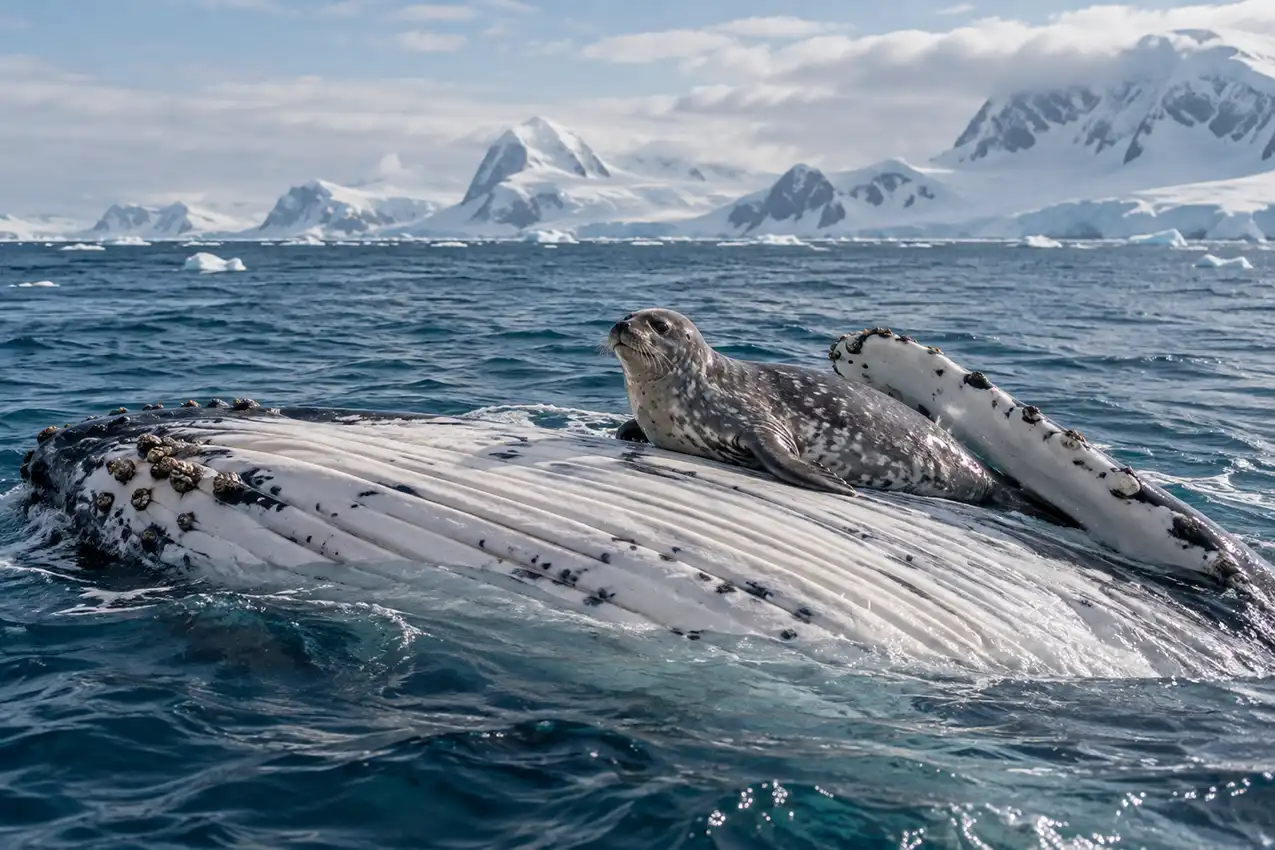
In January 2009, off the Antarctic Peninsula, a Weddell seal found itself being hunted by killer whales. What happened next unsettled a familiar account of how nature works.
A humpback rolled onto its back, and the seal was swept onto its chest. As the predators approached, the whale raised the seal above the water. When it began slipping, the humpback nudged it back with a flipper. The seal eventually reached another ice floe. Marine biologists Robert Pitman and John Durban described the encounter in Natural History that November.1
We cannot interview the whale about its intentions. We can nevertheless recognise that another animal survived an attack with its apparent assistance. That observation deserves attention in a culture so accustomed to finding lessons about ruthlessness in the living world.
A statement circulating online gathers several such stories: whales protecting other animals, crows holding funerals, drought-stricken trees sharing water, dolphins using names and sleeping otters holding hands. It concludes that people meditating together in love can reduce violence throughout a city.
These claims differ considerably in evidential strength. Together, however, they raise a serious question. Have we mistaken one feature of life, competition, for its governing principle, while treating cooperation as an exception requiring explanation?
The research supports a more capacious account. Relationships help organisms survive, and sometimes those benefits cross species boundaries. Understanding how this happens requires attention to the differences between mutual advantage, protective behaviour, interdependence and compassion. Collapsing them into a single comforting story would obscure what makes each remarkable.
The stories we choose also carry consequences. If we regard every encounter as a contest, we can come to treat generosity as naivety and dependence as failure. An account of life that includes cooperation makes room for different expectations. Yet it must remain answerable to observation. Hope becomes fragile when attached to claims that cannot bear scrutiny; it becomes more useful when it helps us recognise possibilities that habit or ideology has taught us to overlook.
Cooperation belongs within evolution
Natural selection does not require every organism to behave selfishly at every moment. Under particular conditions, helping others can improve the persistence of the traits that make helping possible.
Evolutionary theorist Martin Nowak described several mechanisms through which cooperation can emerge, including assistance to relatives, repeated exchanges between individuals and benefits mediated through reputation or social networks. His wider point was that cooperation helps explain the emergence of complex biological organisation, including multicellular bodies and human societies.2
The language needs care. Biological altruism concerns costs and benefits to reproductive success; it does not establish a benevolent intention. Mutualism describes relationships benefiting both parties. A neighbour benefiting incidentally from another organism’s activity may represent facilitation. None requires us to imagine that a fungus possesses a human moral philosophy.
Consider vampire bats, creatures burdened with an unfortunate public image. They share regurgitated blood with companions that have failed to feed. In a study published in 2020, Gerald Carter and colleagues followed previously unfamiliar captive bats for fifteen months. New food-sharing relationships tended to develop through increasing investment in grooming before the animals progressed to the more costly business of providing meals.3
The finding suggests that cooperation can develop through repeated encounters and selective investment. A relationship acquires a history. Assistance becomes possible because animals have opportunities to learn about one another.
For humans, the evolutionary explanation need not diminish the experience of generosity. Explaining the origins of a capacity does not exhaust its meaning. Knowing that attachment has a biological history tells us little about the full significance of sitting beside a dying friend.
What it does challenge is the presumption that care is an artificial restraint imposed upon an otherwise exclusively competitive animal.
Whales and the limits of our explanations
The Antarctic seal encounter was not the only report of humpbacks interfering with killer-whale attacks. Pitman and colleagues assembled 115 accounts of interactions in a study published in the January 2017 issue of Marine Mammal Science.
Among encounters involving attacks for which the prey species was identified, 89 per cent involved animals other than humpbacks. The researchers proposed that humpbacks might initially respond to the sounds of attacking killer whales, before discovering which species was threatened. A defence response useful in protecting humpback calves could consequently benefit other animals. They concluded that interspecies altruism, including unintentional altruism, could not be excluded.4
That is a more interesting finding than either an assured declaration of whale sainthood or a dismissal of the behaviour as meaningless instinct. It leaves the motivational question open while taking the observed intervention seriously.
Humans face a comparable difficulty when interpreting one another. We infer concern from actions, context and relationships; we cannot inspect another person’s experience directly. Across species, those inferences require greater caution, but caution should remain an invitation to investigate.
There is another complication. The killer whales are also cooperating. Their coordinated hunt sustains their own lives. A seal’s rescue is a predator’s lost meal.
Cooperation therefore tells us something about how living beings act together, without automatically deciding whose interests should prevail. Human alliances possess the same ambiguity. People cooperate to provide emergency relief and to wage war. The ethical question includes who benefits, who is excluded and who bears the cost.
What crows learn from death
The phrase “crows hold funerals” translates an arresting observation into a familiar human ceremony. Crows do gather around dead members of their species. Whether those gatherings involve anything resembling human mourning is a separate question.
Kaeli Swift and John Marzluff investigated American crows’ responses to dead crows, predators and people associated with them. Their 2015 study showed that a dead crow could function as information about danger. Birds gathered and called, became wary of feeding in the area, and learned to recognise people associated with threatening encounters. Some remembered those people for six weeks.5
The evidence supports learning and threat assessment. It does not establish a funeral ritual or resolve whether the birds experience grief.
Calling this merely practical behaviour would also miss its significance. Information about a death can influence the conduct of survivors. The gathering connects an individual event to the responses of other birds. Social life gives danger a wider audience.
Our vocabulary can distort in both directions. We may attribute human feelings too readily, or assume their absence because an animal cannot report them in our language. Respectful observation requires resisting both habits. A crow need not perform a recognisably human ceremony for its relationships to deserve our attention.
Beneath the forest floor
The image’s claim that trees send water through their roots to struggling neighbours rests on real processes, but assigns them a purpose the evidence does not establish.
One process is hydraulic redistribution. Where roots span wetter and drier soil, water can move through the root system and be released into drier layers. This often occurs at night, when water loss through leaves declines. Nearby plants may then absorb some of that moisture. A major review by Martyn Caldwell, Todd Dawson and James Richards documented the phenomenon and its ecological consequences in 1998.6
Water has become available to a neighbour. That does not demonstrate that a tree identified a distressed recipient and chose to help. The movement can follow differences in water potential without any such intention.
Fungal relationships add another dimension. Mycorrhizal fungi associate with plant roots, exchanging soil resources for plant-derived carbon. Experiments by E. Toby Kiers and colleagues showed that plants could allocate more carbohydrates to more beneficial fungal partners, while fungi could preferentially supply phosphorus to roots providing more carbon.7
Such findings reveal conditional exchange. They also remind us that fungi are organisms pursuing their own survival, rather than underground plumbing installed for the convenience of trees.
The broader claim that forests routinely operate as charitable networks is contested. In 2023, Justine Karst, Melanie Jones and Jason Hoeksema reviewed evidence concerning common mycorrhizal networks. They found that prominent claims about widespread resource transfers improving seedling performance exceeded the available field evidence. They also warned that positive findings were being preferentially cited, giving readers an exaggerated impression of certainty.8
This critique concerns particular claims about networks and their effects. It does not erase the importance of plant–fungus relationships, or the evidence for hydraulic redistribution. Distinct mechanisms should not be bundled together under the appealing proposition that trees look after one another.
An adequate account of the forest must accommodate exchange, competition and incidental benefits. A tree can alter its neighbours’ prospects without possessing our concepts of obligation or generosity.
That is already enough to challenge the image of life as a collection of self-contained units. Ecological relationships matter whether or not we can describe them as affection. Protecting a forest should not depend upon proving that its trees love one another.
Names and the company we keep
Dolphins provide stronger grounds for a comparison with a recognisably human social practice. Bottlenose dolphins develop distinctive signature whistles, and other dolphins can copy those signals.
In experiments reported in 2013, Stephanie King and Vincent Janik played wild dolphins copies of their own signature whistles. The animals responded by calling back, with different responses to the control whistles. The findings supported the use of learned vocal labels to address particular individuals.9
Calling these signals “names” is a reasonable shorthand, provided we preserve the distinction between a demonstrated communicative function and the much broader capacities of human language. The experiment did not establish dolphin surnames, grammar or conversations resembling our own.
It did suggest a social world in which an individual can be specifically addressed. Another animal is someone recognisable within a relationship, even if we remain uncertain about how that recognition is experienced.
Naming alone does not prove kindness. Recognition can serve rivalry as readily as affiliation. Nevertheless, it complicates the habit of treating animals as interchangeable representatives of a species. Their relationships can contain distinctions invisible to a passing human observer.
Otters and the work of an ecosystem
Sea otters sometimes hold paws while resting, but the familiar image is easily exaggerated into a universal sleeping arrangement. Seattle Aquarium explains that paw-holding is relatively infrequent. Resting groups, known as rafts, also maintain proximity through attention to one another, bodily contact and adjustments of movement.10
The quieter truth is sufficient: social animals have ways of remaining together. We need not turn every instance into a declaration of devotion.
Otters also illustrate a less sentimental form of interdependence. Research led by Brent Hughes, published in Nature in 2024, combined observations and experiments in California’s Elkhorn Slough. Returning sea otters reduced populations of burrowing crabs. That change strengthened marsh edges and reduced erosion, with predator-exclusion experiments helping establish the causal chain.11
An otter eating a crab is not undertaking coastal restoration. Yet its feeding can influence the physical persistence of a habitat. The benefit emerges through an ecological relationship that includes predation.
This matters for how we think about environmental repair. A damaged ecosystem may have lost interactions as well as individual organisms. Counting surviving species tells only part of its story. We should also ask which relationships remain possible, and which have been interrupted.
The same reasoning gives conservation a firmer basis than admiration alone. Otters deserve concern as living beings; their effects on marshes also show how much can depend on allowing a species to resume its place within a functioning system.
Humans within the relationship
Some of the clearest examples of cooperation cross the boundary we habitually draw between humanity and nature.
In Mozambique, Yao honey-hunters work with greater honeyguides, wild birds that lead people to bees’ nests. People gain honey; birds gain access to wax. Claire Spottiswoode and colleagues tested the hunters’ specialised call against other sounds. The appropriate call increased the likelihood of being guided from about one-third to two-thirds, and the overall probability of locating a nest from 17 to 54 per cent.12
The birds responded to a signal associated with a useful partner. Human skill included knowing how to enter that relationship.
At Laguna, in southern Brazil, dolphins and fishers coordinate their pursuit of mullet. The dolphins herd fish towards shore, and fishers time their net casts to the animals’ behaviour. Research by Mauricio Cantor and colleagues showed that synchronised interactions improved feeding opportunities for both participants. Long-term data also associated cooperative dolphins with a survival advantage, partly through reduced exposure to fisheries in which they risked becoming bycatch.13
These partnerships depend on particular places, practices and animal behaviour. They cannot be reduced to a generic injunction to reconnect with nature. People must know what to notice, when to act and how their actions affect another participant.
They also make human participation in ecology tangible. We are capable of becoming partners whose presence another species finds useful. Preserving such relationships means taking the knowledge of their human participants seriously, alongside research into the animals involved.
Neither example describes universal harmony. The bees lose honey and the mullet are eaten. What survives scrutiny is the existence of practical collaboration across a species boundary, with benefits contingent on how the encounter unfolds.
Meditation and the evidence on violence
The image’s final claim makes a larger evidential leap. A gathering of people in loving silence may be meaningful to its participants. Establishing that it reduces violence among strangers elsewhere in a city requires a different kind of evidence.
The claim resembles research on the proposed “Maharishi effect”. In Washington, DC, during June and July 1993, a gathering of practitioners of Transcendental Meditation and its advanced TM-Sidhi programme reached approximately 4,000 participants. John Hagelin and colleagues reported a maximum model-estimated reduction of 23.3 per cent in combined homicides, rapes and assaults, relative to the expected level. Their paper appeared in Social Indicators Research in 1999.14
The researchers considered temperature, historical patterns and other potential influences. Robberies did not decline significantly when analysed separately. The intervention also involved specific practices, rather than simply sitting together affectionately.
The distinction between an estimated effect and an observed causal mechanism is decisive. A statistical comparison cannot by itself establish that collective consciousness altered the behaviour of nonparticipants. Nor is a modelled reduction equivalent to a straightforward fall of that size in the city’s raw crime count.
The reasonable evidential requirement is independent testing capable of separating the proposed influence from competing explanations, with analysis plans specified in advance and results that withstand different defensible assumptions. Several leading authors were affiliated with Maharishi University of Management. That does not invalidate their work, but strengthens the case for evaluation by researchers without an institutional investment in the claim.
Research on meditators’ own behaviour addresses a narrower question. A 2018 review by Christina Luberto and colleagues found small to moderate improvements in measures of empathy, compassion and prosocial behaviour.15 Another review that year, by Ute Kreplin and colleagues, found that apparent benefits depended substantially on the outcome assessed and methodological quality.16
Neither review establishes a citywide effect transmitted beyond participants through a field of consciousness. The image states that proposition more confidently than the evidence considered here warrants.
There is still a worthwhile human possibility. A contemplative practice may help someone bring greater attention to a difficult relationship. Whether that happens can be examined through conduct: listening, restraining a hostile response, offering assistance. The practical test of cultivated love is what becomes possible between people.
Making cooperation durable
Human beings do not need to borrow every example of helpfulness from other species. Felix Warneken and Michael Tomasello demonstrated that children as young as eighteen months could help adults complete tasks without material reward. Young chimpanzees also helped in some situations.17
The study identifies an early capacity, rather than settling the ancient argument about whether humanity is inherently good. Capacities develop within relationships and circumstances. A child able to help can also learn whom to distrust or disregard.
At the institutional level, Elinor Ostrom’s research challenged the assumption that shared resources inevitably collapse through individual self-interest. Communities could develop workable arrangements for governing them. Successful systems commonly included locally appropriate rules, monitoring, ways to resolve disputes and consequences for repeated violations.18
The implication is demanding. Cooperation needs arrangements that make contribution worthwhile and exploitation harder. Appeals to goodwill leave too much work to those already prepared to give.
Consider what follows for an ecological politics. A community protecting a catchment needs a say in decisions affecting it. Those accepting restrictions need confidence that others will also comply. People carrying the costs of restoration need practical support. The beneficiaries of degradation should not be allowed to transfer its consequences indefinitely to others.
These are proposals about responsibility, informed by the evidence rather than mechanically derived from animal behaviour. No whale can settle our arguments about justice. We must decide how widely to extend concern, including to people we will never meet and beings unable to participate in our institutions.
That decision has ordinary expressions. A garden can be planned with the needs of other inhabitants in mind. A restoration group can monitor whether its work actually improves habitat. A council can consider how a development interrupts movement and access to water. Each involves replacing a vague declaration of care with a relationship that can be examined and sustained. Each also requires correction when good intentions produce poor results. Taking the more-than-human world seriously means allowing its needs to change our plans, including when those needs are inconvenient or belong to creatures we find difficult to admire.
The cooperative world offers grounds for hope because assistance and mutual dependence are already part of life’s repertoire. It also gives that hope a task. Relationships can be damaged, partners removed and conditions for collaboration destroyed. They can be maintained and repaired through deliberate choices.
We need not settle every uncertainty about animal feeling or collective consciousness to recognise the significance of what is documented. The whale’s intervention, the bird’s response and the human capacity to organise common care are substantial enough.
Our responsibility begins with attending accurately to the living world, then deciding what kind of participants we intend to become.
Notes
1. Robert L. Pitman and John W. Durban, “Save the Seal!,” Natural History, November 2009, 48, https://naturalhistorymag.com/exploring-science-and-nature/131929/save-the-seal.
2. Martin A. Nowak, “Five Rules for the Evolution of Cooperation,” Science 314, no. 5805 (2006): 1560–63, https://doi.org/10.1126/science.1133755.
3. Gerald G. Carter et al., “Development of New Food-Sharing Relationships in Vampire Bats,” Current Biology 30, no. 7 (2020): 1275–79.e3, https://doi.org/10.1016/j.cub.2020.01.055.
4. Robert L. Pitman et al., “Humpback Whales Interfering When Mammal-Eating Killer Whales Attack Other Species: Mobbing Behavior and Interspecific Altruism?,” Marine Mammal Science 33, no. 1 (2017): 7–58, https://doi.org/10.1111/mms.12343.
5. Kaeli N. Swift and John M. Marzluff, “Wild American Crows Gather around Their Dead to Learn about Danger,” Animal Behaviour 109 (2015): 187–97, https://doi.org/10.1016/j.anbehav.2015.08.021.
6. Martyn M. Caldwell, Todd E. Dawson, and James H. Richards, “Hydraulic Lift: Consequences of Water Efflux from the Roots of Plants,” Oecologia 113, no. 2 (1998): 151–61, https://doi.org/10.1007/s004420050363.
7. E. Toby Kiers et al., “Reciprocal Rewards Stabilize Cooperation in the Mycorrhizal Symbiosis,” Science 333, no. 6044 (2011): 880–82, https://doi.org/10.1126/science.1208473.
8. Justine Karst, Melanie D. Jones, and Jason D. Hoeksema, “Positive Citation Bias and Overinterpreted Results Lead to Misinformation on Common Mycorrhizal Networks in Forests,” Nature Ecology & Evolution 7 (2023): 501–11, https://doi.org/10.1038/s41559-023-01986-1.
9. Stephanie L. King and Vincent M. Janik, “Bottlenose Dolphins Can Use Learned Vocal Labels to Address Each Other,” Proceedings of the National Academy of Sciences 110, no. 32 (2013): 13216–21, https://doi.org/10.1073/pnas.1304459110.
10. Seattle Aquarium, “Sea Otter,” accessed September 29, 2026, https://www.seattleaquarium.org/animal/sea-otter/.
11. Brent B. Hughes et al., “Top-Predator Recovery Abates Geomorphic Decline of a Coastal Ecosystem,” Nature 626 (2024): 111–18, https://doi.org/10.1038/s41586-023-06959-9.
12. Claire N. Spottiswoode, Keith S. Begg, and Colleen M. Begg, “Reciprocal Signaling in Honeyguide-Human Mutualism,” Science 353, no. 6297 (2016): 387–89, https://doi.org/10.1126/science.aaf4885.
13. Mauricio Cantor, Damien R. Farine, and Fábio G. Daura-Jorge, “Foraging Synchrony Drives Resilience in Human–Dolphin Mutualism,” Proceedings of the National Academy of Sciences 120, no. 6 (2023): e2207739120, https://doi.org/10.1073/pnas.2207739120.
14. John S. Hagelin et al., “Effects of Group Practice of the Transcendental Meditation Program on Preventing Violent Crime in Washington, D.C.: Results of the National Demonstration Project, June–July 1993,” Social Indicators Research 47, no. 2 (1999): 153–201, https://doi.org/10.1023/A:1006978911496. The reported reduction is a statistical estimate relative to modelled expectations, not a simple before-and-after percentage change.
15. Christina M. Luberto et al., “A Systematic Review and Meta-analysis of the Effects of Meditation on Empathy, Compassion, and Prosocial Behaviors,” Mindfulness 9, no. 3 (2018): 708–24, https://doi.org/10.1007/s12671-017-0841-8.
16. Ute Kreplin, Miguel Farias, and Inti A. Brazil, “The Limited Prosocial Effects of Meditation: A Systematic Review and Meta-analysis,” Scientific Reports 8 (2018): 2403, https://doi.org/10.1038/s41598-018-20299-z.
17. Felix Warneken and Michael Tomasello, “Altruistic Helping in Human Infants and Young Chimpanzees,” Science 311, no. 5765 (2006): 1301–3, https://doi.org/10.1126/science.1121448.
18. Elinor Ostrom, “Beyond Markets and States: Polycentric Governance of Complex Economic Systems,” American Economic Review 100, no. 3 (2010): 641–72, https://doi.org/10.1257/aer.100.3.641.