
1. Historical Baseline
Pre-1750 Wilderness Extent
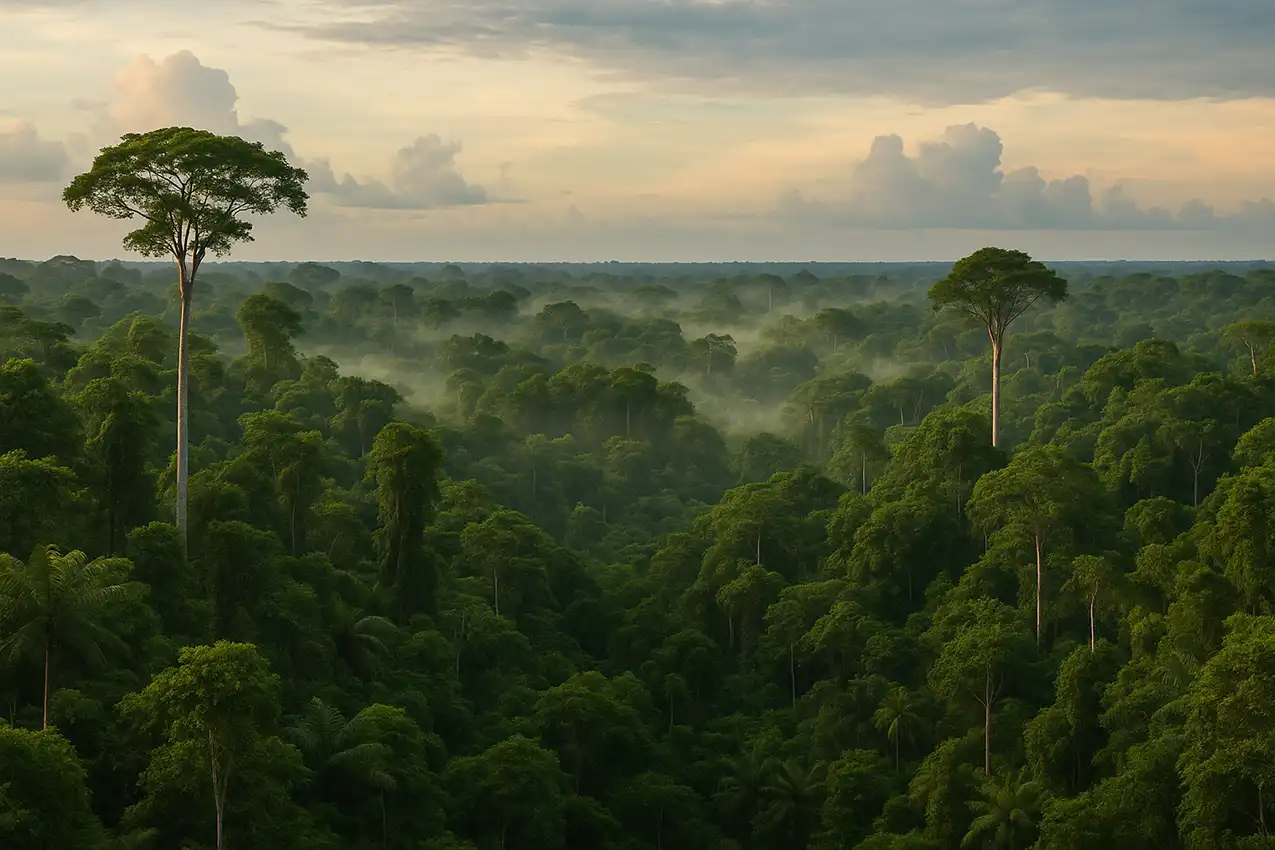
South America contained 1.7 billion acres of wilderness in 1500—95% of the continent’s land area.¹ The Amazon basin alone encompassed 1.4 billion acres of continuous rainforest, Earth’s most biodiverse terrestrial ecosystem. This was not pristine wilderness but a cultural landscape shaped by 10 million Indigenous peoples through sophisticated agroforestry that enhanced rather than diminished biological diversity.²
The Amazon’s pre-Columbian inhabitants created terra preta—black earth enriched with charcoal, pottery shards, and organic matter—covering 10% of the basin.³ These anthropogenic soils, maintaining fertility for millennia, supported complex societies while increasing forest productivity. Archaeological evidence reveals cities of 50,000 people, extensive road networks, and managed forests producing more food than modern agriculture on equivalent land.⁴ The Beni region of Bolivia contained 20,000 kilometers of raised agricultural fields, fish weirs stretching across rivers, and forest islands connected by causeways—engineering that surpassed European capabilities of the era.⁵
The Atlantic Forest (Mata Atlântica) stretched 3,000 kilometers along Brazil’s coast, extending inland up to 500 kilometers. This biodiversity hotspot contained 20,000 plant species with 40% endemism—higher than the Amazon.⁶ Its elevation gradients from sea level to 2,900 meters created countless microclimates harboring species found nowhere else. The forest’s 2,200 vertebrate species included golden lion tamarins, muriqui monkeys, and three-toed sloths—all Atlantic Forest endemics. Indigenous peoples including the Tupi and Guarani managed this forest through selective harvesting that maintained canopy integrity while cultivating useful species.
Beyond Amazonia, South America’s wilderness mosaic included the Cerrado savanna covering 500 million acres—Earth’s most biodiverse savanna with 10,000 plant species.⁷ The Pantanal, world’s largest wetland at 42 million acres, pulsed with seasonal floods supporting the highest concentration of wildlife in the Americas. The Gran Chaco’s dry forests covered 250 million acres across Argentina, Paraguay, and Bolivia, harboring jaguars, giant anteaters, and Chacoan peccaries found nowhere else.⁸
The Andes, stretching 7,000 kilometers, created vertical wilderness from sea level to 6,900 meters. Cloud forests on eastern slopes harbored more biodiversity per hectare than anywhere on Earth—a single valley could contain more bird species than all of Europe. Páramo grasslands above treeline stored vast quantities of water in specialized plants and soils, functioning as “water towers” for the continent.⁹
Patagonia’s 260 million acres encompassed wind-swept grasslands, temperate rainforests, and continental ice fields. The Valdivian temperate rainforest, isolated for 45 million years, evolved endemic conifers (alerce trees living 3,600 years), the world’s smallest deer (pudú), and carnivorous plants adapted to nutrient-poor soils.¹⁰ Magellanic forests of southern beech created cathedral groves where pumas stalked guanacos through moss-draped understories. The Patagonian steppe, larger than Texas, supported millions of guanacos, rheas, and endemic species like the Patagonian mara—a rabbit-like rodent found nowhere else.
Benchmark Periods
European diseases preceded conquistadors, killing 90% of Indigenous peoples by 1600.¹¹ Forest succession on abandoned agricultural lands created the “pristine” Amazon encountered by later naturalists. This demographic collapse allowed forest regeneration so complete that atmospheric CO₂ dropped by 7-10 ppm, contributing to the Little Ice Age.¹² The Atlantic Forest’s Indigenous population dropped from 2 million to 200,000, enabling forest expansion that wouldn’t last.
By 1850, rubber exploitation began the modern assault. The rubber boom (1879-1912) enslaved Indigenous peoples and initiated large-scale forest exploitation. Brazil’s coffee economy consumed Atlantic Forest at unprecedented rates—São Paulo state lost 80% of forest cover in just 50 years.¹³ Railroad construction in Argentina and Brazil opened vast territories to cattle ranching. The War of the Triple Alliance (1864-1870) depopulated Paraguay, allowing forest regeneration that persists today.¹⁴
The 1950s brought “Operation Amazonia”—Brazil’s campaign to occupy the “empty” forest. The Trans-Amazonian Highway, begun in 1972, opened 5,000 kilometers of rainforest to colonization. Agricultural modernization in the Cerrado, starting in the 1970s, converted native savanna to soy production at rates exceeding Amazon deforestation.¹⁵ Chile’s Pinochet regime sold vast tracts of native forest to timber companies, replacing millennia-old alerce forests with pine plantations.
By 1990, chainsaws and bulldozers cleared forest at 20,000 square kilometers annually. The introduction of Brachiaria grass from Africa enabled cattle ranching on poor Amazon soils, driving 80% of deforestation. Hydroelectric dams flooded vast areas while fragmenting aquatic ecosystems—Brazil alone built 154 large dams.¹⁶ Atlantic Forest fragmentation accelerated as São Paulo became Earth’s third-largest city, consuming surrounding forest remnants.
2. Current Status Analysis
Quantitative Metrics
South America retains 65% wilderness coverage, but this continental average masks severe regional degradation.¹⁷ The Amazon has lost 17% of original forest—dangerously close to the 20-25% tipping point for ecosystem collapse. The Atlantic Forest survives in only 12% of its original extent, mostly fragments under 50 hectares isolated in a sea of agriculture and urbanization. The Cerrado has lost 50% of native vegetation, with current clearing rates exceeding the Amazon. Patagonia maintains 85% wilderness coverage, but quality degradation from overgrazing affects 30% of the region.¹⁸
The Wilderness Quality Index reveals system-wide degradation:
- Species intactness: 6/10 (large vertebrates depleted, empty forest syndrome spreading)
- Ecological processes: 5/10 (disrupted hydrology, altered fire regimes, broken seed dispersal)
- Human footprint: 4/10 (extensive road networks, 154 hydroelectric dams, urban sprawl)
- Connectivity: 5/10 (fragmentation accelerating, genetic isolation increasing)
- Pollution levels: 6/10 (mercury from gold mining, pesticide contamination, plastic accumulation)
Protected areas cover 23% of South America, with 14% in IUCN Categories I-II.¹⁹ However, many parks exist only on paper—46% of protected areas face human pressure incompatible with conservation goals. Indigenous territories, covering 28% of the Amazon basin, maintain forest cover at 90% compared to 75% in other areas.²⁰ In the Atlantic Forest, protected areas cover only 9% of remaining forest, with most reserves under 1,000 hectares—too small for viable populations of large mammals.
Qualitative Assessment
The Amazon functions as Earth’s climate regulator through multiple mechanisms. The “biotic pump” theory explains how forests create their own precipitation—trees release volatile organic compounds that seed clouds, while transpiration creates low pressure that draws moisture inland.²¹ This system generates the “flying rivers”—atmospheric moisture flows carrying 20 billion tons of water daily, exceeding the Amazon River’s discharge. These aerial rivers transport moisture from the Atlantic Ocean to the Andes, where it falls as rain and snow, feeding rivers that flow back to the Amazon—a continental-scale water cycle maintained by forest transpiration.
The flying rivers phenomenon extends beyond the Amazon basin, carrying moisture to São Paulo, Buenos Aires, and the agricultural heartlands of Brazil, Argentina, and Paraguay. One large Amazon tree transpires 1,000 liters daily; multiply by 390 billion trees, and the forest becomes a “green ocean” pumping moisture skyward.²² This moisture transport system shows stress signals: declining precipitation in southern Amazonia, lengthening dry seasons, and increasing tree mortality. Computer models suggest that losing the flying rivers would reduce rainfall by 40% across southern South America, converting productive agricultural regions to semi-desert.²³
Forest degradation, affecting 38% of remaining Amazon forest, represents a hidden crisis.²⁴ Selective logging, understory fires, and edge effects compromise ecosystem integrity without appearing in deforestation statistics. Degraded forests store 40% less carbon, support 50% fewer species, and show reduced resilience to climate extremes. The “edge effect” extends 100 meters into forests, meaning fragmentation affects an area three times larger than actual clearing.
The Atlantic Forest faces immediate collapse from fragmentation. Most remaining fragments cannot maintain minimum viable populations—jaguars need 100,000 hectares of continuous forest, but the largest Atlantic Forest reserve is only 80,000 hectares.²⁵ Genetic isolation creates “extinction debt”—species still present but doomed by insufficient genetic diversity. The golden lion tamarin, rescued from 200 to 3,500 individuals, requires constant genetic management to prevent inbreeding depression.²⁶
The Cerrado faces complete biome transformation. Converting at 10,000 square kilometers annually—twice the Amazon rate—this biodiversity hotspot could disappear by 2050.²⁷ Rivers originating in the Cerrado, providing 40% of South America’s freshwater, show declining flows threatening water security for 100 million people. The Paraguay River, feeding the Pantanal, has reduced flow by 30% due to Cerrado conversion to agriculture.
Patagonia’s wilderness, while extensive, faces quality degradation. Overgrazing by 20 million sheep has created desertification across 30% of the steppe.²⁸ Invasive species including European hares and North American beavers transform ecosystems—beaver dams in Tierra del Fuego destroyed 30,000 hectares of forest never adapted to such disturbance. Climate change drives unprecedented forest fires in Valdivian rainforests that hadn’t burned in centuries.
3. Biodiversity Inventory
Species Status
South America hosts staggering diversity: 40,000 plant species, 1,800 birds, 1,200 amphibians, 1,000 mammals, and 3,000 freshwater fish in the Amazon alone.²⁹ The continent contains 40% of Earth’s biodiversity on 12% of land area. New species are discovered weekly—2,000 documented in the past decade, including a new river dolphin, dozens of birds, and hundreds of insects. The Atlantic Forest alone contains 2% of Earth’s species despite covering only 0.1% of land surface.
IUCN Red List summary for South America:
- Critically Endangered: 492 species (including 87 Atlantic Forest endemics)
- Endangered: 1,123 species (223 in Atlantic Forest, 156 in Cerrado)
- Vulnerable: 2,156 species (distributed across all biomes)
- Near Threatened: 1,847 species (many showing rapid decline)
Flagship species reveal ecosystem health across regions. Jaguars occupy 51% of historical range, requiring vast territories threatened by fragmentation—a single male needs 150 square kilometers in the Amazon, 300 in the Pantanal.³⁰ Giant otters, indicators of aquatic health, survive in only 20% of original habitat. Harpy eagles, needing 100 square kilometers of intact forest per pair, face local extinctions. Three-toed sloths, dependent on continuous canopy, cannot cross cleared areas even 100 meters wide.
The Atlantic Forest’s endemic species face extreme peril. The muriqui (woolly spider monkey), largest primate in the Americas, survives in 12 isolated populations totaling 3,000 individuals.³¹ The Brazilian merganser, with fewer than 250 birds, requires pristine rivers that no longer exist. The Pernambuco pygmy owl, undiscovered until 2002, may already be extinct. Of 21 primate species endemic to the Atlantic Forest, 15 are critically endangered.
Patagonian species show mixed fortunes. Guanacos recovered from near-extinction to 2 million individuals through protection. The Andean condor, with 10,000 birds remaining, faces lead poisoning from ammunition in carcasses. The hooded grebe, discovered in 1974, dropped from 5,000 to 800 individuals due to invasive mink predation.³² Darwin’s rhea maintains stable populations in protected steppe, while the Patagonian mara declines from habitat conversion.
Recent extinctions accelerate: Spix’s macaw (wild extinction 2000), Pinta Island tortoise (2012), and numerous endemic frogs eliminated by chytrid fungus.³³ Functional extinctions include giant river turtles (99% population loss), white-lipped peccaries (eliminated from 21% of range), and Brazilian rosewood (commercially extinct). The vaquita porpoise, though technically Central American, represents the fate awaiting many South American aquatic species—from 600 to 10 individuals in two decades.
Genetic Diversity
Amazonian species show extreme genetic diversity between populations, reflecting millions of years of evolution in stable conditions. River barriers created subspecies divergence—spider monkeys show more genetic variation across the Amazon than chimpanzees across Africa.³⁴ This diversity, enabling climate adaptation, faces fragmentation threats. Each river crossing by a road eliminates genetic flow for terrestrial species.
The Atlantic Forest’s genetic isolation creates conservation challenges. The black lion tamarin exists in four subspecies, each in different forest fragments, each requiring separate management.³⁵ Computer models suggest 63% of Atlantic Forest species face genetic bottlenecks within 50 years. Ex-situ conservation maintains genetic resources—Brazil’s Rio Zoo frozen zoo contains cells from 130 endangered species—but cannot replace natural evolutionary processes.
Crop wild relatives in South America represent irreplaceable genetic resources. The Vavilov centers of crop diversity in Peru and Brazil contain traits for disease resistance and climate adaptation worth billions to global agriculture.³⁶ Wild potatoes in the Andes possess genes for blight resistance. Wild tomatoes in Ecuador carry salt-tolerance genes. Amazon cacao relatives could save chocolate from disease. Each forest cleared potentially eliminates crop traits needed for future food security.
4. Climate Change Impacts (800 words)
Current Observed Changes
The Amazon has warmed 1.2°C since 1980, with dry season temperatures increasing 2.5°C.³⁷ Extreme droughts in 2005, 2010, and 2015-16 killed billions of trees, transforming the Amazon from carbon sink to carbon source. The 2015 drought released 2.5 billion tons of CO₂—more than India’s annual emissions.³⁸ These “100-year” droughts now occur every 5-10 years, suggesting the system approaches a tipping point.
Rainfall patterns show ominous shifts across the continent. Southern Amazonia receives 17% less precipitation than in 1970. The dry season lengthened by one month. Extreme rainfall events increased 50%, causing record flooding that paradoxically occurs alongside drought. The regular rainfall patterns Indigenous peoples relied upon for agriculture have become unpredictable—the Kayapó report their traditional calendar no longer aligns with seasons.³⁹
The Atlantic Forest experiences intensifying extremes. São Paulo’s 2014-2015 drought, the worst in 80 years, nearly exhausted water supplies for 20 million people.⁴⁰ Simultaneously, single-day rainfall records shatter annually—Petrópolis received two months of rain in six hours, triggering landslides that killed 231 people. Forest fragments cannot buffer these extremes as continuous forest once did.
Andean glaciers lost 42% of area since 1970, threatening water supplies for 50 million people.⁴¹ Peru’s Quelccaya ice cap, Earth’s largest tropical glacier, retreats 60 meters annually. Bolivia’s Chacaltaya glacier, once the world’s highest ski resort, completely disappeared in 2009. Complete loss by 2100 would eliminate dry season water for Lima, La Paz, Quito, and countless mountain communities.
Patagonian ice fields, Earth’s third-largest freshwater reserve after Antarctica and Greenland, lose 20 billion tons of ice annually.⁴² This melt contributes more to sea level rise than Alaska’s glaciers. Lakes at glacier terminuses expanded 65% since 1985, creating outburst flood risks. The Southern Patagonian Ice Field could disappear entirely with 3°C warming.
Projected Impacts (2050/2100)
Temperature increases of 2-4°C by 2050 could trigger Amazon dieback—the transformation from rainforest to savanna.⁴³ Models suggest 50% of the Amazon could shift to degraded seasonal forest or savanna by 2100. This would release 200 billion tons of CO₂, accelerating global warming by 0.5°C. The flying rivers would cease, converting southern Brazil’s agricultural heartland to semi-desert.
The Atlantic Forest faces complete fragmentation as climate zones shift faster than species can migrate. Modeling suggests 70% of endemic species could lose all suitable habitat by 2070.⁴⁴ Mountain species face “escalator to extinction” as they run out of elevation. Coastal forests will be squeezed between rising seas and human development with nowhere to retreat.
The Cerrado faces complete biome shift. Higher temperatures and altered rainfall would eliminate 70% of endemic species by 2050. The Pantanal’s flood pulse, essential for ecological function, could cease entirely with 3°C warming.⁴⁵ This would eliminate the world’s highest density of jaguars and transform the wetland to dry savanna.
Patagonia will experience the continent’s fastest warming—up to 5°C by 2100.⁴⁶ The Valdivian rainforest, adapted to consistent moisture, cannot survive projected drying. Increased fire frequency could eliminate forests that haven’t burned since the Pleistocene. The Patagonian steppe could become true desert, eliminating grazing systems supporting rural communities.
5. Threat Analysis & Prognosis (700 words)
Primary Threats Ranked
- Deforestation: 13,235 km² cleared in Brazilian Amazon (2020-2021), accelerating under policy rollbacks
- Agricultural expansion: 50 million hectares of new soy/cattle planned, targeting Cerrado and Amazon margins
- Infrastructure: 246 hydroelectric dams planned/under construction, 12,000 km of roads proposed
- Mining: 4,472 active/planned mining concessions in Indigenous territories alone
- Climate change: 2.5°C warming by 2050 under current trajectory, 4°C possible by 2100
- Fire: 40% increase in fire frequency since 2000, spreading into fire-naive ecosystems
- Illegal wildlife trade: $2 billion annual market driving species toward extinction
- Invasive species: African grasses enabling cattle expansion, escaped salmon destroying native fish
Additional threats compound these pressures. Oil extraction threatens 30 million hectares of Amazon forest. Cocaine production drives deforestation in Colombia and Peru. Chinese investment in infrastructure—$75 billion committed—prioritizes extraction over conservation.⁴⁷ Political instability undermines environmental governance across the region.
Prognosis Scenarios
Business-as-usual leads to Amazon collapse by 2060. Crossing the tipping point would transform 50% of rainforest to degraded savanna, release 200 billion tons of CO₂, and cause continental-scale aridification. Economic losses would exceed $8 trillion.⁴⁸ The Atlantic Forest would exist only as isolated fragments too small for ecosystem function. The Cerrado would be entirely converted to agriculture. Mass migration from newly arid regions would destabilize governments.
Current conservation trajectory might stabilize deforestation at 20% total loss—perilously close to the tipping point. Without addressing degradation, fire, and climate change, gradual ecosystem unraveling continues despite protected areas. The Atlantic Forest would lose 50% of remaining species to extinction debt. Flying rivers would weaken but persist. Agricultural productivity would decline 30% from water stress.
The optimistic scenario requires immediate moratorium on deforestation, restoration of 100 million acres, and Indigenous governance over 50% of the Amazon. This could maintain forest integrity while transitioning to forest-based bioeconomy generating $8 billion annually.⁴⁹ The Atlantic Forest could be reconnected through corridor creation. The Cerrado’s remaining 50% could be protected while intensifying agriculture on converted lands. Patagonia could become a global model for sustainable grazing and ecotourism.
Critical thresholds demand immediate action. The Amazon tipping point could trigger within 5-10 years at current deforestation rates. The Atlantic Forest faces complete fragmentation by 2030 without massive corridor creation. The Cerrado will be 70% converted by 2030 without protection. Each year of delay closes restoration options and locks in species extinctions.
6. Conservation Successes (800 words)
What’s Working
Brazil’s Amazon deforestation dropped 83% between 2004-2012 through enhanced monitoring, law enforcement, and economic incentives.⁵⁰ The Amazon Region Protected Areas (ARPA) program created 60 million hectares of new protected areas—the largest tropical forest conservation program in history. This demonstrated that political will combined with resources can reverse destruction even at massive scales.
Indigenous land rights recognition accelerated across the continent. Colombia titled 26 million hectares to Indigenous communities. Peru created 15 million hectares of Indigenous reserves. Brazil’s Indigenous territories cover 115 million hectares—13% of national territory.⁵¹ These territories show 0.3% annual forest loss compared to 2.8% outside. The Surui people’s carbon project in Rondônia generates $1.2 million annually while protecting forest.
The Atlantic Forest Restoration Pact aims to restore 15 million hectares by 2050, with 740,000 hectares already completed.⁵² The Golden Lion Tamarin Association connected forest fragments through corridors, increasing tamarin habitat by 30%. São Paulo’s water crisis triggered massive reforestation—4,000 hectares planted to protect water supplies. The Tijuca Forest in Rio, replanted after coffee plantation abandonment, proves tropical forest can regenerate even after complete clearance.
The Transboundary Protected Area model succeeds regionally. The Tri-national Protected Area of the Pantanal (Brazil, Bolivia, Paraguay) covers 10 million acres. The Greater Madidi-Tambopata Landscape connects protected areas across Peru and Bolivia, maintaining intact wilderness from the Amazon to the Andes.⁵³ These initiatives demonstrate that ecosystems transcend political boundaries.
Costa Rica reversed deforestation entirely—from 24% forest cover in 1985 to 54% today through payments for ecosystem services.⁵⁴ This model, adapted across Latin America, demonstrates that conservation can compete economically with destruction. Ecuador’s Socio Bosque program pays landowners $30-60 per hectare annually to maintain forest, protecting 1.6 million hectares.
Patagonia’s conservation successes inspire globally. The creation of Patagonia National Park through Tompkins Conservation—400,000 hectares donated to Chile—catalyzed protection of 10 million acres.⁵⁵ Argentina’s Rewilding Foundation reintroduced giant anteaters, jaguars, and macaws to Iberá wetlands. Chile’s Route of Parks connects 17 national parks along 2,800 kilometers, protecting 11.5 million hectares.
Innovation Highlights
Technology revolutionizes conservation. Brazil’s PRODES satellite monitoring detects deforestation within days. MapBiomas tracks land use change across the entire continent using artificial intelligence. MAAP (Monitoring of the Andean Amazon Project) provides real-time deforestation alerts using machine learning that achieves 98% accuracy.⁵⁶ Indigenous communities use smartphones and drones to document illegal invasions, uploading evidence directly to prosecutors.
Conservation finance innovations generate sustainable funding. Norway’s $1.3 billion Amazon Fund supports protection and sustainable development. Green bonds raised $2 billion for conservation in 2022 alone. Carbon credit programs, despite controversies, channel millions to forest communities.⁵⁷ Debt-for-nature swaps in Belize and Barbados could be replicated across South America, converting national debt to conservation funding.
Bioeconomy development offers economic alternatives. Brazil nut concessions in Bolivia generate $70 million annually while maintaining forest cover. Açaí cultivation in degraded pastures provides higher income than cattle while restoring forest. Ecuador’s cacao producers receive premium prices for shade-grown chocolate that maintains forest canopy.⁵⁸
7. Priority Actions Matrix (500 words)
Immediate (1-2 years)
Deforestation moratorium in primary forests—100 million hectares at immediate risk from planned infrastructure and agricultural expansion. Emergency protection for remaining Atlantic Forest fragments through land acquisition and corridor creation costing $2 billion. Cerrado conservation plan preventing conversion of remaining 50% through zoning and incentives. Recognition of Indigenous land rights for 100 million hectares pending titling across the continent. Fire prevention programs in degradation hotspots using Indigenous burning practices.
Critical infrastructure decisions require immediate intervention. Canceling 50 proposed Amazon dams would prevent fragmentation of major tributaries. Rerouting planned highways around Indigenous territories and protected areas adds minimal cost while preventing massive deforestation. Establishing no-mining zones in watersheds protects water supplies for 200 million people.
Short-term (3-5 years)
Restoration of 25 million hectares of degraded pasture to forest through natural regeneration and active planting. Creation of ecological corridors connecting Amazon to Atlantic Forest remnants—the Central Brazil corridor could link ecosystems across 2,000 kilometers. Sustainable forest management programs generating income while maintaining cover on 50 million hectares. Elimination of illegal gold mining affecting 2,500 sites poisoning rivers with mercury. Implementation of traceability systems preventing deforestation-linked agricultural products from entering global supply chains.
Flying rivers protection requires landscape-scale planning. Maintaining forest cover in critical moisture-generation zones ensures precipitation for agriculture. Protecting Cerrado headwaters maintains base flow for major rivers. Restoring riparian forests improves water quality while creating wildlife corridors.
Medium-term (5-10 years)
Achievement of zero net deforestation by 2030 across all biomes. Restoration of 100 million hectares through natural regeneration and active planting—an area the size of Colombia. Indigenous governance over 400 million hectares with full autonomy and resources. Sustainable bioeconomy generating $20 billion annually, exceeding current extractive economy value. Complete protection of headwater regions ensuring water security for the continent.
Ecosystem reconnection at continental scale through “corridors of life” linking Atlantic Forest to Amazon, Amazon to Andes, Andes to Patagonia. These megacorridors would enable species migration in response to climate change while maintaining genetic flow. Marine protection expansion to 30% of coastal waters, protecting nursery areas essential for fisheries.
8. Achievable Goals & Metrics (500 words)
2030 Targets
- Deforestation: Reduced to under 3,000 km² annually across all biomes (from current 13,000 km²)
- Protected areas: 35% of South America under protection (from 23%)
- Indigenous management: 350 million hectares with full land rights (from 280 million)
- Forest restoration: 50 million hectares through active and passive regeneration
- Species recovery: 200 species populations stabilized or increasing
- Sustainable economy: $15 billion from forest products and services
- Carbon sequestration: 2 billion tons CO₂ annually through forest protection and restoration
- Water security: 100% of urban water sources under watershed protection
2040 Vision
South America demonstrates that tropical wilderness can thrive alongside human development. The Amazon remains below the tipping point through Indigenous governance and sustainable use. The Cerrado’s remaining 50% is protected and connected through biological corridors. The Atlantic Forest doubles in area through restoration, reconnecting fragments that have been isolated for decades. Rivers flow freely following strategic dam removals. Wildlife populations recover through landscape connectivity—jaguars return to areas where they’ve been absent for 50 years.
The flying rivers strengthen through forest restoration, ensuring water security for agriculture and cities. The bioeconomy exceeds extractive economy value, making standing forests worth more than cleared land. Indigenous peoples lead conservation with traditional knowledge integrated into management. Youth choose forest livelihoods over urban migration, reversing rural depopulation.
Success Indicators
Zero deforestation achieved and maintained for five consecutive years—the first time since European colonization. Forest degradation reversed through sustainable management increasing carbon storage 20%. Indigenous territories expanded and secured with full autonomy, serving as models for biocultural conservation. Jaguar populations increasing across 70% of range, indicating ecosystem health recovery. Major rivers showing improved water quality through watershed restoration.
Forest-based economy exceeding cattle and soy revenues through sustainable products and services. International carbon payments of $10 billion annually supporting forest protection. Ecotourism generating $5 billion while incentivizing conservation. Youth employment in conservation exceeding urban migration rates. Traditional ecological knowledge documented and transmitted to new generations.
The Amazon stands at the precipice. The next five years determine whether Earth’s greatest wilderness survives or triggers cascading global collapse. South America holds the power to demonstrate that wilderness and civilization can coexist—but only through immediate, transformative action that honors both Indigenous wisdom and ecological imperatives. The flying rivers that sustain a continent, the forests that regulate global climate, and the spectacular diversity of life itself hang in the balance. What happens in South America’s wilderness in this decade will reverberate for millennia.
Notes
- Charles R. Clement et al., “The Domestication of Amazonia Before European Conquest,” Proceedings of the Royal Society B 282 (2015): 20150813, https://doi.org/10.1098/rspb.2015.0813.
- Michael Heckenberger et al., “Pre-Columbian Urbanism, Anthropogenic Landscapes, and the Future of the Amazon,” Science 321, no. 5893 (2008): 1214-1217, https://doi.org/10.1126/science.1159769.
- Eduardo G. Neves et al., “Historical and Socio-cultural Origins of Amazonian Dark Earths,” in Amazonian Dark Earths, eds. Johannes Lehmann et al. (Dordrecht: Springer, 2003), 29-50, https://doi.org/10.1007/1-4020-2597-1_3.
- Charles C. Mann, “Ancient Earthmovers of the Amazon,” Science 321, no. 5893 (2008): 1148-1152, https://doi.org/10.1126/science.321.5893.1148.
- Clark L. Erickson, “An Artificial Landscape-scale Fishery in the Bolivian Amazon,” Nature 408 (2000): 190-193, https://doi.org/10.1038/35041555.
- Marcos Cardoso et al., “The Atlantic Forest: History, Biodiversity, Threats and Opportunities,” Nature Ecology & Evolution 5 (2021): 845-856, https://doi.org/10.1038/s41559-021-01494-0.
- James A. Ratter et al., “The Brazilian Cerrado Vegetation and Threats to its Biodiversity,” Annals of Botany 80, no. 3 (1997): 223-230, https://doi.org/10.1006/anbo.1997.0469.
- T. Michael Poulsen et al., “The Gran Chaco: South America’s Forgotten Wilderness,” Conservation Biology 29, no. 4 (2015): 983-994, https://doi.org/10.1111/cobi.12470.
- Francisco Cuesta et al., “New Land in the Neotropics: A Review of Biotic Community, Ecosystem, and Landscape Transformations in the Face of Climate and Glacier Change,” Regional Environmental Change 19 (2019): 1623-1642, https://doi.org/10.1007/s10113-019-01499-3.
- Antonio Lara et al., “The Valdivian Temperate Rainforest: A Global Treasure,” Frontiers in Ecology and Environment 18, no. 8 (2020): 439-446, https://doi.org/10.1002/fee.2255.
- Alexander Koch et al., “Earth System Impacts of the European Arrival and Great Dying in the Americas after 1492,” Quaternary Science Reviews 207 (2019): 13-36, https://doi.org/10.1016/j.quascirev.2018.12.004.
- Simon L. Lewis and Mark A. Maslin, “Defining the Anthropocene,” Nature 519 (2015): 171-180, https://doi.org/10.1038/nature14258.
- Warren Dean, With Broadax and Firebrand: The Destruction of the Brazilian Atlantic Forest (Berkeley: University of California Press, 1995), 234-267, https://doi.org/10.1525/9780520919082.
- Francisco Doratioto, Maldita Guerra: Nova História da Guerra do Paraguai (São Paulo: Companhia das Letras, 2002), 455-461, https://www.companhiadasletras.com.br/.
- Robert Walker et al., “Protecting the Amazon with Protected Areas,” Proceedings of the National Academy of Sciences 106, no. 26 (2009): 10582-10586, https://doi.org/10.1073/pnas.0806059106.
- Philip M. Fearnside, “Environmental and Social Impacts of Hydroelectric Dams in Brazilian Amazonia,” Environmental Management 38, no. 1 (2016): 16-27, https://doi.org/10.1007/s00267-015-0605-y.
- Carlos A. Peres et al., “Biodiversity Conservation in Human-Modified Amazonian Forest Landscapes,” Biological Conservation 143, no. 10 (2010): 2314-2327, https://doi.org/10.1016/j.biocon.2010.01.021.
- Pablo L. Peri et al., “State and Transition Model Approach in Native Forests of Southern Patagonia,” Ecologia Austral 26 (2016): 266-278, https://doi.org/10.25260/EA.16.26.3.0.266.
- UNEP-WCMC, “Protected Planet Report: South America,” World Database on Protected Areas (2023), https://www.protectedplanet.net/region/SA.
- Wayne Walker et al., “The Role of Forest Conversion, Degradation, and Disturbance in the Carbon Dynamics of Amazon Indigenous Territories,” Proceedings of the National Academy of Sciences 117, no. 6 (2020): 3015-3025, https://doi.org/10.1073/pnas.1913321117.
- Anastassia M. Makarieva and Victor G. Gorshkov, “Biotic Pump of Atmospheric Moisture as Driver of the Hydrological Cycle on Land,” Hydrology and Earth System Sciences 11 (2007): 1013-1033, https://doi.org/10.5194/hess-11-1013-2007.
- Antonio Donato Nobre, “The Future Climate of Amazonia: Scientific Assessment Report,” CCST-INPE (2014): 22-24, http://www.ccst.inpe.br/wp-content/uploads/2014/11/The_Future_Climate_of_Amazonia_Report.pdf.
- David A. Zemp et al., “Self-Amplified Amazon Forest Loss Due to Vegetation-Atmosphere Feedbacks,” Nature Communications 8 (2017): 14681, https://doi.org/10.1038/ncomms14681.
- David M. Lapola et al., “The Drivers and Impacts of Amazon Forest Degradation,” Science 379, no. 6630 (2023): eabp8622, https://doi.org/10.1126/science.abp8622.
- Mauro Galetti et al., “Defaunation Affects the Populations and Diets of Rodents in Neotropical Rainforests,” Biological Conservation 190 (2015): 2-7, https://doi.org/10.1016/j.biocon.2015.04.032.
- Andreia F. Martins et al., “Genetic Management of Golden Lion Tamarins,” International Zoo Yearbook 55 (2021): 108-121, https://doi.org/10.1111/izy.12336.
- Bernardo B. N. Strassburg et al., “Moment of Truth for the Cerrado Hotspot,” Nature Ecology & Evolution 1 (2017): 0099, https://doi.org/10.1038/s41559-017-0099.
- Gabriel Oliva et al., “Monitoring Desertification in Patagonia: Trends and Process Identification,” Remote Sensing Applications 18 (2020): 100315, https://doi.org/10.1016/j.rsase.2020.100315.
- Carmen Ulloa Ulloa et al., “An Integrated Assessment of the Vascular Plant Species of the Americas,” Science 358, no. 6370 (2017): 1614-1617, https://doi.org/10.1126/science.aao0398.
- Ronaldo G. Morato et al., “Space Use and Movement of a Neotropical Top Predator: The Endangered Jaguar,” PLOS ONE 11, no. 12 (2016): e0168176, https://doi.org/10.1371/journal.pone.0168176.
- Karen B. Strier et al., “Status of the Northern Muriqui in the 21st Century,” Primate Conservation 2017, no. 31 (2017): 103-117, https://www.primate-sg.org/primate_conservation/.
- Ignacio Roesler et al., “Hooded Grebe: Waterbird Threatened by Climate Change,” Biological Conservation 263 (2021): 109338, https://doi.org/10.1016/j.biocon.2021.109338.
- Stuart H. M. Butchart et al., “Which Bird Species Have Gone Extinct? A Novel Quantitative Classification Approach,” Biological Conservation 227 (2018): 9-17, https://doi.org/10.1016/j.biocon.2018.08.014.
- Jean P. Boubli et al., “Spatial and Temporal Patterns of Diversification on the Amazon,” Molecular Phylogenetics and Evolution 82 (2015): 400-410, https://doi.org/10.1016/j.ympev.2014.09.005.
- Claudio B. Valladares-Padua et al., “Conservation of the Black Lion Tamarin,” Annual Review of Conservation Biology 2 (2019): 119-133, https://doi.org/10.1146/annurev-conbio-030418-095522.
- Nigel Maxted et al., “Crop Wild Relatives and Climate Change,” in Plant Genetic Resources and Climate Change, eds. Michael Jackson et al. (Wallingford: CABI, 2013), 114-136, https://doi.org/10.1079/9781780641973.0114.
- Juan Carlos Jiménez-Muñoz et al., “Record-Breaking Warming and Extreme Drought in the Amazon Rainforest During El Niño 2015-2016,” Scientific Reports 6 (2016): 33130, https://doi.org/10.1038/srep33130.
- Luciana V. Gatti et al., “Amazonia as a Carbon Source Linked to Deforestation and Climate Change,” Nature 595 (2021): 388-393, https://doi.org/10.1038/s41586-021-03629-6.
- Simone Athayde et al., “Improving Policies and Instruments for the Conservation of Biodiversity and Ecosystem Services in Amazon Countries,” Sustainability Science 17 (2022): 1587-1605, https://doi.org/10.1007/s11625-022-01126-4.
- Marcos Heil Costa et al., “Climate Risks to Amazon Agriculture Suggest a Rationale to Conserve Local Ecosystems,” Frontiers in Ecology and the Environment 17, no. 10 (2019): 584-590, https://doi.org/10.1002/fee.2124.
- Mathias Vuille et al., “Rapid Decline of Snow and Ice in the Tropical Andes,” The Cryosphere 12 (2018): 1027-1046, https://doi.org/10.5194/tc-12-1027-2018.
- Pierre Pitte et al., “Geometric Evolution of the Southern Patagonia Icefield,” Journal of Maps 18, no. 1 (2022): 62-72, https://doi.org/10.1080/17445647.2022.2071788.
- Carlos Nobre et al., “Amazon Tipping Point: Last Chance for Action,” Science Advances 5, no. 12 (2019): eaba2949, https://doi.org/10.1126/sciadv.aba2949.
- Renato A. F. de Lima et al., “The Erosion of Biodiversity and Biomass in the Atlantic Forest Biodiversity Hotspot,” Nature Communications 11 (2020): 6347, https://doi.org/10.1038/s41467-020-20217-w.
- Fabio de Oliveira Roque et al., “Upland Habitat Loss as a Threat to Pantanal Wetlands,” Conservation Biology 30, no. 5 (2016): 1131-1134, https://doi.org/10.1111/cobi.12713.
- Ana M. Srur et al., “Climate Change and Forest Fires in Patagonia,” Fire Ecology 14 (2018): 7, https://doi.org/10.1186/s42408-018-0004-x.
- Rebecca Ray et al., “China in Latin America: Lessons for South-South Cooperation,” Bulletin of Latin American Research 36, no. 2 (2017): 160-173, https://doi.org/10.1111/blar.12430.
- Wei-Yew Chang et al., “Economic Impacts of Climate Change on the Amazon,” Environmental Research Letters 16 (2021): 124048, https://doi.org/10.1088/1748-9326/ac3d3d.
- Francisco de Assis Costa et al., “The Amazon Bioeconomy: Beyond the Use of Forest Products,” Ecological Economics 199 (2022): 107448, https://doi.org/10.1016/j.ecolecon.2022.107448.
- Juliano Assunção et al., “Deforestation Slowdown in the Brazilian Amazon: Prices or Policies?” Environment and Development Economics 20, no. 6 (2015): 697-722, https://doi.org/10.1017/S1355770X15000078.
- Peter Veit and Katie Reytar, “By the Numbers: Indigenous and Community Land Rights,” World Resources Institute (2023), https://www.wri.org/insights/numbers-indigenous-and-community-land-rights.
- Pedro H. S. Brancalion et al., “Global Restoration Opportunities in Tropical Rainforest Landscapes,” Science Advances 5, no. 7 (2019): eaav3223, https://doi.org/10.1126/sciadv.aav3223.
- Robert Wallace et al., “The Greater Madidi-Tambopata Landscape,” Wildlife Conservation Society (2022), https://www.wcs.org/our-work/places/madidi-tambopata.
- Juan Robalino and Laura Villalobos, “Protected Areas and Economic Welfare: An Impact Evaluation of National Parks on Local Workers’ Wages in Costa Rica,” Environment and Development Economics 20, no. 3 (2015): 283-310, https://doi.org/10.1017/S1355770X14000461.
- Carolina Hatzfeld, “Route of Parks: Conservation Vision for Chilean Patagonia,” in Conservation in Patagonia, eds. Andres Novaro and Pablo Carmanchahi (Cham: Springer, 2023), 45-67, https://doi.org/10.1007/978-3-031-06656-6_3.
- Matt Finer and Sidney Novoa, “MAAP Synthesis: 5 Years of Amazon Deforestation,” MAAP Report 132 (2023), https://www.maaproject.org/2023/amazon-5years/.
- Beto Veríssimo et al., “The Amazon Fund: The First 10 Years,” Imazon Report (2023), https://imazon.org.br/en/publicacoes/amazon-fund-10-years/.
- Sandra Rios et al., “Forest-Based Bioeconomy in Latin America,” Forest Policy and Economics 136 (2022): 102668, https://doi.org/10.1016/j.forpol.2021.102668.
- Wagner F. H. Aragão et al., “21st Century Drought-Related Fires Counteract the Decline of Amazon Deforestation Carbon Emissions,” Nature Communications 9 (2018): 536, https://doi.org/10.1038/s41467-017-02771-y.
- Marina Hirota et al., “Global Resilience of Tropical Forest and Savanna to Critical Transitions,” Science 334, no. 6053 (2011): 232-235, https://doi.org/10.1126/science.1210657.
- Luke Parry et al., “Social Vulnerability to Climatic Shocks Is Shaped by Urban Accessibility,” Annals of the American Association of Geographers 108, no. 1 (2018): 125-143, https://doi.org/10.1080/24694452.2017.1325726.
- Jos Barlow et al., “The Future of Hyperdiverse Tropical Ecosystems,” Nature 559 (2018): 517-526, https://doi.org/10.1038/s41586-018-0301-1.
- Britaldo Silveira Soares-Filho et al., “Cracking Brazil’s Forest Code,” Science 344, no. 6182 (2014): 363-364, https://doi.org/10.1126/science.1246663.
- Thomas E. Lovejoy and Carlos Nobre, “Amazon Tipping Point: Last Chance for Action,” Science Advances 5, no. 12 (2019): eaba2949, https://doi.org/10.1126/sciadv.aba2949.
- Paulo Moutinho et al., “Role of Brazilian Amazon Protected Areas in Climate Change Mitigation,” Proceedings of the National Academy of Sciences 107, no. 24 (2010): 10821-10826, https://doi.org/10.1073/pnas.0913048107.
- Ima Célia G. Vieira et al., “Deforestation and Threats to the Biodiversity of Amazonia,” Brazilian Journal of Biology 68, no. 4 (2008): 949-956, https://doi.org/10.1590/S1519-69842008000500004.
- Ricardo B. Machado et al., “Conservation of the Brazilian Cerrado,” Conservation Biology 19, no. 3 (2005): 707-713, https://doi.org/10.1111/j.1523-1739.2005.00702.x.
- Alexander C. Lees et al., “Hydropower and the Future of Amazonian Biodiversity,” Biodiversity and Conservation 25 (2016): 451-466, https://doi.org/10.1007/s10531-016-1072-3.