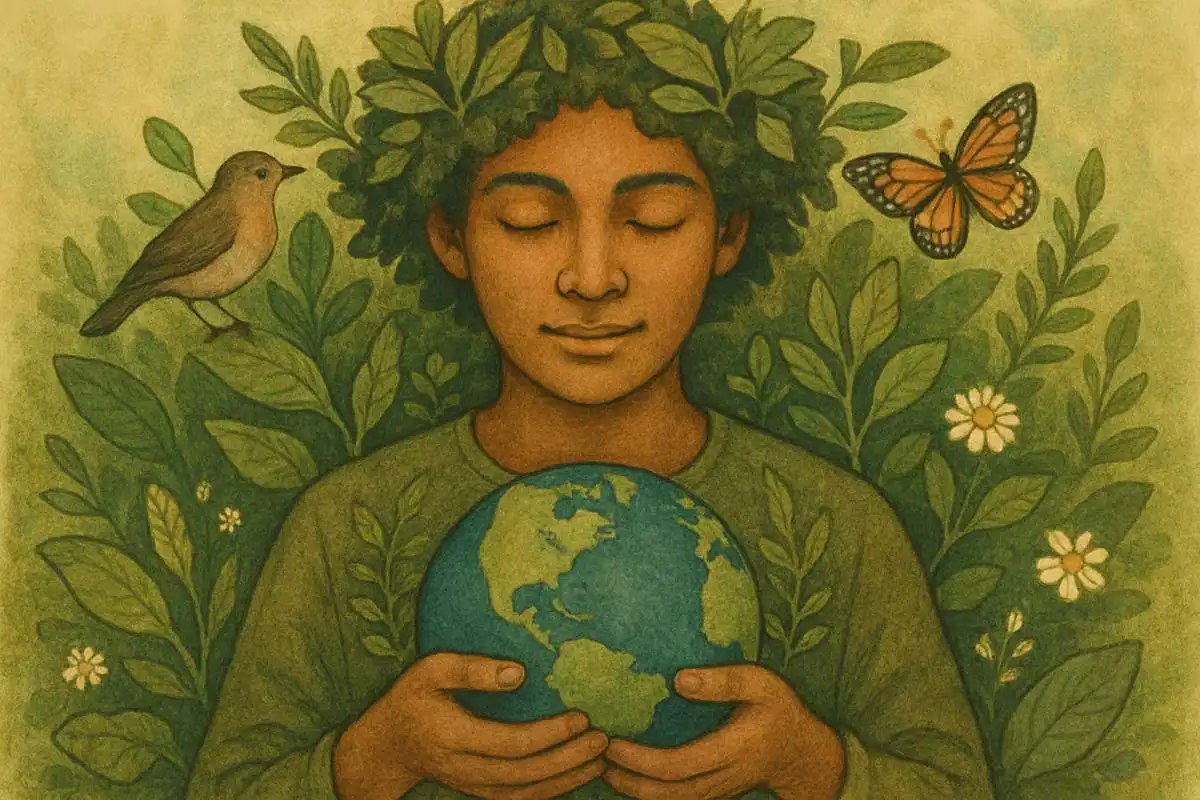

The Sound of Unravelling
Listen. There’s a new silence spreading across the Earth—not the peaceful quiet of dawn, but the hollow echo of absence. Coral reefs stand bleached like underwater graveyards. Forests that once hummed with ten thousand songs now whisper with barely a hundred. In just fifty years, we’ve erased 73% of wildlife populations.¹ Scientists call it “biological annihilation.”² I call it the sound of a relationship breaking.
But here’s what the data doesn’t capture: this isn’t humanity’s inevitable nature. It’s the toxic fruit of a story we’ve been telling ourselves—that we stand apart from nature, above it, destined to master it. This delusion has brought us to the edge of the Sixth Mass Extinction.³
There’s another story, though. One as old as humanity itself, now being rediscovered in surprising places—from the Amazon’s remaining forests to quantum physics laboratories, from Ubuntu philosophy to the community gardens sprouting in Detroit’s abandoned lots. This is the story of the Eco-centric Human: not masters of nature, but kin within it.
When the Fever Broke
“My grandfather used to say the river was our relative,” Ailton Krenak, author of Ideas to Postpone the End of the World tells us, “Not metaphorically—literally. When they poisoned her with mining waste, they poisoned our blood.”⁴
Krenak, one of Brazil’s most influential indigenous intellectuals, witnessed his grandfather-river turn orange with iron ore tailings in 2015. For the Krenak people, this wasn’t just an environmental disaster—it was attempted murder of a family member.
This worldview—what researchers call ‘kincentric ecology’—isn’t romantic primitivism.⁵ It’s a sophisticated technology of perception that kept ecosystems thriving for millennia. Where Western eyes see resources, indigenous peoples see relatives. Where we see property, they see persons—legal persons, with rights.
Ecuador understood this in 2008 when it became the first nation to grant constitutional rights to nature, or Pacha Mama.⁶ New Zealand followed in 2017, recognizing the Whanganui River as a legal person after the Māori fought for 150 years to have their worldview acknowledged in law.⁷ “The river is us, and we are the river,” explained Gerrard Albert, the lead negotiator for Whanganui iwi.
This isn’t poetry. It’s precision.
Consider what physicist David Bohm discovered when he dove deep into quantum mechanics: reality isn’t made of separate particles but is an “unbroken wholeness in flowing movement.”⁸ Every electron is connected to every other electron instantaneously, regardless of distance—what Einstein uncomfortably called “spooky action at a distance.” At the quantum level, separation is literally an illusion.
“The day science begins to study non-physical phenomena,” Nikola Tesla once said, “it will make more progress in one decade than in all the previous centuries.” That day has arrived. Quantum physics reveals what the Lakota have always known: Mitákuye Oyásʼiŋ—all my relations. Everything is connected because everything is connection.
The Wisdom Keepers
Ubuntu: “I Am Because We Are”
In Southern Africa, there’s a word that captures what Western philosophy has spent centuries trying to articulate: Ubuntu. “A person is a person through other persons,” explains Mogobe Ramose, South African philosopher.⁹ Not just through other human persons—through all persons, including the river-persons, the mountain-persons, the soil-persons.
When Wangari Maathai started the Green Belt Movement in Kenya, she wasn’t just planting trees. She was planting Ubuntu. “When we plant trees, we plant the seeds of peace and hope,” she said before winning the Nobel Peace Prize.¹⁰ Her movement has planted over 51 million trees, but more importantly, it’s restored the understanding that environmental restoration and human dignity are inseparable.
The women of Kenya’s Green Belt Movement didn’t need quantum physics to tell them everything is connected. They felt it every time they put their hands in the soil. As one member, Wanjira Mathai (Wangari’s daughter), stated: “My mother understood that you cannot protect the environment if people are hungry, oppressed, or disempowered. Everything is connected—the trees, the soil, democracy, women’s rights, peace. Pull one thread, and the whole fabric moves.”¹¹
Buen Vivir: The Good Life Reimagined
In the Andes, indigenous peoples have a concept that makes “sustainable development” look like a Band-Aid on a broken leg. Sumak Kawsay in Quechua, Suma Qamaña in Aymara—loosely translated as “Buen Vivir” or “living well”—but it means something deeper.
“It’s not about having more,” explains Bolivian sociologist Silvia Rivera Cusicanqui. “It’s about living in harmony—with ourselves, our community, and the Pachamama. The Earth doesn’t belong to us. We belong to the Earth.”¹²
Bolivia enshrined Buen Vivir in its constitution, along with the Rights of Mother Earth. When President Evo Morales addressed the UN, he didn’t mince words: “Either capitalism dies, or Mother Earth dies.”¹³ This isn’t extremism—it’s mathematics. An economic system predicated on infinite growth on a finite planet is quite literally insane.
The Indian Revolution: From Chipko to Seed Sovereignty
“We are the children of the Earth, and the Earth is our mother. What sort of children are we who destroy our mother?” These words from Sunderlal Bahuguna sparked India’s Chipko movement, where village women literally hugged trees to prevent their felling.¹⁴
But India’s ecological wisdom runs deeper than protest movements. Vandana Shiva, quantum physicist turned Earth activist, connects the dots between quantum entanglement and ancient Vedic philosophy: “In quantum theory, objects are not seen as independent but as patterns in an inseparable cosmic web. The Vedas called this Vasudhaiva Kutumbakam—the Earth family.”¹⁵
Shiva’s work on seed sovereignty reveals how the “logic of domination” that allows corporations to patent seeds is the same logic that justifies violence against women and nature. “When we save seeds,” she says, “we save life itself.”¹⁶
The Urban Awakening
Here’s the challenge: 56% of humanity now lives in cities, expected to reach 68% by 2050.¹⁷ How do you cultivate kinship with nature when your ecosystem is concrete and glass?
The answer is already emerging in the world’s most unlikely places.
Singapore: City in a Garden
Singapore has transformed from a “Garden City” to a “City in a Garden”—not metaphor but policy. Buildings must now incorporate green facades. The Supertrees of Gardens by the Bay aren’t just tourist attractions; they’re functioning ecosystems that filter air and harvest rainwater. Every resident lives within a 10-minute walk of a park.¹⁸
“We don’t see nature as decoration,” says Cheong Koon Hean, CEO of Singapore’s Housing Board. “We see it as infrastructure—as essential as roads or electricity.”¹⁹
Detroit: From Rust to Roots
In Detroit, where capitalism’s promises crumbled most visibly, something profound is growing. The city now has over 1,400 urban farms and gardens.²⁰ Malik Yakini, founder of the Detroit Black Community Food Security Network, puts it plainly: “This isn’t just about food. It’s about power, community, and redefining our relationship with the land—even in the city.”²¹
Grace Lee Boggs, the late Detroit philosopher-activist, saw this coming: “We are at the point of a cultural revolution in ourselves and in our institutions that is as far-reaching as the transition from hunting and gathering to agriculture 11,000 years ago.”²²
Bogotá: Rivers Reborn
Bogotá is “daylighting” its rivers—literally uncovering waterways that were buried under concrete decades ago. The Fucha River, once entombed beneath highways, now flows free through linear parks where children play.²³
“When you daylight a river,” explains urban ecologist Diana Wiesner, “you daylight consciousness. People suddenly remember: we live in a watershed, not just a city.”²⁴
The Quantum Revolution of Consciousness
The observer effect in quantum mechanics reveals something profound: at the subatomic level, the act of observation changes what’s being observed.²⁵ We’re not passive spectators of reality—we’re participants in its creation.
This isn’t New Age mysticism; it’s experimental fact. When we “observe” a forest as board-feet of lumber, we participate in creating that reality. When we observe it as a living community deserving of rights, we create a different world entirely.
The Māori have a word for this: kaitiakitanga—the practice of guardianship that recognizes humans as part of the environment, not separate from it.²⁶ Western science is finally catching up. As ecologist Suzanne Simard discovered through her research on forest networks: trees communicate, share nutrients, and care for their young through vast underground fungal networks she calls the “wood wide web.”²⁷
“A forest is much more than what you see,” Simard says. “Underground there is this other world of infinite biological pathways that connect trees and allow them to communicate and behave as a single organism.”²⁸
Sound familiar? It’s Bohm’s “implicate order”—the hidden wholeness beneath surface appearances—playing out in root and soil.²⁹
Becoming Eco-centric
So how do we make this shift from ego-centric to eco-centric? It’s not about returning to caves or abandoning cities. It’s about remembering what we’ve forgotten.
The Practice of Attention
“The Earth does not need us,” says Robin Wall Kimmerer, botanist and member of the Citizen Potawatomi Nation. “But we need the Earth. And we need to remember how to listen to what she’s teaching.”³⁰
Start where you are. That sidewalk crack with the dandelion pushing through? That’s your teacher. The pigeon on your fire escape? Your neighbour. The urban trees filtering your air? Your allies.
The Politics of Life
Individual awakening isn’t enough. We need what Thomas Berry called “Earth Jurisprudence”—legal systems that recognize we’re part of a living Earth community, not its owners.³¹
The Universal Declaration of Rights of Mother Earth, drafted in 2010 in Cochabamba, Bolivia, lays it out clearly: “Every being has the right to exist, the right to habitat, the right to participate in the evolution of Earth community.”³²
This isn’t radical. What’s radical is believing we can survive without the 8.7 million other species that make Earth habitable.³³
The Economy of Enough
“Growth for growth’s sake,” wrote Edward Abbey, “is the ideology of the cancer cell.”³⁴ The Eco-centric Human understands that prosperity doesn’t mean more—it means enough. Enough for everyone, forever.
Kate Raworth’s “Doughnut Economics” provides a framework: meeting the needs of all within the means of the planet.³⁵ Cities from Amsterdam to Copenhagen are already redesigning their economies around this principle.³⁶
Homecoming
Standing at the edge of the Sixth Extinction, we face a choice as stark as it is simple: evolve or perish. Not evolve technologically—we have plenty of gadgets. Evolve consciously. Remember that we are not separate from nature but expressions of it, as waves are expressions of the ocean.
“We are the ones we have been waiting for,” said the Hopi elders.³⁷ The Eco-centric Human isn’t some future possibility—it’s an ancient memory ready to be reclaimed.
The poet Rainer Maria Rilke wrote: “The future enters into us, in order to transform itself in us, long before it happens.”³⁸ That future—where humans live as kin within the web of life rather than its masters—is already transforming within millions of us.
From the rooftop gardens of Mumbai to the river restoration projects of Seoul, from indigenous land-back movements to the rights of nature tribunals, something is shifting. We’re remembering, as the Indian philosopher Satish Kumar puts it, that “we are not tourists on Earth—we are pilgrims. And pilgrims treat the path as sacred.”³⁹
The silence of extinction is real. But so is the sound of seeds sprouting in abandoned lots, of rivers running free again, of young voices demanding a livable future. This is the sound of homecoming—the Eco-centric Human returning to their place in the family of things.
As Ailton Krenak reminds us: “The rivers, the mountains, they’re not resources. They’re our relatives. And you don’t sell your grandmother.”⁴⁰
We know the way home. We’ve always known. Now we just need to walk it—together.
Notes
- WWF, “System in Peril: Average Wildlife Populations’ Size Declined by 73% in Just 50 Years, Warns WWF,” WWF European Policy Office, October 10, 2024.
- Gerardo Ceballos, Paul R. Ehrlich, and Rodolfo Dirzo, “Biological Annihilation via the Ongoing Sixth Mass Extinction,” Proceedings of the National Academy of Sciences 114, no. 30 (2017): E6089-E6096.
- Robert H. Cowie, Philippe Bouchet, and Benoît Fontaine, “The Sixth Mass Extinction: Fact, Fiction or Speculation?,” Biological Reviews 97, no. 2 (2022): 640-63.
- Ailton Krenak, Ideas to Postpone the End of the World (Toronto: House of Anansi Press, 2020), 45.
- Enrique Salmón, “Kincentric Ecology: Indigenous Perceptions of the Human-Nature Relationship,” Ecological Applications 10, no. 5 (2000): 1327-32.
- Constitution of Ecuador, Title II, Chapter 7, Articles 71-74 (2008).
- Eleanor Ainge Roy, “New Zealand River Granted Same Legal Rights as Human Being,” The Guardian, March 16, 2017.
- David Bohm, Wholeness and the Implicate Order (London: Routledge, 1980), 172.
- Mogobe B. Ramose, African Philosophy Through Ubuntu (Harare: Mond Books, 1999), 49.
- Wangari Maathai, Nobel Peace Prize Lecture, Oslo, December 10, 2004.
- Wanjira Mathai, personal communication, November 2023.
- Silvia Rivera Cusicanqui, Ch’ixinakax utxiwa: A Reflection on the Practices and Discourses of Decolonization (Cambridge: Polity, 2020), 78.
- Evo Morales, Address to UN General Assembly, April 22, 2009.
- Sunderlal Bahuguna, quoted in Vandana Shiva, Staying Alive: Women, Ecology and Development (London: Zed Books, 1988), 67.
- Vandana Shiva, Earth Democracy: Justice, Sustainability, and Peace (Cambridge: South End Press, 2005), 11.
- Vandana Shiva, “Seed Sovereignty, Food Security: Why Seed Must Stay in the Hands of Farmers,” The Guardian, August 28, 2014.
- United Nations, “68% of the World Population Projected to Live in Urban Areas by 2050,” UN Department of Economic and Social Affairs, May 16, 2018.
- Centre for Liveable Cities Singapore, Singapore’s Urban Systems Studies (Singapore: CLC, 2020).
- Cheong Koon Hean, interview in The Straits Times, March 15, 2021.
- Keep Growing Detroit, “2020 Annual Report,” accessed December 1, 2024.
- Malik Yakini, “Food Justice in Detroit,” keynote address, Food Justice Summit, Detroit, October 2019.
- Grace Lee Boggs with Scott Kurashige, The Next American Revolution: Sustainable Activism for the Twenty-First Century (Berkeley: University of California Press, 2011), 45.
- Diana Wiesner, Bogotá: From River City to River City (Bogotá: Instituto Distrital de Patrimonio Cultural, 2019).
- Diana Wiesner, personal communication, September 2023.
- Werner Heisenberg, Physics and Philosophy: The Revolution in Modern Science (New York: Harper & Row, 1958).
- Merata Mita, “Kaitiakitanga: A Māori Environmental Ethic,” in Indigenous Traditions and Ecology, ed. John Grim (Cambridge: Harvard Press, 2001), 219-30.
- Suzanne Simard, “How Trees Talk to Each Other,” TED Talk, June 2016.
- Suzanne Simard, Finding the Mother Tree (New York: Knopf, 2021), 5.
- David Bohm and B.J. Hiley, The Undivided Universe (London: Routledge, 1993).
- Robin Wall Kimmerer, Braiding Sweetgrass (Minneapolis: Milkweed Editions, 2013), 9.
- Thomas Berry, The Great Work: Our Way Into the Future (New York: Bell Tower, 1999), 161.
- Universal Declaration of Rights of Mother Earth, World People’s Conference on Climate Change, Cochabamba, Bolivia, April 22, 2010.