HomeNews2.5 Million Trees Planted...

2.5 Million Trees Planted in Minnesota by The Nature Conservancy

TNC has planted more than 13 million trees in Minnesota since 2005 to benefit people and nature.

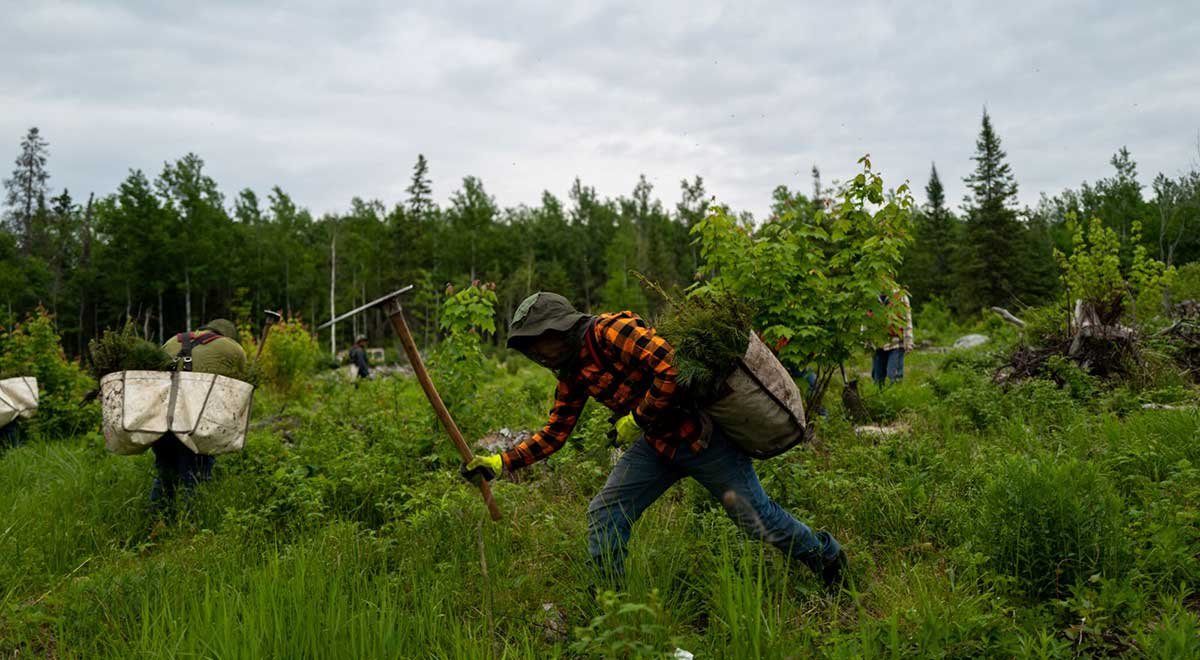
MINNEAPOLIS, Minn. – The Nature Conservancy (TNC) announced it planted 2.5 million trees in northern Minnesota this year in partnership with the U.S. Forest ServiceMinnesota Department of Natural Resources and three county land departments. This is a record number for the organization, and the second consecutive year the program has planted more than 2 million tree seedlings.

The tree seedlings were planted on public lands—across 5,810 acres of national forest, state forest, state park and county-managed forest lands—and covered six counties, including Cook, Lake, Saint Louis, Itasca, Cass and Carlton County.

The planting areas included 1.8 miles along scenic Highway 61 and 41 miles of stream, river and lakeshore that connect to Lake Superior. It also included 1,740 acres of moose habitat enhancement, completed in partnership with the Ruffed Grouse Society and Minnesota Moose Habitat Collaborative—whose tribal representation is critical in maintaining habitat for this species of cultural importance to Indigenous communities.

“Our Northwoods are an essential part of our state,” said Ann Mulholland, TNC’s director in Minnesota, North Dakota and South Dakota. “They absorb and store carbon from the atmosphere, filter our water, support our economy, offer wildlife habitat and give us places to hike, hunt and relax. We’re planting trees to improve the diversity and resilience of our Northwoods for generations to come.”

Warming temperatures, pressure from development, and pests like spruce budworm are rapidly changing Minnesota’s forests. As the forests become more fragmented and less diverse, they grow increasingly vulnerable to disease and wildfire. In response to this spring’s devastating wildfires, the team also planted 5,100 trees on 11 acres that were burned in the Camp House wildfire.

TNC uses science-based methods to carefully select and plant trees that will thrive in future climate conditions and enhance the health of the forest. This year, the team planted 14 different native and climate-hardy tree species, including white pine, white spruce, red pine, jack pine, red oak and yellow birch.

“Diversity is the superpower of our forests. Like a diverse stock portfolio, we want a diverse mix of tree species to ensure that enough survive different stresses like drought, pests and warmer temperatures,” said Jim Manolis, TNC’s director of forest strategy and stewardship in Minnesota.

Tree planting at this scale requires an enormous amount of planning, collaboration and effort. The team orders tree seedlings two years in advance and coordinates with agencies and partners to ensure the trees are planted on time during the six-week spring planting season.

“Strong partnerships with the DNR, Forest Service and local counties are the reason we have been able to plant more than 13 million trees across northern Minnesota since 2005,” said Manolis.

This accomplishment was only possible with the hard work of 65 seasonal guest workers who specialize in tree planting and tending. Non-immigrant guest workers from Latin America plant more than 85% of the trees planted in the U.S. each year on temporary visas. An important pillar of TNC’s program is ensuring these highly skilled workers are well compensated, cared for and appreciated while helping TNC achieve its forestry goals.

Learn more about TNC’s work to protect Minnesota’s forests at nature.org/mnforests

The Nature Conservancy is a global conservation organization dedicated to conserving the lands and waters on which all life depends. Guided by science, we create innovative, on-the-ground solutions to our world’s toughest challenges so that nature and people can thrive together. We are tackling climate change, conserving lands, waters and oceans at an unprecedented scale, providing food and water sustainably and helping make cities more resilient. The Nature Conservancy is working to make a lasting difference around the world in 81 countries and territories (40 by direct conservation impact and 41 through partners) through a collaborative approach that engages local communities, governments, the private sector, and other partners. To learn more, visit nature.org or follow @nature_press on X.

Latest Posts

More from Author

Central America Wilderness: Biological Corridors

1. Historical Baseline Pre-1750 Wilderness Extent The jaguar padded through continuous forest from...

Between Recovering Doctrine and Reformation: Christianity’s Ecological Crossroads

The question of whether Christianity can become genuinely "green" forces us...

Read Now

Central America Wilderness: Biological Corridors

1. Historical Baseline Pre-1750 Wilderness Extent The jaguar padded through continuous forest from Mexico's Yucatan to Colombia's Darién Gap, never leaving tree cover across 2,000 kilometers.¹ Central America's narrow isthmus—never more than 200 kilometers wide—functioned as Earth's great biological bridge, enabling species exchange between continents for three million years...

Between Recovering Doctrine and Reformation: Christianity’s Ecological Crossroads

The question of whether Christianity can become genuinely "green" forces us into uncomfortable theological and philosophical territory. It requires confronting not merely lapses in practice but potential flaws in foundational doctrine, while simultaneously excavating buried wisdom that mainstream Christianity has systematically suppressed. The tension between recovering lost...

White Scars and Contrails of Crisis: Aviation and Climate Change

We have been taught to look down. To see the airports, the concrete, the crowds, and the queues as the footprint of flight. Or we look at the numbers, the comforting, almost negligible figures. Aviation, the industry tells us, accounts for just 2.5% of global CO2 emissions.¹ It...

The Enchantress of Abstraction: The Life, Work, Legacy and Genius of Augusta Ada Lovelace

The Convergence of Poetry and Logic The history of science is frequently punctuated by figures who exist at the confluence of opposing forces—individuals whose intellects bridge the chasm between the empirical and the imaginative. Among these, few cast a longer or more complex shadow than Augusta Ada King,...

Do Androids Dream of Electric Sheep? Philip K. Dick’s Question Meets Quantum Consciousness and the Age of AI

The question Philip K. Dick posed in 1968 was never really about sheep. It was about the ineffable thing that separates life from simulation, consciousness from computation, being from seeming. In his dystopian San Francisco, where nuclear fallout had rendered authentic animals nearly extinct, owning a real sheep...

Between Recovery and Reformation: Christianity’s Need to Reform Anthropocentric Theology

The question of whether Christianity can become genuinely "green" forces us into uncomfortable theological and philosophical territory. It requires confronting not merely lapses in practice but potential flaws in foundational doctrine, while simultaneously excavating buried wisdom that mainstream Christianity has systematically suppressed. The tension between recovering lost...

The Vanished Cities of the Amazon: Evidence of Pre-Columbian Civilizations

Christianity must both recover suppressed creation-centered traditions and fundamentally reform anthropocentric theology—authentic recovery itself transforms doctrine.

Gaia Song

Gaia Frequencies — The Voice of Earth · 600 CE *, *::before, *::after { box-sizing: border-box; margin: 0; padding: 0; } ``` :root { --font-display:...

Moltbook: The Bot-Only Social Network Isn’t the Singularity—It’s a Stress Test for the Agent Era

*An ABC Australia report on Moltbook (February 2026) and the ensuing security coverage is the spark for this commentary—because beneath the memes is a serious preview of where “agentic AI” is heading.*¹ - Kevin Parker - Site Publisher Moltbook arrived like a prank from the near future: a...

The Poles: Arctic and Antarctic Wilderness

Earth’s poles—vast, fragile, warming fast—anchor global climate. Indigenous wisdom, science, and cooperation are key to preserving these icy wildernesses.

The Large Language Model Landscape of February 2026

The Permian competition tightens: pruning, agentic browsers, and the energy bill becomes law. February 2026 doesn’t feel like a month of flashy invention. It feels like a month of selection. Not the Cambrian chaos of 2025—new architectures every week, new “god models” proclaimed hourly—but the colder logic of the...

The Attention Trap: Social Media Addiction, Behavioural Design, and the Architecture of Digital Wellbeing

The digital landscape of the mid-2020s is defined not by the information it provides, but by the relentless competition for the human focus that consumes it. This essay explores the phenomenon commonly termed "social media addiction," examining the delicate balance between the profound social utility of these...
error: Content unavailable for cut and paste at this time