

A Planet Ablaze: Fire, Civilisation and the Return of an Ancient Force
Four hundred and twenty million years of fire, a century of forgetting, and the question the burning of Europe is really asking us
I. Deep Time: Fire Is Older Than Forests
Before there were trees to burn, there was fire.
In rocks laid down in the late Silurian period, roughly 420 million years ago, palaeobotanists have found fossil charcoal—the carbonised remains of some of the earliest land plants, small and primitive things barely a few centimetres high. Something set them alight. There were no humans, no mammals, no dinosaurs, and scarcely anything that could be called a forest. There was simply vegetation, oxygen and lightning, and the moment those three things coexisted on land, the planet began to burn.
This is worth sitting with, because it inverts almost every instinct we bring to the subject. Fire is not an intrusion into the biosphere. Fire is a product of the biosphere—an emergent property of a living planet. Combustion requires atmospheric oxygen above roughly sixteen per cent, and the only reason Earth’s atmosphere holds twenty-one per cent oxygen is that plants spent hundreds of millions of years putting it there. Photosynthesis assembles carbon, water and sunlight into living tissue. Fire takes that tissue apart again and returns it to the air. It is photosynthesis run backwards, at speed. Life made the conditions for its own burning.
During the Carboniferous, when atmospheric oxygen may have reached thirty per cent or more, fires were probably vaster and more frequent than anything in the modern record; charcoal is abundant in coal seams of that age. This has been a fire planet for almost the entire time there has been anything on land to burn.
Fire as an architect
Given that timescale, it should not surprise us that evolution has had ample opportunity to work with fire rather than merely against it. What is genuinely surprising is how far that adaptation has gone. Across four continents, entire biomes are not simply fire-tolerant; they are fire-dependent. Remove fire and they do not flourish. They collapse into something else.
Australians live inside the clearest example on Earth. Many banksias hold their seed in woody follicles that are sealed shut with resin and open only when heated—a strategy called serotiny, which amounts to a plant depositing its entire reproductive future in a fireproof safe and handing the combination to the next fire. Eucalypts carry dormant epicormic buds beneath thick bark, allowing a tree that appears comprehensively dead to re-clothe its own trunk in green within weeks. Many species carry lignotubers, swollen woody reserves at the base of the stem, holding energy and buds below the reach of flame.
Most striking of all, Australian researchers established in the early 2000s that certain seeds germinate in response to specific chemical compounds present in smoke itself—karrikins, named from a Noongar word for smoke. These are plants that do not merely survive fire. They wait for it. They read the chemistry of a burnt landscape and interpret it as an instruction to begin.
The pattern repeats worldwide with local variations: the fynbos of the Cape, the chaparral of California, the maquis and garrigue of the Mediterranean basin, the serotinous cones of North American lodgepole pines, the fire-maintained savannas of Africa. In each case, the diversity we admire is not merely coexisting with fire. It is a product of it.
The question was never whether these landscapes would burn. Fire is the oldest ecological process on land, older than seeds, older than flowers, older than anything with a backbone. The only questions that have ever mattered are how often, how hot, and in what pattern.
Hold that sentence, because it is the hinge on which this entire essay turns. If fire is ancient, inevitable and in many places necessary, then the crisis unfolding across the Northern Hemisphere this month is not the return of an ancient force. It is the distortion of one. Something has changed the frequency, the intensity and the pattern—and it is not the fire that has changed. It is us.
Four Hundred and Twenty Million Years of Fire
A chronology of fire on Earth, from the first fossil charcoal to the present. Note that the horizontal scale is heavily compressed and non-linear: the entire human relationship with fire occupies the final fraction of one per cent. Grey markers denote fire as a purely natural process; orange denotes fire under human direction; dark red denotes industrial combustion.
II. The Bargain: How Fire Built Us, and How We Forgot
Every technology humanity possesses is downstream of a single acquisition: the ability to start, carry and control a fire.
The archaeological evidence for habitual fire use runs back at least a million years, and the anthropologist Richard Wrangham has argued influentially that cooking was not a refinement of the human diet but a precondition for the human body. Cooked food is pre-digested food. It surrenders vastly more energy for vastly less gut. On this account, fire funded the metabolically expensive brain that now reads this sentence—an external stomach that let us grow an internal luxury.
Everything that follows is fire too. Ceramics are fire. Metallurgy is fire, and with it every blade, plough, rail and turbine. Glass is fire. Lime and cement, and therefore the city, are fire. Bread is fire. When we speak of the hearth as the centre of the home, we are not being sentimental; we are being accurate about the physical arrangement of human settlement for most of its existence. Civilisation is not something that happened alongside our use of fire. Civilisation is what our use of fire made possible.
The second fire: reading Country
There is a second, subtler application, and Australia holds the longest continuous record of it anywhere on Earth. For something in the order of sixty-five thousand years, Aboriginal and Torres Strait Islander peoples have used fire not as a tool of clearance but as a language of management—what is now often called cultural burning, or in the older phrasing, firestick farming.
The principle is not complicated to state, though it takes a lifetime to practise: the right fire, in the right place, at the right time, for the right Country. Cool burns, lit in the correct season, moving slowly enough that animals can walk away from them and low enough that the canopy is untouched. Applied in mosaics, so the landscape becomes a patchwork of recently burnt, moderately grown and long-unburnt ground. That patchwork does two things simultaneously. It sustains the habitat diversity on which biodiversity depends, and it means no single fire can run unbroken across a whole landscape, because it keeps encountering ground that has nothing left to give it.
This is not folklore. It is applied ecology developed over a timescale no scientific institution can approach, and practitioners such as Victor Steffensen and the Firesticks Alliance have spent years demonstrating that it still works. The knowledge is read from the land itself: from the flowering of particular plants, the behaviour of particular animals, the moisture in particular soils. It requires being present, repeatedly, in one place, over a long time.
Which is precisely what colonisation destroyed. Across Australia and North America alike, the practice was outlawed, dismissed as primitive, or simply rendered impossible by removing the practitioners from the land. What was lost was not just a technique. It was a relationship of attention.
Ecological amnesia and its two faces
Into that vacuum stepped an idea that seemed, at the time, obviously correct: that fire is an enemy, and that a well-organised society should be able to abolish it. This has proved to be one of the most expensive misjudgements in the history of land management, and it produced two opposite failures with an identical result.
- The suppression paradox of North America and Australia. A century of aggressive total suppression—attacking every ignition, extinguishing every flame—succeeded at exactly the thing it attempted and failed at everything that mattered. By interrupting the frequent, low-intensity fires that historically consumed the understorey, suppression permitted an unprecedented accumulation of what foresters call ladder fuels: the shrubs and small stems that carry flame from the ground into the canopy. Each fire successfully prevented deposited its unburnt fuel into the account of the next one. The forests that resulted are not natural. They are stockpiles.
- The abandonment crisis of Southern Europe. In Spain, Portugal, Italy and Greece the mechanism ran in reverse. Rural depopulation through the twentieth century emptied the countryside; terraces, orchards, olive groves and grazed commons were left untended. Grazing animals that had cropped the understorey for millennia disappeared. Flammable scrub and pine advanced into ground that had been managed continuously since antiquity. Nobody suppressed anything. The landscape simply stopped being read, and it responded by growing fuel.
The two histories look nothing alike and arrive at the same place. In one, we intervened too aggressively; in the other, we withdrew entirely. What they share is the loss of a continuous, attentive, seasonal relationship with a specific piece of ground—and the substitution of policy for observation. This is the ecological amnesia the burning of 2026 has exposed. We did not forget the facts. We forgot the practice of looking.
“We are not just fighting fire; we are fighting the accumulation of a hundred years of ecological debt. We spent a century trying to remove fire from the landscape, only to discover that fire is not a visitor we can refuse. We only ever got to choose what kind of visit it would be: a manageable one, or a catastrophic one.”
III. The Pyrocene: The Third Fire Rewrites the First
The American fire historian Stephen Pyne has offered the most useful framework available for understanding what is happening, and it is worth setting out carefully because it reorganises everything else.
Pyne describes three fires. The first fire is nature’s: lightning in a dry forest, burning what the seasons have made available, on the timetable of the seasons. The second fire is ours, applied to the land—the cultural burning described above, the cleared field, the managed mosaic. The third fire is also ours, but it is different in kind. It is combustion removed from the landscape altogether and confined inside machines: the boiler, the furnace, the internal combustion engine. This third fire burns not living biomass but fossil biomass, carbon that has been out of circulation for hundreds of millions of years.
Pyne’s argument is that the third fire has now become so vast that it has begun to rewrite the operating conditions of the first two. It has altered the atmosphere in which every landscape fire burns. He calls the resulting epoch the Pyrocene—an Age of Fire, offered deliberately as the counterpart to an Ice Age. Where ice once reorganised the surface of the planet, its ecosystems and its coastlines, fire is now doing the equivalent work.
This is the vertical context that reporting on individual fires almost always omits. We are not experiencing a bad run of fire seasons. We are experiencing a change of state.
The mechanism: atmospheric thirst
The physical link between the third fire and the first is less about heat than most people assume. It is about thirst.
Warmer air can hold substantially more water vapour—by the Clausius–Clapeyron relation, roughly seven per cent more for each additional degree Celsius. Crucially, the atmosphere does not merely have the capacity to hold more; it exerts a stronger pull to fill that capacity. The measure of this is the vapour pressure deficit, the gap between the moisture the air holds and the moisture it could hold. As that gap widens, the atmosphere draws water out of soils, leaf litter and living vegetation with increasing force.
The consequences are disproportionate to the temperature change that causes them. Fine fuels—grass, litter, small twigs—dry faster and further. Live fuel moisture in shrubs and trees falls, so that vegetation which would once have resisted ignition now carries fire readily. Landscapes that used to hold enough moisture to stop a fire at nightfall no longer do, which is why so many contemporary fires refuse to lie down overnight. The result is what fire scientists call a lengthening and deepening of the fire weather window: more days per year on which extreme fire behaviour is physically possible.
Two further mechanisms compound it. Dry lightning—thunderstorms delivering ignition without meaningful rainfall—is a growing ignition source across high latitudes. And the most extreme fires now manufacture their own weather: pyrocumulonimbus clouds, thunderstorms generated by the fire’s own convective column, which can throw embers many kilometres ahead and produce lightning that starts new fires. This behaviour was documented in Australia during the 2019–20 Black Summer and has been reported again this month in the fires west of Bordeaux. A fire that generates its own ignitions has, in a meaningful sense, stopped being a fire and started being a weather system.
The Climate–Fire Feedback Loop
How emissions drive atmospheric thirst, producing high-intensity fire that releases long-stored carbon and reinforces the original warming. The loop is self-amplifying, which is why it cannot be addressed at any single point.
The frontlines, July 2026
The abstraction becomes concrete very quickly.
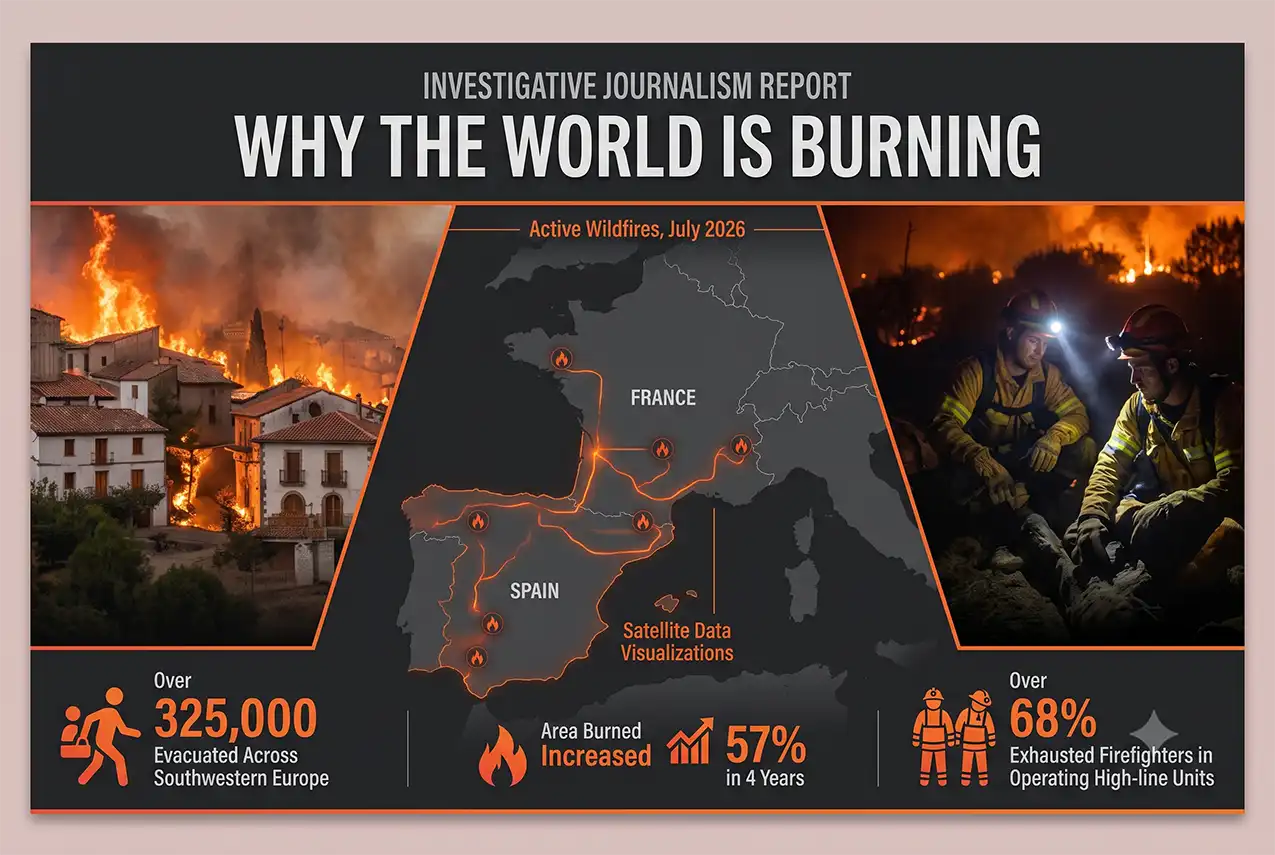
Southwestern Europe is experiencing the most severe displacement event of the modern European fire record. More than 325,000 people have been evacuated across France and Spain, with roughly 220,000 in France, around 100,000 in Spain and a further 30,000 in Portugal. The evacuation around Bordeaux is the largest in France since the Second World War, with the exhibition centre at Bordeaux-Lac converted into a reception hall for displaced families and residents of evacuated aged-care homes. Spain declared a national emergency as fires advanced on the Madrid region, with over 63,000 evacuated across Madrid, Toledo and Ávila. According to Copernicus data, France has recorded roughly 3.4 times its annual average number of fires this year; Spain roughly 1.7 times. The WHO’s European office reports that the area burned across its European region rose by fifty-seven per cent in four years, reaching 2.2 million hectares in 2025.
Canada has run the opposite trajectory within a single season. The year opened well below average—under 170,000 hectares by early June—before conditions turned. By mid-July more than 800 fires were burning simultaneously, roughly 200 of them in Ontario, and the season total had climbed past 1.4 million hectares on federal figures, with independent trackers reporting higher. This is not 2023, when 18.4 million hectares burned. What alarms fire scientists is the speed of the escalation: a season can now travel from unremarkable to national emergency in about ten days.
The boreal and Arctic present the gravest long-term problem, because there the fire is not primarily in the trees. The Arctic is warming roughly three to four times faster than the global average, thawing permafrost that has held carbon out of circulation for millennia. Fires there ignite peat and deep organic soils, burn downward rather than outward, and can smoulder underground through winter beneath snow before re-emerging in spring—overwintering or “zombie” fires. This releases ancient carbon and methane directly into the feedback loop described above. It is, in the most literal sense, the past catching fire.
Northern and temperate Europe now face what might be called an adaptation deficit. When London recorded 40°C in July 2022 and its fire brigade had its busiest day since the Second World War, the problem was not that the fires were large by global standards. It was that nothing—not the building stock, not the vegetation management, not the responder training, not the public’s instincts—had been designed with fire in mind. Competence is regional and slow to build.
Australia supplies the reference case for all of it. The 2019–20 Black Summer burned in the order of 24 million hectares, an extent of temperate forest fire without documented precedent. Thirty-three people died directly. Modelling published subsequently attributed several hundred further deaths to smoke exposure—a figure worth stating carefully, since it is an epidemiological estimate rather than a count, but one that reframes what a fire death is. Australia has already run the experiment that Europe is now entering.
Regional Fire Regime Comparison Matrix
Drivers, fuels, historical context and principal vulnerabilities across the major affected zones. Note that the historical context column describes a management failure in every case except the Arctic—where the driver is almost purely climatic.
| Region | Primary Driver | Principal Fuel | Historical Context | Key Vulnerability |
|---|---|---|---|---|
| Mediterranean / S. Europe | Heat domes and dry downslope winds | Scrub, pine, ungrazed former farmland | Rural depopulation and land abandonment | Historic towns, coastal tourism, ageing rural populations |
| W. North America | High vapour pressure deficit | Overstocked conifer forest | A century of total suppression | WUI expansion, power grids, insurance withdrawal |
| Boreal & Arctic | Permafrost thaw and dry lightning | Peat, moss, carbon-rich soils | Accelerated warming (3–4× global rate) | Remote communities; subterranean carbon feedback |
| SE Australia | Drought, extreme heat, pyroconvection | Eucalypt forest with high bark and litter loads | Displacement of cultural burning; suppression era | Dispersed settlement, catchments, biodiversity thresholds |
| N. & Central Europe | Unfamiliar drought and heatwaves | Mixed forest, heath, grassland | Historically low-risk; no institutional memory | Adaptation deficit in codes, training and public instinct |
Smoke: the impact that ignores every border
The fire is local. The smoke is not.
Smoke has become the mechanism by which wildfire converts from a regional disaster into a hemispheric public health event. Plumes from the Ontario fires streamed east across Quebec and into the American Midwest and Northeast this month, tracked by satellite. In 2023, Canadian smoke turned the sky over New York a colour that people photographed because they had no reference for it. Black Summer smoke crossed the Pacific and was detected circling the Southern Hemisphere in the stratosphere.
This matters beyond the spectacle. Smoke closes airports, shuts schools and worksites, and suppresses outdoor economies for weeks. More seriously, it delivers fine particulate matter to populations with no connection to the fire, no warning system calibrated for it, and no influence over the land management that produced it. A child with asthma a thousand kilometres downwind bears a cost generated in a forest they will never see.
“There is no ‘away’ any more. Smoke does not respect borders, and it does not check whether you voted for anything. We are connected by the air we breathe, and what burns in a remote boreal forest today can put a child in hospital a continent away tomorrow.”
IV. The Reckoning: What Fire Actually Costs
The accounting that follows a major fire is almost always wrong, because it counts what is easy to count. Structures destroyed. Hectares burned. Direct fatalities. These numbers are published within days and they are the smallest part of the total.
The psychological injury
Begin here, because it is the cost most consistently omitted and the one most likely to be relevant to anyone reading this in the aftermath of an evacuation.
The Australian philosopher Glenn Albrecht, working in the Hunter Valley among communities watching open-cut mining transform the landscape around them, coined a term for a specific kind of distress: solastalgia. Nostalgia is the pain of being away from home. Solastalgia is the pain of being at home while home becomes unrecognisable. You have not moved. The place has.
It is difficult to imagine a more exact description of what a returning fire-affected community experiences. The house may be rebuilt in eighteen months. The ridgeline will not look like that again within a lifetime. The specific stand of trees, the birdsong at a particular hour, the walk that constituted the texture of ordinary life—these have a recovery horizon measured in decades, and some of them will not recover at all. People frequently report feeling that their grief over trees and landscape is illegitimate compared with the loss of houses and lives. It is not. Attachment to place is a well-documented dimension of human wellbeing, and its disruption is a genuine injury rather than a sentimental indulgence.
Alongside this sits the more familiar territory of trauma. Longitudinal research following the 2009 Black Saturday fires in Victoria—among the most thorough long-term studies of a fire-affected population anywhere—found elevated rates of post-traumatic stress, depression and alcohol use persisting for years, with significant numbers of people still affected long after the recovery infrastructure had been dismantled. Two findings from that body of work deserve wide circulation.
The first is that psychological recovery runs on a much longer clock than physical reconstruction, and it is not linear. Anniversaries matter. The first hot, windy day of the following summer matters. Children who appeared unaffected may present years later.
The second is more hopeful, and it should shape policy directly: the strongest predictors of recovery are social. Connectedness to community, and a sense of agency—of being consulted and involved rather than processed and managed—consistently predict better outcomes. Communities that are given a genuine role in their own recovery do better than communities that are efficiently administered. The anger that so many displaced people are feeling right now is not a pathology to be managed. It is, quite often, the beginning of the agency that will help them recover, and the institutions on the receiving end of it would do well to understand it that way.
The physical health cost
Wildfire smoke is not woodsmoke. When fire moves through the wildland–urban interface it burns houses, and houses are chemistry: treated timber, insulation, plastics, wiring, refrigerants, vehicles, solar arrays, batteries. The resulting plume carries heavy metals, dioxins and volatile organics alongside the particulates.
PM2.5 is the principal concern because of its size. Particles below 2.5 micrometres penetrate deep into the lung and pass into the bloodstream. The established consequences include acute respiratory distress and measurable increases in cardiovascular events during and immediately after smoke episodes. The emerging literature—which should be described as emerging rather than settled—points toward associations with adverse birth outcomes and with cognitive effects in older populations. There is also evidence that wildfire-derived PM2.5 may be more toxic per unit mass than the equivalent urban pollution, which would mean existing air quality standards understate the risk.
The economic mechanism that ends communities
The most consequential economic effect of wildfire is not the cost of rebuilding. It is the withdrawal of insurance.
The sequence is worth setting out precisely, because it is now visible in California, in parts of the Mediterranean and in northern Australia, and because it is how a fire-affected place becomes a former place. Losses rise. Insurers reprice, then restrict, then withdraw from the market entirely. Homeowners find cover unavailable or unaffordable. Without insurance, mortgages cannot be written. Without mortgages, buyers cannot purchase. Property values fall, which erodes the rate base that funds the local road maintenance, vegetation management and volunteer fire service that might have reduced the risk in the first place.
This is the uninsurability loop, and its significance is that it does not require a fire to destroy a town. It only requires the credible expectation of one. Risk that cannot be priced becomes risk that cannot be transferred, and assets in that condition are stranded. The insurance industry is, in effect, conducting the most rigorous climate risk assessment in the economy and publishing the results in the form of withdrawn products.
Water, soil and the second disaster
Fire’s effect on water supply is chronically underappreciated outside the utilities that manage it. Melbourne, Sydney, Denver and Cape Town all draw from forested catchments, where a severe fire produces effects lasting years.
Intense fire destroys the root structure holding soil in place and can render the surface temporarily water-repellent. The next significant rainfall then moves ash and sediment into waterways in a pulse: turbidity spikes beyond what treatment plants are designed for, and ash slugs strip oxygen from streams, killing fish that survived the fire itself. Debris flows—fast slurries of mud and rock—can kill people in valleys the fire never reached, sometimes months later. In some regrowth forests, the dense young stand replacing mature trees transpires more water than its predecessor, reducing catchment yield for decades.
Biodiversity beyond the photogenic
Public attention after a major fire settles, understandably, on animals we find charismatic. The ecologically decisive damage is usually elsewhere. Soil is a living system—fungal networks, invertebrates, microbial communities mediating the nutrient cycling on which plant recovery depends—and high-intensity fire can sterilise the upper profile outright.
More critical still is fire interval. Obligate seeders are killed by fire and regenerate only from seed, requiring a minimum number of years to mature and build a seed bank. Burn them again before that threshold and there is no second generation. The species is lost locally, not because any single fire was too severe, but because two arrived too close together. Shortening fire intervals is a mechanism of extinction that leaves no dramatic imagery behind.
Where this compounds, ecosystems cross thresholds and do not return. Forest that burns too hot and too often converts to shrubland; shrubland invaded by flammable exotic grasses converts to grassland that burns more readily still, locking in the new state. This is not a forest recovering slowly. It is a different ecosystem, and it is more flammable than the one it replaced.
The moral geography of fire
Finally, a question the technical literature raises less often than it should: who actually bears this?
Fire risk is not distributed randomly, and neither is the capacity to withstand it. Land in high-risk zones is frequently cheaper, which means exposure correlates with limited means. Evacuation assumes a vehicle, fuel, somewhere to go and the ability to lose several days’ income—assumptions that fail for casual workers, for people without cars, for those with mobility limitations or care responsibilities. Older residents in depopulated European villages, precisely the demographic left behind by the rural abandonment that grew the fuel, are the least able to leave quickly. Renters receive no insurance payout and no reconstruction assistance, because they own nothing that was destroyed except the contents of their lives. Remote Indigenous communities face the longest response times and the thinnest infrastructure.
Fire does not create these inequalities. It reads them, amplifies them, and makes them briefly visible.
V. The Return: What Actually Works
Everything above is diagnosis. This section is the part that matters, and it begins with a hard clarification: there is no version of the future in which these landscapes do not burn. Any proposal premised on stopping fire is not a solution but a more expensive restatement of the problem. The achievable goal is different and genuinely attainable—to break the link between ignition and catastrophe, so that fire arrives as an event rather than a disaster.
1. Put good fire back into the landscape
The single most effective intervention is the deliberate application of low-intensity fire under controlled conditions: prescribed burning in the Western management tradition, cultural burning in the Indigenous one. These are related but not identical, and the difference matters. Prescribed burning is generally a fuel reduction operation with a hazard objective. Cultural burning is a land management relationship with ecological, cultural and custodial objectives, of which fuel reduction is a by-product.
The evidence supports both, with one caveat advocates should state plainly: fuel treatment does not stop fires under the most extreme weather. What it reliably does is widen the range of conditions under which suppression is possible and give crews somewhere defensible to stand. That is not a small claim—most fires do not occur under catastrophic conditions, and the fires that destroy towns are frequently ones that could have been stopped a day earlier and a kilometre back.
Scaling faces real constraints: shrinking weather windows, smoke management near populations, liability, and a severe shortage of experienced practitioners. Resourcing Indigenous-led fire programmes properly—on Country, with genuine authority rather than consultative decoration—addresses the last of these while doing considerable justice at the same time.
2. Accept that the house is the problem
Post-fire investigations across three continents converge on a finding that remains counter-intuitive to most homeowners: houses are usually destroyed not by a wall of flame but by embers. Wind-borne embers arrive ahead of the fire front, accumulate in gutters, enter roof cavities through unscreened vents and open eaves, lodge under decks, and ignite the structure from within, sometimes hours after the front has passed.
This is unambiguously good news, because it means the decisive variables are cheap and local:
- The home ignition zone. The first metre or two around the structure does disproportionate work. Gravel rather than bark mulch. Nothing combustible stored against walls or under decks. Gutters cleared. This is not clear-felling the garden; it is managing a narrow band with precision.
- Ember-resistant construction. Non-combustible roofing, enclosed eaves, fine metal mesh over every vent and weep hole, sealed gaps, ember-rated seals on doors and windows. Australia’s construction standard for bushfire-prone areas provides the most developed framework internationally, and its underlying logic transfers directly to Mediterranean and North American contexts.
- Neighbourhood-scale treatment. A hardened house next to an untreated one is at risk from its neighbour. Ember and radiant-heat exposure is a shared condition, which makes this a collective problem masquerading as an individual one.
3. The choices we make about where and how to live
Some of what has driven this crisis is not climate or forestry but preference. Across Australia, North America and increasingly Europe, people have moved in large numbers into forested and peri-urban landscapes—for beauty, for space, for cost, for the tree change. The wildland–urban interface has expanded faster than almost any other land use category, and every additional dwelling adds both an asset to defend and a potential ignition source.
These are legitimate choices, and this is not an argument for prohibition but for honesty at the point of decision. Fire risk should be disclosed at sale and lease as seriously as flood risk. Planning approvals should account for evacuation capacity, not merely lot size—a single-road subdivision in heavy fuel is a design failure however well each house is built. And insurance pricing, uncomfortable as it is, transmits real information that policy has often preferred to suppress.
In the highest-risk locations, where mitigation cannot realistically succeed, managed retreat must be discussable. Handled badly it is displacement by another name. Handled well—voluntary, generously funded, community-led, with the land returned to managed open space—it is the same instrument societies already accept for floodplains.
4. The politics of prevention
Why, given that almost all of this is known, is so little of it done?
Because prevention is politically unrewarding. A minister can be photographed beside a water-bombing aircraft; nobody is photographed beside a fire that did not happen. Australia’s Productivity Commission examined this directly and found disaster funding overwhelmingly weighted toward recovery rather than mitigation—a ratio of roughly nineteen dollars spent after the event for every one spent before it. The economic literature on mitigation returns points consistently in the other direction, with benefit–cost ratios for well-targeted prevention typically estimated at several times the outlay.
The deeper mismatch is temporal. Fuel accumulates over years to decades; forests operate on centuries; electoral cycles run three or four years and insurance contracts renew annually. We have built institutions that cannot see the timescale of the problem they exist to manage. That is not a failure of individual politicians but a design fault in the machinery—and it is fixable, through statutory mitigation targets, independent long-horizon advisory bodies and multi-year quarantined funding.
5. Technology: real help, honest limits
Satellite detection now identifies new ignitions within minutes. Machine learning models predict fire spread with improving accuracy. Camera networks and remote sensors deliver early warning. Aerial ignition by drone makes prescribed burning safer and cheaper. Canada has committed substantial funding to a national aerial firefighting surge capacity for this season.
All of it is worth having; none of it is a solution. Technology improves detection, prediction and response speed. It does not reduce fuel, harden a house, relocate a subdivision or restore seasonal attention to a landscape. The risk is that it becomes a way of appearing to act while deferring the harder, less photogenic work. A perfectly predicted catastrophe is still a catastrophe.
6. Both, not either
A persistent false choice deserves retiring. Adaptation and mitigation are not competing strategies. Emissions reduction sets the eventual ceiling on how severe fire weather becomes; nothing else does. Adaptation determines how much damage occurs beneath whatever ceiling we end up with. Mitigation without adaptation abandons people to the warming already locked in. Adaptation without mitigation is an arms race against a threat that keeps escalating. The correct answer has never been in doubt.
7. Fire diplomacy
The response to the current European fires demonstrates both the promise and the fragility of international cooperation. Greek water-bombing aircraft flew operations near Ávila this week, deployed to Spain under the EU Civil Protection Mechanism. Australian and North American crews have exchanged personnel for years, exploiting the fact that the two hemispheres burn in opposite seasons.
That last arrangement contains a warning. It works only while the seasons remain separated in time. As they lengthen at both ends the windows overlap, and the shared pool of aircraft and experienced crews is drawn down simultaneously by countries that had assumed they would be taking turns. Mutual aid built on seasonal complementarity is quietly becoming mutual competition. Formalising standing arrangements—deployment treaties, strategic reserves, common training standards, open satellite data—is the alternative to a bidding war for aircraft during the worst week of the year.
From Reactive to Proactive: The Resilience Paradigm Shift
Comparing the long-term economic and human outcomes of post-disaster response against front-end landscape stewardship. The distinction is not the amount spent, but when it is spent and on what.
Reactive Model
Stewardship Model
The uncomfortable truth in that comparison is not that we lack the knowledge. It is that we know precisely what to do, and our institutions are structured to reward doing it too late.
Coda: A New Covenant
Return to where this began. Fire has been present on this planet for four hundred and twenty million years. It shaped the plants, the soils and the distribution of every biome we have ever known. It cooked the food that grew our brains, smelted the metal that built our cities, and fired the bricks of every house now burning outside Bordeaux. There is no version of us that is separate from it.
What has changed is not fire’s nature but our position relative to it. For most of human history we lived inside a fire relationship: seasonal, attentive, reciprocal, conducted at the scale of a particular piece of ground by people who would be standing on it again next year. Then, over roughly two centuries, we did two things simultaneously. We moved combustion indoors, into engines and furnaces, on a scale that has altered the atmosphere itself. And we declared the fire outdoors to be an enemy, and stopped paying attention to it.
The burning of 2026 is the invoice for both decisions arriving at once.
The word that keeps recurring in the more thoughtful literature is stewardship, and it is worth being precise about what it means, because it is not a synonym for management. Management implies control of an object. Stewardship implies responsibility toward something that has its own nature, which you are obliged to understand rather than override. It is closer to how we speak about caring for a person than about operating a machine.
Adopting it would mean accepting that some things cannot be controlled but can be lived with intelligently; that knowledge accumulated over sixty-five thousand years of continuous attention belongs at the centre of the response rather than in an appendix to it; and that our obligations run along a timescale no institution we have built can currently perceive. The forests replanted this year will mature under a climate the children now sleeping in evacuation centres will inherit. Fuel loads are a debt we pass forward. So is fuel treatment.
For those currently displaced, none of this is consolation, and this article does not pretend otherwise. Analysis does not restore a house or a hillside. But the questions that follow the fire—why did this happen, could it have been prevented, will it happen again—have real answers, and the answers are not fatalistic. This was not a random misfortune. It was the predictable outcome of specific decisions about land, settlement, energy and attention, most of which can be decided differently.
The task is not to defeat fire. That was always a fantasy, and pursuing it is what produced the landscapes now burning. The task is to re-enter a relationship with it: to understand what it is, what it does, and what it requires of anyone who intends to live in its company. That relationship is available. It is older than agriculture, it is still practised, and it works.
The alternative is to keep insisting on control, and to keep receiving the invoice.
A note on sources and figures. Evacuation and area-burned figures for the July 2026 European and Canadian fires are drawn from official statements and contemporaneous reporting current at the time of publication, and are provisional; active-incident numbers move daily and later official reviews frequently revise them. The Canadian season total is cited from Government of Canada updates, with independent trackers reporting somewhat higher figures on differing methodologies. Health impact figures attributed to smoke exposure are epidemiological estimates rather than counts, and are presented as such. The Pyrocene framework is Stephen Pyne’s; solastalgia is Glenn Albrecht’s; the cooking hypothesis discussed is Richard Wrangham’s. Deep-time dates for fossil charcoal and Carboniferous oxygen levels carry the uncertainty normal to the palaeorecord. Where evidence is emerging rather than established—particularly on the long-term neurological and birth outcomes of smoke exposure—this is indicated in the text.
Download a copy of ‘Why the World Is Burning: The 2026 Wildfire Crisis Explained‘


