
Ecocide The World Is Beginning to Draw a Line
When Destroying Nature Becomes a Crime: The Ecocide Revolution
How an emerging international legal movement is challenging the impunity of those responsible for the gravest destruction of the living world.
Twelve twenty-eight
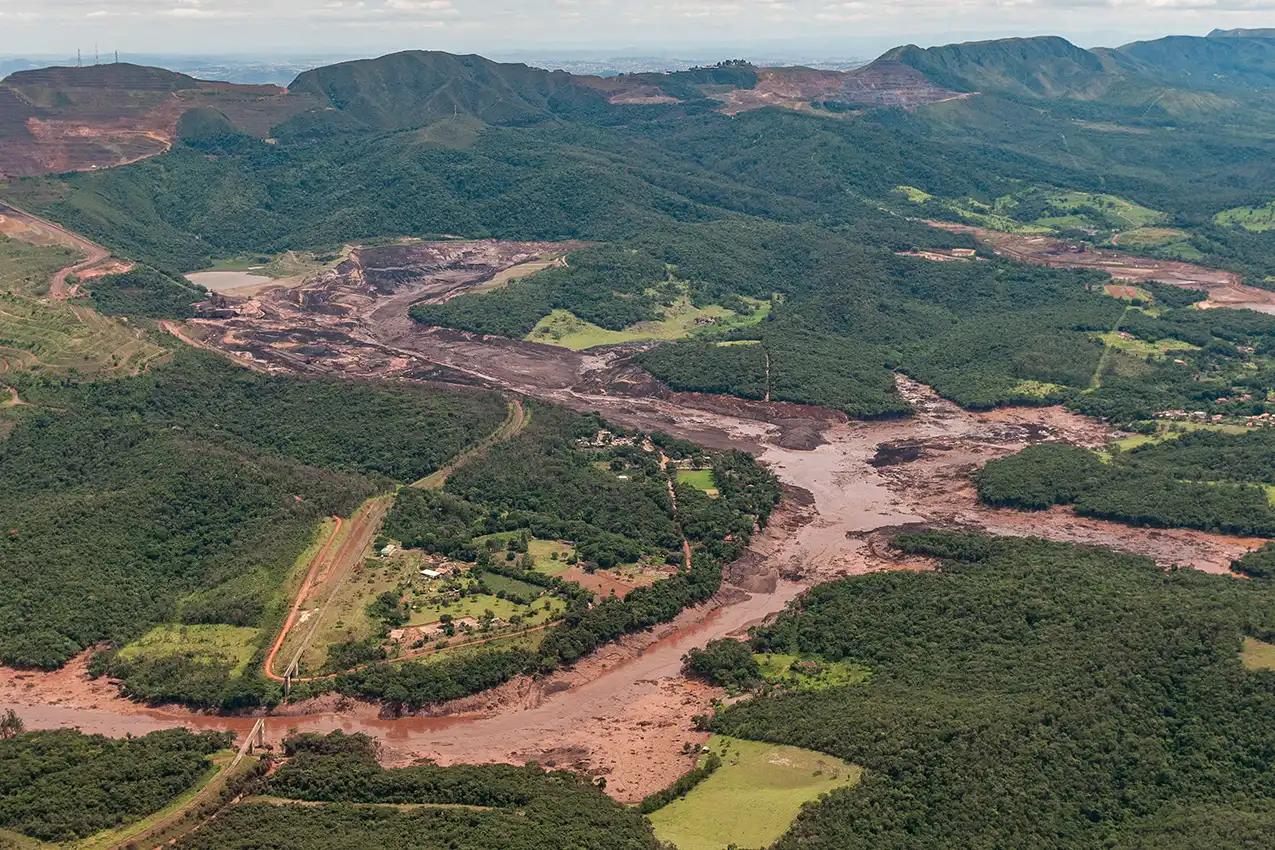
At 12.28 pm on 25 January 2019, a tailings dam at the Córrego do Feijão iron-ore mine in Brumadinho, in the Brazilian state of Minas Gerais, gave way. A wall of mining waste surged down the valley at lunchtime, engulfing the mine’s canteen and offices, then houses, a railway bridge and a guesthouse, before pouring into the Paraopeba River.
Brazilian state authorities record 272 lives lost, including two unborn children, and approximately 12 million cubic metres of tailings released.1 Much of the waste settled along the Ferro-Carvão stream and the Paraopeba, where water use was restricted for a long stretch of the river. This was not damage that could be tidied away when the cameras departed. It changed the landscape, scattered a community and began a programme of monitoring and restoration that continues today.
What investigators then found about the months before the collapse is the reason the disaster opens a series about ecocide law.
A parliamentary commission of inquiry in Minas Gerais concluded in September 2019 that the mine’s owner, Vale, had known of risks to the dam and had failed to take the necessary measures.2 Brazil’s National Mining Agency reported discrepancies between the information supplied to regulators and the company’s internal records, and said that accurate reporting could have allowed precautionary action.3 In January 2020, state prosecutors charged sixteen individuals who had worked for Vale or for TÜV SÜD, the German firm that had certified the dam’s stability, with homicide and environmental crimes; the two companies were charged with environmental offences.4
Nearly eight years on, no court has decided whether any of them is guilty.
The proceedings were transferred to the federal courts, where evidentiary hearings finally opened on 23 February 2026: seventy-six sitting days, scheduled to run until May 2027, with the defendants not due to be questioned until March of that year. Only then will the judge decide whether the homicide charges go before a jury. In March 2024 a federal regional court had dismissed the case against Vale’s former chief executive, Fabio Schvartsman, finding insufficient evidence of his involvement. In April 2026 Brazil’s Superior Court of Justice reversed that decision by three votes to two; in June it unanimously rejected his appeal, and in August a further appeal failed. His case has been severed and will be heard apart from those of the other former executives, the company and the certifier.5 As this article went to press, the court was still hearing witnesses and no verdict had been reached. These remain allegations. They are not findings of guilt, and the presumption of innocence applies to every defendant.
Vale, for its part, describes an extensive remediation and monitoring programme and reports improvements in several water-quality measures.6 Restoration matters. It does not restore 272 lives, and it does not answer the question of why the structure failed.
Brumadinho is not presented here as a proven case of ecocide. The international crime proposed under that name did not exist in 2019, and whether any defendant’s conduct could satisfy a future legal definition would require evidence tested in court. It is presented instead as the question that ecocide law asks us to confront: when serious environmental damage is foreseeable, when warnings sit on the record, and when preventable devastation follows, should criminal accountability reach the decisions that preceded it — and should it take the better part of a decade to find out?
A crime without a name
Strip away the particulars and the pattern is familiar. A corporation is warned. Assessments identify the risks. Internal reports describe the likely consequences. Operations continue, profits accumulate, and the damage arrives — sometimes in an afternoon, more often across decades. Eventually regulators intervene. There may be a fine, a promise of rehabilitation, a carefully worded expression of regret in the annual report.
But what if the destruction cannot be repaired? What if a river remains poisoned beyond the lifetimes of the people who depended on it, and the people responsible knew that outcome was a substantial possibility before they proceeded?
Here lies a startling inconsistency at the heart of our legal systems. We accept that deliberate or reckless conduct causing catastrophic harm to human beings can warrant criminal prosecution, and we have built international law to confront genocide, war crimes, crimes against humanity and aggression. But the gravest destruction of the ecosystems that sustain human and non-human life has no equivalent standalone offence under the Rome Statute of the International Criminal Court.
That absence is increasingly difficult to defend, and a growing coalition of lawyers, scientists, Indigenous representatives, governments and civil-society organisations is seeking to end it. Their argument is simple: some environmental destruction is so severe, so foreseeable and so fundamentally incompatible with the survival of living communities that it should cross the boundary from regulatory violation into serious crime.
They have given that boundary a name. Ecocide.
And in 2026, what was once dismissed as an unrealistic ambition is acquiring legislative substance — unevenly, incompletely, and in more places than most people realise.
The evidence of a civilisation in ecological trouble
The case for ecocide legislation does not depend on environmental sentiment. It begins with evidence.
In 2019 the Intergovernmental Science-Policy Platform on Biodiversity and Ecosystem Services (IPBES) published one of the most comprehensive assessments of the natural world ever undertaken. Around one million animal and plant species were estimated to face extinction, many within decades, unless the pressures driving biodiversity loss were reduced. The assessment identified changes in land and sea use, exploitation of organisms, climate change, pollution and invasive species as the principal direct drivers.7
This was not a warning about charismatic animals or remote wildernesses. It described the erosion of the systems that support agriculture, fresh water, fisheries, climate regulation and the countless relationships on which societies depend.
The evidence has continued to accumulate. The United Nations Food and Agriculture Organization’s Global Forest Resources Assessment 2025, released in October 2025, estimated that the world lost approximately 489 million hectares of forest to deforestation between 1990 and 2025. Annual deforestation has slowed, but still averaged about 10.9 million hectares a year during 2015–2025.8
That is roughly 109,000 square kilometres each year: an area the size of Cuba, or more than one and a half Tasmanias, cleared from the world’s forests annually.
Not all forest loss is permanent: net of regrowth and planting, the FAO puts the annual loss at 4.12 million hectares. Not all forests have equal ecological value, and not every case of deforestation is ecocide. Those distinctions matter. But the cumulative picture reveals an extraordinary contradiction. Humanity has built instruments capable of monitoring ecosystem decline with unprecedented precision: satellites detect disappearing forests, chemistry identifies contamination, ecologists document species collapse. We know what is happening. Knowledge has not reliably translated into prevention.
In many cases ecological destruction is not a surprise discovered after development has occurred. It is a foreseeable consequence of decisions taken with environmental assessments already sitting on desks.
This is where the moral question becomes unavoidable. If catastrophic environmental harm is foreseeable, why should the law so often treat it principally as an administrative or financial problem rather than a potential crime?
The lawyer who refused to accept the inevitable
The modern campaign for ecocide law owes an extraordinary debt to the late Scottish barrister Polly Higgins.
Higgins began in conventional practice, including corporate and employment law, but became preoccupied with a fundamental absence: the lack of an overarching criminal duty to prevent the gravest destruction of the natural world. In 2010 she proposed to the United Nations that ecocide be recognised as a fifth international crime. It was a formidable ambition. International criminal law had developed around atrocities against human beings — mass killing, persecution, warfare, aggression. Higgins asked whether destroying the ecological foundations on which every human society depends should also be recognised as a wrong of exceptional gravity.
Her campaign challenged the assumption that nature is principally property, territory, a resource or an economic input. Forests could be logged, rivers diverted, mountains excavated; the legitimacy of each activity was assessed through property rights, development approvals, environmental legislation and economic interest. Higgins wanted a further question asked: regardless of who owned the land or authorised the activity, was the resulting destruction so grave that it should be criminal?
She died in April 2019, aged fifty, before seeing her ambition translated into the international proposals that followed.9 The movement did not die with her. Jojo Mehta, who had co-founded the Stop Ecocide campaign with Higgins in 2017, led its international expansion, and Stop Ecocide International now works across diplomatic, legal, political and civil-society networks.
Its achievement has been to move the discussion beyond protest and into the harder territory of legislative drafting, criminal liability and international negotiation. Moral outrage may generate a movement. If that movement intends to change the behaviour of powerful institutions, it must produce laws capable of surviving intense scrutiny.
The breakthrough of 2021
A decisive advance came in June 2021. An Independent Expert Panel convened by the Stop Ecocide Foundation, co-chaired by the international lawyers Philippe Sands and Dior Fall Sow, published a proposed legal definition of ecocide drafted for insertion into the Rome Statute.
The proposed definition describes ecocide as:
“unlawful or wanton acts committed with knowledge that there is a substantial likelihood of severe and either widespread or long-term damage to the environment being caused by those acts.”10
Independent Expert Panel for the Legal Definition of Ecocide, June 2021
Every element matters. The proposal does not criminalise all environmental harm. It does not reach the farmer clearing vegetation, the developer constructing a building or the business with an ecological footprint. The damage must be severe and either widespread or long-term. The conduct must be unlawful or wanton. And the person responsible must know there is a substantial likelihood of such damage.
The word wanton is the most consequential. Under the panel’s formulation it means reckless disregard for damage that would be clearly excessive in relation to the social and economic benefits anticipated. That opens a difficult but necessary debate. Should an activity escape criminal responsibility simply because a government authorised it? If a project is lawful but its foreseeable destruction is grossly disproportionate to its benefits, should legality alone provide protection? The panel’s answer is that authorisation should not necessarily end the inquiry.
One qualification is essential and will recur throughout this series: the panel’s text is a proposal. It does not itself create criminal liability anywhere.
Still, the definition marks a profound shift. It offers a way to separate ordinary environmental regulation from the gravest destruction, and it insists that the environment deserves protection in its own right — not only when damage can be translated into identifiable human injury or financial loss. A species does not need a bank account to possess ecological significance. A forest does not become valueless because its inhabitants cannot testify in court. A river is not restored because an injured party receives compensation.
Why existing law has failed to draw the line
Environmental legislation has expanded enormously over half a century: pollution controls, protected areas, impact assessments, biodiversity protections, licensing regimes, and international agreements on climate, wildlife trade and hazardous waste. Yet the ecological crisis continues.
This is not evidence that environmental law is useless; many laws have prevented serious harm and enabled recovery. The problem is that legal protections coexist with political and economic arrangements that permit continued degradation. The United Nations Environment Programme documented this implementation gap in its 2019 Environmental Rule of Law report: enforcement capacity, resourced institutions, judicial independence and public participation determine whether laws protect anything at all.11
Ecocide itself illustrates the point. The word has been on statute books for decades. Vietnam legislated in 1990, and nine successor states of the Soviet Union — Ukraine among them, under Article 441 of its Criminal Code — followed between 1996 and 2003. When Belgium’s government approved its bill in 2023, Stop Ecocide International counted the country as set to become the twelfth with the crime on its statute books.12 Until Ukraine began applying Article 441 to wartime destruction after Russia’s full-scale invasion in 2022, prosecutions under those older provisions were vanishingly rare. France offers a more recent caution: its 2021 Climate and Resilience Law created an offence it called écocide, but classed it as a lesser délit confined to intentional versions of specified pollution offences — a long way from the crime its own citizens’ climate assembly had demanded.13
The lesson is uncomfortable for campaigners and essential for honest reporting. The word is not the law. Definition, enforcement and political will are.
Consider how the regulatory model works. A company proposes a project. Risks are assessed, conditions negotiated, approval granted. Inspectors monitor compliance; violations may bring fines or restrictions. Under an effective system, this prevents serious harm. Under a weak or compromised one, it becomes the mechanism through which destruction is authorised, managed and financially accommodated. The question is not whether an activity has a permit. It is whether the permit protects the systems at risk.
Nor is the problem confined to corporations. Governments authorise destructive projects, weaken protections and disregard scientific warnings; officials face pressure to approve developments promising jobs, revenue or electoral advantage; communities are divided between legitimate economic needs and long-term protection of their environment. These dilemmas are real. But the existence of difficult choices does not mean every conceivable consequence should remain legally permissible. Societies already accept that economic benefit cannot justify certain conduct. Ecocide law extends that principle to the most extreme ecological destruction.
The international breakthrough
For years, proposals to criminalise ecocide lived at the margins of diplomacy. That changed as vulnerable states grasped what international criminal accountability might offer.
On 9 September 2024, Vanuatu, Fiji and Samoa formally submitted a proposal to amend the Rome Statute to add ecocide as a fifth crime, adopting the panel’s definition.14 The Democratic Republic of the Congo became the first African state to endorse the amendment the following month.15 In October 2025 the Assembly of States Parties’ Working Group on Amendments took up the proposal for consideration.16
The initiative’s significance lies partly in its authors. Pacific island states face severe environmental and climate threats despite contributing little to the emissions driving them. Their leadership exposes a great injustice of the contemporary world: the geography of ecological damage does not match the geography of economic benefit. Resources are extracted in one country, processed in another, financed elsewhere and consumed across wealthy markets. The profits travel thousands of kilometres. The destroyed forest, the contaminated water and the eroded coastline stay where they are.
An international crime cannot by itself resolve those inequalities, nor would it automatically establish criminal liability for climate change; proving responsibility for diffuse, cumulative emissions presents major legal challenges. But the Pacific initiative placed a new proposition before the international community: the most serious environmental destruction belongs within the architecture of international criminal justice.
That was a historic diplomatic advance. It was not the completion of the task.
As of November 2026, ecocide has not been adopted as a fifth crime under the Rome Statute. The Court’s jurisdiction remains limited to genocide, crimes against humanity, war crimes and aggression. Environmental destruction may already be relevant to prosecutions under those crimes, but there is no standalone international offence of ecocide. The Assembly of States Parties meets for its twenty-fifth session in The Hague from 30 November to 7 December 2026,17 and this series will report on what it does — and does not — decide.
Europe begins to act
While international negotiation continues, some of the most consequential developments are national and regional.
Belgium is the clearest example. On 1 September 2026 its new Criminal Code entered into force, and with it Article 94 of Book II, which makes ecocide a domestic crime.18 The offence consists of deliberately committing, by act or omission, an unlawful act causing serious, widespread and long-term damage to the environment, knowing that it causes such damage. It carries up to twenty years’ imprisonment for individuals, and the same code recognises ecocide as an international crime alongside genocide, crimes against humanity, war crimes and aggression.19
It is an important achievement — and it is narrower than the panel’s proposal. The Belgian definition is cumulative: the damage must be serious and widespread and long-term, where the panel requires severe and either widespread or long-term. It applies only to unlawful conduct, so “wanton” but lawful destruction is excluded. And its reach is confined by Belgium’s constitutional division of powers between federal and regional authorities.20 Recognising ecocide in principle is one thing. Writing it into a code so that it is precise, enforceable and compatible with a given legal order is another, and the compromises show.
The European Union has moved too. Directive (EU) 2024/1203 requires member states to criminalise serious environmental offences, including qualified offences where specified unlawful conduct causes exceptionally serious ecological damage — cases its recitals describe as “comparable to ecocide”. It does not create a uniform offence by that name.21 Beyond the EU, the Council of Europe adopted a Convention on the Protection of the Environment through Criminal Law in May 2025 and opened it for signature on 3 December 2025. It is the first legally binding international instrument dedicated to environmental crime, enabling states to prosecute intentional conduct causing disasters “tantamount to ecocide”. It will bind no one until ten states have ratified it; Latvia became the first in September 2026.22
Other developments have followed. In September 2026 Croatia’s government approved a new Article 214a of its Criminal Code creating an offence of ecocide and referred it to parliament, where it had its first reading in October.23 In Denmark, Radikale Venstre, a member of the governing coalition, adopted ecocide law as official policy; Finland’s Social Democrats did the same at their 2026 congress; and in Germany the Greens and Die Linke have pressed for a standalone offence going beyond the federal government’s draft implementation of the EU directive.24
Scotland supplies the cautionary tale. The Ecocide (Scotland) Bill, introduced by Monica Lennon MSP and drawing directly on the panel’s definition, passed its first parliamentary stage in February 2026 by 90 votes to 26. It then fell at the dissolution of the Scottish Parliament on 8 April 2026, the responsible committee having judged there was no time to resolve outstanding technical questions before the election.25 A law can win a vote and still die.
These developments are not equivalent. Some are enacted law; others are government proposals, bills or party positions. Together they indicate that the subject is becoming difficult for legislators to ignore.
Latin America enters the debate
Perhaps the most significant recent development has come from the region with the most to lose.
On 1 October 2026 a Model Ecocide Law for Latin America was launched in Mexico City by Stop Ecocide International, the Mexican Center for Environmental Law (CEMDA) and researchers at the Universidad Iberoamericana. It was built through a regional public consultation, online working sessions involving 74 experts from 14 countries, and a two-day drafting conference of more than thirty legal experts.26 The text runs to eighteen articles, proposes prison terms of eight to twenty years, treats ecocide as a crime of both result and endangerment, and calls for protection — including police escort — for whistleblowers, witnesses and experts in ecocide cases.27
That last provision reflects a grim reality. According to Global Witness, 85 per cent of the 124 environmental defenders murdered in 2025 were killed in Latin America.28
“We are champions at passing beautiful laws that are then not enforced,” Rodrigo Lledó, the Chilean lawyer who directs Stop Ecocide International’s work in the Americas, told AFP.28 The Model Law’s answer is to insist that the difficulty of identifying perpetrators does not relieve the state of its duty to stop the destruction and repair the damage.
The region’s ecological significance explains the stakes. The Amazon Basin, the forests of Central America, Andean ecosystems, wetlands, dry forests and great river systems hold a remarkable share of global biodiversity — and they are environments where extractive industry, land speculation, poverty, political influence and organised crime intersect. Legal systems must confront these realities without treating local communities as obstacles to development.
A model law establishes no offence and creates no court. Its effect depends on whether governments adopt credible provisions, fund enforcement and protect the independence of prosecutors and judges. Argentina’s Senate committees approved an ecocide bill in June 2026, only for governing-party senators to withdraw their support a fortnight later after objections from agribusiness; Peru’s Congress has a unified bill before it; Brazil’s lower house has had one since 2023.29 None has yet become law. But the initiative shows that ecocide law is no longer a European conversation. It is increasingly led by countries and communities at the front line of destruction — and those communities must help design the solutions, not merely receive legal models drawn elsewhere.
Africa and Asia draw their own lines
The movement’s geography is wider still. In April 2026 Mauritius made ecocide a domestic crime, writing the panel’s definition into its Environment Act with a penalty of up to ten years.30 In the Democratic Republic of the Congo a national ecocide bill was lodged in parliament in December 2025, and President Félix Tshisekedi has used both the UN General Assembly and the opening of COP30 to back the Rome Statute amendment; the seventeen-state Congo Basin Climate Commission has called for an international crime.31 In Ghana, members of parliament and a state-mandated constitutional review have proposed a domestic offence in response to the devastation caused by illegal gold mining.32
In Asia and the Pacific, Azerbaijan amended its criminal code to include ecocide in October 2024; bills have been introduced in India, as a private member’s bill, and in the Philippines; and in October 2026 Iran’s foreign minister called for an independent international crime amid damage from military strikes on the country.33 Later instalments in this series will examine these developments in their own right.
Following the decisions to the boardroom
The strongest argument for ecocide law may also be its most politically uncomfortable: environmental destruction frequently results from decisions made far from where the damage occurs.
A river is contaminated in a remote region, but the financial calculations were approved in a distant capital. The consultants are overseas. The shareholders never visit. The executives who made the strategic decisions remain physically removed from the consequences. Modern corporate structures disperse responsibility across subsidiaries, contractors and management hierarchies. Everyone participates in a system; identifying the individuals legally responsible for its most destructive outcomes can be extraordinarily difficult.
This is why serious criminal accountability matters. The International Criminal Court prosecutes natural persons, not corporations. A proposed international ecocide crime would therefore require investigators to establish the responsibility of particular individuals according to the crime’s elements and the Court’s rules on individual criminal responsibility and the mental element.34 It would not be enough to show that an enterprise caused damage; investigators would need evidence connecting particular people to the relevant conduct — environmental assessments, internal communications, scientific warnings, risk reports, chains of authority. The Prosecutor’s new environmental policy already signals that corporate decision-makers may be investigated where their conduct contributes to crimes within the Court’s jurisdiction.35
The prospect is significant. A financial penalty becomes a cost in a business calculation. Personal criminal liability is harder to treat as an operating expense.
A warning is necessary. It would be irresponsible to suggest that directors could automatically be imprisoned because a company caused serious environmental harm. Criminal responsibility must be proven individually, and the requirements depend on the law. Due process, judicial independence, the presumption of innocence and the burden of proof are not obstacles to ecological justice; they are its conditions. The Brumadinho proceedings, with their dismissal and reinstatement of charges against a former chief executive, show both how hard and how necessary that individual inquiry is. Properly constructed ecocide legislation should be formidable and fair: designed to deter and punish exceptionally serious wrongdoing, not to criminalise ordinary disagreement about environmental policy.
The objections that deserve to be answered
Any proposal to extend criminal law into complex environmental decision-making will attract legitimate objections, and a serious campaign should welcome them.
Critics question whether the proposed definition is certain enough. What is severe? How large is widespread? How long is long-term? How should a court weigh a project’s environmental consequences against its social and economic benefits — and who decides what is “clearly excessive”? Can damage to a complex ecosystem be attributed reliably to particular individuals? Scholars who support criminalisation in principle have urged “legal humility”: recognising the limits of criminal law and treating ecocide as one tool among many rather than a singular solution.36 These are not trivial questions. But criminal courts already confront intention, recklessness, causation and foreseeability every day. Complexity does not make accountability impossible; it demands precision.
A second objection concerns development. Could ecocide law discourage investment, infrastructure, agriculture or energy? Poorly designed legislation could create uncertainty, and some commentators in the Global South fear that a cost-benefit test for “wanton” conduct could be applied more readily to projects in poorer countries than to those in richer ones.36 But the proposed threshold is deliberately high. Businesses that identify serious risks, act lawfully and take meaningful preventive measures should have little to fear from a properly framed offence. Credible legislation could provide greater certainty by clarifying the outer boundary of acceptable conduct, and reduce the competitive advantage of operators willing to impose devastating costs on communities and future generations.
A third objection is geopolitical. Would international ecocide law be applied selectively against weaker states while powerful ones escape? The danger is real; international criminal justice already struggles with influence, jurisdiction and unequal cooperation. The answer is not to abandon accountability but to insist on independent institutions, transparent standards and protection against political manipulation. The choice is not between imperfect criminal law and a perfect alternative. It is between strengthening accountability and tolerating gaps that leave the gravest destruction unaddressed.
A fourth objection is the one Scotland and France illustrate: symbolism. A law that is passed and never used, or passed in a form too narrow to use, changes nothing. That is why this series will measure every development against a single test — not whether the word appears in a statute, but whether anyone could realistically be prosecuted under it.
The International Criminal Court is already changing
A further development deserves attention. On 4 December 2025 the Office of the Prosecutor launched its Policy on Addressing Environmental Damage through the Rome Statute, explaining how environmental harm may be relevant to crimes already within the Court’s jurisdiction. In September 2026 the Office reported that implementation was under way, including consideration of numerous communications alleging Rome Statute crimes with an environmental dimension.37
This sits within a wider shift in the world’s courts. In advisory opinions published in July 2025, the International Court of Justice set out states’ binding obligations to protect the climate system, and the Inter-American Court of Human Rights declared the prevention of irreversible environmental harm a peremptory norm of international law.38 Neither opinion creates a crime. Together they change the legal climate in which one is being argued for.
The ICC policy is real progress. It is not a substitute for a standalone offence. Existing crimes were designed around other interests. The most severe destruction of an ecosystem may occur without the conditions required for genocide, crimes against humanity or war crimes. A forest can be devastated in peacetime; a river poisoned without an armed conflict; an irreplaceable habitat erased without satisfying any existing atrocity crime. The gap remains. Recognising ecocide would close it by treating sufficiently grave environmental destruction as a crime in its own right.
The deeper question: what does the law exist to protect?
Behind these developments lies a question deeper than statutory drafting: what do we regard as worthy of protection?
The history of law is partly a history of societies reconsidering relationships once accepted as natural or beyond challenge. Practices one generation regarded as legitimate have been recognised by the next as profound injustices. That does not make such transformations simple or inevitable, and it does not equate ecocide with genocide or other crimes of deliberate persecution of human populations. It does show that legal systems are not fixed expressions of eternal truth. They reflect the values, power and knowledge of particular societies.
Ecocide law asks whether contemporary civilisation has failed to recognise an especially important category of wrongdoing. We know humanity depends on functioning ecosystems. We know much destruction is irreversible. We possess the science to identify significant risks. And we know that powerful institutions can continue destructive conduct despite substantial warnings. What we have not established is a sufficiently strong legal boundary against the worst foreseeable consequences.
Every vanished species is a lineage that cannot be recreated. Every destroyed ancient forest erases relationships among organisms, soils, water and climate built over immense time. Every permanently poisoned waterway narrows what future generations can inherit. Economic accounting can estimate some of these losses; it cannot express them. Neither can criminal law restore what has been destroyed. But law has a moral and practical function: it tells a society which conduct has crossed a boundary that cannot be justified by wealth, convenience or influence. The ecocide movement asks whether we are ready to draw that boundary for the living world.
From recognition to responsibility
Ecocide legislation is not a complete solution to the ecological crisis. Criminal law is selective: particular conduct, defined standards, evidence sufficient to prove guilt. Many of the forces driving decline — economic incentives, consumption, unequal ownership, political institutions, cultural assumptions about humanity’s place in nature — cannot be prosecuted away.
Nor should criminal law replace strong regulation, biodiversity protection, Indigenous land rights, restoration programmes, public-interest science or democratic oversight. It should reinforce them. An effective response needs competent regulators, independent prosecutors, accessible environmental information, protection for whistleblowers and environmental defenders, mechanisms for remediation and meaningful participation by affected communities — and the political determination to enforce the law against influential offenders. Prevention first; accountability where necessary; recovery wherever possible.
That is why the progress reported by Stop Ecocide International is encouraging. The movement is building definitions, national proposals, diplomatic relationships and political support across jurisdictions. It is attempting to change not merely the administrative rules under which destruction occurs but the legal status of the most devastating acts themselves.
Success is far from guaranteed. Economic interests will resist. Governments may dilute legislation. Support may evaporate. Laws may be enacted without enforcement. A symbolic offence that never reaches a courtroom will not protect a river; a statute without independent investigators will not restore a forest. But the movement has crossed a threshold. It is no longer asking only whether ecocide should be discussed. It is asking how the law should define it, who should be held responsible and which institutions must be empowered to act. Those are the questions of a movement acquiring practical influence.
The line we have refused to draw
Perhaps future generations will look back at the early twenty-first century with astonishment. They may wonder how societies capable of mapping distant galaxies and decoding genomes could permit the systematic destruction of the ecosystems on which their existence depended; how extraordinary scientific warnings so often failed to overcome ordinary financial and political calculations; and why it took so long to recognise that certain destruction should be treated not as an unfortunate consequence of progress but as a grave violation of responsibility.
There is no guarantee that ecocide legislation will transform civilisation. There is a compelling case that civilisation cannot continue indefinitely without stronger limits on its destructive power.
The most important question is no longer whether environmental damage matters; the science has answered that. Nor is it whether decision-makers can foresee the risks; the record shows they can. The question is whether legal systems will respond with a seriousness proportionate to the harm.
A civilisation that can identify the destruction of its own ecological foundations, but repeatedly fails to prevent the most extreme and foreseeable instances, has a profound problem of accountability.
Ecocide law offers one necessary part of the answer. It proposes that the living world is not a storehouse to be exploited until the costs become politically inconvenient; that certain forms of destruction lie beyond legitimate conduct; and that those who knowingly cross that boundary should face consequences commensurate with what they have done.
The world does not need another expression of regret when an ancient forest disappears, a river dies or an ecosystem passes beyond recovery. It needs laws capable of preventing such destruction, governments prepared to enforce them, and the courage to tell those who wield enormous power that there are limits.
Some things must not be destroyed.
That is the principle at the heart of the ecocide revolution. The record of 2026 suggests its time is arriving — slowly, unevenly, and against resistance.
Notes and references
1. Government of Minas Gerais, “Histórico do rompimento das barragens da Vale na Mina Córrego do Feijão,” updated 7 August 2026, https://www.mg.gov.br/pro-brumadinho/pagina/historico-do-rompimento-das-barragens-da-vale-na-mina-corrego-do-feijao. ↩
2. Assembleia Legislativa de Minas Gerais, “CPI conclui que Vale sabia dos riscos e aponta responsáveis,” 12 September 2019, https://www.almg.gov.br/acompanhe/noticias/arquivos/2019/09/12_cpi_barragem_relatorio_final_principal.html. ↩
3. Agência Nacional de Mineração, “Agência Nacional de Mineração conclui o relatório técnico sobre barragem de Brumadinho,” 5 November 2019, https://www.gov.br/anm/pt-br/assuntos/noticias/2019/agencia-nacional-de-mineracao-conclui-o-relatorio-tecnico-sobre-barragem-de-brumadinho/. ↩
4. Ministério Público de Minas Gerais, “MPMG e PCMG finalizam investigações sobre o rompimento da barragem em Brumadinho: 16 pessoas são denunciadas por homicídio qualificado e crimes ambientais,” 21 January 2020, https://www.mpmg.mp.br/portal/menu/comunicacao/noticias/mpmg-e-pcmg-finalizam-investigacoes-sobre-o-rompimento-da-barragem-em-brumadinho-16-pessoas-sao-denunciadas-por-homicidio-qualificado-e-crimes-ambientais.shtml; Reuters, “Brazil Charges Ex-Vale CEO with Homicide for Dam Disaster,” Al Jazeera, 21 January 2020, https://www.aljazeera.com/news/2020/01/brazil-charges-vale-ceo-homicide-dam-disaster-200121203104412.html. ↩
5. Tribunal Regional Federal da 6ª Região, “TRF6 inicia audiências do caso Brumadinho a partir desta segunda-feira (23 de fevereiro),” February 2026, https://portal.trf6.jus.br/trf6-inicia-audiencias-do-caso-brumadinho-a-partir-desta-segunda-feira-23-de-fevereiro/; Agência Brasil, “Former Vale Head Faces Retrial over Brumadinho Tragedy,” 7 April 2026, https://agenciabrasil.ebc.com.br/en/justica/noticia/2026-04/former-vale-head-faces-retrial-over-brumadinho-tragedy; Observatório das Ações Penais sobre a Tragédia de Brumadinho, “Após decisão do STJ, Justiça Federal reinclui Fábio Schvartsman em ações penais por Brumadinho,” 7 May 2026, https://obspenalbrumadinho.com.br/apos-decisao-do-stj-justica-federal-reinclui-fabio-schvartsman-em-acoes-penais-por-brumadinho/; O Fator, “STJ nega recurso e mantém ex-presidente da Vale como réu em ações penais por Brumadinho,” 3 June 2026, https://ofator.com.br/informacao/stj-nega-recurso-e-mantem-ex-presidente-da-vale-como-reu-em-acoes-penais-por-brumadinho/; Observatório das Ações Penais sobre a Tragédia de Brumadinho, “STJ rejeita novo recurso e ex-CEO da Vale permanece no banco dos réus por Brumadinho,” August 2026, https://obspenalbrumadinho.com.br/en/stj-rejeita-novo-recurso-e-ex-ceo-da-vale-permanece-no-banco-dos-reus-por-brumadinho/. ↩
6. Vale, “Reparação e recuperação ambiental em Brumadinho,” https://www.vale.com/pt/meio-ambiente-reparacao (accessed 7 November 2026). ↩
7. Intergovernmental Science-Policy Platform on Biodiversity and Ecosystem Services (IPBES), “Nature’s Dangerous Decline ‘Unprecedented’; Species Extinction Rates ‘Accelerating’,” media release, 6 May 2019, https://www.ipbes.net/news/Media-Release-Global-Assessment. ↩
8. Food and Agriculture Organization of the United Nations (FAO), Global Forest Resources Assessment 2025 (Rome: FAO, 2025), https://www.fao.org/interactive/2025/forest-resources-assessment/en/; FAO, “Global Deforestation Slows, but Forests Remain under Pressure, FAO Report Shows,” 21 October 2025, https://www.fao.org/newsroom/detail/global-deforestation-slows–but-forests-remain-under-pressure–fao-report-shows/en. ↩
9. Klaus Bosselmann, “Tribute to Polly Higgins,” International Union for Conservation of Nature, 7 May 2019, https://iucn.org/news/world-commission-environmental-law/201905/tribute-polly-higgins. ↩
10. Independent Expert Panel for the Legal Definition of Ecocide, “Legal Definition of Ecocide: Commentary and Core Text,” Stop Ecocide Foundation, June 2021, https://www.stopecocide.earth/legal-definition. ↩
11. United Nations Environment Programme, Environmental Rule of Law: First Global Report (Nairobi: UNEP, 2019), https://wedocs.unep.org/handle/20.500.11822/27279. ↩
12. Stop Ecocide International, “Belgium One Step Closer to Ecocide Law,” 21 July 2023, https://www.stopecocide.earth/content/belgium-one-step-closer-to-ecocide-law; Loyens & Loeff, “Ecocide Crime in the New Belgian Criminal Code: Understanding Scope and Context,” 2024 (listing the earlier national provisions and their dates), https://loyensloeff.com/insights/news–events/news/ecocide-crime-in-the-new-belgian-criminal-code-understanding-scope-and-context; Stop Ecocide International, “‘Unprecedented’ Report on Environmental Impact of Ukraine Conflict Recommends Ecocide Investigation Units,” 10 February 2024 (noting Article 441 of Ukraine’s Criminal Code), https://www.stopecocide.earth/content/unprecedented-report-on-environmental-impact-of-ukraine-conflict-recommends-ecocide-investigation-units. ↩
13. France, Loi n° 2021-1104 du 22 août 2021 portant lutte contre le dérèglement climatique et renforcement de la résilience face à ses effets, art. 280, inserting art. L. 231-3 into the Code de l’environnement; Eco Jurisprudence Monitor, “France Ecocide Law,” https://ecojurisprudence.org/initiatives/france-ecocide-law/; Notre Affaire à Tous, “Écocide : l’occasion manquée,” September 2021, https://notreaffaireatous.org/wp-content/uploads/2021/09/Ecocide-_-loccasion-manquee.pdf. ↩
14. Assembly of States Parties to the Rome Statute, Proposal Submitted by Vanuatu to Amend the Rome Statute, ICC-ASP/23/26, Annex II (1 December 2024); Stop Ecocide International, “Mass Destruction of Nature Reaches International Criminal Court (ICC) as Pacific Island States Propose Recognition of ‘Ecocide’ as International Crime,” 9 September 2024, https://www.stopecocide.earth/content/mass-destruction-of-nature-reaches-international-criminal-court-icc-as-pacific-island-states-propose-recognition-of-ecocide-as-international-crime; Daniel Bertram, “Towards an International Crime of Ecocide,” TOAEP Policy Brief Series, no. 157 (2024), https://www.toaep.org/pbs-pdf/157-bertram/. ↩
15. Stop Ecocide International, “DRC Joins Pacific Island Nations in Call for an International Crime of Ecocide,” 31 October 2024, https://www.stopecocide.earth/content/drc-joins-pacific-island-nations-in-call-for-an-international-crime-of-ecocide. ↩
16. Assembly of States Parties to the Rome Statute, Report of the Working Group on Amendments, ICC-ASP/24/26 (2025), sec. G, https://asp.icc-cpi.int/sites/default/files/asp_docs/ICC-ASP-24-26-ENG.pdf. ↩
17. International Criminal Court, “Twenty-fifth Session of the Assembly of States Parties to Be Held in The Hague,” press release, 29 September 2026, https://www.icc-cpi.int/news/twenty-fifth-session-assembly-states-parties-be-held-hague. ↩
18. Belgium, Loi du 29 février 2024 introduisant le Livre II du Code pénal, art. 94, https://refli.be/fr/lex/2024A02088; Stop Ecocide International, “Belgium’s Ecocide Law Enters into Force,” 1 September 2026, https://www.stopecocide.earth/content/belgiums-ecocide-law-enters-into-force. ↩
19. Linklaters, “Belgium Introduces the Offence of Ecocide,” 2024, https://sustainablefutures.linklaters.com/post/102j15x/belgium-introduces-the-offence-of-ecocide; Norton Rose Fulbright, “Belgium: The Brand New EU Leader in the Fight against Ecocides,” March 2024, https://www.nortonrosefulbright.com/en-gb/knowledge/publications/c8fe0599/belgium-the-brand-new-eu-leader-in-the-fight-against-ecocides. ↩
20. Peter A. Allard School of Law, University of British Columbia, “Criminalizing Ecocide: Belgium Leading the Way,” 2024, https://allard.ubc.ca/about-us/blog/2024/criminalizing-ecocide-belgium-leading-way. ↩
21. European Parliament and Council, Directive (EU) 2024/1203 of 11 April 2024 on the Protection of the Environment through Criminal Law, https://eur-lex.europa.eu/eli/dir/2024/1203/oj. ↩
22. Council of Europe, Convention on the Protection of the Environment through Criminal Law (CETS No. 228), adopted by the Committee of Ministers 14 May 2025, opened for signature 3 December 2025, https://www.coe.int/en/web/cdpc/convention-on-the-protection-of-the-environment-through-criminal-law; Council of Europe, “New Council of Europe Convention Marks Milestone in the Fight against Environmental Crime,” 3 December 2025, https://www.coe.int/web/cdpc/-/new-council-of-europe-convention-marks-milestone-in-the-fight-against-environmental-crime; Council of Europe, “Latvia Ratifies the Council of Europe Convention on the Protection of the Environment through Criminal Law,” 17 September 2026, https://www.coe.int/en/web/reykjavik-process-and-the-environment/-/latvia-ratifies-the-council-of-europe-convention-on-the-protection-of-the-environment-through-criminal-law. ↩
23. Croatia, Ministry of Justice, Public Administration and Digital Transformation, “Minister Habijan Announces Introduction of Ecocide in Criminal Code,” 2026, https://mpudt.gov.hr/news-25399/minister-habijan-announces-introduction-of-ecocide-in-criminal-code/31041; Stop Ecocide International, “Croatian Government Approves Ecocide Law Proposal,” 15 September 2026, https://www.stopecocide.earth/content/croatian-government-approves-ecocide-law-proposal; “Doživotni zatvor za najteže zločine, ekocid bez zastare,” Glas Slavonije, 14 October 2026, https://www.glas-slavonije.hr/novosti/hrvatska/2026/10/14/dozivotni-zatvor-za-najteze-zlocine-ekocid-bez-zastare-791769/. ↩
24. Stop Ecocide International, “Denmark: Governing Coalition Party Adopts Ecocide Law as Official Policy,” 19 September 2026, https://www.stopecocide.earth/content/denmark-governing-party-adopts-ecocide-law-as-official-policy; Stop Ecocide International, “Finland’s Largest Party Backs Ecocide Law,” 31 May 2026, https://www.stopecocide.earth/content/finlands-largest-party-backs-ecocide-law; Stop Ecocide International, “German Parties Push for New Crime of Ecocide,” 7 July 2026, https://www.stopecocide.earth/content/german-parties-push-for-new-crime-of-ecocide. ↩
25. Scottish Parliament, “Ecocide (Scotland) Bill,” https://www.parliament.scot/bills-and-laws/bills/s6/ecocide-scotland-bill; Scottish Parliament, Motion S6M-20606, vote of 5 February 2026, https://www.parliament.scot/chamber-and-committees/votes-and-motions/S6M-20606. ↩
26. Stop Ecocide International, “Top Experts from 14 Latin American Countries Launch Legal Framework to Prevent ‘Ecocide’,” 1 October 2026, https://www.stopecocide.earth/content/top-experts-from-14-latin-american-countries-launch-legal-framework-to-prevent-ecocide; El Economista (Mexico), “ONGs proponen desde México marco legal común contra el ecocidio en América Latina,” 1 October 2026, https://www.eleconomista.com.mx/politica/ongs-proponen-mexico-marco-legal-comun-ecocidio-america-latina-20261001-836420.html. ↩
27. Noticias Ambientales, “Un grupo de más de 30 expertos presentan una ley modelo contra el ecocidio para toda América Latina,” 12 October 2026, https://noticiasambientales.com/medio-ambiente/un-grupo-de-mas-de-30-expertos-presentan-una-ley-modelo-contra-el-ecocidio-para-toda-america-latina/. ↩
28. Agence France-Presse, “Latin America Campaigners Unveil Model ‘Ecocide’ Law,” CTV News, 2 October 2026, https://www.ctvnews.ca/climate-and-environment/article/latin-america-campaigners-unveil-model-ecocide-law/. ↩a ↩b
29. Stop Ecocide International, “Argentina: Ecocide Bill Advances Following Senate Committee Approval,” 9 June 2026, https://www.stopecocide.earth/content/argentina-ecocide-bill-advances-following-senate-committee-approval; “Marcha atrás: La Libertad Avanza retiró las firmas de un polémico proyecto de ecocidio,” La Nación, 23 June 2026, https://www.lanacion.com.ar/economia/campo/marcha-atras-la-libertad-avanza-retiro-las-firmas-de-un-polemico-proyecto-de-ecocidio-que-preveia-nid23062026/; Stop Ecocide International, “Peru: Unified Ecocide Bill Advances,” 21 May 2025, https://www.stopecocide.earth/content/peru-unified-ecocide-bill-advances; Stop Ecocide International, “Brazil ‘Ecocide Bill’ Takes First Step toward Law,” 8 November 2023, https://www.stopecocide.earth/content/brazil-ecocide-bill-takes-first-step-toward-law. ↩
30. Stop Ecocide International, “Mauritius Criminalises Ecocide,” 18 April 2026, https://www.stopecocide.earth/content/mauritius-criminalises-ecocide; ENSafrica, “Mauritius Criminalises Ecocide,” 13 May 2026 (Environment Act 2024, s 135A, in force 18 April 2026), https://www.ensafrica.com/news/detail/11758/mauritius-criminalises-ecocide. ↩
31. Stop Ecocide International, “DRC: National Ecocide Bill Lodged in Parliament,” 15 December 2025, https://www.stopecocide.earth/content/drc-national-ecocide-bill-lodged-in-parliament; Stop Ecocide International, “COP30: DRC President Calls for International Crime of Ecocide,” 7 November 2025, https://www.stopecocide.earth/content/cop30-drc-president-calls-for-international-crime-of-ecocide; Stop Ecocide International, “Congo Basin Climate Commission (CBCC), Representing 17 States, Calls for Ecocide to Be Recognised as an International Crime,” 17 December 2025, https://www.stopecocide.earth/content/congo-basin-climate-commission-cbcc-representing-17-states-calls-for-ecocide-to-be-recognised-as-an-international-crime. ↩
32. Stop Ecocide International, “Ghana: MPs Urge Parliament to Criminalise Ecocide,” 9 March 2026, https://www.stopecocide.earth/content/ghana-mps-urge-parliament-to-criminalise-ecocide; Stop Ecocide International, “Ghana: National Crime of Ecocide Proposed in State-Mandated Constitutional Review,” 22 December 2025, https://www.stopecocide.earth/content/ghana-national-crime-of-ecocide-proposed-in-state-mandated-constitutional-review. ↩
33. Stop Ecocide International, “Azerbaijan Criminalises Ecocide,” 22 October 2024, https://www.stopecocide.earth/content/azerbaijan-criminalises-ecocide; Stop Ecocide International, “India: Ecocide Bill Introduced in Parliament,” 5 December 2025, https://www.stopecocide.earth/content/india-ecocide-bill-introduced-in-parliament; Stop Ecocide International, “Philippines: Ecocide Bill Introduced in Congress,” 2 March 2026, https://www.stopecocide.earth/content/philippines-ecocide-bill-introduced-in-congress; Stop Ecocide International, “Iran Calls for International Crime of Ecocide,” 12 October 2026, https://www.stopecocide.earth/content/iran-calls-for-international-crime-of-ecocide. ↩
34. International Criminal Court, Rome Statute of the International Criminal Court, arts. 25 and 30, https://www.icc-cpi.int/publications/core-legal-texts/rome-statute-international-criminal-court. ↩
35. International Criminal Court, Office of the Prosecutor, Policy on Addressing Environmental Damage Through the Rome Statute (The Hague: ICC, December 2025), https://www.icc-cpi.int/sites/default/files/2025-12/2025-env-eng.pdf. ↩
36. Rachel Killean and Damien Short, “A Critical Defence of the Crime of Ecocide,” Environmental Politics (2025), https://doi.org/10.1080/09644016.2025.2492441; Rachel Killean, “Should Ecocide Be Added to the Rome Statute? Critiquing the Expert Panel’s Proposal,” and other contributions to the ICC Forum debate “Should the Crime of Ecocide Be Added to the Rome Statute?” (May–December 2026), https://iccforum.com/ecocide. ↩a ↩b
37. International Criminal Court, “ICC Office of the Prosecutor Launches Policy on Addressing Environmental Damage through the Rome Statute,” 4 December 2025, https://www.icc-cpi.int/news/icc-office-prosecutor-launches-policy-addressing-environmental-damage-through-rome-statute; International Criminal Court, “Statement of the ICC Office of the Prosecutor on the Implementation of Its Policy on Addressing Environmental Damage through the Rome Statute,” 22 September 2026, https://www.icc-cpi.int/news/statement-icc-office-prosecutor-implementation-its-policy-addressing-environmental-damage. ↩
38. International Court of Justice, Obligations of States in Respect of Climate Change, Advisory Opinion, 23 July 2025, https://www.icj-cij.org/case/187; Inter-American Court of Human Rights, Advisory Opinion OC-32/25, Climate Emergency and Human Rights, 29 May 2025 (notified 3 July 2025); Stop Ecocide International, “International Court of Justice Sets Out States’ Climate Obligations — Major Implications for Ecocide Law,” 23 July 2025, https://www.stopecocide.earth/content/international-court-of-justice-sets-out-states-climate-obligations-major-implications-for-ecocide-law; Stop Ecocide International, “Inter-American Court of Human Rights: Preventing Destruction of Nature Is a Global Legal Duty,” 3 July 2025, https://www.stopecocide.earth/content/inter-american-court-of-human-rights-preventing-nature-destruction-a-global-legal-duty. ↩
Sources and legal statuses verified 11 November 2026. Jurisdictional statuses change frequently; readers should treat “proposal”, “bill”, “approved” and “in force” as distinct stages and check the primary sources linked above.
Follow the movement
This series was inspired by the ongoing international work of Stop Ecocide International, advancing recognition of severe environmental destruction as a serious crime. Follow updates, legal resources and campaigns at https://www.stopecocide.earth/. This is an independent editorial series; its interpretations are those of the author, and nothing in it should be taken as sponsored, endorsed or approved by Stop Ecocide International.
Editorial transparency
Research, source identification, structural development and drafting of this article were assisted by ChatGPT, an artificial intelligence system developed by OpenAI, with subsequent fact-checking, source verification and editorial revision assisted by Claude, an artificial intelligence system developed by Anthropic, both working under the direction of the author. The author retains responsibility for editorial decisions, interpretation, verification, accuracy and the final published text.
© 2026 Kevin Parker | kevinparker.com.au