

Short on time? Listen to our seven-minute summary of the article below.
I. Introduction: Echoes of the Wild
Wolves (Canis lupus) are among the most iconic and often misunderstood creatures in the natural world, embodying both the raw power of wilderness and the intricate dynamics of social cooperation. Their presence in ecosystems worldwide evokes a spectrum of human emotions, from primal fear to profound admiration, and their ecological role is undeniably profound. Historically, wolves were a testament to adaptability, boasting the most expansive natural range of any living terrestrial mammal, inhabiting vast stretches of the Northern Hemisphere, from the Arctic to southern Central Mexico, northern Africa, and southern Asia. This widespread distribution across diverse biomes underscored their remarkable evolutionary success and capacity to thrive in varied environments¹.
However, this historical dominance has been severely curtailed in modern times. Deliberate human persecution, driven by livestock predation and fears of attacks on humans, has drastically reduced the wolf’s global range to approximately one-third of its historical extent². Consequently, wolves have been extirpated (locally extinct) from significant portions of their former territories, including much of Western Europe, the United States, and Mexico, and entirely from the British Isles³. This reduction highlights a profound shift in the primary determinants of wolf survival. An organism biologically and evolutionarily highly successful and adaptable, capable of thriving in a vast array of environments, has been disproportionately impacted and driven to local extinction not by natural environmental pressures or competition from other species, but by the actions of Homo sapiens. This indicates that anthropogenic factors, including historical persecution and ongoing land-use changes, have increasingly become the predominant selective pressure influencing wolf populations. Their survival in the modern era is less a reflection of their inherent biological fitness in the face of natural challenges and more a testament to human tolerance, conservation policies, and the effectiveness of human-led recovery efforts.
This essay will delve into the evolutionary journey and unique biological traits that define wolves, examine their critical function as apex predators shaping the health and balance of ecosystems, and critically analyze the complex historical and contemporary dynamics of human-wolf interactions, including the successes and persistent challenges of modern conservation and reintroduction programs.
II. A Portrait of the Wolf: Biology and Behavior
A. Evolutionary Roots and Taxonomy
Gray wolves (Canis lupus) stand as the largest extant species within the Canidae family, a diverse group that also includes dogs, coyotes, jackals, and foxes⁴. This familial connection underscores the shared ancestry that ties these canids together. The evolutionary narrative of gray wolves is a long and intricate one, marked by periods of extinction and survival. Genetic and morphological evidence points to their emergence during the Pliocene and early Pleistocene epochs, diverging from an ancestral line of small canids (likely Canis lepophagus) that also gave rise to coyotes, approximately 1.5 million years ago⁵. Interestingly, the first wolf species is believed to have evolved in North America, subsequently migrating to Eurasia where it diversified into gray wolves, before a later migration brought them back to North America⁵.
The classification of wolves, particularly the number and distribution of subspecies, remains a subject of ongoing debate among scientists⁶. Historically, between 36 to 40 subspecies of gray wolves were recognized globally⁵. However, modern approaches integrating genetic, morphological, and ecological information are challenging these traditional delimitations, with some studies suggesting a single pool of North American gray wolves in the northern continent⁶. Terms like “timber wolf” or “tundra wolf” are often colloquial names for Canis lupus individuals adapted to specific environments, rather than distinct taxonomic species or subspecies⁷.
Beyond Canis lupus, two other species are generally recognized as wolves: the Red Wolf (Canis rufus) and the Eastern Wolf (Canis lycaon)⁷. The Red Wolf, found in a critically small area of coastal North Carolina, is classified as Critically Endangered by the International Union for Conservation of Nature (IUCN)⁸. Genetic studies suggest a common evolutionary history between the Eastern Canadian wolf and the red wolf, distinct from the gray wolf, adding layers of complexity to their taxonomic status⁹. The extinct Dire Wolf (Aenocyon dirus), a formidable predator of Pleistocene North America, though superficially similar to living wolves, has been genetically placed as distinct, with its ancestry derived from lineages sister to or near the base of the gray wolf, coyote, and dhole clade¹⁰. This highlights the diverse evolutionary paths within the broader canid family.
B. Physical Adaptations
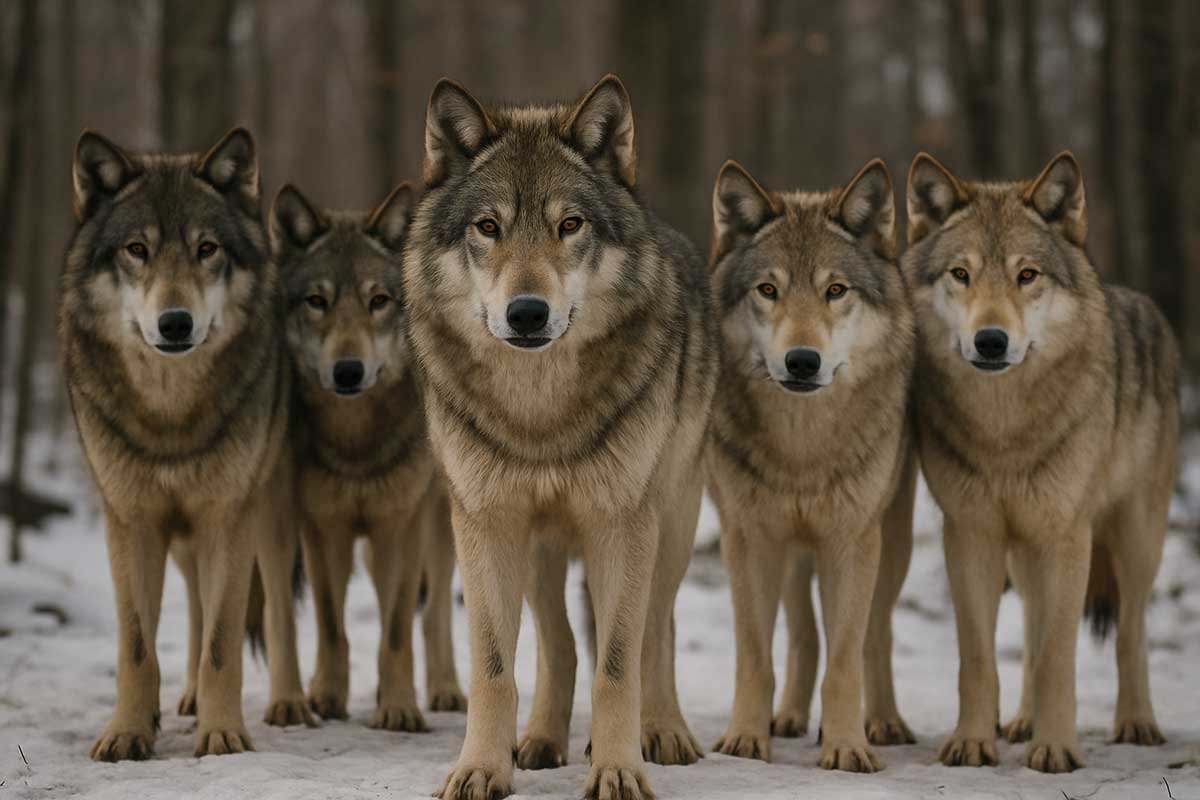
The gray wolf’s physical appearance, largely consistent over millennia, is characterized by a muscular, deep-chested body, long slender limbs, a bushy tail, a long slender muzzle, and large erect ears¹¹. Their fur coloration is remarkably variable, ranging from white to grizzled gray, brown, or coal black¹². A dense underfur layer provides exceptional insulation against harsh cold conditions¹³.
Size varies geographically, with northern populations typically exhibiting larger dimensions¹³. Adult males generally weigh between 70 and 110 pounds (31.7-49.9 kg) and measure 5 to 6.5 feet (1.5-2.0 m) from nose to tail tip, standing 26 to 32 inches (66-81 cm) tall at the shoulder¹⁴. Females are slightly smaller, weighing 60 to 80 pounds (27.2-36.3 kg) and measuring 4.5 to 6 feet (1.4-1.8 m) in length¹⁴. Their tail length ranges from 13 to 22 inches (33-55 cm)¹³. The average foot size is approximately 4 inches (10.2 cm) wide by 5 inches (12.7 cm) long¹⁴.
Equipped with 42 teeth and a large, powerful skull and jaws, wolves are exceptionally well-suited for catching and consuming large mammals¹⁵. Their long legs are a key adaptation for cursorial locomotion, enabling them to move with impressive speed (sprinting up to 36-38 miles per hour for short distances, with a usual travel pace of 5 miles per hour) and cover significant distances (up to 200 km daily) in their relentless search for food¹⁶. Beyond physical prowess, wolves possess acute senses of smell, hearing, and vision, which are indispensable tools for detecting prey, navigating their environment, and communicating with pack members¹⁷.
In the wild, gray wolves typically have a relatively short lifespan, rarely exceeding four or five years, though individual females have been documented reproducing at 11 years of age¹¹. In controlled environments, such as captivity, their lifespan can extend significantly, up to 15 to 20 years¹³.
Table 1: Gray Wolf Physical Characteristics
| Characteristic | Male Average/Range | Female Average/Range | Notes |
| Weight | 70-110 lbs (31.7-49.9 kg) | 60-80 lbs (27.2-36.3 kg) | Northern populations generally larger¹⁴ |
| Height (at shoulder) | 26-32 inches (66-81 cm) | 26-32 inches (66-81 cm) | |
| Length (nose to tail) | 5-6.5 feet (1.5-2.0 m) | 4.5-6 feet (1.4-1.8 m) | Tail length: 13-22 inches (33-55 cm)¹³ |
| Foot Size | 4 inches wide by 5 inches long | 4 inches wide by 5 inches long | |
| Fur Color | Gray, black, white, grizzled gray, brown, cinnamon | Gray, black, white, grizzled gray, brown, cinnamon | Highly variable across individuals and populations¹² |
| Number of Teeth | 42 | 42 | Specialized for large prey consumption¹⁵ |
| Breeding Season | February to March | February to March | Can range from January to April¹⁸ |
| Gestation Period | 60-63 days | 60-63 days | |
| Average Litter Size | 4-7 pups | 4-7 pups | |
| Average Pack Size | 5-9 individuals (range 2-30+) | 5-9 individuals (range 2-30+) | |
| Average Travel Speed | 5 miles per hour (8 km/hr) | 5 miles per hour (8 km/hr) | |
| Sprinting Speed | 36-38 miles per hour (58-61 km/hr) | 36-38 miles per hour (58-61 km/hr) | For short distances¹⁶ |
| Lifespan (Wild) | Usually 6-8 years (up to 13) | Usually 6-8 years (up to 13) | Environmental and genetic factors influence lifespan¹¹ |
| Lifespan (Captivity) | Up to 15-20 years | Up to 15-20 years |
C. The Social Fabric of the Pack
Wolves are profoundly social creatures, typically living in highly organized packs that function as extended family units¹⁹. While pack sizes can vary widely from 2 to over 30 individuals, the average pack generally comprises 5 to 9 members²⁰. The social structure is primarily based on family relationships rather than strict linear hierarchies of aggression²¹. At the core of most packs is the adult breeding pair, often referred to as the “alpha pair,” who are typically the parents of the other pack members²². This alpha pair assumes leadership, making crucial decisions regarding hunting locations and the allocation of food, and they are typically the sole breeders within the pack²³.
While traditional “rank” models (alpha, beta, delta, omega) may simplify the nuanced relationships, they broadly describe functional roles: betas may assist in maintaining pack discipline, deltas often survey territory, and omegas typically occupy the lowest social position²⁴. Critically, all individuals benefit from pack membership, which provides collective strength for larger kills, enhanced protection, and the ability to defend more extensive territories²⁵. This collective strength allows them to thrive where solitary predators might fail. However, this strength also implies a significant vulnerability: the disruption of pack cohesion, particularly through the loss of key members like the alpha pair (often targets of human persecution), can have disproportionately severe negative impacts on the pack’s hunting efficiency, reproductive output, and overall survival, extending beyond the loss of a single individual. This underscores that effective conservation efforts must consider not just population numbers but also the integrity and stability of pack structures to ensure long-term viability.
Communication within and between wolf packs is sophisticated and multi-modal:
- Body Language: Wolves convey a wealth of information through their posture and movements²⁶. Dominance is asserted through a high tail carriage and tall stance, while submissive behaviors include a lowered tail, crouching, muzzle licking, and exposing the vulnerable underside²⁷. Play bows, where a wolf lowers its front torso while keeping its hindquarters upright, are clear invitations for playful interaction²⁸. Subtle shifts in ear position and facial expressions can communicate anger, suspicion, or fear²⁶.
- Vocalizations: Howling is the most iconic and far-reaching form of wolf communication, used for long-distance contact, territorial claims, locating dispersed pack members, rallying the group, and even, at times, for apparent social bonding or “fun”²⁹. Other vocalizations include barking (used as a warning or display of aggression), whimpering (indicating a desire to nurse or submission), and growling (a warning or dominance display)³⁰. These sounds can also combine, such as a bark-howl³⁰.
- Scent Marking: Wolves utilize a complex chemical communication system through scent marking. Urine, along with pheromones produced by glands on their toes, tail, eyes, anus, genitalia, and skin, conveys critical information such as territorial boundaries, the presence of estrus females, and even marking exhausted food caches to prevent wasted effort³¹.
D. Apex Predator and Opportunist
As obligate carnivores, wolves primarily obtain their sustenance by hunting prey, often cooperatively in packs, but they also engage in kleptoparasitism (stealing kills from other predators) and scavenging carrion³². Their diet exhibits significant geographical variation, dictated largely by the availability of prey species in their specific habitat³³.
Wolves predominantly prey on large and medium-sized ungulates (hoofed mammals). In North America, key prey species include elk, moose, caribou, white-tailed deer, mule deer, bison, and historically, wild horses³⁴. Across Eurasia, their diet is dominated by moose, red deer, roe deer, and wild boar³⁵. Wolves specialize in targeting vulnerable individuals within prey populations, such as the weak, old, or immature³⁶. A large pack, for instance, a group of 15, is capable of bringing down an adult moose³⁵. Coordinated hunting is a hallmark of wolf behavior, a strategy rare among large carnivores³⁷. Pack members maintain constant awareness of one another’s spatial and temporal positions, adapting their hunting style to the specific prey³⁷. During a take-down, they typically focus their attacks on the rump, flank, and shoulder areas of large ungulates³⁸.
Despite their specialization, wolves are remarkably adaptable and “not fussy eaters”³⁵. This dual nature—specialized predation combined with extreme dietary opportunism—is a critical factor in understanding the wolf’s historical success and current challenges. While their pack hunting of ungulates establishes their apex predator status and ecological role, their ability to consume almost anything available (from megafauna to grasshoppers and domestic waste) is a profound adaptive trait. This flexibility allows them to survive periods of prey scarcity and persist even in degraded or human-altered landscapes. This very opportunism, however, directly contributes to human-wolf conflict, as they turn to livestock or garbage when wild prey is scarce, highlighting a complex feedback loop between their adaptability and their contentious relationship with humans.
When primary ungulate prey is scarce, their diet is supplemented by a wide array of smaller animals, including rodents, hares, insectivores, and smaller carnivores³⁵. They also frequently consume waterfowl and their eggs, and in times of extreme scarcity, may resort to lizards, snakes, frogs, and even grasshoppers³⁵. Some wolf populations in specific regions have been observed consuming fish and marine life³⁵. Furthermore, plant material forms a part of their diet, with wolves in Europe consuming apples, pears, figs, melons, berries, and cherries, while North American wolves eat blueberries and raspberries³⁵. The consumption of grass is also noted, potentially for vitamin intake or to induce vomiting to expel intestinal parasites or ingested guard hairs³⁵.
A single wolf can consume a substantial amount of meat, up to 9 kg (20 pounds), in one meal³⁹. They possess an efficient digestive system, capable of processing meals in a few hours and feeding multiple times within a day³⁵. Well-fed wolves store fat under their skin and around vital organs, particularly during the crucial autumn and winter months, as an energy reserve³⁵. In periods of extreme food scarcity, wolves readily turn to carrion³⁵. In regions with high human population density, some wolf populations are compelled to subsist largely on livestock and garbage³⁵. Notably, cannibalism is not uncommon during harsh winters, where packs may attack weak or injured wolves or consume the bodies of deceased pack members³⁵.
Table 3: Primary Prey Species by Geographic Region
| Geographic Region | Primary Prey Species | Opportunistic/Supplementary Diet |
| North America | Elk, Moose, Caribou, White-tailed Deer, Mule Deer, Bison, Wild Horses (historically)³⁴ | Rodents, Hares, Insectivores, Smaller Carnivores, Waterfowl & Eggs, Lizards, Snakes, Frogs, Grasshoppers, Fish, Marine Life, Blueberries, Raspberries³⁵ |
| Eurasia/Europe | Moose, Red Deer, Roe Deer, Wild Boar³⁵ | Domestic Species (if wild prey scarce), Rodents, Hares, Insectivores, Smaller Carnivores, Waterfowl & Eggs, Lizards, Snakes, Frogs, Grasshoppers, Fish, Marine Life, Apples, Pears, Figs, Melons, Berries, Cherries, Grain Crops, Grass³⁵ |
| Asia | Wild Medium-sized Hoofed Mammals, Domestic Species³⁵ | Rodents, Hares, Insectivores, Smaller Carnivores, Waterfowl & Eggs, Lizards, Snakes, Frogs, Grasshoppers, Fish, Marine Life, Carrion, Garbage, various Fruits, Grain Crops, Grass³⁵ |
| Global (Scarcity) | Carrion, Garbage, Weak/Injured Wolves (cannibalism)³⁵ |
III. The Wolf’s Domain: Habitat and Ecological Impact
A. Global Footprint and Environmental Adaptability
Gray wolves once held an unparalleled global footprint, with their original range encompassing the majority of the Northern Hemisphere—from the Arctic regions south to approximately 20° S latitude, extending through southern Central Mexico, northern Africa, and southern Asia⁴⁰. This vast historical distribution underscores their remarkable ecological versatility.
However, this expansive domain has been drastically curtailed due to a combination of habitat destruction, environmental changes, and intense human persecution⁴¹. In modern times, the wolf’s range has been reduced to about one-third of its historic extent globally, and only a mere 5-8% of the contiguous 48 United States⁴². They are now primarily found in wilderness and remote areas, having been extirpated from much of their former territories in Western Europe, the United States, and Mexico⁴³.
Despite this reduction, wolves continue to demonstrate extraordinary adaptability, thriving in a wide array of diverse habitats⁴⁴. They can be found from sea level up to 3,000 meters (9,800 ft) in elevation⁴⁵. Their preferred biomes include temperate forests, inland wetlands, shrublands, grasslands (including Arctic tundra), pastures, deserts, rocky peaks on mountains, taiga, and chaparral⁴⁶. The specific habitat use by wolf populations is dynamic, influenced by critical factors such as the abundance of prey, prevailing snow conditions, densities of livestock and roads, human presence, and the local topography⁴⁵. This adaptability allows them to persist even in landscapes increasingly fragmented or altered by human activity, albeit often leading to increased conflict.
Table 2: Global Wolf Habitat Distribution
| Aspect | Description |
| Historical Range | Majority of the Northern Hemisphere: Arctic south to ~20° S latitude, including southern Central Mexico, northern Africa, southern Asia⁴⁰ |
| Current Range | Approximately one-third of historic range globally; 5-8% of contiguous 48 United States; predominantly in wilderness and remote areas⁴³ |
| Typical Habitats | Forests, inland wetlands, shrublands, grasslands (including Arctic tundra), pastures, deserts, rocky peaks on mountains, temperate forests, taiga, chaparral⁴⁶ |
| Elevation Range | Sea level to 3,000 m (9,800 ft)⁴⁵ |
| Influencing Factors | Prey abundance, snow conditions, livestock densities, road densities, human presence, topography⁴⁵ |
B. Architects of Ecosystems: The Trophic Cascade
Wolves, as apex predators at the top of the food chain, are recognized for their capacity to generate “trophic cascades”—profound ecological effects that ripple throughout an entire ecosystem⁴⁷. This concept illustrates how the presence or absence of a top predator can have far-reaching beneficial or detrimental impacts on all lower trophic levels⁴⁷.
The reintroduction of gray wolves into Yellowstone National Park in 1995 stands as one of the most compelling and widely studied examples of a terrestrial trophic cascade⁴⁸. Prior to wolf reintroduction, the absence of this key predator led to an overpopulation of elk, which extensively overgrazed streamside vegetation, denuding riverbanks and impacting forest regeneration⁴⁹. The return of wolves instilled a “landscape of fear,” compelling elk to become more vigilant and move more frequently, thereby reducing concentrated browsing pressure⁵⁰. This behavioral shift contributed to the significant recovery of aspens and willows along riparian areas⁵¹.
The regrowth of riparian vegetation had cascading positive effects. It led to an increase in beaver colonies, as they had more willows and aspens for food and dam building⁵². The rejuvenated habitat also provided crucial nesting sites and resources for songbirds, leading to their increased presence⁵³. Furthermore, the shade provided by the recovering trees helped cool river waters, increasing oxygen levels and boosting fish populations⁵³. Wolves also play a vital role in regulating mesopredator populations. In Yellowstone, they significantly reduced coyote numbers by up to 80% in areas they occupied⁵⁴. This reduction in coyote competition and predation, in turn, benefited raptors like eagles, hawks, and ospreys by increasing the availability of small rodent prey⁵⁵. Additionally, scavengers such as grizzly bears, ravens, and eagles benefited from wolf presence, as they frequently scavenged leftovers from wolf kills, providing an important food source, especially for bears to feed their cubs⁵⁶.
While the Yellowstone case vividly demonstrates the power of wolves as a keystone species, it is crucial to acknowledge the complexity of natural ecosystems⁵⁷. Scientific investigations suggest that wolves are likely not solely responsible for all observed ecological changes; other factors, including drought, harsh winters, the presence of other predators (such as bears and mountain lions), and human hunting, also contribute to ecosystem dynamics and prey population regulation⁵⁸. Understanding these intricate interactions means that there are “no simple answers” to predicting the full ecological effects of wolf reintroduction⁵⁷.
A profound observation regarding the concept of “wilderness” emerges from this. While modern wolves are often associated with remote areas, the detailed accounts of trophic cascades reveal that human removal of wolves degraded these very ecosystems (e.g., through overbrowsing, erosion) and that human reintroduction of wolves restored their ecological balance. This suggests that in many landscapes, what is perceived as “wild” or “natural” is, in fact, a state that has been significantly altered by past human interventions (e.g., predator eradication). The subsequent human-led reintroduction of wolves is not merely letting nature “take its course” but is an active management intervention to restore a more natural ecological function. This implies that the future of wolf conservation is not simply about protecting untouched areas, but about actively managing landscapes, even those considered wild, to mitigate past human impacts and facilitate the return of ecological processes. The “wild world of wolves” is now inextricably linked to the “managed world of humans.”
The extensive evidence of trophic cascades elevates the wolf’s conservation status beyond that of merely preserving an endangered species. It demonstrates that wolves are foundational to the health and resilience of entire ecosystems. Their presence triggers a cascade of positive effects that enhance biodiversity, restore ecological processes (e.g., riparian vegetation recovery), and even influence water quality. This provides a powerful scientific and ethical imperative for conservation efforts: it is not just about saving wolves, but about restoring the functional integrity of the ecosystems they inhabit. The implication is that wolf conservation is a cost-effective strategy for broader environmental restoration, making their recovery a high-priority target for ecological health. The conservationist Aldo Leopold’s seminal essay, “Thinking Like a Mountain,” presciently described the detrimental cascading effects of wolf extirpation: an unchecked increase in deer populations, leading to severe overgrazing, subsequent deforestation and soil erosion, and ultimately, the collapse of the deer population itself due to resource depletion⁵⁹. This historical perspective underscores the long-recognized ecological importance of wolves.
IV. A Troubled Coexistence: Humans and Wolves
A. A History of Persecution
The historical relationship between humanity and wolves has been predominantly one of intense conflict and persecution, deeply rooted in a combination of unfounded fear, direct competition for shared prey resources, and tangible economic losses due to livestock depredation⁶⁰. From the 17th century through the mid-20th century, government-sanctioned policies and widespread public sentiment were geared towards wolf eradication⁶¹. This relentless campaign led to the near-extermination of wolves across vast territories, including much of Western Europe and the contiguous United States⁶².
Key drivers of this extirpation included extensive predator-control programs, often magnified by the use of bounties, coupled with widespread habitat degradation and a drastic decline in native wild prey populations⁶³. A prime example in North America was the elimination of bison on the Great Plains, which forced wolves to increasingly prey on newly established livestock, making them direct targets for hunters and trappers⁶⁴. By the mid-1930s, gray wolves were almost entirely eliminated from the continental United States, with only a few hundred individuals persisting in isolated pockets of northern Minnesota⁶⁵. Similarly, wolf populations in Europe reached their lowest point between the 1950s and 1980s⁶¹. Beyond direct killing, the “big bad wolf” narrative, deeply ingrained in cultural folklore, fueled a pervasive hatred and fear⁶⁶. This contributed to deep-rooted social conflicts, often manifesting as a stark divide between rural communities, who bore the brunt of perceived and actual impacts, and urban populations, who might hold more abstract, positive views⁶⁷. The perceived risk from wolves, particularly to human safety, was frequently much higher than the actual threat they posed⁶⁶.
B. The Path to Recovery: Conservation and Reintroduction
A significant shift in public attitudes and conservation policy emerged in the late 20th century, paving the way for wolf recovery efforts⁶⁸. The Endangered Species Act (ESA) of 1973 proved to be a pivotal piece of legislation in the United States, serving as a critical safety net for species facing extinction, including various wolf populations⁶⁹. The ESA mandates comprehensive recovery efforts aimed at bringing species back to a point where they no longer require federal protection⁶⁹.
Gray wolf conservation in the United States has been hailed as a “remarkable success” over the past three decades, with robust wolf populations recolonizing many regions where they had been extirpated⁷⁰. This success is attributable, in part, to direct human intervention through carefully planned reintroduction programs and the establishment of captive breeding programs designed to conserve genetic lineages and repopulate vacant habitats⁷¹.
- Yellowstone National Park Reintroduction (1995): Arguably the most well-known and impactful wolf recovery effort, the reintroduction of gray wolves from Canada into Yellowstone National Park in 1995 marked their return to the Western United States⁷². This program became a celebrated case study, providing compelling evidence of the positive cascading ecological effects wolves have on ecosystems⁷³.
- Red Wolf Recovery: The Red Wolf (Canis rufus) is classified as Critically Endangered by the International Union for Conservation of Nature (IUCN)⁷⁴. A comprehensive captive-breeding program was initiated in 1973, followed by reintroductions into the wild, notably in North Carolina, beginning in 1987⁷⁵. Despite these efforts, challenges persist, including critically low wild populations (as few as 8-16 known individuals in North Carolina as of 2021/2025), interbreeding with coyotes, and ongoing legal battles over management policies⁷⁶.
- Mexican Gray Wolf Recovery: The Mexican gray wolf (Canis lupus baileyi), declared extinct in the wild by the mid-1980s, was reintroduced into Arizona and New Mexico in 1998 under a federal program⁷⁷. Its recovery has been significantly slower compared to the Yellowstone population, largely due to persistent social tolerance issues, past management policies emphasizing lethal removal of conflict wolves, and numerous legal challenges from various stakeholders⁷⁸. The recovery plan aims for 320 wolves in the US and 200 in Mexico, but current wild populations remain far below this target, with only 163 individuals across both countries⁷⁸. Captive breeding programs remain crucial for maintaining genetic diversity within this highly endangered subspecies⁷⁹.
While wolf conservation has achieved remarkable biological successes, these very successes have brought forth new and complex challenges⁸⁰. As wolf populations expand and colonize landscapes increasingly dominated by human activity, they face issues such as habitat fragmentation, barriers to dispersal, and a heightened frequency of encounters with humans, pets, and livestock, leading to increased conflicts⁸¹. Predicting precise wolf dispersal and colonization patterns in these dynamic human-modified environments remains a significant scientific challenge⁸¹. Furthermore, emerging scientific concerns include the potential for hybridization with coyotes and the increased risk of disease transmission from domestic dogs, which can severely impact wolf population growth, particularly in smaller, more vulnerable groups⁸².
A critical evolution in the nature of wolf conservation challenges is evident. While the scientific and biological aspects of reintroduction (e.g., captive breeding, habitat assessment) have largely proven effective, the enduring and most significant barrier to full recovery and sustainable populations is human social acceptance and the willingness to coexist. The “success” of a reintroduction program cannot be measured solely by increasing wolf numbers; it must also encompass the integration of wolves into human-dominated landscapes without escalating conflict. This implies that future conservation efforts must increasingly prioritize social science research, community engagement, conflict mediation, and the development of effective human-wildlife coexistence strategies, rather than focusing exclusively on biological interventions. The “wild world of wolves” is now inextricably linked to the complex “human world” of values, economics, and politics.
Table 4: Key Wolf Reintroduction Programs: Successes and Challenges
| Program Name | Location | Start Year | Key Successes | Key Challenges |
| Yellowstone National Park | Western US (Wyoming, Idaho, Montana) | 1995 | Rapid population recovery; demonstrated positive trophic cascades (elk behavior change, riparian vegetation recovery, beaver and songbird increase, coyote reduction); averted extinction in lower 48 states⁸³ | Political controversy; social tolerance issues; debates over delisting and state management; ongoing conflicts with livestock industry⁸⁴ |
| Red Wolf Recovery Program | Southeastern US (Coastal North Carolina) | Captive Breeding 1973, Reintroduction 1987 | Saved from extinction in wild; established captive population; initial reintroduction success⁸⁵ | Critically low wild numbers (8-16 known in wild as of 2021/2025); interbreeding with coyotes; legal challenges to management; slow recovery; high mortality rates⁸⁶ |
| Mexican Gray Wolf Recovery Program | Southwestern US (Arizona, New Mexico) & Mexico | Reintroduction 1998 | Established reintroduced population; genetic management in captivity⁸⁷ | Significantly slower recovery; low wild numbers (163 total in US/Mexico); social tolerance issues; past lethal removal policies; legal challenges; inbreeding depression in early stages⁸⁸ |
C. Navigating Modern Conflicts
Livestock Depredation: A persistent and contentious issue, livestock depredation remains a primary source of human-wolf conflict⁸⁹. Research indicates that wolves tend to focus on livestock that are easier to kill, such as calves and sheep, and rarely attack adult cattle or horses⁹⁰. In some instances, packs develop “chronic depredation” on livestock, a learned behavior passed from parents to pups, or it may simply be a consequence of a scarcity of natural wild prey⁹¹. Compensation programs are in place in many areas to reimburse ranchers for documented losses to wolves⁹¹.
Public Perception: Perhaps no other wildlife issue elicits such polarized opinions as wolf conservation⁹². There is generally strong support for wolf restoration among urban populations, while rural communities, especially ranchers and hunters, often express significant opposition⁹³. Surveys in regions like the Southern Rockies have shown high overall public support for wolf reestablishment (64%), yet ranchers consistently exhibit greater opposition (53%)⁹⁴. Attitudes tend to be more negative in areas with a continuous wolf presence or recent reintroduction, as residents experience increased direct conflict, heightened media attention, and tangible livestock losses⁹⁵.
Intriguingly, studies suggest that objective knowledge about wolves does not necessarily correlate with more positive attitudes. In some cases, groups with less knowledge express more positive views, while hunters, despite possessing accurate objective knowledge due to direct experience, often hold the most negative attitudes, indicating that lived experience and perceived impacts can outweigh abstract understanding⁹⁶. This indicates that the human-wolf conflict is not simply a matter of factual understanding or direct biological impact; it is deeply rooted in differing values, livelihoods, and cultural identities. The “knowledge paradox” suggests that traditional education campaigns alone are insufficient to shift attitudes, especially for those directly impacted. Instead, effective coexistence strategies must acknowledge, validate, and address the socio-economic concerns, historical grievances, and cultural narratives of affected rural communities. This implies that top-down conservation mandates from urban centers can exacerbate conflict if they fail to engage meaningfully with and respect the lived experiences of those living closest to wolves. The future of wolf conservation, therefore, largely depends on bridging this profound social and cultural divide and finding common ground for shared landscapes.
The debate over wolves frequently transcends ecological concerns, symbolizing deeper societal conflicts over public land management, differing cultural values of wildlife, and the perceived economic and cultural threats to traditional rural ways of life⁹⁷.
Disease Transmission: As wolf populations expand and interact more with human-dominated landscapes, the risk of disease transmission becomes an increasing concern⁹⁸. Wolves are susceptible to several diseases that can be transmitted from domestic dogs, which can significantly affect wolf population growth, posing a particular threat to small or recovering wolf populations where an outbreak could be catastrophic⁹⁸.
D. Strategies for Harmonious Coexistence
Effective wolf management necessitates a dual approach: addressing both the direct human-wildlife conflicts and the underlying, deep-rooted social conflicts that often fuel opposition to wolf presence⁹⁹. Simply introducing technological solutions for depredation is insufficient; successful coexistence requires engaging with and validating the diverse social values held by rural and urban communities¹⁰⁰. Public opinion increasingly favors non-lethal methods of predator control over lethal measures¹⁰¹. While some livestock producers express skepticism regarding the effectiveness and cost-feasibility of non-lethal deterrents¹⁰², case studies demonstrate that a proactive and adaptive application of various non-lethal techniques can significantly reduce livestock losses, even in large-scale grazing operations¹⁰³.
Table 5: Non-Lethal Wolf Management Strategies
| Strategy | Description | Effectiveness/Considerations |
| Livestock Guardian Dogs (LGDs) | Dogs raised with livestock to bond with them and deter predators¹⁰⁴. | Effective for alerting, need human support; proper training and breed selection crucial; may pose risk to public in populated areas¹⁰⁴. |
| Fencing | High wire or electric fencing to contain livestock and deter wolves¹⁰⁴. | Helpful for containing livestock and reducing attacks¹⁰⁴. |
| Fladry | Lines of cloth flags on rope/wire, acting as a temporary visual barrier¹⁰⁵. | Useful for small pastures, temporary protection; wolves may habituate¹⁰⁵. |
| Increased Human Presence (Herders/Riders) | More human activity in grazing areas to deter wolves¹⁰⁴. | Can help reduce wolf presence; may be costly¹⁰⁴. |
| Scare Devices (Lights, Sirens, RAG boxes) | Auditory and visual deterrents triggered by wolf presence or manually¹⁰⁶. | Can frighten wolves; effectiveness unproven or temporary due to habituation¹⁰⁷. |
| Less-than-Lethal Munitions | Cracker shells, bean bag shells, rubber bullets to deter bold wolves¹⁰⁴. | Can make wolves more wary; rarely cause permanent injury¹⁰⁴. |
| Carcass Management | Proper and timely disposal of livestock carcasses¹⁰⁴. | Prevents attracting wolves to livestock areas¹⁰⁴. |
| Relocation/Translocation | Moving problem wolves to new, vacant areas¹⁰⁸. | Often ineffective as wolves may return; requires suitable vacant areas¹⁰⁸. |
| Fertility Control | Experimental methods to limit pup production¹⁰⁸. | Potential to limit wolf density near livestock; still in experimental phase¹⁰⁸. |
Ultimately, the long-term success and sustainability of wolf populations are often influenced more by the capacity of human communities to tolerate their presence than by the sheer availability of suitable habitat¹⁰⁹. Therefore, building and fostering social tolerance through collaborative, adaptive management approaches is paramount for ensuring the future of wild wolves¹⁰⁹.
V. Conclusion: The Future of the Wild Howl
The wolf, a creature of profound biological adaptability and intricate social complexity, stands as a living testament to the delicate balance of natural ecosystems. Its indispensable role as an apex predator, vividly demonstrated through the cascading ecological effects observed in various landscapes, is fundamental for maintaining ecosystem health and fostering biodiversity.
However, the narrative of the wolf is inextricably intertwined with human history—a history predominantly marked by widespread persecution driven by deep-seated fears, perceived threats to human safety, and tangible economic conflicts arising from livestock depredation. This adversarial relationship led to severe population declines and extirpation across much of their historical range.
In recent decades, modern conservation efforts, bolstered by robust scientific understanding and protective legislation such as the Endangered Species Act, have achieved remarkable biological successes in facilitating wolf recovery. Yet, the journey towards true and sustainable coexistence remains fraught with significant social challenges, particularly the persistent and often polarized divisions in public perception and the ongoing conflicts over livestock depredation.
The continued survival and flourishing of wolf populations hinge not merely on their inherent biological resilience or the availability of suitable habitat, but critically on fostering greater human tolerance and implementing adaptive, multi-faceted management strategies. These strategies must adeptly address both the ecological needs of wolves and the legitimate socio-economic concerns of human communities. Ongoing scientific research remains vital to continually refine our understanding of wolf ecology, behavior, and the complex dynamics of human-wolf interactions. Such research can inform more effective conservation practices and conflict mitigation tools. Education must evolve beyond simply dispelling myths; it needs to engage diverse stakeholders in meaningful dialogue, acknowledge and respect varied perspectives, and collaboratively build a shared vision for coexistence that values both wildlife and human livelihoods. Ultimately, the enduring presence of the wild howl across global landscapes will only be secured if humanity fully embraces its role as a responsible steward, recognizing the intrinsic value of these magnificent creatures and their essential, irreplaceable contribution to a healthy, balanced planet.
Notes
¹ Wikipedia, “Wolf,” accessed, https://en.wikipedia.org/wiki/Wolf; Project Coyote, “Wolf Profile,” accessed, https://projectcoyote.org/act/learning-hub/wolf-profile/; Animal Diversity Web, “Canis lupus,” accessed, https://animaldiversity.org/accounts/Canis_lupus/; International Wolf Center, “Types of Wolves,” accessed, https://wolf.org/wolf-info/basic-wolf-info/types-of-wolves/.
² Wikipedia, “Wolf,” https://en.wikipedia.org/wiki/Wolf; Project Coyote, “Wolf Profile,” https://projectcoyote.org/act/learning-hub/wolf-profile/; International Wolf Center, “Types of Wolves,” https://wolf.org/wolf-info/basic-wolf-info/types-of-wolves/.
³ Wikipedia, “Wolf,” https://en.wikipedia.org/wiki/Wolf; Project Coyote, “Wolf Profile,” https://projectcoyote.org/act/learning-hub/wolf-profile/.
⁴ Project Coyote, “Wolf Profile,” https://projectcoyote.org/act/learning-hub/wolf-profile/; U.S. Fish & Wildlife Service, “Gray Wolf (Canis lupus),” accessed, https://www.fws.gov/species/gray-wolf-canis-lupus/; International Wolf Center, “Types of Wolves,” https://wolf.org/wolf-info/basic-wolf-info/types-of-wolves/.
⁵ Project Coyote, “Wolf Profile,” https://projectcoyote.org/act/learning-hub/wolf-profile/.
⁶ Project Coyote, “Wolf Profile,” https://projectcoyote.org/act/learning-hub/wolf-profile/; The Wolf Intelligencer, “Wolf Evolution,” accessed, https://thewolfintelligencer.com/wolf-evolution/; International Wolf Center, “Types of Wolves,” https://wolf.org/wolf-info/basic-wolf-info/types-of-wolves/.
⁷ International Wolf Center, “Types of Wolves,” https://wolf.org/wolf-info/basic-wolf-info/types-of-wolves/.
⁸ International Wolf Center, “Types of Wolves,” https://wolf.org/wolf-info/basic-wolf-info/types-of-wolves/; Wolf Conservation Center, “Red Wolf,” accessed, https://nywolf.org/learn/red-wolf/; Wikipedia, “Red Wolf,” accessed, https://en.wikipedia.org/wiki/Red_wolf.
⁹ The Wolf Intelligencer, “Wolf Evolution,” https://thewolfintelligencer.com/wolf-evolution/.
¹⁰ BioRxiv, “Dire wolves (Aenocyon dirus) are extinct predators of Pleistocene North America,” accessed, https://www.biorxiv.org/content/10.1101/2025.04.09.647074v1.
¹¹ Project Coyote, “Wolf Profile,” https://projectcoyote.org/act/learning-hub/wolf-profile/; Animal Diversity Web, “Canis lupus,” https://animaldiversity.org/accounts/Canis_lupus/.
¹² U.S. Fish & Wildlife Service, “Gray Wolf (Canis lupus),” https://www.fws.gov/species/gray-wolf-canis-lupus/; International Wolf Center, “Fun Wolf Facts,” accessed, https://wolf.org/wolf-info/just-for-kids/fun-facts/; Project Coyote, “Wolf Profile,” https://projectcoyote.org/act/learning-hub/wolf-profile/.
¹³ Animal Diversity Web, “Canis lupus,” https://animaldiversity.org/accounts/Canis_lupus/; Project Coyote, “Wolf Profile,” https://projectcoyote.org/act/learning-hub/wolf-profile/.
¹⁴ U.S. Fish & Wildlife Service, “Gray Wolf (Canis lupus),” https://www.fws.gov/species/gray-wolf-canis-lupus/; International Wolf Center, “Fun Wolf Facts,” https://wolf.org/wolf-info/just-for-kids/fun-facts/; Project Coyote, “Wolf Profile,” https://projectcoyote.org/act/learning-hub/wolf-profile/; Animal Diversity Web, “Canis lupus,” https://animaldiversity.org/accounts/Canis_lupus/.
¹⁵ U.S. Fish & Wildlife Service, “Gray Wolf (Canis lupus),” https://www.fws.gov/species/gray-wolf-canis-lupus/; International Wolf Center, “Fun Wolf Facts,” https://wolf.org/wolf-info/just-for-kids/fun-facts/.
¹⁶ U.S. Fish & Wildlife Service, “Gray Wolf (Canis lupus),” https://www.fws.gov/species/gray-wolf-canis-lupus/; Animal Diversity Web, “Canis lupus,” https://animaldiversity.org/accounts/Canis_lupus/; International Wolf Center, “Fun Wolf Facts,” https://wolf.org/wolf-info/just-for-kids/fun-facts/.
¹⁷ U.S. Fish & Wildlife Service, “Gray Wolf (Canis lupus),” https://www.fws.gov/species/gray-wolf-canis-lupus/.
¹⁸ Internet Center for Wildlife Damage Management, “Wolf Biology,” accessed, https://icwdm.org/species/carnivores/wolves/wolf-biology/#:~:text=Reproduction,usually%20during%20April%20or%20May.; International Wolf Center, “Fun Wolf Facts,” https://wolf.org/wolf-info/just-for-kids/fun-facts/.
¹⁹ Animal Diversity Web, “Canis lupus,” https://animaldiversity.org/accounts/Canis_lupus/; Wikipedia, “Pack (canine),” accessed, https://en.wikipedia.org/wiki/Pack_(canine; Rjourney, “Wolf Pack Hierarchy: Understanding Wolves’ Complex Dynamics,” accessed, https://rjourney.com/blog/wolf-pack-hierarchy-understanding-wolves/; Internet Center for Wildlife Damage Management, “Wolf Biology,” https://icwdm.org/species/carnivores/wolves/wolf-biology/.
²⁰ Animal Diversity Web, “Canis lupus,” https://animaldiversity.org/accounts/Canis_lupus/; International Wolf Center, “Fun Wolf Facts,” https://wolf.org/wolf-info/just-for-kids/fun-facts/; Rjourney, “Wolf Pack Hierarchy: Understanding Wolves’ Complex Dynamics,” https://rjourney.com/blog/wolf-pack-hierarchy-understanding-wolves/.
²¹ Project Coyote, “Wolf Profile,” https://projectcoyote.org/act/learning-hub/wolf-profile/; Wikipedia, “Pack (canine),” https://en.wikipedia.org/wiki/Pack_(canine.
²² Animal Diversity Web, “Canis lupus,” https://animaldiversity.org/accounts/Canis_lupus/; Wikipedia, “Pack (canine),” https://en.wikipedia.org/wiki/Pack_(canine; Rjourney, “Wolf Pack Hierarchy: Understanding Wolves’ Complex Dynamics,” https://rjourney.com/blog/wolf-pack-hierarchy-understanding-wolves/; Internet Center for Wildlife Damage Management, “Wolf Biology,” https://icwdm.org/species/carnivores/wolves/wolf-biology/.
²³ Wikipedia, “Pack (canine),” https://en.wikipedia.org/wiki/Pack_(canine; Rjourney, “Wolf Pack Hierarchy: Understanding Wolves’ Complex Dynamics,” https://rjourney.com/blog/wolf-pack-hierarchy-understanding-wolves/; Internet Center for Wildlife Damage Management, “Wolf Biology,” https://icwdm.org/species/carnivores/wolves/wolf-biology/.
²⁴ Rjourney, “Wolf Pack Hierarchy: Understanding Wolves’ Complex Dynamics,” https://rjourney.com/blog/wolf-pack-hierarchy-understanding-wolves/.
²⁵ Wikipedia, “Pack (canine),” https://en.wikipedia.org/wiki/Pack_(canine.
²⁶ International Wolf Center, “How do wolves communicate?,” accessed, https://wolf.org/wolf-info/basic-wolf-info/biology-and-behavior/communication/.
²⁷ Rjourney, “Wolf Pack Hierarchy: Understanding Wolves’ Complex Dynamics,” https://rjourney.com/blog/wolf-pack-hierarchy-understanding-wolves/; International Wolf Center, “How do wolves communicate?,” https://wolf.org/wolf-info/basic-wolf-info/biology-and-behavior/communication/.
²⁸ International Wolf Center, “How do wolves communicate?,” https://wolf.org/wolf-info/basic-wolf-info/biology-and-behavior/communication/; International Wolf Center, “Wolf Ethogram A-G,” accessed, https://wolf.org/wolf-info/wolf-ethogram/wolf-ethogram-a-g/.
²⁹ National Geographic, “wolves characteristics,” YouTube video, accessed, https://www.youtube.com/watch?v=YXMo5w9aMNs&pp=0gcJCfwAo7VqN5tD; International Wolf Center, “How do wolves communicate?,” https://wolf.org/wolf-info/basic-wolf-info/biology-and-behavior/communication/.
³⁰ International Wolf Center, “How do wolves communicate?,” https://wolf.org/wolf-info/basic-wolf-info/biology-and-behavior/communication/.
³¹ Internet Center for Wildlife Damage Management, “Wolf Biology,” https://icwdm.org/species/carnivores/wolves/wolf-biology/; International Wolf Center, “How do wolves communicate?,” https://wolf.org/wolf-info/basic-wolf-info/biology-and-behavior/communication/.
³² Animal Diversity Web, “Canis lupus,” https://animaldiversity.org/accounts/Canis_lupus/.
³³ Wikipedia, “Wolf,” https://en.wikipedia.org/wiki/Wolf; Animal Diversity Web, “Canis lupus,” https://animaldiversity.org/accounts/Canis_lupus/.
³⁴ Wikipedia, “Wolf,” https://en.wikipedia.org/wiki/Wolf; U.S. Fish & Wildlife Service, “Gray Wolf (Canis lupus),” https://www.fws.gov/species/gray-wolf-canis-lupus/; Animal Diversity Web, “Canis lupus,” https://animaldiversity.org/accounts/Canis_lupus/; International Wolf Center, “Fun Wolf Facts,” https://wolf.org/wolf-info/just-for-kids/fun-facts/; Internet Center for Wildlife Damage Management, “Wolf Biology,” https://icwdm.org/species/carnivores/wolves/wolf-biology/.
³⁵ Wikipedia, “Wolf,” https://en.wikipedia.org/wiki/Wolf.
³⁶ Animal Diversity Web, “Canis lupus,” https://animaldiversity.org/accounts/Canis_lupus/.
³⁷ Project Coyote, “Wolf Profile,” https://projectcoyote.org/act/learning-hub/wolf-profile/.
³⁸ Animal Diversity Web, “Canis lupus,” https://animaldiversity.org/accounts/Canis_lupus/.
³⁹ Animal Diversity Web, “Canis lupus,” https://animaldiversity.org/accounts/Canis_lupus/; Internet Center for Wildlife Damage Management, “Wolf Biology,” https://icwdm.org/species/carnivores/wolves/wolf-biology/.
⁴⁰ Animal Diversity Web, “Canis lupus,” https://animaldiversity.org/accounts/Canis_lupus/; Project Coyote, “Wolf Profile,” https://projectcoyote.org/act/learning-hub/wolf-profile/; International Wolf Center, “Types of Wolves,” https://wolf.org/wolf-info/basic-wolf-info/types-of-wolves/.
⁴¹ Animal Diversity Web, “Canis lupus,” https://animaldiversity.org/accounts/Canis_lupus/; International Wolf Center, “Types of Wolves,” https://wolf.org/wolf-info/basic-wolf-info/types-of-wolves/.
⁴² Wikipedia, “Wolf,” https://en.wikipedia.org/wiki/Wolf; International Wolf Center, “Types of Wolves,” https://wolf.org/wolf-info/basic-wolf-info/types-of-wolves/.
⁴³ Wikipedia, “Wolf,” https://en.wikipedia.org/wiki/Wolf; Project Coyote, “Wolf Profile,” https://projectcoyote.org/act/learning-hub/wolf-profile/; Animal Diversity Web, “Canis lupus,” https://animaldiversity.org/accounts/Canis_lupus/.
⁴⁴ U.S. Fish & Wildlife Service, “Gray Wolf (Canis lupus),” https://www.fws.gov/species/gray-wolf-canis-lupus/; Animal Diversity Web, “Canis lupus,” https://animaldiversity.org/accounts/Canis_lupus/; Project Coyote, “Wolf Profile,” https://projectcoyote.org/act/learning-hub/wolf-profile/.
⁴⁵ Wikipedia, “Wolf,” https://en.wikipedia.org/wiki/Wolf.
⁴⁶ Wikipedia, “Wolf,” https://en.wikipedia.org/wiki/Wolf; U.S. Fish & Wildlife Service, “Gray Wolf (Canis lupus),” https://www.fws.gov/species/gray-wolf-canis-lupus/; Animal Diversity Web, “Canis lupus,” https://animaldiversity.org/accounts/Canis_lupus/; Internet Center for Wildlife Damage Management, “Wolf Biology,” https://icwdm.org/species/carnivores/wolves/wolf-biology/.
⁴⁷ Mission:Wolf, “Trophic Cascade,” accessed, https://missionwolf.org/trophic-cascade; Colorado State University, “Ecological Effects of Wolves,” accessed, https://extension.colostate.edu/topic-areas/people-predators/ecological-effects-of-wolves-8-005/.
⁴⁸ U.S. Department of the Interior, “Management of Wolves,” accessed, https://www.doi.gov/ocl/management-wolves; Mission:Wolf, “Trophic Cascade,” https://missionwolf.org/trophic-cascade; Colorado State University, “Ecological Effects of Wolves,” https://extension.colostate.edu/topic-areas/people-predators/ecological-effects-of-wolves-8-005/; Ecological Society of America, “Yellowstone wolves take a blow to their rep,” accessed, https://esa.org/esablog/2014/03/11/yellowstone-wolves-take-a-blow-to-their-rep/; Mongabay, “Wolves’ continued spread in California brings joy, controversy & conflicts,” accessed, https://news.mongabay.com/2025/08/wolves-continued-spread-in-california-brings-joy-controversy-conflicts/.
⁴⁹ U.S. Department of the Interior, “Management of Wolves,” https://www.doi.gov/ocl/management-wolves; Mission:Wolf, “Trophic Cascade,” https://missionwolf.org/trophic-cascade; Ecological Society of America, “Yellowstone wolves take a blow to their rep,” https://esa.org/esablog/2014/03/11/yellowstone-wolves-take-a-blow-to-their-rep/.
⁵⁰ Mission:Wolf, “Trophic Cascade,” https://missionwolf.org/trophic-cascade; Ecological Society of America, “Yellowstone wolves take a blow to their rep,” https://esa.org/esablog/2014/03/11/yellowstone-wolves-take-a-blow-to-their-rep/.
⁵¹ U.S. Department of the Interior, “Management of Wolves,” https://www.doi.gov/ocl/ocl/management-wolves; Mission:Wolf, “Trophic Cascade,” https://missionwolf.org/trophic-cascade; Colorado State University, “Ecological Effects of Wolves,” https://extension.colostate.edu/topic-areas/people-predators/ecological-effects-of-wolves-8-005/; Ecological Society of America, “Yellowstone wolves take a blow to their rep,” https://esa.org/esablog/2014/03/11/yellowstone-wolves-take-a-blow-to-their-rep/.
⁵² U.S. Department of the Interior, “Management of Wolves,” https://www.doi.gov/ocl/management-wolves; Colorado State University, “Ecological Effects of Wolves,” https://extension.colostate.edu/topic-areas/people-predators/ecological-effects-of-wolves-8-005/.
⁵³ Mission:Wolf, “Trophic Cascade,” https://missionwolf.org/trophic-cascade; Colorado State University, “Ecological Effects of Wolves,” https://extension.colostate.edu/topic-areas/people-predators/ecological-effects-of-wolves-8-005/.
⁵⁴ Mission:Wolf, “Trophic Cascade,” https://missionwolf.org/trophic-cascade.
⁵⁵ Mission:Wolf, “Trophic Cascade,” https://missionwolf.org/trophic-cascade; Colorado State University, “Ecological Effects of Wolves,” https://extension.colostate.edu/topic-areas/people-predators/ecological-effects-of-wolves-8-005/.
⁵⁶ Mission:Wolf, “Trophic Cascade,” https://missionwolf.org/trophic-cascade; Colorado State University, “Ecological Effects of Wolves,” https://extension.colostate.edu/topic-areas/people-predators/ecological-effects-of-wolves-8-005/.
⁵⁷ Colorado State University, “Ecological Effects of Wolves,” https://extension.colostate.edu/topic-areas/people-predators/ecological-effects-of-wolves-8-005/.
⁵⁸ Colorado State University, “Ecological Effects of Wolves,” https://extension.colostate.edu/topic-areas/people-predators/ecological-effects-of-wolves-8-005/; Ecological Society of America, “Yellowstone wolves take a blow to their rep,” https://esa.org/esablog/2014/03/11/yellowstone-wolves-take-a-blow-to-their-rep/.
⁵⁹ U.S. Department of the Interior, “Management of Wolves,” https://www.doi.gov/ocl/management-wolves; Mission:Wolf, “Trophic Cascade,” https://missionwolf.org/trophic-cascade/.
⁶⁰ Wikipedia, “Wolf,” https://en.wikipedia.org/wiki/Wolf; National Geographic, “wolves characteristics,” https://www.youtube.com/watch?v=YXMo5w9aMNs&pp=0gcJCfwAo7VqN5tD; WellBeing International, Inc., “Human-Wolf Conflict and Wolf Protection,” accessed, https://wellbeingintl.org/human-wolf-conflict-and-wolf-protection/; Mongabay, “Wolves’ continued spread in California brings joy, controversy & conflicts,” https://news.mongabay.com/2025/08/wolves-continued-spread-in-california-brings-joy-controversy-conflicts/; National Wildlife Federation, “Lessons Learned to Inform Colorado Wolf Reintroduction & Management,” accessed, https://www.nwf.org/-/media/PDFs/Rocky-Mountain/NWF_Boyd_Wolf_Report_Web-compressed_FINAL.pdf; PubMed Central, “Perception Toward Wolves Are Driven by Economic Status and Religion Across Their Distribution Range,” accessed, https://pmc.ncbi.nlm.nih.gov/articles/PMC12071121/.
⁶¹ WellBeing International, Inc., “Human-Wolf Conflict and Wolf Protection,” https://wellbeingintl.org/human-wolf-conflict-and-wolf-protection/.
⁶² Wikipedia, “Wolf,” https://en.wikipedia.org/wiki/Wolf; Project Coyote, “Wolf Profile,” https://projectcoyote.org/act/learning-hub/wolf-profile/; U.S. Fish & Wildlife Service, “Gray Wolf (Canis lupus),” https://www.fws.gov/species/gray-wolf-canis-lupus/; WellBeing International, Inc., “Human-Wolf Conflict and Wolf Protection,” https://wellbeingintl.org/human-wolf-conflict-and-wolf-protection/; Mongabay, “Wolves’ continued spread in California brings joy, controversy & conflicts,” https://news.mongabay.com/2025/08/wolves-continued-spread-in-california-brings-joy-controversy-conflicts/; National Wildlife Federation, “Lessons Learned to Inform Colorado Wolf Reintroduction & Management,” https://www.nwf.org/-/media/PDFs/Rocky-Mountain/NWF_Boyd_Wolf_Report_Web-compressed_FINAL.pdf.
⁶³ U.S. Fish & Wildlife Service, “Gray Wolf (Canis lupus),” https://www.fws.gov/species/gray-wolf-canis-lupus/; National Geographic, “wolves characteristics,” https://www.youtube.com/watch?v=YXMo5w9aMNs&pp=0gcJCfwAo7VqN5tD; U.S. Department of the Interior, “Management of Wolves,” https://www.doi.gov/ocl/management-wolves; WellBeing International, Inc., “Human-Wolf Conflict and Wolf Protection,” https://wellbeingintl.org/human-wolf-conflict-and-wolf-protection/; National Wildlife Federation, “Lessons Learned to Inform Colorado Wolf Reintroduction & Management,” https://www.nwf.org/-/media/PDFs/Rocky-Mountain/NWF_Boyd_Wolf_Report_Web-compressed_FINAL.pdf; Wolf Conservation Center, “Mexican Gray Wolf,” accessed, https://nywolf.org/learn/mexican-gray-wolf/.
⁶⁴ National Geographic, “wolves characteristics,” https://www.youtube.com/watch?v=YXMo5w9aMNs&pp=0gcJCfwAo7VqN5tD; Internet Center for Wildlife Damage Management, “Wolf Biology,” https://icwdm.org/species/carnivores/wolves/wolf-biology/; National Wildlife Federation, “Lessons Learned to Inform Colorado Wolf Reintroduction & Management,” https://www.nwf.org/-/media/PDFs/Rocky-Mountain/NWF_Boyd_Wolf_Report_Web-compressed_FINAL.pdf; Wolf Conservation Center, “Mexican Gray Wolf,” https://nywolf.org/learn/mexican-gray-wolf/.
⁶⁵ U.S. Fish & Wildlife Service, “Gray Wolf (Canis lupus),” https://www.fws.gov/species/gray-wolf-canis-lupus/; National Geographic, “wolves characteristics,” https://www.youtube.com/watch?v=YXMo5w9aMNs&pp=0gcJCfwAo7VqN5tD; U.S. Department of the Interior, “Management of Wolves,” https://www.doi.gov/ocl/management-wolves; WellBeing International, Inc., “Human-Wolf Conflict and Wolf Protection,” https://wellbeingintl.org/human-wolf-conflict-and-wolf-protection/; National Wildlife Federation, “Lessons Learned to Inform Colorado Wolf Reintroduction & Management,” https://www.nwf.org/-/media/PDFs/Rocky-Mountain/NWF_Boyd_Wolf_Report_Web-compressed_FINAL.pdf.
⁶⁶ WellBeing International, Inc., “Human-Wolf Conflict and Wolf Protection,” https://wellbeingintl.org/human-wolf-conflict-and-wolf-protection/; PubMed Central, “Perception Toward Wolves Are Driven by Economic Status and Religion Across Their Distribution Range,” https://pmc.ncbi.nlm.nih.gov/articles/PMC12071121/.
⁶⁷ WellBeing International, Inc., “Human-Wolf Conflict and Wolf Protection,” https://wellbeingintl.org/human-wolf-conflict-and-wolf-protection/; PubMed Central, “Perception Toward Wolves Are Driven by Economic Status and Religion Across Their Distribution Range,” https://pmc.ncbi.nlm.nih.gov/articles/PMC12071121/; Colorado State University, “Dialogue and Social Conflict about Wolves,” accessed, https://extension.colostate.edu/topic-areas/people-predators/dialogue-and-social-conflict-about-wolves-8-009/.
⁶⁸ National Geographic, “wolves characteristics,” https://www.youtube.com/watch?v=YXMo5w9aMNs&pp=0gcJCfwAo7VqN5tD; WellBeing International, Inc., “Human-Wolf Conflict and Wolf Protection,” https://wellbeingintl.org/human-wolf-conflict-and-wolf-protection/.
⁶⁹ U.S. Department of the Interior, “Management of Wolves,” https://www.doi.gov/ocl/management-wolves; Wolf Conservation Center, “Red Wolf,” https://nywolf.org/learn/red-wolf/; Wikipedia, “Red wolf,” https://en.wikipedia.org/wiki/Red_wolf.
⁷⁰ Oxford Academic, “challenges of success: Future wolf conservation and management in the United States,” accessed, https://academic.oup.com/bioscience/article/73/8/587/7238114; National Wildlife Federation, “Lessons Learned to Inform Colorado Wolf Reintroduction & Management,” https://www.nwf.org/-/media/PDFs/Rocky-Mountain/NWF_Boyd_Wolf_Report_Web-compressed_FINAL.pdf.
⁷¹ Oxford Academic, “challenges of success: Future wolf conservation and management in the United States,” https://academic.oup.com/bioscience/article/73/8/587/7238114.
⁷² U.S. Department of the Interior, “Management of Wolves,” https://www.doi.gov/ocl/management-wolves; Denver Museum of Nature & Science, “A Path Forward for Wolves: Lessons from Past Reintroductions,” accessed, https://institute.dmns.org/perspectives/posts/a-path-forward-for-wolves-lessons-from-past-reintroductions/; Mongabay, “Wolves’ continued spread in California brings joy, controversy & conflicts,” https://news.mongabay.com/2025/08/wolves-continued-spread-in-california-brings-joy-controversy-conflicts/; Ecological Society of America, “Yellowstone wolves take a blow to their rep,” https://esa.org/esablog/2014/03/11/yellowstone-wolves-take-a-blow-to-their-rep/.
⁷³ U.S. Department of the Interior, “Management of Wolves,” https://www.doi.gov/ocl/management-wolves; Mission:Wolf, “Trophic Cascade,” https://missionwolf.org/trophic-cascade; Colorado State University, “Ecological Effects of Wolves,” https://extension.colostate.edu/topic-areas/people-predators/ecological-effects-of-wolves-8-005/; Ecological Society of America, “Yellowstone wolves take a blow to their rep,” https://esa.org/esablog/2014/03/11/yellowstone-wolves-take-a-blow-to-their-rep/.
⁷⁴ Wolf Conservation Center, “Red Wolf,” https://nywolf.org/learn/red-wolf/; Wikipedia, “Red wolf,” https://en.wikipedia.org/wiki/Red_wolf.
⁷⁵ Wolf Conservation Center, “Red Wolf,” https://nywolf.org/learn/red-wolf/; Wikipedia, “Red wolf,” https://en.wikipedia.org/wiki/Red_wolf.
⁷⁶ Wolf Conservation Center, “Red Wolf,” https://nywolf.org/learn/red-wolf/; Wikipedia, “Red wolf,” https://en.wikipedia.org/wiki/Red_wolf; Redwolves.com, “Mexican and red wolves were both faced with extinction in the wild,” accessed, https://redwolves.com/wp/wp-content/uploads/2016/01/17-Hedrick-and-Fredrickson-2008.pdf.
⁷⁷ Wolf Conservation Center, “Mexican Gray Wolf,” https://nywolf.org/learn/mexican-gray-wolf/.
⁷⁸ Denver Museum of Nature & Science, “A Path Forward for Wolves: Lessons from Past Reintroductions,” https://institute.dmns.org/perspectives/posts/a-path-forward-for-wolves-lessons-from-past-reintroductions/; Redwolves.com, “Mexican and red wolves were both faced with extinction in the wild,” https://redwolves.com/wp/wp-content/uploads/2016/01/17-Hedrick-and-Fredrickson-2008.pdf; Wolf Conservation Center, “Mexican Gray Wolf,” https://nywolf.org/learn/mexican-gray-wolf/.
⁷⁹ Redwolves.com, “Mexican and red wolves were both faced with extinction in the wild,” https://redwolves.com/wp/wp-content/uploads/2016/01/17-Hedrick-and-Fredrickson-2008.pdf; Wolf Conservation Center, “Mexican Gray Wolf,” https://nywolf.org/learn/mexican-gray-wolf/.
⁸⁰ Oxford Academic, “challenges of success: Future wolf conservation and management in the United States,” https://academic.oup.com/bioscience/article/73/8/587/7238114.
⁸¹ Oxford Academic, “challenges of success: Future wolf conservation and management in the United States,” https://academic.oup.com/bioscience/article/73/8/587/7238114.
⁸² Oxford Academic, “challenges of success: Future wolf conservation and management in the United States,” https://academic.oup.com/bioscience/article/73/8/587/7238114.
⁸³ U.S. Department of the Interior, “Management of Wolves,” https://www.doi.gov/ocl/management-wolves; Mission:Wolf, “Trophic Cascade,” https://missionwolf.org/trophic-cascade; Colorado State University, “Ecological Effects of Wolves,” https://extension.colostate.edu/topic-areas/people-predators/ecological-effects-of-wolves-8-005/; Oxford Academic, “challenges of success: Future wolf conservation and management in the United States,” https://academic.oup.com/bioscience/article/73/8/587/7238114; Denver Museum of Nature & Science, “A Path Forward for Wolves: Lessons from Past Reintroductions,” https://institute.dmns.org/perspectives/posts/a-path-forward-for-wolves-lessons-from-past-reintroductions/; Ecological Society of America, “Yellowstone wolves take a blow to their rep,” https://esa.org/esablog/2014/03/11/yellowstone-wolves-take-a-blow-to-their-rep/; National Wildlife Federation, “Lessons Learned to Inform Colorado Wolf Reintroduction & Management,” https://www.nwf.org/-/media/PDFs/Rocky-Mountain/NWF_Boyd_Wolf_Report_Web-compressed_FINAL.pdf.
⁸⁴ Denver Museum of Nature & Science, “A Path Forward for Wolves: Lessons from Past Reintroductions,” https://institute.dmns.org/perspectives/posts/a-path-forward-for-wolves-lessons-from-past-reintroductions/; Colorado Sun, “Colorado’s top wildlife official finally opens up about wolves, conservation,” accessed, https://coloradosun.com/2025/08/15/colorados-top-wildlife-official-finally-opens-up-about-wolves/; National Wildlife Federation, “Lessons Learned to Inform Colorado Wolf Reintroduction & Management,” https://www.nwf.org/-/media/PDFs/Rocky-Mountain/NWF_Boyd_Wolf_Report_Web-compressed_FINAL.pdf.
⁸⁵ Wolf Conservation Center, “Red Wolf,” https://nywolf.org/learn/red-wolf/; Wikipedia, “Red wolf,” https://en.wikipedia.org/wiki/Red_wolf; Redwolves.com, “Mexican and red wolves were both faced with extinction in the wild,” https://redwolves.com/wp/wp-content/uploads/2016/01/17-Hedrick-and-Fredrickson-2008.pdf.
⁸⁶ Wolf Conservation Center, “Red Wolf,” https://nywolf.org/learn/red-wolf/; Wikipedia, “Red wolf,” https://en.wikipedia.org/wiki/Red_wolf; Redwolves.com, “Mexican and red wolves were both faced with extinction in the wild,” https://redwolves.com/wp/wp-content/uploads/2016/01/17-Hedrick-and-Fredrickson-2008.pdf.
⁸⁷ Redwolves.com, “Mexican and red wolves were both faced with extinction in the wild,” https://redwolves.com/wp/wp-content/uploads/2016/01/17-Hedrick-and-Fredrickson-2008.pdf; Wolf Conservation Center, “Mexican Gray Wolf,” https://nywolf.org/learn/mexican-gray-wolf/.
⁸⁸ Denver Museum of Nature & Science, “A Path Forward for Wolves: Lessons from Past Reintroductions,” https://institute.dmns.org/perspectives/posts/a-path-forward-for-wolves-lessons-from-past-reintroductions/; Redwolves.com, “Mexican and red wolves were both faced with extinction in the wild,” https://redwolves.com/wp/wp-content/uploads/2016/01/17-Hedrick-and-Fredrickson-2008.pdf; Wolf Conservation Center, “Mexican Gray Wolf,” https://nywolf.org/learn/mexican-gray-wolf/.
⁸⁹ Wikipedia, “Wolf,” https://en.wikipedia.org/wiki/Wolf; National Geographic, “wolves characteristics,” https://www.youtube.com/watch?v=YXMo5w9aMNs&pp=0gcJCfwAo7VqN5tD; Mongabay, “Wolves’ continued spread in California brings joy, controversy & conflicts,” https://news.mongabay.com/2025/08/wolves-continued-spread-in-california-brings-joy-controversy-conflicts/; Defenders of Wildlife, “Livestock and Wolves: A Guide to Nonlethal Tools and Methods to Reduce Conflicts,” accessed, https://defenders.org/sites/default/files/publications/livestock_and_wolves.pdf.
⁹⁰ Defenders of Wildlife, “Livestock and Wolves: A Guide to Nonlethal Tools and Methods to Reduce Conflicts,” https://defenders.org/sites/default/files/publications/livestock_and_wolves.pdf.
⁹¹ Mongabay, “Wolves’ continued spread in California brings joy, controversy & conflicts,” https://news.mongabay.com/2025/08/wolves-continued-spread-in-california-brings-joy-controversy-conflicts/; New Mexico State University, “Effectiveness of Non-Lethal Wolf Deterrents Academic Review,” accessed, https://pubs.nmsu.edu/_ritf/RITF78.pdf.
⁹² Colorado Sun, “Colorado’s top wildlife official finally opens up about wolves, conservation,” https://coloradosun.com/2025/08/15/colorados-top-wildlife-official-finally-opens-up-about-wolves/; Defenders of Wildlife, “The influence of persuasive arguments on public attitudes toward a proposed wolf restoration in the southern Rockies,” accessed, https://defenders.org/sites/default/files/publications/the_influence_of_persuasive_arguments_on_public_attitudes_toward_a_proposed_wolf_restoration_in_the_southern_rockies.pdf; National Wildlife Federation, “Lessons Learned to Inform Colorado Wolf Reintroduction & Management,” https://www.nwf.org/-/media/PDFs/Rocky-Mountain/NWF_Boyd_Wolf_Report_Web-compressed_FINAL.pdf; ResearchGate, “Public Attitudes and the Future of Wolves,” accessed, https://www.researchgate.net/publication/236993550_Public_Attitudes_and_the_Future_of_Wolves; PubMed Central, “Perception Toward Wolves Are Driven by Economic Status and Religion Across Their Distribution Range,” https://pmc.ncbi.nlm.nih.gov/articles/PMC12071121/; Boise State University, “Factors Influencing Public Perception of Wolves Academic,” accessed, https://scholarworks.boisestate.edu/cgi/viewcontent.cgi?article=3387&context=td; PubMed Central, “Attitudes towards gray wolves (Canis lupus) – A systematic review,” accessed, https://pmc.ncbi.nlm.nih.gov/articles/PMC11383909/.
⁹³ Colorado Sun, “Colorado’s top wildlife official finally opens up about wolves, conservation,” https://coloradosun.com/2025/08/15/colorados-top-wildlife-official-finally-opens-up-about-wolves/; Defenders of Wildlife, “The influence of persuasive arguments on public attitudes toward a proposed wolf restoration in the southern Rockies,” https://defenders.org/sites/default/files/publications/the_influence_of_persuasive_arguments_on_public_attitudes_toward_a_proposed_wolf_restoration_in_the_southern_rockies.pdf; ResearchGate, “Public Attitudes and the Future of Wolves,” https://www.researchgate.net/publication/236993550_Public_Attitudes_and_the_Future_of_Wolves; Boise State University, “Factors Influencing Public Perception of Wolves Academic,” https://scholarworks.boisestate.edu/cgi/viewcontent.cgi?article=3387&context=td.
⁹⁴ Defenders of Wildlife, “The influence of persuasive arguments on public attitudes toward a proposed wolf restoration in the southern Rockies,” https://defenders.org/sites/default/files/publications/the_influence_of_persuasive_arguments_on_public_attitudes_toward_a_proposed_wolf_restoration_in_the_southern_rockies.pdf.
⁹⁵ PubMed Central, “Attitudes towards gray wolves (Canis lupus) – A systematic review,” https://pmc.ncbi.nlm.nih.gov/articles/PMC11383909/.
⁹⁶ ResearchGate, “Public Attitudes and the Future of Wolves,” https://www.researchgate.net/publication/236993550_Public_Attitudes_and_the_Future_of_Wolves/.
⁹⁷ Colorado State University, “Dialogue and Social Conflict about Wolves,” https://extension.colostate.edu/topic-areas/people-predators/dialogue-and-social-conflict-about-wolves-8-009/.
⁹⁸ Oxford Academic, “challenges of success: Future wolf conservation and management in the United States,” https://academic.oup.com/bioscience/article/73/8/587/7238114.
⁹⁹ WellBeing International, Inc., “Human-Wolf Conflict and Wolf Protection,” https://wellbeingintl.org/human-wolf-conflict-and-wolf-protection/.
¹⁰⁰ WellBeing International, Inc., “Human-Wolf Conflict and Wolf Protection,” https://wellbeingintl.org/human-wolf-conflict-and-wolf-protection/; Colorado State University, “Dialogue and Social Conflict about Wolves,” https://extension.colostate.edu/topic-areas/people-predators/dialogue-and-social-conflict-about-wolves-8-009/.
¹⁰¹ Oxford Academic, “Adaptive use of nonlethal strategies for minimizing wolf–sheep conflict in Idaho,” accessed, https://academic.oup.com/jmammal/article/98/1/33/2977254; USDA APHIS, “Adaptive use of non-lethal methods for wolf-sheep depredation,” accessed, https://www.aphis.usda.gov/sites/default/files/adaptive-use-of-non-lethal-methods-for-wolf-sheep-depredation.pdf.
¹⁰² Oxford Academic, “Adaptive use of nonlethal strategies for minimizing wolf–sheep conflict in Idaho,” https://academic.oup.com/jmammal/article/98/1/33/2977254; USDA APHIS, “Adaptive use of non-lethal methods for wolf-sheep depredation,” https://www.aphis.usda.gov/sites/default/files/adaptive-use-of-non-lethal-methods-for-wolf-sheep-depredation.pdf; New Mexico State University, “Effectiveness of Non-Lethal Wolf Deterrents Academic Review,” https://pubs.nmsu.edu/_ritf/RITF78.pdf.
¹⁰³ Oxford Academic, “Adaptive use of nonlethal strategies for minimizing wolf–sheep conflict in Idaho,” https://academic.oup.com/jmammal/article/98/1/33/2977254; USDA APHIS, “Adaptive use of non-lethal methods for wolf-sheep depredation,” https://www.aphis.usda.gov/sites/default/files/adaptive-use-of-non-lethal-methods-for-wolf-sheep-depredation.pdf.
¹⁰⁴ Defenders of Wildlife, “Livestock and Wolves: A Guide to Nonlethal Tools and Methods to Reduce Conflicts,” https://defenders.org/sites/default/files/publications/livestock_and_wolves.pdf; USDA APHIS, “Adaptive use of non-lethal methods for wolf-sheep depredation,” https://www.aphis.usda.gov/sites/default/files/adaptive-use-of-non-lethal-methods-for-wolf-sheep-depredation.pdf.
¹⁰⁵ Defenders of Wildlife, “Livestock and Wolves: A Guide to Nonlethal Tools and Methods to Reduce Conflicts,” https://defenders.org/sites/default/files/publications/livestock_and_wolves.pdf; New Mexico State University, “Effectiveness of Non-Lethal Wolf Deterrents Academic Review,” https://pubs.nmsu.edu/_ritf/RITF78.pdf.
¹⁰⁶ Defenders of Wildlife, “Livestock and Wolves: A Guide to Nonlethal Tools and Methods to Reduce Conflicts,” https://defenders.org/sites/default/files/publications/livestock_and_wolves.pdf; USDA APHIS, “Adaptive use of non-lethal methods for wolf-sheep depredation,” https://www.aphis.usda.gov/sites/default/files/adaptive-use-of-non-lethal-methods-for-wolf-sheep-depredation.pdf; New Mexico State University, “Effectiveness of Non-Lethal Wolf Deterrents Academic Review,” https://pubs.nmsu.edu/_ritf/RITF78.pdf.
¹⁰⁷ New Mexico State University, “Effectiveness of Non-Lethal Wolf Deterrents Academic Review,” https://pubs.nmsu.edu/_ritf/RITF78.pdf; USDA APHIS, “Adaptive use of non-lethal methods for wolf-sheep depredation,” https://www.aphis.usda.gov/sites/default/files/adaptive-use-of-non-lethal-methods-for-wolf-sheep-depredation.pdf.
¹⁰⁸ New Mexico State University, “Effectiveness of Non-Lethal Wolf Deterrents Academic Review,” https://pubs.nmsu.edu/_ritf/RITF78.pdf.
¹⁰⁹ National Wildlife Federation, “Lessons Learned to Inform Colorado Wolf Reintroduction & Management,” https://www.nwf.org/-/media/PDFs/Rocky-Mountain/NWF_Boyd_Wolf_Report_Web-compressed_FINAL.pdf; Oxford Academic, “challenges of success: Future wolf conservation and management in the United States,” https://academic.oup.com/bioscience/article/73/8/587/7238114.
Bibliography
Animal Diversity Web. “Canis lupus.” Accessed. https://animaldiversity.org/accounts/Canis_lupus/.
Boise State University. “Factors Influencing Public Perception of Wolves Academic.” Accessed. https://scholarworks.boisestate.edu/cgi/viewcontent.cgi?article=3387&context=td.
BioRxiv. “Dire wolves (Aenocyon dirus) are extinct predators of Pleistocene North America.” Accessed. https://www.biorxiv.org/content/10.1101/2025.04.09.647074v1.
Colorado State University. “Dialogue and Social Conflict about Wolves – 8.009.” Accessed. https://extension.colostate.edu/topic-areas/people-predators/dialogue-and-social-conflict-about-wolves-8-009/.
Colorado State University. “Ecological Effects of Wolves – 8.005.” Accessed. https://extension.colostate.edu/topic-areas/people-predators/ecological-effects-of-wolves-8-005/.
Colorado Sun. “Colorado’s top wildlife official finally opens up about wolves, conservation.” Accessed. https://coloradosun.com/2025/08/15/colorados-top-wildlife-official-finally-opens-up-about-wolves/.
Defenders of Wildlife. “Livestock and Wolves: A Guide to Nonlethal Tools and Methods to Reduce Conflicts.” Accessed. https://defenders.org/sites/default/files/publications/livestock_and_wolves.pdf.
Defenders of Wildlife. “The influence of persuasive arguments on public attitudes toward a proposed wolf restoration in the southern Rockies.” Accessed. https://defenders.org/sites/default/files/publications/the_influence_of_persuasive_arguments_on_public_attitudes_toward_a_proposed_wolf_restoration_in_the_southern_rockies.pdf.
Denver Museum of Nature & Science. “A Path Forward for Wolves: Lessons from Past Reintroductions.” Accessed. https://institute.dmns.org/perspectives/posts/a-path-forward-for-wolves-lessons-from-past-reintroductions/.
Ecological Society of America. “Yellowstone wolves take a blow to their rep.” Accessed. https://esa.org/esablog/2014/03/11/yellowstone-wolves-take-a-blow-to-their-rep/.
Internet Center for Wildlife Damage Management. “Wolf Biology.” Accessed. https://icwdm.org/species/carnivores/wolves/wolf-biology/.
International Wolf Center. “Fun Wolf Facts.” Accessed. https://wolf.org/wolf-info/just-for-kids/fun-facts/.
International Wolf Center. “How do wolves communicate?” Accessed. https://wolf.org/wolf-info/basic-wolf-info/biology-and-behavior/communication/.
International Wolf Center. “Types of Wolves.” Accessed. https://wolf.org/wolf-info/basic-wolf-info/types-of-wolves/.
International Wolf Center. “Wolf Ethogram A-G.” Accessed. https://wolf.org/wolf-info/wolf-ethogram/wolf-ethogram-a-g/.
Mission:Wolf. “Trophic Cascade.” Accessed. https://missionwolf.org/trophic-cascade.
Mongabay. “Wolves’ continued spread in California brings joy, controversy & conflicts.” Accessed. https://news.mongabay.com/2025/08/wolves-continued-spread-in-california-brings-joy-controversy-conflicts/.
National Geographic. “wolves characteristics.” YouTube video. Accessed. https://www.youtube.com/watch?v=YXMo5w9aMNs&pp=0gcJCfwAo7VqN5tD.
National Geographic. “and saw sympathy guilt sadness and joy new falling snow always put the wolves in a playful mood.” YouTube video. Accessed. https://www.youtube.com/watch?v=d36MK94POaI.
National Wildlife Federation. “Lessons Learned to Inform Colorado Wolf Reintroduction & Management.” Accessed. https://www.nwf.org/-/media/PDFs/Rocky-Mountain/NWF_Boyd_Wolf_Report_Web-compressed_FINAL.pdf.
New Mexico State University. “Effectiveness of Non-Lethal Wolf Deterrents Academic Review.” Accessed. https://pubs.nmsu.edu/_ritf/RITF78.pdf.
Oxford Academic. “Adaptive use of nonlethal strategies for minimizing wolf–sheep conflict in Idaho.” Accessed. https://academic.oup.com/jmammal/article/98/1/33/2977254.
Oxford Academic. “challenges of success: Future wolf conservation and management in the United States.” Accessed. https://academic.oup.com/bioscience/article/73/8/587/7238114.
Project Coyote. “Wolf Profile.” Accessed. https://projectcoyote.org/act/learning-hub/wolf-profile/.
PubMed Central. “Attitudes towards gray wolves (Canis lupus) – A systematic review.” Accessed. https://pmc.ncbi.nlm.nih.gov/articles/PMC11383909/.
PubMed Central. “Perception Toward Wolves Are Driven by Economic Status and Religion Across Their Distribution Range.” Accessed. https://pmc.ncbi.nlm.nih.gov/articles/PMC12071121/.
Redwolves.com. “Mexican and red wolves were both faced with extinction in the wild.” Accessed. https://redwolves.com/wp/wp-content/uploads/2016/01/17-Hedrick-and-Fredrickson-2008.pdf.
ResearchGate. “Public Attitudes and the Future of Wolves.” Accessed. https://www.researchgate.net/publication/236993550_Public_Attitudes_and_the_Future_of_Wolves.
Rjourney. “Wolf Pack Hierarchy: Understanding Wolves’ Complex Dynamics.” Accessed. https://rjourney.com/blog/wolf-pack-hierarchy-understanding-wolves/.
The Wolf Intelligencer. “Wolf Evolution.” Accessed. https://thewolfintelligencer.com/wolf-evolution/.
U.S. Department of the Interior. “Management of Wolves.” Accessed. https://www.doi.gov/ocl/management-wolves.
U.S. Fish & Wildlife Service. “Gray Wolf (Canis lupus).” Accessed. https://www.fws.gov/species/gray-wolf-canis-lupus/.
USDA APHIS. “Adaptive use of non-lethal methods for wolf-sheep depredation.” Accessed. https://www.aphis.usda.gov/sites/default/files/adaptive-use-of-non-lethal-methods-for-wolf-sheep-depredation.pdf.
Wikipedia. “Pack (canine).” Accessed. https://en.wikipedia.org/wiki/Pack_(canine.
Wikipedia. “Red wolf.” Accessed. https://en.wikipedia.org/wiki/Red_wolf.
Wikipedia. “Wolf.” Accessed. https://en.wikipedia.org/wiki/Wolf.
Wolf Conservation Center. “Mexican Gray Wolf.” Accessed. https://nywolf.org/learn/mexican-gray-wolf/.
Wolf Conservation Center. “Red Wolf.” Accessed. https://nywolf.org/learn/red-wolf/.


