

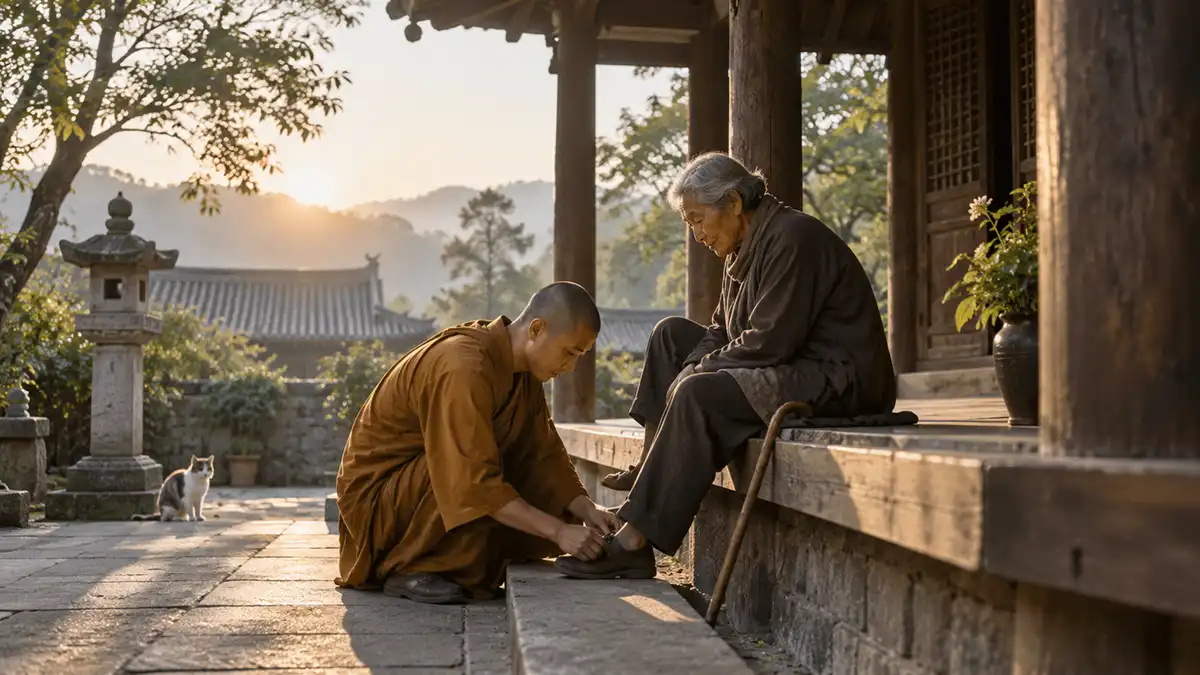
Kindness across traditions · Essay two
Every tradition praises kindness. One treats it as a skill — taught in stages, with an order of training, a manual, and named ways of going wrong. This is an essay about what happens when kindness is put on a syllabus.
The story the tradition tells goes like this.
Five hundred monks took a meditation subject from the Buddha at Sāvatthī and walked north to the foothills of the Himalayas for the rains retreat. They found a grove — cool, dense, a spring of clean water, a market town near enough for alms. The villagers built them huts. Each monk chose a tree and sat under it, by day and by night.
The trees were occupied. Tree deities had their mansions built on them, and out of respect for the meditating monks they came down with their families and stood aside, expecting the visitors to stay a night or two. Day after day the monks stayed. The commentary that preserves the story compares the deities to dispossessed villagers whose houses have been commandeered by the officials of visiting royalty, watching from a distance and wondering when they will get them back.1
So the deities set out to drive the monks away. They produced terrifying shapes, dreadful noises and a sickening stench. The monks went pale, lost their meditation subject, then lost even their basic mindfulness. They walked all the way back to Sāvatthī and asked, with some feeling, for somewhere else.
The Buddha, the story says, surveyed the whole of India and found no other place in it where those five hundred could reach liberation. Go back to the same spot, he told them. Learn this discourse; it will be your meditation subject and your protection. Then he recited the Karaṇīya Mettā Sutta, the discourse on loving-kindness. They learned it by heart, walked back, and recited it as they came in sight of the grove. The deities came out to meet them in human form, took their bowls, brought water, and invited them to sit under the trees and practise without fear.
None of this is record. It comes from the commentary on the Sutta Nipāta, traditionally ascribed to Buddhaghosa and written some nine centuries after the events it describes. What it preserves is not a fact but an instruction: the answer to a frightening place is a practice, not a transfer.
Tihar Jail covers several hundred acres of suburban New Delhi and held around nine thousand people, ninety per cent of them awaiting trial. In May 1993 Kiran Bedi, the first woman admitted to the Indian Police Service, was appointed Inspector General of Prisons and announced that she intended to turn Tihar into an ashram within six months. Her first Vipassana course was not for prisoners. She sent the angriest members of her jail staff.2
On the evening of 4 April 1994, 1,003 male prisoners sat down in a tent in Jail No. 4 to receive opening instructions from S. N. Goenka. In Jail No. 1, forty-nine women began the same course. The students had been charged with offences from drug trafficking to murder; more than a third could not read.
In the early hours of the first day an unseasonal storm brought the tent down and soaked the cushions. The assistant teachers met at half past three in the morning to decide whether to abandon the course, and decided instead to sit with the prisoners in their wards until the weather cleared. Prisoners not enrolled dried a thousand cushions in the sun, stitched the torn sections and remounted the ceiling fans. By seven that evening the hall was up and the first discourse went ahead.
Then ten days of silence. On the last full day, as in every course in that tradition, the students were taught mettā.3
A word that will not sit still
Mettā comes into English as loving-kindness, and the compound is older than its Buddhist use by four centuries. Miles Coverdale minted it in 1535 to carry the Hebrew chesed into the Psalms, and Victorian translators borrowed it from the King James Bible when they needed an English word for a Pali one.4 It arrived, in other words, secondhand and pre-warmed.
Buddhaghosa’s own etymology is cooler. Mettā, he writes, is what softens; and it comes about with respect to a friend, mitta.5 The root of the word is friendship, not love.
Thanissaro Bhikkhu has pressed the point furthest. Pali already has a word for love — pema — and the Buddha did not use it here. He argues that goodwill translates mettā better than loving-kindness, because goodwill is something you can honestly extend to everyone, including people who would find your affection intrusive or useful. You’re not there to cherish these beings or to look after them.
6
This is not pedantry. The two translations issue different instructions.
Take the sutta’s most quoted verse. In Bhikkhu Sujato’s rendering: Even as a mother would protect with her life her child, her only child, so too for all creatures unfold a boundless heart.
7 Nearly every reader takes the simile to mean love all beings as a mother loves her only child. Thanissaro reads the Pali as drawing its parallel elsewhere: between the way a mother protects the child and the way a practitioner protects the goodwill. On the first reading you are being told what to feel. On the second you are being told to guard an intention that your feelings will keep trying to erode.
Or take the best-known line in the Dhammapada. The Pali turns on averena — by non-enmity. Max Müller, in 1881, gave it as: hatred ceases by love, this is an old rule.
Buddharakkhita keeps the negative: By non-hatred alone is hatred appeased. This is a law eternal.
8 Same verse. One reads like a sentiment; the other like a specification.
The Pali is a negative. English keeps turning it into a feeling.
What should be done
The discourse takes its name from its first word. Karaṇīya means what should be done — a gerundive, an obligation.9 Before it is a hymn it is a set of instructions.
Its opening verses say nothing about feeling at all. They are a character list: capable, upright, easy to speak to, gentle, humble, content, unburdensome, unbusied, living lightly, senses calmed, not fawning on families. Only after that inventory does the wish appear — may all beings be happy — and then the expansion outwards, to the frail and the firm, the seen and the unseen, those already born and those about to be.
The practice ends in the four postures. When standing, walking, sitting, or lying down while yet unweary, keep this ever in mind.
That, the text says, is the divine abiding in this life. Kindness here is not an episode but a posture, held through the whole waking day.
The tradition is also frank about what the training returns. A canonical list gives eleven benefits: you sleep at ease, wake happily, have no bad dreams, are dear to humans and non-humans, deities protect you, fire and poison and blade cannot harm you, your mind settles quickly, your face is clear and bright, you die unconfused, and short of full liberation you are reborn in a realm of divinity.10
Note who receives them. This is a discipline with a syllabus and a results table, and the results accrue to the practitioner.
The drill
For the syllabus itself, the tradition’s manual is the Visuddhimagga, Buddhaghosa’s fifth-century compendium, whose ninth book sets out the four divine abidings in the order they are trained: loving-kindness, compassion, gladness at others’ good fortune, equanimity.
Begin with yourself. May I be happy and free from suffering. Buddhaghosa then raises the obvious objection against his own instruction — the canonical texts nowhere describe practising on oneself — and answers it. The self is the example, not the target. Repeat I am happy for a thousand years and nothing will come of it; but reason from it, just as I want to be happy and dread pain, so does everyone, and the wish for others becomes intelligible from the inside.11
Then the order, and it is strict: a teacher or someone you revere, a dear friend, a neutral person, a hostile person. Make the mind pliable at each stage before moving on.
The cautions give away what kind of document this is. Do not begin with someone of the opposite sex. An elder, asked by a friend’s son whom one should practise on, said: someone you love. The young man chose his wife, and spent the night beating on the wall of his own locked room, trying to get out. Do not practise on the dead, either; the object has to be alive.12
For the hostile person, Buddhaghosa supplies a ladder of remedies, each climbed only when the one below it fails. Recall the simile of the saw — that a monk whose limbs were being severed by bandits and who entertained hatred would not be following the teaching. Remember one controlled thing about the person, however small. Review that you each own your actions. Reflect that in the beginningless round this person has been your mother. Resolve them into elements, and ask which element you are angry with.
And if all of that fails: give them a present. Buddhaghosa is specific about the case he has in mind — a bowl worth eight ducats, handed over by a monk to the senior elder who had thrown him out of his lodging three times.13
The stage is passed by a thought experiment. Suppose you are sitting with a dear person, a neutral person and a hostile person, yourself the fourth, and bandits arrive demanding one of you for a sacrifice. If you would hand over the enemy, the barriers are intact. If you would offer yourself instead, the barriers are also intact — because, Buddhaghosa says, you are still seeking someone’s harm, and it happens to be your own. Only when you can see no reason to give up any of the four have they gone.14
If you would hand over the enemy, you have failed. If you would hand over yourself, you have also failed.
Near and far enemies
Buddhaghosa then does something unusual. He describes how each of the four qualities fails.
Every divine abiding, he writes, has two enemies, one far and one near. The far enemy is the obvious opposite — ill will for loving-kindness, cruelty for compassion. It sits like a foe ensconced in a rock wilderness
: visible, at a distance, and impossible to hold in the mind at the same time as the virtue itself.
The near enemy is the dangerous one, because it resembles the virtue. Greed is the near enemy of loving-kindness, since both share in seeing virtues
. It behaves like a foe who keeps close by a man, and it easily finds an opportunity.
15
Here the modern teaching and the text part company. The familiar formulation says the near enemy of compassion is pity — a condescension that keeps the sufferer at a distance. Buddhaghosa says something else: the near enemy of compassion is grief based on the home life, the ordinary sorrow of failing to get what you wanted or losing what you had, since both share in seeing failure
. And his test elsewhere is exact: compassion succeeds when it makes cruelty subside, and it fails when it produces sorrow.16
That is a harder diagnosis than pity, and a more useful one. The failure it names is not looking down on someone. It is collapsing in front of them — meeting another person’s pain with a grief that is actually running on your own unfinished business, and leaving them to manage you. Anyone who has tried to tell a friend something difficult and found themselves comforting the friend instead knows the mechanism from the inside.
Equanimity gets the same treatment, and the near enemy named there is the equanimity of unknowing: indifference wearing the face of peace, which ignores faults and virtues alike and calls the ignorance calm.
Does it work?
The tradition’s own answer is testimony. The deities came down and took the monks’ bowls. At Tihar, men wept in the hall and said afterwards that they no longer wanted revenge.
The prison courses were studied at the time — two small investigations in 1994, of 120 and 150 subjects, conducted under the auspices of the All India Institute of Medical Sciences, reporting improvement on most psychological measures.17 Small samples, self-selecting participants, an institution with an interest in the outcome.
The wider evidence is more sobering. A 2018 meta-analysis of randomised controlled trials of meditation in healthy adults found a moderate effect on compassion and empathy, and no measurable effect at all on aggression, connectedness or prejudice. It also found that the compassion effect appeared only under two conditions: when the meditation teacher was a co-author of the study, and when the control group was a waiting list rather than an active alternative.18
That is not a refutation of anything the sutta claims. It is a warning about the size of claim the evidence will bear. The training may well make a person kinder to the one in front of them while doing nothing whatever about the category of people they have already written off.
The seam
I have written a book arguing that kindness is infrastructure: unnoticed while it holds, catastrophic when it fails.19 It reaches that claim from the outside, from what can be observed about how families, workplaces and states behave when the element is missing. The Buddhist account works from the inside, and the two part company at three points.
The first is impartiality. The whole aim of the drill is to break the barriers between self, friend, stranger and enemy, until the four are regarded alike. My argument begins somewhere else — in recognition, the perception that this particular person’s reality is as real as mine. Buddhaghosa would say the particular is where you start, not where you stop; the dear friend is scaffolding, removed once the building stands.
Śāntideva takes the logic further. Another’s pain should be destroyed, he writes, simply because it is a pain
— an argument that holds regardless of who is having it, and one he pushes to its conclusion: we love our own limbs as members of a body, so why not our fellow creatures, as members of the universe.20 At the limit the reasoning dissolves the sufferer into the suffering. That consequence I do not want. The strongest case against me is that recognition rations kindness by accident of encounter — you help whoever you happen to see. The strongest case for me is that kindness with no particular face becomes administration, and administration is where kindness historically goes to die.
The second is the horizon. Buddhaghosa gives the purpose of the four abidings as the bliss of insight and an excellent future existence.21 The eleven benefits accrue to the meditator. Thanissaro is blunter still: you are not there to look after these beings. Liberation is the aim; a kinder world is a real effect and a secondary one. My book has no horizon beyond this one. The load holds or it does not.
The third is what the two accounts share, and it is the reason for the essay. Neither treats kindness as a mood that visits the deserving. Both treat it as something built, maintained and capable of failing under load. The argument is about what the maintenance is for.
The shadows
The tradition with the most developed doctrine of loving-kindness in the world has the following also on its record.
In Myanmar, the monk Ashin Wirathu told an audience of thousands, in a sermon reported by the New York Times in June 2013, that one could be full of kindness and love and still not sleep next to a mad dog. He was speaking of the country’s Muslims. In 2018 the UN’s Independent International Fact-Finding Mission on Myanmar concluded that military operations in Rakhine State had been carried out with genocidal intent, and that there was sufficient information to warrant the prosecution of senior commanders; some seven hundred thousand Rohingya had by then fled to Bangladesh.22
On 30 October 2017, Sitagu Sayadaw — a monk internationally known for his humanitarian and interfaith work — preached to army officers at a garrison in Kayin State and retold a passage from the Mahāvaṃsa, the fifth-century Sri Lankan chronicle. King Duṭṭhagāmaṇi, appalled at the slaughter he has caused, is consoled by a delegation of arahants, who assure him that only one and a half human beings were killed: one had taken the refuges and one the five precepts, and the rest were not more to be esteemed than beasts
. Sitagu attributed the arithmetic to the Sri Lankan monks rather than to himself, and added that Myanmar’s soldiers should bear the story in mind.23
The text is Sri Lankan, and Sri Lanka has its own file. Between 15 and 17 June 2014, after a rally addressed by Galagoda Aththe Gnanasara of the monk-led Bodu Bala Sena, mobs attacked Muslim homes, shops and mosques in Aluthgama and neighbouring towns. At least four people were killed and about eighty injured.24
My own book names Aung San Suu Kyi among figures whose discipline under pressure drew on Buddhist traditions of endurance. Her government honoured Sitagu Sayadaw with a national title in 2017, and the UN mission found that her administration had allowed hate speech to thrive and that she had not used her position to stem what was happening in Rakhine. I do not withdraw what I wrote about the years of house arrest. I record what followed them.
Western convert Buddhism has its own record. After eight students set out allegations against Sogyal Rinpoche in 2017, the Rigpa network commissioned an independent investigation; the report, by the law firm Lewis Silkin, found on the balance of probabilities that students in his inner circle had been subjected to serious physical, sexual and emotional abuse, and the Charity Commission for England and Wales subsequently found misconduct by trustees who had known and failed to act.25 In February 2019 an investigation commissioned by Shambhala International found two claims of sexual misconduct against its leader Sakyong Mipham Rinpoche credible, and recorded twenty further reports concerning other leaders.26
None of this happened for want of doctrine. The near-enemy apparatus exists precisely to detect virtue-shaped counterfeits, and Śāntideva forbids hatred even towards those who destroy images and revile the teaching, on the ground that the teaching takes no hurt from it.27 The instruments were in the manual. They were not picked up.
I can put the difficulty at its sharpest and leave it there. A discipline that reliably improves a person’s conduct towards whoever is in the room may do nothing at all about the people they have already placed outside it — and that is exactly where the meta-analysis found nothing. The tradition trains the heart towards all beings impartially, and then some of its most trained practitioners decide who counts as a being. I know of no reading of the record that closes the gap, and I am not going to manufacture one.
Coda
So, the three questions.
What does this tradition think kindness is? A skill. Goodwill, made habitual by repetition and then extended deliberately to people one has no reason to like — with stages, an order of training, characteristic failures and a manual.
What does it think kindness costs? Your preferences. The special claim of those you love, the satisfaction of your enemies’ being your enemies, and at the limit the self that was doing the preferring.
What is kindness for? Freedom, and first of all the practitioner’s own. A kinder world follows, and follows second.
The monks went back to the same grove. There was no better place; that was the whole of the Buddha’s advice. And on 15 April 1994, when the ten days ended, a permanent meditation centre was opened inside the walls of Tihar, and the courses simply continued.
Neither story ends with anybody being moved somewhere safer. Both end with a frightening place, entered again on purpose, with something practised in it.
-
The background story comes from the Sutta Nipāta commentary (Paramatthajotikā) traditionally attributed to Buddhaghosa. Translated and summarised in Acharya Buddharakkhita, Metta: The Philosophy and Practice of Universal Love, Wheel Publication 365/366 (Kandy: Buddhist Publication Society, 1989), ch. 2. A shorter version appears in Piyadassi Thera, trans., The Book of Protection (Kandy: Buddhist Publication Society, 1999). ↑
-
“Freedom Behind Bars: Vipassana in Prison,” International Vipassana Newsletter, September 1994, reproduced by the Vipassana Research Institute, vridhamma.org. Accounts of the storm and of Bedi’s remarks to jail staff derive from this source and from the recollections of the superintendent of Jail No. 2 reproduced in it. ↑
-
On the structure of a ten-day course, in which mettā-bhāvanā is taught on the final full day, see Vipassana Research Institute, “10 Day Courses,” vridhamma.org. The 1994 courses are also documented in Doing Time, Doing Vipassana, dir. Ayelet Menahemi and Eilona Ariel (Karuna Films, 1997). ↑
-
Coverdale’s coinage first appears at Psalm 25:6 in his 1535 Bible; see Oxford English Dictionary, s.v. “loving-kindness,” and “Lovingkindness,” in The Encyclopedia of the Bible. ↑
-
Bhadantācariya Buddhaghosa, The Path of Purification (Visuddhimagga), trans. Bhikkhu Ñāṇamoli, 4th ed. (Kandy: Buddhist Publication Society, 2010), IX.92. ↑
-
Thanissaro Bhikkhu, “Metta Means Goodwill” (2011), dhammatalks.org. ↑
-
Karaṇīya Mettā Sutta (Sn 1.8), trans. Bhikkhu Sujato, Anthology of Discourses, suttacentral.net, verse 7. Subsequent quotations from the sutta follow the same translation. ↑
-
Dhammapada 5. F. Max Müller, trans., The Dhammapada, Sacred Books of the East, vol. 10 (Oxford: Clarendon Press, 1881); Acharya Buddharakkhita, trans., The Dhammapada: The Buddha’s Path of Wisdom (Kandy: Buddhist Publication Society, 1985). ↑
-
Piya Tan, “Karaṇīya Metta Sutta,” Sutta Discovery 38.3, themindingcentre.org. ↑
-
Mettānisaṁsa Sutta (AN 11.15), trans. Bhikkhu Sujato, Numbered Discourses, suttacentral.net. ↑
-
Buddhaghosa, Visuddhimagga, IX.8–10, quoting the verse also found at Ud 5.1 and SN 3.8. ↑
-
Ibid., IX.6–7. ↑
-
Ibid., IX.15–39. The simile of the saw is at MN 21. ↑
-
Ibid., IX.40–42. ↑
-
Ibid., IX.98. ↑
-
Ibid., IX.99 and IX.94. The passage on grief based on the home life quotes MN 137. For the widely circulated modern formulation, see Jack Kornfield, “The Near Enemies of Awakening,” jackkornfield.com. ↑
-
“Psychological Effects of Vipassana on Tihar Jail Inmates,” Vipassana Research Institute, vridhamma.org. ↑
-
Ute Kreplin, Miguel Farias and Inti A. Brazil, “The Limited Prosocial Effects of Meditation: A Systematic Review and Meta-Analysis,” Scientific Reports 8 (2018): 2403. ↑
-
Kevin J. Parker, The Backbone of Kindness: Rekindling Our Oldest Virtue in Troubled Times (Sydney: Sane Earth, 2026), shorturl.at/iO86g. ↑
-
Śāntideva, The Path of Light: The Bodhicharyāvatāra of Śāntideva, trans. L. D. Barnett (London: John Murray, 1909), ch. 8. Barnett’s rendering condenses the chapter and omits several verses; for a complete modern translation see Kate Crosby and Andrew Skilton, trans., The Bodhicaryāvatāra (Oxford: Oxford University Press, 1996), 8.90–103. ↑
-
Buddhaghosa, Visuddhimagga, IX.97. ↑
-
Thomas Fuller, “Extremism Rises Among Myanmar Buddhists,” New York Times, 20 June 2013; Human Rights Council, Report of the Independent International Fact-Finding Mission on Myanmar, A/HRC/39/64 (27 August 2018). ↑
-
Paul Fuller, “Sitagu Sayadaw and Justifiable Evils in Buddhism,” New Mandala, 13 November 2017. The passage is Mahāvaṃsa XXV; see Wilhelm Geiger, trans., The Mahāvaṃsa, or the Great Chronicle of Ceylon (London: Pali Text Society, 1912). ↑
-
Human Rights Watch, “Sri Lanka: Investigate Anti-Muslim Violence,” 19 June 2014. ↑
-
Karen Baxter, Lewis Silkin LLP, Outcome of an Investigation into Allegations Made Against Sogyal Lakar, 22 August 2018; Charity Commission for England and Wales, inquiry report into the Rigpa Fellowship, 2019. ↑
-
Selina Bath, Wickwire Holm, report to the Shambhala Interim Board, released 3 February 2019. ↑
-
Śāntideva, Path of Light, ch. 6. ↑
This essay is the second in a series reading kindness across religious, philosophical, literary and popular traditions.
The Backbone of Kindness: Rekindling Our Oldest Virtue in Troubled Times by Kevin J. Parker is published by Sane Earth, Sydney, in paperback, ebook and audiobook. Available on Amazon.
Download a copy of The Trainable Heart: Buddhism and the Discipline of Kindness with my compliments- Kevin J Parker- Publisher


