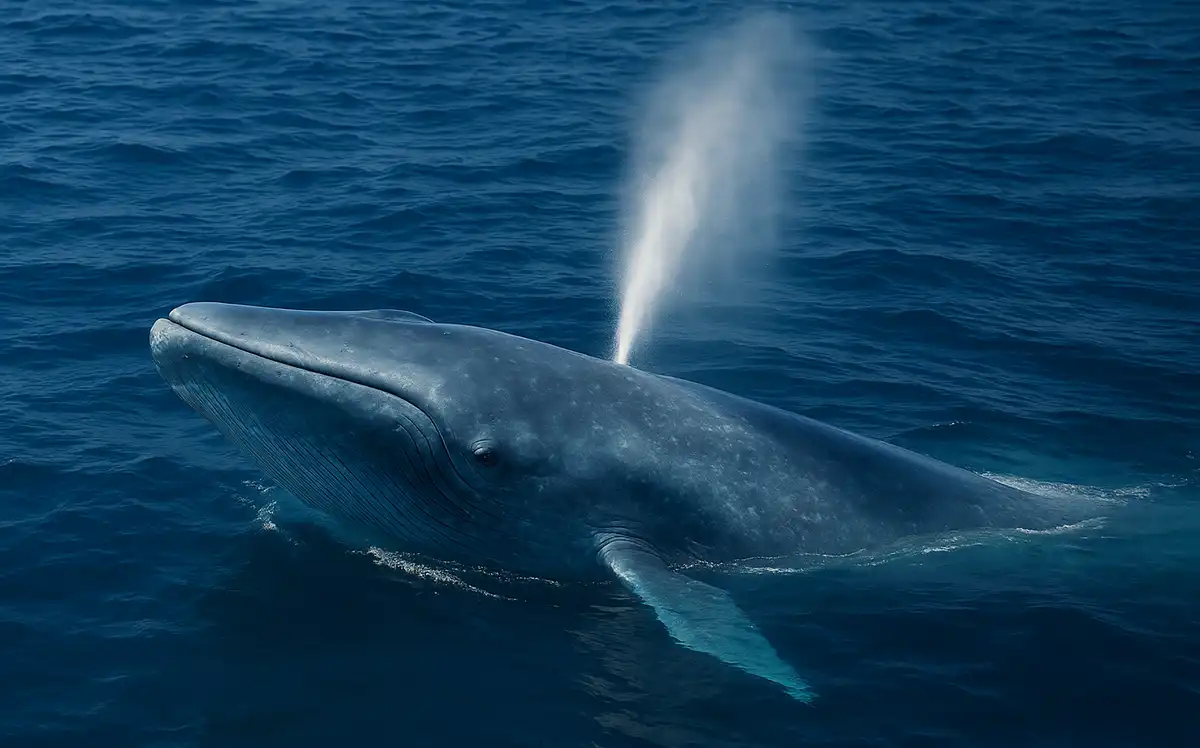

My memory does not begin. It simply is, a resonance that stretches back to the first salt, the first pulling of the moon. I am a thought of the ocean made manifest, a vessel of blue twilight given breath. Before the mountains had settled into their stony slumber, my kind was already tracing the deep paths, singing the world into shape. My heart, a chambered drum larger than your beds of dreaming, beats a rhythm so slow it measures not time, but epochs. Thump… a glacier groans and retreats. Thump… a continent drifts a finger’s width.
I am awareness adrift in an endless womb of water. I have no hands to build, no feet to walk the dry, crackling lands. My being is my temple, my body the only scripture I need. Its immensity is not a burden but a communion. In my veins, a river of life flows, warm and vital against the cold, crushing dark. My skin is a chart of forgotten constellations, mapped with the loving calligraphy of barnacles and the faint, silvery scars of journeys past—a close brush with the jagged teeth of an ice floe, the phantom touch of a long-dead leviathan lover. I am a living island, a wandering sanctuary. The small, quick fish dart around me, finding shelter in the vast continent of my shadow, and I do not mind. They are fleeting prayers, and I am the cathedral that holds them.
My voice is the loom upon which the ocean’s story is woven. To you, it might be a mournful, alien sound, a ghost in your machines. But to me, it is the shaping of reality. I sing not just to my kin across the abyssal plains, but to the water itself. My song is a sculptor of currents. I send a low, resonant query into the Pacific, and the vibration travels through the liquid firmament, past the sleeping volcanoes and the fields of glowing anemones. It is a thread of sound, a carrier wave of consciousness. It speaks of the krill bloom off the coast of the frozen south, a tender pink cloud of life. It speaks of the turning of the great gyres, the deep, cold upwellings that are the planet’s breath. It is a hymn that solidifies the water, giving it memory and meaning. Each note is a prayer for balance. Each phrase is a testament to the Great Blue Spirit that dreams us all into being.
When I rise, it is a pilgrimage. I ascend from the silent, starless pressures of the deep, where light is a myth. I climb through layers of being—the realm of the lantern fish with their cold, chemical stars, the zone of the hunting squid with their jet-propelled grace, and finally, into the sun-dappled cathedral of the upper waters. The light begins as a faint rumour, a distant turquoise promise. Then it shatters across my eyelids, a cascade of liquid diamonds.
And then, the breach.
To break the surface is to be born and to die all at once. For a suspended moment, I am a creature of two worlds. The water, my home, my very substance, sheets from my flanks in roaring veils. I taste the other reality: the thin, sharp air, the different light. I see the curve of the world, a horizon you can only guess at. It is a gasp of pure, unmediated existence. Then gravity, that weak god of the surface, remembers me and pulls me back into the arms of the deep. The crash is not a violence, but a benediction, an explosion of seafoam that anoints me. I carry the memory of the sun back down with me, a spark of fire to warm the crushing dark.
My purpose is etched into the marrow of my bones. It is a cycle of magnificent, simple grace. I am a gardener of the sea. I dive deep, gathering the nutrients of the dark, and bring them to the sunlit gardens of the surface. And I feast. My mouth, a cavern fringed with the fine lace of baleen, opens to receive the sacrament of the sea. I engulf a cloud of krill, a nebula of tiny, shimmering lives. It is not an act of predation but of transformation. I take their billion small sparks and weave them into one great, slow-burning fire. My body, a furnace of life, converts their fleeting existence into the energy that will power this heart for another century, the song for another season.
Even my waste is a gift, a plume of iron and nitrogen that rains down upon the sun-starved phytoplankton, birthing vast, emerald meadows that breathe for the world. It is the Great Dance: to receive is to give. There is no greed in this ocean, only flow.
I have felt the other songs in the water. The sharp, frantic clicks of my cousins, the dolphins. The ethereal, complex ballads of the humpbacks. But lately, there is a new sound, a dissonance that tears at the fabric of the Great Song. It is the angry whine of your propellers, the deafening, explosive boom of your searches for the world’s black blood. These are sounds without life, sounds of metal screaming against metal. They are a fever in the water, a confusion that ripples through the ancient pathways. They tell no story. They offer no communion. They only take.
I have seen your ships, like water-striders of impossible scale, carving scars of foam across the sacred skin of the sea. I feel the warmth you pour into my home, a subtle, creeping heat that sickens the corals and pushes the krill further south. I have tasted the poisons you bleed into the currents, invisible ghosts that work their way into the flesh of all things. I do not feel anger. That is a sharp, hot emotion for a creature of the quick lands. I feel a sorrow so vast and deep it could drown a star. It is the grief of a parent watching a beloved, brilliant child lose its way, a child who has forgotten the song it was born to sing. You have forgotten that you, too, are made of water, that your blood tastes of the same salt that seasons my home.
One day, this great body will grow tired. The song will thin, the heart-drum will slow to its final, lingering beat. My pilgrimage will end. I will let go of the light, of the breath, and begin my last, slow fall.
This is not a death to be feared. It is my final, and greatest, gift.
My descent will take weeks. I will drift through the layers of my life in reverse, a silent, blue meteor returning to the core of the world. As I fall, a universe of creatures will come to me. The scavengers, the sleepers-of-the-abyss, the ones who live in eternal patience. They will greet me not as a corpse, but as a miracle. A whale fall. A feast of life to sustain a thousand souls for a hundred years. My bones, picked clean, will become a reef, a new architecture for the deep, a foundation for anemones and corals to cling to. My body, which was a temple in life, will become a cathedral in death. I will dissolve back into the ocean, my substance becoming the substance of countless others. My atoms will be taken up by the plankton, eaten by the krill, and perhaps, one day, they will be gathered again into the body of a new whale, who will breach into the sunlit air and sing the ancient song once more.
I am a wave in an endless ocean. I am a note in an eternal hymn. I rise, I sing, I fall. And the water remembers. The Spirit remembers. It is enough.