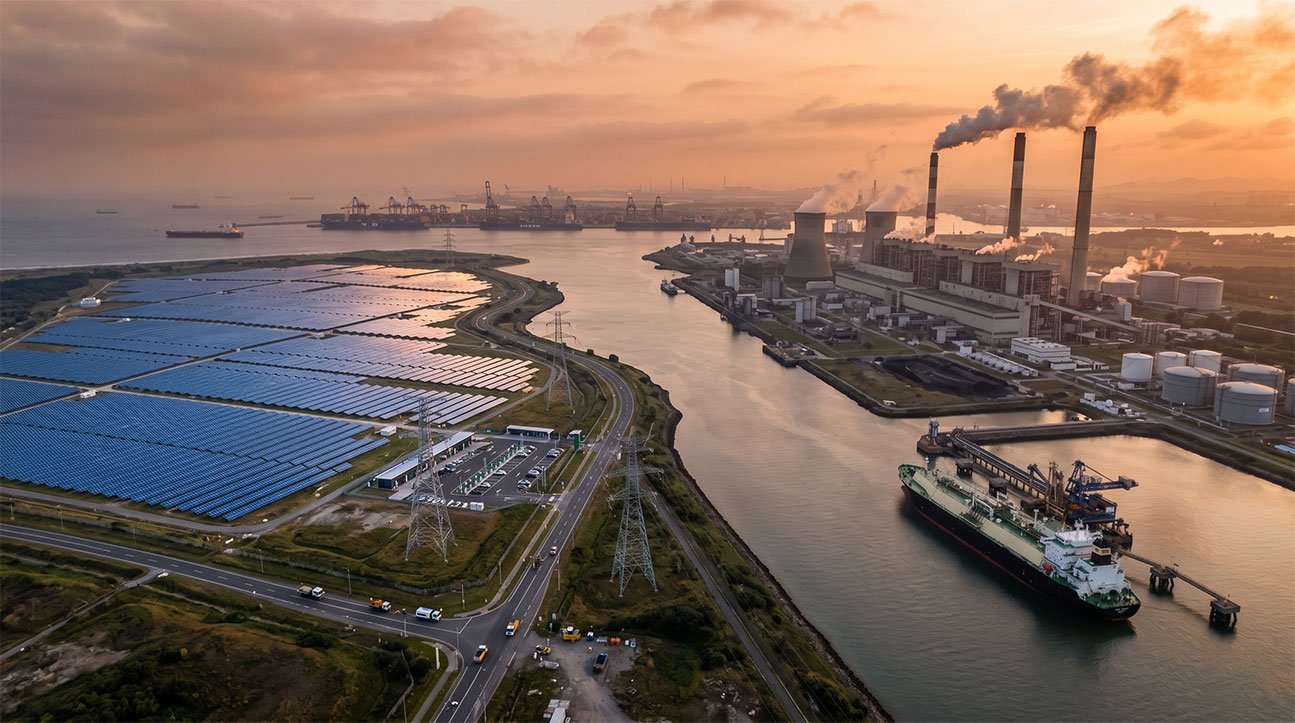

In May 2026, the international climate arena presents a striking paradox. It is alive, highly active, and structurally transformed, yet it remains profoundly underpowered relative to the physical systems it seeks to govern. The institutional architecture established by the Paris Agreement has not collapsed; on the contrary, it has successfully driven tectonic shifts in national industrial policy, corporate investment, renewable energy deployment, electric vehicle adoption, and international litigation.
Yet, as diplomatic gears grind and market forces accelerate, the stark reality remains: the collective global effort is failing to move fast enough to prevent a dangerous overshoot of the 1.5°C warming threshold. The climate transition has become a formidable force in the real economy, but it has yet to achieve sovereignty over the entrenched global fossil economy.
1. The Empty Chair and the Gavel: A Divided Geopolitical Landscape
The geometry of global climate diplomacy shifted fundamentally on January 27, 2026, when the United States’ second formal withdrawal from the Paris Agreement took effect. By walking away from the landmark treaty and initiating a broader retreat from the UN Framework Convention on Climate Change (UNFCCC), the Trump administration has introduced severe legal and diplomatic uncertainty into the international order. The immediate effect has been a sharp erosion of global trust in U.S. climate reliability, effectively turning the world’s largest historical emitter into a destabilizing wildcard.
       [ Old Multilateral Era ]                   [ The 2026 Multi-Polar Reality ]
    US-China Bilateral Diplomacy            China / European Union / India / Brazil
 (The Anchor of the Paris Agreement)       Asymmetrical Blocs, Trade Border Adjustments,
                                               and Climate Accountability Courts
Yet, the global machinery has not ground to a halt. Instead, the departure of the United States has accelerated a shift toward a multi-polar climate architecture. Responsibility and strategic leverage are concentrating within a new configuration: China, the European Union, India, Brazil, and a highly mobilized coalition of climate-vulnerable states.
This transformation was on full display in May 2026 at the United Nations General Assembly. In a historic 141–8 vote, the Assembly voted to support the International Court of Justice’s (ICJ) climate advisory opinion, which had been delivered in July 2025. Despite fierce, concentrated opposition from a bloc of major hydrocarbon states—including the United States, Saudi Arabia, Russia, and Iran—the resolution passed with an overwhelming majority.
The vote signals a profound systemic evolution: climate action is migrating from the arena of voluntary diplomatic promises into the domain of international legal obligation. While the ICJ opinion is not directly enforceable by a global police force, its integration into General Assembly policy establishes a clear baseline of state responsibility.
Courts, human rights law, investor duties, and mandatory corporate disclosure frameworks are forming a legal pressure system. This alternative front operates independently of shifting political winds in Washington or Riyadh, turning climate liability into a material risk for states and corporations alike.
2. The Thermodynamic Baseline: Accumulating Heat and Atmospheric Realities
While the legal and diplomatic architecture experiences these structural tremors, the physical climate system continues to register its own compounding deficits. According to data compiled by the World Meteorological Organization (WMO) in its State of the Global Climate 2025 report, the decade spanning 2015 through 2025 constitutes the hottest 11-year sequence ever recorded by humanity.
The year 2025 closed as either the second or third warmest year on record, fluctuating at approximately 1.43°C above the 1850–1900 pre-industrial baseline. This long-term trend indicates that the planetary system is consistently operating at the outer boundaries of the Paris Agreement’s primary target.
GLOBAL ATMOSPHERIC CO₂ CONCENTRATION
Pre-Industrial: ████████████ 280 ppm
May 2026:       ██████████████████ 427 ppm (+52%)
This atmospheric warming is driven by an underlying energy imbalance that is reshaping global geography:
- Oceanic Heat and Carbon Absorption: The global ocean continues to absorb more than 90% of the excess heat trapped by greenhouse gases, alongside vast quantities of carbon dioxide, driving compounding marine heatwaves and accelerating acidification.
- Cryosphere Decay: Arctic sea ice extents remain near historic lows, while Antarctic sea ice tracked its third-lowest coverage on record. Concurrently, global glacial mass loss has continued unabated, locking in long-term sea-level rise.
- The Emissions Trajectory: According to the International Energy Agency (IEA), global energy-related carbon dioxide emissions grew by roughly 0.4% in 2025, climbing to an unprecedented peak of nearly 38.4 billion tonnes. While this represents a significant deceleration in the rate of emissions growth—suggesting a plateau is near—absolute volumes continue to expand.
- Atmospheric Saturation: This continuous influx pushed atmospheric carbon dioxide concentrations to approximately 427 parts per million (ppm), a value roughly 50% higher than pre-industrial levels.
       [ THE EMISSIONS GAP (By 2035, vs 2019 Levels) ]

Current Pledges (NDCs):   █ 17% Reduction
Required for 2°C Path:   █████ 35% Reduction
Required for 1.5°C Path: █████████ 55% Reduction
The mathematical disconnect between this physical reality and current policy is detailed in the UN Environment Programme’s (UNEP) 2025 Emissions Gap Report. UNEP finds that while the Paris Agreement succeeded in bending the worst-case climate trajectory—lowering projected end-of-century warming from a pre-Paris track of 3°C to 3.5°C down to a lower range—the latest round of national commitments has barely moved the needle.
To maintain a viable pathway toward limiting warming to 2°C, global emissions must be cut by 35% by 2035 relative to 2019 levels. To preserve the 1.5°C target, those reductions must reach 55% by 2035.
The initial wave of National Climate Plans (NDCs 3.0) submitted during the 2025 cycle highlights this ambition gap. A UNFCCC synthesis of 64 newly updated NDCs revealed that these plans covered a mere 30% of 2019 global emissions. Collectively, the submitted strategies imply an emissions reduction of only 17% by 2035 compared to 2019 levels—leaving a vast, dangerous shortfall between national strategy and scientific necessity.
3. The Impasse of Belém and the Financial Chasm
This widening gap between commitments and physical necessity dictated the tense dynamics of COP30, held in Belém, Brazil. Framed explicitly as an “Implementation COP” under the leadership of President Luiz Inácio Lula da Silva, the summit sought to bridge the divide between diplomatic rhetoric and real-world execution.
The resulting Belém Package yielded 29 consensus decisions spanning just transition frameworks, adaptation finance, trade policy, gender equality, and technology transfer. Crucially, the summit launched the Global Implementation Accelerator and the Belém Mission to 1.5, dual mechanisms engineered to provide technical and bureaucratic assistance to developing nations struggling to implement their NDCs and National Adaptation Plans.
                    [ COP30 BELÉM IMPASSE ]
  ┌─────────────────────────────────────────┐
  │         The Belém Package               │
  │  (29 Consensus Decisions, Just          │
  │   Transition & Tech Accel)              │
  └────────────────────┬────────────────────┘
                       ▼
  ┌─────────────────────────────────────────┐
  │        The Fossil Fuel Omission         │
  │  (No Phase-out Timeline, No Subsidy    │
  │   Reform, No Explicit Roadmap)          │
  └─────────────────────────────────────────┘
However, the summit met a significant roadblock over the core driver of planetary warming: fossil fuels. While an alliance of more than 80 climate-vulnerable and progressive nations advocated for a binding roadmap to phase out hydrocarbons, the final consensus text omitted both a definitive fossil fuel phase-out timeline and clear language regarding fossil fuel subsidy reform.
According to analyses by the International Institute for Sustainable Development (IISD), this omission left the historic declaration from COP28 in Dubai—which called for a “transitioning away from fossil fuels”—without a clear, actionable pathway for execution. It exposed a deep reluctance among major producing states to codify the decline of their primary economic assets.
This diplomatic friction over fossil fuels is inextricably linked to the central battlefield of modern climate politics: international finance. Without adequate, predictable capital flows, developing nations cannot reasonably be expected to leapfrog fossil-fueled industrialization or protect themselves from intensifying climate impacts. While the financial architecture has seen incremental progress, deep structural deficits remain.
                    [ ANNUAL ADAPTATION FINANCE GAP (Developing Nations, 2035) ]

Actual Int'l Public Finance (2023):  █ $26 Billion
Total Needed Adaptation Funds:        ██████████████████████████████ $310 - $365 Billion
At COP29 in Baku, negotiators succeeded in raising the core climate finance target for developing nations from the long-standing, frequently missed baseline of US$100 billion per year up to a new commitment of US$300 billion annually by 2035. The Baku text also called for broader efforts to scale total public and private capital flows to US$1.3 trillion per year by 2035.
At COP30 in Belém, parties agreed to sustain these negotiations through a dedicated two-year work programme, alongside an explicit call to triple adaptation finance by 2035.
Nevertheless, this financial compromise has drawn sharp criticism from developing states and civil society organizations. The new target delays critical capital delivery to 2035 and lacks a transparent, accountable baseline. The scale of this shortfall is underscored by UNEP’s Adaptation Gap Report 2025.
Developing nations will require between US$310 billion and US$365 billion annually by 2035 solely to fund adaptation measures. In stark contrast, international public adaptation finance actually contracted, slipping from US$28 billion in 2022 down to US$26 billion in 2023. This leaves an enormous funding gap that leaves vulnerable populations exposed to escalating systemic shocks.
4. The Parallel Universe: Market Realities and the Rise of Climate Border Taxes
In contrast to the slow, gridlocked pace of international diplomacy, the real economy is moving at an unprecedented speed. A genuine clean energy surge is underway, driven by industrial scaling, technological learning curves, and national security strategies rather than multilateral consensus alone.
2025 NEW RENEWABLE CAPACITY ADDITIONS (800 GW TOTAL)
█████████████████████████████████████████████ Solar PV (>75%)
████████████ Wind (~20%)
███ Other (~5%)
Data from the IEA indicates that global renewable energy capacity additions expanded by 16% in 2025, reaching a historic 800 gigawatts (GW) in a single year. Solar photovoltaics (PV) formed the backbone of this expansion, accounting for more than three-quarters of all new capacity worldwide, while wind energy generated roughly 20%.
Concurrently, the electrification of transport has moved from a niche market into a primary industrial driver. The IEA’s Global EV Outlook 2026 reports that global electric vehicle sales surpassed 20 million units in 2025, marking a 20% increase from 2024. EVs now command approximately 25% of the total global automobile market, signaling a structural disruption of oil demand in the passenger transport sector.
               [ THE HYDROCARBON PRODUCTION PARADOX ]

Max Production Allowed for 1.5°C Path: ████████████
Actual Planned Production (2030):      ████████████████████████ (+110%)
Yet, this rapid growth exists alongside an entrenched fossil fuel infrastructure. The core paradox of the 2026 climate landscape is that clean energy is expanding rapidly without triggering an equivalent retirement of fossil fuel assets.
According to the 2025 Production Gap Report, governments worldwide still maintain extraction plans that far exceed Paris-compatible limits. Current national trajectories indicate that governments intend to produce more than double the volume of fossil fuels in 2030 than what is mathematically consistent with stabilizing global temperatures at 1.5°C.
This industrial friction is rapidly spilling over into international trade policy, making climate strategy inseparable from global commerce. On January 1, 2026, the European Union’s Carbon Border Adjustment Mechanism (CBAM) entered its definitive phase. Importers into the EU are now legally required to report embedded emissions and purchase CBAM certificates to match the carbon pricing that would have been incurred under EU domestic regulations.
                       [ EU CBAM DEFINITIVE PHASE ]
       Importers to the EU must buy carbon certificates for embedded emissions.
                       ┌─────────────────────────┐
                       ▼                         ▼
            [ High-Emission Imports ]   [ Low-Emission Imports ]
               Financial Penalty          Competitive Advantage
                       │                         │
                       ▼                         ▼
            Strains Global Trade Relations   Accelerates Supply Chain
            (G-77 & China Pushback)          Decarbonization
This border tax marks a turning point: it forces external trading partners to either decarbonize their manufacturing sectors or pay a direct financial penalty to access Europe’s single market.
At COP30, this mechanism provoked intense debate. Developing nations, led by coalitions within the G-77 and China, expressed deep concerns that border carbon adjustments could function as a form of green protectionism. They argue that such measures impose unfair, unilateral costs on emerging economies that are still seeking basic industrial development without the requisite capital cushions.
This intersection of trade protectionism, industrial strategy, and carbon accounting is set to be a defining geopolitical issue through COP31 and subsequent negotiation cycles.
5. Operation Over Speculation: The Early Reality of Loss and Damage
As these economic and trade wars play out, the tangible costs of historical emissions are forcing the creation of new institutional mechanisms. The most significant diplomatic breakthrough of recent years—the establishment of a dedicated Fund for responding to Loss and Damage—has transitioned from a symbolic victory into an operational, though modest, reality.
       [ THE LOSS & DAMAGE FUND (Initial Scale) ]

Barbados Modalities Pilot (2025-2026):  █ $250 Million
Total Real-World Loss & Damage:        █████████████████████████ $Billions Needed
Under the initial Barbados Implementation Modalities, the fund designated its first US$250 million for immediate interventions over the 2025–2026 biennial cycle. The formal window for submitting funding requests opened on December 15, 2025, and is scheduled to close its initial round on June 15, 2026.
| Fund Element | Status as of May 2026 |
| Operational Framework | Barbados Implementation Modalities active |
| Initial Funding Allocation | US$250 million for 2025–2026 pilot interventions |
| Application Window | Open December 15, 2025 – June 15, 2026 |
| Primary Structural Purpose | Dedicated capital deployment for non-adaptable climate harms |
| Scale Adequacy | Pilot scale; severely underfunded relative to long-term liabilities |
Politically, the operationalization of this fund is highly significant. For the first time, vulnerable nations possess a dedicated, distinct UN mechanism designed to address climate-driven harms that cannot be mitigated or adapted away—such as total island inundation, irreversible cultural loss, permanent agricultural desertification, and climate-induced migration.
However, the fund’s current resource base is purely pilot-scale. A quarter of a billion dollars is a minor sum when contrasted with the hundreds of billions of dollars required to address immediate infrastructure destruction and slow-onset disasters across the Global South. The mechanism exists, but it remains an empty vessel waiting for wealthy nations to provide funding commensurate with the scale of the damage.
6. The Road Through Bonn to Antalya
The immediate trajectory of international climate policy now runs through two critical upcoming convenings. From June 8–18, 2026, the Bonn Climate Change Conference (SB64) will gather technical delegations in Germany. The objective of Bonn is to manage the complex, highly sensitive technical negotiations regarding trade friction, NDC verification, and baseline metrics for the tripling of adaptation finance. These technical agreements will form the foundation for the political decisions required later in the year.
                      [ THE 2026 DIPLOMATIC ROADMAP ]
     ┌──────────────────────────────────────────────────────────────┐
     │          Bonn Climate Change Conference (SB64)                │
     │                 June 8–18, 2026                              │
     │  - Technical adjustments on trade metrics and NDC auditing.  │
     └──────────────────────────────┬───────────────────────────────┘
                                    ▼
     ┌──────────────────────────────────────────────────────────────┐
     │                   COP31 Antalya, Türkiye                     │
     │               November 9–20, 2026                            │
     │  - Co-presided by Australia and Pacific Island Nations.       │
     │  - Confronting the fossil fuel transition pathway.           │
     └──────────────────────────────────────────────────────────────┘
This technical spadework will culminate at COP31, scheduled for November 9–20, 2026, in Antalya, Türkiye. While Türkiye will act as the physical host country, Australia is set to assume a unique, central role as the President of Negotiations, anchoring a joint diplomatic bid coordinated alongside the Pacific Island nations.
This co-presidency creates an unusual, high-stakes diplomatic dynamic. It pairs Australia—a major global exporter of coal and liquefied natural gas—with the Pacific Islands, which represent the global vanguard of existential climate vulnerability. This leadership configuration ensures that COP31 will directly confront the core contradictions of the modern energy transition: the tension between fossil fuel extraction revenues and the survival of vulnerable nations.
7. The Implementation Decade
The international community has entered a mature, highly volatile era of climate management. The period of abstract, long-term pledges has drawn to a close, replaced by a much harder phase of concrete delivery.
                        THE CORE CONTRADICTION

      [ Market Momentum ]                   [ Diplomatic & Geopolitical ]
   - 800 GW Renewables added (2025)       - US withdrawal from Paris (Jan 2026)
   - 20M+ Electric Vehicles sold          - Planned fossil production doubles 1.5°C limits
   - ICJ Legal Liability expansion       - Severe adaptation funding deficits ($300B+)
The current landscape is defined by complex structural challenges: updating regional electrical grids, securing critical transition minerals, scaling adaptation capital, managing industrial trade disputes, establishing legal accountability, and formulating national industrial strategies.
The hopeful truth of May 2026 is that clean energy deployment, real-economy electrification, and international climate law are advancing with unexpected speed and resilience. The market mechanisms and legal foundations required to build a decarbonized world are functioning and scaling up.
The hard truth is that absolute global emissions are still hovering near historic peaks, fossil fuel production plans remain fundamentally misaligned with scientific boundaries, adaptation funding remains entirely inadequate, and the geopolitics of international cooperation are more fractured than at any point since the signing of the Paris Agreement.
The global climate transition is a tangible, rapidly growing reality. However, it has not yet achieved sovereignty over the broader fossil economy. While international negotiations have managed to keep the window for a 1.5°C pathway open, the fundamental question remains: can governments accelerate policy and enforcement before the accelerating physical climate system forces a much more disruptive conclusion?